1
The MySQL Query Optimizer
Explained Through Optimizer Trace
Øystein Grøvlen
Senior Staff Engineer
Alibaba Cloud
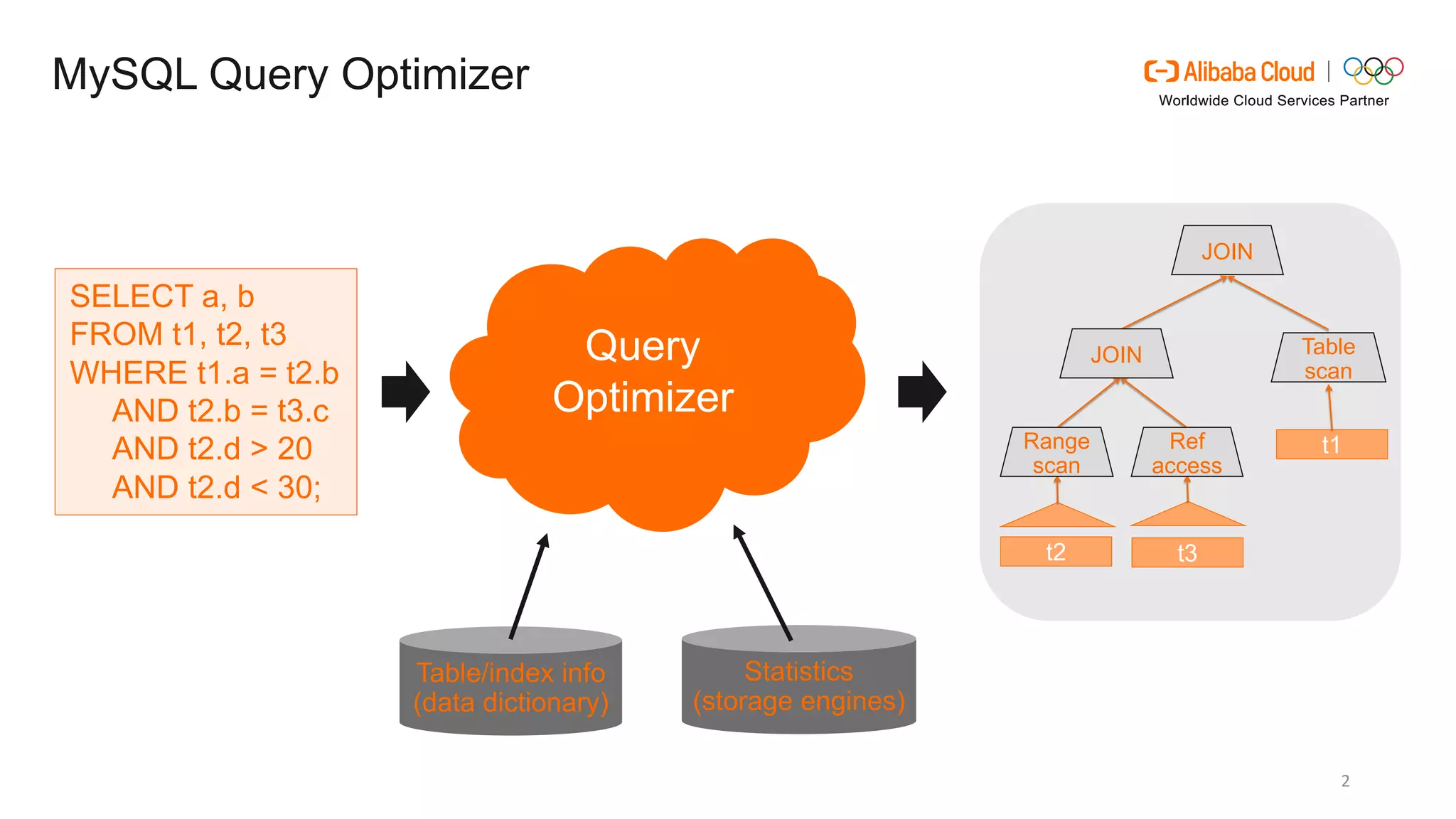
MySQL Query Optimizer
SELECT a, b
FROM t1, t2, t3
WHERE t1.a = t2.b
AND t2.b = t3.c
AND t2.d > 20
AND t2.d < 30;
Table/index info
(data dictionary)
Statistics
(storage engines)
t2 t3
t1
Table
scan
Range
scan
Ref
access
JOIN
JOINQuery
Optimizer
2
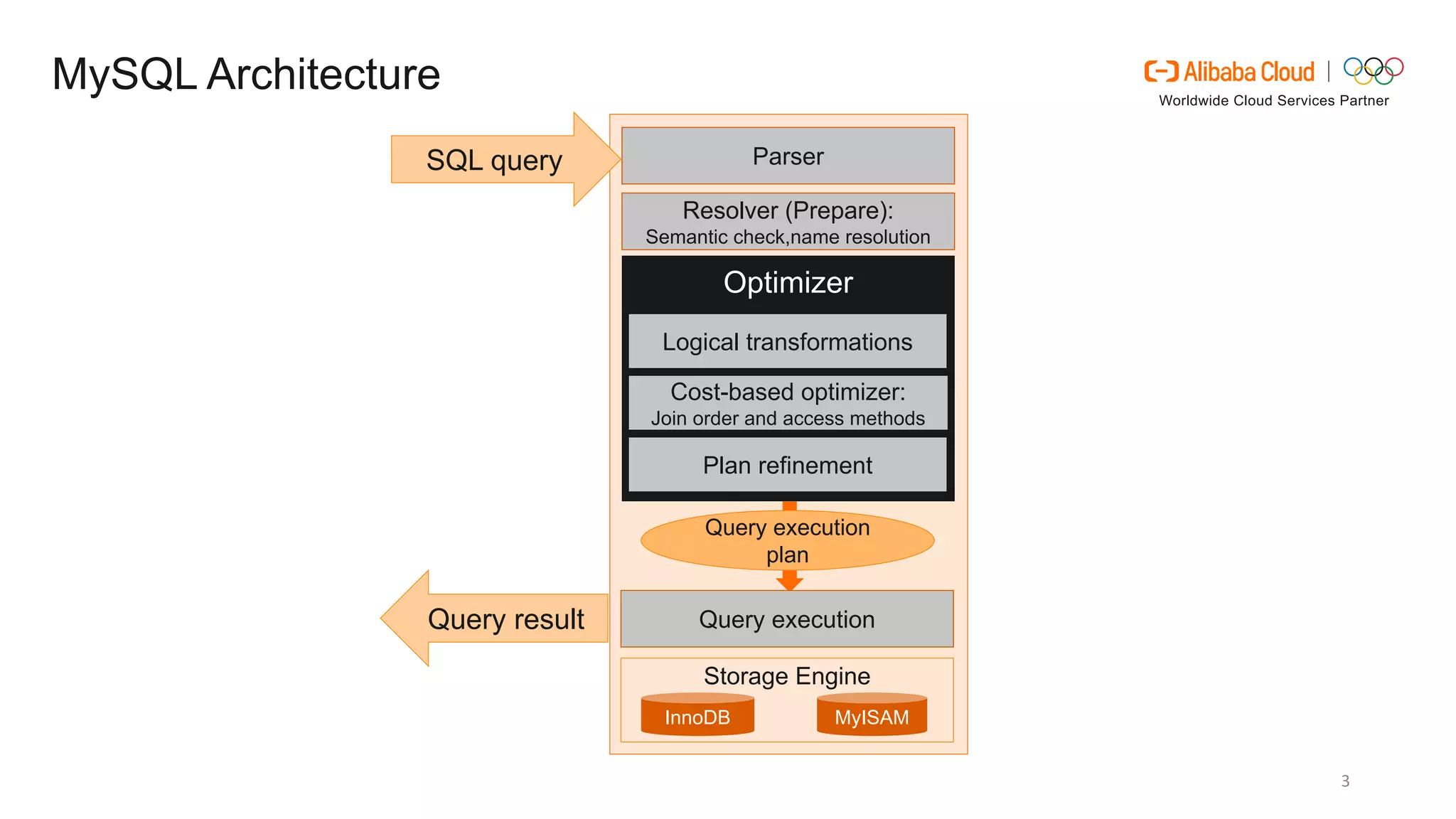
MySQL Architecture
Optimizer
Logical transformations
Cost-based optimizer:
Join order and access methods
Plan refinement
Query execution
plan
Query execution
Parser
Resolver (Prepare):
Semantic check,name resolution
Storage Engine
InnoDB MyISAM
SQL query
Query result
3
Optimizer Trace
• EXPLAIN shows the selected plan
• Optimizer trace shows WHY the plan was selected
SET optimizer_trace= "enabled=on";
SELECT * FROM t1, t2 WHERE f1=1 AND f1=f2 AND f2>0;
SELECT trace FROM information_schema.optimizer_trace
INTO OUTFILE filename LINES TERMINATED BY ’’;
SET optimizer_trace="enabled=off";
QUERY SELECT * FROM t1, t2 WHERE f1=1 AND f1=f2 AND f2>0;
TRACE { "steps": [ { "join_preparation": { "select#": 1,… } … } …] }
MISSING_BYTES_BEYOND_MAX_MEM_SIZE 0
INSUFFICIENT_PRIVILEGES 0
How to generate it
4
Optimizer Trace
{
"steps": [
{
"join_preparation": {
"select#": 1,
"steps": [
{
"expanded_query": "/* select#1 */ select `t1`.`f1` AS `f1`,`t2`.`f2` AS `f2` from `t1` join `t2` where ((`t1`.`f1` = 1) and (`t1`.`f1` = `t2`.`f2`) and (`t2`.`f2` > 0))"
}
]
}
},
{
"join_optimization": {
"select#": 1,
"steps": [
{
"condition_processing": {
"condition": "WHERE",
"original_condition": "((`t1`.`f1` = 1) and (`t1`.`f1` = `t2`.`f2`) and (`t2`.`f2` > 0))",
"steps": [
{
…
Example
5
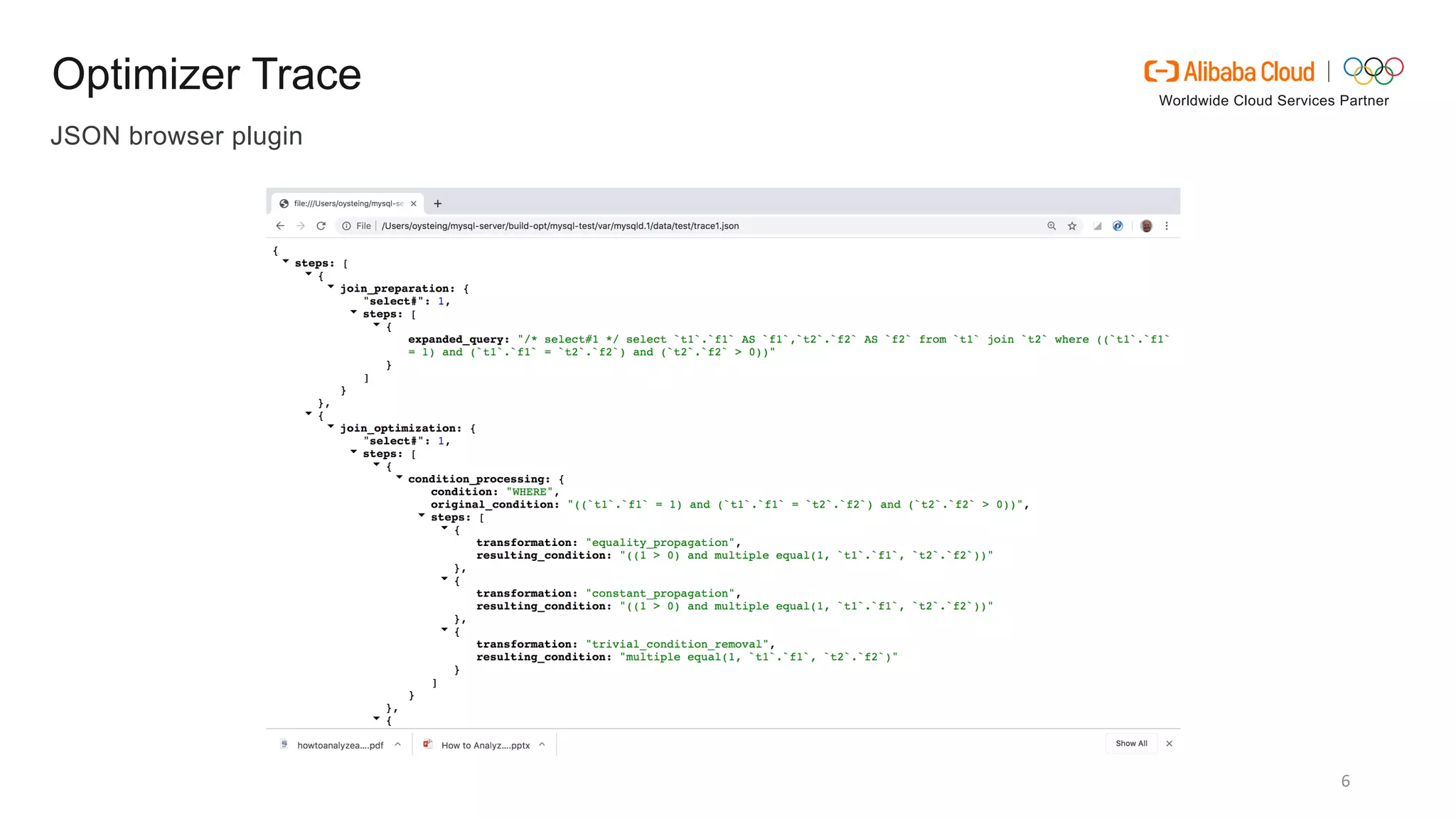
Optimizer Trace
JSON browser plugin
6
Browser Plugin
Collapse to see main trace objects/phases
7
Browser Plugin
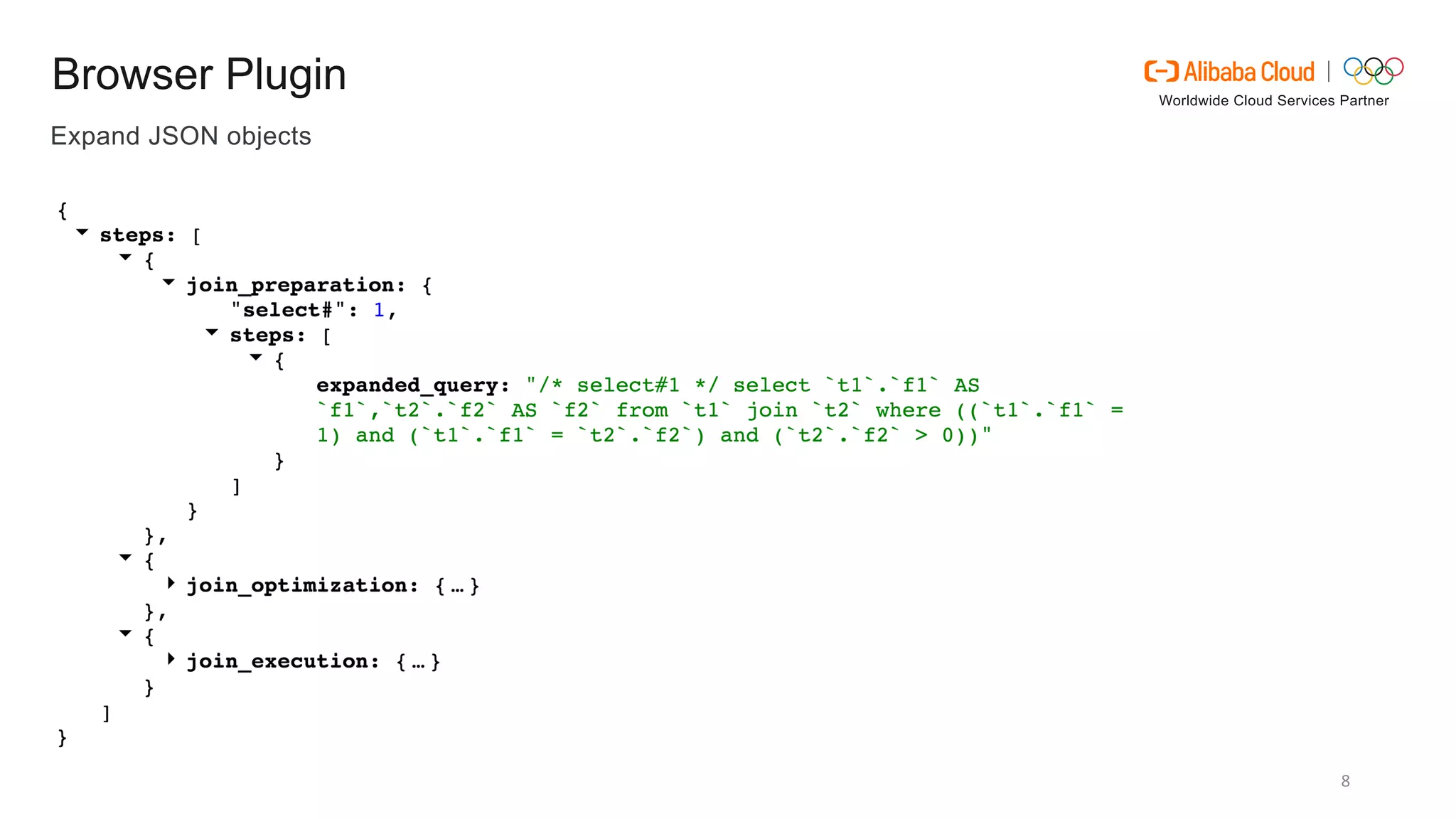
Expand JSON objects
8
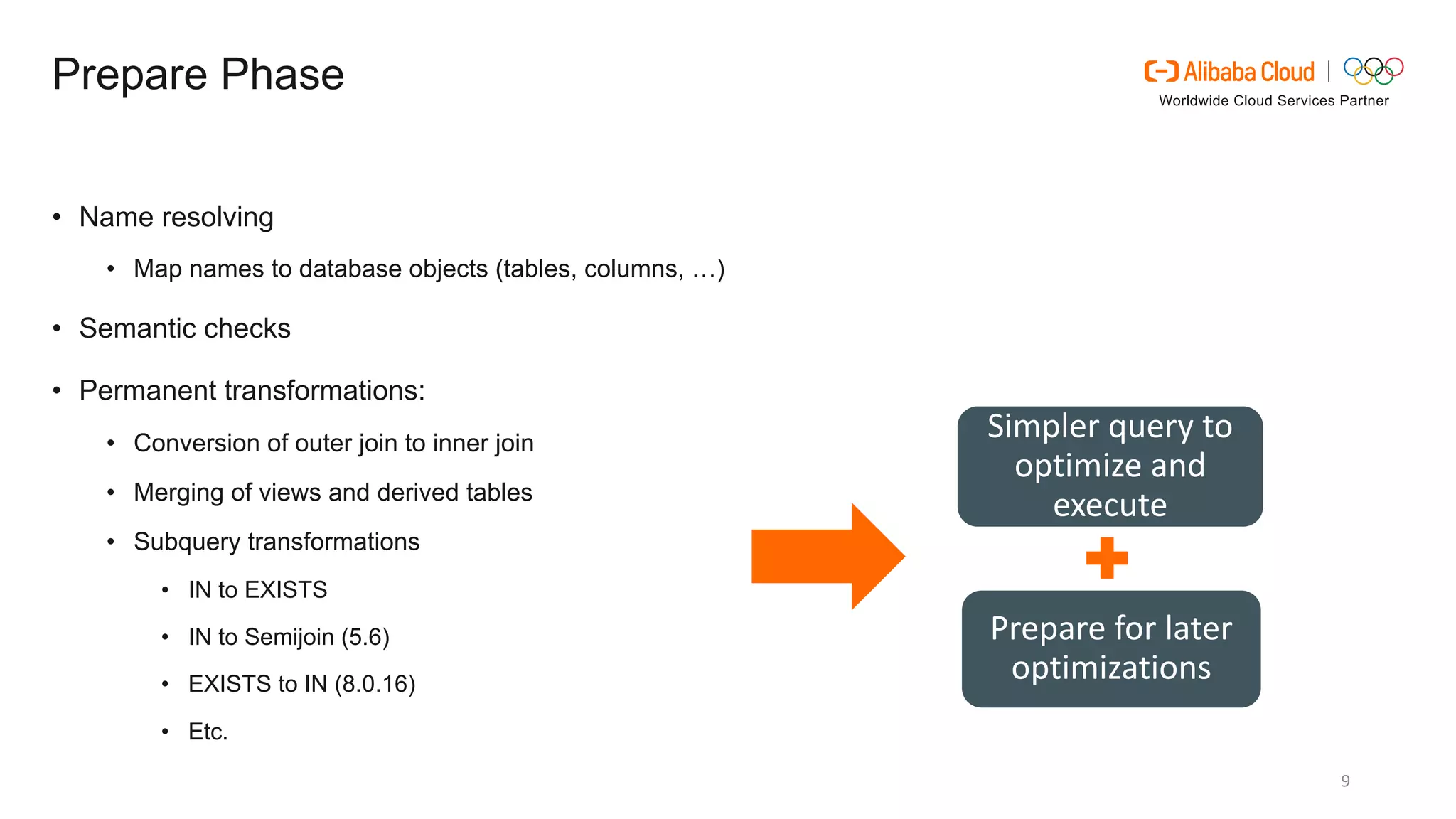
Prepare Phase
• Name resolving
• Map names to database objects (tables, columns, …)
• Semantic checks
• Permanent transformations:
• Conversion of outer join to inner join
• Merging of views and derived tables
• Subquery transformations
• IN to EXISTS
• IN to Semijoin (5.6)
• EXISTS to IN (8.0.16)
• Etc.
Simpler query to
optimize and
execute
Prepare for later
optimizations
9
Conversion of outer join to inner join
SELECT o_orderkey FROM orders LEFT JOIN lineitem ON o_orderkey = l_orderkey
WHERE l_discount > 0.10;
"join_preparation": {
"select#": 1,
"steps": [
{
"expanded_query": "/* select#1 */ select `orders`.`o_orderkey` AS `o_orderkey` from (`orders` left join `lineitem` on
((`orders`.`o_orderkey` = `lineitem`.`l_orderkey`))) where (`lineitem`.`l_discount` > 0.10)"
},
{
"transformations_to_nested_joins": {
"transformations": [
"outer_join_to_inner_join",
"JOIN_condition_to_WHERE",
"parenthesis_removal"
],
"expanded_query": "/* select#1 */ select `orders`.`o_orderkey` AS `o_orderkey` from `orders` join `lineitem` where
((`lineitem`.`l_discount` > 0.10) and(`orders`.`o_orderkey` = `lineitem`.`l_orderkey`))"
} …
10
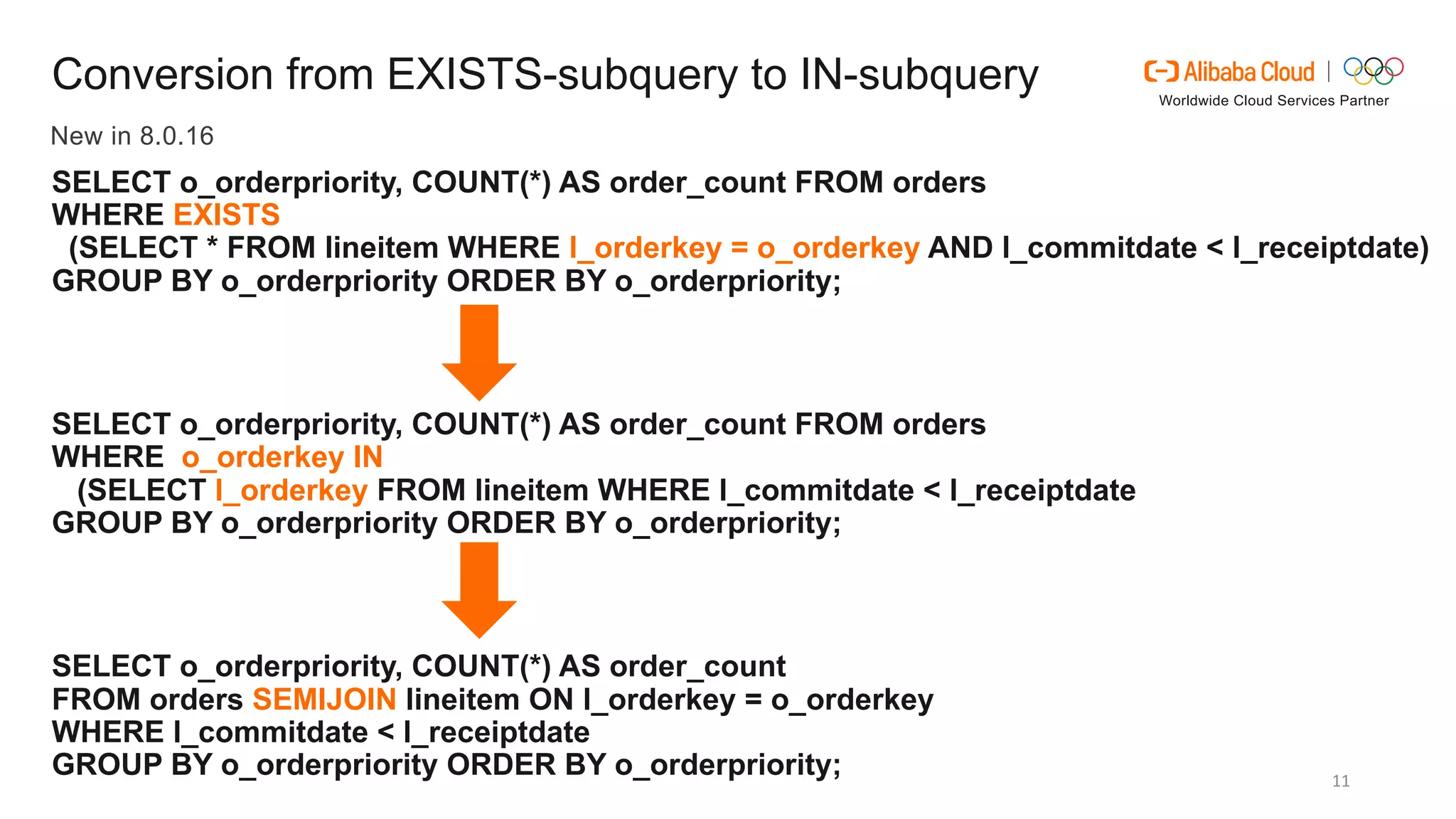
Conversion from EXISTS-subquery to IN-subquery
SELECT o_orderpriority, COUNT(*) AS order_count FROM orders
WHERE EXISTS
(SELECT * FROM lineitem WHERE l_orderkey = o_orderkey AND l_commitdate < l_receiptdate)
GROUP BY o_orderpriority ORDER BY o_orderpriority;
SELECT o_orderpriority, COUNT(*) AS order_count FROM orders
WHERE o_orderkey IN
(SELECT l_orderkey FROM lineitem WHERE l_commitdate < l_receiptdate
GROUP BY o_orderpriority ORDER BY o_orderpriority;
SELECT o_orderpriority, COUNT(*) AS order_count
FROM orders SEMIJOIN lineitem ON l_orderkey = o_orderkey
WHERE l_commitdate < l_receiptdate
GROUP BY o_orderpriority ORDER BY o_orderpriority;
New in 8.0.16
11
Conversion from EXISTS-subquery to IN-subquery
"join_preparation": {
"select#": 1,
"steps": [
{
"join_preparation": {
"select#": 2,
"steps": [
{
"expanded_query": "/* select#2 */ select 1 from `lineitem` where ((`lineitem`.`l_orderkey` = `orders`.`o_orderkey`)
and (`lineitem`.`l_commitDATE` < `lineitem`.`l_receiptDATE`))"
},
{
"transformation": {
"select#": 2,
"from": "EXISTS (SELECT)",
"to": "semijoin",
"chosen": true
}
}
]
…
Optimizer trace
12
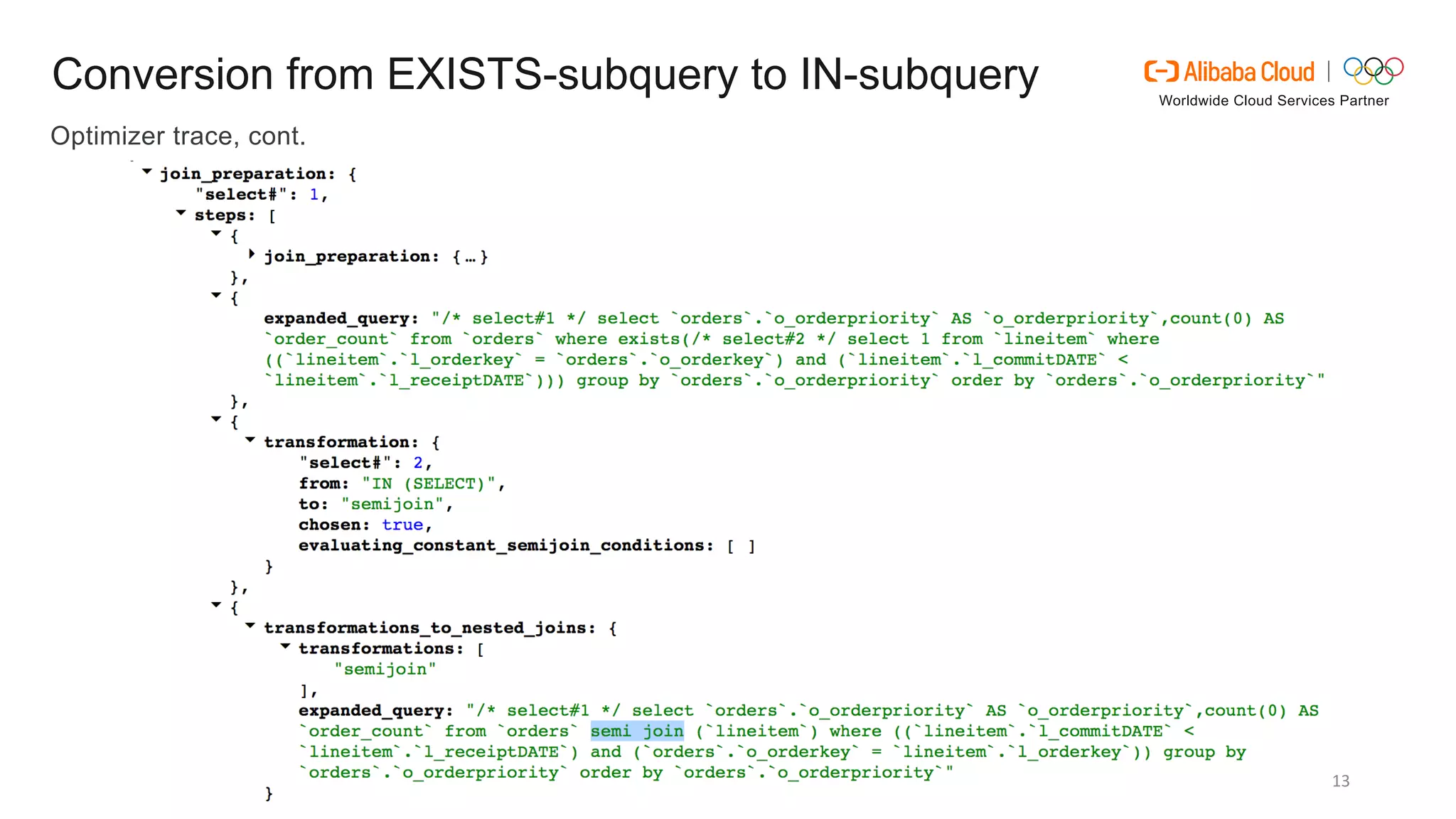
Conversion from EXISTS-subquery to IN-subquery
Optimizer trace, cont.
13
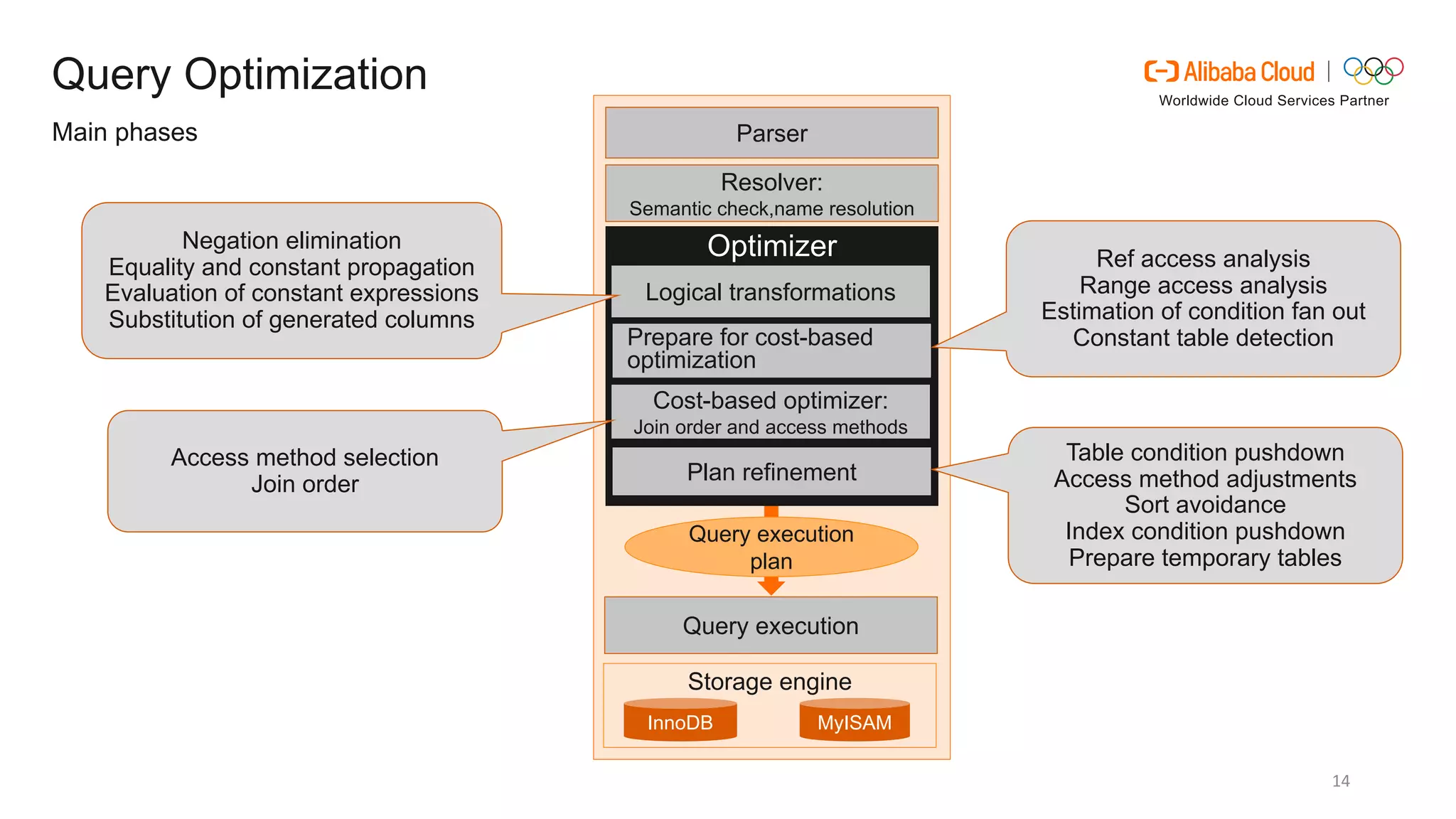
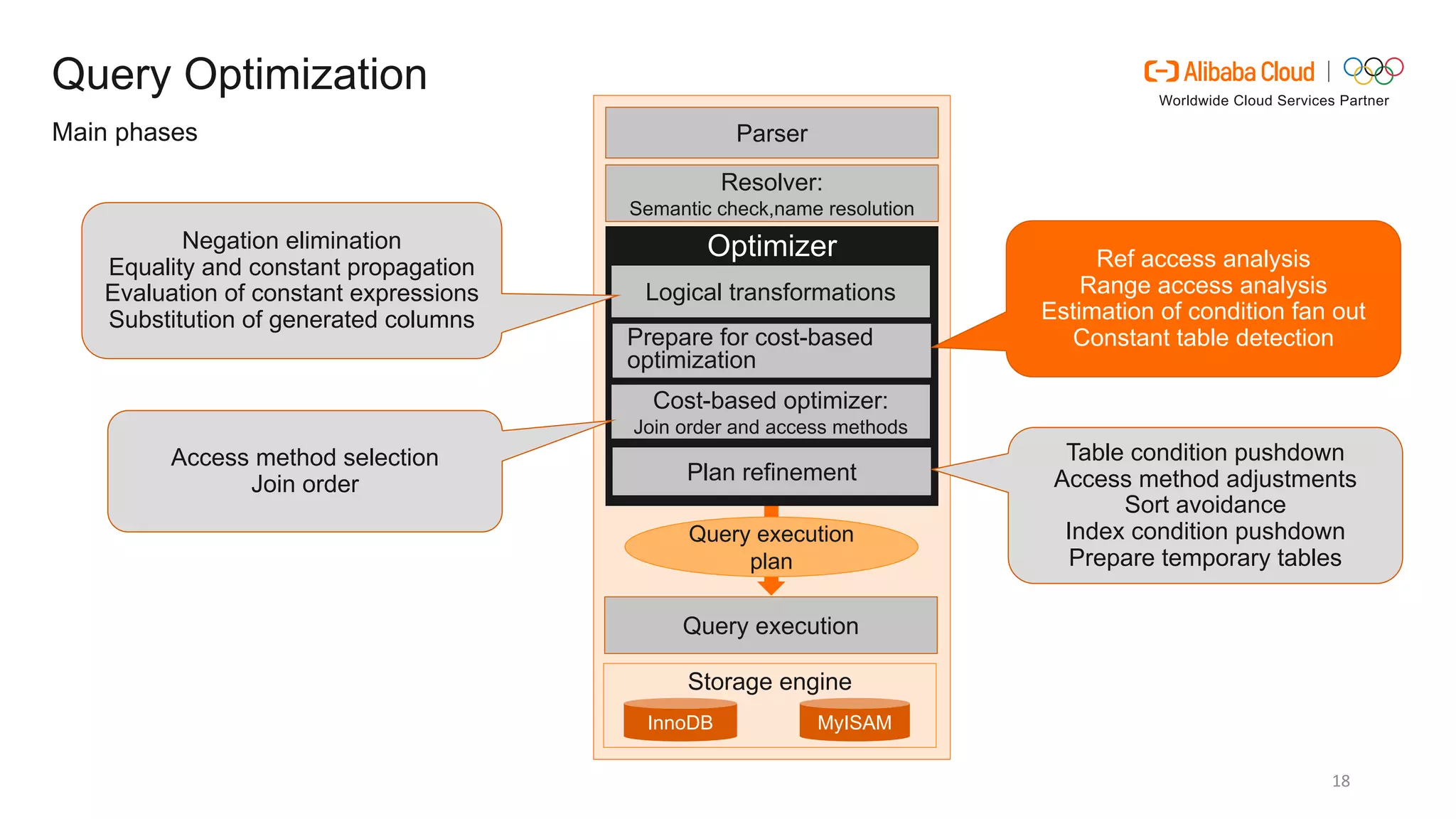
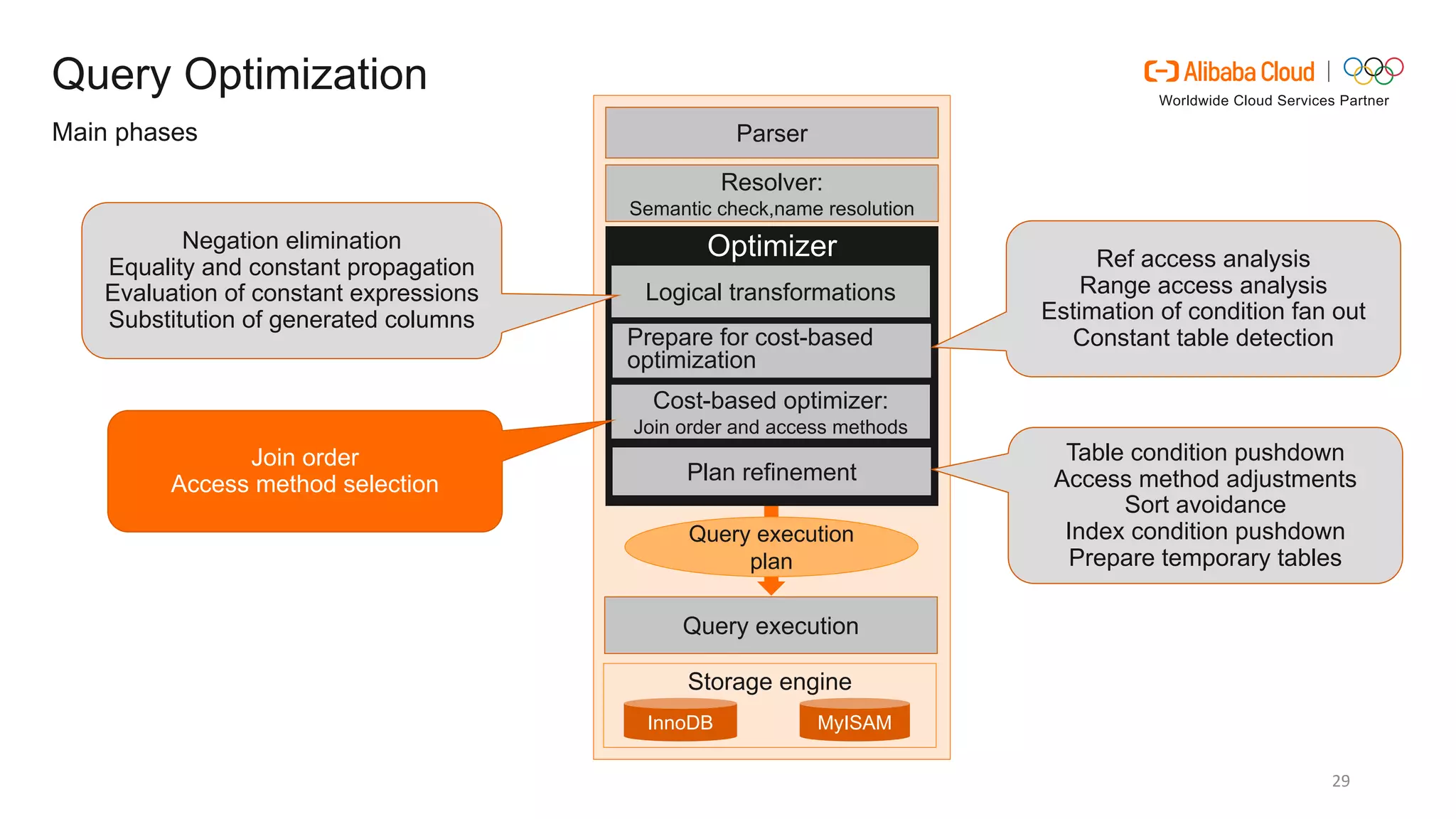
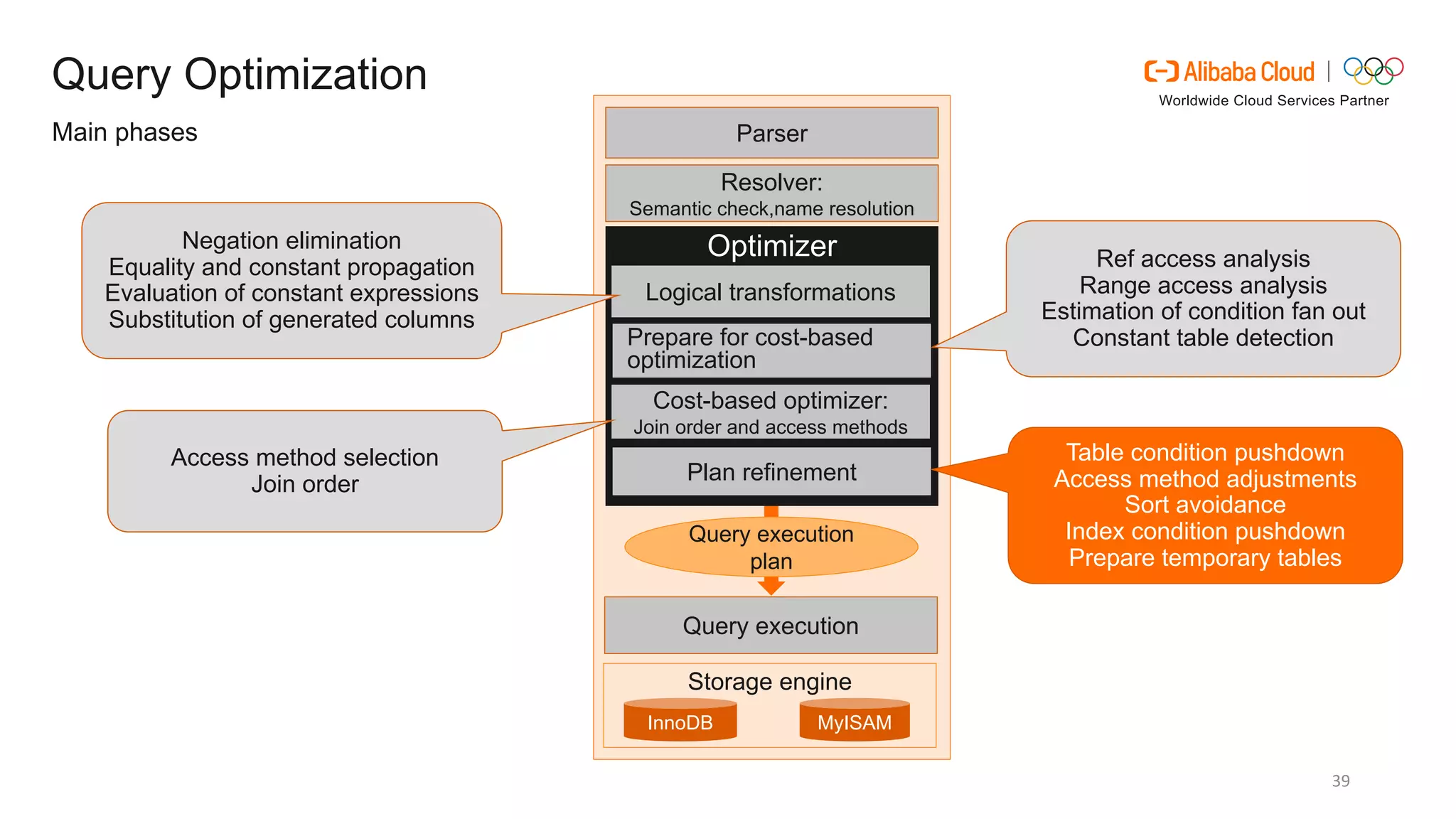
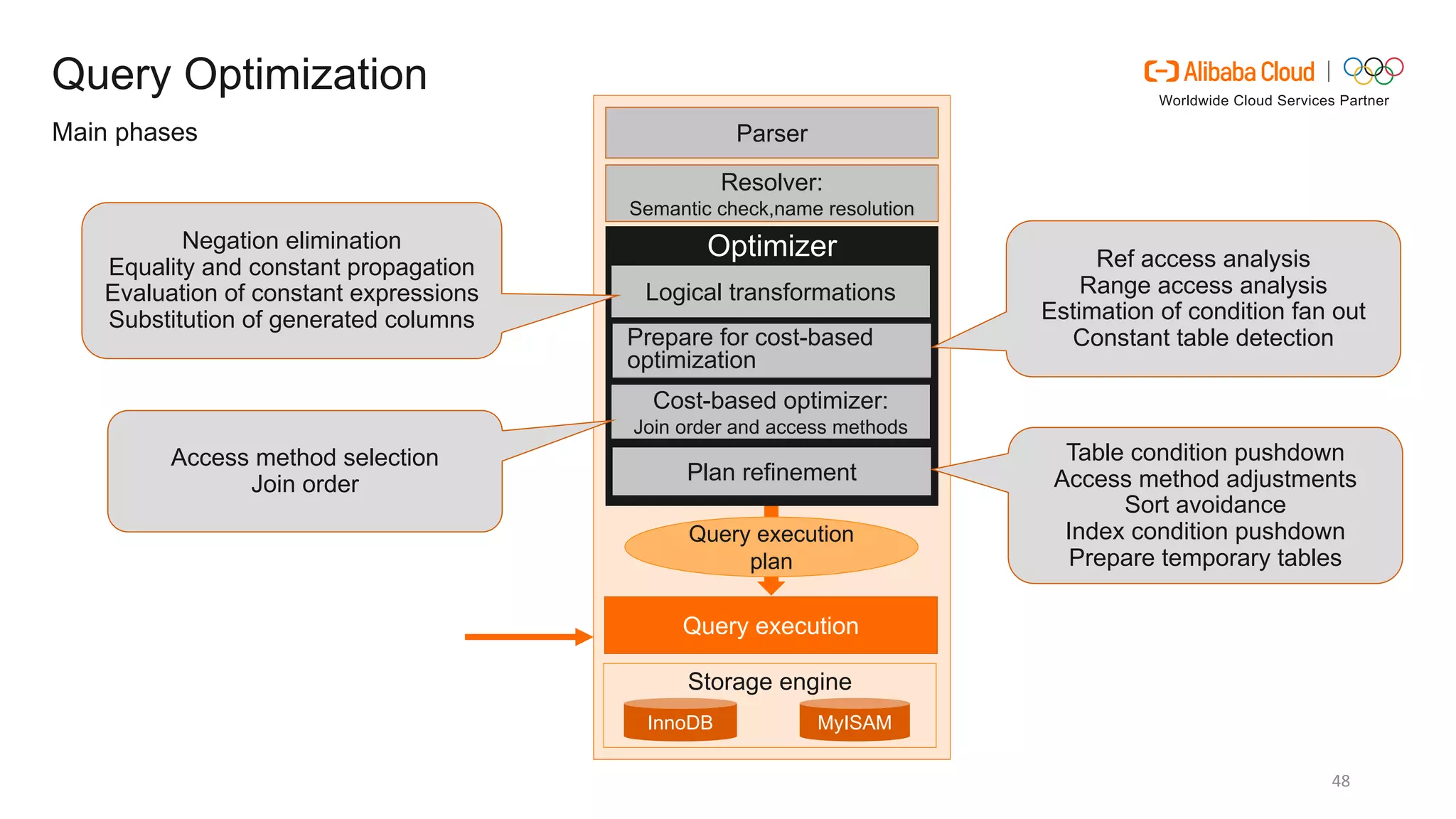
Query Optimization
Main phases
Optimizer
Logical transformations
Cost-based optimizer:
Join order and access methods
Plan refinement
Query execution
plan
Query execution
Parser
Resolver:
Semantic check,name resolution
Storage engine
InnoDB MyISAM
Prepare for cost-based
optimization
Negation elimination
Equality and constant propagation
Evaluation of constant expressions
Substitution of generated columns
Ref access analysis
Range access analysis
Estimation of condition fan out
Constant table detection
Table condition pushdown
Access method adjustments
Sort avoidance
Index condition pushdown
Prepare temporary tables
Access method selection
Join order
14
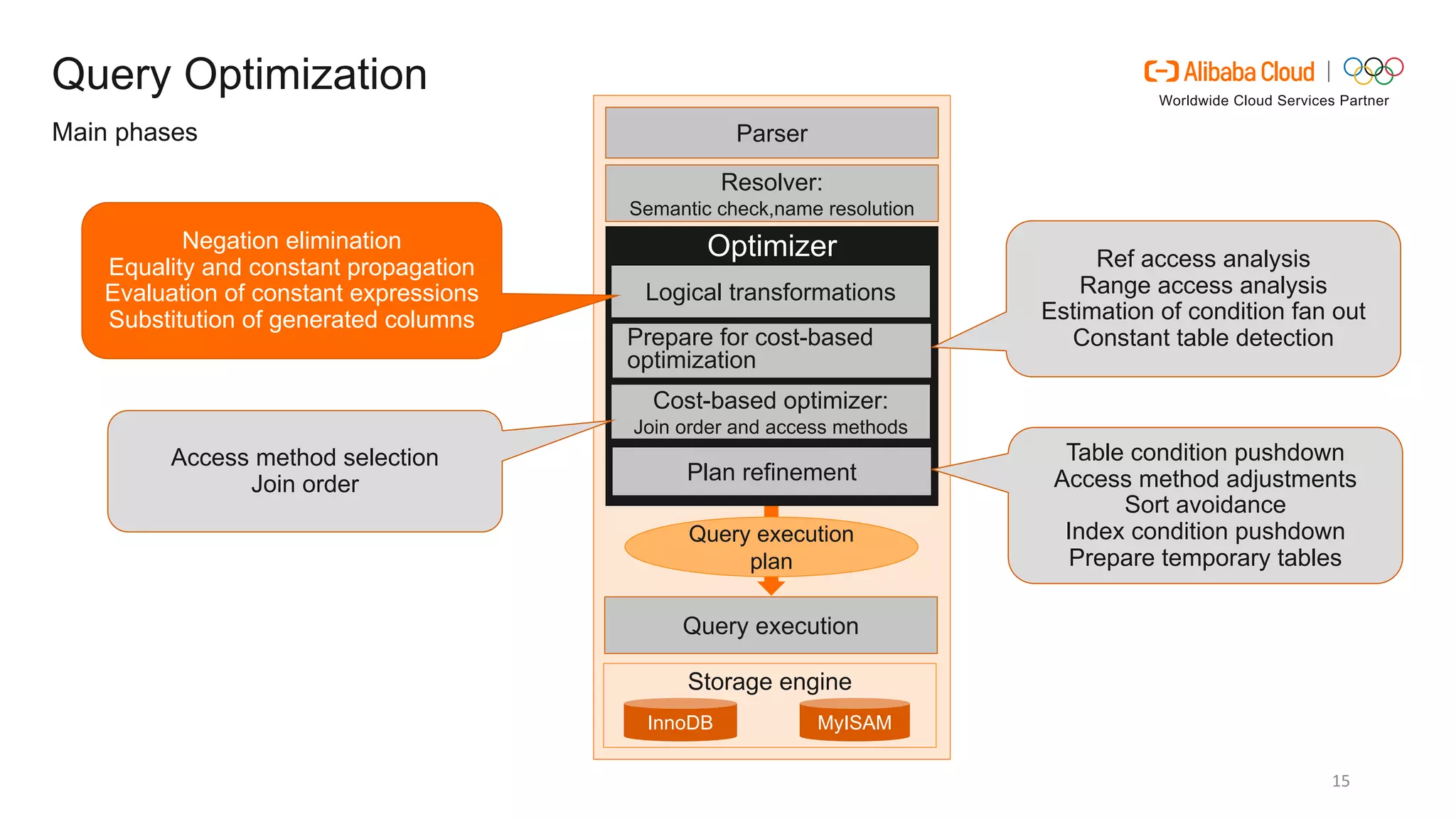
Query Optimization
Main phases
Optimizer
Logical transformations
Cost-based optimizer:
Join order and access methods
Plan refinement
Query execution
plan
Query execution
Parser
Resolver:
Semantic check,name resolution
Storage engine
InnoDB MyISAM
Prepare for cost-based
optimization
Negation elimination
Equality and constant propagation
Evaluation of constant expressions
Substitution of generated columns
Ref access analysis
Range access analysis
Estimation of condition fan out
Constant table detection
Access method selection
Join order
Table condition pushdown
Access method adjustments
Sort avoidance
Index condition pushdown
Prepare temporary tables
15
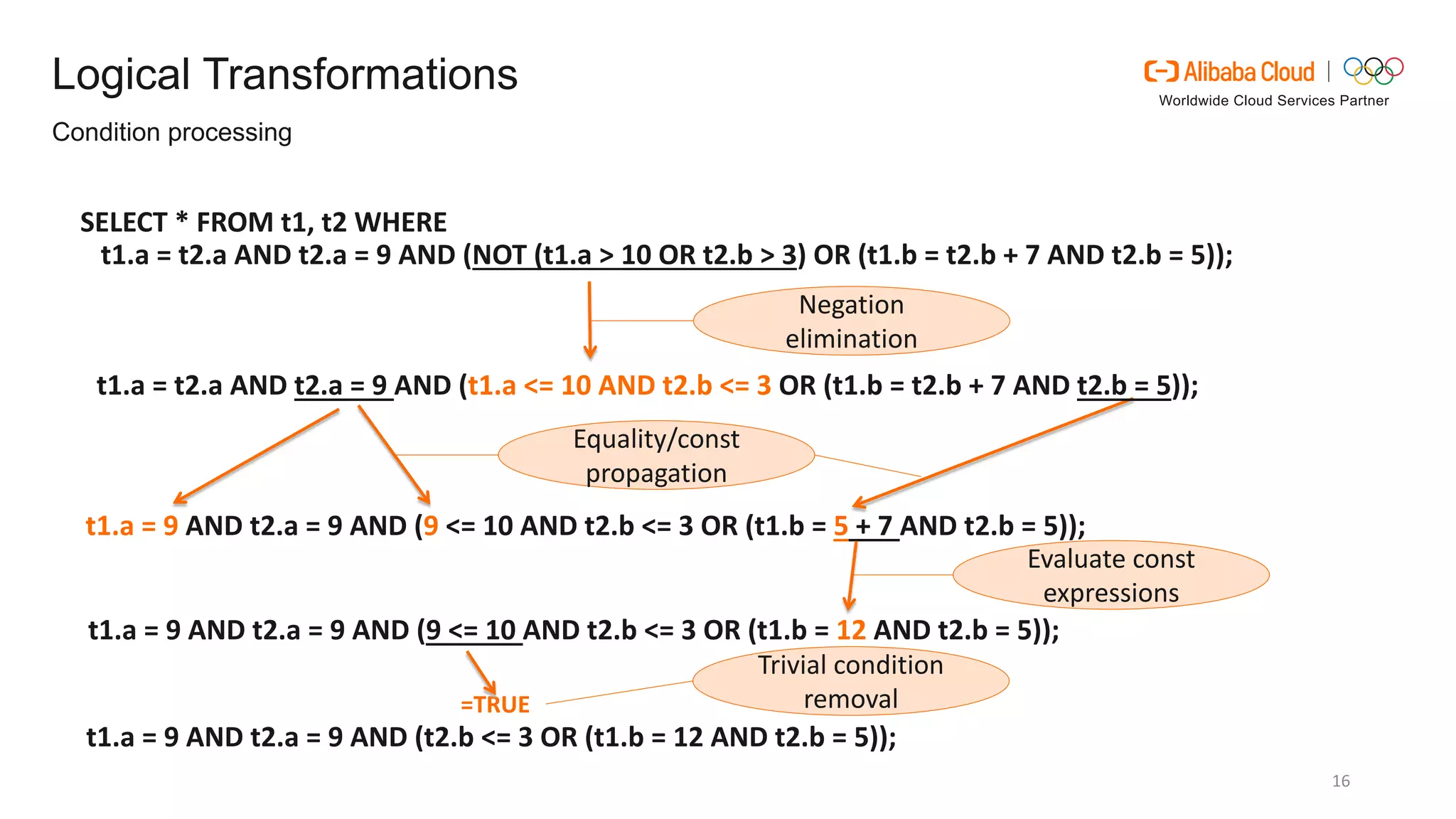
=TRUE
Trivial condition
removal
t1.a = 9 AND t2.a = 9 AND (t2.b <= 3 OR (t1.b = 12 AND t2.b = 5));
t1.a = 9 AND t2.a = 9 AND (9 <= 10 AND t2.b <= 3 OR (t1.b = 5 + 7 AND t2.b = 5));
Equality/const
propagation
Logical Transformations
Condition processing
t1.a = 9 AND t2.a = 9 AND (9 <= 10 AND t2.b <= 3 OR (t1.b = 12 AND t2.b = 5));
Evaluate const
expressions
SELECT * FROM t1, t2 WHERE
t1.a = t2.a AND t2.a = 9 AND (NOT (t1.a > 10 OR t2.b > 3) OR (t1.b = t2.b + 7 AND t2.b = 5));
Negation
elimination
t1.a = t2.a AND t2.a = 9 AND (t1.a <= 10 AND t2.b <= 3 OR (t1.b = t2.b + 7 AND t2.b = 5));
16
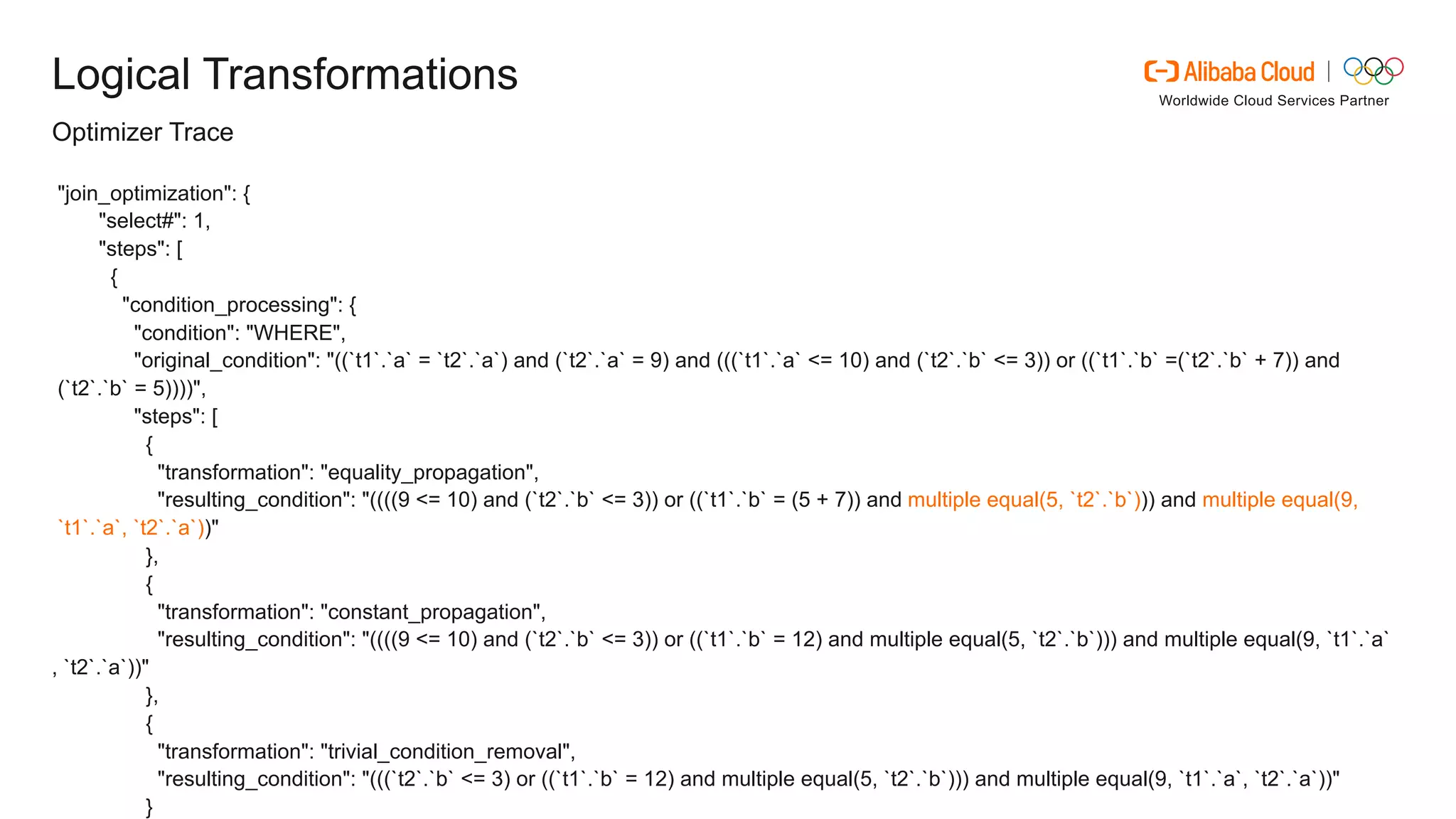
Logical Transformations
"join_optimization": {
"select#": 1,
"steps": [
{
"condition_processing": {
"condition": "WHERE",
"original_condition": "((`t1`.`a` = `t2`.`a`) and (`t2`.`a` = 9) and (((`t1`.`a` <= 10) and (`t2`.`b` <= 3)) or ((`t1`.`b` =(`t2`.`b` + 7)) and
(`t2`.`b` = 5))))",
"steps": [
{
"transformation": "equality_propagation",
"resulting_condition": "((((9 <= 10) and (`t2`.`b` <= 3)) or ((`t1`.`b` = (5 + 7)) and multiple equal(5, `t2`.`b`))) and multiple equal(9,
`t1`.`a`, `t2`.`a`))"
},
{
"transformation": "constant_propagation",
"resulting_condition": "((((9 <= 10) and (`t2`.`b` <= 3)) or ((`t1`.`b` = 12) and multiple equal(5, `t2`.`b`))) and multiple equal(9, `t1`.`a`
, `t2`.`a`))"
},
{
"transformation": "trivial_condition_removal",
"resulting_condition": "(((`t2`.`b` <= 3) or ((`t1`.`b` = 12) and multiple equal(5, `t2`.`b`))) and multiple equal(9, `t1`.`a`, `t2`.`a`))"
}
Optimizer Trace
Query Optimization
Main phases
Optimizer
Logical transformations
Cost-based optimizer:
Join order and access methods
Plan refinement
Query execution
plan
Query execution
Parser
Resolver:
Semantic check,name resolution
Storage engine
InnoDB MyISAM
Prepare for cost-based
optimization
Negation elimination
Equality and constant propagation
Evaluation of constant expressions
Substitution of generated columns
Ref access analysis
Range access analysis
Estimation of condition fan out
Constant table detection
Access method selection
Join order
Table condition pushdown
Access method adjustments
Sort avoidance
Index condition pushdown
Prepare temporary tables
18
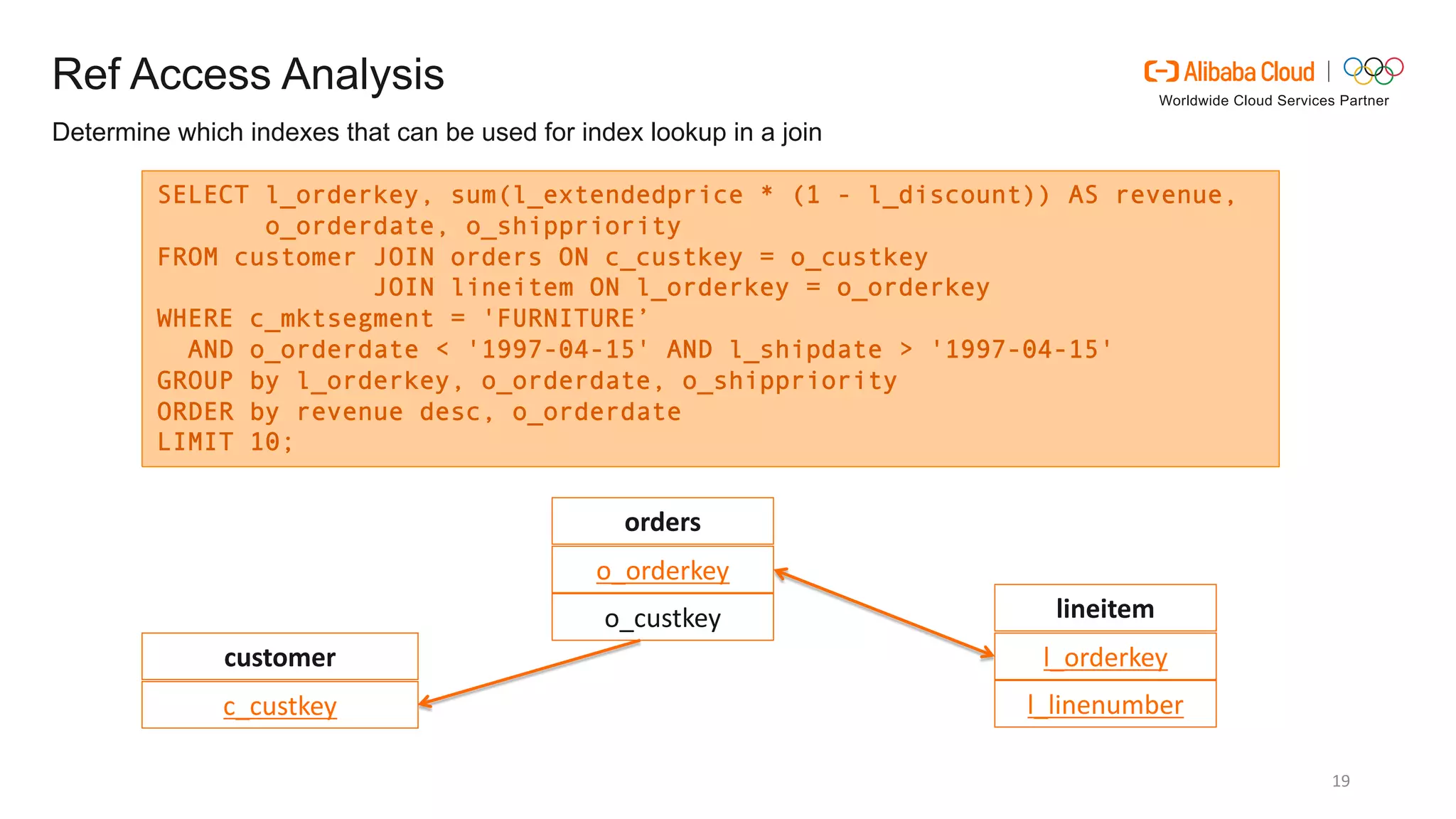
Ref Access Analysis
Determine which indexes that can be used for index lookup in a join
SELECT l_orderkey, sum(l_extendedprice * (1 - l_discount)) AS revenue,
o_orderdate, o_shippriority
FROM customer JOIN orders ON c_custkey = o_custkey
JOIN lineitem ON l_orderkey = o_orderkey
WHERE c_mktsegment = 'FURNITURE’
AND o_orderdate < '1997-04-15' AND l_shipdate > '1997-04-15'
GROUP by l_orderkey, o_orderdate, o_shippriority
ORDER by revenue desc, o_orderdate
LIMIT 10;
customer
c_custkey
orders
o_orderkey
o_custkey lineitem
l_orderkey
l_linenumber
19
Ref Access Analysis
{
"ref_optimizer_key_uses": [
{
"table": "`customer`",
"field": "c_custkey",
"equals": "`orders`.`o_custkey`",
"null_rejecting": true
},
{
"table": "`orders`",
"field": "o_orderkey",
"equals": "`lineitem`.`l_orderkey`",
"null_rejecting": false
},
{
"table": "`lineitem`",
"field": "l_orderkey",
"equals": "`orders`.`o_orderkey`",
"null_rejecting": false
},
{
"table": "`lineitem`",
"field": "l_orderkey",
"equals": "`orders`.`o_orderkey`",
"null_rejecting": false
}
]
},
Optimizer trace
20
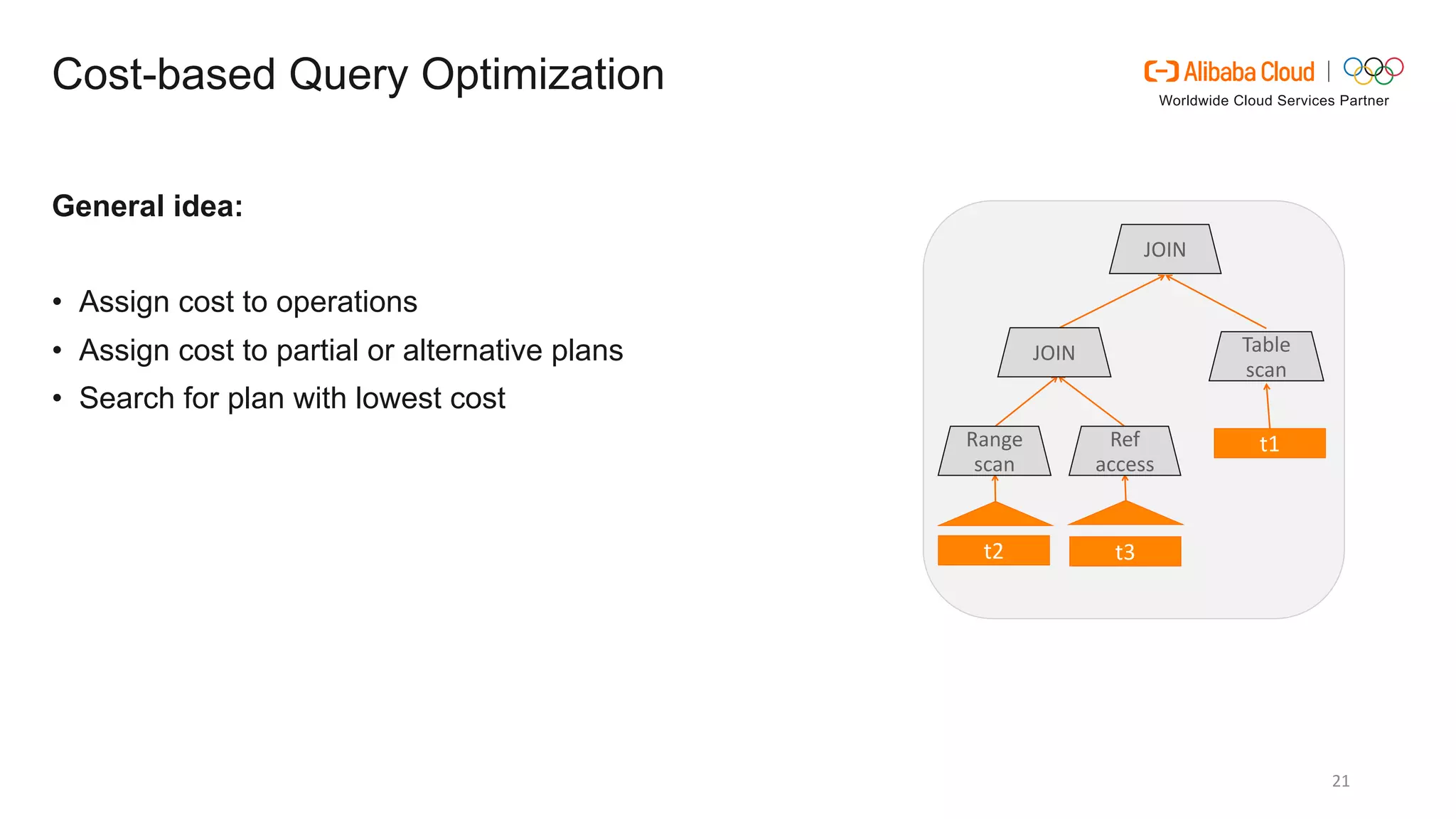
Cost-based Query Optimization
General idea:
• Assign cost to operations
• Assign cost to partial or alternative plans
• Search for plan with lowest cost
t2 t3
t1
Table
scan
Range
scan
Ref
access
JOIN
JOIN
21
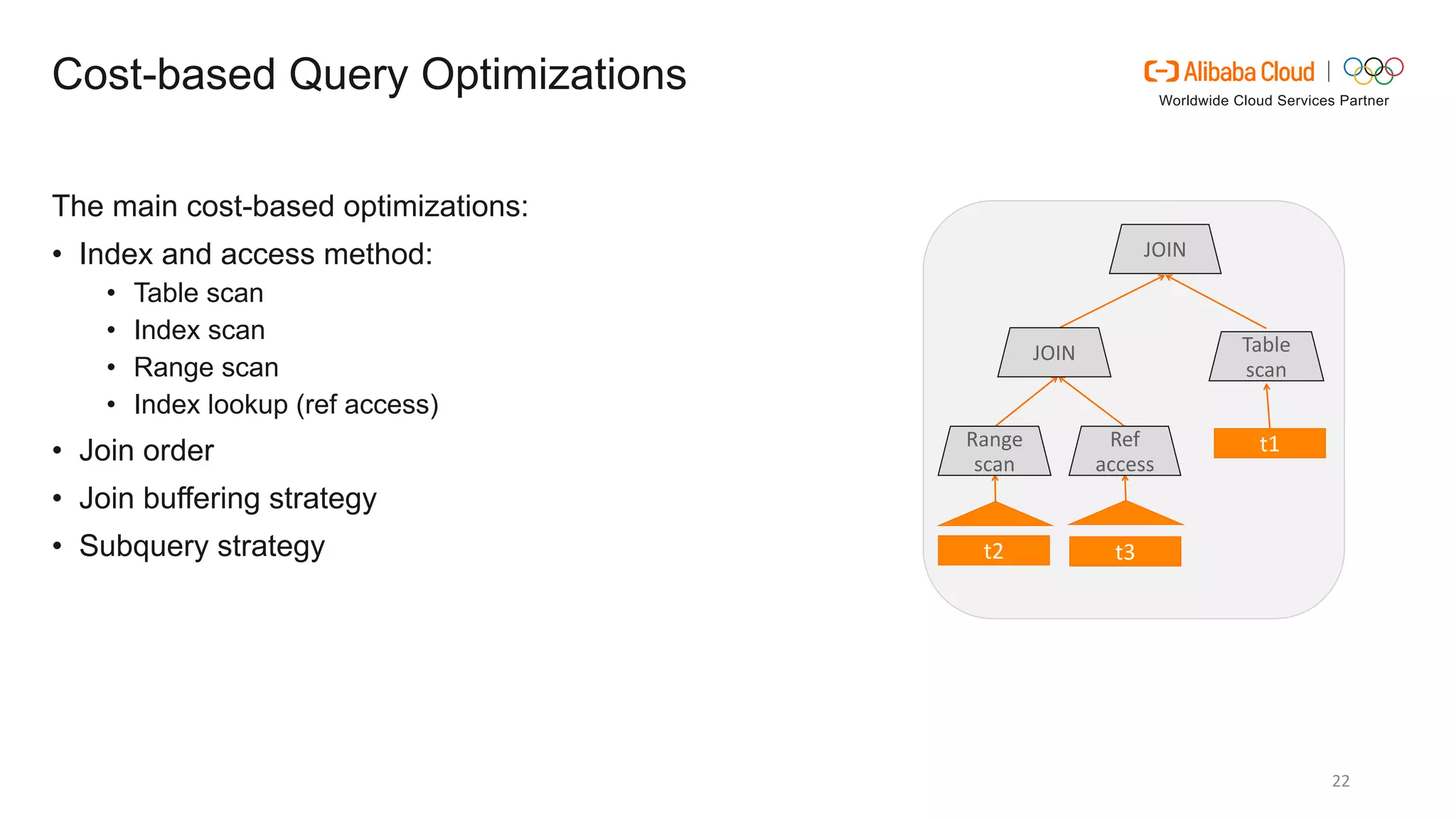
Cost-based Query Optimizations
The main cost-based optimizations:
• Index and access method:
• Table scan
• Index scan
• Range scan
• Index lookup (ref access)
• Join order
• Join buffering strategy
• Subquery strategy t2 t3
t1
Table
scan
Range
scan
Ref
access
JOIN
JOIN
22
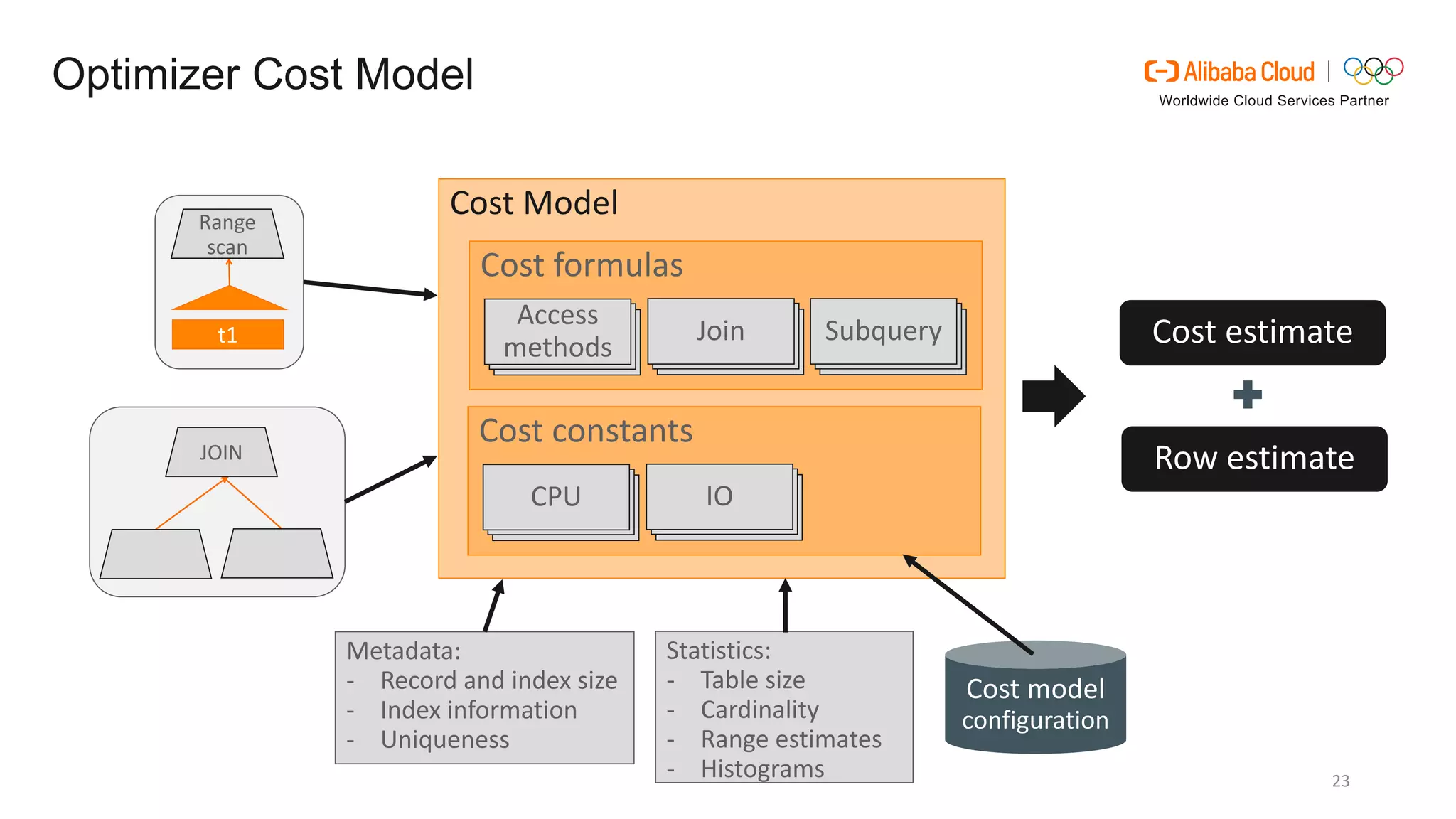
Optimizer Cost Model
t1 Cost estimate
Row estimate
Cost Model
Cost formulas
Access
methods
Join Subquery
Cost constants
CPU IO
Metadata:
- Record and index size
- Index information
- Uniqueness
Statistics:
- Table size
- Cardinality
- Range estimates
- Histograms
Cost model
configuration
Range
scan
JOIN
23
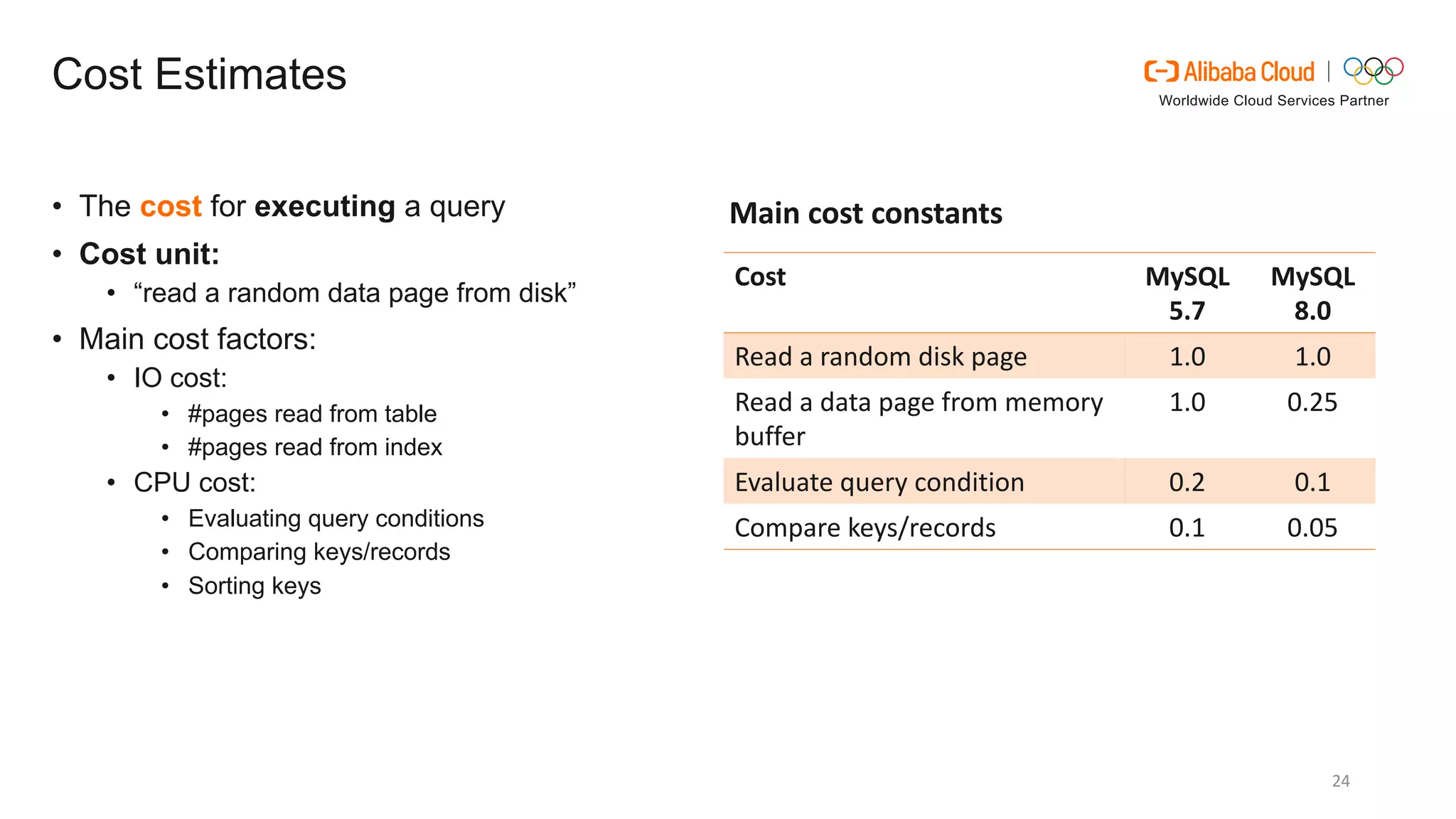
Cost Estimates
• The cost for executing a query
• Cost unit:
• “read a random data page from disk”
• Main cost factors:
• IO cost:
• #pages read from table
• #pages read from index
• CPU cost:
• Evaluating query conditions
• Comparing keys/records
• Sorting keys
Cost MySQL
5.7
MySQL
8.0
Read a random disk page 1.0 1.0
Read a data page from memory
buffer
1.0 0.25
Evaluate query condition 0.2 0.1
Compare keys/records 0.1 0.05
Main cost constants
24
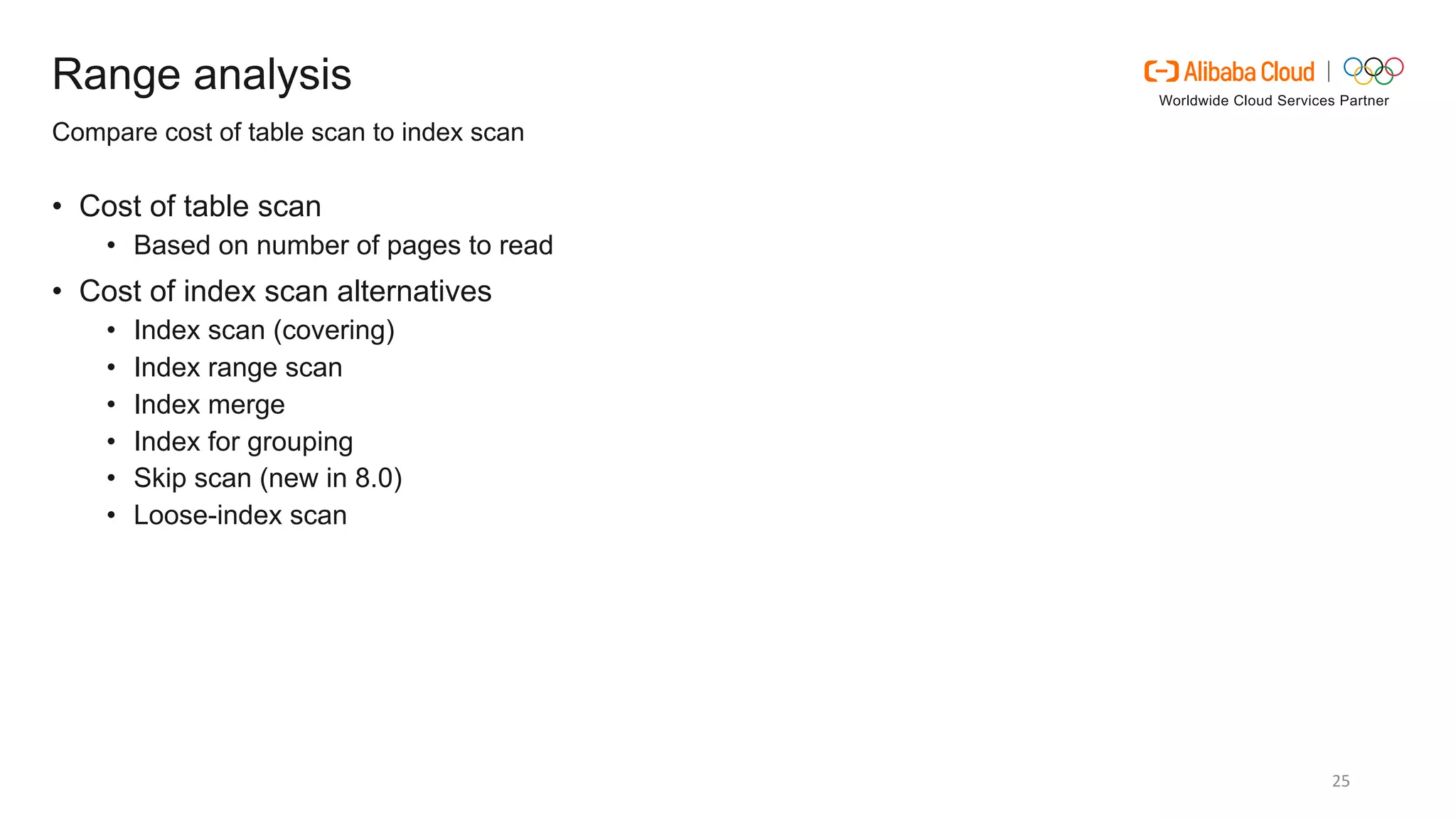
Range analysis
• Cost of table scan
• Based on number of pages to read
• Cost of index scan alternatives
• Index scan (covering)
• Index range scan
• Index merge
• Index for grouping
• Skip scan (new in 8.0)
• Loose-index scan
Compare cost of table scan to index scan
25
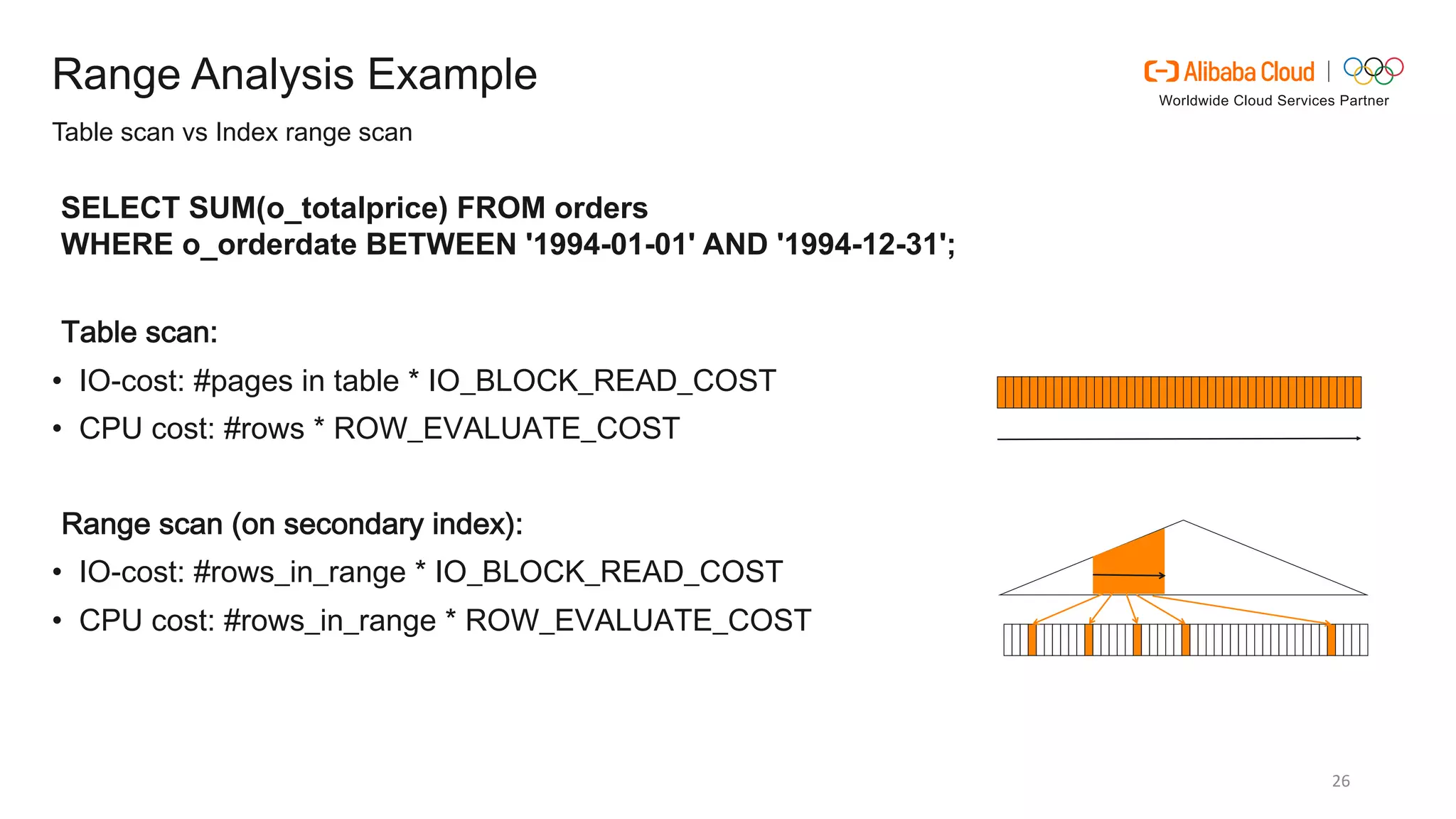
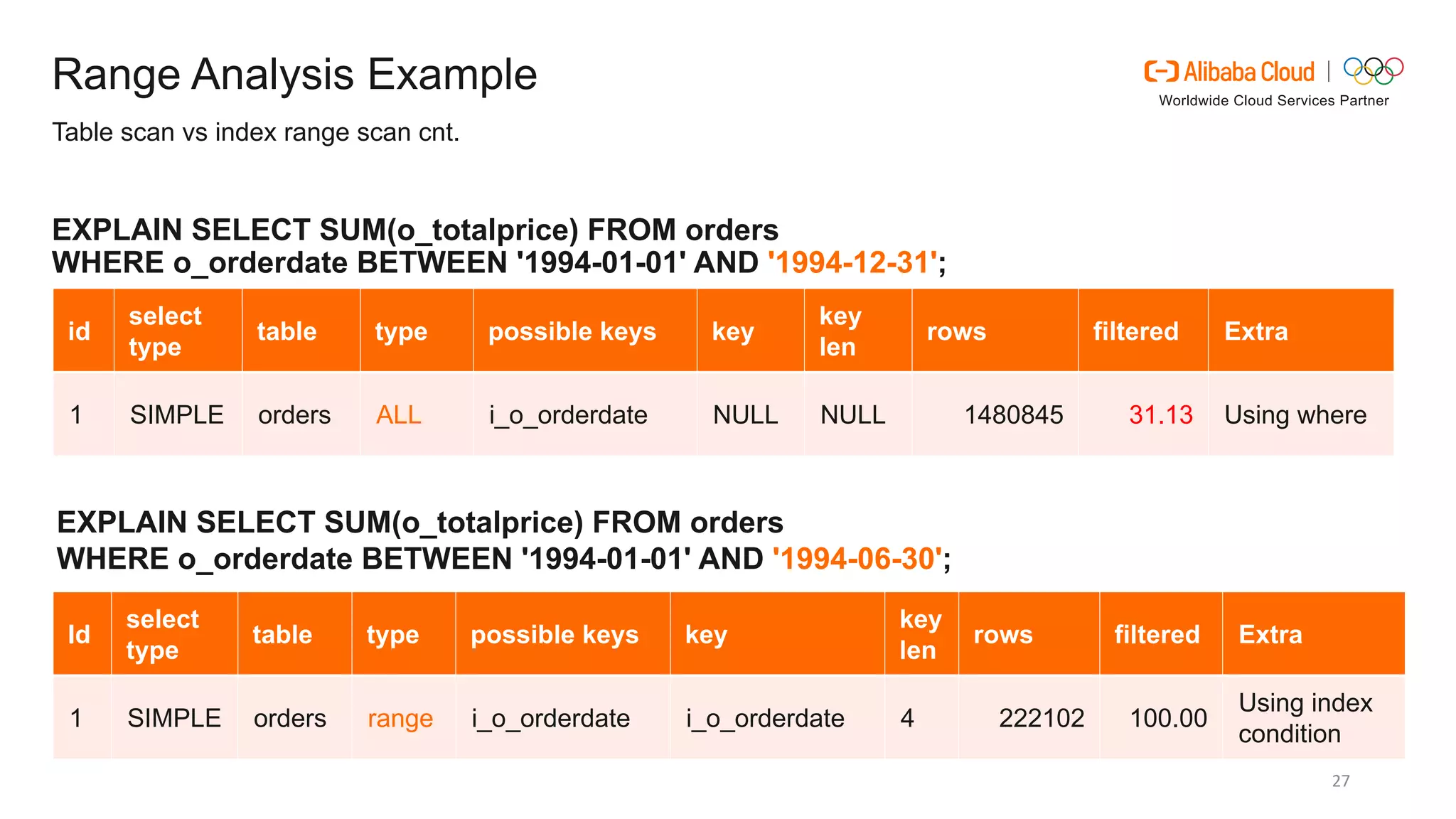
Range Analysis Example
Table scan:
• IO-cost: #pages in table * IO_BLOCK_READ_COST
• CPU cost: #rows * ROW_EVALUATE_COST
Range scan (on secondary index):
• IO-cost: #rows_in_range * IO_BLOCK_READ_COST
• CPU cost: #rows_in_range * ROW_EVALUATE_COST
SELECT SUM(o_totalprice) FROM orders
WHERE o_orderdate BETWEEN '1994-01-01' AND '1994-12-31';
Table scan vs Index range scan
26
Range Analysis Example
EXPLAIN SELECT SUM(o_totalprice) FROM orders
WHERE o_orderdate BETWEEN '1994-01-01' AND '1994-12-31';
EXPLAIN SELECT SUM(o_totalprice) FROM orders
WHERE o_orderdate BETWEEN '1994-01-01' AND '1994-06-30';
id
select
type
table type possible keys key
key
len
rows filtered Extra
1 SIMPLE orders ALL i_o_orderdate NULL NULL 1480845 31.13 Using where
Id
select
type
table type possible keys key
key
len
rows filtered Extra
1 SIMPLE orders range i_o_orderdate i_o_orderdate 4 222102 100.00
Using index
condition
Table scan vs index range scan cnt.
27
"rows_estimation": [
{
"table": "`orders`",
"range_analysis": {
"table_scan": {
"rows": 1480845,
"cost": 151138
},
"potential_range_indexes": [
{
"index": "PRIMARY",
"usable": false,
"cause": "not_applicable"
},
{
"index": "i_o_orderdate",
"usable": true,
"key_parts": [
"o_orderDATE",
"o_orderkey"
] } ],
"setup_range_conditions": [
],
"group_index_range": {
"chosen": false,
"cause": "not_group_by_or_distinct"
},
"skip_scan_range": {
"potential_skip_scan_indexes": [
{
"index": "i_o_orderdate",
"usable": false,
"cause": "query_references_nonkey_column"
}
]
},
"analyzing_range_alternatives": {
"range_scan_alternatives": [
{
"index": "i_o_orderdate",
"ranges": [
"0x21940f <= o_orderDATE <= 0x9f950f"
],
"index_dives_for_eq_ranges": true,
"rowid_ordered": false,
"using_mrr": false,
"index_only": false,
"rows": 460938,
"cost": 161329,
"chosen": false,
"cause": "cost"
}
],
"analyzing_roworder_intersect": {
"usable": false,
"cause": "too_few_roworder_scans"
} } } }]
Range Analysis Example
Optimizer trace
28
Query Optimization
Main phases
Optimizer
Logical transformations
Cost-based optimizer:
Join order and access methods
Plan refinement
Query execution
plan
Query execution
Parser
Resolver:
Semantic check,name resolution
Storage engine
InnoDB MyISAM
Prepare for cost-based
optimization
Negation elimination
Equality and constant propagation
Evaluation of constant expressions
Substitution of generated columns
Ref access analysis
Range access analysis
Estimation of condition fan out
Constant table detection
Join order
Access method selection
Table condition pushdown
Access method adjustments
Sort avoidance
Index condition pushdown
Prepare temporary tables
29
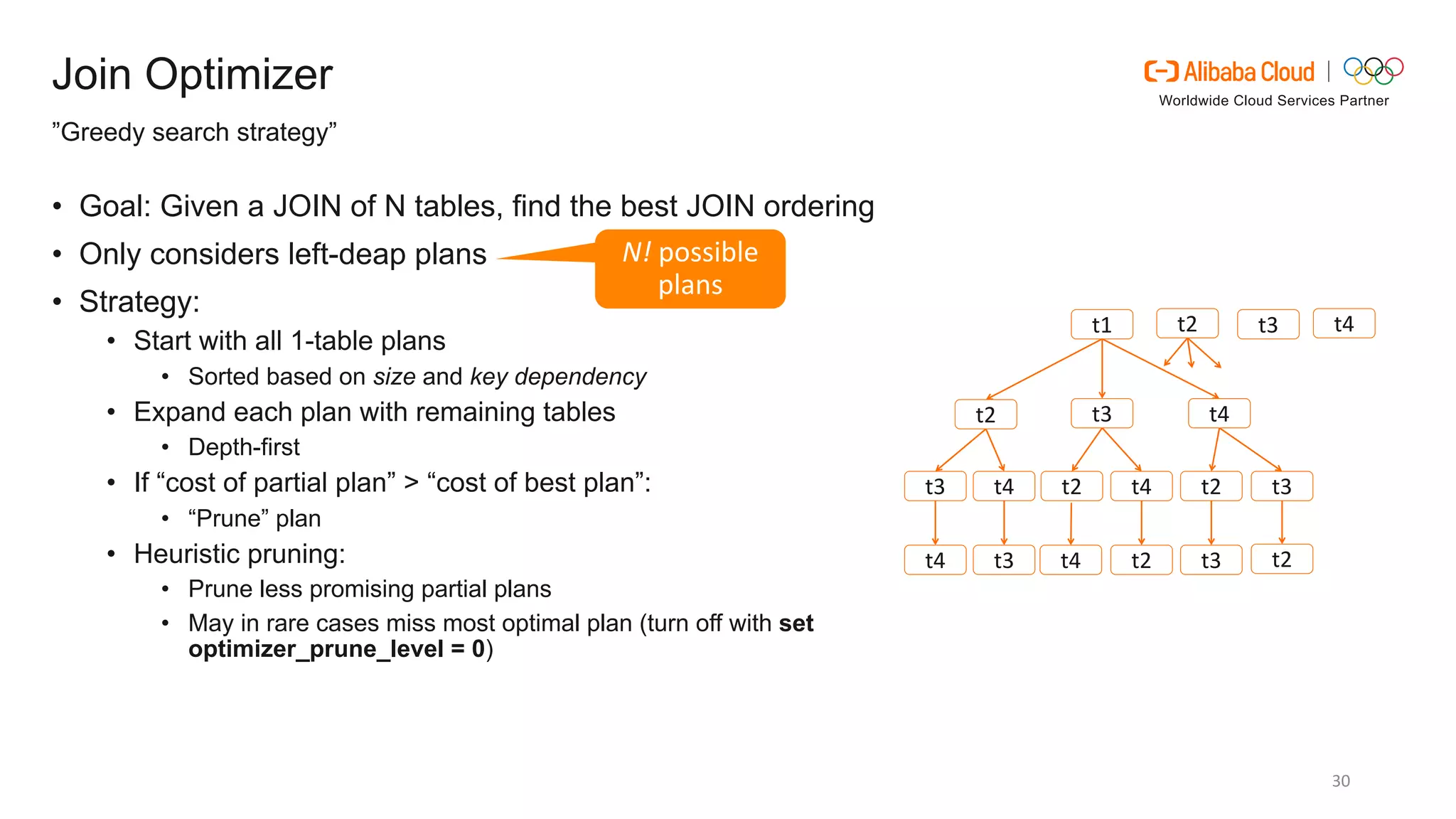
Join Optimizer
• Goal: Given a JOIN of N tables, find the best JOIN ordering
• Only considers left-deap plans
• Strategy:
• Start with all 1-table plans
• Sorted based on size and key dependency
• Expand each plan with remaining tables
• Depth-first
• If “cost of partial plan” > “cost of best plan”:
• “Prune” plan
• Heuristic pruning:
• Prune less promising partial plans
• May in rare cases miss most optimal plan (turn off with set
optimizer_prune_level = 0)
”Greedy search strategy”
t1
t2
t2
t2
t2
t3
t3
t3
t4t4
t4
t4t4
t3
t3 t2
t4t2 t3
N! possible
plans
30
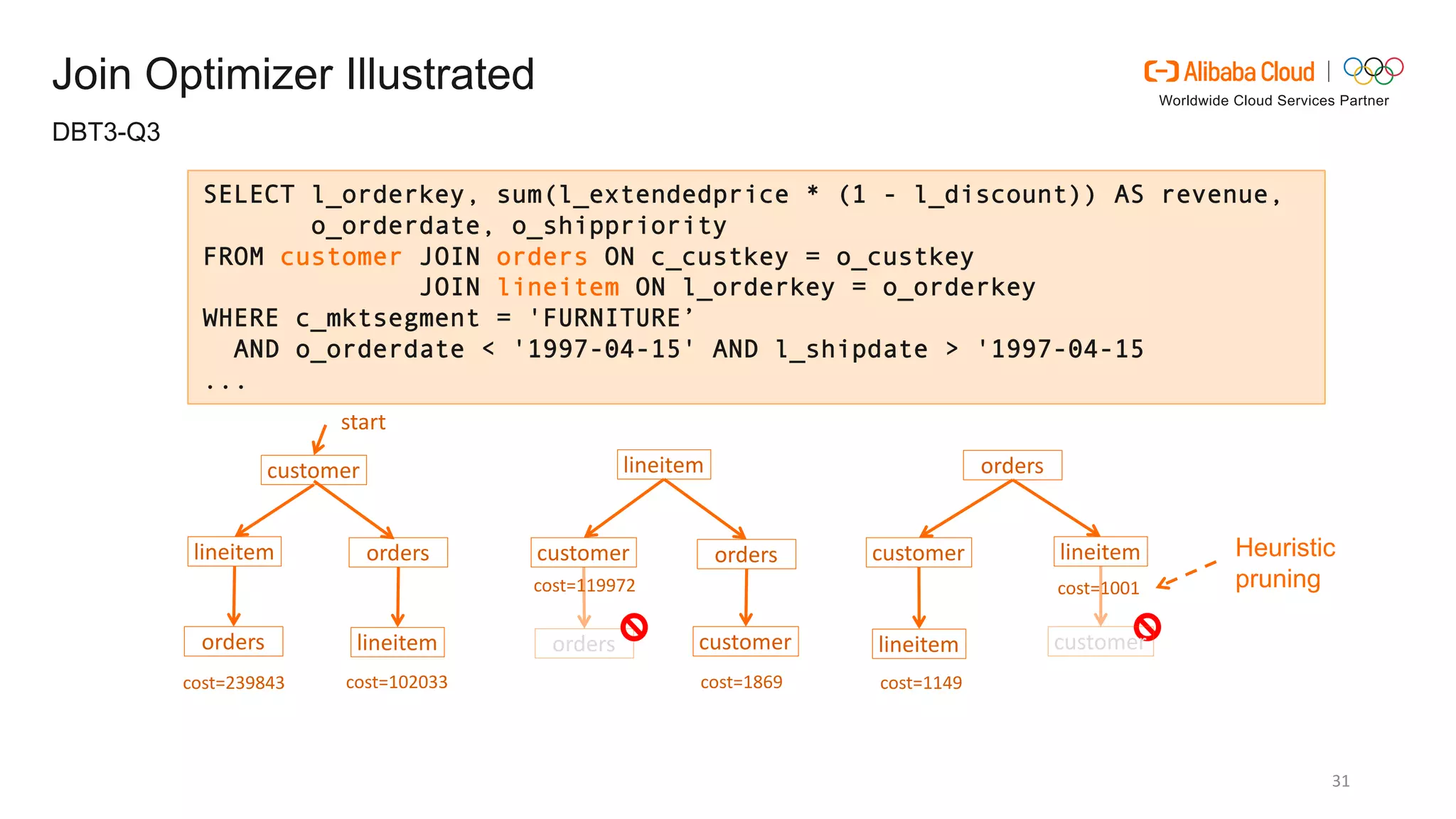
Join Optimizer Illustrated
DBT3-Q3
customer lineitem orders
customer
customer
customerlineitem
lineitem lineitem
lineitem
orders
ordersorders
orders
cost=239843 cost=102033
cost=119972
cost=1869 cost=1149
start
SELECT l_orderkey, sum(l_extendedprice * (1 - l_discount)) AS revenue,
o_orderdate, o_shippriority
FROM customer JOIN orders ON c_custkey = o_custkey
JOIN lineitem ON l_orderkey = o_orderkey
WHERE c_mktsegment = 'FURNITURE’
AND o_orderdate < '1997-04-15' AND l_shipdate > '1997-04-15
...
cost=1001
Heuristic
pruning
customer
31
Join Optimizer
Optimizer trace
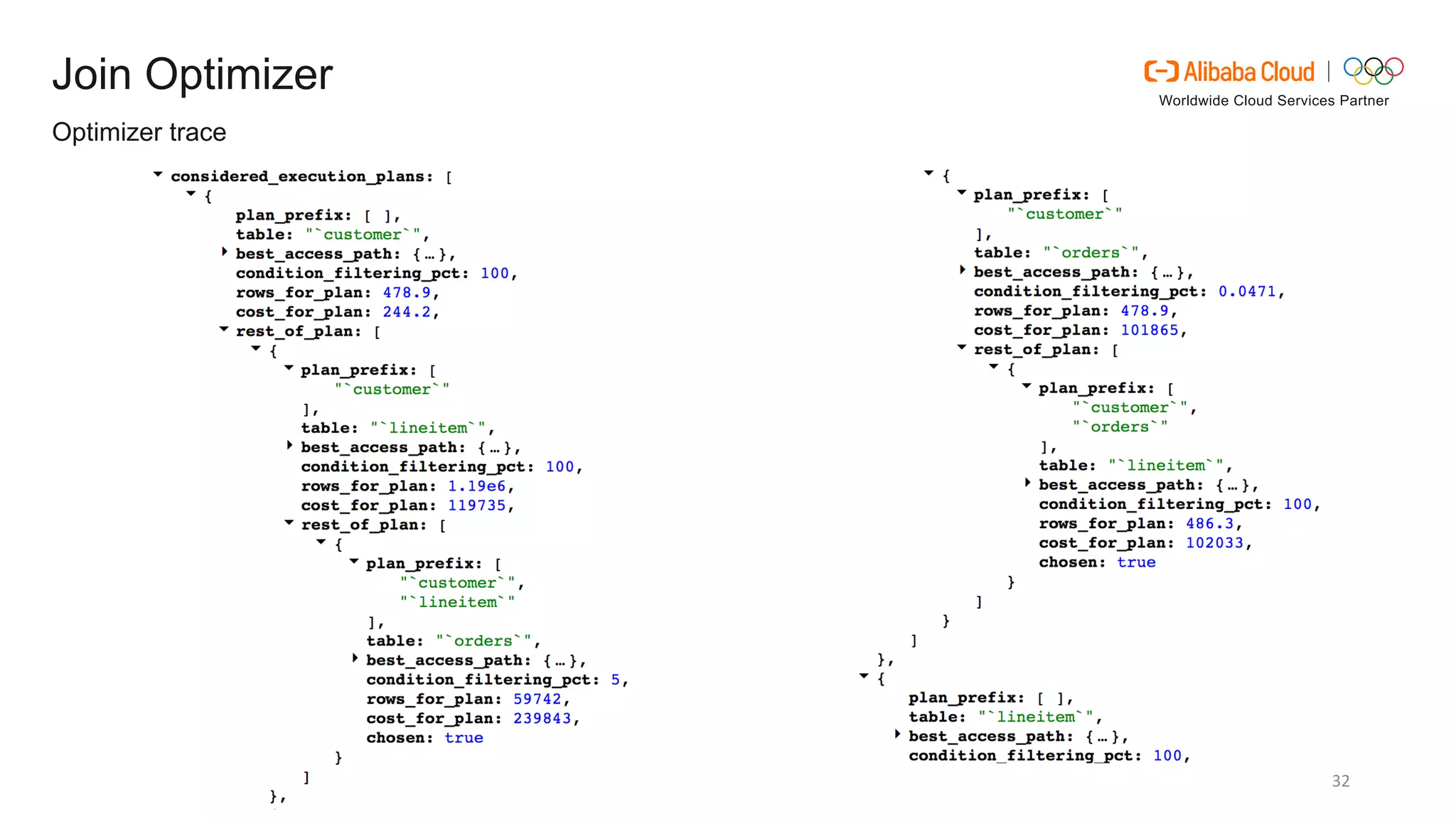
32
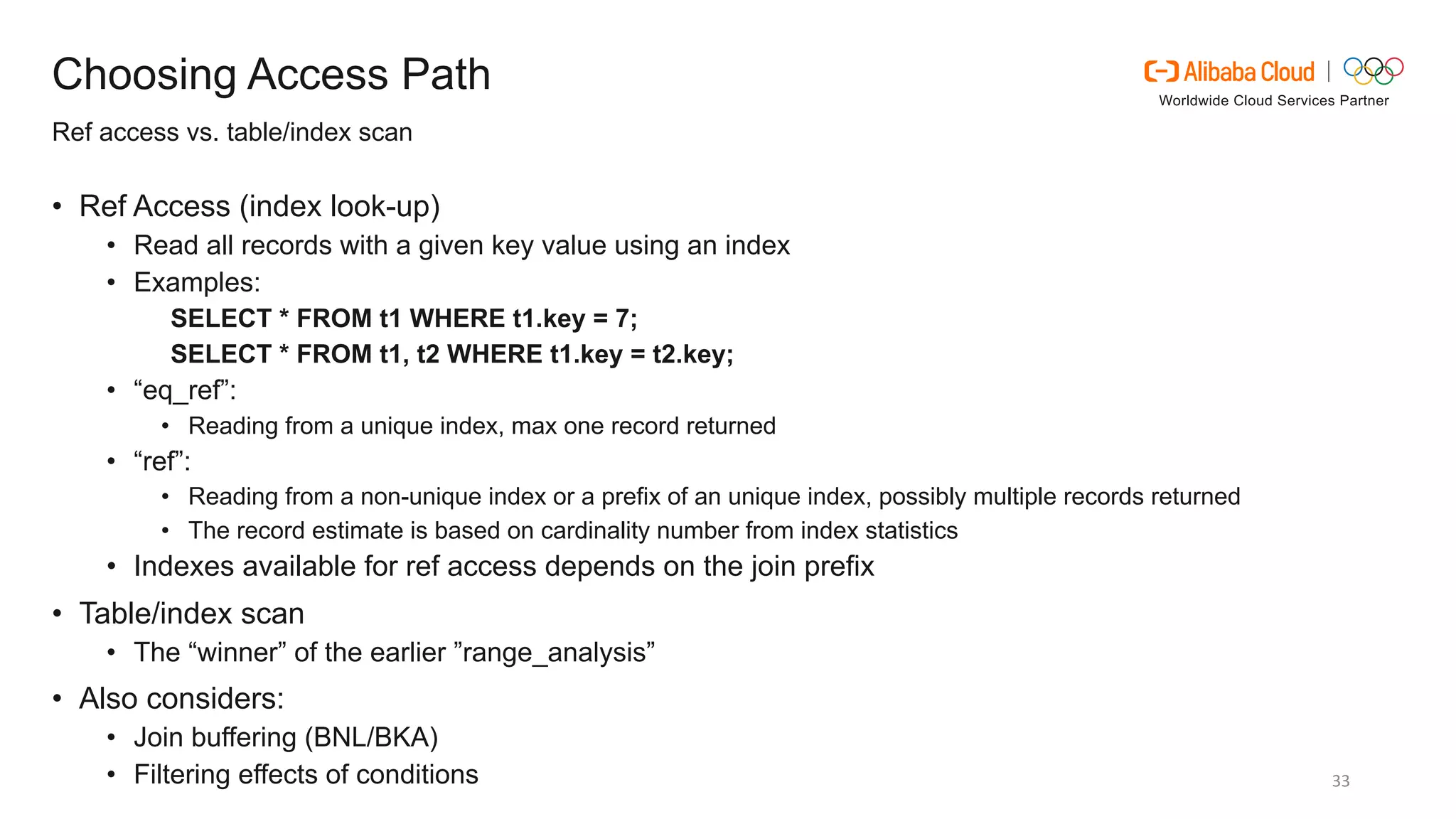
Choosing Access Path
• Ref Access (index look-up)
• Read all records with a given key value using an index
• Examples:
SELECT * FROM t1 WHERE t1.key = 7;
SELECT * FROM t1, t2 WHERE t1.key = t2.key;
• “eq_ref”:
• Reading from a unique index, max one record returned
• “ref”:
• Reading from a non-unique index or a prefix of an unique index, possibly multiple records returned
• The record estimate is based on cardinality number from index statistics
• Indexes available for ref access depends on the join prefix
• Table/index scan
• The “winner” of the earlier ”range_analysis”
• Also considers:
• Join buffering (BNL/BKA)
• Filtering effects of conditions
Ref access vs. table/index scan
33
Choosing the Access Path
"plan_prefix": [
],
"table": "`customer`",
"best_access_path": {
"considered_access_paths": [
{
"access_type": "ref",
"index": "PRIMARY",
"usable": false,
"chosen": false
},
{
"rows_to_scan": 2367,
"filtering_effect": [
{
"condition": "(`customer`.`c_mktsegment` = 'FURNITURE')",
"histogram_selectivity": 0.2023
}
],
customer
"final_filtering_effect": 0.2023,
"access_type": "scan",
"resulting_rows": 478.9,
"cost": 244.2,
"chosen": true
}
]
},
"condition_filtering_pct": 100,
"rows_for_plan": 478.9,
"cost_for_plan": 244.2,
34
Choosing the Access Path
"rest_of_plan": [
{
"plan_prefix": [
"`customer`"
],
"table": "`lineitem`",
"best_access_path": {
"considered_access_paths": [
{
"access_type": "ref",
"index": "PRIMARY",
"usable": false,
"chosen": false
},
{
"access_type": "ref",
"index": "i_l_orderkey",
"usable": false,
"chosen": false
},
customer → lineitem
{
"rows_to_scan": 2495,
"filtering_effect": [
],
"final_filtering_effect": 1,
"access_type": "scan",
"using_join_cache": true,
"buffers_needed": 1,
"resulting_rows": 2495,
"cost": 119491,
"chosen": true
}
]
},
"condition_filtering_pct": 100,
"rows_for_plan": 1.19e6,
"cost_for_plan": 119735,
35
Choosing the Access Path
"rest_of_plan": [
{
"plan_prefix": [
"`customer`",
"`lineitem`"
],
"table": "`orders`",
"best_access_path": {
"considered_access_paths": [
{
"access_type": "eq_ref",
"index": "PRIMARY",
"rows": 1,
"cost": 120108,
"chosen": true,
"cause": "clustered_pk_chosen_by_heuristics"
},
customer → lineitem → orders
{
"rows_to_scan": 2502,
"filtering_effect": [
],
"final_filtering_effect": 0.8477,
"access_type": "scan",
"using_join_cache": true,
"buffers_needed": 292,
"resulting_rows": 2121,
"cost": 2.53e8,
"chosen": false
}
]
},
"condition_filtering_pct": 5,
"rows_for_plan": 59742,
"cost_for_plan": 239843,
"chosen": true
}
] 36
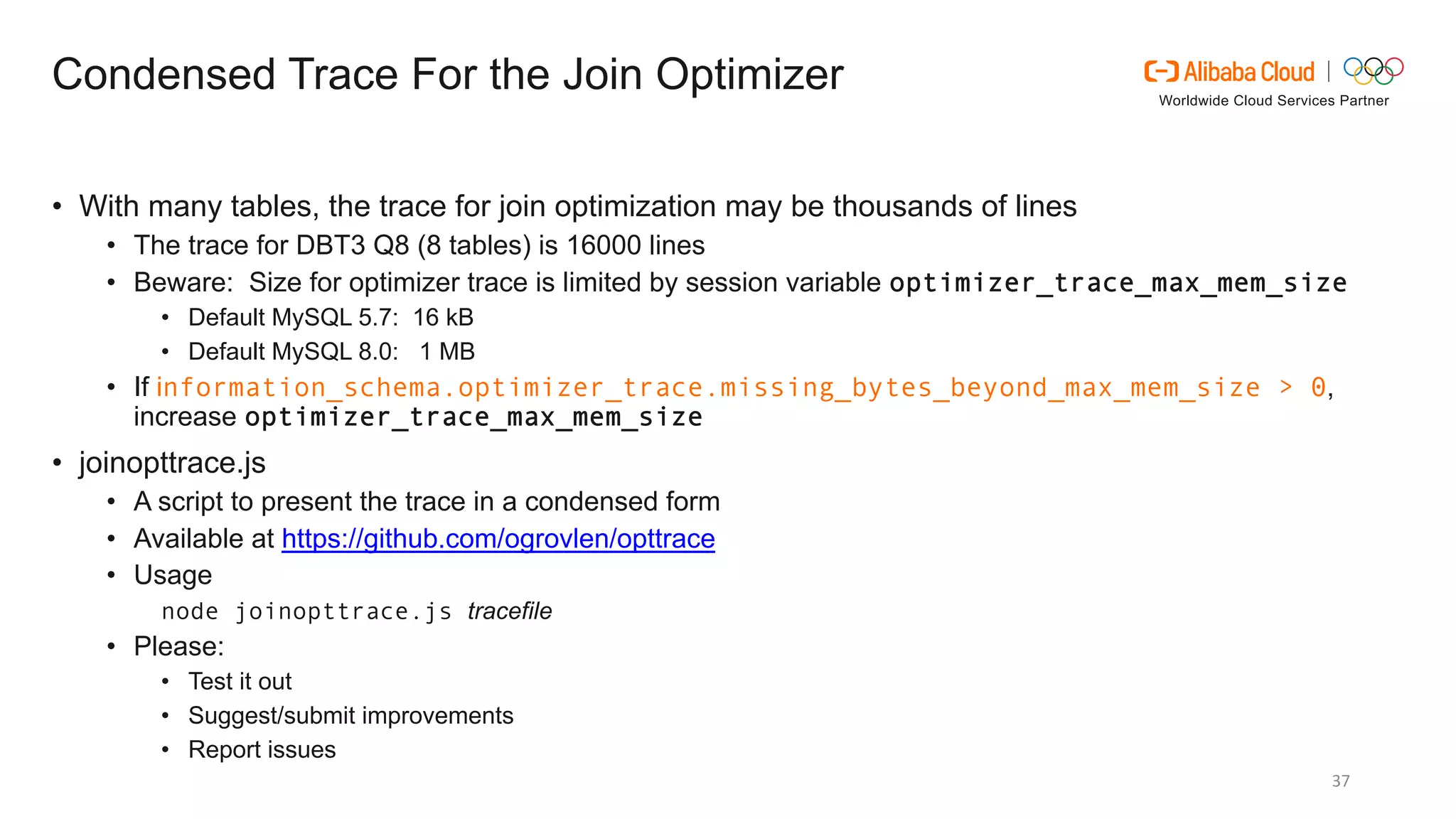
Condensed Trace For the Join Optimizer
• With many tables, the trace for join optimization may be thousands of lines
• The trace for DBT3 Q8 (8 tables) is 16000 lines
• Beware: Size for optimizer trace is limited by session variable optimizer_trace_max_mem_size
• Default MySQL 5.7: 16 kB
• Default MySQL 8.0: 1 MB
• If information_schema.optimizer_trace.missing_bytes_beyond_max_mem_size > 0,
increase optimizer_trace_max_mem_size
• joinopttrace.js
• A script to present the trace in a condensed form
• Available at https://github.com/ogrovlen/opttrace
• Usage
node joinopttrace.js tracefile
• Please:
• Test it out
• Suggest/submit improvements
• Report issues
37
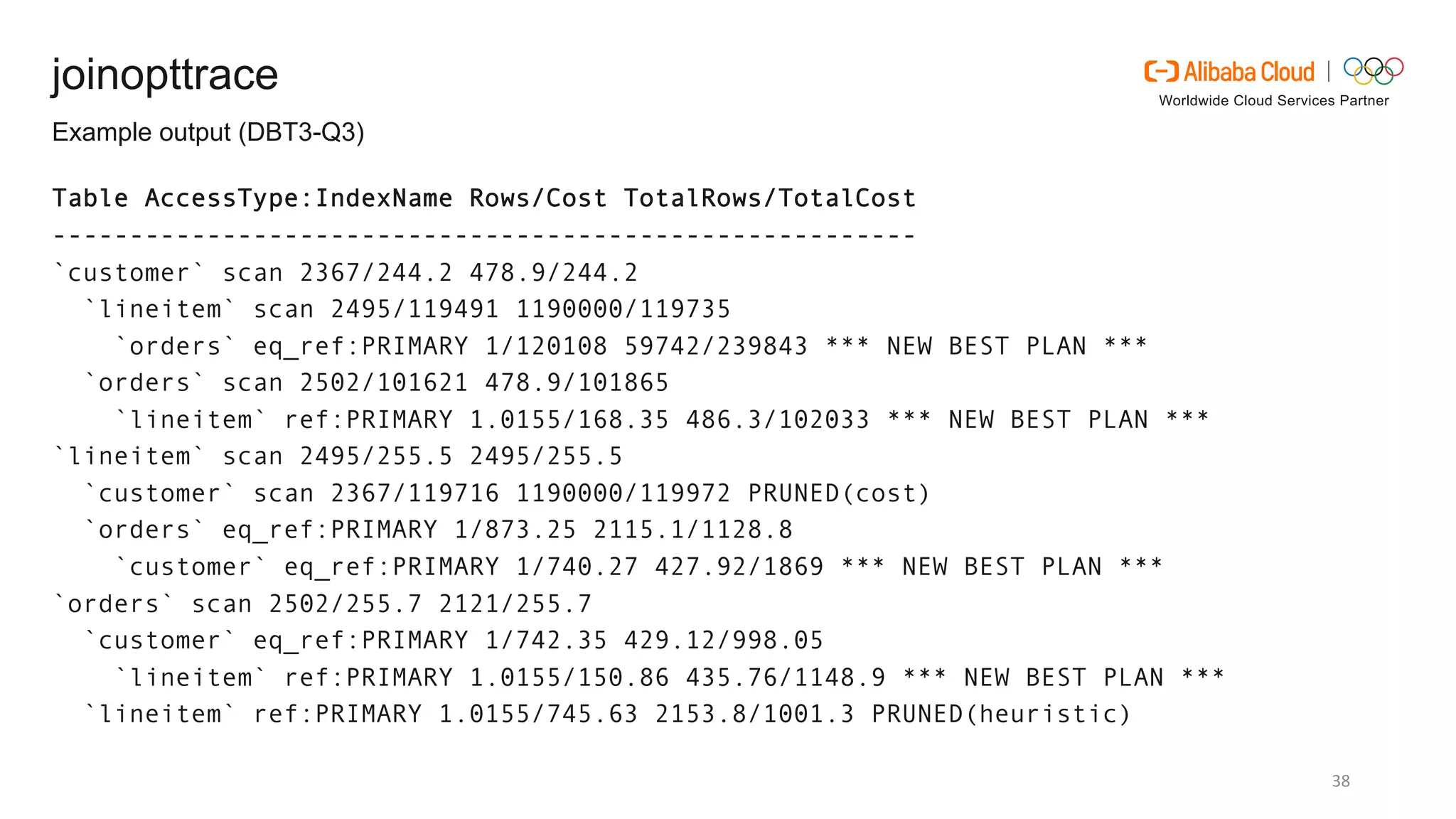
joinopttrace
Table AccessType:IndexName Rows/Cost TotalRows/TotalCost
--------------------------------------------------------
`customer` scan 2367/244.2 478.9/244.2
`lineitem` scan 2495/119491 1190000/119735
`orders` eq_ref:PRIMARY 1/120108 59742/239843 *** NEW BEST PLAN ***
`orders` scan 2502/101621 478.9/101865
`lineitem` ref:PRIMARY 1.0155/168.35 486.3/102033 *** NEW BEST PLAN ***
`lineitem` scan 2495/255.5 2495/255.5
`customer` scan 2367/119716 1190000/119972 PRUNED(cost)
`orders` eq_ref:PRIMARY 1/873.25 2115.1/1128.8
`customer` eq_ref:PRIMARY 1/740.27 427.92/1869 *** NEW BEST PLAN ***
`orders` scan 2502/255.7 2121/255.7
`customer` eq_ref:PRIMARY 1/742.35 429.12/998.05
`lineitem` ref:PRIMARY 1.0155/150.86 435.76/1148.9 *** NEW BEST PLAN ***
`lineitem` ref:PRIMARY 1.0155/745.63 2153.8/1001.3 PRUNED(heuristic)
Example output (DBT3-Q3)
38
Query Optimization
Main phases
Optimizer
Logical transformations
Cost-based optimizer:
Join order and access methods
Plan refinement
Query execution
plan
Query execution
Parser
Resolver:
Semantic check,name resolution
Storage engine
InnoDB MyISAM
Prepare for cost-based
optimization
Negation elimination
Equality and constant propagation
Evaluation of constant expressions
Substitution of generated columns
Ref access analysis
Range access analysis
Estimation of condition fan out
Constant table detection
Access method selection
Join order
Table condition pushdown
Access method adjustments
Sort avoidance
Index condition pushdown
Prepare temporary tables
39
Assigning Query Conditions to Tables
"attaching_conditions_to_tables": {
"original_condition": "((`customer`.`c_custkey` = `orders`.`o_custkey`) and (`lineitem`.`l_orderkey` = `orders`.`o_orderkey`) and
(`customer`.`c_mktsegment` = 'FURNITURE') and (`orders`.`o_orderDATE` < DATE'1997-04-15') and (`lineitem`.`l_shipDATE` > DATE'1997-
04-15'))",
"attached_conditions_computation": [
{
"table": "`orders`",
"rechecking_index_usage": {
"recheck_reason": "low_limit",
"limit": 10,
"row_estimate": 2121 } } ],
"attached_conditions_summary": [
{
"table": "`orders`",
"attached": "((`orders`.`o_orderDATE` < DATE'1997-04-15') and (`orders`.`o_custkey` is not null))" },
{
"table": "`customer`",
"attached": "((`customer`.`c_custkey` = `orders`.`o_custkey`) and (`customer`.`c_mktsegment` = 'FURNITURE'))" },
{
"table": "`lineitem`",
"attached": "((`lineitem`.`l_orderkey` = `orders`.`o_orderkey`) and (`lineitem`.`l_shipDATE` > DATE'1997-04-15'))" } ] }
Evaluate conditions as early as possible in join order
40
Assigning Query Conditions to Tables
"finalizing_table_conditions": [
{
"table": "`orders`",
"original_table_condition": "((`orders`.`o_orderDATE` < DATE'1997-04-15') and (`orders`.`o_custkey` is not null))",
"final_table_condition ": "((`orders`.`o_orderDATE` < DATE'1997-04-15') and (`orders`.`o_custkey` is not null))” },
{
"table": "`customer`",
"original_table_condition": "((`customer`.`c_custkey` = `orders`.`o_custkey`) and (`customer`.`c_mktsegment` = 'FURNITURE'))",
"final_table_condition ": "(`customer`.`c_mktsegment` = 'FURNITURE’)” },
{
"table": "`lineitem`",
"original_table_condition": "((`lineitem`.`l_orderkey` = `orders`.`o_orderkey`) and (`lineitem`.`l_shipDATE` > DATE'1997-04-15'))",
"final_table_condition ": "(`lineitem`.`l_shipDATE` > DATE'1997-04-15’)” }
]
Remove conditions satisfied by ref access
41
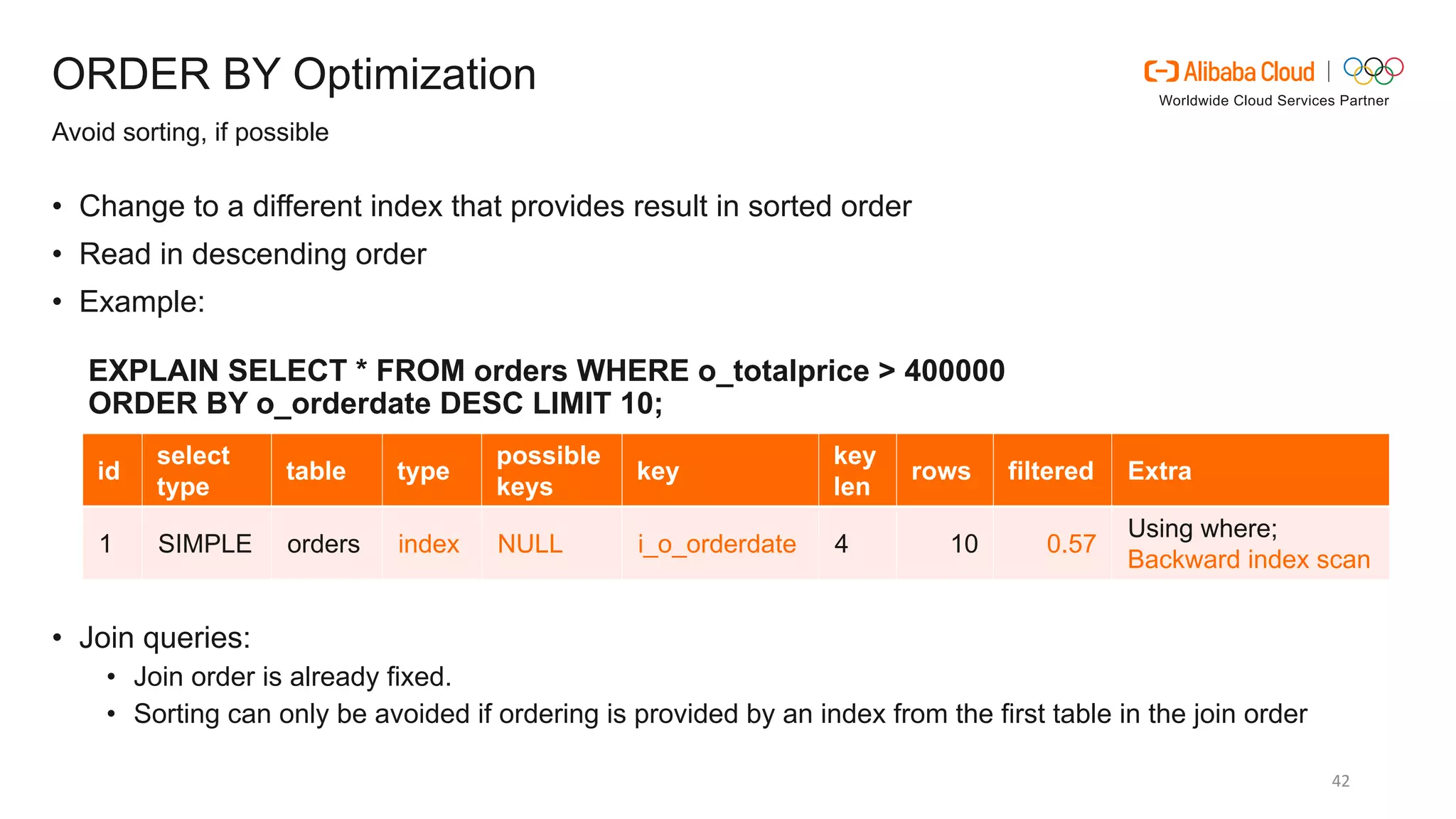
ORDER BY Optimization
• Change to a different index that provides result in sorted order
• Read in descending order
• Example:
• Join queries:
• Join order is already fixed.
• Sorting can only be avoided if ordering is provided by an index from the first table in the join order
Avoid sorting, if possible
EXPLAIN SELECT * FROM orders WHERE o_totalprice > 400000
ORDER BY o_orderdate DESC LIMIT 10;
id
select
type
table type
possible
keys
key
key
len
rows filtered Extra
1 SIMPLE orders index NULL i_o_orderdate 4 10 0.57
Using where;
Backward index scan
42
Assigning Query Conditions to Tables
{
"optimizing_distinct_group_by_order_by": {
"simplifying_order_by": {
"original_clause": "`orders`.`o_orderDATE` desc",
"items": [
{
"item": "`orders`.`o_orderDATE`"
}
],
"resulting_clause_is_simple": true,
"resulting_clause": "`orders`.`o_orderDATE` desc"
}
}
},
{
"reconsidering_access_paths_for_index_ordering": {
"clause": "ORDER BY",
"steps": [
],
"index_order_summary": {
"table": "`orders`",
"index_provides_order": true,
"order_direction": "desc",
"index": "i_o_orderdate",
"plan_changed": true,
"access_type": "index"
}
}
},
Evaluate conditions as early as possible in join order
• Unfortunately, no information on cost calculations!
43
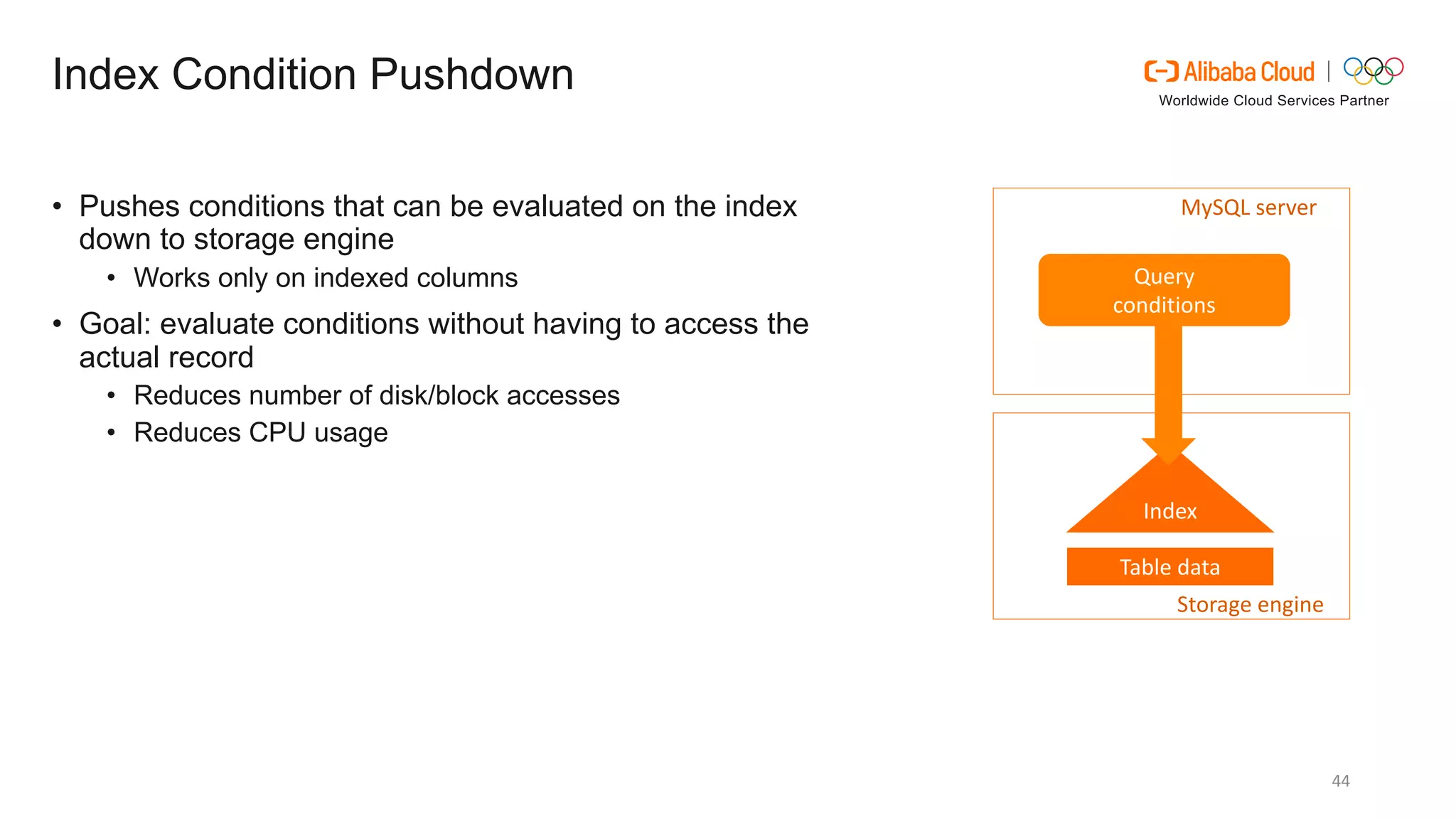
Index Condition Pushdown
• Pushes conditions that can be evaluated on the index
down to storage engine
• Works only on indexed columns
• Goal: evaluate conditions without having to access the
actual record
• Reduces number of disk/block accesses
• Reduces CPU usage
Query
conditions
Index
Table data
Storage engine
MySQL server
44
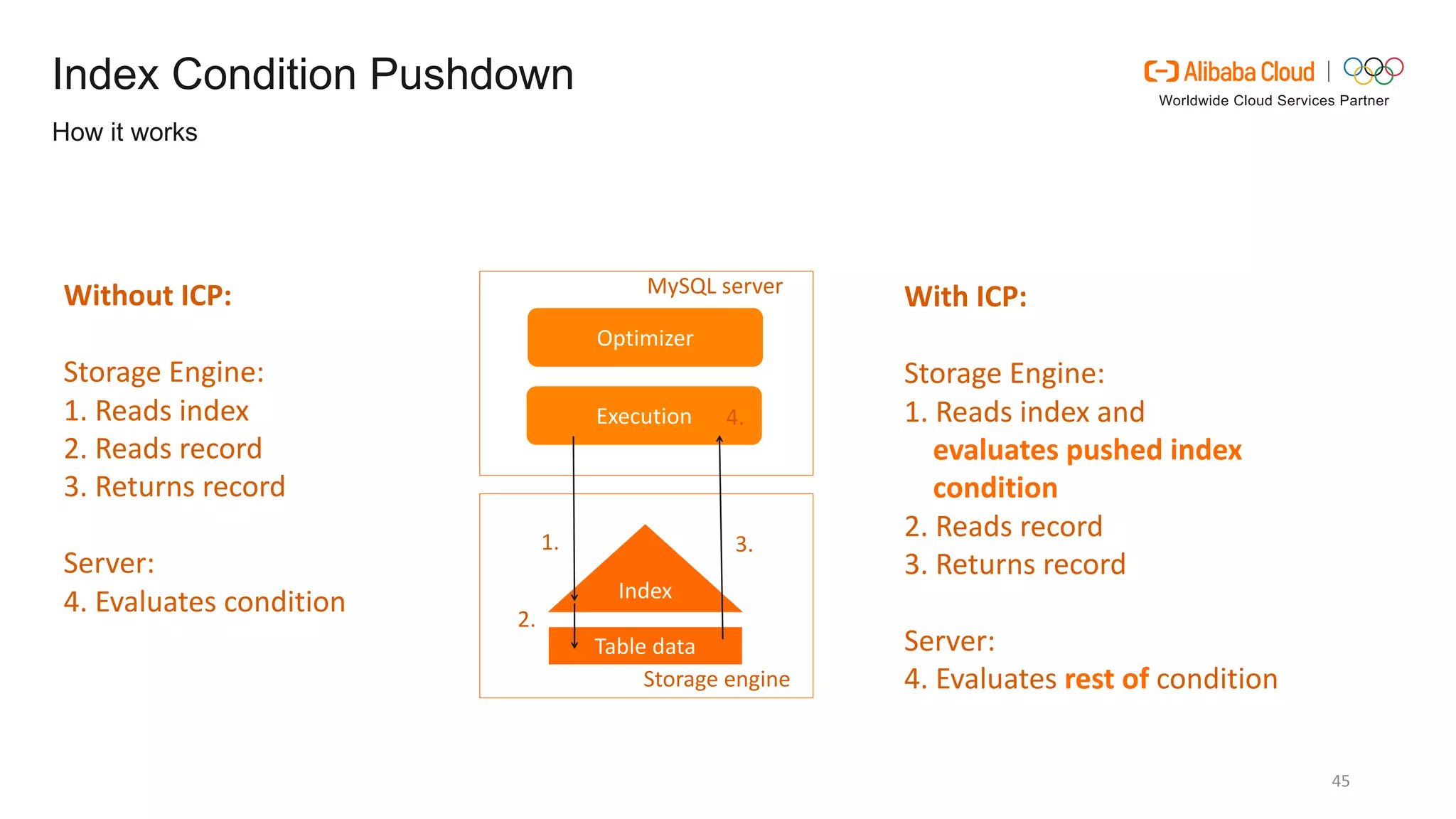
Index Condition Pushdown
How it works
Without ICP:
Storage Engine:
1. Reads index
2. Reads record
3. Returns record
Server:
4. Evaluates condition
With ICP:
Storage Engine:
1. Reads index and
evaluates pushed index
condition
2. Reads record
3. Returns record
Server:
4. Evaluates rest of condition
Execution
Index
Table data
2.
1. 3.
4.
Storage engine
MySQL server
Optimizer
45
Index Condition Pushdown
{
"refine_plan": [
{
"table": "`part`"
},
{
"table": "`lineitem` FORCE INDEX (`i_l_partkey_plus`)",
"pushed_index_condition": "((`lineitem`.`l_quantity` >= 1.00) and (`lineitem`.`l_quantity` <= <cache>((1 + 10))) and
(`lineitem`.`l_shipmode` in ('AIR','AIR REG')))",
"table_condition_attached": "(`lineitem`.`l_shipinstruct` = 'DELIVER IN PERSON')"
}
]
},
Optimizer trace
Index: lineitem(l_partkey,l_quantity,l_shipmode)
46
Prepare Temporary Tables
{
"considering_tmp_tables": [
{
"adding_tmp_table_in_plan_at_position": 3,
"write_method": "continuously_update_group_row"
},
{
"adding_sort_to_table_in_plan_at_position": 3
}
]
}
DBT3-Q3
SELECT l_orderkey, sum(l_extendedprice * (1 - l_discount)) AS revenue,
o_orderdate, o_shippriority
FROM customer JOIN orders ON c_custkey = o_custkey
JOIN lineitem ON l_orderkey = o_orderkey
WHERE c_mktsegment = 'FURNITURE’
AND o_orderdate < '1997-04-15' AND l_shipdate > '1997-04-15'
GROUP by l_orderkey, o_orderdate, o_shippriority
ORDER by revenue desc, o_orderdate
LIMIT 10;
47
Query Optimization
Main phases
Optimizer
Logical transformations
Cost-based optimizer:
Join order and access methods
Plan refinement
Query execution
plan
Query execution
Parser
Resolver:
Semantic check,name resolution
Storage engine
InnoDB MyISAM
Prepare for cost-based
optimization
Negation elimination
Equality and constant propagation
Evaluation of constant expressions
Substitution of generated columns
Ref access analysis
Range access analysis
Estimation of condition fan out
Constant table detection
Access method selection
Join order
Table condition pushdown
Access method adjustments
Sort avoidance
Index condition pushdown
Prepare temporary tables
48
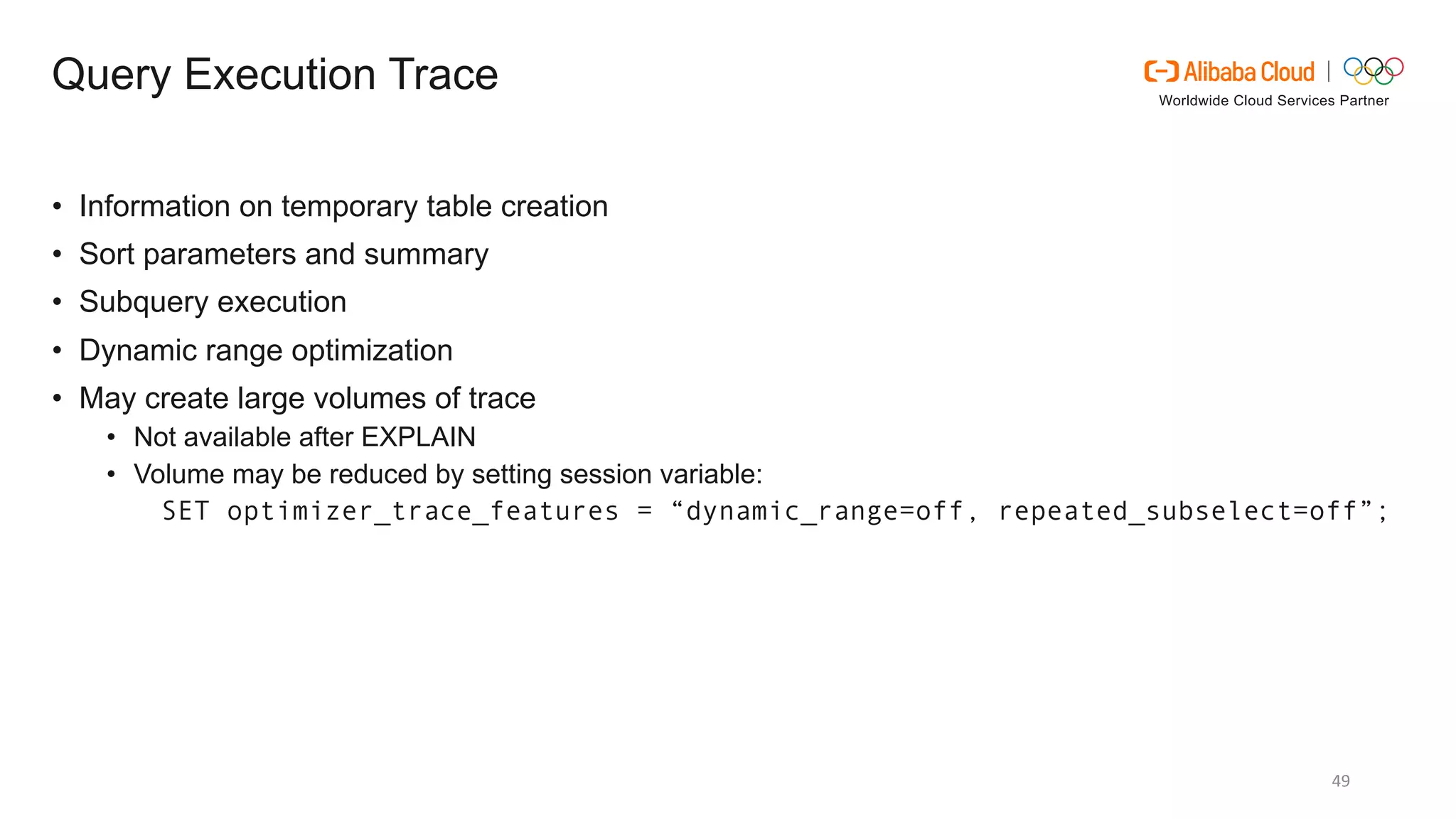
Query Execution Trace
• Information on temporary table creation
• Sort parameters and summary
• Subquery execution
• Dynamic range optimization
• May create large volumes of trace
• Not available after EXPLAIN
• Volume may be reduced by setting session variable:
SET optimizer_trace_features = “dynamic_range=off, repeated_subselect=off”;
49
Query Execution Trace
{
"join_execution": {
"select#": 1,
"steps": [
{
"temp_table_aggregate": {
"select#": 1,
"steps": [
{
"creating_tmp_table": {
"tmp_table_info": {
"in_plan_at_position": 3,
"columns": 4,
"row_length": 34,
"key_length": 13,
"unique_constraint": false,
"makes_grouped_rows": true,
"cannot_insert_duplicates": false,
"location": "TempTable"
} } } ] }
Temporary table information
50
Query Execution Trace
{
"sorting_table_in_plan_at_position": 3,
"filesort_information": [
{
"direction": "desc",
"field": "revenue"
},
{
"direction": "asc",
"field": "o_orderDATE"
}
],
"filesort_priority_queue_optimization": {
"limit": 10,
"chosen": true
},
"filesort_execution": [
],
"filesort_summary": {
"memory_available": 262144,
"key_size": 33,
"row_size": 33,
"max_rows_per_buffer": 11,
"num_rows_estimate": 452,
"num_rows_found": 442,
"num_initial_chunks_spilled_to_disk": 0,
"peak_memory_used": 451,
"sort_algorithm": "std::sort",
"unpacked_addon_fields": "using_priority_queue",
"sort_mode": "<fixed_sort_key, rowid>"
}
}
Sort information
51
A Last Tip
• Example: Present the filesort summary from the last execution:
SELECT JSON_PRETTY(trace->'$.steps[*].join_execution.steps[*].filesort_summary’)
FROM information_schema.optimizer_trace;
• Queries against information_schema.optimizer_trace will not generate a new trace, so
you can execute multiple queries on the same trace.
Use MySQL JSON functionality to process the optimizer trace
52
More information
• The optimizer trace manual: https://dev.mysql.com/doc/internals/en/optimizer-tracing.html
• Enable/disable trace of selected features of the optimizer
• Tune trace purging (by default an optimizer trace overwrites the previous trace)
• Make it more human readable (but no longer valid JSON)
• My blog: https://oysteing.blogspot.com
• For information about MySQL related work at Alibaba:
Attend the AliSQL & POLARDB track tomorrow
53
Thank You!
Please, remember to rate this session in the
Percona Live APP!
54
55

The MySQL Query Optimizer Explained Through Optimizer Trace

  • 1.
    1 The MySQL QueryOptimizer Explained Through Optimizer Trace Øystein Grøvlen Senior Staff Engineer Alibaba Cloud
  • 2.
    MySQL Query Optimizer SELECTa, b FROM t1, t2, t3 WHERE t1.a = t2.b AND t2.b = t3.c AND t2.d > 20 AND t2.d < 30; Table/index info (data dictionary) Statistics (storage engines) t2 t3 t1 Table scan Range scan Ref access JOIN JOINQuery Optimizer 2
  • 3.
    MySQL Architecture Optimizer Logical transformations Cost-basedoptimizer: Join order and access methods Plan refinement Query execution plan Query execution Parser Resolver (Prepare): Semantic check,name resolution Storage Engine InnoDB MyISAM SQL query Query result 3
  • 4.
    Optimizer Trace • EXPLAINshows the selected plan • Optimizer trace shows WHY the plan was selected SET optimizer_trace= "enabled=on"; SELECT * FROM t1, t2 WHERE f1=1 AND f1=f2 AND f2>0; SELECT trace FROM information_schema.optimizer_trace INTO OUTFILE filename LINES TERMINATED BY ’’; SET optimizer_trace="enabled=off"; QUERY SELECT * FROM t1, t2 WHERE f1=1 AND f1=f2 AND f2>0; TRACE { "steps": [ { "join_preparation": { "select#": 1,… } … } …] } MISSING_BYTES_BEYOND_MAX_MEM_SIZE 0 INSUFFICIENT_PRIVILEGES 0 How to generate it 4
  • 5.
    Optimizer Trace { "steps": [ { "join_preparation":{ "select#": 1, "steps": [ { "expanded_query": "/* select#1 */ select `t1`.`f1` AS `f1`,`t2`.`f2` AS `f2` from `t1` join `t2` where ((`t1`.`f1` = 1) and (`t1`.`f1` = `t2`.`f2`) and (`t2`.`f2` > 0))" } ] } }, { "join_optimization": { "select#": 1, "steps": [ { "condition_processing": { "condition": "WHERE", "original_condition": "((`t1`.`f1` = 1) and (`t1`.`f1` = `t2`.`f2`) and (`t2`.`f2` > 0))", "steps": [ { … Example 5
  • 6.
  • 7.
    Browser Plugin Collapse tosee main trace objects/phases 7
  • 8.
  • 9.
    Prepare Phase • Nameresolving • Map names to database objects (tables, columns, …) • Semantic checks • Permanent transformations: • Conversion of outer join to inner join • Merging of views and derived tables • Subquery transformations • IN to EXISTS • IN to Semijoin (5.6) • EXISTS to IN (8.0.16) • Etc. Simpler query to optimize and execute Prepare for later optimizations 9
  • 10.
    Conversion of outerjoin to inner join SELECT o_orderkey FROM orders LEFT JOIN lineitem ON o_orderkey = l_orderkey WHERE l_discount > 0.10; "join_preparation": { "select#": 1, "steps": [ { "expanded_query": "/* select#1 */ select `orders`.`o_orderkey` AS `o_orderkey` from (`orders` left join `lineitem` on ((`orders`.`o_orderkey` = `lineitem`.`l_orderkey`))) where (`lineitem`.`l_discount` > 0.10)" }, { "transformations_to_nested_joins": { "transformations": [ "outer_join_to_inner_join", "JOIN_condition_to_WHERE", "parenthesis_removal" ], "expanded_query": "/* select#1 */ select `orders`.`o_orderkey` AS `o_orderkey` from `orders` join `lineitem` where ((`lineitem`.`l_discount` > 0.10) and(`orders`.`o_orderkey` = `lineitem`.`l_orderkey`))" } … 10
  • 11.
    Conversion from EXISTS-subqueryto IN-subquery SELECT o_orderpriority, COUNT(*) AS order_count FROM orders WHERE EXISTS (SELECT * FROM lineitem WHERE l_orderkey = o_orderkey AND l_commitdate < l_receiptdate) GROUP BY o_orderpriority ORDER BY o_orderpriority; SELECT o_orderpriority, COUNT(*) AS order_count FROM orders WHERE o_orderkey IN (SELECT l_orderkey FROM lineitem WHERE l_commitdate < l_receiptdate GROUP BY o_orderpriority ORDER BY o_orderpriority; SELECT o_orderpriority, COUNT(*) AS order_count FROM orders SEMIJOIN lineitem ON l_orderkey = o_orderkey WHERE l_commitdate < l_receiptdate GROUP BY o_orderpriority ORDER BY o_orderpriority; New in 8.0.16 11
  • 12.
    Conversion from EXISTS-subqueryto IN-subquery "join_preparation": { "select#": 1, "steps": [ { "join_preparation": { "select#": 2, "steps": [ { "expanded_query": "/* select#2 */ select 1 from `lineitem` where ((`lineitem`.`l_orderkey` = `orders`.`o_orderkey`) and (`lineitem`.`l_commitDATE` < `lineitem`.`l_receiptDATE`))" }, { "transformation": { "select#": 2, "from": "EXISTS (SELECT)", "to": "semijoin", "chosen": true } } ] … Optimizer trace 12
  • 13.
    Conversion from EXISTS-subqueryto IN-subquery Optimizer trace, cont. 13
  • 14.
    Query Optimization Main phases Optimizer Logicaltransformations Cost-based optimizer: Join order and access methods Plan refinement Query execution plan Query execution Parser Resolver: Semantic check,name resolution Storage engine InnoDB MyISAM Prepare for cost-based optimization Negation elimination Equality and constant propagation Evaluation of constant expressions Substitution of generated columns Ref access analysis Range access analysis Estimation of condition fan out Constant table detection Table condition pushdown Access method adjustments Sort avoidance Index condition pushdown Prepare temporary tables Access method selection Join order 14
  • 15.
    Query Optimization Main phases Optimizer Logicaltransformations Cost-based optimizer: Join order and access methods Plan refinement Query execution plan Query execution Parser Resolver: Semantic check,name resolution Storage engine InnoDB MyISAM Prepare for cost-based optimization Negation elimination Equality and constant propagation Evaluation of constant expressions Substitution of generated columns Ref access analysis Range access analysis Estimation of condition fan out Constant table detection Access method selection Join order Table condition pushdown Access method adjustments Sort avoidance Index condition pushdown Prepare temporary tables 15
  • 16.
    =TRUE Trivial condition removal t1.a =9 AND t2.a = 9 AND (t2.b <= 3 OR (t1.b = 12 AND t2.b = 5)); t1.a = 9 AND t2.a = 9 AND (9 <= 10 AND t2.b <= 3 OR (t1.b = 5 + 7 AND t2.b = 5)); Equality/const propagation Logical Transformations Condition processing t1.a = 9 AND t2.a = 9 AND (9 <= 10 AND t2.b <= 3 OR (t1.b = 12 AND t2.b = 5)); Evaluate const expressions SELECT * FROM t1, t2 WHERE t1.a = t2.a AND t2.a = 9 AND (NOT (t1.a > 10 OR t2.b > 3) OR (t1.b = t2.b + 7 AND t2.b = 5)); Negation elimination t1.a = t2.a AND t2.a = 9 AND (t1.a <= 10 AND t2.b <= 3 OR (t1.b = t2.b + 7 AND t2.b = 5)); 16
  • 17.
    Logical Transformations "join_optimization": { "select#":1, "steps": [ { "condition_processing": { "condition": "WHERE", "original_condition": "((`t1`.`a` = `t2`.`a`) and (`t2`.`a` = 9) and (((`t1`.`a` <= 10) and (`t2`.`b` <= 3)) or ((`t1`.`b` =(`t2`.`b` + 7)) and (`t2`.`b` = 5))))", "steps": [ { "transformation": "equality_propagation", "resulting_condition": "((((9 <= 10) and (`t2`.`b` <= 3)) or ((`t1`.`b` = (5 + 7)) and multiple equal(5, `t2`.`b`))) and multiple equal(9, `t1`.`a`, `t2`.`a`))" }, { "transformation": "constant_propagation", "resulting_condition": "((((9 <= 10) and (`t2`.`b` <= 3)) or ((`t1`.`b` = 12) and multiple equal(5, `t2`.`b`))) and multiple equal(9, `t1`.`a` , `t2`.`a`))" }, { "transformation": "trivial_condition_removal", "resulting_condition": "(((`t2`.`b` <= 3) or ((`t1`.`b` = 12) and multiple equal(5, `t2`.`b`))) and multiple equal(9, `t1`.`a`, `t2`.`a`))" } Optimizer Trace
  • 18.
    Query Optimization Main phases Optimizer Logicaltransformations Cost-based optimizer: Join order and access methods Plan refinement Query execution plan Query execution Parser Resolver: Semantic check,name resolution Storage engine InnoDB MyISAM Prepare for cost-based optimization Negation elimination Equality and constant propagation Evaluation of constant expressions Substitution of generated columns Ref access analysis Range access analysis Estimation of condition fan out Constant table detection Access method selection Join order Table condition pushdown Access method adjustments Sort avoidance Index condition pushdown Prepare temporary tables 18
  • 19.
    Ref Access Analysis Determinewhich indexes that can be used for index lookup in a join SELECT l_orderkey, sum(l_extendedprice * (1 - l_discount)) AS revenue, o_orderdate, o_shippriority FROM customer JOIN orders ON c_custkey = o_custkey JOIN lineitem ON l_orderkey = o_orderkey WHERE c_mktsegment = 'FURNITURE’ AND o_orderdate < '1997-04-15' AND l_shipdate > '1997-04-15' GROUP by l_orderkey, o_orderdate, o_shippriority ORDER by revenue desc, o_orderdate LIMIT 10; customer c_custkey orders o_orderkey o_custkey lineitem l_orderkey l_linenumber 19
  • 20.
    Ref Access Analysis { "ref_optimizer_key_uses":[ { "table": "`customer`", "field": "c_custkey", "equals": "`orders`.`o_custkey`", "null_rejecting": true }, { "table": "`orders`", "field": "o_orderkey", "equals": "`lineitem`.`l_orderkey`", "null_rejecting": false }, { "table": "`lineitem`", "field": "l_orderkey", "equals": "`orders`.`o_orderkey`", "null_rejecting": false }, { "table": "`lineitem`", "field": "l_orderkey", "equals": "`orders`.`o_orderkey`", "null_rejecting": false } ] }, Optimizer trace 20
  • 21.
    Cost-based Query Optimization Generalidea: • Assign cost to operations • Assign cost to partial or alternative plans • Search for plan with lowest cost t2 t3 t1 Table scan Range scan Ref access JOIN JOIN 21
  • 22.
    Cost-based Query Optimizations Themain cost-based optimizations: • Index and access method: • Table scan • Index scan • Range scan • Index lookup (ref access) • Join order • Join buffering strategy • Subquery strategy t2 t3 t1 Table scan Range scan Ref access JOIN JOIN 22
  • 23.
    Optimizer Cost Model t1Cost estimate Row estimate Cost Model Cost formulas Access methods Join Subquery Cost constants CPU IO Metadata: - Record and index size - Index information - Uniqueness Statistics: - Table size - Cardinality - Range estimates - Histograms Cost model configuration Range scan JOIN 23
  • 24.
    Cost Estimates • Thecost for executing a query • Cost unit: • “read a random data page from disk” • Main cost factors: • IO cost: • #pages read from table • #pages read from index • CPU cost: • Evaluating query conditions • Comparing keys/records • Sorting keys Cost MySQL 5.7 MySQL 8.0 Read a random disk page 1.0 1.0 Read a data page from memory buffer 1.0 0.25 Evaluate query condition 0.2 0.1 Compare keys/records 0.1 0.05 Main cost constants 24
  • 25.
    Range analysis • Costof table scan • Based on number of pages to read • Cost of index scan alternatives • Index scan (covering) • Index range scan • Index merge • Index for grouping • Skip scan (new in 8.0) • Loose-index scan Compare cost of table scan to index scan 25
  • 26.
    Range Analysis Example Tablescan: • IO-cost: #pages in table * IO_BLOCK_READ_COST • CPU cost: #rows * ROW_EVALUATE_COST Range scan (on secondary index): • IO-cost: #rows_in_range * IO_BLOCK_READ_COST • CPU cost: #rows_in_range * ROW_EVALUATE_COST SELECT SUM(o_totalprice) FROM orders WHERE o_orderdate BETWEEN '1994-01-01' AND '1994-12-31'; Table scan vs Index range scan 26
  • 27.
    Range Analysis Example EXPLAINSELECT SUM(o_totalprice) FROM orders WHERE o_orderdate BETWEEN '1994-01-01' AND '1994-12-31'; EXPLAIN SELECT SUM(o_totalprice) FROM orders WHERE o_orderdate BETWEEN '1994-01-01' AND '1994-06-30'; id select type table type possible keys key key len rows filtered Extra 1 SIMPLE orders ALL i_o_orderdate NULL NULL 1480845 31.13 Using where Id select type table type possible keys key key len rows filtered Extra 1 SIMPLE orders range i_o_orderdate i_o_orderdate 4 222102 100.00 Using index condition Table scan vs index range scan cnt. 27
  • 28.
    "rows_estimation": [ { "table": "`orders`", "range_analysis":{ "table_scan": { "rows": 1480845, "cost": 151138 }, "potential_range_indexes": [ { "index": "PRIMARY", "usable": false, "cause": "not_applicable" }, { "index": "i_o_orderdate", "usable": true, "key_parts": [ "o_orderDATE", "o_orderkey" ] } ], "setup_range_conditions": [ ], "group_index_range": { "chosen": false, "cause": "not_group_by_or_distinct" }, "skip_scan_range": { "potential_skip_scan_indexes": [ { "index": "i_o_orderdate", "usable": false, "cause": "query_references_nonkey_column" } ] }, "analyzing_range_alternatives": { "range_scan_alternatives": [ { "index": "i_o_orderdate", "ranges": [ "0x21940f <= o_orderDATE <= 0x9f950f" ], "index_dives_for_eq_ranges": true, "rowid_ordered": false, "using_mrr": false, "index_only": false, "rows": 460938, "cost": 161329, "chosen": false, "cause": "cost" } ], "analyzing_roworder_intersect": { "usable": false, "cause": "too_few_roworder_scans" } } } }] Range Analysis Example Optimizer trace 28
  • 29.
    Query Optimization Main phases Optimizer Logicaltransformations Cost-based optimizer: Join order and access methods Plan refinement Query execution plan Query execution Parser Resolver: Semantic check,name resolution Storage engine InnoDB MyISAM Prepare for cost-based optimization Negation elimination Equality and constant propagation Evaluation of constant expressions Substitution of generated columns Ref access analysis Range access analysis Estimation of condition fan out Constant table detection Join order Access method selection Table condition pushdown Access method adjustments Sort avoidance Index condition pushdown Prepare temporary tables 29
  • 30.
    Join Optimizer • Goal:Given a JOIN of N tables, find the best JOIN ordering • Only considers left-deap plans • Strategy: • Start with all 1-table plans • Sorted based on size and key dependency • Expand each plan with remaining tables • Depth-first • If “cost of partial plan” > “cost of best plan”: • “Prune” plan • Heuristic pruning: • Prune less promising partial plans • May in rare cases miss most optimal plan (turn off with set optimizer_prune_level = 0) ”Greedy search strategy” t1 t2 t2 t2 t2 t3 t3 t3 t4t4 t4 t4t4 t3 t3 t2 t4t2 t3 N! possible plans 30
  • 31.
    Join Optimizer Illustrated DBT3-Q3 customerlineitem orders customer customer customerlineitem lineitem lineitem lineitem orders ordersorders orders cost=239843 cost=102033 cost=119972 cost=1869 cost=1149 start SELECT l_orderkey, sum(l_extendedprice * (1 - l_discount)) AS revenue, o_orderdate, o_shippriority FROM customer JOIN orders ON c_custkey = o_custkey JOIN lineitem ON l_orderkey = o_orderkey WHERE c_mktsegment = 'FURNITURE’ AND o_orderdate < '1997-04-15' AND l_shipdate > '1997-04-15 ... cost=1001 Heuristic pruning customer 31
  • 32.
  • 33.
    Choosing Access Path •Ref Access (index look-up) • Read all records with a given key value using an index • Examples: SELECT * FROM t1 WHERE t1.key = 7; SELECT * FROM t1, t2 WHERE t1.key = t2.key; • “eq_ref”: • Reading from a unique index, max one record returned • “ref”: • Reading from a non-unique index or a prefix of an unique index, possibly multiple records returned • The record estimate is based on cardinality number from index statistics • Indexes available for ref access depends on the join prefix • Table/index scan • The “winner” of the earlier ”range_analysis” • Also considers: • Join buffering (BNL/BKA) • Filtering effects of conditions Ref access vs. table/index scan 33
  • 34.
    Choosing the AccessPath "plan_prefix": [ ], "table": "`customer`", "best_access_path": { "considered_access_paths": [ { "access_type": "ref", "index": "PRIMARY", "usable": false, "chosen": false }, { "rows_to_scan": 2367, "filtering_effect": [ { "condition": "(`customer`.`c_mktsegment` = 'FURNITURE')", "histogram_selectivity": 0.2023 } ], customer "final_filtering_effect": 0.2023, "access_type": "scan", "resulting_rows": 478.9, "cost": 244.2, "chosen": true } ] }, "condition_filtering_pct": 100, "rows_for_plan": 478.9, "cost_for_plan": 244.2, 34
  • 35.
    Choosing the AccessPath "rest_of_plan": [ { "plan_prefix": [ "`customer`" ], "table": "`lineitem`", "best_access_path": { "considered_access_paths": [ { "access_type": "ref", "index": "PRIMARY", "usable": false, "chosen": false }, { "access_type": "ref", "index": "i_l_orderkey", "usable": false, "chosen": false }, customer → lineitem { "rows_to_scan": 2495, "filtering_effect": [ ], "final_filtering_effect": 1, "access_type": "scan", "using_join_cache": true, "buffers_needed": 1, "resulting_rows": 2495, "cost": 119491, "chosen": true } ] }, "condition_filtering_pct": 100, "rows_for_plan": 1.19e6, "cost_for_plan": 119735, 35
  • 36.
    Choosing the AccessPath "rest_of_plan": [ { "plan_prefix": [ "`customer`", "`lineitem`" ], "table": "`orders`", "best_access_path": { "considered_access_paths": [ { "access_type": "eq_ref", "index": "PRIMARY", "rows": 1, "cost": 120108, "chosen": true, "cause": "clustered_pk_chosen_by_heuristics" }, customer → lineitem → orders { "rows_to_scan": 2502, "filtering_effect": [ ], "final_filtering_effect": 0.8477, "access_type": "scan", "using_join_cache": true, "buffers_needed": 292, "resulting_rows": 2121, "cost": 2.53e8, "chosen": false } ] }, "condition_filtering_pct": 5, "rows_for_plan": 59742, "cost_for_plan": 239843, "chosen": true } ] 36
  • 37.
    Condensed Trace Forthe Join Optimizer • With many tables, the trace for join optimization may be thousands of lines • The trace for DBT3 Q8 (8 tables) is 16000 lines • Beware: Size for optimizer trace is limited by session variable optimizer_trace_max_mem_size • Default MySQL 5.7: 16 kB • Default MySQL 8.0: 1 MB • If information_schema.optimizer_trace.missing_bytes_beyond_max_mem_size > 0, increase optimizer_trace_max_mem_size • joinopttrace.js • A script to present the trace in a condensed form • Available at https://github.com/ogrovlen/opttrace • Usage node joinopttrace.js tracefile • Please: • Test it out • Suggest/submit improvements • Report issues 37
  • 38.
    joinopttrace Table AccessType:IndexName Rows/CostTotalRows/TotalCost -------------------------------------------------------- `customer` scan 2367/244.2 478.9/244.2 `lineitem` scan 2495/119491 1190000/119735 `orders` eq_ref:PRIMARY 1/120108 59742/239843 *** NEW BEST PLAN *** `orders` scan 2502/101621 478.9/101865 `lineitem` ref:PRIMARY 1.0155/168.35 486.3/102033 *** NEW BEST PLAN *** `lineitem` scan 2495/255.5 2495/255.5 `customer` scan 2367/119716 1190000/119972 PRUNED(cost) `orders` eq_ref:PRIMARY 1/873.25 2115.1/1128.8 `customer` eq_ref:PRIMARY 1/740.27 427.92/1869 *** NEW BEST PLAN *** `orders` scan 2502/255.7 2121/255.7 `customer` eq_ref:PRIMARY 1/742.35 429.12/998.05 `lineitem` ref:PRIMARY 1.0155/150.86 435.76/1148.9 *** NEW BEST PLAN *** `lineitem` ref:PRIMARY 1.0155/745.63 2153.8/1001.3 PRUNED(heuristic) Example output (DBT3-Q3) 38
  • 39.
    Query Optimization Main phases Optimizer Logicaltransformations Cost-based optimizer: Join order and access methods Plan refinement Query execution plan Query execution Parser Resolver: Semantic check,name resolution Storage engine InnoDB MyISAM Prepare for cost-based optimization Negation elimination Equality and constant propagation Evaluation of constant expressions Substitution of generated columns Ref access analysis Range access analysis Estimation of condition fan out Constant table detection Access method selection Join order Table condition pushdown Access method adjustments Sort avoidance Index condition pushdown Prepare temporary tables 39
  • 40.
    Assigning Query Conditionsto Tables "attaching_conditions_to_tables": { "original_condition": "((`customer`.`c_custkey` = `orders`.`o_custkey`) and (`lineitem`.`l_orderkey` = `orders`.`o_orderkey`) and (`customer`.`c_mktsegment` = 'FURNITURE') and (`orders`.`o_orderDATE` < DATE'1997-04-15') and (`lineitem`.`l_shipDATE` > DATE'1997- 04-15'))", "attached_conditions_computation": [ { "table": "`orders`", "rechecking_index_usage": { "recheck_reason": "low_limit", "limit": 10, "row_estimate": 2121 } } ], "attached_conditions_summary": [ { "table": "`orders`", "attached": "((`orders`.`o_orderDATE` < DATE'1997-04-15') and (`orders`.`o_custkey` is not null))" }, { "table": "`customer`", "attached": "((`customer`.`c_custkey` = `orders`.`o_custkey`) and (`customer`.`c_mktsegment` = 'FURNITURE'))" }, { "table": "`lineitem`", "attached": "((`lineitem`.`l_orderkey` = `orders`.`o_orderkey`) and (`lineitem`.`l_shipDATE` > DATE'1997-04-15'))" } ] } Evaluate conditions as early as possible in join order 40
  • 41.
    Assigning Query Conditionsto Tables "finalizing_table_conditions": [ { "table": "`orders`", "original_table_condition": "((`orders`.`o_orderDATE` < DATE'1997-04-15') and (`orders`.`o_custkey` is not null))", "final_table_condition ": "((`orders`.`o_orderDATE` < DATE'1997-04-15') and (`orders`.`o_custkey` is not null))” }, { "table": "`customer`", "original_table_condition": "((`customer`.`c_custkey` = `orders`.`o_custkey`) and (`customer`.`c_mktsegment` = 'FURNITURE'))", "final_table_condition ": "(`customer`.`c_mktsegment` = 'FURNITURE’)” }, { "table": "`lineitem`", "original_table_condition": "((`lineitem`.`l_orderkey` = `orders`.`o_orderkey`) and (`lineitem`.`l_shipDATE` > DATE'1997-04-15'))", "final_table_condition ": "(`lineitem`.`l_shipDATE` > DATE'1997-04-15’)” } ] Remove conditions satisfied by ref access 41
  • 42.
    ORDER BY Optimization •Change to a different index that provides result in sorted order • Read in descending order • Example: • Join queries: • Join order is already fixed. • Sorting can only be avoided if ordering is provided by an index from the first table in the join order Avoid sorting, if possible EXPLAIN SELECT * FROM orders WHERE o_totalprice > 400000 ORDER BY o_orderdate DESC LIMIT 10; id select type table type possible keys key key len rows filtered Extra 1 SIMPLE orders index NULL i_o_orderdate 4 10 0.57 Using where; Backward index scan 42
  • 43.
    Assigning Query Conditionsto Tables { "optimizing_distinct_group_by_order_by": { "simplifying_order_by": { "original_clause": "`orders`.`o_orderDATE` desc", "items": [ { "item": "`orders`.`o_orderDATE`" } ], "resulting_clause_is_simple": true, "resulting_clause": "`orders`.`o_orderDATE` desc" } } }, { "reconsidering_access_paths_for_index_ordering": { "clause": "ORDER BY", "steps": [ ], "index_order_summary": { "table": "`orders`", "index_provides_order": true, "order_direction": "desc", "index": "i_o_orderdate", "plan_changed": true, "access_type": "index" } } }, Evaluate conditions as early as possible in join order • Unfortunately, no information on cost calculations! 43
  • 44.
    Index Condition Pushdown •Pushes conditions that can be evaluated on the index down to storage engine • Works only on indexed columns • Goal: evaluate conditions without having to access the actual record • Reduces number of disk/block accesses • Reduces CPU usage Query conditions Index Table data Storage engine MySQL server 44
  • 45.
    Index Condition Pushdown Howit works Without ICP: Storage Engine: 1. Reads index 2. Reads record 3. Returns record Server: 4. Evaluates condition With ICP: Storage Engine: 1. Reads index and evaluates pushed index condition 2. Reads record 3. Returns record Server: 4. Evaluates rest of condition Execution Index Table data 2. 1. 3. 4. Storage engine MySQL server Optimizer 45
  • 46.
    Index Condition Pushdown { "refine_plan":[ { "table": "`part`" }, { "table": "`lineitem` FORCE INDEX (`i_l_partkey_plus`)", "pushed_index_condition": "((`lineitem`.`l_quantity` >= 1.00) and (`lineitem`.`l_quantity` <= <cache>((1 + 10))) and (`lineitem`.`l_shipmode` in ('AIR','AIR REG')))", "table_condition_attached": "(`lineitem`.`l_shipinstruct` = 'DELIVER IN PERSON')" } ] }, Optimizer trace Index: lineitem(l_partkey,l_quantity,l_shipmode) 46
  • 47.
    Prepare Temporary Tables { "considering_tmp_tables":[ { "adding_tmp_table_in_plan_at_position": 3, "write_method": "continuously_update_group_row" }, { "adding_sort_to_table_in_plan_at_position": 3 } ] } DBT3-Q3 SELECT l_orderkey, sum(l_extendedprice * (1 - l_discount)) AS revenue, o_orderdate, o_shippriority FROM customer JOIN orders ON c_custkey = o_custkey JOIN lineitem ON l_orderkey = o_orderkey WHERE c_mktsegment = 'FURNITURE’ AND o_orderdate < '1997-04-15' AND l_shipdate > '1997-04-15' GROUP by l_orderkey, o_orderdate, o_shippriority ORDER by revenue desc, o_orderdate LIMIT 10; 47
  • 48.
    Query Optimization Main phases Optimizer Logicaltransformations Cost-based optimizer: Join order and access methods Plan refinement Query execution plan Query execution Parser Resolver: Semantic check,name resolution Storage engine InnoDB MyISAM Prepare for cost-based optimization Negation elimination Equality and constant propagation Evaluation of constant expressions Substitution of generated columns Ref access analysis Range access analysis Estimation of condition fan out Constant table detection Access method selection Join order Table condition pushdown Access method adjustments Sort avoidance Index condition pushdown Prepare temporary tables 48
  • 49.
    Query Execution Trace •Information on temporary table creation • Sort parameters and summary • Subquery execution • Dynamic range optimization • May create large volumes of trace • Not available after EXPLAIN • Volume may be reduced by setting session variable: SET optimizer_trace_features = “dynamic_range=off, repeated_subselect=off”; 49
  • 50.
    Query Execution Trace { "join_execution":{ "select#": 1, "steps": [ { "temp_table_aggregate": { "select#": 1, "steps": [ { "creating_tmp_table": { "tmp_table_info": { "in_plan_at_position": 3, "columns": 4, "row_length": 34, "key_length": 13, "unique_constraint": false, "makes_grouped_rows": true, "cannot_insert_duplicates": false, "location": "TempTable" } } } ] } Temporary table information 50
  • 51.
    Query Execution Trace { "sorting_table_in_plan_at_position":3, "filesort_information": [ { "direction": "desc", "field": "revenue" }, { "direction": "asc", "field": "o_orderDATE" } ], "filesort_priority_queue_optimization": { "limit": 10, "chosen": true }, "filesort_execution": [ ], "filesort_summary": { "memory_available": 262144, "key_size": 33, "row_size": 33, "max_rows_per_buffer": 11, "num_rows_estimate": 452, "num_rows_found": 442, "num_initial_chunks_spilled_to_disk": 0, "peak_memory_used": 451, "sort_algorithm": "std::sort", "unpacked_addon_fields": "using_priority_queue", "sort_mode": "<fixed_sort_key, rowid>" } } Sort information 51
  • 52.
    A Last Tip •Example: Present the filesort summary from the last execution: SELECT JSON_PRETTY(trace->'$.steps[*].join_execution.steps[*].filesort_summary’) FROM information_schema.optimizer_trace; • Queries against information_schema.optimizer_trace will not generate a new trace, so you can execute multiple queries on the same trace. Use MySQL JSON functionality to process the optimizer trace 52
  • 53.
    More information • Theoptimizer trace manual: https://dev.mysql.com/doc/internals/en/optimizer-tracing.html • Enable/disable trace of selected features of the optimizer • Tune trace purging (by default an optimizer trace overwrites the previous trace) • Make it more human readable (but no longer valid JSON) • My blog: https://oysteing.blogspot.com • For information about MySQL related work at Alibaba: Attend the AliSQL & POLARDB track tomorrow 53
  • 54.
    Thank You! Please, rememberto rate this session in the Percona Live APP! 54
  • 55.