Programming the
Cell Processor
A simple raytracer from pseudo-code
to spu-code
Michael Ellerman
Linux on Cell/Power Kernel Team
IBM OzLabs
Australia Development Lab
Overview
Cell Processor
Raytracing
Optimisation strategies
Bling
Summary
The Cell Processor
The Cell Broadband
Engine® Processor
An implementation of the Cell
Broadband Engine® Architecture
Cell Broadband Engine is a trademark of Sony Computer Entertainment Inc.
Why is Cell
interesting?
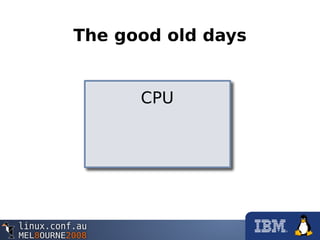
The good old days
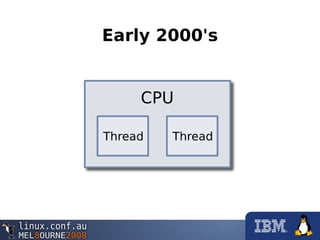
Early 2000's
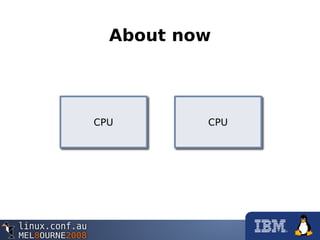
About now
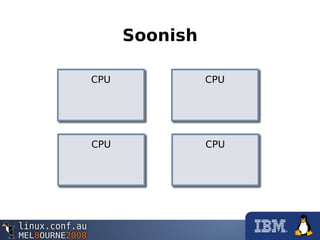
Soonish
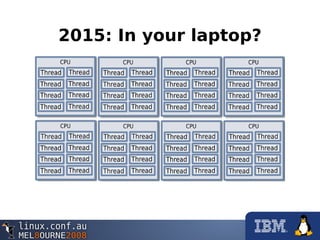
2015: In your laptop?
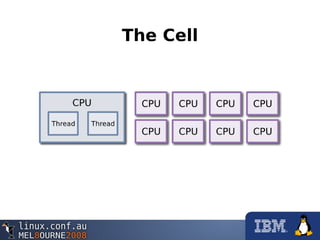
The Cell
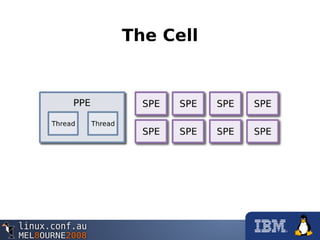
The Cell
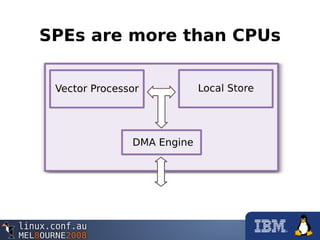
SPEs are more than CPUs
There will be no CPU
So what's it like
to program?
A simple raytracer
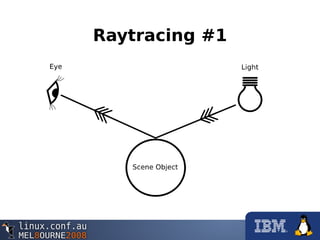
Raytracing #1
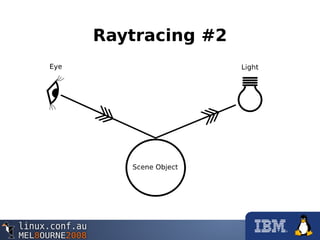
Raytracing #2
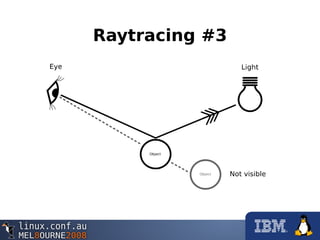
Raytracing #3
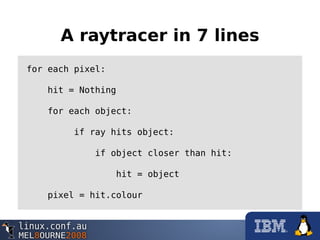
A raytracer in 7 lines
for each pixel:
hit = Nothing
for each object:
if ray hits object:
if object closer than hit:
hit = object
pixel = hit.colour
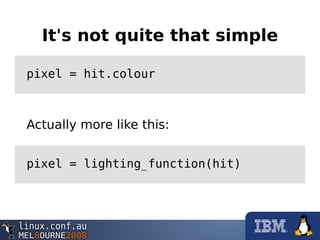
It's not quite that simple
pixel = hit.colour
Actually more like this:
pixel = lighting_function(hit)

A raytracer on Cell
•It's a new instruction set
•C, C++, Fortran, Ada?
•C - close to the metal
•I don't know Fortran
Python prototype first
•Get the algorithms right first
•Python ~= pseudo code
•Library routines for vectors
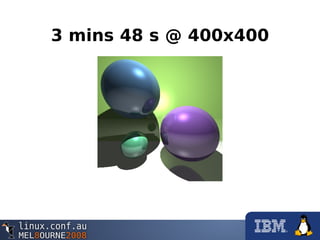
3 mins 48 s @ 400x400
How to parallelise on Cell?
•6 SPUs on PS3
•16 SPUs on IBM QS2x Blades
•One SPU thread per pixel?
•Split hit detection and lighting?
•Each SPU renders 1/nth of the rows?
Thread creation
and switch is costly,
synchronisation
is hard
How to parallelise on Cell?
•By rows: each SPU renders 1/n rows
•For large scenes rectangles would be
better - object locality
•Adaptive partitioning
•Open question IMHO
PPE Structure
load_scene()
for 0 to num_spus:
threads[i] = spawn_spu_thread(i)
for 0 to num_spus:
wait_for(threads[i])
save_image()
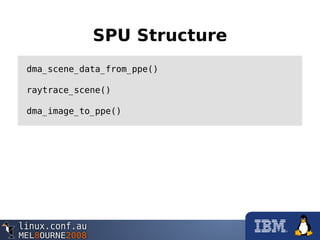
SPU Structure
dma_scene_data_from_ppe()
raytrace_scene()
dma_image_to_ppe()
This will appear
to work, but ..
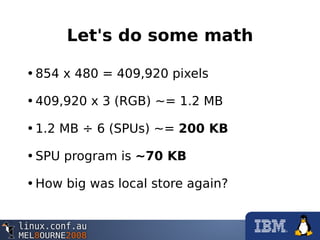
Let's do some math
•854 x 480 = 409,920 pixels
•409,920 x 3 (RGB) ~= 1.2 MB
•1.2 MB ÷ 6 (SPUs) ~= 200 KB
•SPU program is ~70 KB
•How big was local store again?
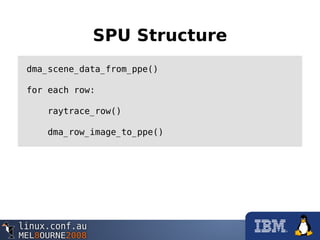
SPU Structure
dma_scene_data_from_ppe()
for each row:
raytrace_row()
dma_row_image_to_ppe()
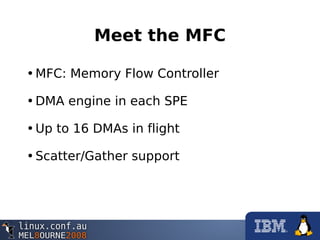
Meet the MFC
•MFC: Memory Flow Controller
•DMA engine in each SPE
•Up to 16 DMAs in flight
•Scatter/Gather support
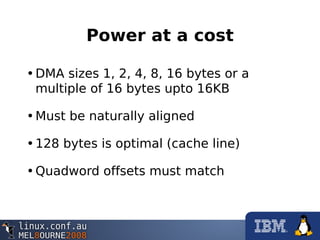
Power at a cost
•DMA sizes 1, 2, 4, 8, 16 bytes or a
multiple of 16 bytes upto 16KB
•Must be naturally aligned
•128 bytes is optimal (cache line)
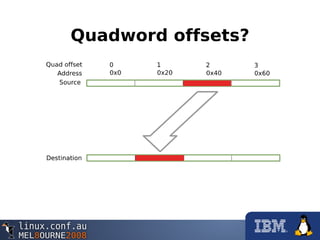
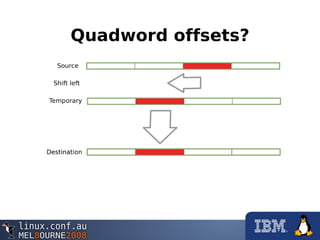
•Quadword offsets must match
Quadword offsets?
Quadword offsets?
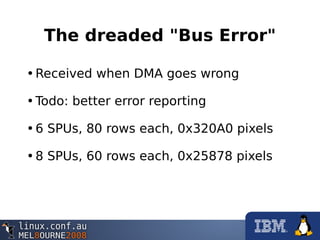
The dreaded "Bus Error"
•Received when DMA goes wrong
•Todo: better error reporting
•6 SPUs, 80 rows each, 0x320A0 pixels
•8 SPUs, 60 rows each, 0x25878 pixels
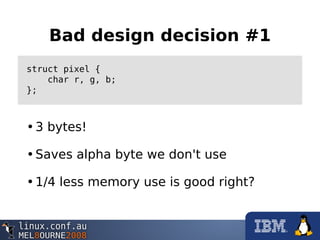
Bad design decision #1
struct pixel {
char r, g, b;
};
•3 bytes!
•Saves alpha byte we don't use
•1/4 less memory use is good right?
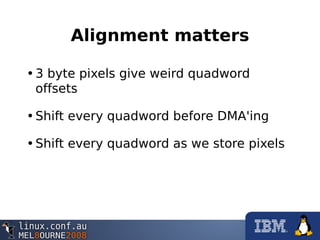
Alignment matters
•3 byte pixels give weird quadword
offsets
•Shift every quadword before DMA'ing
•Shift every quadword as we store pixels
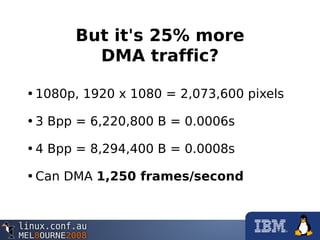
But it's 25% more
DMA traffic?
•1080p, 1920 x 1080 = 2,073,600 pixels
•3 Bpp = 6,220,800 B = 0.0006s
•4 Bpp = 8,294,400 B = 0.0008s
•Can DMA 1,250 frames/second
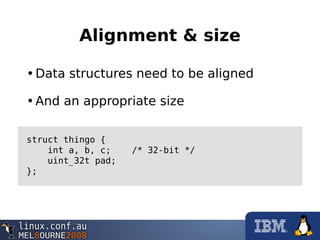
Alignment & size
•Data structures need to be aligned
•And an appropriate size
struct thingo {
int a, b, c; /* 32-bit */
uint_32t pad;
};
Raytracer core is
all 3D vector math
I won't bore you with the details
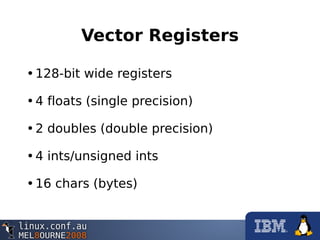
Vector Registers
•128-bit wide registers
•4 floats (single precision)
•2 doubles (double precision)
•4 ints/unsigned ints
•16 chars (bytes)
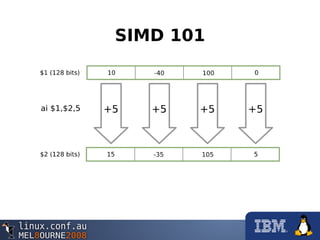
SIMD 101
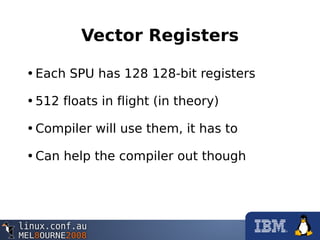
Vector Registers
•Each SPU has 128 128-bit registers
•512 floats in flight (in theory)
•Compiler will use them, it has to
•Can help the compiler out though
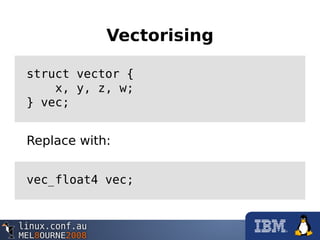
Vectorising
struct vector {
x, y, z, w;
} vec;
Replace with:
vec_float4 vec;
A little more
raytracing theory
Ray / object intersections
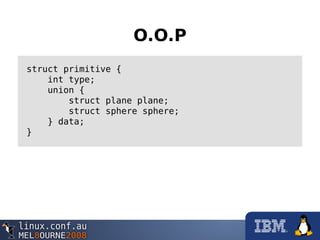
O.O.P
struct primitive {
int type;
union {
struct plane plane;
struct sphere sphere;
} data;
}
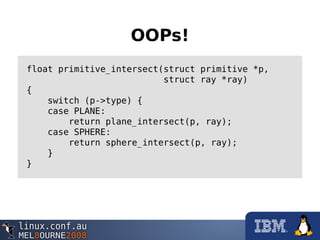
OOPs!
float primitive_intersect(struct primitive *p,
struct ray *ray)
{
switch (p->type) {
case PLANE:
return plane_intersect(p, ray);
case SPHERE:
return sphere_intersect(p, ray);
}
}
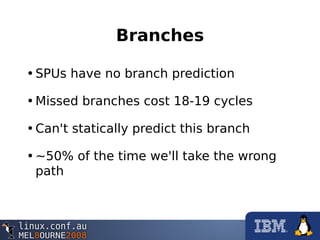
Branches
•SPUs have no branch prediction
•Missed branches cost 18-19 cycles
•Can't statically predict this branch
•~50% of the time we'll take the wrong
path
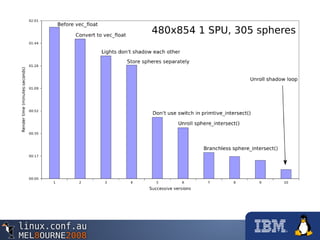
No Branches
•Move the test up
•Loop through all spheres, then all planes
•Inside the loop we know what we're
dealing with
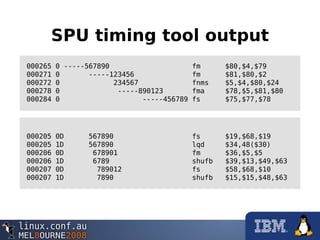
SPU timing tool
•Part of IBM SDK
•Estimate of execution pattern
•Dual issues
•Stalls
SPU timing tool output
000265 0 -----567890 fm $80,$4,$79
000271 0 -----123456 fm $81,$80,$2
000272 0 234567 fnms $5,$4,$80,$24
000278 0 -----890123 fma $78,$5,$81,$80
000284 0 -----456789 fs $75,$77,$78
000205 0D 567890 fs $19,$68,$19
000205 1D 567890 lqd $34,48($30)
000206 0D 678901 fm $36,$5,$5
000206 1D 6789 shufb $39,$13,$49,$63
000207 0D 789012 fs $58,$68,$10
000207 1D 7890 shufb $15,$15,$48,$63
Unroll your loops
•Reduces loop management overhead
•More code in the loop body
•Compiler has more chance to schedule
•Not pretty code
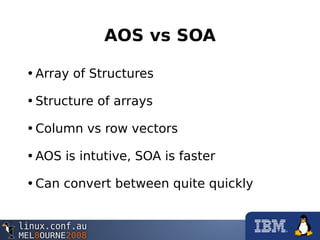
AOS vs SOA
•Array of Structures
•Structure of arrays
•Column vs row vectors
•AOS is intutive, SOA is faster
•Can convert between quite quickly
This slide accidentally left blank
Bling
292 spheres at 854x480 on
6 SPEs in ~0.65s per frame
Random thoughts
•Code quality vs speed
•Single source base?
•Compilers could get better
•Real issues with debugging optimised
code
A complex raytracer?
•Space partitioning approach
•Scenes larger than Local Store
•Object caching, DMA prefetching
•More complex lighting
•Dynamic code loading
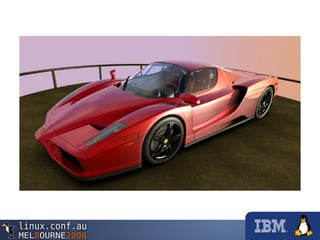
IBM iRT
•~300,000 polygon models in real time
•Runs on PS3 and QS2x blades
•Linear scaling across multiple machines
•Several man years of effort
•Awesome
Props to ..
•Jk for his SVGs
•Everyone at OzLabs
•The Böblingen crowd
•Meg
Links
•IBM iRT: http://www.alphaworks.ibm.com/tech/irt
•IBM Cell SDK: http://www.ibm.com/developerworks/power/cell/
•My Blog: http://michael.ellerman.id.au/blog
Legal
•This work represents the view of the authors and does not necessarily represent
the view of IBM.
•Linux is a registered trademark of Linus Torvalds.
•Cell Broadband Engine is a trademark of Sony Computer Entertainment Inc.
•PLAYSTATION is a trademark of Sony Computer Entertainment Inc.
•Other company, product, and service names may be trademarks or service marks
of others.
Questions?

Programming the Cell Processor A simple raytracer from pseudo-code to spu-code