Programming
Fundamentals using
C++
Programming
 Much of human behavior and thought is characterized by
logical sequences of actions applied to objects.
 Think of every step involved in a process as simple as
turning a page by hand:
1. Lift hand.
2. Move hand to right side of book.
3. Grasp top-right corner of page.
4. Move hand from right to left until page is positioned so that you
can read what is on the other side.
5. Let go of page.
.
Programming
 Think how many neurons must fire and how many
muscles must respond, all in a certain order or
sequence, to move your arm and hand. Yet you do it
unconsciously.
 We create order, both consciously and unconsciously,
through a process called programming
How Do We Write a Program?
 A computer is not intelligent. It cannot analyze a problem
and come up with a solution.
 A human (the programmer) must analyze the problem,
develop the instructions for solving the problem, and
then have the computer carry out the instructions.
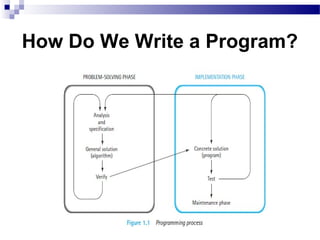
 To write a program for a computer to follow, we must go
through a two-phase process: problem solving and
implementation
How Do We Write a Program?
Problem-Solving Phase
1.Analysis and Specification. Understand (define) the problem and what the
solution must do.
A. Defining/Specifying the problem:
• What the computer program do?
• What tasks will it perform?
• What kind of data will it use, and where will get its data from?
• What will be the output of the program?
• How will the program interact with the computer user?
How Do We Write a Program?
B. Analyzing the problem
 It involves identifying the problem
 Inputs that is, the data you have to work with
 Outputs, the desired results
 Additional requirements or constraints on the solution.
2. General Solution (Algorithm). Specify the required data
types and the logical sequences of steps that solve the
problem.
3. Verify. Follow the steps exactly to see if the solution
really does solve the problem.
 Implementation Phase
1. Concrete Solution (Program).
Translate the algorithm (the general solution) into
a programming language.
2. Test.
Have the computer follow the instructions. Then
manually check the results. If you find errors,
analyze the program and the algorithm to
determine the source of the errors, and then
make corrections.
How Do We Write a Program?
Maintenance Phase
1. Use. Use the program.
2. Maintain. Modify the program to meet changing
requirements or to correct any errors that show up
while using it.
How Do We Write a Program?
Maintenance Phase
1. Use. Use the program.
2. Maintain. Modify the program to meet changing
requirements or to correct any errors that show up
while using it.
How Do We Write a Program?

Programming Fundamentals using C++

  • 1.
  • 2.
    Programming  Much ofhuman behavior and thought is characterized by logical sequences of actions applied to objects.  Think of every step involved in a process as simple as turning a page by hand: 1. Lift hand. 2. Move hand to right side of book. 3. Grasp top-right corner of page. 4. Move hand from right to left until page is positioned so that you can read what is on the other side. 5. Let go of page. .
  • 3.
    Programming  Think howmany neurons must fire and how many muscles must respond, all in a certain order or sequence, to move your arm and hand. Yet you do it unconsciously.  We create order, both consciously and unconsciously, through a process called programming
  • 4.
    How Do WeWrite a Program?  A computer is not intelligent. It cannot analyze a problem and come up with a solution.  A human (the programmer) must analyze the problem, develop the instructions for solving the problem, and then have the computer carry out the instructions.  To write a program for a computer to follow, we must go through a two-phase process: problem solving and implementation
  • 5.
    How Do WeWrite a Program?
  • 6.
    How Do WeWrite a Program? Problem-Solving Phase 1.Analysis and Specification. Understand (define) the problem and what the solution must do. A. Defining/Specifying the problem: • What the computer program do? • What tasks will it perform? • What kind of data will it use, and where will get its data from? • What will be the output of the program? • How will the program interact with the computer user?
  • 7.
    How Do WeWrite a Program? B. Analyzing the problem  It involves identifying the problem  Inputs that is, the data you have to work with  Outputs, the desired results  Additional requirements or constraints on the solution. 2. General Solution (Algorithm). Specify the required data types and the logical sequences of steps that solve the problem. 3. Verify. Follow the steps exactly to see if the solution really does solve the problem.
  • 8.
     Implementation Phase 1.Concrete Solution (Program). Translate the algorithm (the general solution) into a programming language. 2. Test. Have the computer follow the instructions. Then manually check the results. If you find errors, analyze the program and the algorithm to determine the source of the errors, and then make corrections. How Do We Write a Program?
  • 9.
    Maintenance Phase 1. Use.Use the program. 2. Maintain. Modify the program to meet changing requirements or to correct any errors that show up while using it. How Do We Write a Program?
  • 10.
    Maintenance Phase 1. Use.Use the program. 2. Maintain. Modify the program to meet changing requirements or to correct any errors that show up while using it. How Do We Write a Program?