Trade Technical College has been offering Career Technical Programs since 1925
Over the past 5 years, Trade Technical College has educated over 75,000 people in  Career Technical Education and Training Programs
75% of Trade-Tech’s programs are Career Technical
53% of students coming to Trade Tech are here to achieve two year or shorter… Career Related Goals
LA Trade-Tech is the number 1 community college in the state for awarding AA/AS degrees in: Family and Consumer Sciences Fashion Design Culinary Electrical Carpentry Labor Studies Plumbing Diesel Technology Telecommunications Technology HVAC Machining and Machine Tools
AT WHAT COST?
High Cost Program Criteria 29 Career-Technical Education (CTE) Programs have been identified as “high cost” by meeting all of the following criteria: VATEA Eligible Has required Lab Space Assignable Square Footage (ASF) per Student > 30 Requires specialized equipment Requires equipment maintenance Requires consumable supplies Requires instructional support staff
Key Financial Factors Impacting CTE Program Viability Direct Program Costs Lost Revenue due to Class Size Limitations
Direct Program Costs Direct Costs include the Costs of: Maintenance of lab space Specialized/Required Storage space Equipment  Equipment Maintenance  Consumable Supplies Specialized Staff required to maintain program (Costs are normalized in that they are over and above the cost to maintain a General Education Class)
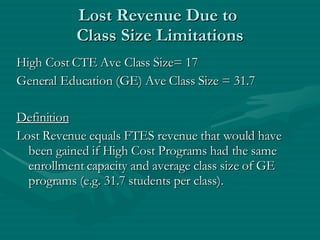
Lost Revenue Due to  Class Size Limitations High Cost CTE Ave Class Size= 17 General Education (GE) Ave Class Size = 31.7 Definition Lost Revenue equals FTES revenue that would have been gained if High Cost Programs had the same enrollment capacity and average class size of GE programs (e.g. 31.7 students per class).
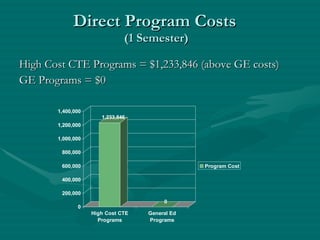
Direct Program Costs  (1 Semester) High Cost CTE Programs = $1,233,846 (above GE costs) GE Programs = $0
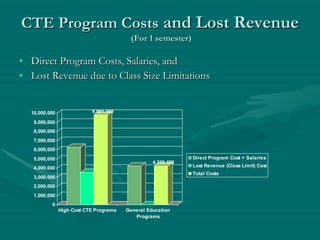
CTE Program Costs  and Lost Revenue   (For 1 semester) Direct Program Costs, Salaries, and Lost Revenue due to Class Size Limitations
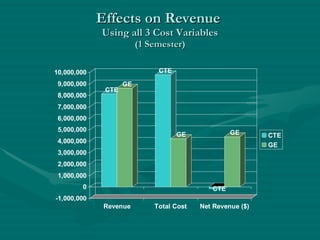
Effects on Revenue  Using all 3 Cost Variables (1 Semester)
New - High Demand Programs A key priority for Trade-Tech is to develop new programs that are in high demand to meet the needs of the business community. This includes: Starting new programs, and Expanding existing programs to meet industry  demand.
Startup Costs (examples) Culinary Program expansion/renovation: $13 million to expand the Culinary program at Trade-Tech to meet student demand. New Automotive Paint Program: Approx $4.5 million to start up a new Automotive Paint Program that would meet industry standards.
New High Cost Program Analysis Developing new programs to meet the needs of the community is a fundamental goal. However, the cost of developing such a program is so prohibitive, it is nearly impossible without a mechanism to fund such programs.
Other High Cost Program Studies Other states, based on comprehensive cost study results,  have recognized the necessity to fund CTE programs at a higher rate to compensate for both higher direct costs and revenue limitations.  These states include: Kansas, Mississippi, Arkansas, Nebraska, Pennsylvania, Massachusetts, and Texas.
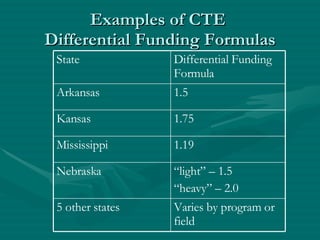
Examples of CTE  Differential Funding Formulas Varies by program or field 5 other states “ light” – 1.5 “ heavy” – 2.0 Nebraska 1.19 Mississippi 1.75 Kansas 1.5  Arkansas Differential Funding Formula State
Summary of Cost Study Analysis 58% of Trade-Tech’s disciplines are Career-Technical – 29% of which have been identified using the 6 aforementioned categories, as high cost Net revenues for high cost CTE programs at Trade-Tech are 68.7% lower than GE programs Total costs of high-cost CTE programs are 5.9 times greater than GE programs Other states have implemented differential funding multipliers for CTE programs ranging from 1.19 to 2.0 (an average of 1.59)
Recommendation To approve and implement a funding differential multiplier of 1.59 / FTES for high cost CTE programs. [Note: this multiplier equals  both  the total cost difference between CTE and GE programs at the college  AND  the average CTE multiplier of other states with differential funding]

High Cost Program Presentation

  • 1.
    Trade Technical Collegehas been offering Career Technical Programs since 1925
  • 2.
    Over the past5 years, Trade Technical College has educated over 75,000 people in Career Technical Education and Training Programs
  • 3.
    75% of Trade-Tech’sprograms are Career Technical
  • 4.
    53% of studentscoming to Trade Tech are here to achieve two year or shorter… Career Related Goals
  • 5.
    LA Trade-Tech isthe number 1 community college in the state for awarding AA/AS degrees in: Family and Consumer Sciences Fashion Design Culinary Electrical Carpentry Labor Studies Plumbing Diesel Technology Telecommunications Technology HVAC Machining and Machine Tools
  • 6.
  • 7.
    High Cost ProgramCriteria 29 Career-Technical Education (CTE) Programs have been identified as “high cost” by meeting all of the following criteria: VATEA Eligible Has required Lab Space Assignable Square Footage (ASF) per Student > 30 Requires specialized equipment Requires equipment maintenance Requires consumable supplies Requires instructional support staff
  • 8.
    Key Financial FactorsImpacting CTE Program Viability Direct Program Costs Lost Revenue due to Class Size Limitations
  • 9.
    Direct Program CostsDirect Costs include the Costs of: Maintenance of lab space Specialized/Required Storage space Equipment Equipment Maintenance Consumable Supplies Specialized Staff required to maintain program (Costs are normalized in that they are over and above the cost to maintain a General Education Class)
  • 10.
    Lost Revenue Dueto Class Size Limitations High Cost CTE Ave Class Size= 17 General Education (GE) Ave Class Size = 31.7 Definition Lost Revenue equals FTES revenue that would have been gained if High Cost Programs had the same enrollment capacity and average class size of GE programs (e.g. 31.7 students per class).
  • 11.
    Direct Program Costs (1 Semester) High Cost CTE Programs = $1,233,846 (above GE costs) GE Programs = $0
  • 12.
    CTE Program Costs and Lost Revenue (For 1 semester) Direct Program Costs, Salaries, and Lost Revenue due to Class Size Limitations
  • 13.
    Effects on Revenue Using all 3 Cost Variables (1 Semester)
  • 14.
    New - HighDemand Programs A key priority for Trade-Tech is to develop new programs that are in high demand to meet the needs of the business community. This includes: Starting new programs, and Expanding existing programs to meet industry demand.
  • 15.
    Startup Costs (examples)Culinary Program expansion/renovation: $13 million to expand the Culinary program at Trade-Tech to meet student demand. New Automotive Paint Program: Approx $4.5 million to start up a new Automotive Paint Program that would meet industry standards.
  • 16.
    New High CostProgram Analysis Developing new programs to meet the needs of the community is a fundamental goal. However, the cost of developing such a program is so prohibitive, it is nearly impossible without a mechanism to fund such programs.
  • 17.
    Other High CostProgram Studies Other states, based on comprehensive cost study results, have recognized the necessity to fund CTE programs at a higher rate to compensate for both higher direct costs and revenue limitations. These states include: Kansas, Mississippi, Arkansas, Nebraska, Pennsylvania, Massachusetts, and Texas.
  • 18.
    Examples of CTE Differential Funding Formulas Varies by program or field 5 other states “ light” – 1.5 “ heavy” – 2.0 Nebraska 1.19 Mississippi 1.75 Kansas 1.5 Arkansas Differential Funding Formula State
  • 19.
    Summary of CostStudy Analysis 58% of Trade-Tech’s disciplines are Career-Technical – 29% of which have been identified using the 6 aforementioned categories, as high cost Net revenues for high cost CTE programs at Trade-Tech are 68.7% lower than GE programs Total costs of high-cost CTE programs are 5.9 times greater than GE programs Other states have implemented differential funding multipliers for CTE programs ranging from 1.19 to 2.0 (an average of 1.59)
  • 20.
    Recommendation To approveand implement a funding differential multiplier of 1.59 / FTES for high cost CTE programs. [Note: this multiplier equals both the total cost difference between CTE and GE programs at the college AND the average CTE multiplier of other states with differential funding]