Profiling Science FacultyPatti C. McCall, MA, MLS Science Librarian University of Central Florida
(and Law & Order junky)
It’s going to require some detective work……..
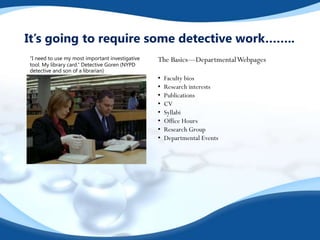
“I need to use my most important investigative
tool. My library card.” Detective Goren (NYPD
detective and son of a librarian)
The Basics—DepartmentalWebpages
• Faculty bios
• Research interests
• Publications
• CV
• Syllabi
• Office Hours
• Research Group
• Departmental Events
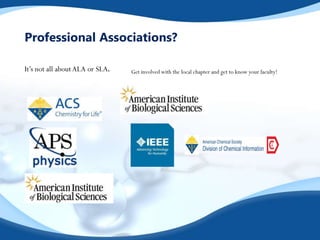
Professional Associations?
It’s not all aboutALA or SLA. Get involved with the local chapter and get to know your faculty!
You can often find student groups on
Facebook. Ask if you can attend a
meeting and introduce yourself. Get
to know your students, not just your
faculty.
• Student chapter of the American
Chemical Society
• Society of Physics Students
• Astronomy Society at UCF
• Physics Women Society
• UCF Forensics Society
Don’t Forget Student Groups!
Take your information and your services straight to your students!
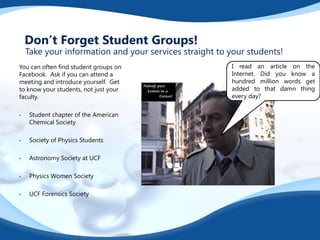
I read an article on the
Internet. Did you know a
hundred million words get
added to that damn thing
every day?
Some simple internet sleuthing (or some might call it
stalking—HA!) can reveal all sort of interesting
info….publications, professional activities, hobbies, arrest
records (often entertaining but not recommended for
discussion)………..
Getting in touch via LinkedIn is a great way to connect
and stay updated on faculty activities.
Google, Facebook, LinkedIn, Web of Science, etc……….
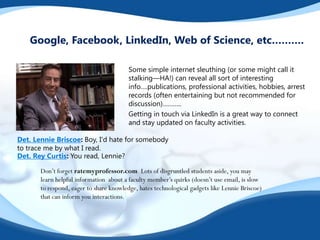
Det. Lennie Briscoe: Boy, I'd hate for somebody
to trace me by what I read.
Det. Rey Curtis: You read, Lennie?
Don’t forget ratemyprofessor.com Lots of disgruntled students aside, you may
learn helpful information about a faculty member’s quirks (doesn’t use email, is slow
to respond, eager to share knowledge, hates technological gadgets like Lennie Briscoe)
that can inform you interactions.
Be a proactive sleuth (snoop, investigator, operative) and attend departmental events. Get into the
minds of your subjects!
• Show that the work of your faculty and students matters to YOU and learn about your department.
• You don’t need to be a scientist to make an effort to learn the needs of you researchers and what tools
researchers need.
• Become a regular presence and you and your library will be on the minds of your students and faculty.
• Volunteer
• Attend seminars/colloquia
• Thesis and dissertation defenses
• Research presentations (i.e. UCF Research Week)
• Visit the departments and deliver brochures on research tools, offer training
• Show your enthusiasm for excellence in librarianship and research
• Be an advocate for your departments
Be seen….and be on the scene
Don’t be discouraged. It’s an ongoing process of
building relationships and gaining knowledge that
takes time (but is very rewarding!)
Go undercover (sort of ) and schmooze (but don’t be smarmy)
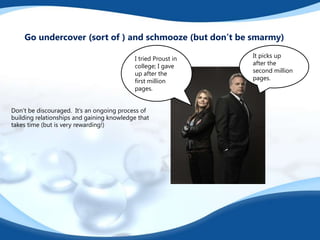
It picks up
after the
second million
pages.
I tried Proust in
college; I gave
up after the
first million
pages.

Profiling science faculty

  • 1.
    Profiling Science FacultyPattiC. McCall, MA, MLS Science Librarian University of Central Florida (and Law & Order junky)
  • 2.
    It’s going torequire some detective work…….. “I need to use my most important investigative tool. My library card.” Detective Goren (NYPD detective and son of a librarian) The Basics—DepartmentalWebpages • Faculty bios • Research interests • Publications • CV • Syllabi • Office Hours • Research Group • Departmental Events
  • 3.
    Professional Associations? It’s notall aboutALA or SLA. Get involved with the local chapter and get to know your faculty!
  • 4.
    You can oftenfind student groups on Facebook. Ask if you can attend a meeting and introduce yourself. Get to know your students, not just your faculty. • Student chapter of the American Chemical Society • Society of Physics Students • Astronomy Society at UCF • Physics Women Society • UCF Forensics Society Don’t Forget Student Groups! Take your information and your services straight to your students! I read an article on the Internet. Did you know a hundred million words get added to that damn thing every day?
  • 5.
    Some simple internetsleuthing (or some might call it stalking—HA!) can reveal all sort of interesting info….publications, professional activities, hobbies, arrest records (often entertaining but not recommended for discussion)……….. Getting in touch via LinkedIn is a great way to connect and stay updated on faculty activities. Google, Facebook, LinkedIn, Web of Science, etc………. Det. Lennie Briscoe: Boy, I'd hate for somebody to trace me by what I read. Det. Rey Curtis: You read, Lennie? Don’t forget ratemyprofessor.com Lots of disgruntled students aside, you may learn helpful information about a faculty member’s quirks (doesn’t use email, is slow to respond, eager to share knowledge, hates technological gadgets like Lennie Briscoe) that can inform you interactions.
  • 6.
    Be a proactivesleuth (snoop, investigator, operative) and attend departmental events. Get into the minds of your subjects! • Show that the work of your faculty and students matters to YOU and learn about your department. • You don’t need to be a scientist to make an effort to learn the needs of you researchers and what tools researchers need. • Become a regular presence and you and your library will be on the minds of your students and faculty. • Volunteer • Attend seminars/colloquia • Thesis and dissertation defenses • Research presentations (i.e. UCF Research Week) • Visit the departments and deliver brochures on research tools, offer training • Show your enthusiasm for excellence in librarianship and research • Be an advocate for your departments Be seen….and be on the scene
  • 7.
    Don’t be discouraged.It’s an ongoing process of building relationships and gaining knowledge that takes time (but is very rewarding!) Go undercover (sort of ) and schmooze (but don’t be smarmy) It picks up after the second million pages. I tried Proust in college; I gave up after the first million pages.