PROFESSIONAL
TEACHING STANDARDS
AUDREY YEE M20131000365
JOYCE JONG SHEN EE M20131000376
KUEH SU LI M20131000375
LAU EE M20131000380
TING JACK YEW M20131000384
teacher
TEACHING PROFESSION
SELF
“Every teacher needs to improve, not because
they are not good enough, but because
they can be even better.”
Dylan Wiliam
TEACHING PROFESSION
SELF
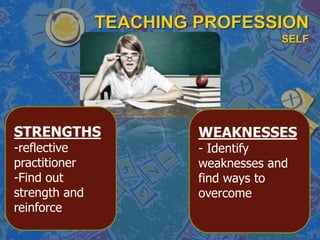
STRENGTHS
-reflective
practitioner
-Find out
strength and
reinforce
WEAKNESSES
- Identify
weaknesses and
find ways to
overcome
TEACHING PROFESSION
SELF
TEACHING PROFESSION
SELF
TEACHING PROFESSION
SELF
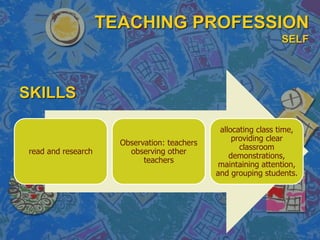
SKILLS
read and research
Observation: teachers
observing other
teachers
allocating class time,
providing clear
classroom
demonstrations,
maintaining attention,
and grouping students.
TEACHING PROFESSION
SELF
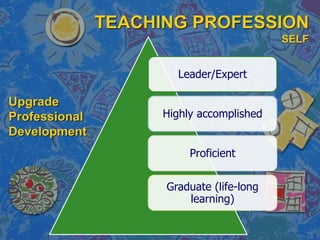
Upgrade
Professional
Development
Leader/Expert
Highly accomplished
Proficient
Graduate (life-long
learning)
TEACHING PROFESSION
SELF
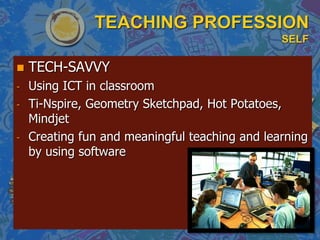
 TECH-SAVVY
- Using ICT in classroom
- Ti-Nspire, Geometry Sketchpad, Hot Potatoes,
Mindjet
- Creating fun and meaningful teaching and learning
by using software
BACK
TEACHING PROFESSION
TEACHING & LEARNING
 PLANNING
– Inadequate lesson planning
 Teacher draws on the board and pupils grow restless
while waiting for teacher to finish
 Too many activities, too little time (or vice versa)
 Transitions: smooth lesson flows
 Time allocation for activity
– too little (objective X)
– too much (chaos happens)
TEACHING PROFESSION
TEACHING & LEARNING
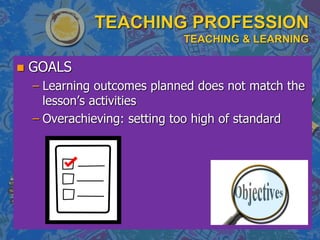
 GOALS
– Learning outcomes planned does not match the
lesson‟s activities
– Overachieving: setting too high of standard
TEACHING PROFESSION
TEACHING & LEARNING
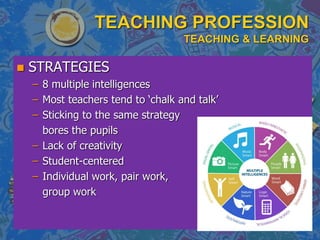
 STRATEGIES
– 8 multiple intelligences
– Most teachers tend to „chalk and talk‟
– Sticking to the same strategy
bores the pupils
– Lack of creativity
– Student-centered
– Individual work, pair work,
group work
TEACHING PROFESSION
TEACHING & LEARNING
 RESOURCES
– Certain school especially in rural areas lack of
resources
– Teachers need to be given guideline on reliable
reference books in stores
– Partitioning the board
TEACHING PROFESSION
TEACHING & LEARNING
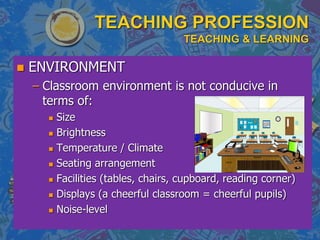
 ENVIRONMENT
– Classroom environment is not conducive in
terms of:
 Size
 Brightness
 Temperature / Climate
 Seating arrangement
 Facilities (tables, chairs, cupboard, reading corner)
 Displays (a cheerful classroom = cheerful pupils)
 Noise-level
TEACHING PROFESSION
ASSESSMENT
 STRENGTHS & WEAKNESSES
– Assessment does not reflect pupils‟ strengths
and weaknesses (MCQ)
– Teacher depends too much on references
written by others that may not be suitable for
own pupils
– Synchronized assessment
 Teachers rush to finish the syllabus
BACK
TEACHING PROFESSION
CATERING TO STUDENT’S…
 INTRODUCTION
– Knowledge about students will enable teacher
to refine lesson, class discussions, comments,
illustrations, and activities so that students are
more effective in learning.
– References to student interests, backgrounds,
knowledge, and even anxieties can make the
class seem more personal and the material
more accessible.
TEACHING PROFESSION
CATERING TO STUDENT’S…
 BACKGROUND
– Students come from different family background.
– The teacher respects learners as individuals with
different personal and family backgrounds and
various skills, abilities, perspectives, talents, and
interests.
– Teachers know the ways in which learning take
place, and they know the appropriate levels of
intellectual, physical, social and emotional
development of their students.
TEACHING PROFESSION
CATERING TO STUDENT’S…
 BACKGROUND
– Teachers build on students‟ prior knowledge, life
experience and interests to achieve learning goals
for all students.
– Teachers help students to see the connections
between what they already know with subject
matter.
– Teachers should incorporate students‟ prior
knowledge and experience in instructional planning
to keep students motivated in learning.
TEACHING PROFESSION
CATERING TO STUDENT’S…
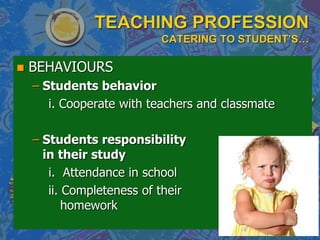
 BEHAVIOURS
– Students behavior
i. Cooperate with teachers and classmate
– Students responsibility
in their study
i. Attendance in school
ii. Completeness of their
homework
TEACHING PROFESSION
CATERING TO STUDENT’S…
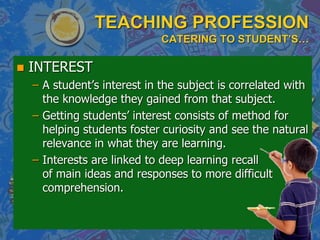
 INTEREST
– A student‟s interest in the subject is correlated with
the knowledge they gained from that subject.
– Getting students‟ interest consists of method for
helping students foster curiosity and see the natural
relevance in what they are learning.
– Interests are linked to deep learning recall
of main ideas and responses to more difficult
comprehension.
TEACHING PROFESSION
CATERING TO STUDENT’S…
 INTEREST
– Teacher will be able to see students interest in the
subject if the students are more active in the class
and more willing to contribute to the classroom
discussion.
– Teachers will also be able to see lack of
interest if the students doesn‟t pay
attention, become lazy with his/her work
or always absence from the class.
TEACHING PROFESSION
CATERING TO STUDENT’S…
 HOW TO GAIN INTEREST
1. Make the material relevant to the students.
2. Utilizing critical thinking into the lesson
3. Teachers must stay interest in the subject and keep
students in a subject by bringing up interesting
4. Teachers should present the material in a variety of
different ways such as incorporate movies, lectures,
debates, research projects, groups projects, role
playing, visual and audios into their classroom.
TEACHING PROFESSION
CATERING TO STUDENT’S…
 STRENGTHS
– The teacher creates developmentally appropriate
instruction that takes into account individual
learners‟ strengths, interests, and needs and that
enables each learner to advance and accelerate
his/her learning.
– Teachers know how students think and learn.
Teachers understand the influences on students
learning and differentiate instruction, adapt
resources to address the strengths and weaknesses
of students.
TEACHING PROFESSION
CATERING TO STUDENT’S…
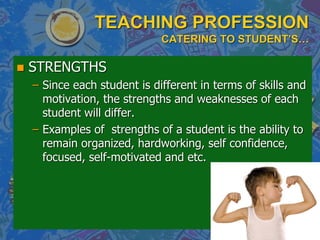
 STRENGTHS
– Since each student is different in terms of skills and
motivation, the strengths and weaknesses of each
student will differ.
– Examples of strengths of a student is the ability to
remain organized, hardworking, self confidence,
focused, self-motivated and etc.
TEACHING PROFESSION
CATERING TO STUDENT’S…
 NEEDS
– Therefore, the teacher regularly assesses individual
and group performance in order to design and
modify instruction to meet learners‟ needs in each
area of development (cognitive, linguistic, social,
emotional, and physical) and scaffolds the next
level of development.
– The teacher understands students with exceptional
needs, including those associated with disabilities
and giftedness, and knows how to use strategies
and resources to address these needs.
TEACHING PROFESSION
CATERING TO STUDENT’S…
 NEEDS
– Teachers have to adapt teaching strategies to
students needs.
– For example: if the students has difficulty in
learning by listening, the teacher can provide visual
via the board or projector, use the flash card and
have students to take notes and use colored marker
to highlight.
BACK
TEACHING PROFESSION
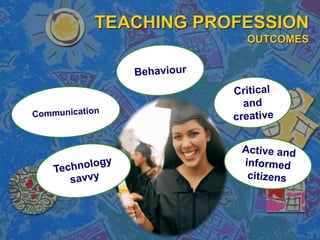
OUTCOMES
TEACHING PROFESSION
OUTCOMES
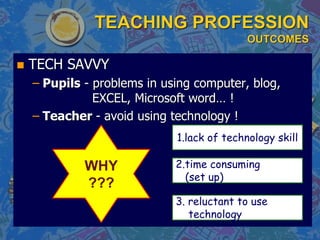
 TECH SAVVY
– Pupils - problems in using computer, blog,
EXCEL, Microsoft word… !
– Teacher - avoid using technology !
WHY
???
2.time consuming
(set up)
1.lack of technology skill
3. reluctant to use
technology
TEACHING PROFESSION
OUTCOMES
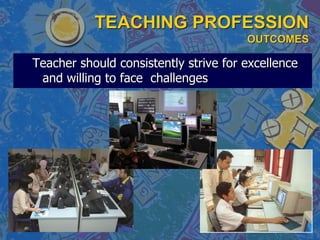
Teacher should consistently strive for excellence
and willing to face challenges
TEACHING PROFESSION
OUTCOMES
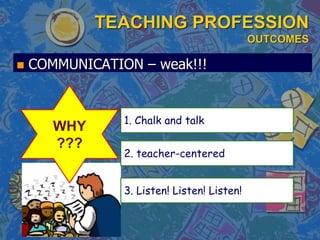
 COMMUNICATION – weak!!!
WHY
???
2. teacher-centered
1. Chalk and talk
3. Listen! Listen! Listen!
TEACHING PROFESSION
OUTCOMES
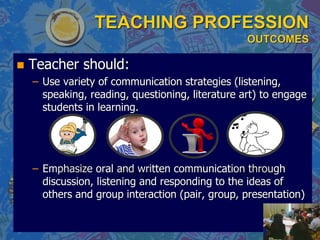
 Teacher should:
– Use variety of communication strategies (listening,
speaking, reading, questioning, literature art) to engage
students in learning.
– Emphasize oral and written communication through
discussion, listening and responding to the ideas of
others and group interaction (pair, group, presentation)
TEACHING PROFESSION
OUTCOMES
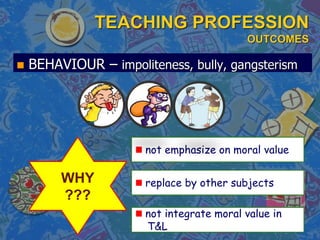
 BEHAVIOUR – impoliteness, bully, gangsterism
WHY
???
replace by other subjects
not emphasize on moral value
not integrate moral value in
T&L
TEACHING PROFESSION
OUTCOMES
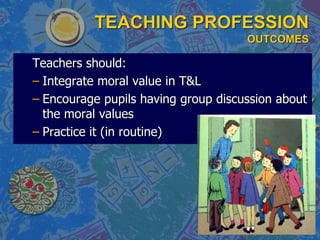
Teachers should:
– Integrate moral value in T&L
– Encourage pupils having group discussion about
the moral values
– Practice it (in routine)
TEACHING PROFESSION
OUTCOMES
 CRITICAL & CREATIVE THINKING
– Pupils - waiting for answer/examples (dependent)
– Use to traditional teaching style
WHY
??? class controlling
teaching strategies
TEACHING PROFESSION
OUTCOMES
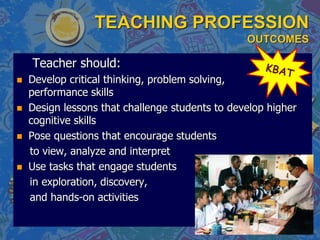
Teacher should:
 Develop critical thinking, problem solving,
performance skills
 Design lessons that challenge students to develop higher
cognitive skills
 Pose questions that encourage students
to view, analyze and interpret
 Use tasks that engage students
in exploration, discovery,
and hands-on activities
TEACHING PROFESSION
OUTCOMES
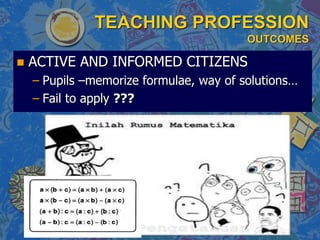
 ACTIVE AND INFORMED CITIZENS
– Pupils –memorize formulae, way of solutions…
– Fail to apply ???
TEACHING PROFESSION
OUTCOMES
Teachers should:
– Discovery learning - logical thinking and
reasoning skills such as (comparison,
classification, sequencing, cause/effect) to
develop initiative to learn
– Encourage creating something new or original
(skills of elaboration, brainstorming,
modification, imagery) to stimulate curiosity
TEACHING PROFESSION
OUTCOMES
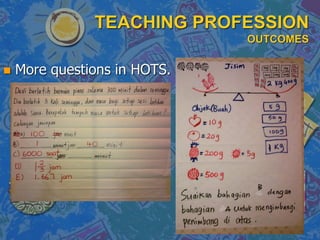
 More questions in HOTS.
BACK
TEACHING PROFESSION
TOWARDS SOCIETY
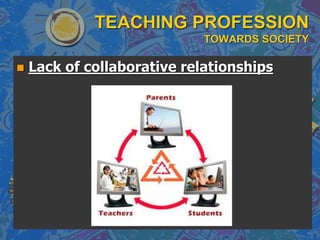
 Lack of collaborative relationships
TEACHING PROFESSION
TOWARDS SOCIETY
These causes:
 Tendency to escape from school
 Never complete the homework
 Parents do not know how their child is performing
(a lot research show parent involvement, have
direct impact on students‟ )
 Parents do not support the school activities (RM
etc)
TEACHING PROFESSION
TOWARDS SOCIETY
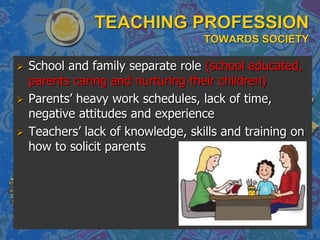
 School and family separate role (school educated,
parents caring and nurturing their children)
 Parents‟ heavy work schedules, lack of time,
negative attitudes and experience
 Teachers‟ lack of knowledge, skills and training on
how to solicit parents
TEACHING PROFESSION
TOWARDS SOCIETY
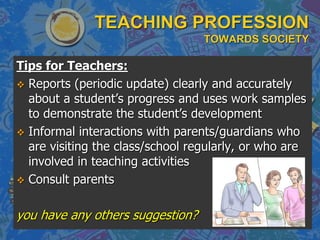
Tips for Teachers:
 Reports (periodic update) clearly and accurately
about a student‟s progress and uses work samples
to demonstrate the student‟s development
 Informal interactions with parents/guardians who
are visiting the class/school regularly, or who are
involved in teaching activities
 Consult parents
you have any others suggestion?
TEACHING PROFESSION
TOWARDS SOCIETY
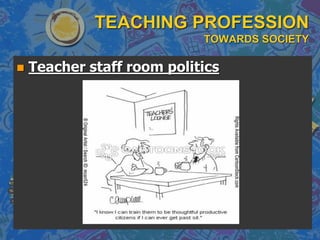
 Teacher staff room politics
TEACHING PROFESSION
TOWARDS SOCIETY
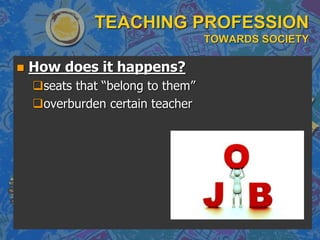
 How does it happens?
seats that “belong to them”
overburden certain teacher
TEACHING PROFESSION
TOWARDS SOCIETY
 Tips for teachers
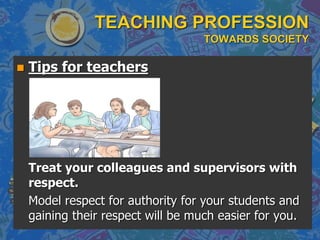
Treat your colleagues and supervisors with
respect.
Model respect for authority for your students and
gaining their respect will be much easier for you.
TEACHING PROFESSION
TOWARDS SOCIETY
 Tips for teachers
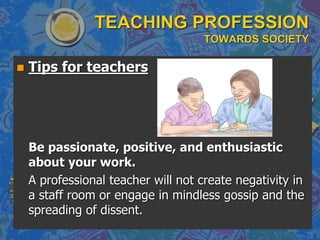
Be passionate, positive, and enthusiastic
about your work.
A professional teacher will not create negativity in
a staff room or engage in mindless gossip and the
spreading of dissent.
TEACHING PROFESSION
TOWARDS SOCIETY
 Tips for teachers
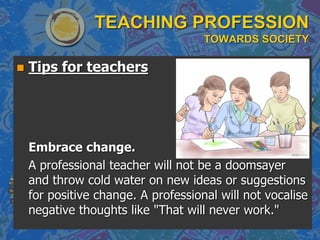
Embrace change.
A professional teacher will not be a doomsayer
and throw cold water on new ideas or suggestions
for positive change. A professional will not vocalise
negative thoughts like "That will never work."
BACK

Professional Teaching Standards Slides

  • 1.
    PROFESSIONAL TEACHING STANDARDS AUDREY YEEM20131000365 JOYCE JONG SHEN EE M20131000376 KUEH SU LI M20131000375 LAU EE M20131000380 TING JACK YEW M20131000384
  • 2.
  • 3.
    TEACHING PROFESSION SELF “Every teacherneeds to improve, not because they are not good enough, but because they can be even better.” Dylan Wiliam
  • 4.
    TEACHING PROFESSION SELF STRENGTHS -reflective practitioner -Find out strengthand reinforce WEAKNESSES - Identify weaknesses and find ways to overcome
  • 5.
  • 6.
  • 7.
    TEACHING PROFESSION SELF SKILLS read andresearch Observation: teachers observing other teachers allocating class time, providing clear classroom demonstrations, maintaining attention, and grouping students.
  • 8.
  • 9.
    TEACHING PROFESSION SELF  TECH-SAVVY -Using ICT in classroom - Ti-Nspire, Geometry Sketchpad, Hot Potatoes, Mindjet - Creating fun and meaningful teaching and learning by using software
  • 10.
  • 11.
    TEACHING PROFESSION TEACHING &LEARNING  PLANNING – Inadequate lesson planning  Teacher draws on the board and pupils grow restless while waiting for teacher to finish  Too many activities, too little time (or vice versa)  Transitions: smooth lesson flows  Time allocation for activity – too little (objective X) – too much (chaos happens)
  • 12.
    TEACHING PROFESSION TEACHING &LEARNING  GOALS – Learning outcomes planned does not match the lesson‟s activities – Overachieving: setting too high of standard
  • 13.
    TEACHING PROFESSION TEACHING &LEARNING  STRATEGIES – 8 multiple intelligences – Most teachers tend to „chalk and talk‟ – Sticking to the same strategy bores the pupils – Lack of creativity – Student-centered – Individual work, pair work, group work
  • 14.
    TEACHING PROFESSION TEACHING &LEARNING  RESOURCES – Certain school especially in rural areas lack of resources – Teachers need to be given guideline on reliable reference books in stores – Partitioning the board
  • 15.
    TEACHING PROFESSION TEACHING &LEARNING  ENVIRONMENT – Classroom environment is not conducive in terms of:  Size  Brightness  Temperature / Climate  Seating arrangement  Facilities (tables, chairs, cupboard, reading corner)  Displays (a cheerful classroom = cheerful pupils)  Noise-level
  • 16.
    TEACHING PROFESSION ASSESSMENT  STRENGTHS& WEAKNESSES – Assessment does not reflect pupils‟ strengths and weaknesses (MCQ) – Teacher depends too much on references written by others that may not be suitable for own pupils – Synchronized assessment  Teachers rush to finish the syllabus
  • 17.
  • 18.
    TEACHING PROFESSION CATERING TOSTUDENT’S…  INTRODUCTION – Knowledge about students will enable teacher to refine lesson, class discussions, comments, illustrations, and activities so that students are more effective in learning. – References to student interests, backgrounds, knowledge, and even anxieties can make the class seem more personal and the material more accessible.
  • 19.
    TEACHING PROFESSION CATERING TOSTUDENT’S…  BACKGROUND – Students come from different family background. – The teacher respects learners as individuals with different personal and family backgrounds and various skills, abilities, perspectives, talents, and interests. – Teachers know the ways in which learning take place, and they know the appropriate levels of intellectual, physical, social and emotional development of their students.
  • 20.
    TEACHING PROFESSION CATERING TOSTUDENT’S…  BACKGROUND – Teachers build on students‟ prior knowledge, life experience and interests to achieve learning goals for all students. – Teachers help students to see the connections between what they already know with subject matter. – Teachers should incorporate students‟ prior knowledge and experience in instructional planning to keep students motivated in learning.
  • 21.
    TEACHING PROFESSION CATERING TOSTUDENT’S…  BEHAVIOURS – Students behavior i. Cooperate with teachers and classmate – Students responsibility in their study i. Attendance in school ii. Completeness of their homework
  • 22.
    TEACHING PROFESSION CATERING TOSTUDENT’S…  INTEREST – A student‟s interest in the subject is correlated with the knowledge they gained from that subject. – Getting students‟ interest consists of method for helping students foster curiosity and see the natural relevance in what they are learning. – Interests are linked to deep learning recall of main ideas and responses to more difficult comprehension.
  • 23.
    TEACHING PROFESSION CATERING TOSTUDENT’S…  INTEREST – Teacher will be able to see students interest in the subject if the students are more active in the class and more willing to contribute to the classroom discussion. – Teachers will also be able to see lack of interest if the students doesn‟t pay attention, become lazy with his/her work or always absence from the class.
  • 24.
    TEACHING PROFESSION CATERING TOSTUDENT’S…  HOW TO GAIN INTEREST 1. Make the material relevant to the students. 2. Utilizing critical thinking into the lesson 3. Teachers must stay interest in the subject and keep students in a subject by bringing up interesting 4. Teachers should present the material in a variety of different ways such as incorporate movies, lectures, debates, research projects, groups projects, role playing, visual and audios into their classroom.
  • 25.
    TEACHING PROFESSION CATERING TOSTUDENT’S…  STRENGTHS – The teacher creates developmentally appropriate instruction that takes into account individual learners‟ strengths, interests, and needs and that enables each learner to advance and accelerate his/her learning. – Teachers know how students think and learn. Teachers understand the influences on students learning and differentiate instruction, adapt resources to address the strengths and weaknesses of students.
  • 26.
    TEACHING PROFESSION CATERING TOSTUDENT’S…  STRENGTHS – Since each student is different in terms of skills and motivation, the strengths and weaknesses of each student will differ. – Examples of strengths of a student is the ability to remain organized, hardworking, self confidence, focused, self-motivated and etc.
  • 27.
    TEACHING PROFESSION CATERING TOSTUDENT’S…  NEEDS – Therefore, the teacher regularly assesses individual and group performance in order to design and modify instruction to meet learners‟ needs in each area of development (cognitive, linguistic, social, emotional, and physical) and scaffolds the next level of development. – The teacher understands students with exceptional needs, including those associated with disabilities and giftedness, and knows how to use strategies and resources to address these needs.
  • 28.
    TEACHING PROFESSION CATERING TOSTUDENT’S…  NEEDS – Teachers have to adapt teaching strategies to students needs. – For example: if the students has difficulty in learning by listening, the teacher can provide visual via the board or projector, use the flash card and have students to take notes and use colored marker to highlight.
  • 29.
  • 30.
  • 31.
    TEACHING PROFESSION OUTCOMES  TECHSAVVY – Pupils - problems in using computer, blog, EXCEL, Microsoft word… ! – Teacher - avoid using technology ! WHY ??? 2.time consuming (set up) 1.lack of technology skill 3. reluctant to use technology
  • 32.
    TEACHING PROFESSION OUTCOMES Teacher shouldconsistently strive for excellence and willing to face challenges
  • 33.
    TEACHING PROFESSION OUTCOMES  COMMUNICATION– weak!!! WHY ??? 2. teacher-centered 1. Chalk and talk 3. Listen! Listen! Listen!
  • 34.
    TEACHING PROFESSION OUTCOMES  Teachershould: – Use variety of communication strategies (listening, speaking, reading, questioning, literature art) to engage students in learning. – Emphasize oral and written communication through discussion, listening and responding to the ideas of others and group interaction (pair, group, presentation)
  • 35.
    TEACHING PROFESSION OUTCOMES  BEHAVIOUR– impoliteness, bully, gangsterism WHY ??? replace by other subjects not emphasize on moral value not integrate moral value in T&L
  • 36.
    TEACHING PROFESSION OUTCOMES Teachers should: –Integrate moral value in T&L – Encourage pupils having group discussion about the moral values – Practice it (in routine)
  • 37.
    TEACHING PROFESSION OUTCOMES  CRITICAL& CREATIVE THINKING – Pupils - waiting for answer/examples (dependent) – Use to traditional teaching style WHY ??? class controlling teaching strategies
  • 38.
    TEACHING PROFESSION OUTCOMES Teacher should: Develop critical thinking, problem solving, performance skills  Design lessons that challenge students to develop higher cognitive skills  Pose questions that encourage students to view, analyze and interpret  Use tasks that engage students in exploration, discovery, and hands-on activities
  • 39.
    TEACHING PROFESSION OUTCOMES  ACTIVEAND INFORMED CITIZENS – Pupils –memorize formulae, way of solutions… – Fail to apply ???
  • 40.
    TEACHING PROFESSION OUTCOMES Teachers should: –Discovery learning - logical thinking and reasoning skills such as (comparison, classification, sequencing, cause/effect) to develop initiative to learn – Encourage creating something new or original (skills of elaboration, brainstorming, modification, imagery) to stimulate curiosity
  • 41.
  • 42.
  • 43.
    TEACHING PROFESSION TOWARDS SOCIETY Lack of collaborative relationships
  • 44.
    TEACHING PROFESSION TOWARDS SOCIETY Thesecauses:  Tendency to escape from school  Never complete the homework  Parents do not know how their child is performing (a lot research show parent involvement, have direct impact on students‟ )  Parents do not support the school activities (RM etc)
  • 45.
    TEACHING PROFESSION TOWARDS SOCIETY School and family separate role (school educated, parents caring and nurturing their children)  Parents‟ heavy work schedules, lack of time, negative attitudes and experience  Teachers‟ lack of knowledge, skills and training on how to solicit parents
  • 46.
    TEACHING PROFESSION TOWARDS SOCIETY Tipsfor Teachers:  Reports (periodic update) clearly and accurately about a student‟s progress and uses work samples to demonstrate the student‟s development  Informal interactions with parents/guardians who are visiting the class/school regularly, or who are involved in teaching activities  Consult parents you have any others suggestion?
  • 47.
    TEACHING PROFESSION TOWARDS SOCIETY Teacher staff room politics
  • 48.
    TEACHING PROFESSION TOWARDS SOCIETY How does it happens? seats that “belong to them” overburden certain teacher
  • 49.
    TEACHING PROFESSION TOWARDS SOCIETY Tips for teachers Treat your colleagues and supervisors with respect. Model respect for authority for your students and gaining their respect will be much easier for you.
  • 50.
    TEACHING PROFESSION TOWARDS SOCIETY Tips for teachers Be passionate, positive, and enthusiastic about your work. A professional teacher will not create negativity in a staff room or engage in mindless gossip and the spreading of dissent.
  • 51.
    TEACHING PROFESSION TOWARDS SOCIETY Tips for teachers Embrace change. A professional teacher will not be a doomsayer and throw cold water on new ideas or suggestions for positive change. A professional will not vocalise negative thoughts like "That will never work."
  • 52.