Proceedings of the 1
st
UPI International Conference on Technical and Vocational Education and Training
Bandung, Indonesia, 10-11 November 2010
19
The Development of Competency of Vocational Teachers in Malaysia:
Curriculum Development Perspective
Wahid Razzaly
Universiti Tun Hussein Onn Malaysia (UTHM)
wahid@uthm.edu.my
Noraini Kaprawi
Universiti Tun Hussein Onn Malaysia (UTHM)
norain@uthm.edu.my
Ghazaly Spahat
Universiti Tun Hussein Onn Malaysia (UTHM)
Abstract
The development towards a knowledge based economy capable of sustainable economic growth
and stronger national unity brings new challenges to the development of human capital
development. The development of high quality vocational education and training is a crucial and
integral part of this context, notably in terms of promoting employability and competitiveness.
Owing to the dynamic nature of TVET, they are continuously subjected to the forces driving change
in the schools, training institutions, industry and society. The context of today is not about the value
and importance of TVET but how to ensure its relevance, responsiveness and value in an
increasingly global economy. Being a developing country, Malaysia needs a strong support for
TVET that turns the wheel of the industry. Consequently, the importance of sustainable and
effective training of teachers and instructors can not be taken lightly. There has to be a critical
analysis of the requirements, training processes and product evaluation. Therefore the central
issues lie in the heart of the system; the curriculum that will drive the 99 vocational schools in
Malaysia. This paper addresses the training of teachers concept from the perspective of curriculum
development that would be able to meet the requirement of the stakeholders.More specifically the
questions to be addressed are:
(i) What are the expected attributes of vocational teachers in Malaysia?
(ii) How curriculum for vocational teachers should be developed?
The basis of the above two questions perhaps may be seen from the perspective of philosophy,
which span from the idealism to the existentialism. The method for this is largely descriptive
analysis of relevant documents, interviews and discussions with notable policy makers in the
teahers' training community. Added to that are the active involvement of the researchers in the
process of the curriculum development intended for the new vocational teachers requiremens.
In summary, this paper describes the curriculum development framework that the Faculty of
Technical Education adopted in its effort to improving the competency of the teachers. The new
curriculum design that will have its first intake of teacher trainees in July 2011 is expected to be
able to provide TVE teachers acceptable to the Ministry of education. A number of critical issues in
the course of its curriculum development processes will be highlighted for the purpose of academic
discourse.
20
1 Introduction
When the Deputy Prime Minister of Malaysia lamented that the transformation of vocational
education was critical when some 46% of the new jobs will require a minimum of vocational or
diploma qualifications as currently 100,000 SPM holders (about 22%) enter the job market annually
without any skills training, the importance of vocational education became the talk of the town.
Soon after, when the 2011 Budget was announced by the Prime Minister on the 15th
October 2011, the education sectors alone was provided with a handsome 22.9% of the total
annual budget (RM212 billion), indicating the seriousness of the government in its National Key
Result Areas (NKRA).
Following that, the Ministry of Education has asked the TVED to quickly start the action plan
of strengthening the Vocational Education in Malaysia. Hence, there is also an urgent need to
address the quantity and quality of vocational teachers. Being a Provider based and Unified
System [NCVER,2002] of vocational education, Malaysia has a lot to do for its Vocational
education and training of vocational teachers.
2 Issues on Vocational Teachers
The paper will discuss the issues that is central to the development of quality TVE teachers, that
includes Scholarship of Teaching and Learning (SoTL), framework for quality teachers, standard
for TVE teachers before elaborating on teachers and curriculum development.
Scholarship of Teaching and Learning (SoTL)
Boyers (1990) and Bransford et al.(2005 ) are among the few scholars who supported the concept
of Scholarship of Teaching and Learning (SoTL) that should be an inherent in teachers. Bransford
et al.(2005) asserts that to have a research informed professional practice, one should possess
knowledge of subject matter, knowledge of learners and knowledge of teaching. Boyers (1990)
accorded that a SoTL is always reflected in the for areas of scholarship, namely: Scholarship of
Discovery, Scholarship of Integration, Scholarship of Application and Scholarship of Pedagogy.
The purpose of each context of scholarship is shown in Table 1 below.
Table 1: Boyer’s Model Scholarship (1990)
Scholarship of
Discovery
New content knowledge is acquired and disseminated
Scholarship of
Discovery
Creation of coherent pattern of new knowledge by synthesizing and
making connection across disciplines
Scholarship of
Application
Bridge the gap between theory and practice through both research
and action
Scholarship of
Pedagogy
Discovering the ways our students learn and the identification and
assessment of the methods that are used to convey the knowledge.
Another researcher, Dreyfus (1990) introduced skills acquisition model that may run through
across many disciplines with the 5 stages of development; (i) novice, (ii) advanced beginners (iii)
competent (iv) proficient, and (v) expert. This model is a popular model for skills acquisition,
particularly in the nursing communities.
The relationship between the scope and attributes of teachers as demonstrated by
Bransford et al., Boyers and the skills acquisition model by Dreyfus could be depicted by the
following Figure 1. The framework illustrates the teacher will ultimately be transformed into a
quality teacher that have the three main job scope; teaching and learning, research and
development, and services and consultancy. How one can integrate the three main job scopes will
enable him to attain the level of competency as described by Dreyfus. A vocational teacher who
21
has a research activity, providing advice and services in his area of expertise and performing
lecture and workshop activities will be able to produce quality students or in other words as an
expert,
Figure 1: Scholarship of Teaching and Learning (SoTL) (Adapted from Boyers(1990),
Dreyfus(1991), Bransford et al.(2005) )
Apart from the above model of quality teacher, there are others that have received much attention
among researchers and practitioners on the conception of quality teacher framework or standard;
(i) Stillman Teacher Education Programme (STEP) Conceptual Framework. [Stillman
College, 2008]
(ii) Framework for Teacher Quality [Goe, 2007]
(iii) Teacher Education Conceptual Framework [Cleveland State University, 2003]
(iv) National framework for Professional Standards [MCEETYA, 2003]
(v) Malaysian Teacher Standard [Ministry of Education, 2009]
A rather comprehensive research based study conducted through an EU-AsiaLink Project
titled The Development of Transnational Standards for Training for Technical and Vocational
Education and Training with a Multidisciplinary and Industrial Orientation involving representative
institutions from Germany, Spain, Malaysia and Indonesia [http://www.itb.uni-bremen.de/tt-tvet/]
provided some details of teacher training framework, standard and curriculum which is enshrined in
the Bandung Declaration in conjunction with the First World Congress on Teacher Education for
Technical and Vocational Education and Training in Bandung, July 2008. [Dittrich,J. et al.(2009)]
While there are numerous attributes of vocational teachers, they should be able to adapt to
changes in the future and Spottl (2009) suggested four central issues;
(i) The changed role of the teacher
(ii) The changed methods of instruction
(iii) The development logical structurisation of instruction content
(iv) The changed shaping of the learning environment and the shaping of framework
conditions.
The outcomes of the EU-Asialink Project earlier discussed, agreed upon the Open and
Dynamic Approach to Standards which are based upon the following six domains.
Expert
Novice
INPUT PROCESS OUTPUT
BOYER (1990), BERNSTEIN (1971), BRANSFORD ET AL. (2005)
Proficient
Competent
Advanced Beginner
DREYFUS(1991)
RnD
Services
Teaching
RnD
Services
Teaching
RnD
Services
Teaching
RnD
Services
Teaching
Teaching
Services
RnD
Teaching
RnD
Services
22
i. Standards for Lecturers’ activities (in TVET Teacher Education) as support for
Teachers’ practice in TVET
ii. Standards for supporting students and their learning processes within TVET teacher
education
iii. Standards for Evaluation (of curricula) and for Assessment (of students’ achievements)
iv. Standards for developing Curricula and Learning Contents
v. Standards for developing methods for Instruction and Training
vi. Standards for developing the Organisational Frameworks for learning environments
3 Teachers and Curriculum Development
A framework for curriculum development and professional growth of teachers is widely discussed
and among others are observation by El-Okda(2005) who asserted these principles are equally
important for the school and the teachers as well.
1. Curriculum development is an on-going process that should not cease once a new series of
textbooks are introduced.
2. Curriculum development and teacher development cannot be separated.
3. Teacher involvement in curriculum development is a major aspect of teacher expertise.
4. A national curriculum and school based curriculum initiatives can co-exist.
5. Teacher involvement in on-going curriculum development is essentially a collaborative
endeavor.
6. Teacher research was historically introduced within the framework of curriculum
development projects and should continue to be basically viewed as a tool for involving
teachers in on-going curriculum development.
4 UTHM Curriculum Development Model of Vocational Teachers Training
As one of the provider of Technical and Vocational Teachers Training in Malaysia, the Faculty of
Technical Education (FTE) has to keep abreast with the current and future development of
vocational teacher training in Malaysia and elsewhere. It is basically a business that requires one
to provide a viable business model that can sustain the faculty and its activities.
The business model, helps us in understanding our core business, main factors affecting
the business, and key players in performing the business. The model also helps to understand
customers demand, and strategise the action to achieve the business targets. Business model is
defined as the mechanism by which a business intends to generate revenue and profits. It is a
summary of how a company plans to serve its customers using both strategy and implementation.
Unlike private educational institutions, UTHM is under less pressure to come up with a
working business model as it is largely financed by the Government of Malaysia. Nevertheless, the
enculturation that the funding will some days subside and the Faculty has to earn its own funding
must be thought of seriously. A Balance Score Card (BSC) as a monitoring and management tool
was introduced since 2006 to familiarize each Faculty of its core business and target,
While the researcher was the Dean for the Centre for Academic Development (CAD) a
framework for curriculum development was developed to help Faculties in the design,
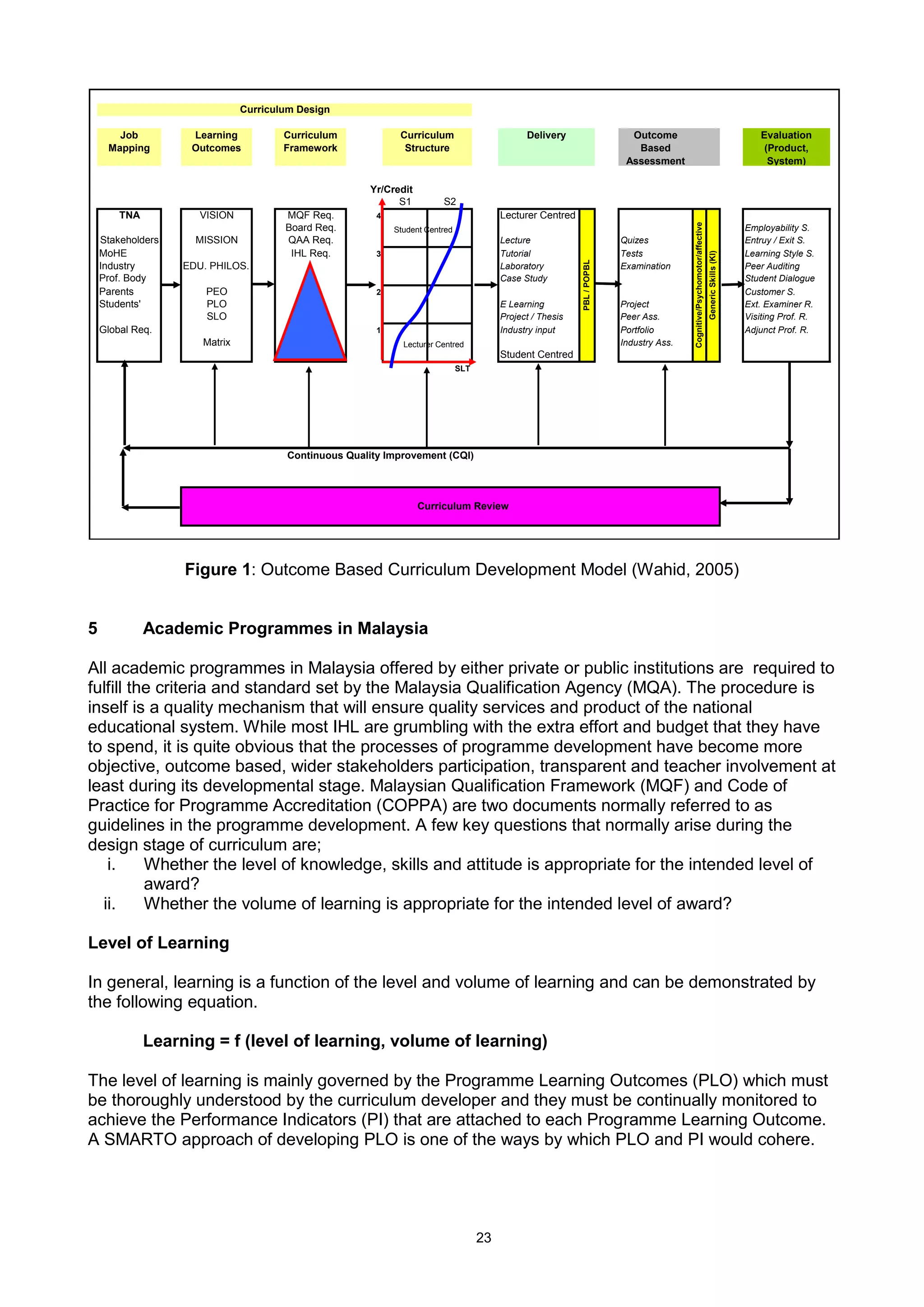
development, delivery, assessment and evaluation of the programme. (Figure 1)
Largely, the University is practicing OBE in its academic programmes provisions across all
faculties and disciplines. The eye browsing question of this model when applied to the trainees
who at the end of the day will be teaching and facilitating the skills or competency based education
(CBE) is somewhat quite challenging and requires some level of understanding of curriculum
development vis a vis teacher training.
23
Figure 1: Outcome Based Curriculum Development Model (Wahid, 2005)
5 Academic Programmes in Malaysia
All academic programmes in Malaysia offered by either private or public institutions are required to
fulfill the criteria and standard set by the Malaysia Qualification Agency (MQA). The procedure is
inself is a quality mechanism that will ensure quality services and product of the national
educational system. While most IHL are grumbling with the extra effort and budget that they have
to spend, it is quite obvious that the processes of programme development have become more
objective, outcome based, wider stakeholders participation, transparent and teacher involvement at
least during its developmental stage. Malaysian Qualification Framework (MQF) and Code of
Practice for Programme Accreditation (COPPA) are two documents normally referred to as
guidelines in the programme development. A few key questions that normally arise during the
design stage of curriculum are;
i. Whether the level of knowledge, skills and attitude is appropriate for the intended level of
award?
ii. Whether the volume of learning is appropriate for the intended level of award?
Level of Learning
In general, learning is a function of the level and volume of learning and can be demonstrated by
the following equation.
Learning = f (level of learning, volume of learning)
The level of learning is mainly governed by the Programme Learning Outcomes (PLO) which must
be thoroughly understood by the curriculum developer and they must be continually monitored to
achieve the Performance Indicators (PI) that are attached to each Programme Learning Outcome.
A SMARTO approach of developing PLO is one of the ways by which PLO and PI would cohere.
Job
Mapping
Learning
Outcomes
Curriculum
Framework
Outcome
Based
Assessment
Evaluation
(Product,
System)
Yr/Credit
TNA VISION MQF Req. 4 Lecturer Centred
Board Req. Employability S.
Stakeholders MISSION QAA Req. Lecture Quizes Entruy / Exit S.
MoHE IHL Req. 3 Tutorial Tests Learning Style S.
Industry EDU. PHILOS. Laboratory Examination Peer Auditing
Prof. Body Case Study Student Dialogue
Parents PEO 2 Customer S.
Students' PLO E Learning Project Ext. Examiner R.
SLO Project / Thesis Peer Ass. Visiting Prof. R.
Global Req. 1 Industry input Portfolio Adjunct Prof. R.
Matrix Industry Ass.
Student Centred
SLT F_pbl!A1
C:qaOBEkk_cur dev_ ver4_0405.xls
Curriculum Review
Cognitive/Psychomotor/affective
GenericSkills(KI)
Continuous Quality Improvement (CQI)
Curriculum Design
Delivery
PBL/POPBL
S1 S2
Curriculum
Structure
Student Centred
Lecturer Centred
24
Volume of Learning
The term normally used in the academic definition of the volume of learning is simply Credit and it
is the equivalent currency used all over the world. Credit is further defined as the operational SLT
used in a particular system of education. SLT may be defined as the quantitative measure of
learning activities to achieve a specified learning outcome [MQA,2006]. SLT concept is not only
important to the teachers involved in the development and implementation of learning, but also to
the learners or students who would like to perform in their study as there is a relationship between
students achievement and SLT on the part of the learners.
Relationship of Students Achievements and SLT
Theoretically, the students’ achievement in learning is the function of their ability, effort and the
instruction given to them [Zainai, 2006]. This can be written in the following form:
Ach = f(a + e + i)
Where
Ach = Achievement;
a = Ability, which is the function of innate ability and acquired ability;
e = Effort, which is the function of motivation and time spent on task;
i = Instruction, which is the function of quality of preparation and quality of
delivery.
This theory shows that a component of achievement exists in the form of self-effort or
independent study. Hence, SLT is directly related to the person’s effort in learning, and the
student’s achievement is influenced by his effective implementation of SLT. In other words, to be
successful in their studies, students should utilise to the fullest the component e in the above
equation. SLT is also related to the term i in the above equation which represents delivery
(instruction) whereby i also constitutes the official contact time, be it in the form of scheduled
timetabling or the meetings made through appointment arranged by the students and their
supervisors.
6 Bachelor of Vocational Education (Specialisation) with Honours at UTHM
Using the Outcome Based Curriculum Development Model (2005) earlier discussed, the
stakeholders inputs and perspectives were sought through meetings, dialogues and workshops at
different levels of involvement. The main strategies by the Technical and Vocational Education
Division (TVED) involved the rethinking and strengthening of (i) Curriculum (ii) Enrolment (iii)
Schools and Facilities (iv) Technical strand (v) Skills (vi) Industry linkages (vii) Higher Education
Institutions Collaboration, and (viii) School Enterprise.
As far as the requirement of TVED in terms of TVE teachers attributes or Programme Learning
Outcomes, they would like to have the following;
i. Graduate Teachers (Level 6 of MQF)
ii. Professional Qualification / Teaching Certificate
iii. Skills Competency
iv. Entrepreneurship Skills
v. Generic Skills
25
Figure 2: Curriculum Design Framework
Faced with the above requirements, the Faculty had a very long discussion with the stakeholders,
curriculum developers, academic leaders and teachers to come up with a design framework that
will satisfy our stakeholders and yet philosophically and theoretically sound. In Malaysia, the
Teaching Professionalism is under the jurisdiction of the Teachers Education Division, Ministry of
Education while Skills Competency Standard is under the Department of Skills Development
(DSD), the Ministry of Human Resource.
Being a public University, the FTE is subjected to the requirements of these two important
departments apart from the Ministry of Higher Education. While there is no right or wrong models,
the FTE is more comfortable with the third model; Thematic Model. The Thematic Model offers
more of academic rather than pragmatic justifications. While it would be pragmatic to implement
the more popular framework of Course Based or Modular Based, the idea of implementing Theme
Based is very much in its piloting stages.[Froyd and Ohland,2006]
There are altogether 7 new programmes with the similar nomenclature that are proposed to
the Malaysian Qualification Agency and so far 2 programmes were approved while the others are
still in the process for approval. They are;
i. Bachelor of Vocational Education (Electric and Electronics) with Honours
ii. Bachelor of Vocational Education (Catering) with Honours
iii. Bachelor of Vocational Education (Construction) with Honours
iv. Bachelor of Vocational Education (Creative Multimedia) with Honours
v. Bachelor of Vocational Education (Refrigeration and Airconditioning) with Honours
vi. Bachelor of Vocational Education (Welding and Fabrication) with Honours
vii. Bachelor of Vocational Education (Machining) with Honours
The main structure of the curriculum was designed having the programme outcome in mind
or the trainee teacher in mind. They must be graduated as a Graduate Licensed Teacher who has
at least level 2 of Malaysian Skills Certificate. Apart of having some good command of generic
skills, he has to have some Entrepreneurship skills to support the school enterprise programme at
vocational schools.
Designing a programme of this nature, bi-polar (academic on one end and skills on the
other end) is quite a challenging task, primarily because academic courses require more cognitive
processes while skill courses need more time for practices or psychomotor processes. In doing so,
the features of the programme is as follows;
i. Total of 135 credits, with Core Vocational Education (55%), Specialisation (30%) and
General Compulsory Courses (15%).
ii. The mapping of the academic outcomes and the skills outcomes, to avoid overlapping of
outcomes or contents.
Model
Topping up
Mixed Topping up
Thematic
Note:
Knowledge
Professional
Skills
26
iii. Provision of Industrial Attachment in addition to the normally Teaching Practice.
iv. Allowing skills assessment to be conducted by DSD to certify the trainee level of skills
competency or working on equivalency of outcomes and activities.
v. Provision of Lab School Networking with vocational schools to allow for more interactivities
between schools and the Faculty.
vi. Provision of research collaborations between vocational teachers and the Faculty.
vii. Improving the practice of theme based learning activities.
The Faculty and the 9 vocational schools in the southern region has formed a networking
collaboration to improve the quality of teacher training by making the schools as their laboratory
that they can visit and experiment and do research. The recently held Voctech Learning Aid
Competition was an initiative to develop research and entrepreneurship capabilities among
teachers.
7 Summary
The involvement of teachers in the curriculum development should be encouraged to ensure that
the teachers and teacher trainees will benefit from such initiatives. While recognizing the
importance of skills competency requirement of vocational teachers, the role of academic
development should be given the highest priority as it will determine the long term efficacy and
development of the learning institution. It is our hope that the new programme for vocational
teachers training would produce an impact of excellence among students and schools at large.
University
REFERENCES
Bransford J., Hammond, D. And LePage, P.(2005). Preparing Teachers for a Changing World.
Indianapolis: Jossey-Bass.
Cleveland State University,(2003). The Teacher as a Responsive, Reflective Professional: a
Partner in Learning, Accessed: from http://www.csuohio.edu/cehs/about/docs/Conceptual
Frameworks Report.pdf
Dittrich,J. Jailani, M.Y., Spottl,G.,Bukit,M.(eds).(2009).Standardisation in TVET Teacher
Education.Peter Lang. pp. 190
Froyd,J.E. and Ohland.M.W. 2005. Integrated Engineering Curricula. Journal of Engineering
Education). Jan 2005. Vol.91.1. ProQuest Education Journals. Pp.147-163
Goe,L.(2007). The Link between Teacher Qualty and Students Outcomes: a Research Synthesis.
Technical Report (S283B050051). Washington: National Comprehensive Center for Teacher
Quality.
Malaysian Qualification Agency.(2006). Malaysian Qualification Framework. Pp. 3
Ministerial Council on Education, Employment Training and Youth Affairs Australia.(2003). A
National Framework for Professional Standards for Teaching: Teacher Quality and Educational
Leadership Taskforce. Accessed: from
http://www.mceetya.edu.au/verve/_resources/national_framework_file.pdf
Ministry of Education.(2009). Malaysian Teacher Standard. Teacher Education Division. Accessed:
from http://www.ipik.edu.my/sgmdoc/
27
Mohamed El-Okda.(2005). A Proposed Model for EFL Teacher Involvement in On-going
Curriculum Development. The Asian EFL Journal Quarterly Dec. 2005 Vol.7 Issue 4. Pp. 33-49
NCVER (2002). Review of Research: Comparative Study of Vocational Education and Training
Systems: National Vocational Education and Training Systems across three Regions under
Pressure of Change. NCVER Ltd.Australia.
Spottl,G.(2009) in Dittrich,J. Jailani, M.Y., Spottl,G.,Bukit,M.(eds).(2009).Standardisation in TVET
Teacher Education.Peter Lang. pp. 18
Stillman College.(2008). The Standard of Excellence in Teacher Preparation. Accessed: April 11,
2009 from http://www.stillman.edu/stillman/education/ncate/default.htm.
Zainai Mohamed.(2006). Managing Student Learning Time For Effective Learning. Proceeding the
first National Conference on Technical Education 2006 – Enhancing Human Capital Development
Through Quality Technical Education. 27-29 August 2006, Penang.

Professional teaching standard 2

  • 1.
    Proceedings of the1 st UPI International Conference on Technical and Vocational Education and Training Bandung, Indonesia, 10-11 November 2010 19 The Development of Competency of Vocational Teachers in Malaysia: Curriculum Development Perspective Wahid Razzaly Universiti Tun Hussein Onn Malaysia (UTHM) wahid@uthm.edu.my Noraini Kaprawi Universiti Tun Hussein Onn Malaysia (UTHM) norain@uthm.edu.my Ghazaly Spahat Universiti Tun Hussein Onn Malaysia (UTHM) Abstract The development towards a knowledge based economy capable of sustainable economic growth and stronger national unity brings new challenges to the development of human capital development. The development of high quality vocational education and training is a crucial and integral part of this context, notably in terms of promoting employability and competitiveness. Owing to the dynamic nature of TVET, they are continuously subjected to the forces driving change in the schools, training institutions, industry and society. The context of today is not about the value and importance of TVET but how to ensure its relevance, responsiveness and value in an increasingly global economy. Being a developing country, Malaysia needs a strong support for TVET that turns the wheel of the industry. Consequently, the importance of sustainable and effective training of teachers and instructors can not be taken lightly. There has to be a critical analysis of the requirements, training processes and product evaluation. Therefore the central issues lie in the heart of the system; the curriculum that will drive the 99 vocational schools in Malaysia. This paper addresses the training of teachers concept from the perspective of curriculum development that would be able to meet the requirement of the stakeholders.More specifically the questions to be addressed are: (i) What are the expected attributes of vocational teachers in Malaysia? (ii) How curriculum for vocational teachers should be developed? The basis of the above two questions perhaps may be seen from the perspective of philosophy, which span from the idealism to the existentialism. The method for this is largely descriptive analysis of relevant documents, interviews and discussions with notable policy makers in the teahers' training community. Added to that are the active involvement of the researchers in the process of the curriculum development intended for the new vocational teachers requiremens. In summary, this paper describes the curriculum development framework that the Faculty of Technical Education adopted in its effort to improving the competency of the teachers. The new curriculum design that will have its first intake of teacher trainees in July 2011 is expected to be able to provide TVE teachers acceptable to the Ministry of education. A number of critical issues in the course of its curriculum development processes will be highlighted for the purpose of academic discourse.
  • 2.
    20 1 Introduction When theDeputy Prime Minister of Malaysia lamented that the transformation of vocational education was critical when some 46% of the new jobs will require a minimum of vocational or diploma qualifications as currently 100,000 SPM holders (about 22%) enter the job market annually without any skills training, the importance of vocational education became the talk of the town. Soon after, when the 2011 Budget was announced by the Prime Minister on the 15th October 2011, the education sectors alone was provided with a handsome 22.9% of the total annual budget (RM212 billion), indicating the seriousness of the government in its National Key Result Areas (NKRA). Following that, the Ministry of Education has asked the TVED to quickly start the action plan of strengthening the Vocational Education in Malaysia. Hence, there is also an urgent need to address the quantity and quality of vocational teachers. Being a Provider based and Unified System [NCVER,2002] of vocational education, Malaysia has a lot to do for its Vocational education and training of vocational teachers. 2 Issues on Vocational Teachers The paper will discuss the issues that is central to the development of quality TVE teachers, that includes Scholarship of Teaching and Learning (SoTL), framework for quality teachers, standard for TVE teachers before elaborating on teachers and curriculum development. Scholarship of Teaching and Learning (SoTL) Boyers (1990) and Bransford et al.(2005 ) are among the few scholars who supported the concept of Scholarship of Teaching and Learning (SoTL) that should be an inherent in teachers. Bransford et al.(2005) asserts that to have a research informed professional practice, one should possess knowledge of subject matter, knowledge of learners and knowledge of teaching. Boyers (1990) accorded that a SoTL is always reflected in the for areas of scholarship, namely: Scholarship of Discovery, Scholarship of Integration, Scholarship of Application and Scholarship of Pedagogy. The purpose of each context of scholarship is shown in Table 1 below. Table 1: Boyer’s Model Scholarship (1990) Scholarship of Discovery New content knowledge is acquired and disseminated Scholarship of Discovery Creation of coherent pattern of new knowledge by synthesizing and making connection across disciplines Scholarship of Application Bridge the gap between theory and practice through both research and action Scholarship of Pedagogy Discovering the ways our students learn and the identification and assessment of the methods that are used to convey the knowledge. Another researcher, Dreyfus (1990) introduced skills acquisition model that may run through across many disciplines with the 5 stages of development; (i) novice, (ii) advanced beginners (iii) competent (iv) proficient, and (v) expert. This model is a popular model for skills acquisition, particularly in the nursing communities. The relationship between the scope and attributes of teachers as demonstrated by Bransford et al., Boyers and the skills acquisition model by Dreyfus could be depicted by the following Figure 1. The framework illustrates the teacher will ultimately be transformed into a quality teacher that have the three main job scope; teaching and learning, research and development, and services and consultancy. How one can integrate the three main job scopes will enable him to attain the level of competency as described by Dreyfus. A vocational teacher who
  • 3.
    21 has a researchactivity, providing advice and services in his area of expertise and performing lecture and workshop activities will be able to produce quality students or in other words as an expert, Figure 1: Scholarship of Teaching and Learning (SoTL) (Adapted from Boyers(1990), Dreyfus(1991), Bransford et al.(2005) ) Apart from the above model of quality teacher, there are others that have received much attention among researchers and practitioners on the conception of quality teacher framework or standard; (i) Stillman Teacher Education Programme (STEP) Conceptual Framework. [Stillman College, 2008] (ii) Framework for Teacher Quality [Goe, 2007] (iii) Teacher Education Conceptual Framework [Cleveland State University, 2003] (iv) National framework for Professional Standards [MCEETYA, 2003] (v) Malaysian Teacher Standard [Ministry of Education, 2009] A rather comprehensive research based study conducted through an EU-AsiaLink Project titled The Development of Transnational Standards for Training for Technical and Vocational Education and Training with a Multidisciplinary and Industrial Orientation involving representative institutions from Germany, Spain, Malaysia and Indonesia [http://www.itb.uni-bremen.de/tt-tvet/] provided some details of teacher training framework, standard and curriculum which is enshrined in the Bandung Declaration in conjunction with the First World Congress on Teacher Education for Technical and Vocational Education and Training in Bandung, July 2008. [Dittrich,J. et al.(2009)] While there are numerous attributes of vocational teachers, they should be able to adapt to changes in the future and Spottl (2009) suggested four central issues; (i) The changed role of the teacher (ii) The changed methods of instruction (iii) The development logical structurisation of instruction content (iv) The changed shaping of the learning environment and the shaping of framework conditions. The outcomes of the EU-Asialink Project earlier discussed, agreed upon the Open and Dynamic Approach to Standards which are based upon the following six domains. Expert Novice INPUT PROCESS OUTPUT BOYER (1990), BERNSTEIN (1971), BRANSFORD ET AL. (2005) Proficient Competent Advanced Beginner DREYFUS(1991) RnD Services Teaching RnD Services Teaching RnD Services Teaching RnD Services Teaching Teaching Services RnD Teaching RnD Services
  • 4.
    22 i. Standards forLecturers’ activities (in TVET Teacher Education) as support for Teachers’ practice in TVET ii. Standards for supporting students and their learning processes within TVET teacher education iii. Standards for Evaluation (of curricula) and for Assessment (of students’ achievements) iv. Standards for developing Curricula and Learning Contents v. Standards for developing methods for Instruction and Training vi. Standards for developing the Organisational Frameworks for learning environments 3 Teachers and Curriculum Development A framework for curriculum development and professional growth of teachers is widely discussed and among others are observation by El-Okda(2005) who asserted these principles are equally important for the school and the teachers as well. 1. Curriculum development is an on-going process that should not cease once a new series of textbooks are introduced. 2. Curriculum development and teacher development cannot be separated. 3. Teacher involvement in curriculum development is a major aspect of teacher expertise. 4. A national curriculum and school based curriculum initiatives can co-exist. 5. Teacher involvement in on-going curriculum development is essentially a collaborative endeavor. 6. Teacher research was historically introduced within the framework of curriculum development projects and should continue to be basically viewed as a tool for involving teachers in on-going curriculum development. 4 UTHM Curriculum Development Model of Vocational Teachers Training As one of the provider of Technical and Vocational Teachers Training in Malaysia, the Faculty of Technical Education (FTE) has to keep abreast with the current and future development of vocational teacher training in Malaysia and elsewhere. It is basically a business that requires one to provide a viable business model that can sustain the faculty and its activities. The business model, helps us in understanding our core business, main factors affecting the business, and key players in performing the business. The model also helps to understand customers demand, and strategise the action to achieve the business targets. Business model is defined as the mechanism by which a business intends to generate revenue and profits. It is a summary of how a company plans to serve its customers using both strategy and implementation. Unlike private educational institutions, UTHM is under less pressure to come up with a working business model as it is largely financed by the Government of Malaysia. Nevertheless, the enculturation that the funding will some days subside and the Faculty has to earn its own funding must be thought of seriously. A Balance Score Card (BSC) as a monitoring and management tool was introduced since 2006 to familiarize each Faculty of its core business and target, While the researcher was the Dean for the Centre for Academic Development (CAD) a framework for curriculum development was developed to help Faculties in the design, development, delivery, assessment and evaluation of the programme. (Figure 1) Largely, the University is practicing OBE in its academic programmes provisions across all faculties and disciplines. The eye browsing question of this model when applied to the trainees who at the end of the day will be teaching and facilitating the skills or competency based education (CBE) is somewhat quite challenging and requires some level of understanding of curriculum development vis a vis teacher training.
  • 5.
    23 Figure 1: OutcomeBased Curriculum Development Model (Wahid, 2005) 5 Academic Programmes in Malaysia All academic programmes in Malaysia offered by either private or public institutions are required to fulfill the criteria and standard set by the Malaysia Qualification Agency (MQA). The procedure is inself is a quality mechanism that will ensure quality services and product of the national educational system. While most IHL are grumbling with the extra effort and budget that they have to spend, it is quite obvious that the processes of programme development have become more objective, outcome based, wider stakeholders participation, transparent and teacher involvement at least during its developmental stage. Malaysian Qualification Framework (MQF) and Code of Practice for Programme Accreditation (COPPA) are two documents normally referred to as guidelines in the programme development. A few key questions that normally arise during the design stage of curriculum are; i. Whether the level of knowledge, skills and attitude is appropriate for the intended level of award? ii. Whether the volume of learning is appropriate for the intended level of award? Level of Learning In general, learning is a function of the level and volume of learning and can be demonstrated by the following equation. Learning = f (level of learning, volume of learning) The level of learning is mainly governed by the Programme Learning Outcomes (PLO) which must be thoroughly understood by the curriculum developer and they must be continually monitored to achieve the Performance Indicators (PI) that are attached to each Programme Learning Outcome. A SMARTO approach of developing PLO is one of the ways by which PLO and PI would cohere. Job Mapping Learning Outcomes Curriculum Framework Outcome Based Assessment Evaluation (Product, System) Yr/Credit TNA VISION MQF Req. 4 Lecturer Centred Board Req. Employability S. Stakeholders MISSION QAA Req. Lecture Quizes Entruy / Exit S. MoHE IHL Req. 3 Tutorial Tests Learning Style S. Industry EDU. PHILOS. Laboratory Examination Peer Auditing Prof. Body Case Study Student Dialogue Parents PEO 2 Customer S. Students' PLO E Learning Project Ext. Examiner R. SLO Project / Thesis Peer Ass. Visiting Prof. R. Global Req. 1 Industry input Portfolio Adjunct Prof. R. Matrix Industry Ass. Student Centred SLT F_pbl!A1 C:qaOBEkk_cur dev_ ver4_0405.xls Curriculum Review Cognitive/Psychomotor/affective GenericSkills(KI) Continuous Quality Improvement (CQI) Curriculum Design Delivery PBL/POPBL S1 S2 Curriculum Structure Student Centred Lecturer Centred
  • 6.
    24 Volume of Learning Theterm normally used in the academic definition of the volume of learning is simply Credit and it is the equivalent currency used all over the world. Credit is further defined as the operational SLT used in a particular system of education. SLT may be defined as the quantitative measure of learning activities to achieve a specified learning outcome [MQA,2006]. SLT concept is not only important to the teachers involved in the development and implementation of learning, but also to the learners or students who would like to perform in their study as there is a relationship between students achievement and SLT on the part of the learners. Relationship of Students Achievements and SLT Theoretically, the students’ achievement in learning is the function of their ability, effort and the instruction given to them [Zainai, 2006]. This can be written in the following form: Ach = f(a + e + i) Where Ach = Achievement; a = Ability, which is the function of innate ability and acquired ability; e = Effort, which is the function of motivation and time spent on task; i = Instruction, which is the function of quality of preparation and quality of delivery. This theory shows that a component of achievement exists in the form of self-effort or independent study. Hence, SLT is directly related to the person’s effort in learning, and the student’s achievement is influenced by his effective implementation of SLT. In other words, to be successful in their studies, students should utilise to the fullest the component e in the above equation. SLT is also related to the term i in the above equation which represents delivery (instruction) whereby i also constitutes the official contact time, be it in the form of scheduled timetabling or the meetings made through appointment arranged by the students and their supervisors. 6 Bachelor of Vocational Education (Specialisation) with Honours at UTHM Using the Outcome Based Curriculum Development Model (2005) earlier discussed, the stakeholders inputs and perspectives were sought through meetings, dialogues and workshops at different levels of involvement. The main strategies by the Technical and Vocational Education Division (TVED) involved the rethinking and strengthening of (i) Curriculum (ii) Enrolment (iii) Schools and Facilities (iv) Technical strand (v) Skills (vi) Industry linkages (vii) Higher Education Institutions Collaboration, and (viii) School Enterprise. As far as the requirement of TVED in terms of TVE teachers attributes or Programme Learning Outcomes, they would like to have the following; i. Graduate Teachers (Level 6 of MQF) ii. Professional Qualification / Teaching Certificate iii. Skills Competency iv. Entrepreneurship Skills v. Generic Skills
  • 7.
    25 Figure 2: CurriculumDesign Framework Faced with the above requirements, the Faculty had a very long discussion with the stakeholders, curriculum developers, academic leaders and teachers to come up with a design framework that will satisfy our stakeholders and yet philosophically and theoretically sound. In Malaysia, the Teaching Professionalism is under the jurisdiction of the Teachers Education Division, Ministry of Education while Skills Competency Standard is under the Department of Skills Development (DSD), the Ministry of Human Resource. Being a public University, the FTE is subjected to the requirements of these two important departments apart from the Ministry of Higher Education. While there is no right or wrong models, the FTE is more comfortable with the third model; Thematic Model. The Thematic Model offers more of academic rather than pragmatic justifications. While it would be pragmatic to implement the more popular framework of Course Based or Modular Based, the idea of implementing Theme Based is very much in its piloting stages.[Froyd and Ohland,2006] There are altogether 7 new programmes with the similar nomenclature that are proposed to the Malaysian Qualification Agency and so far 2 programmes were approved while the others are still in the process for approval. They are; i. Bachelor of Vocational Education (Electric and Electronics) with Honours ii. Bachelor of Vocational Education (Catering) with Honours iii. Bachelor of Vocational Education (Construction) with Honours iv. Bachelor of Vocational Education (Creative Multimedia) with Honours v. Bachelor of Vocational Education (Refrigeration and Airconditioning) with Honours vi. Bachelor of Vocational Education (Welding and Fabrication) with Honours vii. Bachelor of Vocational Education (Machining) with Honours The main structure of the curriculum was designed having the programme outcome in mind or the trainee teacher in mind. They must be graduated as a Graduate Licensed Teacher who has at least level 2 of Malaysian Skills Certificate. Apart of having some good command of generic skills, he has to have some Entrepreneurship skills to support the school enterprise programme at vocational schools. Designing a programme of this nature, bi-polar (academic on one end and skills on the other end) is quite a challenging task, primarily because academic courses require more cognitive processes while skill courses need more time for practices or psychomotor processes. In doing so, the features of the programme is as follows; i. Total of 135 credits, with Core Vocational Education (55%), Specialisation (30%) and General Compulsory Courses (15%). ii. The mapping of the academic outcomes and the skills outcomes, to avoid overlapping of outcomes or contents. Model Topping up Mixed Topping up Thematic Note: Knowledge Professional Skills
  • 8.
    26 iii. Provision ofIndustrial Attachment in addition to the normally Teaching Practice. iv. Allowing skills assessment to be conducted by DSD to certify the trainee level of skills competency or working on equivalency of outcomes and activities. v. Provision of Lab School Networking with vocational schools to allow for more interactivities between schools and the Faculty. vi. Provision of research collaborations between vocational teachers and the Faculty. vii. Improving the practice of theme based learning activities. The Faculty and the 9 vocational schools in the southern region has formed a networking collaboration to improve the quality of teacher training by making the schools as their laboratory that they can visit and experiment and do research. The recently held Voctech Learning Aid Competition was an initiative to develop research and entrepreneurship capabilities among teachers. 7 Summary The involvement of teachers in the curriculum development should be encouraged to ensure that the teachers and teacher trainees will benefit from such initiatives. While recognizing the importance of skills competency requirement of vocational teachers, the role of academic development should be given the highest priority as it will determine the long term efficacy and development of the learning institution. It is our hope that the new programme for vocational teachers training would produce an impact of excellence among students and schools at large. University REFERENCES Bransford J., Hammond, D. And LePage, P.(2005). Preparing Teachers for a Changing World. Indianapolis: Jossey-Bass. Cleveland State University,(2003). The Teacher as a Responsive, Reflective Professional: a Partner in Learning, Accessed: from http://www.csuohio.edu/cehs/about/docs/Conceptual Frameworks Report.pdf Dittrich,J. Jailani, M.Y., Spottl,G.,Bukit,M.(eds).(2009).Standardisation in TVET Teacher Education.Peter Lang. pp. 190 Froyd,J.E. and Ohland.M.W. 2005. Integrated Engineering Curricula. Journal of Engineering Education). Jan 2005. Vol.91.1. ProQuest Education Journals. Pp.147-163 Goe,L.(2007). The Link between Teacher Qualty and Students Outcomes: a Research Synthesis. Technical Report (S283B050051). Washington: National Comprehensive Center for Teacher Quality. Malaysian Qualification Agency.(2006). Malaysian Qualification Framework. Pp. 3 Ministerial Council on Education, Employment Training and Youth Affairs Australia.(2003). A National Framework for Professional Standards for Teaching: Teacher Quality and Educational Leadership Taskforce. Accessed: from http://www.mceetya.edu.au/verve/_resources/national_framework_file.pdf Ministry of Education.(2009). Malaysian Teacher Standard. Teacher Education Division. Accessed: from http://www.ipik.edu.my/sgmdoc/
  • 9.
    27 Mohamed El-Okda.(2005). AProposed Model for EFL Teacher Involvement in On-going Curriculum Development. The Asian EFL Journal Quarterly Dec. 2005 Vol.7 Issue 4. Pp. 33-49 NCVER (2002). Review of Research: Comparative Study of Vocational Education and Training Systems: National Vocational Education and Training Systems across three Regions under Pressure of Change. NCVER Ltd.Australia. Spottl,G.(2009) in Dittrich,J. Jailani, M.Y., Spottl,G.,Bukit,M.(eds).(2009).Standardisation in TVET Teacher Education.Peter Lang. pp. 18 Stillman College.(2008). The Standard of Excellence in Teacher Preparation. Accessed: April 11, 2009 from http://www.stillman.edu/stillman/education/ncate/default.htm. Zainai Mohamed.(2006). Managing Student Learning Time For Effective Learning. Proceeding the first National Conference on Technical Education 2006 – Enhancing Human Capital Development Through Quality Technical Education. 27-29 August 2006, Penang.