General Methods of Teaching
Lecture No 2
Misconceptions in teaching,
Criteria for professionals
And
Moral obligations of professionals
Misconception:
 A view or opinion that is incorrect because based on
faulty thinking or understanding.
1. Schools are isolated places.
2. Education is about learning of
different subjects.
3. Silence promote learning.
Misconceptions in teaching:
4. Learning is exploring different facts.
 5. Traditional Schooling Prepares Students for Life
 Listening to teachers and studying for tests has little to
do with life in the world of work. People in the work world
create, manage, evaluate, communicate, and collaborate.
According to Friere:
“ In fact knowledge is created, when we act and
reflect”
Paulo Friere was born in 1921 in Brazil.
He was an educator, philosopher, and
influential theorist of critical pedagogy.
He devised a philosophy or social
theory of education that is widely
known as Popular Education.
5. Drama or debates are extra or co-
curricular activities.
• Holistic development.
It means complete development, a child
needs to develop physically, intellectually,
ethically, socially and spiritually.
Co-curricular activities.
 Co-curricular activities (CCAs), previously known as
Extracurricular Activities (ECA) are activities that
educational organizations in some parts of the world
create for school students.
 They believe that extra activities for school students
are a means to enhance social interaction, leadership,
healthy recreation, self-discipline and self-confidence.
 The extra curriculum made its first appearance in
American colleges in the nineteenth century.
 http://encyclopedia.thefreedictionary.com/cocur
ricular+activities
“Teaching is an Art and
Science”
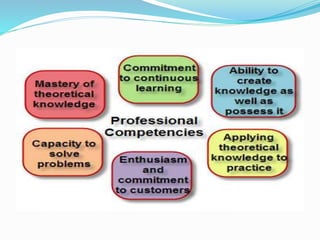
Professionalism
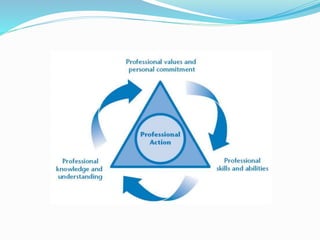
 The term Professionalism embraces a set of attitudes,
skills and behaviour, attributes and values which are
expected from those to whom society has extended the
privilege of being considered a Professional.
Characteristics of professionals:
 Professionals are responsive
 Professionals care about what they do
 Professionals are Knowledgeable
 Professionals teach you something
Criterion:
 A standard, rule, or test on which a judgment or
decision can be based.
OR
 A principle or standard by which something may be
judged or decided:
Criteria for being professionals:
 Learning a profession involves learning
many concepts and principles of that
profession.
 A profession has a body of techniques
and they may be transmitted
Cont..
 A profession is internally organized and
self-disciplined
 A profession has a social function
 A profession allows independence or
Autonomy
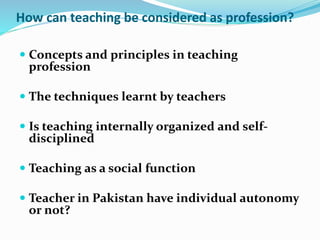
How can teaching be considered as profession?
 Concepts and principles in teaching
profession
 The techniques learnt by teachers
 Is teaching internally organized and self-
disciplined
 Teaching as a social function
 Teacher in Pakistan have individual autonomy
or not?
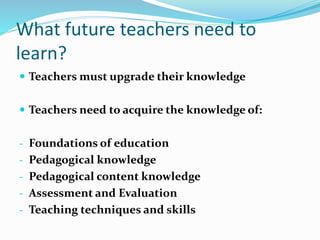
What future teachers need to
learn?
 Teachers must upgrade their knowledge
 Teachers need to acquire the knowledge of:
- Foundations of education
- Pedagogical knowledge
- Pedagogical content knowledge
- Assessment and Evaluation
- Teaching techniques and skills
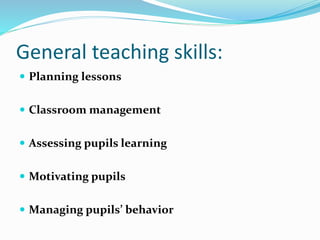
General teaching skills:
 Planning lessons
 Classroom management
 Assessing pupils learning
 Motivating pupils
 Managing pupils’ behavior
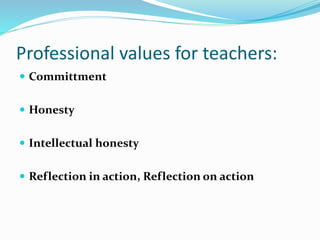
Professional values for teachers:
 Committment
 Honesty
 Intellectual honesty
 Reflection in action, Reflection on action
Moral obligation:
 moral obligation - an obligation arising out of
considerations of right and wrong.
 the social force that binds you to the courses of action
demanded by that force; "we must instill a sense of
duty in our children"; "every right implies a
responsibility; every opportunity, an obligation; every
possession, a duty"- John D.Rockefeller Jr
Lecture # 02.pptx

Lecture # 02.pptx

  • 1.
    General Methods ofTeaching Lecture No 2
  • 2.
    Misconceptions in teaching, Criteriafor professionals And Moral obligations of professionals
  • 3.
    Misconception:  A viewor opinion that is incorrect because based on faulty thinking or understanding.
  • 4.
    1. Schools areisolated places. 2. Education is about learning of different subjects. 3. Silence promote learning. Misconceptions in teaching:
  • 5.
    4. Learning isexploring different facts.  5. Traditional Schooling Prepares Students for Life  Listening to teachers and studying for tests has little to do with life in the world of work. People in the work world create, manage, evaluate, communicate, and collaborate. According to Friere: “ In fact knowledge is created, when we act and reflect”
  • 6.
    Paulo Friere wasborn in 1921 in Brazil. He was an educator, philosopher, and influential theorist of critical pedagogy. He devised a philosophy or social theory of education that is widely known as Popular Education.
  • 7.
    5. Drama ordebates are extra or co- curricular activities. • Holistic development. It means complete development, a child needs to develop physically, intellectually, ethically, socially and spiritually.
  • 8.
    Co-curricular activities.  Co-curricularactivities (CCAs), previously known as Extracurricular Activities (ECA) are activities that educational organizations in some parts of the world create for school students.  They believe that extra activities for school students are a means to enhance social interaction, leadership, healthy recreation, self-discipline and self-confidence.  The extra curriculum made its first appearance in American colleges in the nineteenth century.  http://encyclopedia.thefreedictionary.com/cocur ricular+activities
  • 9.
    “Teaching is anArt and Science”
  • 10.
    Professionalism  The termProfessionalism embraces a set of attitudes, skills and behaviour, attributes and values which are expected from those to whom society has extended the privilege of being considered a Professional.
  • 11.
    Characteristics of professionals: Professionals are responsive  Professionals care about what they do  Professionals are Knowledgeable  Professionals teach you something
  • 14.
    Criterion:  A standard,rule, or test on which a judgment or decision can be based. OR  A principle or standard by which something may be judged or decided:
  • 15.
    Criteria for beingprofessionals:  Learning a profession involves learning many concepts and principles of that profession.  A profession has a body of techniques and they may be transmitted
  • 16.
    Cont..  A professionis internally organized and self-disciplined  A profession has a social function  A profession allows independence or Autonomy
  • 17.
    How can teachingbe considered as profession?  Concepts and principles in teaching profession  The techniques learnt by teachers  Is teaching internally organized and self- disciplined  Teaching as a social function  Teacher in Pakistan have individual autonomy or not?
  • 18.
    What future teachersneed to learn?  Teachers must upgrade their knowledge  Teachers need to acquire the knowledge of: - Foundations of education - Pedagogical knowledge - Pedagogical content knowledge - Assessment and Evaluation - Teaching techniques and skills
  • 19.
    General teaching skills: Planning lessons  Classroom management  Assessing pupils learning  Motivating pupils  Managing pupils’ behavior
  • 20.
    Professional values forteachers:  Committment  Honesty  Intellectual honesty  Reflection in action, Reflection on action
  • 21.
    Moral obligation:  moralobligation - an obligation arising out of considerations of right and wrong.  the social force that binds you to the courses of action demanded by that force; "we must instill a sense of duty in our children"; "every right implies a responsibility; every opportunity, an obligation; every possession, a duty"- John D.Rockefeller Jr