I.Karthikeyan
Assistant Professor,
Mechanical Department .
1
Unit Iv Safety and Responsibilities
and Rights
 Safety and Risk – Assessment of Safety and Risk – Risk
Benefit Analysis and Reducing Risk - Respect for Authority
– Collective Bargaining – Confidentiality – Conflicts of
Interest – Occupational
 Crime – Professional Rights – Employee Rights –
Intellectual Property Rights (IPR) – Discrimination
EMPLOYEE RIGHTS
 Internal Complaint to Human Resources or
management
 Human Rights complaint under the Code
 Stress Leave/Disability (if available)
 Civil Action/Constructive Dismissal
EMPLOYER RESPONSIBILITIES
 Employment Contracts
 Policies (Harassment, Internet Use)
 Training
 Monitoring
 Discipline
EMPLOYER RESPONSIBILITIES
Employment Contract and Policies
 Outline what behaviour is not acceptable in the
workplace
 Set out the employer’s expectations regarding
proper conduct in the workplace
 Advise what range of disciplinary action will be taken
should an employee be found to have breached the
policy
EMPLOYER RESPONSIBILITIES
Investigation
 Assess the complaint
 Appoint an investigator
 Conduct interviews
 Make interim decisions on complainant/respondent
 Process evidence and interview additional parties
EMPLOYER RESPONSIBILITIES
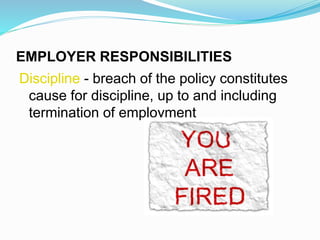
Discipline - breach of the policy constitutes
cause for discipline, up to and including
termination of employment
HUMAN RIGHTS COMPLAINT
 Usually arises after the Employer has either failed to
respond to a complaint or has made a decision with
which the Complainant disagrees
Under the current system an applicant may bring their
complaint directly before the Ontario Human Rights
Tribunal
 Within this system a complaint may be resolved by
adjudication or mediation
DISABILITY BENEFITS
 If the harassment results in severe mental distress it
may result in a claim for short-term or long-term
disability, if available
 Workplace stress has rapidly becoming one of the
most popular causes for employee absence and
disability claims
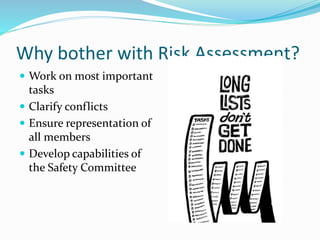
Why bother with Risk Assessment?
 Work on most important
tasks
 Clarify conflicts
 Ensure representation of
all members
 Develop capabilities of
the Safety Committee
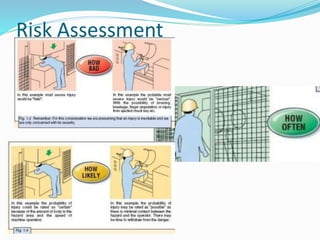
Risk Assessment
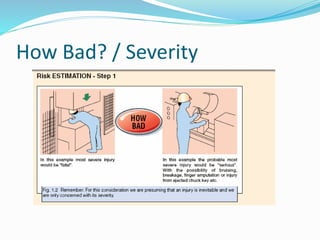
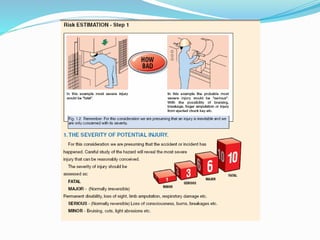
How Bad? / Severity
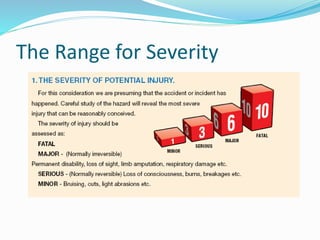
The Range for Severity
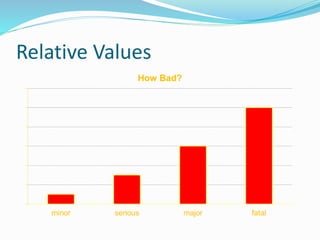
Relative Values
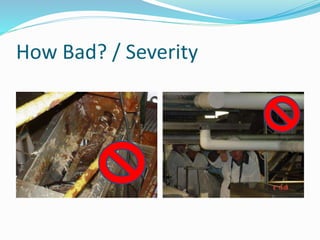
How Bad? / Severity
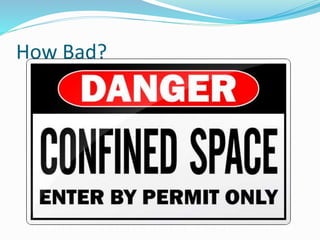
How Bad?
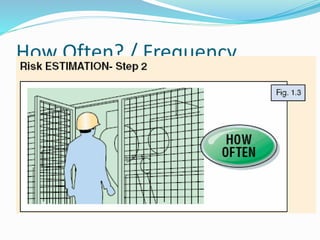
How Often? / Frequency
Elements of “How Much?”
How Many?
How Often?
How Long?
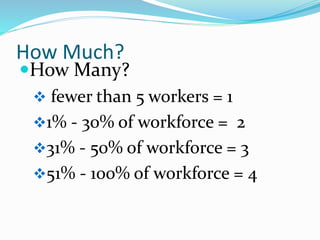
How Much?
How Many?
 fewer than 5 workers = 1
1% - 30% of workforce = 2
31% - 50% of workforce = 3
51% - 100% of workforce = 4
How Much?
How Often?
 A few times a year = 1
Once a month = 2
Weekly = 3
Daily = 4
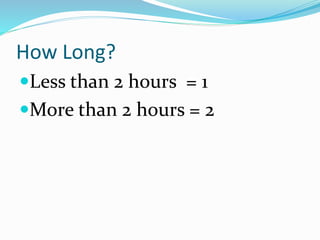
How Long?
Less than 2 hours = 1
More than 2 hours = 2
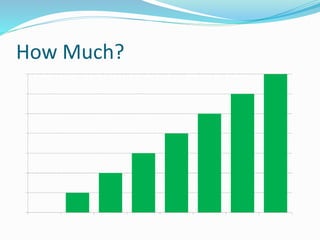
Combine the Elements
 How Many? + How Often? + How Long? = How Much?
How Much?
How Much?
 A maintenance worker has to enter and clean waste
out of a pit every six months. The job takes less than 2
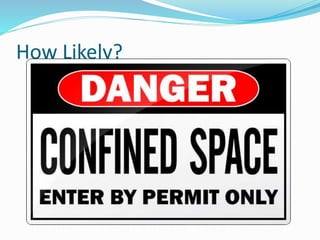
hours and only involves the entrant and the attendant.
This job is classified as a “Permit Required Confined
Space Entry” . The maintenance worker has expressed
concerns about the entry procedure. He does not
think it is safe.
How Much?
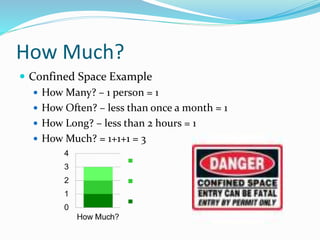
 Confined Space Example
 How Many? – 1 person = 1
 How Often? – less than once a month = 1
 How Long? – less than 2 hours = 1
 How Much? = 1+1+1 = 3
How Much?
 Sanitation example
 All of the sanitation workers in the plant have been
provided with gloves that do not provide sufficient
protection. They are exposed to harsh chemicals
throughout their entire shift. Some workers have
complained of rashes on their hands and wrists.
How Much?
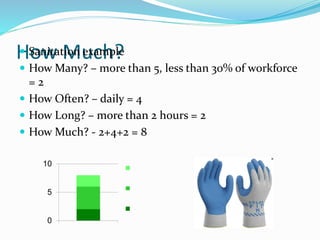
 Sanitation example
 How Many? – more than 5, less than 30% of workforce
= 2
 How Often? – daily = 4
 How Long? – more than 2 hours = 2
 How Much? - 2+4+2 = 8
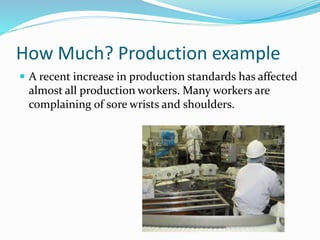
How Much? Production example
 A recent increase in production standards has affected
almost all production workers. Many workers are
complaining of sore wrists and shoulders.
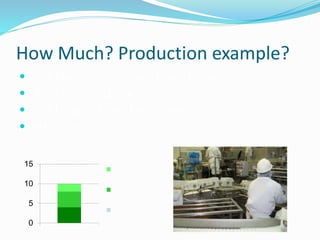
How Much? Production example?
 How Many? – 51% - 100% of workforce = 4
 How Often? – daily = 4
 How Long? – More than 2 hours = 2
 4+4+2 = 10
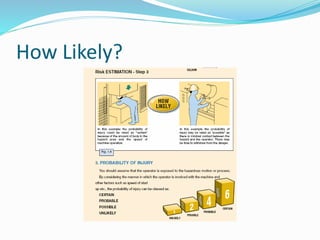
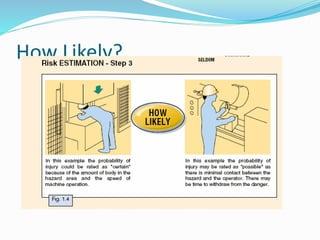
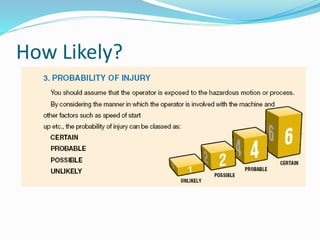
How Likely?
We cannot predict how likely it
is for a complex system to fail!
All mechanical systems fail
eventually.
How Likely?
How Likely?
How Likely?
How Likely?
How Likely?
How Likely?
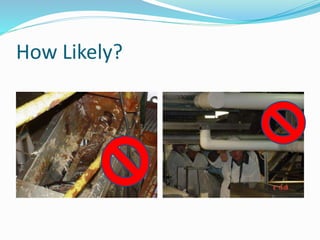
 Assume something has already gone wrong and the
worker IS exposed to the hazard
 Will the exposure to the hazard result in injury?
 All mechanical systems fail.
 Don’t try to predict when complex systems will fail
(unless you are a wizard!)
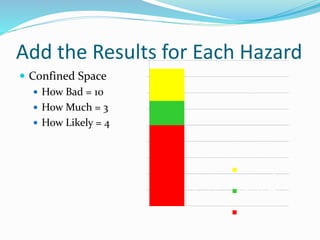
Add the Results for Each Hazard
 Confined Space
 How Bad = 10
 How Much = 3
 How Likely = 4
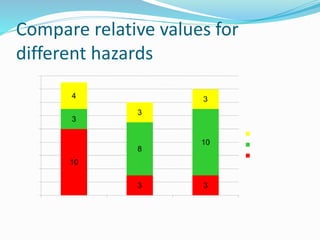
Compare relative values for
different hazards
Imminent Danger
Corporate Social Responsibility
• Concepts, key issues, context
• Key CSR drivers
• Implications for enterprise
• Implications for development
Main Concepts of CSR
CSR (Carrol, 1979)
Firms have responsibilities to societies including economic, legal,
ethical and discretionary (or philanthropic).
- See also DeGeorge (1999) on the “Myth of the Amoral Firm”
Social Contract (Donaldson, 1982; Donaldson and Dunfee,
1999) – There is a tacit social contract between the firm and
society; the contract bestows certain rights in exchange for
certain responsibilities.
Stakeholder Theory (Freeman, 1984) – A stakeholder is “any group
or individual who can affect or is affected by the achievement of an
organisation’s purpose.” Argues that it is in the company’s strategic
interest to respect the interests of all its stakeholders.
Main Concepts of CSR
CSR = political economy
The rights and responsibilities assigned to private industry.
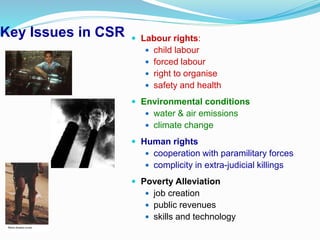
Key Issues in CSR  Labour rights:
 child labour
 forced labour
 right to organise
 safety and health
 Environmental conditions
 water & air emissions
 climate change
 Human rights
 cooperation with paramilitary forces
 complicity in extra-judicial killings
 Poverty Alleviation
 job creation
 public revenues
 skills and technology
Context Globally
 Liberalisation of markets – reduction of the
regulatory approach
 Emergence of global giants, consolidation of
market share
 Development of the ‘embedded firm’ and the
global value chain
 Development of supplier networks in developing
countries
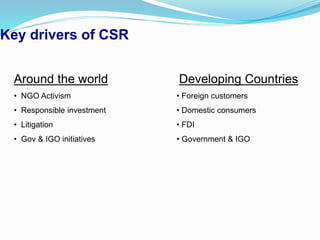
Key drivers of CSR
Around the world
• NGO Activism
• Responsible investment
• Litigation
• Gov & IGO initiatives
Developing Countries
• Foreign customers
• Domestic consumers
• FDI
• Government & IGO
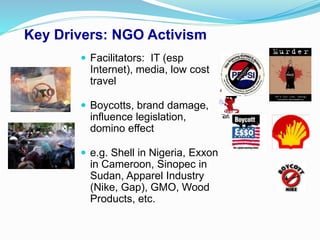
Key Drivers: NGO Activism
 Facilitators: IT (esp
Internet), media, low cost
travel
 Boycotts, brand damage,
influence legislation,
domino effect
 e.g. Shell in Nigeria, Exxon
in Cameroon, Sinopec in
Sudan, Apparel Industry
(Nike, Gap), GMO, Wood
Products, etc.
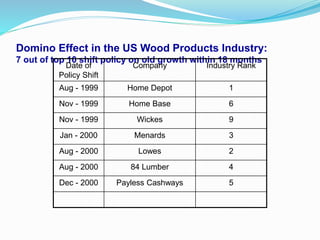
Domino Effect in the US Wood Products Industry:
7 out of top 10 shift policy on old growth within 18 months
Date of
Policy Shift
Company Industry Rank
Aug - 1999 Home Depot 1
Nov - 1999 Home Base 6
Nov - 1999 Wickes 9
Jan - 2000 Menards 3
Aug - 2000 Lowes 2
Aug - 2000 84 Lumber 4
Dec - 2000 Payless Cashways 5
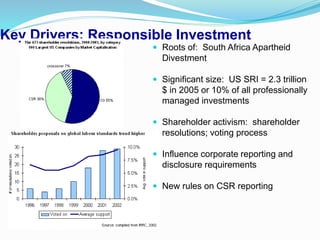
Key Drivers: Responsible Investment
 Roots of: South Africa Apartheid
Divestment
 Significant size: US SRI = 2.3 trillion
$ in 2005 or 10% of all professionally
managed investments
 Shareholder activism: shareholder
resolutions; voting process
 Influence corporate reporting and
disclosure requirements
 New rules on CSR reporting
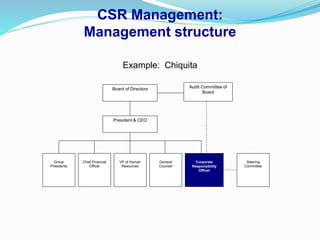
CSR Management:
Management structure
Example: Chiquita
Board of Directors
President & CEO
Group
Presidents
Chief Financial
Officer
VP of Human
Resources
General
Counsel
Corporate
Responsibility
Officer
Steering
Committee
Audit Committee of
Board
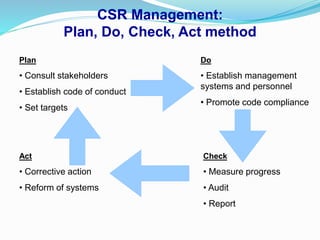
CSR Management:
Plan, Do, Check, Act method
Plan
• Consult stakeholders
• Establish code of conduct
• Set targets
Do
• Establish management
systems and personnel
• Promote code compliance
Check
• Measure progress
• Audit
• Report
Act
• Corrective action
• Reform of systems
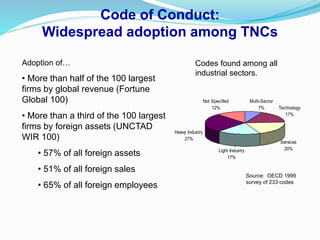
Code of Conduct:
Widespread adoption among TNCs
Adoption of…
• More than half of the 100 largest
firms by global revenue (Fortune
Global 100)
• More than a third of the 100 largest
firms by foreign assets (UNCTAD
WIR 100)
• 57% of all foreign assets
• 51% of all foreign sales
• 65% of all foreign employees
Multi-Sector
7% Technology
17%
Services
20%
Light Industry
17%
Heavy Industry
27%
Not Specified
12%
Codes found among all
industrial sectors.
Source: OECD 1999
survey of 233 codes
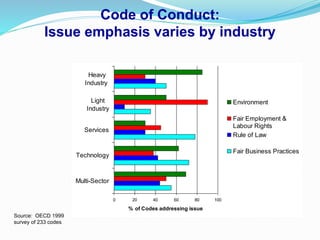
Code of Conduct:
Issue emphasis varies by industry
0 20 40 60 80 100
Multi-Sector
Technology
Services
Light
Industry
Heavy
Industry
% of Codes addressing issue
Environment
Fair Employment &
Labour Rights
Rule of Law
Fair Business Practices
Source: OECD 1999
survey of 233 codes
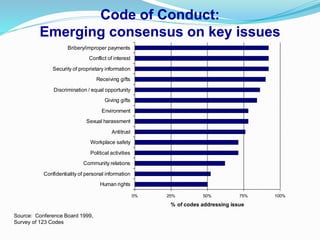
Code of Conduct:
Emerging consensus on key issues
Source: Conference Board 1999,
Survey of 123 Codes
0% 25% 50% 75% 100%
Human rights
Confidentiality of personal information
Community relations
Political activities
Workplace safety
Antitrust
Sexual harassment
Environment
Giving gifts
Discrimination / equal opportunity
Receiving gifts
Security of proprietary information
Conflict of interest
Bribery/improper payments
% of codes addressing issue
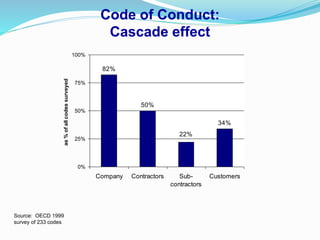
Code of Conduct:
Cascade effect
82%
50%
34%
22%
0%
25%
50%
75%
100%
Company Contractors Sub-
contractors
Customers
as
%
of
all
codes
surveyed
Source: OECD 1999
survey of 233 codes
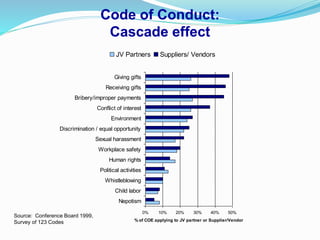
Code of Conduct:
Cascade effect
Source: Conference Board 1999,
Survey of 123 Codes
0% 10% 20% 30% 40% 50%
Nepotism
Child labor
Whistleblowing
Political activities
Human rights
Workplace safety
Sexual harassment
Discrimination / equal opportunity
Environment
Conflict of interest
Bribery/improper payments
Receiving gifts
Giving gifts
% of COE applying to JV partner or Supplier/Vendor
JV Partners Suppliers/ Vendors
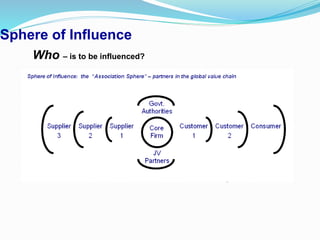
Sphere of Influence
Who – is to be influenced?
Sphere of Influence
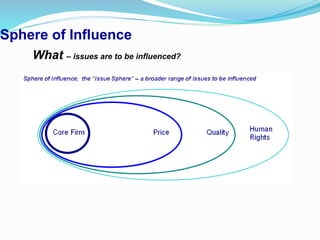
What – issues are to be influenced?
Sphere of Influence
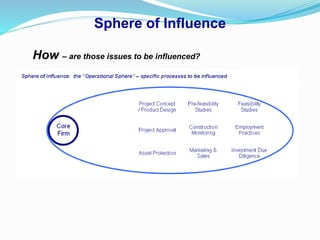
How – are those issues to be influenced?
Sphere of Influence
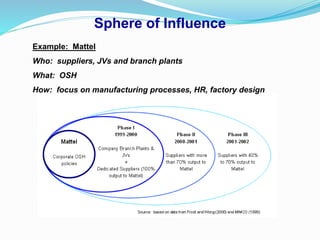
Example: Mattel
Who: suppliers, JVs and branch plants
What: OSH
How: focus on manufacturing processes, HR, factory design
CSR Management:
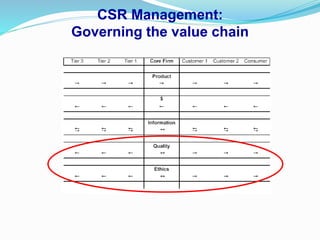
Governing the value chain
Compliance Management:
Management by certification
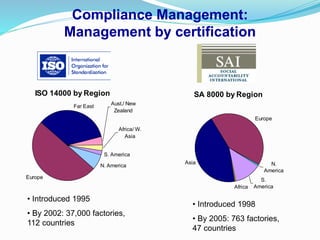
ISO 14000 by Region
Europe
Far East
N. America
Aust./ New
Zealand
S. America
Africa/ W.
Asia
• Introduced 1998
• By 2005: 763 factories,
47 countries
• Introduced 1995
• By 2002: 37,000 factories,
112 countries
SA 8000 by Region
Asia
Europe
N.
America
S.
America
Africa
Compliance Management:
Management by certification
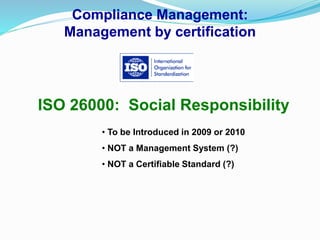
ISO 26000: Social Responsibility
• To be Introduced in 2009 or 2010
• NOT a Management System (?)
• NOT a Certifiable Standard (?)
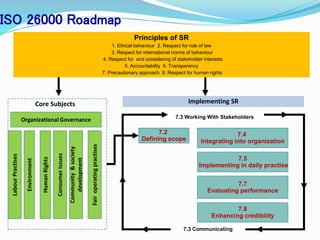
Principles of SR
1. Ethical behaviour 2. Respect for rule of law
3. Respect for international norms of behaviour
4. Respect for and considering of stakeholder interests
5. Accountability 6. Transparency
7. Precautionary approach 8. Respect for human rights
Organizational Governance
Human
Rights
Labour
Practises
Environment
Fair
operating
practises
Consumer
issues
Community
&
society
development
Core Subjects Implementing SR
7.2
Defining scope
7.5
Implementing in daily practise
7.7
Evaluating performance
7.8
Enhancing credibility
7.4
Integrating into organization
ISO 26000 Roadmap
7.3 Working With Stakeholders
7.3 Communicating
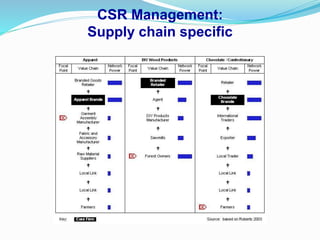
CSR Management:
Supply chain specific
CSR Management:
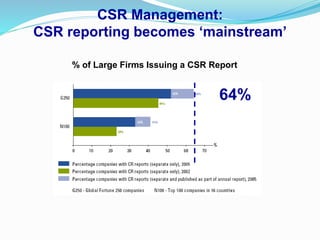
CSR reporting becomes ‘mainstream’
% of Large Firms Issuing a CSR Report
64%
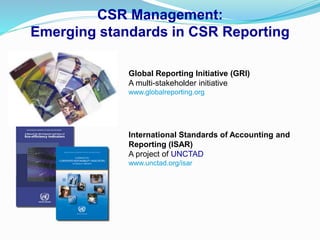
CSR Management:
Emerging standards in CSR Reporting
Global Reporting Initiative (GRI)
A multi-stakeholder initiative
www.globalreporting.org
International Standards of Accounting and
Reporting (ISAR)
A project of UNCTAD
www.unctad.org/isar
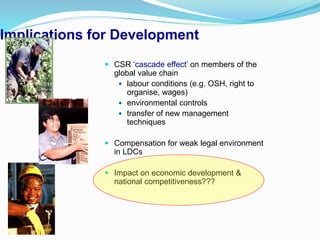
Implications for Development
 CSR ‘cascade effect’ on members of the
global value chain
 labour conditions (e.g. OSH, right to
organise, wages)
 environmental controls
 transfer of new management
techniques
 Compensation for weak legal environment
in LDCs
 Impact on economic development &
national competitiveness???
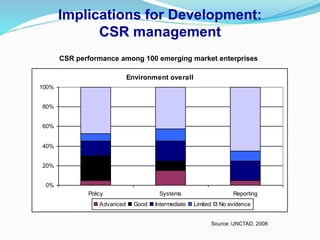
Implications for Development:
CSR management
CSR performance among 100 emerging market enterprises
Source: UNCTAD, 2008
Environment overall
0%
20%
40%
60%
80%
100%
Policy Systems Reporting
Advanced Good Intermediate Limited No evidence
Implications for Development:
CSR management
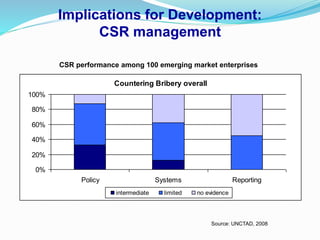
CSR performance among 100 emerging market enterprises
Source: UNCTAD, 2008
Countering Bribery overall
0%
20%
40%
60%
80%
100%
Policy Systems Reporting
intermediate limited no evidence
Implications for Development:
CSR management
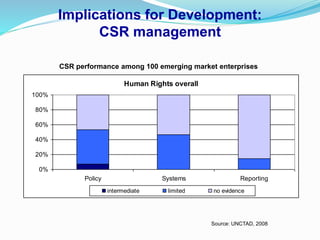
CSR performance among 100 emerging market enterprises
Source: UNCTAD, 2008
Human Rights overall
0%
20%
40%
60%
80%
100%
Policy Systems Reporting
intermediate limited no evidence
Implications for Development:
is CSR good for growth?
“…[CSR] is liable to hold back the development of poor
countries through the suppression of employment opportunities
within them.”
David Henderson
“[CSR]’s adoption would reduce competition and economic
freedom, and undermine the market economy.”
Implications for Development:
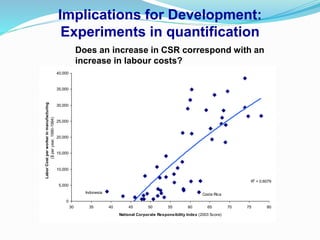
Experiments in quantification
R2
= 0.6079
0
5,000
10,000
15,000
20,000
25,000
30,000
35,000
40,000
30 35 40 45 50 55 60 65 70 75 80
National Corporate Responsibility Index (2003 Score)
Labor
Cost
per
worker
in
manufacturing
($
per
year,
1990-1994)
Indonesia Costa Rica
Does an increase in CSR correspond with an
increase in labour costs?
Implications for Development:
Experiments in quantification
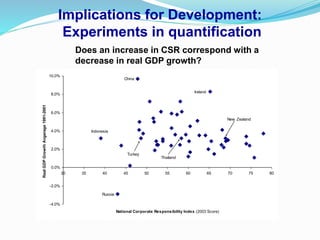
Does an increase in CSR correspond with a
decrease in real GDP growth?
-4.0%
-2.0%
0.0%
2.0%
4.0%
6.0%
8.0%
10.0%
30 35 40 45 50 55 60 65 70 75 80
National Corporate Responsibility Index (2003 Score)
Real
GDP
Growth
Avgerage
1991-2001
China
Turkey
New Zealand
Thailand
Russia
Ireland
Indonesia
Thank you

Professional Ethics in Engineering

  • 1.
  • 2.
    Unit Iv Safetyand Responsibilities and Rights  Safety and Risk – Assessment of Safety and Risk – Risk Benefit Analysis and Reducing Risk - Respect for Authority – Collective Bargaining – Confidentiality – Conflicts of Interest – Occupational  Crime – Professional Rights – Employee Rights – Intellectual Property Rights (IPR) – Discrimination
  • 3.
    EMPLOYEE RIGHTS  InternalComplaint to Human Resources or management  Human Rights complaint under the Code  Stress Leave/Disability (if available)  Civil Action/Constructive Dismissal
  • 4.
    EMPLOYER RESPONSIBILITIES  EmploymentContracts  Policies (Harassment, Internet Use)  Training  Monitoring  Discipline
  • 5.
    EMPLOYER RESPONSIBILITIES Employment Contractand Policies  Outline what behaviour is not acceptable in the workplace  Set out the employer’s expectations regarding proper conduct in the workplace  Advise what range of disciplinary action will be taken should an employee be found to have breached the policy
  • 6.
    EMPLOYER RESPONSIBILITIES Investigation  Assessthe complaint  Appoint an investigator  Conduct interviews  Make interim decisions on complainant/respondent  Process evidence and interview additional parties
  • 7.
    EMPLOYER RESPONSIBILITIES Discipline -breach of the policy constitutes cause for discipline, up to and including termination of employment
  • 8.
    HUMAN RIGHTS COMPLAINT Usually arises after the Employer has either failed to respond to a complaint or has made a decision with which the Complainant disagrees Under the current system an applicant may bring their complaint directly before the Ontario Human Rights Tribunal  Within this system a complaint may be resolved by adjudication or mediation
  • 9.
    DISABILITY BENEFITS  Ifthe harassment results in severe mental distress it may result in a claim for short-term or long-term disability, if available  Workplace stress has rapidly becoming one of the most popular causes for employee absence and disability claims
  • 10.
    Why bother withRisk Assessment?  Work on most important tasks  Clarify conflicts  Ensure representation of all members  Develop capabilities of the Safety Committee
  • 11.
  • 12.
    How Bad? /Severity
  • 13.
    The Range forSeverity
  • 14.
  • 16.
    How Bad? /Severity
  • 17.
  • 18.
    How Often? /Frequency
  • 19.
    Elements of “HowMuch?” How Many? How Often? How Long?
  • 20.
    How Much? How Many? fewer than 5 workers = 1 1% - 30% of workforce = 2 31% - 50% of workforce = 3 51% - 100% of workforce = 4
  • 21.
    How Much? How Often? A few times a year = 1 Once a month = 2 Weekly = 3 Daily = 4
  • 22.
    How Long? Less than2 hours = 1 More than 2 hours = 2
  • 23.
    Combine the Elements How Many? + How Often? + How Long? = How Much?
  • 24.
  • 25.
    How Much?  Amaintenance worker has to enter and clean waste out of a pit every six months. The job takes less than 2 hours and only involves the entrant and the attendant. This job is classified as a “Permit Required Confined Space Entry” . The maintenance worker has expressed concerns about the entry procedure. He does not think it is safe.
  • 26.
    How Much?  ConfinedSpace Example  How Many? – 1 person = 1  How Often? – less than once a month = 1  How Long? – less than 2 hours = 1  How Much? = 1+1+1 = 3
  • 27.
    How Much?  Sanitationexample  All of the sanitation workers in the plant have been provided with gloves that do not provide sufficient protection. They are exposed to harsh chemicals throughout their entire shift. Some workers have complained of rashes on their hands and wrists.
  • 28.
    How Much?  Sanitationexample  How Many? – more than 5, less than 30% of workforce = 2  How Often? – daily = 4  How Long? – more than 2 hours = 2  How Much? - 2+4+2 = 8
  • 29.
    How Much? Productionexample  A recent increase in production standards has affected almost all production workers. Many workers are complaining of sore wrists and shoulders.
  • 30.
    How Much? Productionexample?  How Many? – 51% - 100% of workforce = 4  How Often? – daily = 4  How Long? – More than 2 hours = 2  4+4+2 = 10
  • 31.
  • 32.
    We cannot predicthow likely it is for a complex system to fail!
  • 33.
    All mechanical systemsfail eventually.
  • 34.
  • 35.
  • 36.
  • 37.
  • 38.
  • 39.
    How Likely?  Assumesomething has already gone wrong and the worker IS exposed to the hazard  Will the exposure to the hazard result in injury?  All mechanical systems fail.  Don’t try to predict when complex systems will fail (unless you are a wizard!)
  • 40.
    Add the Resultsfor Each Hazard  Confined Space  How Bad = 10  How Much = 3  How Likely = 4
  • 41.
    Compare relative valuesfor different hazards
  • 42.
  • 43.
    Corporate Social Responsibility •Concepts, key issues, context • Key CSR drivers • Implications for enterprise • Implications for development
  • 44.
    Main Concepts ofCSR CSR (Carrol, 1979) Firms have responsibilities to societies including economic, legal, ethical and discretionary (or philanthropic). - See also DeGeorge (1999) on the “Myth of the Amoral Firm” Social Contract (Donaldson, 1982; Donaldson and Dunfee, 1999) – There is a tacit social contract between the firm and society; the contract bestows certain rights in exchange for certain responsibilities. Stakeholder Theory (Freeman, 1984) – A stakeholder is “any group or individual who can affect or is affected by the achievement of an organisation’s purpose.” Argues that it is in the company’s strategic interest to respect the interests of all its stakeholders.
  • 45.
    Main Concepts ofCSR CSR = political economy The rights and responsibilities assigned to private industry.
  • 46.
    Key Issues inCSR  Labour rights:  child labour  forced labour  right to organise  safety and health  Environmental conditions  water & air emissions  climate change  Human rights  cooperation with paramilitary forces  complicity in extra-judicial killings  Poverty Alleviation  job creation  public revenues  skills and technology
  • 47.
    Context Globally  Liberalisationof markets – reduction of the regulatory approach  Emergence of global giants, consolidation of market share  Development of the ‘embedded firm’ and the global value chain  Development of supplier networks in developing countries
  • 48.
    Key drivers ofCSR Around the world • NGO Activism • Responsible investment • Litigation • Gov & IGO initiatives Developing Countries • Foreign customers • Domestic consumers • FDI • Government & IGO
  • 49.
    Key Drivers: NGOActivism  Facilitators: IT (esp Internet), media, low cost travel  Boycotts, brand damage, influence legislation, domino effect  e.g. Shell in Nigeria, Exxon in Cameroon, Sinopec in Sudan, Apparel Industry (Nike, Gap), GMO, Wood Products, etc.
  • 50.
    Domino Effect inthe US Wood Products Industry: 7 out of top 10 shift policy on old growth within 18 months Date of Policy Shift Company Industry Rank Aug - 1999 Home Depot 1 Nov - 1999 Home Base 6 Nov - 1999 Wickes 9 Jan - 2000 Menards 3 Aug - 2000 Lowes 2 Aug - 2000 84 Lumber 4 Dec - 2000 Payless Cashways 5
  • 51.
    Key Drivers: ResponsibleInvestment  Roots of: South Africa Apartheid Divestment  Significant size: US SRI = 2.3 trillion $ in 2005 or 10% of all professionally managed investments  Shareholder activism: shareholder resolutions; voting process  Influence corporate reporting and disclosure requirements  New rules on CSR reporting
  • 52.
    CSR Management: Management structure Example:Chiquita Board of Directors President & CEO Group Presidents Chief Financial Officer VP of Human Resources General Counsel Corporate Responsibility Officer Steering Committee Audit Committee of Board
  • 53.
    CSR Management: Plan, Do,Check, Act method Plan • Consult stakeholders • Establish code of conduct • Set targets Do • Establish management systems and personnel • Promote code compliance Check • Measure progress • Audit • Report Act • Corrective action • Reform of systems
  • 54.
    Code of Conduct: Widespreadadoption among TNCs Adoption of… • More than half of the 100 largest firms by global revenue (Fortune Global 100) • More than a third of the 100 largest firms by foreign assets (UNCTAD WIR 100) • 57% of all foreign assets • 51% of all foreign sales • 65% of all foreign employees Multi-Sector 7% Technology 17% Services 20% Light Industry 17% Heavy Industry 27% Not Specified 12% Codes found among all industrial sectors. Source: OECD 1999 survey of 233 codes
  • 55.
    Code of Conduct: Issueemphasis varies by industry 0 20 40 60 80 100 Multi-Sector Technology Services Light Industry Heavy Industry % of Codes addressing issue Environment Fair Employment & Labour Rights Rule of Law Fair Business Practices Source: OECD 1999 survey of 233 codes
  • 56.
    Code of Conduct: Emergingconsensus on key issues Source: Conference Board 1999, Survey of 123 Codes 0% 25% 50% 75% 100% Human rights Confidentiality of personal information Community relations Political activities Workplace safety Antitrust Sexual harassment Environment Giving gifts Discrimination / equal opportunity Receiving gifts Security of proprietary information Conflict of interest Bribery/improper payments % of codes addressing issue
  • 57.
    Code of Conduct: Cascadeeffect 82% 50% 34% 22% 0% 25% 50% 75% 100% Company Contractors Sub- contractors Customers as % of all codes surveyed Source: OECD 1999 survey of 233 codes
  • 58.
    Code of Conduct: Cascadeeffect Source: Conference Board 1999, Survey of 123 Codes 0% 10% 20% 30% 40% 50% Nepotism Child labor Whistleblowing Political activities Human rights Workplace safety Sexual harassment Discrimination / equal opportunity Environment Conflict of interest Bribery/improper payments Receiving gifts Giving gifts % of COE applying to JV partner or Supplier/Vendor JV Partners Suppliers/ Vendors
  • 59.
    Sphere of Influence Who– is to be influenced?
  • 60.
    Sphere of Influence What– issues are to be influenced?
  • 61.
    Sphere of Influence How– are those issues to be influenced?
  • 62.
    Sphere of Influence Example:Mattel Who: suppliers, JVs and branch plants What: OSH How: focus on manufacturing processes, HR, factory design
  • 63.
  • 64.
    Compliance Management: Management bycertification ISO 14000 by Region Europe Far East N. America Aust./ New Zealand S. America Africa/ W. Asia • Introduced 1998 • By 2005: 763 factories, 47 countries • Introduced 1995 • By 2002: 37,000 factories, 112 countries SA 8000 by Region Asia Europe N. America S. America Africa
  • 65.
    Compliance Management: Management bycertification ISO 26000: Social Responsibility • To be Introduced in 2009 or 2010 • NOT a Management System (?) • NOT a Certifiable Standard (?)
  • 66.
    Principles of SR 1.Ethical behaviour 2. Respect for rule of law 3. Respect for international norms of behaviour 4. Respect for and considering of stakeholder interests 5. Accountability 6. Transparency 7. Precautionary approach 8. Respect for human rights Organizational Governance Human Rights Labour Practises Environment Fair operating practises Consumer issues Community & society development Core Subjects Implementing SR 7.2 Defining scope 7.5 Implementing in daily practise 7.7 Evaluating performance 7.8 Enhancing credibility 7.4 Integrating into organization ISO 26000 Roadmap 7.3 Working With Stakeholders 7.3 Communicating
  • 67.
  • 68.
    CSR Management: CSR reportingbecomes ‘mainstream’ % of Large Firms Issuing a CSR Report 64%
  • 69.
    CSR Management: Emerging standardsin CSR Reporting Global Reporting Initiative (GRI) A multi-stakeholder initiative www.globalreporting.org International Standards of Accounting and Reporting (ISAR) A project of UNCTAD www.unctad.org/isar
  • 70.
    Implications for Development CSR ‘cascade effect’ on members of the global value chain  labour conditions (e.g. OSH, right to organise, wages)  environmental controls  transfer of new management techniques  Compensation for weak legal environment in LDCs  Impact on economic development & national competitiveness???
  • 71.
    Implications for Development: CSRmanagement CSR performance among 100 emerging market enterprises Source: UNCTAD, 2008 Environment overall 0% 20% 40% 60% 80% 100% Policy Systems Reporting Advanced Good Intermediate Limited No evidence
  • 72.
    Implications for Development: CSRmanagement CSR performance among 100 emerging market enterprises Source: UNCTAD, 2008 Countering Bribery overall 0% 20% 40% 60% 80% 100% Policy Systems Reporting intermediate limited no evidence
  • 73.
    Implications for Development: CSRmanagement CSR performance among 100 emerging market enterprises Source: UNCTAD, 2008 Human Rights overall 0% 20% 40% 60% 80% 100% Policy Systems Reporting intermediate limited no evidence
  • 74.
    Implications for Development: isCSR good for growth? “…[CSR] is liable to hold back the development of poor countries through the suppression of employment opportunities within them.” David Henderson “[CSR]’s adoption would reduce competition and economic freedom, and undermine the market economy.”
  • 75.
    Implications for Development: Experimentsin quantification R2 = 0.6079 0 5,000 10,000 15,000 20,000 25,000 30,000 35,000 40,000 30 35 40 45 50 55 60 65 70 75 80 National Corporate Responsibility Index (2003 Score) Labor Cost per worker in manufacturing ($ per year, 1990-1994) Indonesia Costa Rica Does an increase in CSR correspond with an increase in labour costs?
  • 76.
    Implications for Development: Experimentsin quantification Does an increase in CSR correspond with a decrease in real GDP growth? -4.0% -2.0% 0.0% 2.0% 4.0% 6.0% 8.0% 10.0% 30 35 40 45 50 55 60 65 70 75 80 National Corporate Responsibility Index (2003 Score) Real GDP Growth Avgerage 1991-2001 China Turkey New Zealand Thailand Russia Ireland Indonesia
  • 77.