Corporate Social Responsibility
As Presented in DBJain College
Seminar
CMA.G.Ramkumar
MA,Mcom,MBA,ACMA,ACA,Mphil,NET,SLET,(Phd)
Asst Professor – DG Vaishnav College
Arumbakkam
Definition
WBCSD (World Business Council for
Sustainable Development)
“The continuing commitment by business to
behave ethically and contribute to
sustainable economic development while
improving the quality of life of the workforce
and their families as well as of the local
community and society.”
Intro :
• It is the Corporate Response towards
Support and Sacrifice given by society.
• It emphasises Obligation , action and
Outcome
• A Gratitude for the country Upon the
Phase of Liberalisation which Corporates
started to grow utilising Countries
Resources.
Criticism about Corporates
• Corporate is a Wealth maker than a
Society thinker
• Corporate go for more Profit and power
than caring for the Society
• Corporate do not care for Community
affairs rather act as Monopoly in Decisions
• Selfish attitude towards exploiting
countries rare resources for personel
benefit.
Corporate Social Responsiblity
• It Benefits for the Following :
• Customers
• Workers
• Creditors
• Share Holders
• Government
• Civil Society
• Environment
Customers
• Better Quality
• Better Price
• Better Service
• Better Feedback
• Better Variety
• Lower Cost
Workers
• Better Work Environment
• Better Facilities(Canteen,Health,Medical
etc.)
• Better Scale of Pay
• Better Retirement Policies
• Better Training and Postings
• Better Family Care
• Better Workers Participation
Creditors
• Meeting the Payments
• Creditors Participation
• Better Relationship
• TQM with Creditors help.
• JIT Management with Suppliers
• R&D Matters
Civil Society
• Quality Goods
• Development of Area by School, Colleges
and Hospitals ( Even Transport)
• Better Employment
• Avoiding Unethical Business
• Responsive to Women and Physically
Challenged.
• Move Against Child Labour and Bonded.
Government
• Law Abiding Citizen
• Prompt Tax Payer
• Corporate Governence
• Protecting Human Rights
• Commitment to Society
Past Records
Corporate Disfunction
• Bhopal Gas Tragedy
• Chemical Disposals – Fertiliser and
Pharmaceutical Companies
• Undergraound Water Spoilage by Dyeing
Units
• Genetically Modified Vegetables and
Fruits
• Accidents in Firework Factories
Cont-
• Air Pollution by CFC Companies
• Toxic Disposals by Atomic Plants
• Deforestation by Companies for Land
Aquisitons
• Cultivable lands taken for Industrial
Purposes
• Exploiting ground water / River water for
Beverages and soft Drinks
Cont
• Area Pollution by Cement Companies
• Air Pollution by Distilleries
• Frequent Accidents by Gas Companies
• Further :-
• Wage Cuts , Employment Cuts
• Tribunal Tax Pendings
• Bribery and Illegal Tendering Companies.
Cont
• Financial Companies Sudden Closure and
Failing Investors
• Banks NPA on the rise.
• Sudden Death of Satyam Company
Arguments
• For
• Builds Country a Better Future
• Better Corporate Climates
• Strengthen Brand Image of Corporate
• Better Civil Society and Poverty Allevation
• Better Community Development
• Better Corporate and Country Image
• Protects Countries rare Resources
For - Cont
• Green Foresting
• Income Generation to Society
• Employment to Physically Challenged and
Downtrodden
• Women Empowerment
• Too Much expectency on Government
Minimised.
Arguments -- Against
• Restricts Corporate Profit Maximisation goal and
Divert its aim.
• Corporate is not Knowledgeble about how to go
far CSR which might make them find Loopholes
in Law.
• Might causes Top Management to cancel some
Good Projects which are need for the Country.
• Philanthropy Cannot be forced and even at later
stage CSR might come as TAX sops.
Cont - Against
• Corporates Struggling with Sluggish market
trends and Downtrend Business might find CSR
a Burden
• Uneducated Civic Society might not be
knowledgeble of their right on CSR.
• Too much restrictions from government on CSR
might force Foreign Investors to avoid India.
• Corporate might use CSR as to a Marketing
Trick rise their Brand Image of their Products
Selfishly.
New Trends in CSR
• 1) CORPORATE GOVERNENCE:-
• Committee Setups
• Transparencies in Management
• Internal Controls
• Policy Formulations
• Standards,disclosures and Penalties.
2) Sustainable Employees
Participation
• Better Morale Boosters
• Better Communication
• Social Volunteering
• New Growth Trends
• Overall Strategic Growth
3) Potential Partnership
• Supplier and Producer potential
partnership for better standards and
quality management
• Better Production for Better society
• Low Cost and Geared Out
. Recognition of Society for Long Business
Growth
. Ethical Business Values
4) NGO Partnership
• Corporates directly involve themselves to
people by making an MOU with Social
Organisations
• Make Grants to NGO for People Welfares
• Make their products liked with Social
Welfare Purposes
• Make Social Projects for People
Betterment
5) Society at Large
• Start Institutions and Hospitals
• Give Grants for Institutions
• Make Whole hearted Donations for Social
Calamity – Haridwar, Thane Cyclone etc
• Enlarging Public Utilities-
Transport,Water,Electricityetc.
• Disconnect With Suppliers who does not
follow CSR Policies.
Corporate (CSR) Institutions
• Tata Institute of Social Science
• Birla Heart Research Centre
• Reliance Life Science Institute – Cancer
Research
• Hospitals by Pharmaceutical Companies
• Wipro Azim PRemji Foundation
• HCL Shiv Nadar Educational Institutions
etc
Cont--
• Ashok Leyland Making Bus For
Disabled.Also running AIDS Programmes
• AXIS bank runs Balwadis for Rural
Childrens and also Conducts
Driving,Welding,Software and other
Courses for them.
• BP Corpn taken Drought Stricken Villages
and bring them as self Sufficient.
Cont--
• Hindalco has taken 698 Villages with
Programmes on Well , Dam,Pond and
Borewells setup.
• Infosys has taken 100 schools in
Karnataka and Made Medical treatment for
Teachers.
• Mahindra Provides education for Socially
Disadvantaged through Mahindra Pride
School.
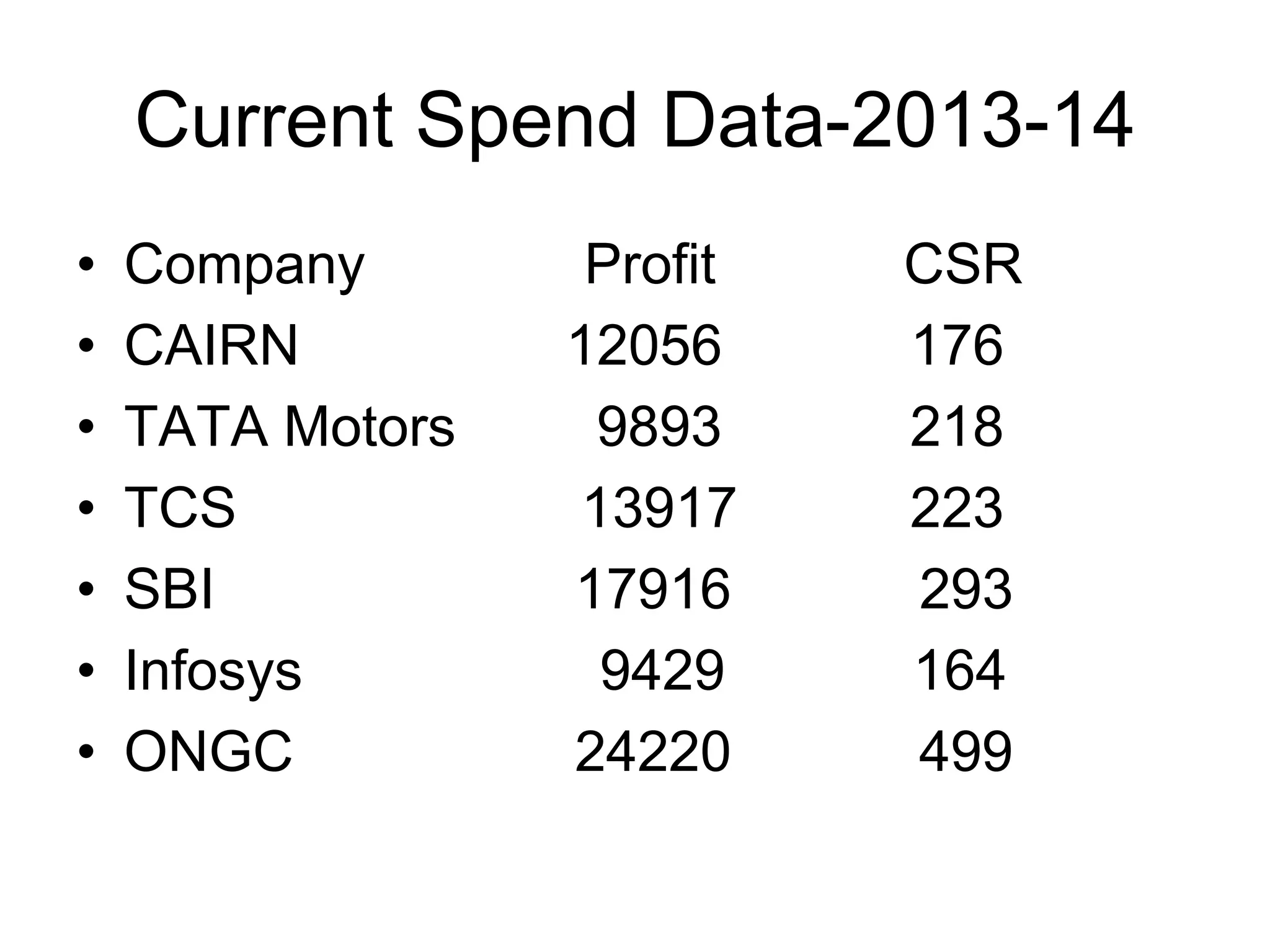
Current Spend Data-2013-14
• Company Profit CSR
• CAIRN 12056 176
• TATA Motors 9893 218
• TCS 13917 223
• SBI 17916 293
• Infosys 9429 164
• ONGC 24220 499
Economic ,Legal and Ethical Issues
• Company Amendment Bill( Sec 135)
• Bill Seek to create an enabling Environment
• Schedule VII draws attention to CSR Activities
and amount spent on It. Out of the Total
allocation made –
• 80 % is to be for Community Projects
• 5% for Natural Calamities
• 15% on Educational Institutions.
• Project Survey , Fund Allocation , Monitoring ,
Third Party Evaluation ,
Legal Issues - Cont
• Corporate Governence Disclosures
• Global Reporting and GAAP Procedures
• International Financial Reporting
• Labour Laws,Human Rights and Child
Labour acts.
• Avoidance of Restrictive Trading and
Monopoly Pricing
• Rights to Information
Ethics - Cont
• Be more Productive and Low Cost
Companies
• Better Management on Countries Rare
Resources
• Better Corporate Citizenship
• Better Business Pricing
Benefits
• Good CSR makes good market
relationship – Which makes a Good
Financial Performance – Which makes
Good Corporate Performance – Which
makes the Products with Brand Image –
Which rise the Goodwill of the Corporate
in the society – Ultimately better share
Pricing.
National Foundation for Corporate
Social Responsiblity
• The NFCSR has been established by Indian Institute
of Corporate affairs which is under the Ministry of
Industrial affairs to create a national platform to work
in partnership with the Governmental , Non-
Governmental, Civil Society and local community
organizations
.
• Stimulate and Facilitate Experience between
Corporate Leaders, Policy Makers , NGO to develop
a Proper CSR Framework
• Publish – Papers, Journals,Seminars,Books and
Periodicals.
Members - NFCSR
• Civil – NGO
• Chamber of Commerce and Industry
• Professional Institutions
• Corporate Sectors
• National Institutions
• Law Agencies
Basic Purpose
Assistance for formulating CSR projects;
 Impact Assessment and Social Audit of CSR
projects;
 Preparing a cadre of Certified CSR Professionals;
 Rating of CSR performance and recognition
through awards;
 Research, including action research
 Training and Development
 Preparing CSR Softwares
Conclusion
• CSR is necessary for the future of the country
and more companies started following them
with Company Law amendment 2013..
• To be Successful in CSR a Permanent
Government body is required for monitoring
companies and their Investments.
• A private hand support is needed for
Government to be successful in CSR Network
• With Better CSR We can Build our Abdul
Kalam’s Dream of Super Power by 2020.
•

Corporate Social Responsiblity

  • 1.
    Corporate Social Responsibility AsPresented in DBJain College Seminar CMA.G.Ramkumar MA,Mcom,MBA,ACMA,ACA,Mphil,NET,SLET,(Phd) Asst Professor – DG Vaishnav College Arumbakkam
  • 2.
    Definition WBCSD (World BusinessCouncil for Sustainable Development) “The continuing commitment by business to behave ethically and contribute to sustainable economic development while improving the quality of life of the workforce and their families as well as of the local community and society.”
  • 3.
    Intro : • Itis the Corporate Response towards Support and Sacrifice given by society. • It emphasises Obligation , action and Outcome • A Gratitude for the country Upon the Phase of Liberalisation which Corporates started to grow utilising Countries Resources.
  • 4.
    Criticism about Corporates •Corporate is a Wealth maker than a Society thinker • Corporate go for more Profit and power than caring for the Society • Corporate do not care for Community affairs rather act as Monopoly in Decisions • Selfish attitude towards exploiting countries rare resources for personel benefit.
  • 5.
    Corporate Social Responsiblity •It Benefits for the Following : • Customers • Workers • Creditors • Share Holders • Government • Civil Society • Environment
  • 6.
    Customers • Better Quality •Better Price • Better Service • Better Feedback • Better Variety • Lower Cost
  • 7.
    Workers • Better WorkEnvironment • Better Facilities(Canteen,Health,Medical etc.) • Better Scale of Pay • Better Retirement Policies • Better Training and Postings • Better Family Care • Better Workers Participation
  • 8.
    Creditors • Meeting thePayments • Creditors Participation • Better Relationship • TQM with Creditors help. • JIT Management with Suppliers • R&D Matters
  • 9.
    Civil Society • QualityGoods • Development of Area by School, Colleges and Hospitals ( Even Transport) • Better Employment • Avoiding Unethical Business • Responsive to Women and Physically Challenged. • Move Against Child Labour and Bonded.
  • 10.
    Government • Law AbidingCitizen • Prompt Tax Payer • Corporate Governence • Protecting Human Rights • Commitment to Society
  • 11.
    Past Records Corporate Disfunction •Bhopal Gas Tragedy • Chemical Disposals – Fertiliser and Pharmaceutical Companies • Undergraound Water Spoilage by Dyeing Units • Genetically Modified Vegetables and Fruits • Accidents in Firework Factories
  • 12.
    Cont- • Air Pollutionby CFC Companies • Toxic Disposals by Atomic Plants • Deforestation by Companies for Land Aquisitons • Cultivable lands taken for Industrial Purposes • Exploiting ground water / River water for Beverages and soft Drinks
  • 13.
    Cont • Area Pollutionby Cement Companies • Air Pollution by Distilleries • Frequent Accidents by Gas Companies • Further :- • Wage Cuts , Employment Cuts • Tribunal Tax Pendings • Bribery and Illegal Tendering Companies.
  • 14.
    Cont • Financial CompaniesSudden Closure and Failing Investors • Banks NPA on the rise. • Sudden Death of Satyam Company
  • 15.
    Arguments • For • BuildsCountry a Better Future • Better Corporate Climates • Strengthen Brand Image of Corporate • Better Civil Society and Poverty Allevation • Better Community Development • Better Corporate and Country Image • Protects Countries rare Resources
  • 16.
    For - Cont •Green Foresting • Income Generation to Society • Employment to Physically Challenged and Downtrodden • Women Empowerment • Too Much expectency on Government Minimised.
  • 17.
    Arguments -- Against •Restricts Corporate Profit Maximisation goal and Divert its aim. • Corporate is not Knowledgeble about how to go far CSR which might make them find Loopholes in Law. • Might causes Top Management to cancel some Good Projects which are need for the Country. • Philanthropy Cannot be forced and even at later stage CSR might come as TAX sops.
  • 18.
    Cont - Against •Corporates Struggling with Sluggish market trends and Downtrend Business might find CSR a Burden • Uneducated Civic Society might not be knowledgeble of their right on CSR. • Too much restrictions from government on CSR might force Foreign Investors to avoid India. • Corporate might use CSR as to a Marketing Trick rise their Brand Image of their Products Selfishly.
  • 19.
    New Trends inCSR • 1) CORPORATE GOVERNENCE:- • Committee Setups • Transparencies in Management • Internal Controls • Policy Formulations • Standards,disclosures and Penalties.
  • 20.
    2) Sustainable Employees Participation •Better Morale Boosters • Better Communication • Social Volunteering • New Growth Trends • Overall Strategic Growth
  • 21.
    3) Potential Partnership •Supplier and Producer potential partnership for better standards and quality management • Better Production for Better society • Low Cost and Geared Out . Recognition of Society for Long Business Growth . Ethical Business Values
  • 22.
    4) NGO Partnership •Corporates directly involve themselves to people by making an MOU with Social Organisations • Make Grants to NGO for People Welfares • Make their products liked with Social Welfare Purposes • Make Social Projects for People Betterment
  • 23.
    5) Society atLarge • Start Institutions and Hospitals • Give Grants for Institutions • Make Whole hearted Donations for Social Calamity – Haridwar, Thane Cyclone etc • Enlarging Public Utilities- Transport,Water,Electricityetc. • Disconnect With Suppliers who does not follow CSR Policies.
  • 24.
    Corporate (CSR) Institutions •Tata Institute of Social Science • Birla Heart Research Centre • Reliance Life Science Institute – Cancer Research • Hospitals by Pharmaceutical Companies • Wipro Azim PRemji Foundation • HCL Shiv Nadar Educational Institutions etc
  • 25.
    Cont-- • Ashok LeylandMaking Bus For Disabled.Also running AIDS Programmes • AXIS bank runs Balwadis for Rural Childrens and also Conducts Driving,Welding,Software and other Courses for them. • BP Corpn taken Drought Stricken Villages and bring them as self Sufficient.
  • 26.
    Cont-- • Hindalco hastaken 698 Villages with Programmes on Well , Dam,Pond and Borewells setup. • Infosys has taken 100 schools in Karnataka and Made Medical treatment for Teachers. • Mahindra Provides education for Socially Disadvantaged through Mahindra Pride School.
  • 27.
    Current Spend Data-2013-14 •Company Profit CSR • CAIRN 12056 176 • TATA Motors 9893 218 • TCS 13917 223 • SBI 17916 293 • Infosys 9429 164 • ONGC 24220 499
  • 28.
    Economic ,Legal andEthical Issues • Company Amendment Bill( Sec 135) • Bill Seek to create an enabling Environment • Schedule VII draws attention to CSR Activities and amount spent on It. Out of the Total allocation made – • 80 % is to be for Community Projects • 5% for Natural Calamities • 15% on Educational Institutions. • Project Survey , Fund Allocation , Monitoring , Third Party Evaluation ,
  • 29.
    Legal Issues -Cont • Corporate Governence Disclosures • Global Reporting and GAAP Procedures • International Financial Reporting • Labour Laws,Human Rights and Child Labour acts. • Avoidance of Restrictive Trading and Monopoly Pricing • Rights to Information
  • 30.
    Ethics - Cont •Be more Productive and Low Cost Companies • Better Management on Countries Rare Resources • Better Corporate Citizenship • Better Business Pricing
  • 31.
    Benefits • Good CSRmakes good market relationship – Which makes a Good Financial Performance – Which makes Good Corporate Performance – Which makes the Products with Brand Image – Which rise the Goodwill of the Corporate in the society – Ultimately better share Pricing.
  • 32.
    National Foundation forCorporate Social Responsiblity • The NFCSR has been established by Indian Institute of Corporate affairs which is under the Ministry of Industrial affairs to create a national platform to work in partnership with the Governmental , Non- Governmental, Civil Society and local community organizations . • Stimulate and Facilitate Experience between Corporate Leaders, Policy Makers , NGO to develop a Proper CSR Framework • Publish – Papers, Journals,Seminars,Books and Periodicals.
  • 33.
    Members - NFCSR •Civil – NGO • Chamber of Commerce and Industry • Professional Institutions • Corporate Sectors • National Institutions • Law Agencies
  • 34.
    Basic Purpose Assistance forformulating CSR projects;  Impact Assessment and Social Audit of CSR projects;  Preparing a cadre of Certified CSR Professionals;  Rating of CSR performance and recognition through awards;  Research, including action research  Training and Development  Preparing CSR Softwares
  • 35.
    Conclusion • CSR isnecessary for the future of the country and more companies started following them with Company Law amendment 2013.. • To be Successful in CSR a Permanent Government body is required for monitoring companies and their Investments. • A private hand support is needed for Government to be successful in CSR Network • With Better CSR We can Build our Abdul Kalam’s Dream of Super Power by 2020. •