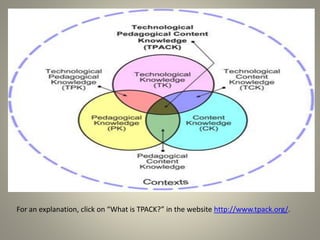
For an explanation, click on “What is TPACK?” in the website http://www.tpack.org/.
• Standards Alignment
• Collaborative with Coaches and Mentors
• Formative and Summative Data
• Adult Learning Theories
• Sufficient Time, Resources & Incentives
• Job-embedded & Authentic
• On and Off-Site Synchronous & Asynchronous
21st Century + 20 years Skills
• Office Suite (Word Processing, Spreadsheet, Presentations)
• File Management
• Cloud Computing (File Storage and Sharing)
• Electronic Communications (Email, Text, Live Streams)
• Online Calendar Management
• Online Survey Implementation
• Troubleshooting (Hardware and Software)
• Internet Searching
• Database Management (LMS)
• Website Design
• Editing (Image, Audio, Video)
• Mobile Technology
• Social Media in the Classroom
• Web 2.0 Tools (Blogs, Podcasts, Vodcasts)
http://bestteacherblog.com/101-web-2-0-tools-every-teacher-should-know-about/
Steps to Implement Professional Development (Killion, 2013)
• Initiation Phase (Subcommittee)
• Discovery Phase (Assess Levels and Develop a Needs Assessment)
• Analysis Phase (Review Policy Instructional Practices and Skill Gaps)
• Recommention Phase (Select Improvement Areas and Delivery Methods)
• Reporting Phase
• Follow-up Phase (Classroom Walkthroughs)
Method Advantage Shortcoming Research
 Presentations
 Workshops
 Seminars
 Conferences
 Efficiency with large
groups
 Formal learning
 Distinct focus
 Minimal time and
individualization
 Few choices
 No feedback/coaching
Garet et al. (2001)
 Face-to-face
Courses
 Efficiency
 Formal learning
 Expensive Garet et al. (2001)
 Peer coaching
 Mentoring
 Positive impact via
feedback
 Interactive
 Requires time and trained
coaches
 Limited-size groups
Garet et al. (2001)
 Action Research
 Study Circles
 Team building
 Focuses on issue
 Personal involvement
 Takes time
 Lacks proven supportive
research
Garet et al. (2001)
 Reflective writings
 Reading research
 One’s own time
 Exploration
 Personal
 Increased commitment
 Potentially no leadership
direction/follow up
Moon (2013)
 Case studies  Problem-based
 Student-centered
 Individual or group
 Limited purpose Walker et al. (2011)
 Online Courses
 Webinars
 Webcasts
 Synchronous or
asynchronous
 Relevant
 Self-paced or not
 Development time
 Limited interactions
 Technical issues
Marrero et al. (2010)
 Online learning
networks
 Social Media
 Synchronous or
asynchronous
 Independent
 Collaborative
 Paradigm shift
 Potentially no leadership
direction/follow up
Skyrme (2012)
Simpson & Kehrwald. (2010)
 Online discussion
(Blogs, Twitter, or
Forums)
 Asynchronous
 Collaborative
 Flexible
 Technology-related
 Paradigm shift
 Limited purposes
 Potentially no leadership
direction/follow up
Skyrme (2012)
Prestridge (2010)
 Resource review
and creation
(Videos, Podcasts)
 Asynchronous
 Specific training
 Skill focus
 Paradigm shift
 Limited purpose
 Correlation to student
Walker et al. (2011)
Professional Development

Professional Development

  • 3.
    For an explanation,click on “What is TPACK?” in the website http://www.tpack.org/.
  • 5.
    • Standards Alignment •Collaborative with Coaches and Mentors • Formative and Summative Data • Adult Learning Theories • Sufficient Time, Resources & Incentives • Job-embedded & Authentic • On and Off-Site Synchronous & Asynchronous
  • 6.
    21st Century +20 years Skills • Office Suite (Word Processing, Spreadsheet, Presentations) • File Management • Cloud Computing (File Storage and Sharing) • Electronic Communications (Email, Text, Live Streams) • Online Calendar Management • Online Survey Implementation • Troubleshooting (Hardware and Software) • Internet Searching • Database Management (LMS) • Website Design • Editing (Image, Audio, Video) • Mobile Technology • Social Media in the Classroom • Web 2.0 Tools (Blogs, Podcasts, Vodcasts) http://bestteacherblog.com/101-web-2-0-tools-every-teacher-should-know-about/
  • 7.
    Steps to ImplementProfessional Development (Killion, 2013) • Initiation Phase (Subcommittee) • Discovery Phase (Assess Levels and Develop a Needs Assessment) • Analysis Phase (Review Policy Instructional Practices and Skill Gaps) • Recommention Phase (Select Improvement Areas and Delivery Methods) • Reporting Phase • Follow-up Phase (Classroom Walkthroughs)
  • 8.
    Method Advantage ShortcomingResearch  Presentations  Workshops  Seminars  Conferences  Efficiency with large groups  Formal learning  Distinct focus  Minimal time and individualization  Few choices  No feedback/coaching Garet et al. (2001)  Face-to-face Courses  Efficiency  Formal learning  Expensive Garet et al. (2001)  Peer coaching  Mentoring  Positive impact via feedback  Interactive  Requires time and trained coaches  Limited-size groups Garet et al. (2001)  Action Research  Study Circles  Team building  Focuses on issue  Personal involvement  Takes time  Lacks proven supportive research Garet et al. (2001)  Reflective writings  Reading research  One’s own time  Exploration  Personal  Increased commitment  Potentially no leadership direction/follow up Moon (2013)  Case studies  Problem-based  Student-centered  Individual or group  Limited purpose Walker et al. (2011)  Online Courses  Webinars  Webcasts  Synchronous or asynchronous  Relevant  Self-paced or not  Development time  Limited interactions  Technical issues Marrero et al. (2010)  Online learning networks  Social Media  Synchronous or asynchronous  Independent  Collaborative  Paradigm shift  Potentially no leadership direction/follow up Skyrme (2012) Simpson & Kehrwald. (2010)  Online discussion (Blogs, Twitter, or Forums)  Asynchronous  Collaborative  Flexible  Technology-related  Paradigm shift  Limited purposes  Potentially no leadership direction/follow up Skyrme (2012) Prestridge (2010)  Resource review and creation (Videos, Podcasts)  Asynchronous  Specific training  Skill focus  Paradigm shift  Limited purpose  Correlation to student Walker et al. (2011)

Editor's Notes

  • #2 Educational administrators ensure effective practice in the study of technology and its infusion across the curriculum.
  • #3 Teaching remains a highly complex activity that draws on varying knowledge, including subject matter, pedagogical (i.e., teaching and learning processes plus practices), and pedagogical content (i.e., teaching approaches to fit the substance).
  • #4 For today’s teachers technological literacy occupies another basic teaching competence (Lawless & Pellegrino, 2007). Therefore, technological pedagogical content knowledge (TPACK) represents acknowledgement of the range of digital mechanisms to accomplish learning tasks and the strategies for using such (Koehler & Mishra, 2009).
  • #5 At district and school levels, TRAs influence all the other factors, including the school culture; teacher attitudes; professional development program; student beliefs, experiences, and skills; and technical structures and resources. TRA leadership, based upon human relationship interactions, emphasizes a collaborative school culture with a shared vision, focused mission, and specific goals (Garland & Tadeja, 2013). TRAs inspire, lead, and challenge teachers to change attitudes and beliefs—powerful forces influencing classroom action and professional practice.
  • #6 Professional development (PD) entails a comprehensive, in-service approach to improve teachers’ and leaders’ capacity to raise student achievement and serves three interlocking functions: (a) to develop individual performances, (b) to advance school accomplishments, and (c) to implement new initiatives (Killion, 2012). Professional learning’s continuum extends from formal, traditional strategies (e.g. workshops, courses) to informal, collaborative approaches (e.g., learning networks, social media). Regardless of the scheme, PD aims to advance staff knowledge, skills, attitudes, aspirations, and behaviors, while technology-related PD intends to benefit the staff in becoming more skillful and enthusiastic about employing media-rich tools in their classroom. Determining staff needs to meet learning objectives, appraising current technology abilities, and motivating the staff to integrate technology exhibit worthy starting points for staff development. The text details what a digitally proficient teacher must possesses to educate today’s youth. Talk about skills assessment.
  • #9 Figure 6.2 Professional Development Delivery Methods The following checklist and steps suggest a process to implement technology professional development in alignment with Killion’s (2013) policy review. Subcommittee Initiation Phase Discovery Phase Analysis Phase Recommendation Phase Reporting Phase Follow-up Phase Celebrate Success