Presented by,
Deepak Tyagi
214218005
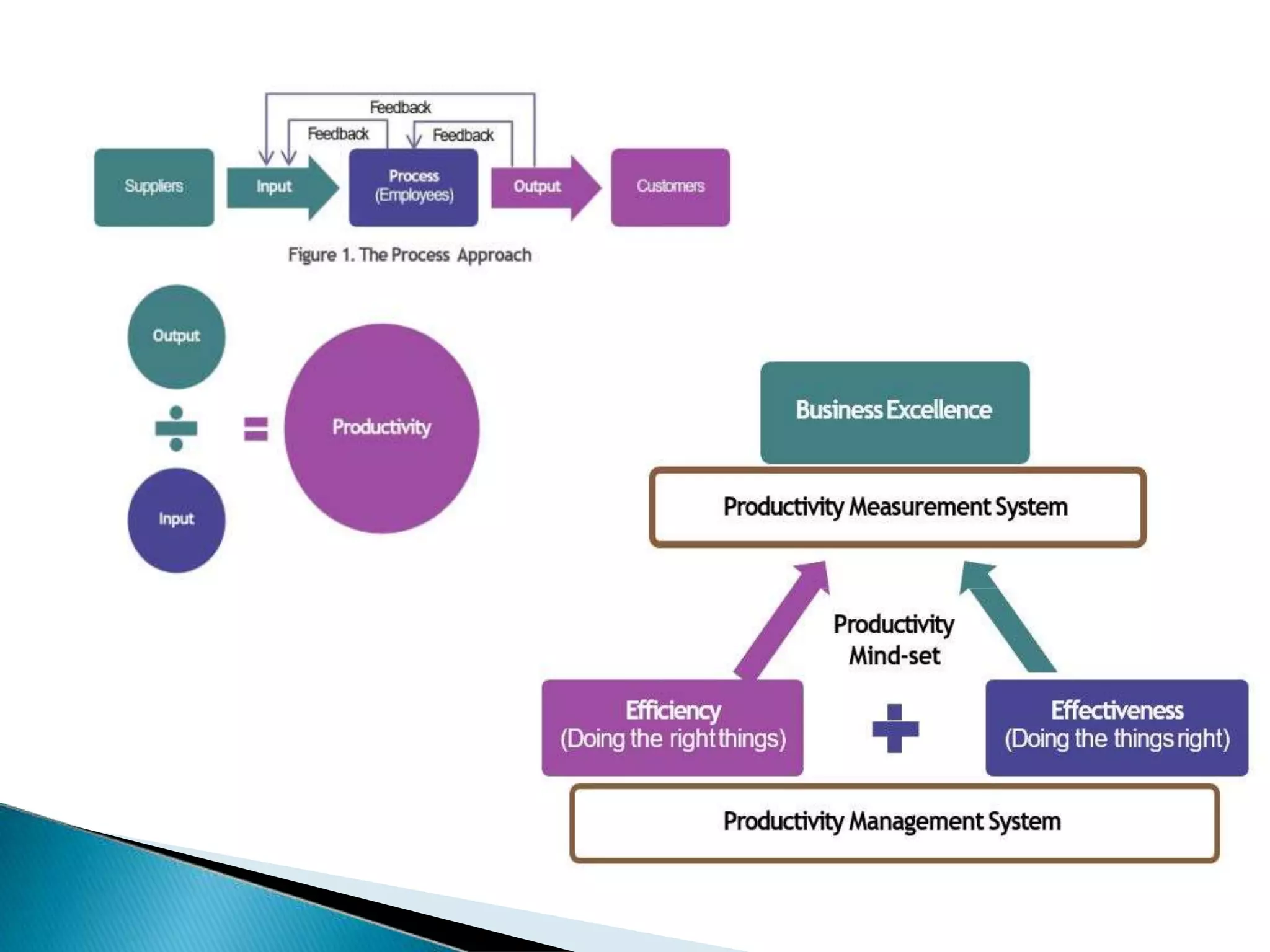
A general
relationship
definition
between
is that productivity
the output generated
is the
by a
production or service system and the input provided
to create this output.
2
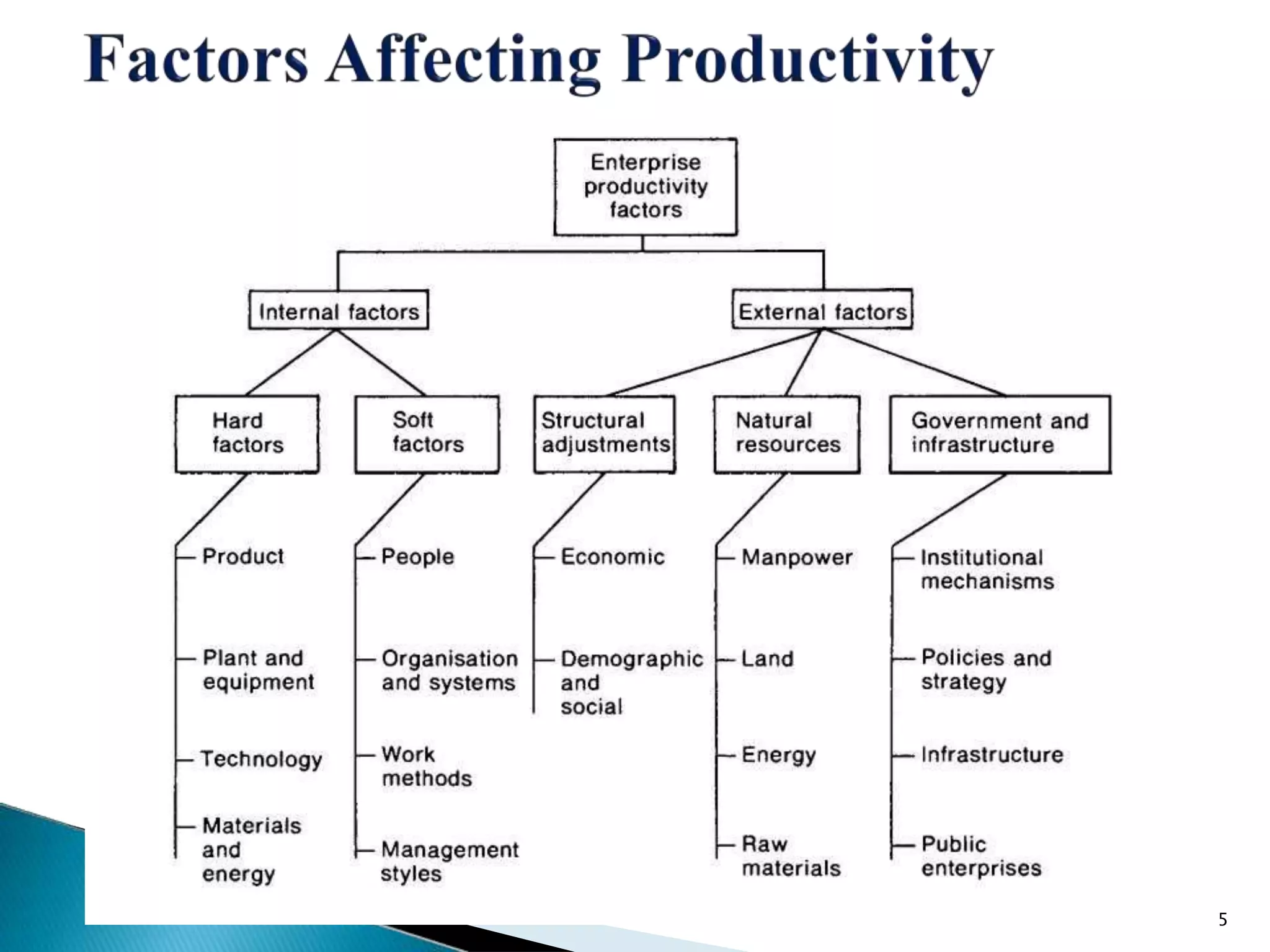
Productivity Variables
4
• Labour - contributes about 1/6 of the
annual increase
• Capital - contributes about 1/6 of the
annual increase
• Management - contributes about 4/6 of
the annual increase
5
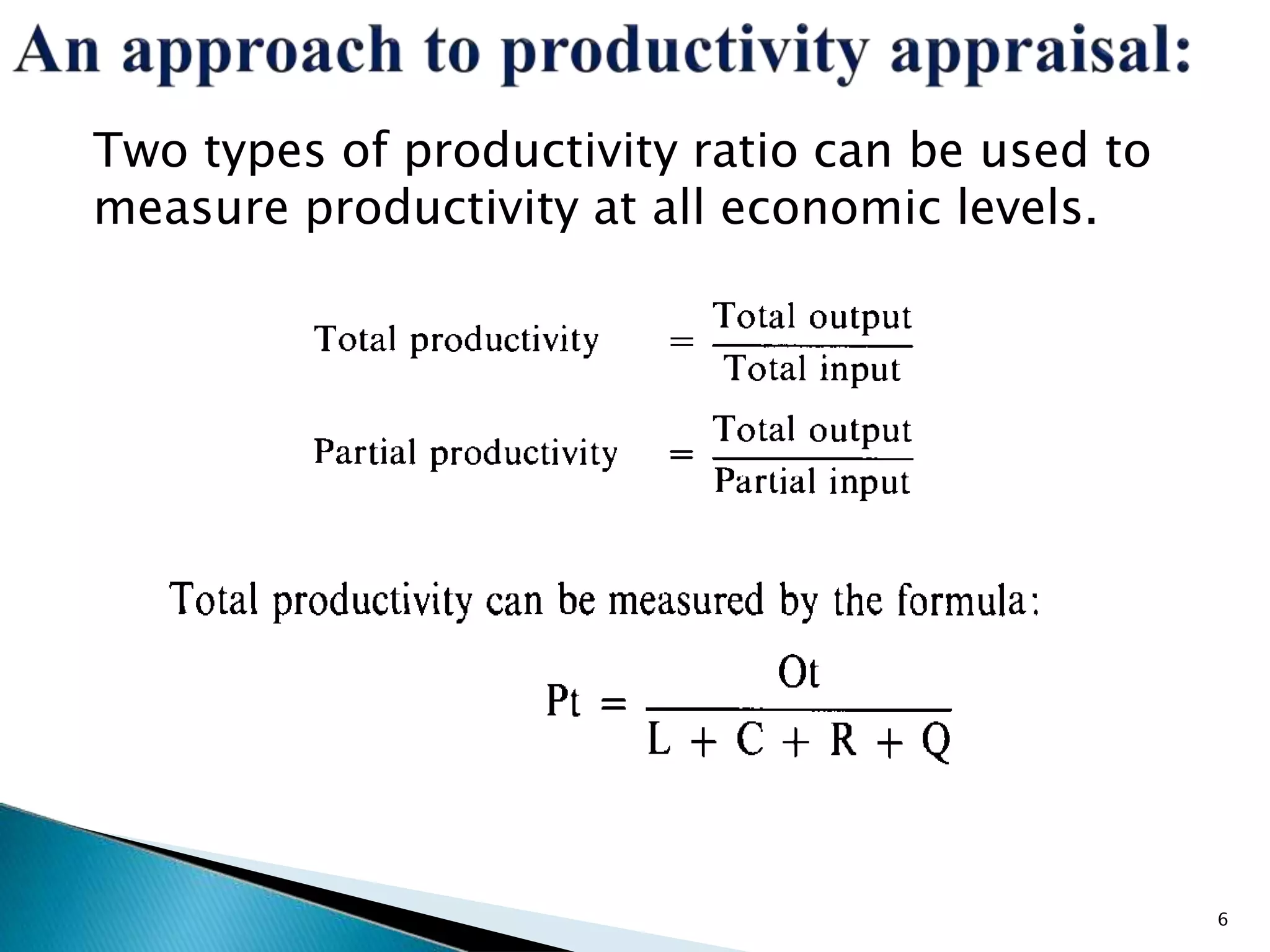
Two types of productivity ratio can be used to
measure productivity at all economic levels.
6
9
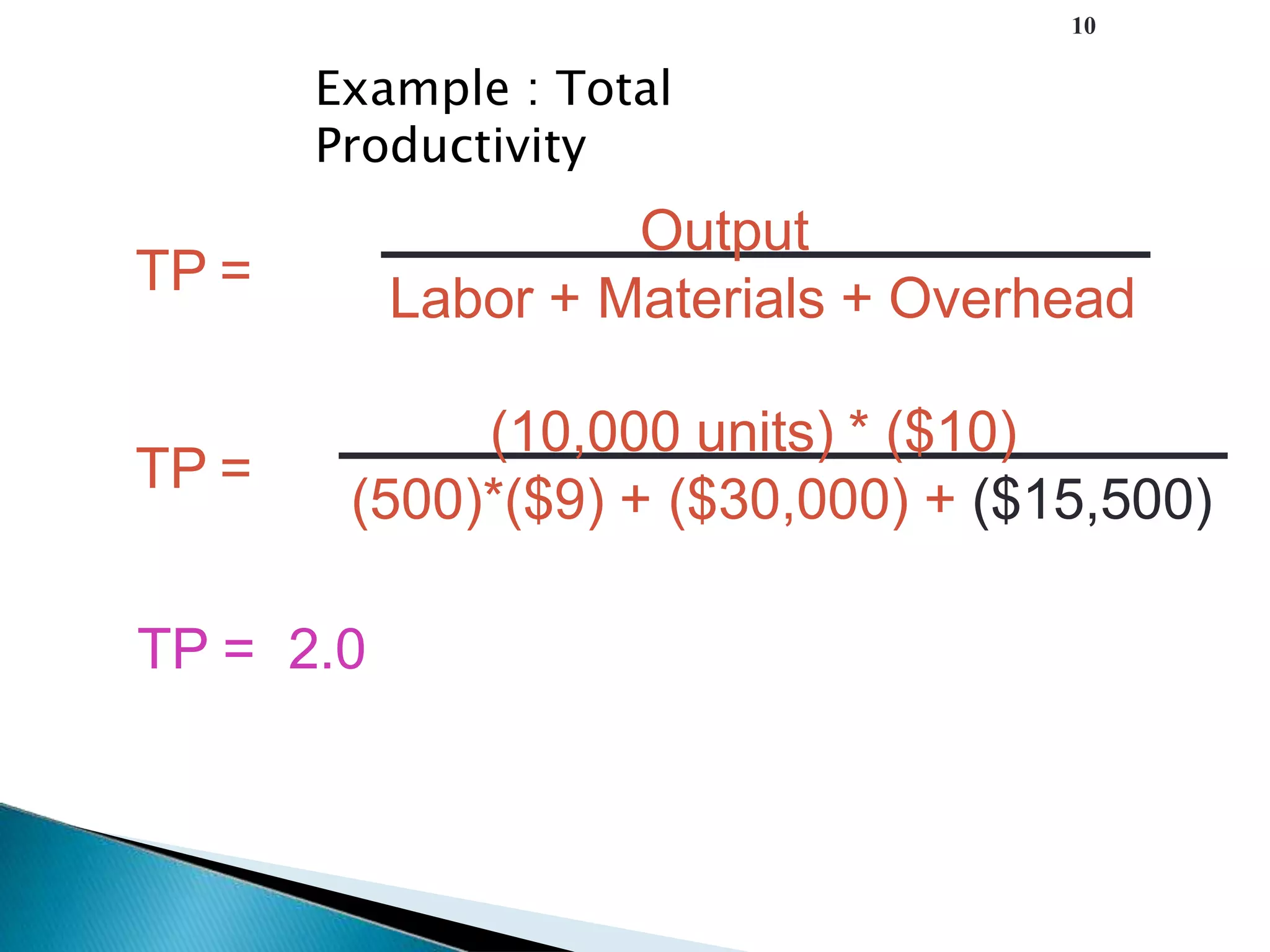
10,000 Units Produced
Sold for $10/unit
500 labor hours
Labor rate: $9/hr
Cost of R/M: $30,000
Overhead: $15,500
Example
10
Output
Labor + Materials + Overhead
(10,000 units) * ($10)
(500)*($9) + ($30,000) + ($15,500)
TP = 2.0
Example : Total
Productivity
TP =
TP =
• 10,000 units / 500hrs = 20 units/hr
• (10,000 units * $10/unit) / 500hrs = $200/hr
• 10,000 units / (500hrs * $9/hr) = 2.2 unit/$
• (10,000 units * $10/unit) / (500hrs * $9/hr) = 22.22
14
Example: Labor
Productivity
 Important for productivity improvement.
 Effective tool for decision-making at all
economic levels.
 To evaluate the impact of national
development programmes.
 To help analyse effectiveness and efficiency.
(enterprises productivity)
 Stimulate operational improvement.(labour
Productivity)
10
Three of the most common purposes are:
 Comparing an enterprise with its competitors;
 Determining the relative performance of
departments and workers;
 Comparing relative benefits of various types
of input for collective bargaining and gains
sharing.
12
• It emphasizes the efficient utilization of all the factors of
production which are scarce universally.
• It attempts to eliminate wastage.
• It facilitates the comparison of the performance of a company to
its competitors or related firms, in terms of aggregate results
and of major components of performance.
• It enables the management to control the performance of the
company by identifying the comparative benefits rising out of
the use of different inputs.
Advantages of Productivity:
 Productivity measurement and evaluation system (ProMES)
 Deterministic productivity accounting (DPA)
 The National Productivity Institute (NPI)
 Theory of constraints (ToC)
 The total productivity model (TPM)
 Alan Lawlor's approach (Lawlor)
 Applied productivity - Gold's approach (Gold)
 Operation function analysis (OFA)
 International Labour Organisation- (ILO)
 Quick productivity appraisal (QPA)
 Kurosawa and Goshi - Japan Productivity Center (Kurosawa)
 Multifactor productivity measurement model (MFPMM)
14
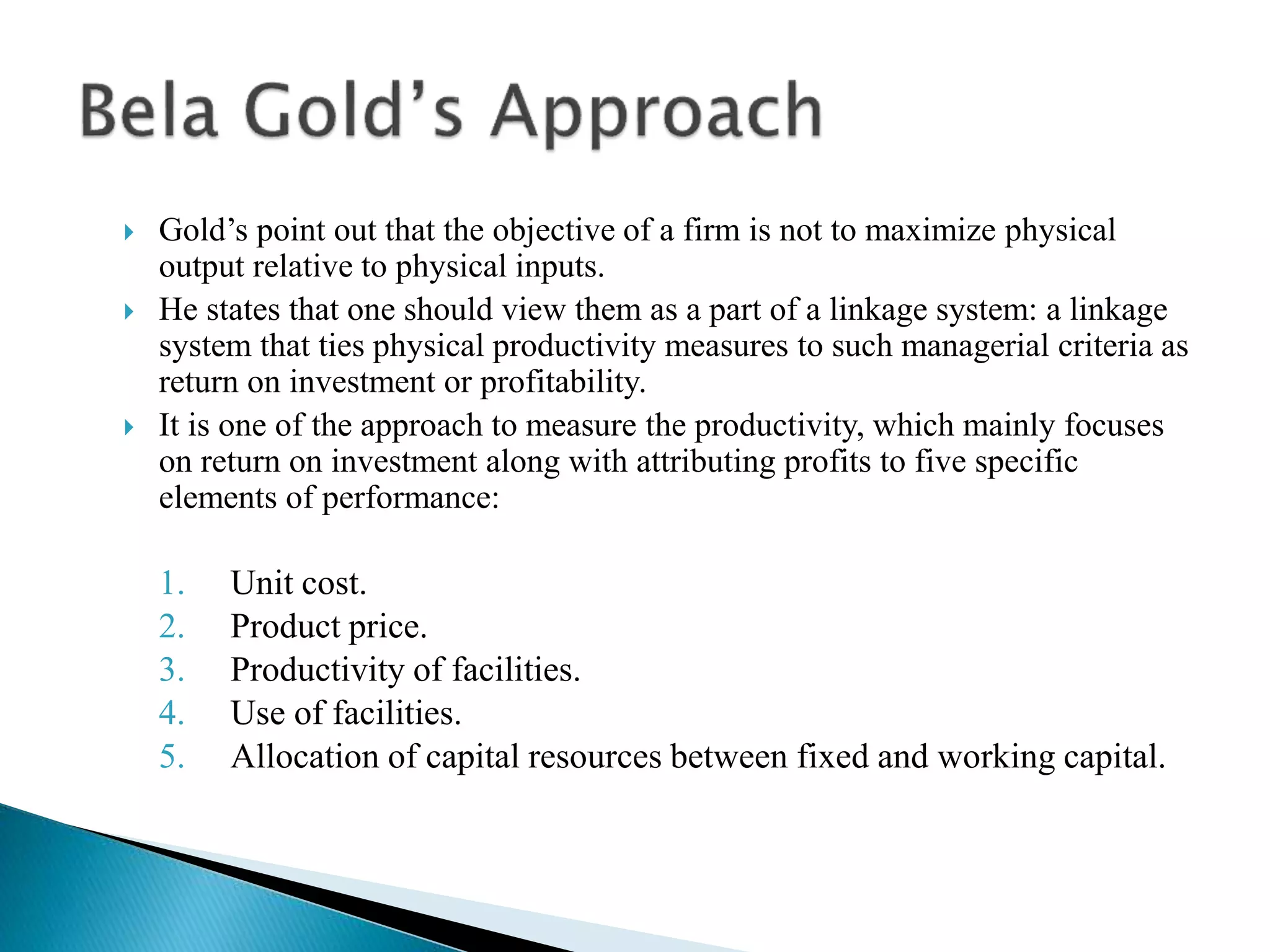
 Gold’s point out that the objective of a firm is not to maximize physical
output relative to physical inputs.
 He states that one should view them as a part of a linkage system: a linkage
system that ties physical productivity measures to such managerial criteria as
return on investment or profitability.
 It is one of the approach to measure the productivity, which mainly focuses
on return on investment along with attributing profits to five specific
elements of performance:
1. Unit cost.
2. Product price.
3. Productivity of facilities.
4. Use of facilities.
5. Allocation of capital resources between fixed and working capital.
 It is one of the approach to measure the productivity,
which mainly focuses on return on investment along
with attributing profits to five specific elements of
performance:
1. Unit cost.
2. Product price.
3. Productivity of facilities.
4. Use of facilities.
5. Allocation of capital resources between fixed and working
capital.
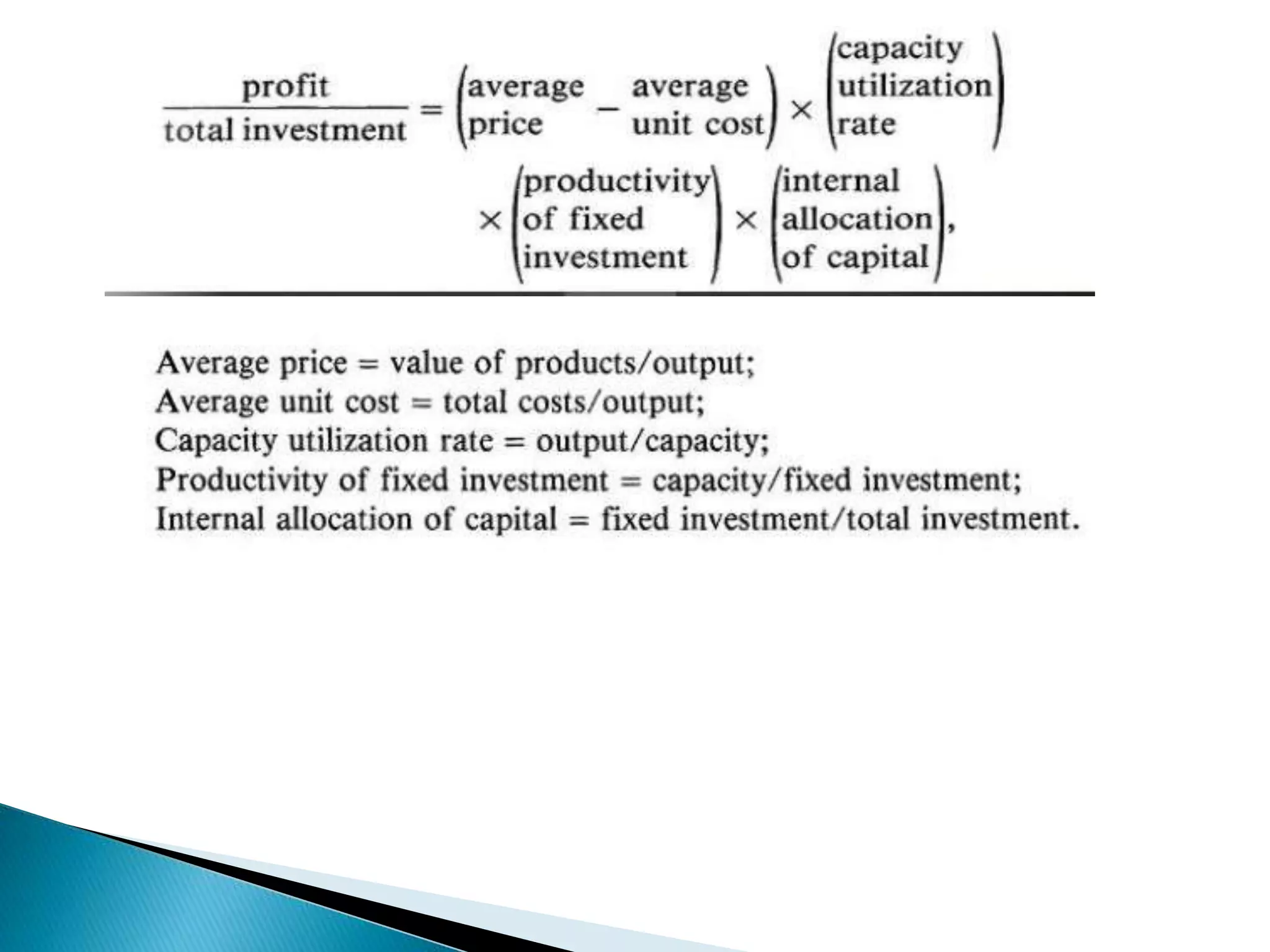
Profit
Investment
Product revenue
out put
= -
Total cost
out put
* out put
capacity
*
Capacity
Fixed investment
* Fixed investment
Total investment
RESULT
21

productivity measures and analysis by gold's approach

  • 1.
  • 2.
    A general relationship definition between is thatproductivity the output generated is the by a production or service system and the input provided to create this output. 2
  • 4.
    Productivity Variables 4 • Labour- contributes about 1/6 of the annual increase • Capital - contributes about 1/6 of the annual increase • Management - contributes about 4/6 of the annual increase
  • 5.
  • 6.
    Two types ofproductivity ratio can be used to measure productivity at all economic levels. 6
  • 7.
    9 10,000 Units Produced Soldfor $10/unit 500 labor hours Labor rate: $9/hr Cost of R/M: $30,000 Overhead: $15,500 Example
  • 8.
    10 Output Labor + Materials+ Overhead (10,000 units) * ($10) (500)*($9) + ($30,000) + ($15,500) TP = 2.0 Example : Total Productivity TP = TP =
  • 9.
    • 10,000 units/ 500hrs = 20 units/hr • (10,000 units * $10/unit) / 500hrs = $200/hr • 10,000 units / (500hrs * $9/hr) = 2.2 unit/$ • (10,000 units * $10/unit) / (500hrs * $9/hr) = 22.22 14 Example: Labor Productivity
  • 10.
     Important forproductivity improvement.  Effective tool for decision-making at all economic levels.  To evaluate the impact of national development programmes.  To help analyse effectiveness and efficiency. (enterprises productivity)  Stimulate operational improvement.(labour Productivity) 10
  • 12.
    Three of themost common purposes are:  Comparing an enterprise with its competitors;  Determining the relative performance of departments and workers;  Comparing relative benefits of various types of input for collective bargaining and gains sharing. 12
  • 13.
    • It emphasizesthe efficient utilization of all the factors of production which are scarce universally. • It attempts to eliminate wastage. • It facilitates the comparison of the performance of a company to its competitors or related firms, in terms of aggregate results and of major components of performance. • It enables the management to control the performance of the company by identifying the comparative benefits rising out of the use of different inputs. Advantages of Productivity:
  • 14.
     Productivity measurementand evaluation system (ProMES)  Deterministic productivity accounting (DPA)  The National Productivity Institute (NPI)  Theory of constraints (ToC)  The total productivity model (TPM)  Alan Lawlor's approach (Lawlor)  Applied productivity - Gold's approach (Gold)  Operation function analysis (OFA)  International Labour Organisation- (ILO)  Quick productivity appraisal (QPA)  Kurosawa and Goshi - Japan Productivity Center (Kurosawa)  Multifactor productivity measurement model (MFPMM) 14
  • 15.
     Gold’s pointout that the objective of a firm is not to maximize physical output relative to physical inputs.  He states that one should view them as a part of a linkage system: a linkage system that ties physical productivity measures to such managerial criteria as return on investment or profitability.  It is one of the approach to measure the productivity, which mainly focuses on return on investment along with attributing profits to five specific elements of performance: 1. Unit cost. 2. Product price. 3. Productivity of facilities. 4. Use of facilities. 5. Allocation of capital resources between fixed and working capital.
  • 16.
     It isone of the approach to measure the productivity, which mainly focuses on return on investment along with attributing profits to five specific elements of performance: 1. Unit cost. 2. Product price. 3. Productivity of facilities. 4. Use of facilities. 5. Allocation of capital resources between fixed and working capital.
  • 18.
    Profit Investment Product revenue out put =- Total cost out put * out put capacity * Capacity Fixed investment * Fixed investment Total investment
  • 19.
  • 21.