PRODUCTION OF
METHANOL FROM
METHANE AND AIR
V.RESHMA SONA, S.VIJAYALAKHSMI,
III YEAR, B.TECH CHEMICAL ENGINEERING,
ACT CAMPUS, ANNA UNIVERSITY.
ABSTRACT
 Methanol can replace petrol and diesel
efficiently but its two step production
process is quite expensive and polluting.
 Producing methanol directly from methane
(a major constituent of natural gas) and air
can make it a cheap, clean and green fuel
METHANOL
 A revolutionary compound in chemical industry
 Annual production – 70 million tones
 Perfect solvent
 Gasoline additive to increase octane number
 Chemical feedstock for hundreds of chemicals
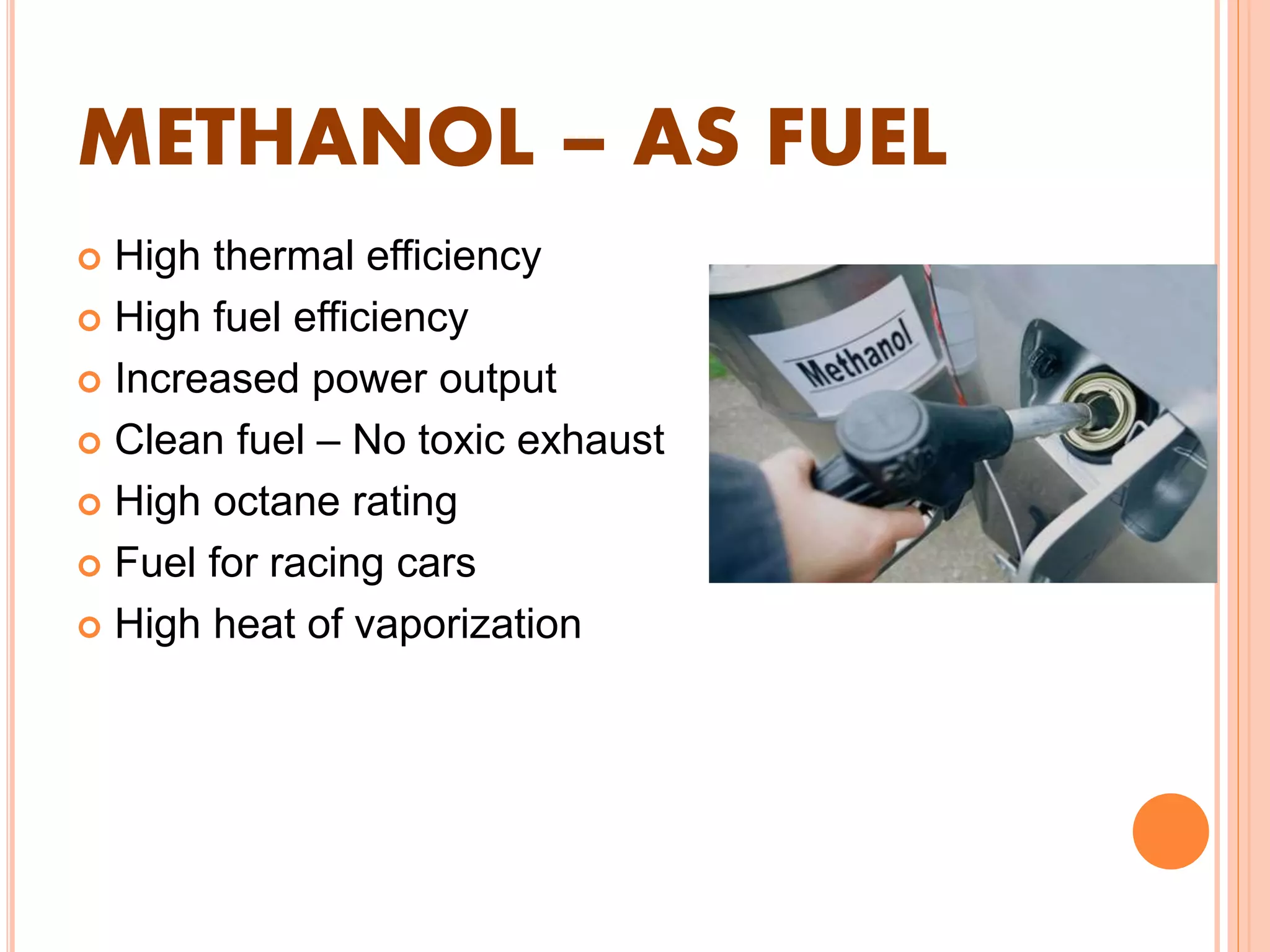
METHANOL – AS FUEL
 High thermal efficiency
 High fuel efficiency
 Increased power output
 Clean fuel – No toxic exhaust
 High octane rating
 Fuel for racing cars
 High heat of vaporization
EXISTING METHANOL PRODUCTION
Methanol production is a two step process.
STEP I : STEAM REFORMING
Methane reacts with steam over nickel catalyst.
At 10-20atm pressure and 1080K
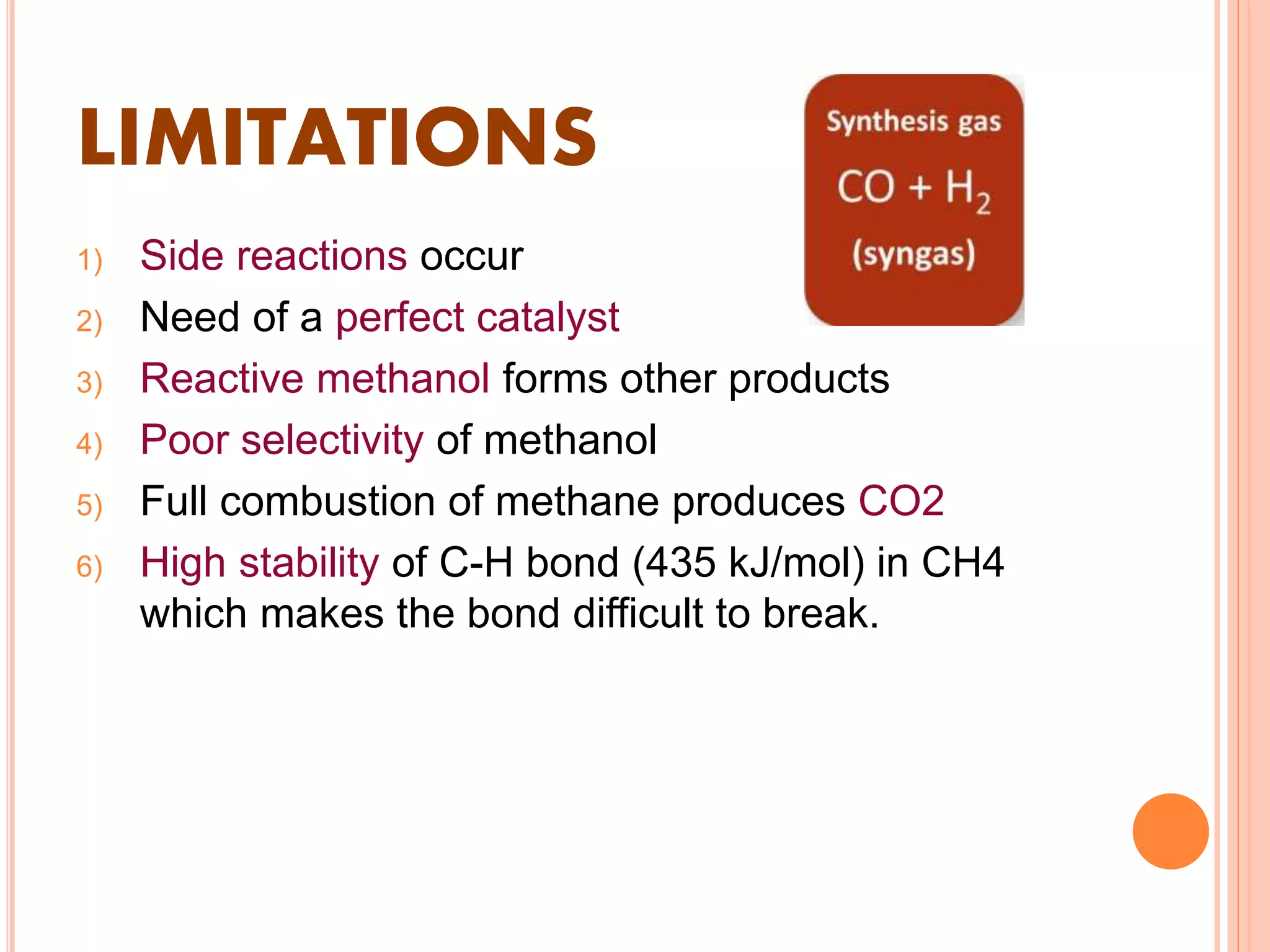
Synthesis gas ( CO + H2 ) is produced.
STEP II : METHANOL SYNTHESIS
Synthesis gas reacts over a fixed bed catalyst.
At 50atm pressure and 523K
Methanol is produced.
PROBLEM AND SOLUTION
PROBLEM:
 Synthesis gas production requires high
temperature, high pressure, high cost.
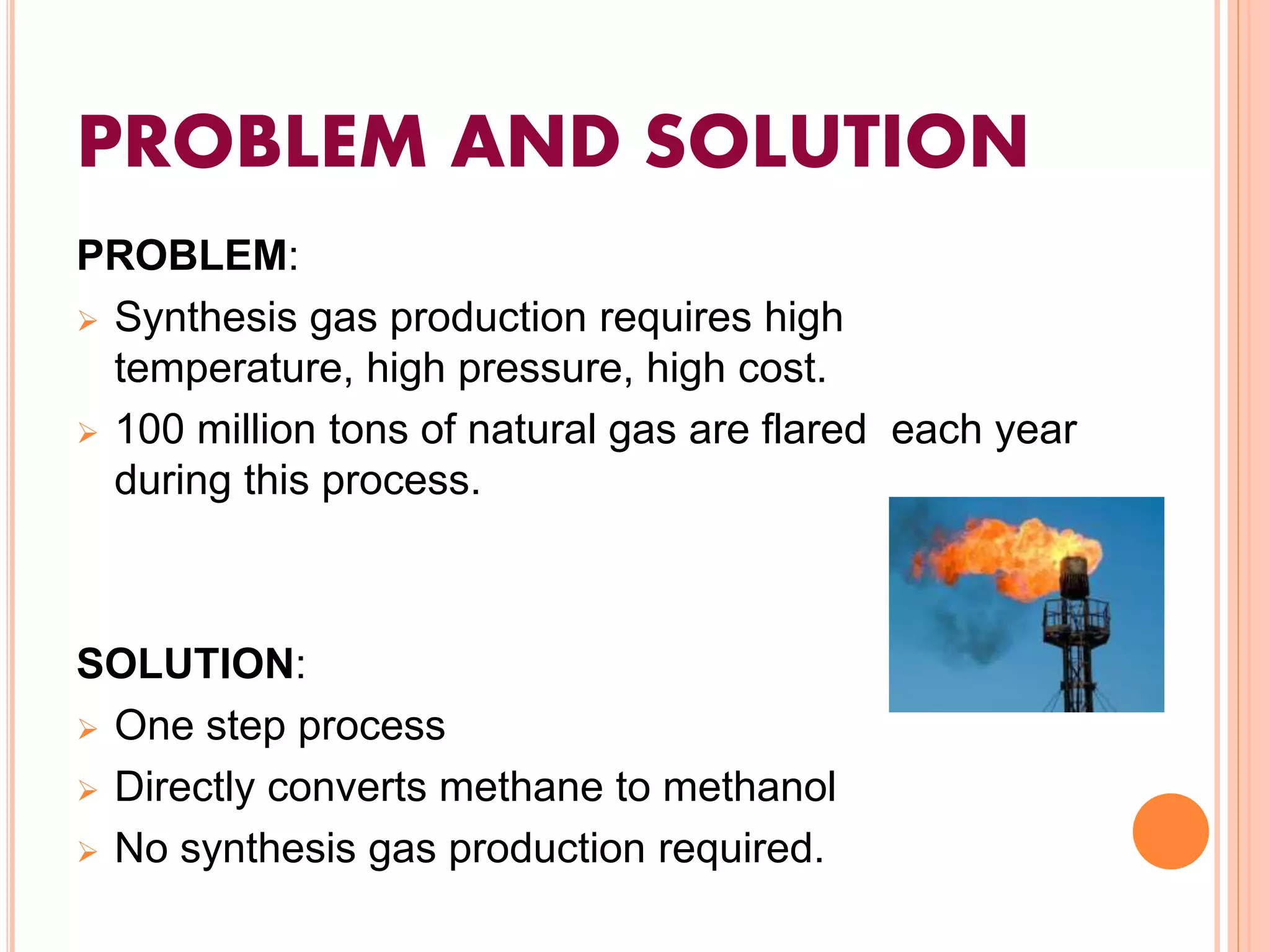
 100 million tons of natural gas are flared each year
during this process.
SOLUTION:
 One step process
 Directly converts methane to methanol
 No synthesis gas production required.
LIMITATIONS
1) Side reactions occur
2) Need of a perfect catalyst
3) Reactive methanol forms other products
4) Poor selectivity of methanol
5) Full combustion of methane produces CO2
6) High stability of C-H bond (435 kJ/mol) in CH4
which makes the bond difficult to break.
NEW METHOD
 Selective partial oxidation (SEP) of methane to
methanol
 Oxidant : O2 in the presence of very small
amount of H2O2
 Catalysts : Colloidal Au-Pd nanoparticles (3-5nm)
 Methyl radicals formed break the C-H bond
RESULTS
Au- + 2CH4 + 1/2O2 = Au-(CH4) + CH3OH
methyl radicals
Au-(CH4) + 1/2O2 = Au- + CH3OH
Adding these reactions, we get,
CH4 + 1/2O2 = CH3OH
Au-Pd catalysts form methyl radicals, which break
the C-H bond, leading to methanol production.
ADVANTAGES
 No side reactions - only methanol formation.
 No methanol oxidation due to low temperature of
the reaction.
 Highest selectivity of 92%
 CO2, a greenhouse gas is not formed.
 Low energy reaction
 Methanol produced here is in an energy form which
is easier to transport
 It is more efficient
CONCLUSION
 Petrol reserves are depleting at a faster rate, so
methanol is the most promising fuel of future.
 Methanol thus produced is cheap and green.
 This method is simpler in use and can be
commercialized.
REFERENCES
[1]Walther, G., Quaade, U., & Horch, S. (2008). 'Methane oxidation on
supported gold catalysts'.
[2]“Why Methanol is a viable alternative fuel for India”(2017, August
7)Retrieved from http://energy.economictimes.indiatimes.com/energy-
speak/why-methanol-is-a-viable-alternative-fuel-for-india/2533
[3]Priyank Khirsariya & Raju K.Mewada (2012) , ‘Single Step Oxidation of
Methane to Methanol–Towards Better Understanding’, Procedia
Engineering, Volume 51, 2013, Pages 409-415
[4]Lemnouer Chibane and Brahim Djellouli (2011), ‘Methane Steam
Reforming Reaction Behaviour in a Packed Bed Membrane Reactor’,
International Journal of Chemical Engineering and Applications, Vol. 2 ,
No. 3 , June 2011.
[5] L. M. Zhou, Xue (1997), Partial Oxidation of Methane to Methanol with
Oxygen or Air in a Nonequilibrium Discharge Plasma, Plasma Chemistry
and Plasma Processing, Vol. 18, No. 3, 1998

Production of methanol from methane and air

  • 1.
    PRODUCTION OF METHANOL FROM METHANEAND AIR V.RESHMA SONA, S.VIJAYALAKHSMI, III YEAR, B.TECH CHEMICAL ENGINEERING, ACT CAMPUS, ANNA UNIVERSITY.
  • 2.
    ABSTRACT  Methanol canreplace petrol and diesel efficiently but its two step production process is quite expensive and polluting.  Producing methanol directly from methane (a major constituent of natural gas) and air can make it a cheap, clean and green fuel
  • 3.
    METHANOL  A revolutionarycompound in chemical industry  Annual production – 70 million tones  Perfect solvent  Gasoline additive to increase octane number  Chemical feedstock for hundreds of chemicals
  • 4.
    METHANOL – ASFUEL  High thermal efficiency  High fuel efficiency  Increased power output  Clean fuel – No toxic exhaust  High octane rating  Fuel for racing cars  High heat of vaporization
  • 5.
    EXISTING METHANOL PRODUCTION Methanolproduction is a two step process. STEP I : STEAM REFORMING Methane reacts with steam over nickel catalyst. At 10-20atm pressure and 1080K Synthesis gas ( CO + H2 ) is produced. STEP II : METHANOL SYNTHESIS Synthesis gas reacts over a fixed bed catalyst. At 50atm pressure and 523K Methanol is produced.
  • 6.
    PROBLEM AND SOLUTION PROBLEM: Synthesis gas production requires high temperature, high pressure, high cost.  100 million tons of natural gas are flared each year during this process. SOLUTION:  One step process  Directly converts methane to methanol  No synthesis gas production required.
  • 7.
    LIMITATIONS 1) Side reactionsoccur 2) Need of a perfect catalyst 3) Reactive methanol forms other products 4) Poor selectivity of methanol 5) Full combustion of methane produces CO2 6) High stability of C-H bond (435 kJ/mol) in CH4 which makes the bond difficult to break.
  • 8.
    NEW METHOD  Selectivepartial oxidation (SEP) of methane to methanol  Oxidant : O2 in the presence of very small amount of H2O2  Catalysts : Colloidal Au-Pd nanoparticles (3-5nm)  Methyl radicals formed break the C-H bond
  • 9.
    RESULTS Au- + 2CH4+ 1/2O2 = Au-(CH4) + CH3OH methyl radicals Au-(CH4) + 1/2O2 = Au- + CH3OH Adding these reactions, we get, CH4 + 1/2O2 = CH3OH Au-Pd catalysts form methyl radicals, which break the C-H bond, leading to methanol production.
  • 10.
    ADVANTAGES  No sidereactions - only methanol formation.  No methanol oxidation due to low temperature of the reaction.  Highest selectivity of 92%  CO2, a greenhouse gas is not formed.  Low energy reaction  Methanol produced here is in an energy form which is easier to transport  It is more efficient
  • 11.
    CONCLUSION  Petrol reservesare depleting at a faster rate, so methanol is the most promising fuel of future.  Methanol thus produced is cheap and green.  This method is simpler in use and can be commercialized.
  • 12.
    REFERENCES [1]Walther, G., Quaade,U., & Horch, S. (2008). 'Methane oxidation on supported gold catalysts'. [2]“Why Methanol is a viable alternative fuel for India”(2017, August 7)Retrieved from http://energy.economictimes.indiatimes.com/energy- speak/why-methanol-is-a-viable-alternative-fuel-for-india/2533 [3]Priyank Khirsariya & Raju K.Mewada (2012) , ‘Single Step Oxidation of Methane to Methanol–Towards Better Understanding’, Procedia Engineering, Volume 51, 2013, Pages 409-415 [4]Lemnouer Chibane and Brahim Djellouli (2011), ‘Methane Steam Reforming Reaction Behaviour in a Packed Bed Membrane Reactor’, International Journal of Chemical Engineering and Applications, Vol. 2 , No. 3 , June 2011. [5] L. M. Zhou, Xue (1997), Partial Oxidation of Methane to Methanol with Oxygen or Air in a Nonequilibrium Discharge Plasma, Plasma Chemistry and Plasma Processing, Vol. 18, No. 3, 1998