GENRE
CONVENTIONS
PRODUCTION
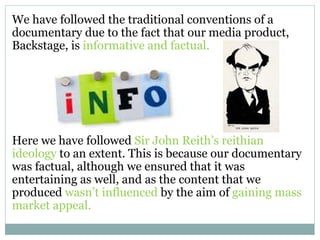
We have followed the traditional conventions of a
documentary due to the fact that our media product,
Backstage, is informative and factual.
Here we have followed Sir John Reith’s reithian
ideology to an extent. This is because our documentary
was factual, although we ensured that it was
entertaining as well, and as the content that we
produced wasn’t influenced by the aim of gaining mass
market appeal.
By ensuring that our production was
entertaining through the cut aways
and inspirational and upbeat music,
we have adhered to the convention
of modern documentaries not being
entirely educational and being
entertaining.
We also feel that, as we expected,
our short documentary is
entertaining as most of our
interviewees were enthusiastic due
to the careers that they have, having
been in the past, or currently being,
involved with acting and theatre.
The modern convention of short
documentaries being entertaining
is usually due to institutions
aiming to gain mass market
appeal, this is typically
conglomerates aiming to profit.
We however as an independent
institution, like previously stated,
weren’t creating an entertaining
product to gain mass market
appeal, this is especially as our
content is niche anyway. Through
having an entertainment value in
our documentary however, we
have created opportunity to
possibly widen our audience.
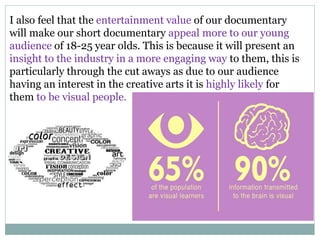
I also feel that the entertainment value of our documentary
will make our short documentary appeal more to our young
audience of 18-25 year olds. This is because it will present an
insight to the industry in a more engaging way to them, this is
particularly through the cut aways as due to our audience
having an interest in the creative arts it is highly likely for
them to be visual people.
Due to the fact that within the creative industry we have
focused on theatre, including musical theatre, our audience are
also likely to engage well will the inspiring music, composed by
James Waymont.
I feel that we made the right decision in
making our documentary factual yet
entertaining as the entertainment value
will appeal to our young primary
audience yet the factual and
informative aspect will appeal to the
fact that they are sophisticated and will
fulfil the intellectual pleasures of our
secondary audience. I feel that we
conveyed enough entertainment
through our chosen methods of using
cutaways, inspirational music and time
lapses.
The fact that we are an independent institution is conventional of
producers of short documentaries, as is our low budget.
It is also typical for short documentaries to have a powerful message and
although our topic isn’t hard-hitting, we feel that to an extent we have
adhered to this convention through our subject matter of the hardships
and rewards of the creative industry. This is as we feel there are various
areas where the passion of the interviewees is evident and the inspiring
music composed by James Waymont also reinforces our message, which is
a positive view on the industry showing that the rewards are worth the
perseverance. Another convention that we have followed is that I
myself,and all the members of our group, as producers, have a strong
interest in our subject matter.
We decided that we would use the expository mode in
group A of documentary modes. We have adhered to the
conventions of this mode due to the fact that we have
created a realistic documentary but we have also
portrayed a specific interpretation of reality, our opinion,
as producers that the creative industry is worth the
perseverance of the hardships in order to get the
rewards.
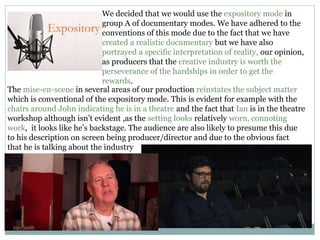
The mise-en-scene in several areas of our production reinstates the subject matter
which is conventional of the expository mode. This is evident for example with the
chairs around John indicating he is in a theatre and the fact that Ian is in the theatre
workshop although isn’t evident ,as the setting looks relatively worn, connoting
work, it looks like he’s backstage. The audience are also likely to presume this due
to his description on screen being producer/director and due to the obvious fact
that he is talking about the industry
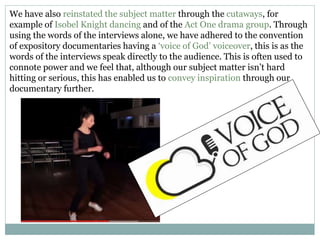
We have also reinstated the subject matter through the cutaways, for
example of Isobel Knight dancing and of the Act One drama group. Through
using the words of the interviews alone, we have adhered to the convention
of expository documentaries having a ‘voice of God’ voiceover, this is as the
words of the interviews speak directly to the audience. This is often used to
connote power and we feel that, although our subject matter isn’t hard
hitting or serious, this has enabled us to convey inspiration through our
documentary further.
On revaluation I now realise the importance of
ensuring that we provided our audience with a
conclusion for our documentary to a further
extent than I did in the planning and research
stages.
This is due to the fact that our primary
audience are at the young ages of 18-25 and are
in further education based on the creative
arts and also because they are looking for a
media product which will confirm that their
ambition of working in the creative industry
will be a rewarding profession.
This shows that a key aspect in our media
product appealing to them is it having a
conclusive ending.
The fact that our primary audience are also looking for safety in
Maslow’s hierarchy of needs through media products, shows that
they will be inspired by the documentary due to the nature of
jobs in creative fields and had we not had been conclusive with the
ending then we may not have been able to be as inspirational as we
would’ve had to have stayed neutral through the way in which we
constructed our representation through editing. This would be so the
audience could therefore conclude our documentary themselves based on
their own interpretation.
I feel that due to our primary audience seeking safety in the
hierarchy, by using the expository mode and having the ‘voice of
god’ voiceover we have also minimised the uncertainty of the
future, therefore helping them to feel security from the product. This
is due to the fact that they will be more trusting on the information
that they are receiving as they are hearing it first hand from the
industry professionals as oppose to through a narrator voiceover.
I feel that choosing to create an expository documentary was the right
decision for us as it has enabled us to ensure that the audience feel guided
and satisfied that that ending has a conclusion. This will therefore enable
our primary audience to feel safety from Maslow's hierarchy of needs, as
they desire, as they will feel confident in perusing a creative career. The
positive message of the industry was conveyed in our documentary mainly
due to the way in which we edited our production to ensure we started
with the hardships and finished with the rewards and the way in which we
ended our documentary with inspirational and upbeat music and an
inspirational montage. I feel that we did this effectively although I feel we
should have explored more options to create a stronger enigma in our
production, for example a different narrative structure to Todorov’s
equilibrium which is what we used.

PRODUCTION: Genre conventions

  • 1.
  • 2.
    We have followedthe traditional conventions of a documentary due to the fact that our media product, Backstage, is informative and factual. Here we have followed Sir John Reith’s reithian ideology to an extent. This is because our documentary was factual, although we ensured that it was entertaining as well, and as the content that we produced wasn’t influenced by the aim of gaining mass market appeal.
  • 3.
    By ensuring thatour production was entertaining through the cut aways and inspirational and upbeat music, we have adhered to the convention of modern documentaries not being entirely educational and being entertaining. We also feel that, as we expected, our short documentary is entertaining as most of our interviewees were enthusiastic due to the careers that they have, having been in the past, or currently being, involved with acting and theatre.
  • 4.
    The modern conventionof short documentaries being entertaining is usually due to institutions aiming to gain mass market appeal, this is typically conglomerates aiming to profit. We however as an independent institution, like previously stated, weren’t creating an entertaining product to gain mass market appeal, this is especially as our content is niche anyway. Through having an entertainment value in our documentary however, we have created opportunity to possibly widen our audience.
  • 5.
    I also feelthat the entertainment value of our documentary will make our short documentary appeal more to our young audience of 18-25 year olds. This is because it will present an insight to the industry in a more engaging way to them, this is particularly through the cut aways as due to our audience having an interest in the creative arts it is highly likely for them to be visual people.
  • 6.
    Due to thefact that within the creative industry we have focused on theatre, including musical theatre, our audience are also likely to engage well will the inspiring music, composed by James Waymont.
  • 7.
    I feel thatwe made the right decision in making our documentary factual yet entertaining as the entertainment value will appeal to our young primary audience yet the factual and informative aspect will appeal to the fact that they are sophisticated and will fulfil the intellectual pleasures of our secondary audience. I feel that we conveyed enough entertainment through our chosen methods of using cutaways, inspirational music and time lapses.
  • 8.
    The fact thatwe are an independent institution is conventional of producers of short documentaries, as is our low budget. It is also typical for short documentaries to have a powerful message and although our topic isn’t hard-hitting, we feel that to an extent we have adhered to this convention through our subject matter of the hardships and rewards of the creative industry. This is as we feel there are various areas where the passion of the interviewees is evident and the inspiring music composed by James Waymont also reinforces our message, which is a positive view on the industry showing that the rewards are worth the perseverance. Another convention that we have followed is that I myself,and all the members of our group, as producers, have a strong interest in our subject matter.
  • 9.
    We decided thatwe would use the expository mode in group A of documentary modes. We have adhered to the conventions of this mode due to the fact that we have created a realistic documentary but we have also portrayed a specific interpretation of reality, our opinion, as producers that the creative industry is worth the perseverance of the hardships in order to get the rewards. The mise-en-scene in several areas of our production reinstates the subject matter which is conventional of the expository mode. This is evident for example with the chairs around John indicating he is in a theatre and the fact that Ian is in the theatre workshop although isn’t evident ,as the setting looks relatively worn, connoting work, it looks like he’s backstage. The audience are also likely to presume this due to his description on screen being producer/director and due to the obvious fact that he is talking about the industry
  • 10.
    We have alsoreinstated the subject matter through the cutaways, for example of Isobel Knight dancing and of the Act One drama group. Through using the words of the interviews alone, we have adhered to the convention of expository documentaries having a ‘voice of God’ voiceover, this is as the words of the interviews speak directly to the audience. This is often used to connote power and we feel that, although our subject matter isn’t hard hitting or serious, this has enabled us to convey inspiration through our documentary further.
  • 11.
    On revaluation Inow realise the importance of ensuring that we provided our audience with a conclusion for our documentary to a further extent than I did in the planning and research stages. This is due to the fact that our primary audience are at the young ages of 18-25 and are in further education based on the creative arts and also because they are looking for a media product which will confirm that their ambition of working in the creative industry will be a rewarding profession. This shows that a key aspect in our media product appealing to them is it having a conclusive ending.
  • 12.
    The fact thatour primary audience are also looking for safety in Maslow’s hierarchy of needs through media products, shows that they will be inspired by the documentary due to the nature of jobs in creative fields and had we not had been conclusive with the ending then we may not have been able to be as inspirational as we would’ve had to have stayed neutral through the way in which we constructed our representation through editing. This would be so the audience could therefore conclude our documentary themselves based on their own interpretation. I feel that due to our primary audience seeking safety in the hierarchy, by using the expository mode and having the ‘voice of god’ voiceover we have also minimised the uncertainty of the future, therefore helping them to feel security from the product. This is due to the fact that they will be more trusting on the information that they are receiving as they are hearing it first hand from the industry professionals as oppose to through a narrator voiceover.
  • 13.
    I feel thatchoosing to create an expository documentary was the right decision for us as it has enabled us to ensure that the audience feel guided and satisfied that that ending has a conclusion. This will therefore enable our primary audience to feel safety from Maslow's hierarchy of needs, as they desire, as they will feel confident in perusing a creative career. The positive message of the industry was conveyed in our documentary mainly due to the way in which we edited our production to ensure we started with the hardships and finished with the rewards and the way in which we ended our documentary with inspirational and upbeat music and an inspirational montage. I feel that we did this effectively although I feel we should have explored more options to create a stronger enigma in our production, for example a different narrative structure to Todorov’s equilibrium which is what we used.