Product Management
Project management – the process of making sure things get done right
vs
Product management – the process of making sure you are doing the right thing
Goals
• Clear overview of product(s)
• Better presentation, pitch, alignment within team
• Clearer statement towards customers, partners, investors, etc.
• Limit scope, create focus
• Be more efficient
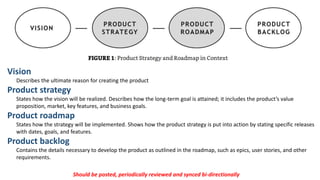
Vision
Describes the ultimate reason for creating the product
Product strategy
States how the vision will be realized. Describes how the long-term goal is attained; it includes the product’s value
proposition, market, key features, and business goals.
Product roadmap
States how the strategy will be implemented. Shows how the product strategy is put into action by stating specific releases
with dates, goals, and features.
Product backlog
Contains the details necessary to develop the product as outlined in the roadmap, such as epics, user stories, and other
requirements.
Should be posted, periodically reviewed and synced bi-directionally
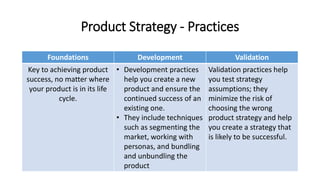
Product Strategy - Practices
Foundations Development Validation
Key to achieving product
success, no matter where
your product is in its life
cycle.
• Development practices
help you create a new
product and ensure the
continued success of an
existing one.
• They include techniques
such as segmenting the
market, working with
personas, and bundling
and unbundling the
product
Validation practices help
you test strategy
assumptions; they
minimize the risk of
choosing the wrong
product strategy and help
you create a strategy that
is likely to be successful.
Strategy Foundations
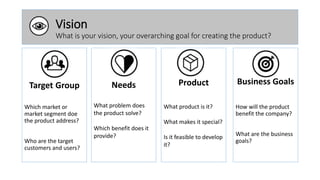
Vision
What is your vision, your overarching goal for creating the product?
Target Group
Which market or
market segment doe
the product address?
Who are the target
customers and users?
Business Goals
How will the product
benefit the company?
What are the business
goals?
Needs
What problem does
the product solve?
Which benefit does it
provide?
Product
What product is it?
What makes it special?
Is it feasible to develop
it?
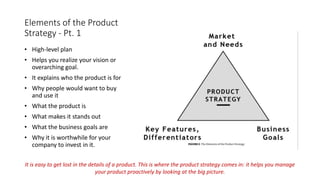
Elements of the Product
Strategy - Pt. 1
• High-level plan
• Helps you realize your vision or
overarching goal.
• It explains who the product is for
• Why people would want to buy
and use it
• What the product is
• What makes it stands out
• What the business goals are
• Why it is worthwhile for your
company to invest in it.
It is easy to get lost in the details of a product. This is where the product strategy comes in: it helps you manage
your product proactively by looking at the big picture.
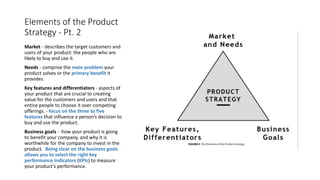
Elements of the Product
Strategy - Pt. 2
Market - describes the target customers and
users of your product: the people who are
likely to buy and use it.
Needs - comprise the main problem your
product solves or the primary benefit it
provides.
Key features and differentiators - aspects of
your product that are crucial to creating
value for the customers and users and that
entice people to choose it over competing
offerings. - focus on the three to five
features that influence a person’s decision to
buy and use the product.
Business goals - how your product is going
to benefit your company, and why it is
worthwhile for the company to invest in the
product. Being clear on the business goals
allows you to select the right key
performance indicators (KPIs) to measure
your product’s performance.
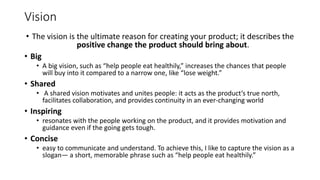
Vision
• The vision is the ultimate reason for creating your product; it describes the
positive change the product should bring about.
• Big
• A big vision, such as “help people eat healthily,” increases the chances that people
will buy into it compared to a narrow one, like “lose weight.”
• Shared
• A shared vision motivates and unites people: it acts as the product’s true north,
facilitates collaboration, and provides continuity in an ever-changing world
• Inspiring
• resonates with the people working on the product, and it provides motivation and
guidance even if the going gets tough.
• Concise
• easy to communicate and understand. To achieve this, I like to capture the vision as a
slogan— a short, memorable phrase such as “help people eat healthily.”
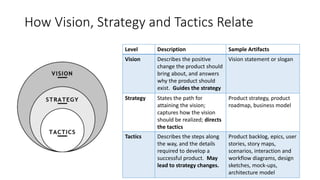
How Vision, Strategy and Tactics Relate
Level Description Sample Artifacts
Vision Describes the positive
change the product should
bring about, and answers
why the product should
exist. Guides the strategy
Vision statement or slogan
Strategy States the path for
attaining the vision;
captures how the vision
should be realized; directs
the tactics
Product strategy, product
roadmap, business model
Tactics Describes the steps along
the way, and the details
required to develop a
successful product. May
lead to strategy changes.
Product backlog, epics, user
stories, story maps,
scenarios, interaction and
workflow diagrams, design
sketches, mock-ups,
architecture model
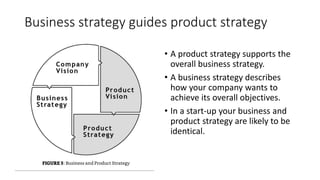
Business strategy guides product strategy
• A product strategy supports the
overall business strategy.
• A business strategy describes
how your company wants to
achieve its overall objectives.
• In a start-up your business and
product strategy are likely to be
identical.
Innovation Types
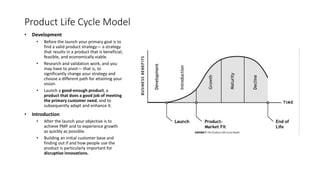
Product Life Cycle Model
• Development
• Before the launch your primary goal is to
find a valid product strategy— a strategy
that results in a product that is beneficial,
feasible, and economically viable.
• Research and validation work, and you
may have to pivot— that is, to
significantly change your strategy and
choose a different path for attaining your
vision.
• Launch a good-enough product, a
product that does a good job of meeting
the primary customer need, and to
subsequently adapt and enhance it.
• Introduction
• After the launch your objective is to
achieve PMF and to experience growth
as quickly as possible.
• Building an initial customer base and
finding out if and how people use the
product is particularly important for
disruptive innovations.
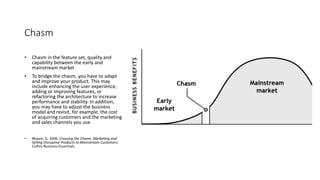
Chasm
• Chasm in the feature set, quality and
capability between the early and
mainstream market
• To bridge the chasm, you have to adapt
and improve your product. This may
include enhancing the user experience,
adding or improving features, or
refactoring the architecture to increase
performance and stability. In addition,
you may have to adjust the business
model and revisit, for example, the cost
of acquiring customers and the marketing
and sales channels you use.
• Moore, G. 2006. Crossing the Chasm. Marketing and
Selling Disruptive Products to Mainstream Customers.
Collins Business Essentials.
Product Strategy
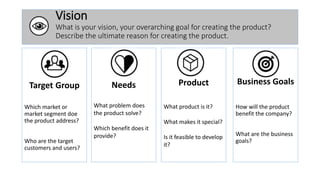
Vision
What is your vision, your overarching goal for creating the product?
Describe the ultimate reason for creating the product.
Target Group
Which market or
market segment doe
the product address?
Who are the target
customers and users?
Business Goals
How will the product
benefit the company?
What are the business
goals?
Needs
What problem does
the product solve?
Which benefit does it
provide?
Product
What product is it?
What makes it special?
Is it feasible to develop
it?
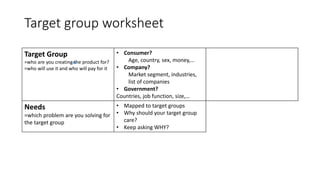
Target group worksheet
Target Group
=who are you creating the product for?
=who will use it and who will pay for it
• Consumer?
Age, country, sex, money,…
• Company?
Market segment, industries,
list of companies
• Government?
Countries, job function, size,…
Needs
=which problem are you solving for
the target group
• Mapped to target groups
• Why should your target group
care?
• Keep asking WHY?
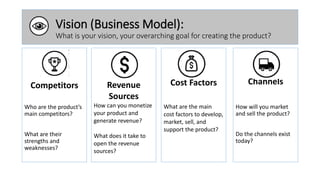
Vision (Business Model):
What is your vision, your overarching goal for creating the product?
Competitors
Who are the product’s
main competitors?
What are their
strengths and
weaknesses?
Channels
How will you market
and sell the product?
Do the channels exist
today?
Revenue
Sources
How can you monetize
your product and
generate revenue?
What does it take to
open the revenue
sources?
Cost Factors
What are the main
cost factors to develop,
market, sell, and
support the product?
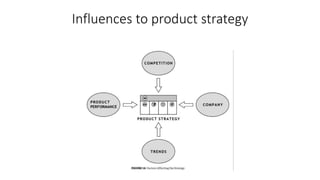
Influences to product strategy
Strategy Development
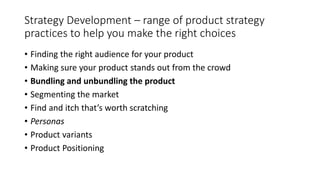
Strategy Development – range of product strategy
practices to help you make the right choices
• Finding the right audience for your product
• Making sure your product stands out from the crowd
• Bundling and unbundling the product
• Segmenting the market
• Find and itch that’s worth scratching
• Personas
• Product variants
• Product Positioning
Strategy Validation
Strategy Validation
• Iterations
• Performance data
• Surveys
• Focus groups
Product Roadmap
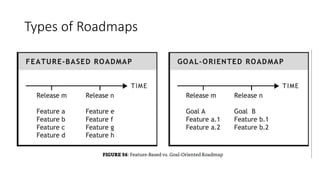
Types of Roadmaps
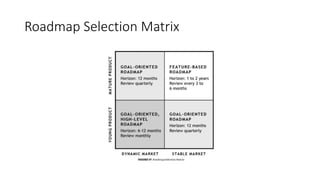
Roadmap Selection Matrix
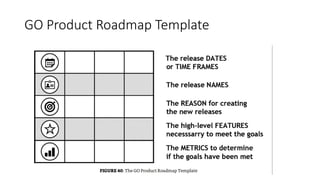
GO Product Roadmap Template
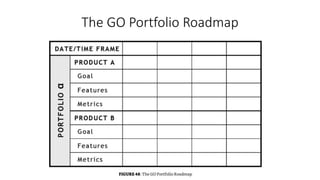
The GO Portfolio Roadmap

Product Management Overview

  • 1.
    Product Management Project management– the process of making sure things get done right vs Product management – the process of making sure you are doing the right thing
  • 2.
    Goals • Clear overviewof product(s) • Better presentation, pitch, alignment within team • Clearer statement towards customers, partners, investors, etc. • Limit scope, create focus • Be more efficient
  • 3.
    Vision Describes the ultimatereason for creating the product Product strategy States how the vision will be realized. Describes how the long-term goal is attained; it includes the product’s value proposition, market, key features, and business goals. Product roadmap States how the strategy will be implemented. Shows how the product strategy is put into action by stating specific releases with dates, goals, and features. Product backlog Contains the details necessary to develop the product as outlined in the roadmap, such as epics, user stories, and other requirements. Should be posted, periodically reviewed and synced bi-directionally
  • 4.
    Product Strategy -Practices Foundations Development Validation Key to achieving product success, no matter where your product is in its life cycle. • Development practices help you create a new product and ensure the continued success of an existing one. • They include techniques such as segmenting the market, working with personas, and bundling and unbundling the product Validation practices help you test strategy assumptions; they minimize the risk of choosing the wrong product strategy and help you create a strategy that is likely to be successful.
  • 5.
  • 6.
    Vision What is yourvision, your overarching goal for creating the product? Target Group Which market or market segment doe the product address? Who are the target customers and users? Business Goals How will the product benefit the company? What are the business goals? Needs What problem does the product solve? Which benefit does it provide? Product What product is it? What makes it special? Is it feasible to develop it?
  • 7.
    Elements of theProduct Strategy - Pt. 1 • High-level plan • Helps you realize your vision or overarching goal. • It explains who the product is for • Why people would want to buy and use it • What the product is • What makes it stands out • What the business goals are • Why it is worthwhile for your company to invest in it. It is easy to get lost in the details of a product. This is where the product strategy comes in: it helps you manage your product proactively by looking at the big picture.
  • 8.
    Elements of theProduct Strategy - Pt. 2 Market - describes the target customers and users of your product: the people who are likely to buy and use it. Needs - comprise the main problem your product solves or the primary benefit it provides. Key features and differentiators - aspects of your product that are crucial to creating value for the customers and users and that entice people to choose it over competing offerings. - focus on the three to five features that influence a person’s decision to buy and use the product. Business goals - how your product is going to benefit your company, and why it is worthwhile for the company to invest in the product. Being clear on the business goals allows you to select the right key performance indicators (KPIs) to measure your product’s performance.
  • 9.
    Vision • The visionis the ultimate reason for creating your product; it describes the positive change the product should bring about. • Big • A big vision, such as “help people eat healthily,” increases the chances that people will buy into it compared to a narrow one, like “lose weight.” • Shared • A shared vision motivates and unites people: it acts as the product’s true north, facilitates collaboration, and provides continuity in an ever-changing world • Inspiring • resonates with the people working on the product, and it provides motivation and guidance even if the going gets tough. • Concise • easy to communicate and understand. To achieve this, I like to capture the vision as a slogan— a short, memorable phrase such as “help people eat healthily.”
  • 10.
    How Vision, Strategyand Tactics Relate Level Description Sample Artifacts Vision Describes the positive change the product should bring about, and answers why the product should exist. Guides the strategy Vision statement or slogan Strategy States the path for attaining the vision; captures how the vision should be realized; directs the tactics Product strategy, product roadmap, business model Tactics Describes the steps along the way, and the details required to develop a successful product. May lead to strategy changes. Product backlog, epics, user stories, story maps, scenarios, interaction and workflow diagrams, design sketches, mock-ups, architecture model
  • 11.
    Business strategy guidesproduct strategy • A product strategy supports the overall business strategy. • A business strategy describes how your company wants to achieve its overall objectives. • In a start-up your business and product strategy are likely to be identical.
  • 12.
  • 13.
    Product Life CycleModel • Development • Before the launch your primary goal is to find a valid product strategy— a strategy that results in a product that is beneficial, feasible, and economically viable. • Research and validation work, and you may have to pivot— that is, to significantly change your strategy and choose a different path for attaining your vision. • Launch a good-enough product, a product that does a good job of meeting the primary customer need, and to subsequently adapt and enhance it. • Introduction • After the launch your objective is to achieve PMF and to experience growth as quickly as possible. • Building an initial customer base and finding out if and how people use the product is particularly important for disruptive innovations.
  • 14.
    Chasm • Chasm inthe feature set, quality and capability between the early and mainstream market • To bridge the chasm, you have to adapt and improve your product. This may include enhancing the user experience, adding or improving features, or refactoring the architecture to increase performance and stability. In addition, you may have to adjust the business model and revisit, for example, the cost of acquiring customers and the marketing and sales channels you use. • Moore, G. 2006. Crossing the Chasm. Marketing and Selling Disruptive Products to Mainstream Customers. Collins Business Essentials.
  • 15.
  • 16.
    Vision What is yourvision, your overarching goal for creating the product? Describe the ultimate reason for creating the product. Target Group Which market or market segment doe the product address? Who are the target customers and users? Business Goals How will the product benefit the company? What are the business goals? Needs What problem does the product solve? Which benefit does it provide? Product What product is it? What makes it special? Is it feasible to develop it?
  • 17.
    Target group worksheet TargetGroup =who are you creating the product for? =who will use it and who will pay for it • Consumer? Age, country, sex, money,… • Company? Market segment, industries, list of companies • Government? Countries, job function, size,… Needs =which problem are you solving for the target group • Mapped to target groups • Why should your target group care? • Keep asking WHY?
  • 18.
    Vision (Business Model): Whatis your vision, your overarching goal for creating the product? Competitors Who are the product’s main competitors? What are their strengths and weaknesses? Channels How will you market and sell the product? Do the channels exist today? Revenue Sources How can you monetize your product and generate revenue? What does it take to open the revenue sources? Cost Factors What are the main cost factors to develop, market, sell, and support the product?
  • 19.
  • 20.
  • 21.
    Strategy Development –range of product strategy practices to help you make the right choices • Finding the right audience for your product • Making sure your product stands out from the crowd • Bundling and unbundling the product • Segmenting the market • Find and itch that’s worth scratching • Personas • Product variants • Product Positioning
  • 22.
  • 23.
    Strategy Validation • Iterations •Performance data • Surveys • Focus groups
  • 24.
  • 25.
  • 26.
  • 27.
  • 28.

Editor's Notes

  • #4 Review essential strategy concepts, techniques, and tools to close any gaps we have in our practices
  • #10 Big - What’s more, it makes it easier to change the strategy (if necessary) while keeping the vision stable. Say that it turns out that my idea of developing a health app is ill conceived. With a big vision in place, I can explore alternatives, such as writing a book on healthy eating or offering mindfulness classes that teach people to become aware of their eating habits. A powerful exercise is to ask the key stakeholders to formulate their visions for the product and to share them with one another. Then look for common ground and use it to create a big, shared, inspiring, and concise vision
  • #14 5 stages Events: Launch – product becomes available PMF - when your product is ready to serve the mainstream market and should become profitable
  • #20 Evaluate these factors quarterly and update the strategy
  • #29 If your product is part of a portfolio, you will benefit from a portfolio roadmap: a plan that shows how the products are likely to grow together. This makes it easier to coordinate the development and launch of the products, and it helps you identify and manage dependencies between them. If your product is constrained by a large number of dependencies, however, then a portfolio roadmap may not be enough; you should also address the dependencies, as I described in the section “Take Dependencies into Account.” Pichler, Roman. Strategize: Product Strategy and Product Roadmap Practices for the Digital Age (Kindle Locations 2035-2038). Pichler Consulting. Kindle Edition.