Brand Name Processing, 
Brand Extension, Brand 
Stretching 
Rahul Mukundan
Why do you need branding? 
It is essential for your business’s success that you are clear about what it 
stands for. A strong brand can accelerate business performance and lift a company from 
obscurity to a top position in the marketplace. By using branding tools – such as brand 
positioning, brand design, MARKETING, advertising, and brand management – in a 
systematic and intelligent way, positive associations with your brand can be generated in 
people’s minds that will benefit and grow your business. 
Branding should be seen as an integrating part of your business practice – 
what keeps it together and drives it forward. It should inform all business decisions and 
operations, spanning across your organization – in personal interactions, corporate culture 
and communications, products and services – and be driven from top management to 
employees and inside out at all times. It is a never ending process.
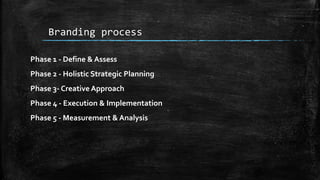
Branding process 
Phase 1 - Define & Assess 
Phase 2 - Holistic Strategic Planning 
Phase 3- Creative Approach 
Phase 4 - Execution & Implementation 
Phase 5 - Measurement & Analysis
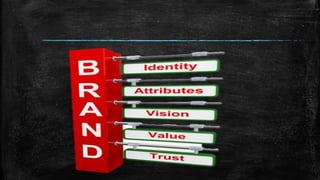
Branding influences virtually every activity in the enterprise with 
each point of customer contact. A well-defined, well-positioned, strong 
brand influences employees and customers to think of a company in 
terms of positive brand attributes: quality, dependability, trust, 
reliability. It is the reason why employees and customers become loyal 
to a company. Brand building is a process that establishes and 
solidifies a relationship between your company, your employees, 
and your customers.
Data gathering is the beginning of creating your dynamic brand. The information collected will serve as the road-map 
for building the brand and positioning it successfully in the market-place. 
▪ Fact finding include: 
▪ Brand audit 
▪ Data gathering - i.e. interviews, workshops 
▪ Distribute questionnaires - executives, leaders, employees, customers 
▪ Define target market 
▪ Identify revenue & market-share goals 
▪ Gather competitive intelligence 
▪ Review existing brand materials i.e printed collateral 
▪ Explore industry & associations 
▪ Identify brand touch-points 
Phase 1 - Define & Assess
Phase 2 - Holistic Strategic Planning 
Facts and your vision collaborate and creatively merge to establish the foundation of your brand 
messaging platforms. Phase 2 is the essential lead to the creative approach that translates the strategy into 
tactical communications tools. 
Holistic BrandTranslation 
▪ Internal (build pride, esteem & involvement for employees) 
▪ External (build buzz, excitement for prospects, present and past customers) 
Message Development 
▪ Vision, mission & values 
▪ Value proposition 
▪ Go-to-Market strategy 
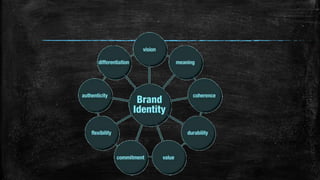
▪ Brand Personality, Positioning, Identity &Architecture 
▪ Tagline 
▪ Deliver Brand Messaging Platform
Creative Direction 
▪ Graphic design & Image Crafting 
▪ Color Palette 
▪ Layout 
▪ Establish company voice/tone 
▪ Review logo (design, emotion, logic) 
▪ Review website (design, functionality, strategy) 
▪ Review all other brand reflections in communication tools
Phase 3 -Creative Approach 
Here we build a comprehensive Marketing Communications Program (MCP). A concurrent, 
integrated MCP channeled across all media drives the delivery of a powerful brand message 
across every customer and employee touch-point. 
Corporate Identity System 
▪ (logo design, signage, stationary, business cards, proposal template, email auto signature etc.) 
▪ Brand and style guidelines for all media 
Website with Optimized SEO 
▪ Content development and management 
▪ Copywriting 
▪ Videos 
▪ Webinars 
▪ Lead Generation
Phase 4 - Execution & Implementation 
External & internal brand launch is in this phase. One of the key indicators of a successful 
brand is building consensus, involvement and emotional connection with employees and stakeholders. 
Externally the campaign will include a concurrent, integrated campaign in each applicable marketing realm. 
▪ Content development & copywriting 
▪ Production (digital, print, product) 
▪ Media plan 
▪ Press conference brand launch 
▪ Newspaper/magazine placement (if applicable) 
▪ Radio/TV media tours (if applicable) 
▪ Speaking engagements (if applicable) 
▪ Direct Marketing 
▪ Conferences 
▪ Tradeshows
Phase 5 Measurement & Analysis 
Measurement of ROBI begins at the launch of your brand initiative. All data 
collected will be measured against previous years' data (if applicable) such as leads 
generated, sales, client touch points, channels used etc.
BRAND EXTENSIONS 
A Brand Extension occurs when a firm uses an established brand name to 
introduce a new product When a new brand is combined with an existing brand , the 
brand extension can also be called a sub-brand. 
An existing brand that gives birth to a brand extension is the parent brand. 
If the parent brand is already associated with multiple products through brand 
extensions, then it may also be called a family brand.
LINE EXTENSION 
The parent brand is used to brand a new product that targets a new market segment with 
in a product category currently served by the parent brand. 
A line extension often adds a different flavor or ingredient variety, a different form or size, 
or a different application for the brand. 
Eg: Head & Shoulders
Head 
& 
Shoulder’s 
Extension
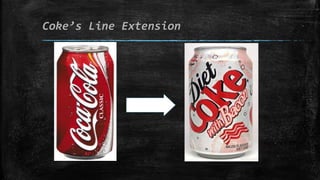
Coke’s Line Extension
CATEGORY EXTENSION 
The parent brand is used to enter a different product 
category from that currently served by the parent brand. 
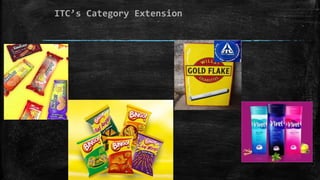
Eg: ITC
ITC’s Category Extension
Why Brand Extensions? 
Leveraging brand equity/value by introduction of logical & complementary 
new product categories 
E.g HP 
Product Innovation to surpass consumer expectations 
It increases awareness of the brand name 
Increases profitability from offerings in more than one product category. 
It’s a great way to reinforce a brand, reach out to new customers, create a BUZZ
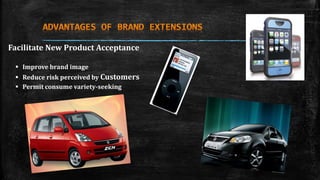
Facilitate New Product Acceptance 
 Improve brand image 
 Reduce risk perceived by Customers 
 Permit consume variety-seeking
Increase the probability of gaining distribution and trial 
Increase efficiency of promotional expenditures 
Reduce costs of introductory & follow-up marketing programs (save 40-80%) 
E.g. Apple iPods 
Avoid costs of developing a new brand 
Allow for packaging & labeling efficiencies
Provide Feedback Benefits to the Parent Brand and Company 
 Clarify brand meaning 
 Enhance the parent brand image 
 Bring new customers into brand franchise and increase market coverage 
 Revitalize the brand 
 Permit subsequent extensions
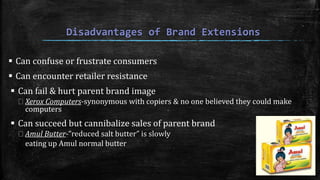
 Can confuse or frustrate consumers 
 Can encounter retailer resistance 
 Can fail & hurt parent brand image 
Xerox Computers-synonymous with copiers & no one believed they could make 
computers 
 Can succeed but cannibalize sales of parent brand 
Amul Butter-”reduced salt butter” is slowly 
eating up Amul normal butter
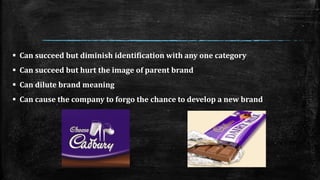
 Can succeed but diminish identification with any one category 
 Can succeed but hurt the image of parent brand 
 Can dilute brand meaning 
 Can cause the company to forgo the chance to develop a new brand
THANK YOUUUU…………

Brand name

  • 1.
    Brand Name Processing, Brand Extension, Brand Stretching Rahul Mukundan
  • 2.
    Why do youneed branding? It is essential for your business’s success that you are clear about what it stands for. A strong brand can accelerate business performance and lift a company from obscurity to a top position in the marketplace. By using branding tools – such as brand positioning, brand design, MARKETING, advertising, and brand management – in a systematic and intelligent way, positive associations with your brand can be generated in people’s minds that will benefit and grow your business. Branding should be seen as an integrating part of your business practice – what keeps it together and drives it forward. It should inform all business decisions and operations, spanning across your organization – in personal interactions, corporate culture and communications, products and services – and be driven from top management to employees and inside out at all times. It is a never ending process.
  • 3.
    Branding process Phase1 - Define & Assess Phase 2 - Holistic Strategic Planning Phase 3- Creative Approach Phase 4 - Execution & Implementation Phase 5 - Measurement & Analysis
  • 5.
    Branding influences virtuallyevery activity in the enterprise with each point of customer contact. A well-defined, well-positioned, strong brand influences employees and customers to think of a company in terms of positive brand attributes: quality, dependability, trust, reliability. It is the reason why employees and customers become loyal to a company. Brand building is a process that establishes and solidifies a relationship between your company, your employees, and your customers.
  • 6.
    Data gathering isthe beginning of creating your dynamic brand. The information collected will serve as the road-map for building the brand and positioning it successfully in the market-place. ▪ Fact finding include: ▪ Brand audit ▪ Data gathering - i.e. interviews, workshops ▪ Distribute questionnaires - executives, leaders, employees, customers ▪ Define target market ▪ Identify revenue & market-share goals ▪ Gather competitive intelligence ▪ Review existing brand materials i.e printed collateral ▪ Explore industry & associations ▪ Identify brand touch-points Phase 1 - Define & Assess
  • 7.
    Phase 2 -Holistic Strategic Planning Facts and your vision collaborate and creatively merge to establish the foundation of your brand messaging platforms. Phase 2 is the essential lead to the creative approach that translates the strategy into tactical communications tools. Holistic BrandTranslation ▪ Internal (build pride, esteem & involvement for employees) ▪ External (build buzz, excitement for prospects, present and past customers) Message Development ▪ Vision, mission & values ▪ Value proposition ▪ Go-to-Market strategy ▪ Brand Personality, Positioning, Identity &Architecture ▪ Tagline ▪ Deliver Brand Messaging Platform
  • 8.
    Creative Direction ▪Graphic design & Image Crafting ▪ Color Palette ▪ Layout ▪ Establish company voice/tone ▪ Review logo (design, emotion, logic) ▪ Review website (design, functionality, strategy) ▪ Review all other brand reflections in communication tools
  • 9.
    Phase 3 -CreativeApproach Here we build a comprehensive Marketing Communications Program (MCP). A concurrent, integrated MCP channeled across all media drives the delivery of a powerful brand message across every customer and employee touch-point. Corporate Identity System ▪ (logo design, signage, stationary, business cards, proposal template, email auto signature etc.) ▪ Brand and style guidelines for all media Website with Optimized SEO ▪ Content development and management ▪ Copywriting ▪ Videos ▪ Webinars ▪ Lead Generation
  • 10.
    Phase 4 -Execution & Implementation External & internal brand launch is in this phase. One of the key indicators of a successful brand is building consensus, involvement and emotional connection with employees and stakeholders. Externally the campaign will include a concurrent, integrated campaign in each applicable marketing realm. ▪ Content development & copywriting ▪ Production (digital, print, product) ▪ Media plan ▪ Press conference brand launch ▪ Newspaper/magazine placement (if applicable) ▪ Radio/TV media tours (if applicable) ▪ Speaking engagements (if applicable) ▪ Direct Marketing ▪ Conferences ▪ Tradeshows
  • 11.
    Phase 5 Measurement& Analysis Measurement of ROBI begins at the launch of your brand initiative. All data collected will be measured against previous years' data (if applicable) such as leads generated, sales, client touch points, channels used etc.
  • 14.
    BRAND EXTENSIONS ABrand Extension occurs when a firm uses an established brand name to introduce a new product When a new brand is combined with an existing brand , the brand extension can also be called a sub-brand. An existing brand that gives birth to a brand extension is the parent brand. If the parent brand is already associated with multiple products through brand extensions, then it may also be called a family brand.
  • 15.
    LINE EXTENSION Theparent brand is used to brand a new product that targets a new market segment with in a product category currently served by the parent brand. A line extension often adds a different flavor or ingredient variety, a different form or size, or a different application for the brand. Eg: Head & Shoulders
  • 16.
  • 17.
  • 18.
    CATEGORY EXTENSION Theparent brand is used to enter a different product category from that currently served by the parent brand. Eg: ITC
  • 19.
  • 20.
    Why Brand Extensions? Leveraging brand equity/value by introduction of logical & complementary new product categories E.g HP Product Innovation to surpass consumer expectations It increases awareness of the brand name Increases profitability from offerings in more than one product category. It’s a great way to reinforce a brand, reach out to new customers, create a BUZZ
  • 21.
    Facilitate New ProductAcceptance  Improve brand image  Reduce risk perceived by Customers  Permit consume variety-seeking
  • 22.
    Increase the probabilityof gaining distribution and trial Increase efficiency of promotional expenditures Reduce costs of introductory & follow-up marketing programs (save 40-80%) E.g. Apple iPods Avoid costs of developing a new brand Allow for packaging & labeling efficiencies
  • 23.
    Provide Feedback Benefitsto the Parent Brand and Company  Clarify brand meaning  Enhance the parent brand image  Bring new customers into brand franchise and increase market coverage  Revitalize the brand  Permit subsequent extensions
  • 24.
     Can confuseor frustrate consumers  Can encounter retailer resistance  Can fail & hurt parent brand image Xerox Computers-synonymous with copiers & no one believed they could make computers  Can succeed but cannibalize sales of parent brand Amul Butter-”reduced salt butter” is slowly eating up Amul normal butter
  • 25.
     Can succeedbut diminish identification with any one category  Can succeed but hurt the image of parent brand  Can dilute brand meaning  Can cause the company to forgo the chance to develop a new brand
  • 26.