UNIT 2
VARSHA RATHOD(58)
ACCORDING TO ARCH PATTON-
“The life-cycle of a product has many points
of similarity with the human life-cycle ;the product is
born , grows lustily ,attains dynamic maturity then
enters its declining year.”
ACCORDING TO PHILLIP KOTLER-
“The product life-cycle is an attempt to
recognize distinct stage in the sales history of the
product.”
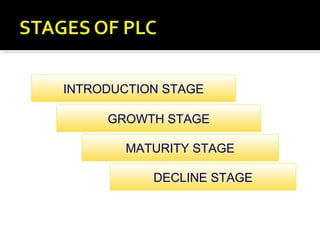
INTRODUCTION STAGE
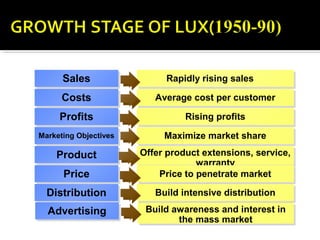
GROWTH STAGE
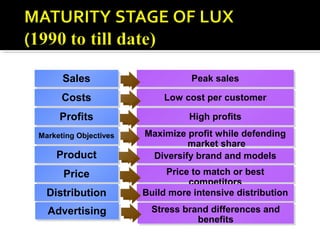
MATURITY STAGE
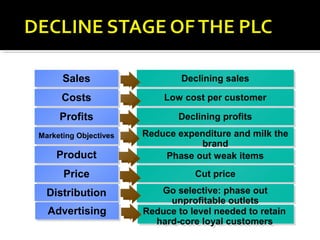
DECLINE STAGE
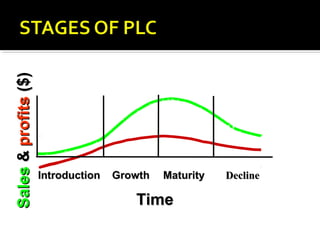
IntroductionIntroduction GrowthGrowth MaturityMaturity DeclineDecline
TimeTime
SalesSales&&profitsprofits($)($)
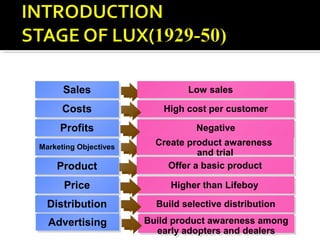
SalesSales
CostsCosts
ProfitsProfits
Marketing ObjectivesMarketing Objectives
ProductProduct
PricePrice
Low salesLow sales
High cost per customerHigh cost per customer
NegativeNegative
Create product awareness
and trial
Create product awareness
and trial
Offer a basic productOffer a basic product
Higher than LifeboyHigher than Lifeboy
DistributionDistribution Build selective distributionBuild selective distribution
AdvertisingAdvertising Build product awareness among
early adopters and dealers
Build product awareness among
early adopters and dealers
Low salesLow sales
Create product awareness
and trial
Create product awareness
and trial
Offer a basic productOffer a basic product
SalesSales
CostsCosts
ProfitsProfits
Marketing ObjectivesMarketing Objectives
ProductProduct
PricePrice
Rapidly rising salesRapidly rising sales
Average cost per customerAverage cost per customer
Rising profitsRising profits
Maximize market shareMaximize market share
Offer product extensions, service,
warranty
Offer product extensions, service,
warranty
Price to penetrate marketPrice to penetrate market
DistributionDistribution Build intensive distributionBuild intensive distribution
AdvertisingAdvertising Build awareness and interest in
the mass market
Build awareness and interest in
the mass market
SalesSales
CostsCosts
ProfitsProfits
Marketing ObjectivesMarketing Objectives
ProductProduct
PricePrice
Peak salesPeak sales
Low cost per customerLow cost per customer
High profitsHigh profits
Maximize profit while defending
market share
Maximize profit while defending
market share
Diversify brand and modelsDiversify brand and models
Price to match or best
competitors
Price to match or best
competitors
DistributionDistribution Build more intensive distributionBuild more intensive distribution
AdvertisingAdvertising Stress brand differences and
benefits
Stress brand differences and
benefits
SalesSales
CostsCosts
ProfitsProfits
Marketing ObjectivesMarketing Objectives
ProductProduct
PricePrice
Declining salesDeclining sales
Low cost per customerLow cost per customer
Declining profitsDeclining profits
Reduce expenditure and milk the
brand
Reduce expenditure and milk the
brand
Phase out weak itemsPhase out weak items
Cut priceCut price
DistributionDistribution Go selective: phase out
unprofitable outlets
Go selective: phase out
unprofitable outlets
AdvertisingAdvertising Reduce to level needed to retain
hard-core loyal customers
Reduce to level needed to retain
hard-core loyal customers
HUMERA PATEL(18)
A firm can obtain new products through:
• Acquisition
• New-product development
9-4
Acquisition refers to the buying of a whole company, a patent,
or a license to produce someone else’s product
New product development refers to original products, product
improvements, product modifications, and new brands
developed from the firm’s own research and development
9-5
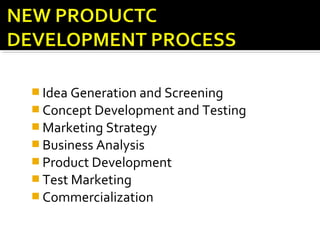
 Idea Generation and Screening
 Concept Development and Testing
 Marketing Strategy
 Business Analysis
 Product Development
 Test Marketing
 Commercialization
New idea generation is the systematic search for
new product ideas
Sources of new-product ideas
• Internal
• External
9-8
Idea Generation
Idea screening refers to reviewing new-product
ideas in order to drop poor ones as soon as
possible
9-10
Idea Screening
Concept Development and Testing
Product idea is an idea for a possible product that the company
can see itself offering to the market
Product concept is a detailed version of the idea stated in
meaningful consumer terms
Product image is the way consumers perceive an actual or
potential product
9-11
NEW PRODUCT
DEVELOPMENT PROCESS
Marketing Strategy Development
Standard test markets are small representative markets where
the firm conducts a full marketing campaign and uses store
audits, consumer and distributor surveys, and other
measures to gauge product performance. Results are used
to forecast national sales and profits, discover product
problems, and fine-tune the marketing program.
9-20
Marketing Strategy Development
Commercialization is the introduction of the new
product
• When to launch
• Where to launch
• Planned market rollout
9-25
 Overestimation of Market Size
 Product Design Problems
 Product Incorrectly Positioned, Priced or Advertised
 Costs of Product Development
 Under-estimation of market competition
 Inadequate market research
 Lack of uniqueness
 Wrong entry timing
 To create successful new products, the company must:
 understand it’s customers, markets and competitors
 develop products that deliver superior value to customers.
HARSHAL SHARMA(16)
2º 3º 4º
RANKING MUNDIAL DE USUÁRIOS DE INTERNET
1º 5º 6º
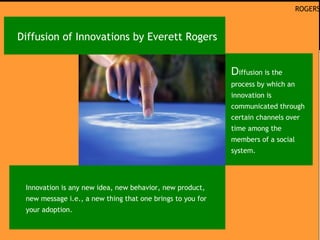
Diffusion is the
process by which an
innovation is
communicated through
certain channels over
time among the
members of a social
system.
ROGERS
Diffusion of Innovations by Everett Rogers
Innovation is any new idea, new behavior, new product,
new message i.e., a new thing that one brings to you for
your adoption.
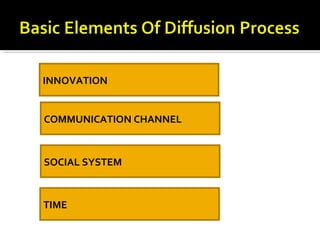
INNOVATION
COMMUNICATION CHANNEL
SOCIAL SYSTEM
TIME
25
2º 3º 4º 5º
RANKING MUNDIAL DE USUÁRIOS DE INTERNET
1º 6º
ROGERS
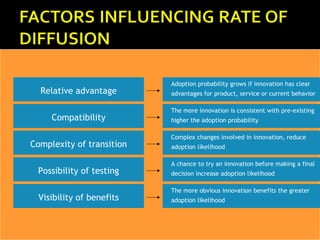
Relative advantage
Compatibility
Complexity of transition
Possibility of testing
Visibility of benefits
Adoption probability grows if innovation has clear
advantages for product, service or current behavior
The more innovation is consistent with pre-existing
higher the adoption probability
Complex changes involved in innovation, reduce
adoption likelihood
A chance to try an innovation before making a final
decision increase adoption likelihood
The more obvious innovation benefits the greater
adoption likelihood
GAYATRI ERALE(ROLL NO-14)
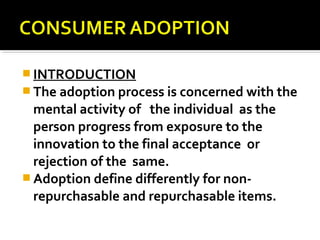
 INTRODUCTION
 The adoption process is concerned with the
mental activity of the individual as the
person progress from exposure to the
innovation to the final acceptance or
rejection of the same.
 Adoption define differently for non-
repurchasable and repurchasable items.
 In context of non-repurchasable items, the decision
to buy the product is called as ‘Adoption’.
 In context of re-purchasable items, the decision to
regularly use the product, is called ‘Adoption’.
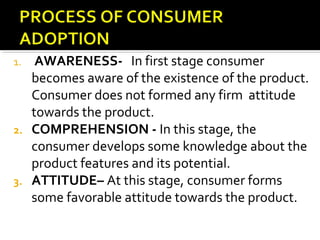
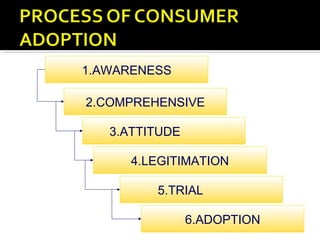
1.AWARENESS
2.COMPREHENSIVE
3.ATTITUDE
4.LEGITIMATION
5.TRIAL
6.ADOPTION
1. AWARENESS- In first stage consumer
becomes aware of the existence of the product.
Consumer does not formed any firm attitude
towards the product.
2. COMPREHENSION - In this stage, the
consumer develops some knowledge about the
product features and its potential.
3. ATTITUDE– At this stage, consumer forms
some favorable attitude towards the product.
4. LEGITIMATION – In this consumer gets favourably
inclined towards the product and forms a favourable
dispostion towards the product.
5.TRIAL - In this stage consumer tries the product so as
to measure the product utility.
6. ADOPTION - In this consumer reaches the decision of
whether he will actually adopt the product or not.
1)Innovation Aspects-The adoption of new
product depends on the relevences of the
innovation.
a)Relative Advantage
b)Compatibility
c)Complexity
d)Divisibility
e)Communicability
2)Organisational Aspects
3)People
4)Personal Influences
SHUBHAM KAMBLE(50)
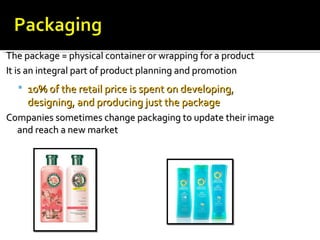
The package = physical container or wrapping for a productThe package = physical container or wrapping for a product
It is an integral part of product planning and promotionIt is an integral part of product planning and promotion
 10% of the retail price is spent on developing,10% of the retail price is spent on developing,
designing, and producing just the packagedesigning, and producing just the package
Companies sometimes change packaging to update their imageCompanies sometimes change packaging to update their image
and reach a new marketand reach a new market
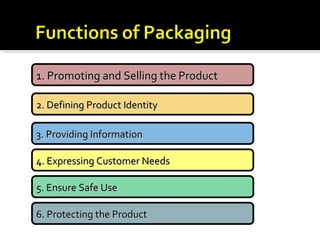
1. Promoting and Selling the Product1. Promoting and Selling the Product
2. Defining Product Identity2. Defining Product Identity
3. Providing Information3. Providing Information
4. Expressing Customer Needs4. Expressing Customer Needs
5. Ensure Safe Use5. Ensure Safe Use
6. Protecting the Product6. Protecting the Product
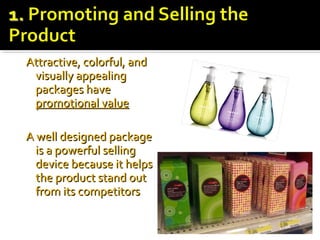
Attractive, colorful, andAttractive, colorful, and
visually appealingvisually appealing
packages havepackages have
promotional valuepromotional value
A well designed packageA well designed package
is a powerful sellingis a powerful selling
device because it helpsdevice because it helps
the product stand outthe product stand out
from its competitorsfrom its competitors
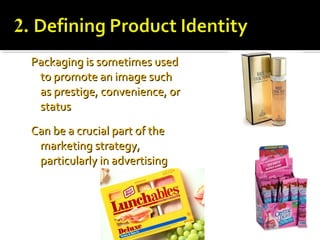
Packaging is sometimes usedPackaging is sometimes used
to promote an image suchto promote an image such
as prestige, convenience, oras prestige, convenience, or
statusstatus
Can be a crucial part of theCan be a crucial part of the
marketing strategy,marketing strategy,
particularly in advertisingparticularly in advertising
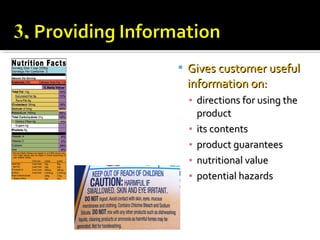
 Gives customer usefulGives customer useful
information on:information on:
▪ directions for using thedirections for using the
productproduct
▪ its contentsits contents
▪ product guaranteesproduct guarantees
▪ nutritional valuenutritional value
▪ potential hazardspotential hazards
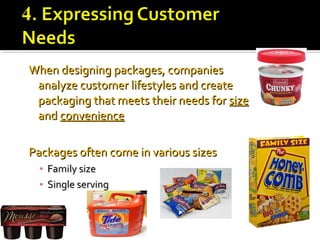
When designing packages, companiesWhen designing packages, companies
analyze customer lifestyles and createanalyze customer lifestyles and create
packaging that meets their needs forpackaging that meets their needs for sizesize
andand convenienceconvenience
Packages often come in various sizesPackages often come in various sizes
▪ Family sizeFamily size
▪ Single servingSingle serving
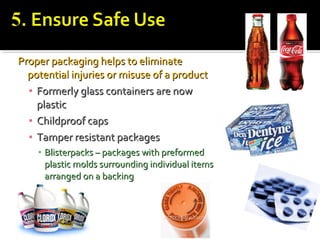
Proper packaging helps to eliminateProper packaging helps to eliminate
potential injuries or misuse of a productpotential injuries or misuse of a product
▪ Formerly glass containers are nowFormerly glass containers are now
plasticplastic
▪ Childproof capsChildproof caps
▪ Tamper resistant packagesTamper resistant packages
▪ Blisterpacks – packages with preformedBlisterpacks – packages with preformed
plastic molds surrounding individual itemsplastic molds surrounding individual items
arranged on a backingarranged on a backing
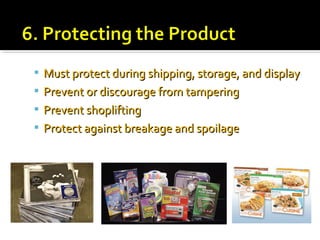
 Must protect during shipping, storage, and displayMust protect during shipping, storage, and display
 Prevent or discourage from tamperingPrevent or discourage from tampering
 Prevent shopliftingPrevent shoplifting
 Protect against breakage and spoilageProtect against breakage and spoilage
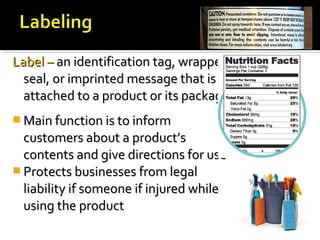
Label –Label – an identification tag, wrapper,an identification tag, wrapper,
seal, or imprinted message that isseal, or imprinted message that is
attached to a product or its packageattached to a product or its package
 Main function is to informMain function is to inform
customers about a product’scustomers about a product’s
contents and give directions for usecontents and give directions for use
 Protects businesses from legalProtects businesses from legal
liability if someone if injured whileliability if someone if injured while
using the productusing the product
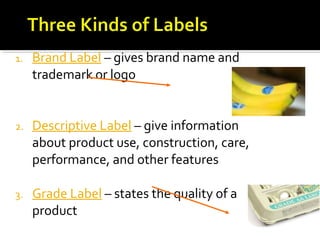
1. Brand Label – gives brand name and
trademark or logo
2. Descriptive Label – give information
about product use, construction, care,
performance, and other features
3. Grade Label – states the quality of a
product
Product life cycle, new product development,diffusion and adoption ,packaging and labeling

Product life cycle, new product development,diffusion and adoption ,packaging and labeling

  • 1.
  • 2.
  • 3.
    ACCORDING TO ARCHPATTON- “The life-cycle of a product has many points of similarity with the human life-cycle ;the product is born , grows lustily ,attains dynamic maturity then enters its declining year.” ACCORDING TO PHILLIP KOTLER- “The product life-cycle is an attempt to recognize distinct stage in the sales history of the product.”
  • 4.
  • 5.
    IntroductionIntroduction GrowthGrowth MaturityMaturityDeclineDecline TimeTime SalesSales&&profitsprofits($)($)
  • 8.
    SalesSales CostsCosts ProfitsProfits Marketing ObjectivesMarketing Objectives ProductProduct PricePrice LowsalesLow sales High cost per customerHigh cost per customer NegativeNegative Create product awareness and trial Create product awareness and trial Offer a basic productOffer a basic product Higher than LifeboyHigher than Lifeboy DistributionDistribution Build selective distributionBuild selective distribution AdvertisingAdvertising Build product awareness among early adopters and dealers Build product awareness among early adopters and dealers Low salesLow sales Create product awareness and trial Create product awareness and trial Offer a basic productOffer a basic product
  • 9.
    SalesSales CostsCosts ProfitsProfits Marketing ObjectivesMarketing Objectives ProductProduct PricePrice Rapidlyrising salesRapidly rising sales Average cost per customerAverage cost per customer Rising profitsRising profits Maximize market shareMaximize market share Offer product extensions, service, warranty Offer product extensions, service, warranty Price to penetrate marketPrice to penetrate market DistributionDistribution Build intensive distributionBuild intensive distribution AdvertisingAdvertising Build awareness and interest in the mass market Build awareness and interest in the mass market
  • 10.
    SalesSales CostsCosts ProfitsProfits Marketing ObjectivesMarketing Objectives ProductProduct PricePrice PeaksalesPeak sales Low cost per customerLow cost per customer High profitsHigh profits Maximize profit while defending market share Maximize profit while defending market share Diversify brand and modelsDiversify brand and models Price to match or best competitors Price to match or best competitors DistributionDistribution Build more intensive distributionBuild more intensive distribution AdvertisingAdvertising Stress brand differences and benefits Stress brand differences and benefits
  • 11.
    SalesSales CostsCosts ProfitsProfits Marketing ObjectivesMarketing Objectives ProductProduct PricePrice DecliningsalesDeclining sales Low cost per customerLow cost per customer Declining profitsDeclining profits Reduce expenditure and milk the brand Reduce expenditure and milk the brand Phase out weak itemsPhase out weak items Cut priceCut price DistributionDistribution Go selective: phase out unprofitable outlets Go selective: phase out unprofitable outlets AdvertisingAdvertising Reduce to level needed to retain hard-core loyal customers Reduce to level needed to retain hard-core loyal customers
  • 12.
  • 13.
    A firm canobtain new products through: • Acquisition • New-product development 9-4
  • 14.
    Acquisition refers tothe buying of a whole company, a patent, or a license to produce someone else’s product New product development refers to original products, product improvements, product modifications, and new brands developed from the firm’s own research and development 9-5
  • 15.
     Idea Generationand Screening  Concept Development and Testing  Marketing Strategy  Business Analysis  Product Development  Test Marketing  Commercialization
  • 16.
    New idea generationis the systematic search for new product ideas Sources of new-product ideas • Internal • External 9-8 Idea Generation
  • 17.
    Idea screening refersto reviewing new-product ideas in order to drop poor ones as soon as possible 9-10 Idea Screening
  • 18.
    Concept Development andTesting Product idea is an idea for a possible product that the company can see itself offering to the market Product concept is a detailed version of the idea stated in meaningful consumer terms Product image is the way consumers perceive an actual or potential product 9-11 NEW PRODUCT DEVELOPMENT PROCESS
  • 19.
    Marketing Strategy Development Standardtest markets are small representative markets where the firm conducts a full marketing campaign and uses store audits, consumer and distributor surveys, and other measures to gauge product performance. Results are used to forecast national sales and profits, discover product problems, and fine-tune the marketing program. 9-20
  • 20.
    Marketing Strategy Development Commercializationis the introduction of the new product • When to launch • Where to launch • Planned market rollout 9-25
  • 21.
     Overestimation ofMarket Size  Product Design Problems  Product Incorrectly Positioned, Priced or Advertised  Costs of Product Development  Under-estimation of market competition  Inadequate market research  Lack of uniqueness  Wrong entry timing  To create successful new products, the company must:  understand it’s customers, markets and competitors  develop products that deliver superior value to customers.
  • 22.
  • 23.
    2º 3º 4º RANKINGMUNDIAL DE USUÁRIOS DE INTERNET 1º 5º 6º Diffusion is the process by which an innovation is communicated through certain channels over time among the members of a social system. ROGERS Diffusion of Innovations by Everett Rogers Innovation is any new idea, new behavior, new product, new message i.e., a new thing that one brings to you for your adoption.
  • 24.
  • 25.
    25 2º 3º 4º5º RANKING MUNDIAL DE USUÁRIOS DE INTERNET 1º 6º ROGERS Relative advantage Compatibility Complexity of transition Possibility of testing Visibility of benefits Adoption probability grows if innovation has clear advantages for product, service or current behavior The more innovation is consistent with pre-existing higher the adoption probability Complex changes involved in innovation, reduce adoption likelihood A chance to try an innovation before making a final decision increase adoption likelihood The more obvious innovation benefits the greater adoption likelihood
  • 26.
  • 27.
     INTRODUCTION  Theadoption process is concerned with the mental activity of the individual as the person progress from exposure to the innovation to the final acceptance or rejection of the same.  Adoption define differently for non- repurchasable and repurchasable items.
  • 28.
     In contextof non-repurchasable items, the decision to buy the product is called as ‘Adoption’.  In context of re-purchasable items, the decision to regularly use the product, is called ‘Adoption’.
  • 29.
  • 30.
    1. AWARENESS- Infirst stage consumer becomes aware of the existence of the product. Consumer does not formed any firm attitude towards the product. 2. COMPREHENSION - In this stage, the consumer develops some knowledge about the product features and its potential. 3. ATTITUDE– At this stage, consumer forms some favorable attitude towards the product.
  • 31.
    4. LEGITIMATION –In this consumer gets favourably inclined towards the product and forms a favourable dispostion towards the product. 5.TRIAL - In this stage consumer tries the product so as to measure the product utility. 6. ADOPTION - In this consumer reaches the decision of whether he will actually adopt the product or not.
  • 32.
    1)Innovation Aspects-The adoptionof new product depends on the relevences of the innovation. a)Relative Advantage b)Compatibility c)Complexity d)Divisibility e)Communicability 2)Organisational Aspects 3)People 4)Personal Influences
  • 33.
  • 34.
    The package =physical container or wrapping for a productThe package = physical container or wrapping for a product It is an integral part of product planning and promotionIt is an integral part of product planning and promotion  10% of the retail price is spent on developing,10% of the retail price is spent on developing, designing, and producing just the packagedesigning, and producing just the package Companies sometimes change packaging to update their imageCompanies sometimes change packaging to update their image and reach a new marketand reach a new market
  • 35.
    1. Promoting andSelling the Product1. Promoting and Selling the Product 2. Defining Product Identity2. Defining Product Identity 3. Providing Information3. Providing Information 4. Expressing Customer Needs4. Expressing Customer Needs 5. Ensure Safe Use5. Ensure Safe Use 6. Protecting the Product6. Protecting the Product
  • 36.
    Attractive, colorful, andAttractive,colorful, and visually appealingvisually appealing packages havepackages have promotional valuepromotional value A well designed packageA well designed package is a powerful sellingis a powerful selling device because it helpsdevice because it helps the product stand outthe product stand out from its competitorsfrom its competitors
  • 37.
    Packaging is sometimesusedPackaging is sometimes used to promote an image suchto promote an image such as prestige, convenience, oras prestige, convenience, or statusstatus Can be a crucial part of theCan be a crucial part of the marketing strategy,marketing strategy, particularly in advertisingparticularly in advertising
  • 38.
     Gives customerusefulGives customer useful information on:information on: ▪ directions for using thedirections for using the productproduct ▪ its contentsits contents ▪ product guaranteesproduct guarantees ▪ nutritional valuenutritional value ▪ potential hazardspotential hazards
  • 39.
    When designing packages,companiesWhen designing packages, companies analyze customer lifestyles and createanalyze customer lifestyles and create packaging that meets their needs forpackaging that meets their needs for sizesize andand convenienceconvenience Packages often come in various sizesPackages often come in various sizes ▪ Family sizeFamily size ▪ Single servingSingle serving
  • 40.
    Proper packaging helpsto eliminateProper packaging helps to eliminate potential injuries or misuse of a productpotential injuries or misuse of a product ▪ Formerly glass containers are nowFormerly glass containers are now plasticplastic ▪ Childproof capsChildproof caps ▪ Tamper resistant packagesTamper resistant packages ▪ Blisterpacks – packages with preformedBlisterpacks – packages with preformed plastic molds surrounding individual itemsplastic molds surrounding individual items arranged on a backingarranged on a backing
  • 41.
     Must protectduring shipping, storage, and displayMust protect during shipping, storage, and display  Prevent or discourage from tamperingPrevent or discourage from tampering  Prevent shopliftingPrevent shoplifting  Protect against breakage and spoilageProtect against breakage and spoilage
  • 42.
    Label –Label –an identification tag, wrapper,an identification tag, wrapper, seal, or imprinted message that isseal, or imprinted message that is attached to a product or its packageattached to a product or its package  Main function is to informMain function is to inform customers about a product’scustomers about a product’s contents and give directions for usecontents and give directions for use  Protects businesses from legalProtects businesses from legal liability if someone if injured whileliability if someone if injured while using the productusing the product
  • 43.
    1. Brand Label– gives brand name and trademark or logo 2. Descriptive Label – give information about product use, construction, care, performance, and other features 3. Grade Label – states the quality of a product