Global Report on
Public-Private
Partnerships:
Tourism Development
Affiliate Members Report: Volume eleven
Affiliate Members Report published by UNWTO and the Griffith
Institute for Tourism (GIFT) Griffith University
Global Report on
Public-Private Partnerships:
Tourism Development
World Tourism Organization (UNWTO)
Secretary-General: Taleb Rifai
Director-Executive Secretary of Member Relations: Carlos Vogeler
UNWTO Editorial team
AM Reports Management: Yolanda Perdomo, Director of the Affiliate Members Programme
Editorial Team: Addaia Arizmendi, Aditya Amaranggana, Beatriz Cano, Afiya Holder, Elena Cholakova,
Jonatan Gomez, Malak Zungi, Dmitriy Ilin (UNWTO Affiliate Members Programme)
UNWTO would like to sincerely thank Griffith Institute for Tourism (GIFT) Griffith University for this joint
publication, edited by Prof Susanne Becken, Dr Fernanda Pegas and Prof Noel Scott.
Copyright © World Tourism Organization, 2015
Affiliate Members Global Report, Volume eleven –
Public-Private Partnerships: Tourism Development
Published and printed by the World Tourism Organization (UNWTO), Madrid, Spain.
First printing: November 2015.
All rights reserved.
The designations employed and the presentation of material in this publication do not imply
the expression of any opinions whatsoever on the part of the Secretariat of the World Tourism
Organization concerning the legal status of any country, territory, city or area, or of its authorities or
concerning the delimitation of its frontiers or boundaries.
World Tourism Organization (UNWTO) 	 Tel.: (+34) 915 678 100
Calle Capitán Haya, 42	 Fax: (+34) 915 713 733
28020 Madrid 	 Website: www.unwto.org
Spain	 E-mail: omt@unwto.org
Citation: 	 World Tourism Organization (2015), Affiliate Members Global Reports, Volume eleven –
Public-Private Partnerships: Tourism Development, UNWTO, Madrid.
UNWTO publications are protected by copyright. Therefore, and unless otherwise specified, no part
of an UNWTO publication may be reproduced, stored in a retrieval system or utilized in any form or
by any means, electronic or mechanical, including photocopying, microfilm, scanning, without prior
permission in writing. UNWTO encourages dissemination of its work and is pleased to consider
permissions, licensing, and translation requests related to UNWTO publications.
Permission to photocopy UNWTO material in Spain must be obtained through:
CEDRO, Centro Español de Derechos Reprográficos	 Tel.: (+34) 91 308 63 30
Calle Monte Esquinza, 14			 Fax: (+34) 91 308 63 27
28010 Madrid				Website: www.cedro.org		
Spain					E-mail: cedro@cedro.org
For authorization of the reproduction of UNWTO works outside of Spain, please contact one of
CEDRO’s partner organizations, with which bilateral agreements are in place (see: www.cedro.org/en).
For all remaining countries as well as for other permissions, requests should be addressed directly to
the World Tourism Organization. For applications see: http://publications.unwto.org/content/rights-
permissions.
Design and printing: Impacto Creativo de Comunicación, SL
Photos by UNWTO / Dreamstime Cover photo: © Tuahlensa Dreamstime.com - Beautiful Sunset
at Gunungkidul, Yogyakarta, Indonesia Photo
Table of
contents
Foreword by UNWTO Secretary-General
8
Harnessing the Power of PPPs in Tourism
10
1. Public-private partnerships: tourism development 12
1.1	 Focus of this report
13
1.2	 Public sector involvement in PPPs
14
1.3	 Role of the private sector in PPPs
15
1.4	 Outcomes of public-private partnerships and lessons
15
1.5	 Resources for developing public-private partnerships
16
2. Case studies 18
2.1	 Grassroots management of a protected area:
	 The Puerto Princesa Subterranean River National Park, Philippines
20
2.2	 Stable partnerships attract funding, Botswana
22
2.3	 Taj Safaris and threatened species conservation, India
24
2.4	 Homestay tourism clustering and snow leopard conservation, India
26
2.5	 Creating an egalitarian, open framework for destination partnership development:
	 the case of Tama River, Japan
28
2.6	 Providing capacity building opportunities: Carnival Australia and cruise ship tourism in Vanuatu, 	
	 Pacific Islands
30
2.7	 Joining forces to minimize risk: development of a “Tsunami Ready Toolbox” to increase disaster
	 preparedness for hotels in Bali, Indonesia
32
2.8	 Visitor focused collaboration in Mavrovo, the former Yugoslav Republic of Macedonia
34
2.9 	 Inclusive business for tourism training in Yangon and Nyaung Shwe (Inle Lakes), Myanmar
36
2.10	 “Smart tourism” development in Nanjing, China
40
2.11 	 Integrating scientific research and tourism to benefit community livelihoods:
	 The Mamirauá Sustainable Development Reserve, Brazil
42
2.12	 Experience Gold Coast: innovative products for Asian visitors
44
2.13	 Samoa´s community tourism operators and the development of innovative mechanisms
	 to adapt to climate change
46
2.14 Saudi Hospitality Heritage Company: the Kingdom of Saudi Arabia
48
2.15 	 Public-private partnerships to promote a sound tourism policy framework in the Asia-Pacific
50
2.16 	 UNWTO and Pilot Productions: showcasing the Silk Road to an audience of 30 million people
52
2.17 	 Sustainable forms of tourism in Ghana West Coast
54
Box 1	 PPPs and Destination Management
57
Box 2	 Universities as resources for PPPs
61
Box 3	 Training and PPPs
65
3. Conclusion: key lessons 68
Business competitiveness
69
Economic sustainability
69
Capacity building
70
Resources for PPPs
71
Environmental conservation
71
Final remarks
71
References
72
08 UNWTO • Affiliate Members Report: Volume eleven
ForewordForeword
Browse any travel website or any travel and lifestyle top listing of places to visit
and there will be without a doubt a series of new destinations unknown to many.
Indeed, over the past six decades, tourism has experienced continued expansion
and diversification with many new destinations emerging in addition to the traditional
favourites of Europe and North America. The data speaks for itself. The market share
of emerging economies increased from 30% in 1980 to 45% in 2014, and is expected
to reach 57% by 2030, equivalent to over 1 billion international tourist arrivals.
The development of tourism in emerging economies have been shaped by many
factors among which Public-Private Partnerships (PPP) play a key role as they
bring together government agencies and the public sector with representatives of
the whole tourism value chain under the same goals of promoting socio-economic
development, sustainability, job creation and international competitiveness through
tourism.
This report prepared by the UNWTO’s Affiliate Members Programme in partnership
with Griffith Institute of Tourism of the Griffith University a valuable Affiliate Member, is
an excellent contribution to understand the models and outreach of PPPs through a
wide range of case studies in countries ranging from Japan to Samoa.
I would like to take this opportunity to thank all the contributors to this report for
providing us with such valuable insights and know-how which I trust will inspire
all those seeking to advance PPPs in tourism and understand the development of
tourism in emerging economies.
Taleb Rifai
Secretary-General,
World Tourism Organization (UNWTO)
09UNWTO • Public-Private Partnerships: Tourism DevelopmentUNWTO • Public-Private Partnerships: Tourism Development 09
Over one billion international tourists travelled the
world in 2014, supporting jobs, generating income
and boosting development.
International tourism currently accounts for 10% of
global GDP, 30% of services exports and 1 in every
11 jobs.
At the World Tourism Organization (UNWTO) we
work to make this impact even greater.
Because every tourist counts.
10 UNWTO • Affiliate Members Report: Volume eleven
Harnessing the
Power of PPPs
in Tourism
As the leading international organization in the field
of tourism, the World Tourism Organization (UNWTO)
facilitates public and private initiatives through its
Affiliate Members Programme which encompass over
480 worldwide entities, representing organizations,
destinations, NGOs, educational institutions and other
bodies whose activities are related to tourism.
The tenets of PPPs are core to the main objectives of
UNWTO Affiliate Members Programme. PPPs are beyond
a developmental tool but are sometimes essential to
stimulate creativity, enhance competitiveness and achieve
visionary results which may be difficult if both parties
operated in isolation.
One signature project of the UNWTO Affiliate Members
Programme is the prototypes which have been initiated
to attain the involvement of a large number of members
working towards a common goal, testing new models of
public-private partnership and developing reports which
provide recommendations applicable in other destinations.
All members work synergistically and transparently under
the UNWTO umbrella to foster the application of innovative
concepts within any destination.
To date, UNWTO has launched three prototypes: Precious
Time, an exercise in creating premium tourism products
for an urban destination; 365, a project designed to
overcome seasonality; and a Wine Tourism Prototype. The
methodology resulting from those prototypical exercises
is a practical tool which can be replicated in destinations
worldwide considering rejuvenating their tourism product
offerings in specific areas.
Another practical illustration of successful PPPs among
the UNWTO Affiliate Members Programme can be seen
in the creation of networks. These networks serve
as platforms for private, public and academic bodies
to interact, share and access relevant information all
the while benefitting from an unparalleled platform to
create, disseminate and implement innovative concepts.
These collaborative frameworks play a prominent role in
harnessing the enormous potential to stimulate a variety
of sectors while maintaining sustainable and ethical use of
resources. Here, experts, destinations, academics and a
wide variety of private and public sector stakeholders all
share a common role in maintaining the respective tourism
sector; a sector which boasts of definite contributions to
the socio-economic development worldwide. Evidence
of this can be demonstrated through the Gastronomy
11UNWTO • Public-Private Partnerships: Tourism Development
Yolanda Perdomo
Director of the Affiliate Members Programme,
World Tourism Organization (UNWTO)
and Shopping Tourism Networks where Member States
and Affiliate Members jointly collaborate as well as the
Knowledge Network, an inclusive community of knowledge
within UNWTO.
In line with above mentioned initiatives, this edition of
UNWTO Affiliate Members Global Report series on the
topic “Public-Private Partnerships: Tourism Development’’
jointly published with our valued Affiliate Member Griffith
Institute for Tourism seeks to highlight the role and need for
PPPs as tools for development. This publication provides
cases of how public-private partnerships which have
jointly enhanced the development and competitiveness of
tourism destinations by facilitating innovation.
It goes without saying that this report highlights the
significance and timeliness of PPPs in this volatile
sector and it would not have been possible without
the contribution and support of all the researchers and
contributors including the esteemed group of UNWTO
Affiliate Members: Brighton University, RIAT, Institute for
Tourism Studies – IFT, CICtourGUNE, USIL - San Ignacio
de Loyola University, Facultad de Turismo y Dirección
Hotelera Sant Ignasi de la Universitat Ramon Llull,
Centro Español de Nuevas Profesiones (CENP), IATA,
Agència Catalana De Turisme, Destino Punta del Este and
Singerman & Makon – Latam Tourism Consulting.
I wish to offer my sincerest gratitude for the contributions
made, contributions which have truly encompassed a
wide array of innovative projects worldwide.
12 UNWTO • Affiliate Members Report: Volume eleven
There are many forms of partnerships and some only
involve the private sector. However, developing tourism
will often require the involvement of governments as they
have control over essential resources such as public lands
(i.e., beaches, mountains, national parks, lakes) and also
the responsibility for activities such as regional economic
development, planning, security of borders, and social and
environmental protection. Here we use the term Public-
Private Partnerships (PPPs) to cover those voluntary
collaborative tourism partnerships that involve both the
government and businesses. In many cases, PPPs also
include non-governmental organizations (NGOs) and
various other types of associations.
PPPs bring together stakeholders with different objectives
and skills, and resources in a formal or informal voluntary
partnership to improve the attractiveness of a regional
destination, its productivity, associated market efficiency,
and the overall management of tourism. In this report, we
discuss PPPs that target improvement in many aspects
necessary for successful tourism such as transportation,
events, accommodation, attractions, business skills and
resource protection. Hence, PPPs are important, and
often vital, elements in the establishment of tourism-based
initiatives and improvement of the market competitiveness
of destinations.
Since 1990, UNWTO has released a series of reports
and publications that highlight the importance of PPPs
in tourism. More specifically, the reports demonstrate the
role of partnerships in policy and practice for tourism;
benefits of PPPs for the public and private sectors; and
how multi-stakeholder collaboration influences tourism
competitiveness through institutional strengthening and
by promoting sustainability (e.g., UNWTO/Fundacion
ACS, 2014; UNWTO, 2011; UNWTO/SNV, 2010; UNWTO,
2001).
Together, these reports provide a solid evidence base for
the use of PPPs in tourism, illustrating partnerships across
different sub-sectors, geographic scales, destinations,
and market segments. For example, a report produced
by UNWTO in collaboration with the SNV Netherlands
Development Organization (UNWTO/SNV, 2010) highlighted
the positive outcomes of nine partnerships (e.g., in
Ghana, Costa Rica, Bhutan). More specifically, the report
demonstrated ways in which partnerships can widen
contacts and strengthen communities, link components
within the tourism value chain, improve marketability of
tourism initiatives, ensure inclusiveness and equity.
1.
Public–private
partnerships:
tourism
development
13UNWTO • Public-Private Partnerships: Tourism Development
© Samrat35 ❘ Dreamstime.com.
1.1	 Focus of this report
In this report, we focus on PPPs as tools for development.
The economic growth of the developing world is driving
demand for traditional holiday destinations in the
developed world that have traditionally catered for English
speaking visitors, as well as a need for new destinations.
The rapid growth of BRIC (Brazil, Russia, India, China)
countries, the increasing recognition by many countries
of tourism as a source of regional economic development,
the low cost carriers travelling to secondary airports,
the growth of cruise ship capacity around the world, the
encouragement of interregional travel in South East Asia
and along the New Silk Road, reductions in visa restrictions
(World Tourism Organization, 2012), and other initiatives
have been combined to create new tourist destinations
around the world (see also Dwyer et al., 2008 on mega
trends). In this report, we particularly focus on these new
tourist destinations because they are a frontier of tourism
development and one of the key action areas where the
international community can make a significant difference
to the lives of the local people.
Not all PPPs are confined to a particular tourist destination
and in some cases an initiative will benefit a number of
locations across a country or region. However, the intent
of this report is to focus on tourism as a form of economic
development with the potential to grow strongly. Many
new tourist destinations are embracing tourism as a form
of economic development. Indeed all the case studies
presented in this report have as part of their objectives
to improve the sustainability of local tourism expenditure,
in order to bring widespread benefits to numerous small
businesses and their employees in the hotel, restaurant,
tour, transportation, and entertainment sectors. While
some argue that these jobs require fewer skills, it is
precisely this that makes them suitable for readily
improving the lives of residents.
14 UNWTO • Affiliate Members Report: Volume eleven
1.2	 Public sector involvement in PPPs
There are two levels of government involved in tourism.
Firstly, at a national level, nations such as BRIC and many
other developing countries are recognizing the importance
of tourism as a form of regional economic development.
This means that in these countries, central and regional
government are prioritising tourism, writing strategies,
enacting new laws, employing tourism advisors within
newly established tourism ministries and so on (OECD,
2012). A tourism economy affects and is affected by other
more traditional areas of government such as agriculture,
transport, economic development, and regional planning
so in many countries these linkages are being charted
and responsibilities are being established. This requires
collaboration between various central government
organizations. It may also require interaction and perhaps
partnerships with non-government agencies including the
private sector.
The second level of government involvement is at
the regional or local nature. Often, tourism focuses
geographically around particular attractions. Therefore,
central governments need to work with regional and local
government agencies to ensure the efficient development
of tourism at these destinations and within the national
context. This collaboration will often centre on a particular
project or PPP initiative. Partnerships are important
because the necessary resources and expertise are
sometimes less developed at a local government level,
and need to be accessed from national-level government
agencies. This suggests that regional and local tourism
governments and destinations may benefit from examples
of good practice from places around the world dealing
with similar problems. This report provides such examples
of innovative PPPs related to tourism development.
Susanne Becken,
Director Griffith Institute for Tourism,
Griffith University
Public-private-partnerships (PPPs) are increasingly
important in a world where resources are constrained
and competition is strong. The best way to think of
a PPP is as an opportunity of bringing together all
the resources required to develop a memorable and
sustainable tourism experience in an effective manner.
Resources can include land, capital, knowledge and
skills, amongst others.
This report has a particular focus on emerging tourism
economies. Here, emerging tourism economies means
tourism economic development initiatives within a
region, a country or, indeed across several countries.
Most of the case studies presented in this report illustrate
how new and emerging forms of tourism contribute to
poverty alleviation, community empowerment, resilience
and sustainability of destinations.
All case studies presented here highlight an element of
innovation. Cases were selected to provide not only an
insight into the different types of PPPs across a broad
range of geographic contexts, but to highlight how
innovative initiatives can lay the pathway for successful
tourism development. It is the intention of this report
to disseminate these innovations and stimulate tourism
stakeholders around the world to develop similarly
new and creative partnerships. It is hoped these
partnerships will result in inclusive, sustainable and
resilient tourism development to contribute to the new
Sustainable Development Goals being developed.
Partnerships are integral to most tourism activities.
Tourism typically involves a wide range of public and
private sector stakeholders, communities and various
types of organizations that – all together – facilitate the
travel experience.
15UNWTO • Public-Private Partnerships: Tourism Development
© Bbbar | Dreamstime.com.
1.3	 Role of the private sector in PPPs
Governments and tourism industries/sectors can work
together in a variety of ways and on a number of different
types of activity at a regional level. Examples include the
development of tourism strategies, the creation of policy
networks or joint investment in co-operative marketing
campaigns. However, in developing tourism, eventually
government must rely on the private sector to deliver
services to tourists. Such services are provided by a
range of stakeholders, including investors, developers,
accommodation businesses, attractions, tour companies,
and others. In addition, government agencies and tourism
offices are working together with representatives of the
local community. Therefore, it is important for the public
and private sectors to cooperate in developing new
tourism initiatives, and managing tourism development.
The cruise ship industry provides an excellent example
of a fast growing form of tourism that has the potential
to deliver substantial economic benefits (for example
Small Island Developing States or SIDS). Harnessing the
benefits and managing the impacts through innovate PPPs
is an important avenue for SIDS to maximise the long-term
benefits from cruise ship tourism.
Developing PPPs as a collaborative form of governance
recognises the interdependence of the various parties
in developing tourism, especially at the early stages.
Partnerships can focus on a particular task and bring
together those organizations with the skills and knowledge
necessary for its completion. In many situations, as
we demonstrate in this report, PPPs play a critical role
in the development of tourism. A government cannot
usually develop tourism by itself, as it does not operate
businesses, while the private sector may need help with
regulations, access to resources, and funding. This is
often true in regional areas where the government may
control the natural attractions and the local people do not
have funds for development or have the skills to develop
tourism. One way to think of a PPP therefore is as a means
of bringing all the required resources together.
1.4	 Outcomes of public-private
partnerships and lessons
What are the initiatives or interventions that may be the
basis for a PPP? In this report, we demonstrate how
PPPs have helped to enhance the competitiveness of
tourism destinations by facilitating intervention in new
16 UNWTO • Affiliate Members Report: Volume eleven
niche markets that can support appropriate economic
development of a destination. The interventions noted
in this report include, but are not limited to, the tourism
product offered (e.g., clustering businesses together
and developing touring routes, developing packages),
marketing strategies (collaborative destination promotion),
funding (e.g., obtaining donor funding), human resources
(e.g., offer training), and infrastructure (e.g., new buildings).
While PPP activities must be designed and understood
within the context of a particular region or destination,
many of the principles found in one case may be useful in
other parts of the globe as the tourism industry has many
similarities in its operation around the world. Therefore,
there is considerable scope for transfer of knowledge on
the operation of PPPs between countries and regions.
This report focuses on the role of partnerships in critical
areas for development of tourism, where tourism skills
are least well developed, where the tension between
issues of resource exploitation and protection are highest;
and arguably the opportunities for tourism to make a
difference in the lives of local peoples are greatest. Each
case illustrates a particular lesson about how PPPs can be
useful in developing tourism.
1.5	 Resources for developing
public-private partnerships
In addition to providing case studies of successful PPPs,
this report also identifies that PPP initiatives commonly are
based in a regional destination management organization
(DMO). In the past, many destinations established a
marketing organization that would work to promote a
region collaboratively. This report identifies that in many
countries, the role of such organizations is expanding to
support product development (see Box 1).
Universities have a role in supporting regional development
and provide important resources for the development of
PPP initiatives. This report identifies numerous examples
of UNWTO Affiliate Member universities working as brokers
and hubs for tourism initiatives. In this context, universities
are seen as providing impartial and expert opinion and
advice, providing a repository of skills and knowledge
related to the region (see Box 2). PPPs in developing
countries require funding and training resources. This
report has identified a number of examples whereby PPPs
provide training to support development (see Box 3).
These examples indicate that UNWTO Affiliate Members
are active in supporting development and provide
resources useful for PPPs.
© Ouytcast85 ❘ Dreamstime.com.
17UNWTO • Public-Private Partnerships: Tourism Development
UNWTO Elibrary
The UNWTO Elibrary is the largest online collection of publications and statistics in the field of
international tourism. It includes over 1165 UNWTO publications and 900 regularly updated
tourism data sets (Tourism Factbook).
Find out how you can access this invaluable source of knowledge by visiting www.e-unwto.org or
contacting elibrary@unwto.org
UNWTO ELibrary – where knowledge no longer depends on distance!
18 UNWTO • Affiliate Members Report: Volume eleven
2.
Case studies
The following case studies provide examples and
insights into the different types of tourism PPPs
currently taking place which foster tourism development
through innovation. They represent PPPs with different
goals, located across different geographic regions,
and economic and political systems (table 2.1).
In some cases, these PPPs have multiple goals. We have
selected these cases to illustrate the variety of settings
in which PPPs are found and objectives that are pursued
through these partnerships.
© Gosiqa | Dreamstime.com.
Table 2.1	 Overview of the 17 case studies 	
Number Case study Country Lesson Scale Main partners
2.1 Grassroots management of
a protected area: the Puerto
Princesa Subterranean River
National Park
The
Philippines
Entrepreneur
convenor
Local State/local governments,
community
2.2 Stable partnerships attract
funding: Tsodilo Hills
Botswana Credibility leads
to financial
support
Regional State/local governments,
private industry, NGOs,
local community
2.3 Taj Safaris and threatened
species conservation
India Adaptability Local Government, private
industry
2.4 Homestay tourism clustering
and snow leopard conservation
India Social
entrepreneurship
Local Local government,
NGO, local community
2.5 Creating an egalitarian, open
framework for destination
partnership development: the
case of Tama River
Japan Collaborative
product
development
Regional Local government,
community, private
industry
19UNWTO • Public-Private Partnerships: Tourism Development
Table 2.1	 Overview of the 17 case studies 	
Number Case study Country Lesson Scale Main partners
2.6 Providing capacity building
opportunities: Carnival Australia
and cruise ship tourism
Pacific
Islands
Clustering International
and National
Federal and local
government, private
industry
2.7 Joining forces to minimize risk:
development of a “Tsunami
Ready Toolbox” to increase
disaster preparedness for hotels
in Bali
Indonesia Minimizing risks National Federal government,
hotel associations,
hotels
2.8 Visitor focused collaboration in
Mavrovo
The former
Yugoslav
Republic of
Macedonia
Tourism product Regional Federal government,
private sector
2.9 Inclusive business for tourism -
training in Yangon and Nyaung
Shwe (Inle Lakes)
Myanmar Expanding
growth
opportunities
Regional Federal government
and international
organization, private
sector
2.10 “Smart tourism” development in
Nanjing
China Technology as a
niche market
Local Federal government,
private sector
2.11 Integrating scientific research
and tourism to benefit
community livelihoods:
The Mamirauá Sustainable
Development Reserve
Brazil Economic
entrepreneurship
Local State government, local
communities
2.12 Experience Gold Coast:
innovative products for Asian
Visitors
Australia Product
innovation
Local Private sector, local
government
2.13 Samoa´s community tourism
operators and the development
of innovative mechanisms to
adapt to climate change
Samoa Climate change
adaptation
Regional Private sector, federal
government, local
communities
2.14 Saudi Hospitality Heritage
Company
The Kingdom
of Saudi
Arabia
Cultural
integration
National Private sector, national
government
2.15 Public-private partnerships to
promote a sound tourism policy
framework
Asia-Pacific
region
Policy framework
development
Multinational Private sector, federal
government
2.16 UNWTO and Pilot Productions:
showcasing the Silk Road to an
audience of 30 million people
Multinational Tourism
marketing
Multinational Private sector, federal
government, local
communities
2.17 Sustainable forms of tourism in
Ghana West Coast
Ghana Destination
management
Regional Private sector, federal
government, local
communities
20 UNWTO • Affiliate Members Report: Volume eleven
Background: The Puerto Princesa Subterranean
River National Park
The Puerto Princesa Subterranean River National Park (PPSRNP) is a
UNESCO World Heritage Site, a Biosphere Reserve, a Ramsar Site, and
an Important Bird Area (IBA). In 2011, the PPSRNP was voted one of the
New7Wonders of Nature. The PPSRNP covers an area of approximately
22,202 hectares and features an 8.2 km long subterranean river system
located near Puerto Princesa City, Palawan Province, Philippines. It is
distinguished as having an underground river system that flows directly
into the sea, with its brackish lower half subjected to tidal influence.
The river’s cavern contains remarkable rock formations. The PPSRNP
contains a full “mountain-to-sea” ecosystem, significant for biodiversity
conservation and protects the most intact and notable forests within the
Palawan biogeographic province and was the first national park devolved
and successfully managed by a local government unit (UNESCO, 2012a).
Site protection is provided through agreements that place legal
ownership in the hands of the City Government of Puerto Princesa. This
arrangement for local ownership ensures the property’s national values
have been maintained. The property is also covered by the National
Integrated Protected Area System (NIPAS) Act of 1992, which ensures
legal protection and conservation of protected areas in the Philippines.
This Act decrees that all management decisions for the property are
made in consultation with the Protected Areas Management Board
(PAMB).
2.1
Grassroots management of a protected area:
The Puerto Princesa Subterranean River National Park, Philippines
Trishah Goloran, The University of
Queensland.
Robert J. S. Beeton, The University of
Queensland.
Noel Scott, Griffith University.
21UNWTO • Public-Private Partnerships: Tourism Development
© Jaspe | Dreamstime.com.
The Partnership
Ecotourism in the PPSRNP originated from the need to
protect the environment and was successful because it
was promoted by the Puerto Princesa City Mayor and
supported by institutional partnerships. The park’s highest
policy-making body is the Protected Area Management
Board (PAMB), chaired by the City Mayor. Through the
Park Management Office, the park supervisor appointed
by the city mayor manages the day-to-day operation of the
park. The PAMB is composed of 20 members, one from the
national government, represented by the Palawan Council
for Sustainable Development Secretariat (PCSDS), one
from the provincial government through the Provincial
Environment and Natural Resource Office (PENRO), seven
from the city government, three chieftains of the different
Certificate of Ancestral Domain Claims (CADCs) covering
the Park, four Barangay Captains of the four barangays or
communities within the Park, a People’s Organization (PO)
representative from Cabayugan, two NGOs, and the Park
Superintendent and Head of the PAMB Secretariat. While
there are no members from the tourism or industry sectors
or from the city and provincial tourism offices, there is
close coordination of the industry with the Mayor’s office.
The PAMB meets regularly. This multi-sectoral organization
creates an important venue for stakeholders to collaborate
and participate in decision-making. Having a legal basis
for the multi-sectoral arrangement of the PAMB and its
actual implementation in a more local instead of national
approach makes it an effective and proactive way of
managing the resource in which ecotourism is based.
People can also readily contact either the PO or the
Barangay representative when there are issues.
Tourism development and impacts
Visitor arrivals to the PPSRNP have shown a sharp
increase, also driving the increasing trend in Palawan
Province, with domestic tourists making up most of the
visitors, due in part to the New7Wonders promotions
campaign. Revenue from the Park increased from
PPH 16.6 million (USD 373,000) in 2009 to PHP 32.4 million
(USD 730,000) in 2011. The popularity of the PPSRNP has
also led to a diversification of activities within the park,
which include jungle trekking, wildlife watching, mangrove
forest tours, adventure caving and an ethnographic
museum. These activities are linked to efforts to distribute
economic benefits to other communities.
All income generated from collection of user fees are
deposited into a Trust Fund created for the PPSRNP,
with its use allocated for PAMB approved projects and
activities. The PPSRNP has been self-sustaining in its
operations since 2008. Partnerships in conservation
management have become a popular strategy worldwide
and in this case have been innovative and effective from a
governance and environmental management perspective
due to strong support from the Mayor.
22 UNWTO • Affiliate Members Report: Volume eleven
© Bcaliff | Dreamstime.com.
Summary
In this case the government, non-government organizations
and the local community have collaborated to promote a
World Heritage Site as a tourist attraction and to develop
a sustainable livelihood for the local community. A stable
and effective partnership has also attracted additional
resources for development of training and infrastructure.
Background:
The Tsodilo Hills World Heritage Site
The Tsodilo Hills, located in North-Western Botswana,
was declared a UNESCO World Heritage Site in 2001.
These dramatic rock formations contain archaeological
accounts of human activities and environmental changes
spanning at least 100,000 years. The Tsodilo Hills hold
more than 4,500 rock paintings, and represent the highest
concentration of rock art in the entire world. The local
Hambukushu and San communities revere Tsodilo as a
place of worship and as a home for ancestral spirits. The
site became a national monument in Botswana and an
important cultural heritage tourism destination.
Joseph E. Mbaiwa, University
of Botswana
2.2 Stable partnerships attract funding, Botswana
23UNWTO • Public-Private Partnerships: Tourism Development
The Tsodilo community comprises 200 people, who live
around the hills. These people earn income from a variety
of ecotourism related businesses and sales of locally
made handicraft products. Ecotourism at Tsodilo Hills is
also beginning to yield socio-economic benefits to the
local communities. Around 15,000 local, regional and
international tourists visit the site each year. The Tsodilo
Hills has developed as a tourism destination through two
different phases; and partnerships have been central to
each.
The partnership initiative
The first phase of development culminated in UNESCO
World Heritage listing the Tsodilo Hills in 2001, which
ensured responsible development of this precious cultural
and heritage resource. The Department of National
Museum and Monuments worked with an independent
advisory group, the Tsodilo Management Authority (TMA),
composed of the representatives from local community
organizations, government and non-governmental
organizations, to achieve this listing.
This partnership provided a mechanism for the various
parties to work together and a way for external bodies
to direct funding and resources in an effective manner.
Essentially, the partnership demonstrated a cohesive
and responsible organization that brought all the relevant
parties together and this enabled effective planning and
innovation to occur. Without this partnership, the individual
organizations could not have achieved the listing. The
various partners each bring particular resources to
the table; for example, one of the NGOs involved, the
Letloa Trust provides technical, institutional, financial
management and fundraising support, while the Tsodilo
Community Trust represents the views of the local people.
The listing of the Tsodilo Hills as a World Heritage
Site placed it on a global stage and increased its
attractiveness to tourists. In addition, its newly found
prominence meant that it could attract funding from
philanthropic organizations. Such organizations want
to ensure that their funding is effective and beneficial to
the local community. The combination of an effective
partnership for managing the site and its global profile
enabled the Tsodilo Community Trust in 2009 to receive
USD 1.25 million in donor funding from the Debswana
and De Beers Diamond Trust. This Trust benefits from
associating with a globally successful tourist attraction.
This funding has contributed to the improvement of
local people’s livelihoods through capacity building
opportunities and upgrading tourism services and
facilities. Specific benefits include the following:
–– Training of guides: five Basarwa and nine
Hambukushu community members - to enhance their
skills in guiding tourists around the hills;
–– Construction of two project staff houses;
–– Employment of seven staff members: a project
manager, two project officers, a curio shop manager,
two campsite staff and one borehole attendant;
–– Three community campsites around Tsodilo Hills to
generate income for the Trust for communities; and
–– Establishment of a craft centre for the community to
sell their crafts.
These developments provide income to the local
community through employment as tour guides, from
entrance and camping fees, and from the sales of locally
made handcrafted products.
Conclusion
The establishment of a public-private partnership at Tsodilo
Hills has been essential in firstly the listing and protection
of a priceless cultural and heritage resources, and in
attracting funds to ensure their responsible development.
Working in partnership, the community has been able to
demonstrate its ability to plan and manage a complex
project and its suitability as a target for further funding.
This has enabled the community to create a sustainable
livelihood and protect their history at the same time. The
key to these achievements has been a comprehensive and
stable PPP.
24 UNWTO • Affiliate Members Report: Volume eleven
The initiative
Private tour operator Taj Safaris has provided funding
and unique expertise to translocate endangered species,
including 50 Indian gaurs and seven swamp deer, to assist
in conservation efforts by the Madhya Pradesh Forest
Department, India. The innovative aspect of this PPP is
that a private company was willing to share its intellectual
property for the greater benefit of biodiversity conservation
– and ultimately the protection of its business resource.
Thus, the case study provides evidence of the symbiotic
relationship between tourism and conservation.
The partnership
&Beyond, the African co-owner of Taj Safaris, has
pioneered or refined techniques for live capture, captive
breeding, safe translocation, and soft release of many
different large African mammals, including both herbivores
and predators. They made this expertise available to
the Madhya Pradesh Forest Department to translocate
50 gaurs, the giant ancestral ox of India, to Bandhavgarh
National Park, and seven swamp deer from Kanha National
Park to Van Vihar National Park. Both translocations have
proved entirely successful.
Ralf Buckley, Griffith University
2.3 Taj Safaris and threatened species conservation, India
25UNWTO • Public-Private Partnerships: Tourism Development
© Andreatalathi | Dreamstime.com.
Innovation
Taj Safaris is apparently the first company that has
deliberately set out to adapt African conservation tourism
approaches in India. This entails a full appreciation and
substantial adaptation between countries with different
cultures, traditions and institutions.
The private partner
Taj Safaris is a joint venture between African conservation
tourism operator &Beyond (2015) and Indian hotel
company Taj Hotels. It has built upmarket lodges
immediately outside protected areas in the province of
Madhya Pradesh, India, and runs game drives with skilled
naturalists inside the parks. Taj Hotels is one of India’s
leading hotel companies, a member of the Tata Group.
&Beyond is one of Africa’s leading conservation tourism
operators, with lodges throughout the principal wildlife
tourism areas of eastern and southern Africa, and makes
ecologically significant contributions to conservation of a
number of threatened species (Buckley, 2010 ab).
The public partner
The Madhya Pradesh Forest Department manages
national parks and reserves which contribute substantially
to conservation of the Bengal tiger and other threatened
species, and are iconic destinations for tiger tourism.
These reserves receive some funding from Project Tiger,
initiated by the Worldwide Wide Fund for Nature (WWF)
and now operated by the national government of India.
They also receive funds from tourism, by charging visitor
entry fees. This supports a livestock compensation fund
for local communities, critical in combatting tiger poaching
(Buckley and Pabla, 2012). Tourism accommodation is
located outside the parks.
Conclusion
Interactions between tourism, conservation and local
communities in central India are complex, particularly
where multiple levels of government are involved. African
experiences could provide a model for use in Madhya
Pradesh, but only if they can be adapted to Indian legal
systems, management institutions, and cultural traditions.
Managers of Madhya Pradesh’s national parks and tiger
reserves would like to use more widespread translocation
and captive breeding programmes in order to restock
particular parks.
26 UNWTO • Affiliate Members Report: Volume eleven
Mountains, livestock herders and snow leopards
The Himalayan range in India is about 2,700 km long and 3,000 km wide, and has
some of the oldest travel routes. Travel within this region is an age-old practice as the
region is part of the famous Silk Route but, more importantly, it is the spiritual and
religious significance that attracts domestic and international visitors. Ladakh, or the
‘Land of Passes’ as it literally means, is in the Trans-Himalayan region of the state of
Jammu and Kashmir. It lies between the Karakoram Mountain Range to the north and
the Himalaya to the south.
Community homestay tourism
The past two decades have seen the growth of different kinds of tourism, the most
recent entrant being adventure tourism, with current tourist numbers reaching over
35,000 annually. Tourism facilities are diversifying to accommodate a broader profile of
tourists travelling through the region. One tourism experience option is the homestay
system. Homestay tourism relies on welcoming hosts in an attractive natural setting
to homes of the local community.
The first homestay in Ladakh was established in the village of Rumbak, located within
the Hemis National Park. The Park protects one of the most fragile ecosystems of the
world and is home to several species of distinctive fauna and flora, the star species
being the endangered snow leopard. In the Hemis National Park, a short trek through
the Rumbak Valley brings visitors to the village. Since this village is on the periphery of
the Hemis National Park, these homestays now also receive support from the Wildlife
Department of Ladakh. Meals in the homestays are provided by, and are taken with
the family, respecting local tradition and consist of local cuisine. Homestays continued
using local Ladakhi toilets, which are both eco-friendly and hygienic.
Seema Bhatt,
Independent consultant
2.4 Homestay tourism clustering and snow leopard conservation, India
27UNWTO • Public-Private Partnerships: Tourism Development
The partnership
The increasing popularity of homestays in Rumbak led to
a partnership between the Snow Leopard Conservancy
(an NGO), the state government (Wildlife Department of
Ladakh), a community association (the Youth Association
for Conservation and Development in Hemis National Park
[YAFCAD HNP]) and the private sector (local households).
The Youth Association provides support in the area of
marketing of this initiative. The Snow Leopard Conservancy
has supported local communities within the national park
to protect natural resources, especially the snow leopard,
and developed sustainable income activities that are
in balance with conservation initiatives. This includes
providing technical support to the local women who are
interested in running homestays. For the tourist, this kind
of tourism provides a safe and culturally rich experience,
by the mean of housing facilities within the trekking routes.
Socioeconomic and environmental
achievements of the partnership
The establishment of the homestay partnership is
providing both short-term and long-term benefits to local
communities and to natural resources in the area. These
benefits include:
–– Empowering local women providing them with financial
resources and capacity building opportunities as they
are the primary managers of these initiatives;
–– Providing the local youth with employment and an
incentive to help in conservation activities;
–– Providing local communities with basic education about
tourist requirements in terms of hygiene standards or
food. By doing so, these opportunities enhance local
capacity building across generations and gender; and
–– Providing a venue for local families to sell their products
through the creation of the Parachute Café.
Conclusion
In Ladakh, homestay tourism has modified the local social
fabric by introducing a new and potentially more lucrative
source of income where nature and culture have become
the community’s sources of income. While homestay
tourism is not new, this case illustrates an innovative
approach to conserve the ecosystem and species within
communities. An important innovation of this PPP is the
clustering of homestays and the resulting synergistic
effects, including mutual learning and capacity building.
© Mladfoto | Dreamstime.com.
28 UNWTO • Affiliate Members Report: Volume eleven
Background:
Forum for the Beautiful Tama River
The Forum for the Beautiful Tama River (“Utsukushii
Tamagawa Forum” in Japanese, hereafter Forum) formed
in 2007. The Forum is a successful multi-sector not-
for-profit partnership, and was established to promote
regional development and preservation of the environment
around the Tama River basin. To accomplish this aim the
Forum focuses its activities on innovation in tourism.
The Tama River is 138 km long and flows east towards
Tokyo. It provides a third of Tokyo’s drinking water as well
as that of the 30 cities, towns and villages in its basin.
During Japan’s high growth era between 1955 and 1970,
rapid urbanization and deforestation degraded the Tama
River basin. Since then, policies to tackle environmental
issues, such as control of air pollution and prevention of
water pollution, have been introduced to maintain and
sustain the natural environment. The Forum has developed
a number of collaborative projects that contribute to
environmental, economic and social sustainability. Two
projects, Yumeno Sakura Gaido and Tmagawa Sakagura
Gaido, are discussed here.
Masahiro Yabuta, Chuo University
Fujio Miyasaka, Ome Shinkin
(Special Advisor)
2.5
Creating an egalitarian, open framework for destination partnership
development: the case of the Tama River, Japan
29UNWTO • Public-Private Partnerships: Tourism Development
© Sc230584 | Dreamstime.com.
The partnership
The Forum originated as part of the corporate social
responsibility activities of the local bank, Ome Shinkin.
This bank is a cooperative financial institution located in
the Tama River basin. Later many other local stakeholders,
such as businesses, individuals, not-for-profits, educational
institutions like universities, and local governments joined
the Forum. The management principles of the Forum are
an equal partnership in the decision-making for each
stakeholder and consensus decisions through discussion
The Forum currently has about 70 board members, who
operate three subcommittees and develop the annual
plan, and 1,500 ordinary members who participate in the
projects. The various activities of the Forum are supported
by contributions and membership fees. Various activities
take place almost every month, are reported annually,
and are monitored by general meetings of the Forum in a
“Plan-Do-Check-Action” cycle.
Tourist initiatives
As part of the activities of the Forum, two initiatives
stand out for their contributions to tourism development.
These initiatives help to connect parts of the Tama River
basin together by creating themed routes or clusters of
businesses:
–– Walking under the beautiful cherry trees
Yumeno Sakura Gaido: the Forum established 88
sites along the Tama River where visitors can enjoy
cherry blossoms during the season. A sightseeing
route connects these sites and provides easy visitor
access to different parts of the river basin. Together,
these sites promote a deeper understanding of the
natural environment. Supporting environmental activities
include planting cherry trees and skill development for
people to care for them; and
–– Sake drinking at cellars in the Tama River
Tamagawa Sake Gaido: the Forum has helped five
long-established sake cellars to work together to create
a tourism cluster that is more attractive to visitors who
want to sample and buy their products. This cluster
is supported by transport companies and touring
operators who can move visitors between the sake
cellars safely. The innovative initiative has established
a vibrant network among the old and isolated sake
cellars in the Tama River basin.
Conclusion
The Forum has provided a regional framework for
collaboration that has created additional opportunities for
partnerships. Tourism in the Tama River basin has benefited
by two types of partnerships; clusters of sake businesses
and development of a cherry blossom tourism route.
30 UNWTO • Affiliate Members Report: Volume eleven
Cruise ship tourism in Vanuatu
The cruise ship industry is an economic pillar for most of
the Pacific Nations. Cruise tourists and cruise companies
provide a range of socioeconomic benefits, including
salaries (hence livelihood) and profits for business owners,
employment opportunities, financial benefits via tourist
spending in the local economy by business operators
and government revenues through taxes (IFC, 2014). Over
the past 10 years, Vanuatu’s cruise arrivals have grown
by 15% per year, with over 240,000 people arriving in the
country in 2013 via cruise ship. In Port Vila, each cruise
ship generated an average of USD 244,000 in direct
expenditures with an average passenger expenditure of
about USD 11,700. In addition to direct income generation,
the industry also helped generate over 3,000 jobs
(IFC, 2014).
Despite being a popular tourist destination, financial
support and business literacy knowledge have yet been
able to fulfill the tourism market needs. Greater skill
development, in turn, can help boost the establishments
of local businesses within and outside Port Vila. By doing
so, these initiatives provide an added value to the local
tourism industry, particularly to the cruise tourism, as
Fernanda de Vasconcellos Pegas,
Griffith University
2.6
Providing capacity building opportunities: Carnival Australia
and cruise ship tourism in Vanuatu, Pacific Islands
31UNWTO • Public-Private Partnerships: Tourism Development
© Damithri | Dreamstime.com.
these destinations would become more attractive from
a cruise ship visitation perspective. Through the existing
partnership, the Australian Government funded Vanuatu
Technical and Vocational Education and Training (TVET)
Centres. These centers provide business and financial
training classes in partnership with local training providers
and industry coaches.
The partnership
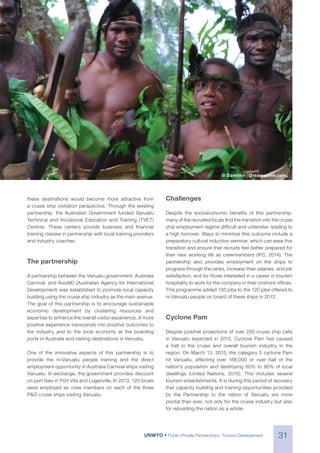
A partnership between the Vanuatu government, Australia
Carnival, and AusAID (Australian Agency for International
Development) was established to promote local capacity
building using the cruise ship industry as the main avenue.
The goal of this partnership is to encourage sustainable
economic development by clustering resources and
expertise to enhance the overall visitor experience. A more
positive experience transcends into positive outcomes to
the industry and to the local economy at the boarding
ports in Australia and visiting destinations in Vanuatu.
One of the innovative aspects of this partnership is to
provide the ni-Vanuatu people training and the direct
employment opportunity in Australia Carnival ships visiting
Vanuatu. In exchange, the government provides discount
on port fees in Port Vila and Luganville. In 2013, 120 locals
were employed as crew members on each of the three
P&O cruise ships visiting Vanuatu.
Challenges
Despite the socioeconomic benefits of this partnership,
many of the recruited locals find the transition into the cruise
ship employment regime difficult and unfamiliar, leading to
a high turnover. Ways to minimize this outcome include a
preparatory cultural induction seminar, which can ease this
transition and ensure that recruits feel better prepared for
their new working life as crewmembers (IFC, 2014). The
partnership also provides employment on the ships to
progress through the ranks, increase their salaries, and job
satisfaction; and for those interested in a career in tourism
hospitality to work for the company in their onshore offices.
This programme added 130 jobs to the 120 jobs offered to
ni-Vanuatu people on board of these ships in 2013.
Cyclone Pam
Despite positive projections of over 230 cruise ship calls
in Vanuatu expected in 2015, Cyclone Pam has caused
a halt in the cruise and overall tourism industry in the
region. On March 13, 2015, the category 5 cyclone Pam
hit Vanuatu, affecting over 166,000 or over half of the
nation’s population and destroying 50% to 90% of local
dwellings (United Nations, 2015). This includes several
tourism establishments. It is during this period of recovery
that capacity building and training opportunities provided
by the Partnership to the nation of Vanuatu are more
pivotal than ever, not only for the cruise industry but also
for rebuilding the nation as a whole.
32 UNWTO • Affiliate Members Report: Volume eleven
© Zdeněk Matyáš | Dreamstime.com.
Background: Tsunamis
More than four million Indonesians live in tsunami-prone areas
along the Southern and Western coasts of Sumatra, Java, and
Bali but few Indonesian communities in tsunami-prone areas
are prepared fully for the kind of low frequency but high-impact
tsunami disasters (Wegscheider et al., 2011). The 2004 Indian
Ocean earthquake occurred on Sunday, 26 December 2004,
with an epicentre off the West coast of Sumatra, Indonesia. A
series of devastating tsunamis killed over 230,000 people in
14 countries. A large number of international tourists lost their
lives and important tourist destinations, such as South Thailand,
suffered major destruction. To prepare for future tsunamis in
Indonesia, a ‘Tsunami ready toolbox’ was developed specifically
targeting the hotel industry.
Research has shown that a tsunami warning system and a
crisis management plan have been used as effective marketing
tools in motivating tourists to visit tsunami-hit destinations
in Thailand (Rittichainuwat, 2013). Specifically, international
tourists at tsunami-hit beach resorts value the existence of a
tsunami warning system, crisis management planning and
evacuation system announcements in their language or a major
international language (Rittichainuwat and Chakraborty, 2012).
Thus, providing disaster risk reduction systems should be
attractive to operators and provide a marketing advantage.
Bongkosh N. Rittichainuwat,
Siam University
Susanne Becken, Griffith University
2.7
Joining forces to minimize risk: development of a “Tsunami Ready
Toolbox” to increase disaster preparedness for hotels in Bali, Indonesia
33UNWTO • Public-Private Partnerships: Tourism Development
The Partnership
The ‘Tsunami Ready Toolbox’ was designed to assist hotels
in Indonesia to prepare for tsunamis. It is an initiative of the
Bali Hotels Association (BHA) and the Ministry of Tourism.
The Ministry of Tourism also supported a ‘Tsunami Ready’
course, based on the toolbox, offered free of charge to
hotels and hotel associations throughout Indonesia, from
Banda Aceh to Papua. In this PPP, the government is
enhancing the competitiveness of the tourism industry by
funding a common approach to and resource to respond
to tsunamis and hence reduce risk to tourists.
Initiative
Following the 2004 tsunami a range of initiatives were
developed to improve tsunami warning systems and
preparedness of at-risk communities, including programs
designed for hotels. The Bali Hotels Association with over
100 star-rated member hotels has proactively engaged
in improving the safety of its sector. A system of early
warnings (including radio, SMS, etc.) has been designed
to reach over 20,000 hotel employees plus guests.
However, warning is not enough for protection. To ensure
that the warnings translate into action, the ‘Tsunami
Ready Toolbox’ was developed as a public‐private sector
partnership between BHA and the Ministry of Tourism.
The toolkit consists of checklists, background information,
templates, Standard Operating Procedures, and best
practice examples to assist hotels preparing for tsunamis.
It also provides information on beach evacuation, planning
of evacuation routes, and location of evacuation spots,
best practice, and natural warning signs. The creation
of a common standard for evacuation route signs to be
used within private hotel grounds was critical. The signs
resemble the official Indonesian tsunami evacuation signs
in order to avoid confusion when crossing from public
areas into private hotel space. BHA member hotels are
already using the signs.
Tourism development and communities
In Tanjung Benoa, BHA hotels also agreed to make their
premises available to the local community at risk who
otherwise have only a very limited chance of survival due
to a lack of suitable evacuation centres. The experience
collected in Tanjung Benoa is currently being incorporated
into additional fact sheets for the toolkit. BHA is also
offering to assist the public with educational events and the
provision of evacuation route signs in public spaces. This
contribution enhances the wider safety of the community
and assists the Ministry of Tourism with enhancing
Indonesia’s image as a safe tourism destination.
Conclusion
The efforts by the BHA in implementing disaster
preparedness through tangible guidelines provided as
part of the ‘Tsunami Ready Courses’ and the ‘Tsunami
Ready Toolbox’ is an important first step of joint public and
private social responsibility to ensure beach safety at the
tsunami-prone destinations.
BHA has provided important industry input, expertise and
staff time in order to produce the toolkit. The organization
acts as a pilot for the Government to promote the
programme nation-wide. The ‘Tsunami Ready Toolbox’
innovation of Ministry of Tourism and BHA has been
selected as a good practice example for “Public Private
Partnership in Disaster Risk Reduction” by the United
Nations Office for Disaster Risk Reduction.
More information
The toolkit can be downloaded free of charge from several
websites including BHA, UNESCO’s Jakarta Tsunami
Information Centre, PreventionWeb and Pacific Disaster Net.
Useful web link: www.preventionweb.net/english/
professional/publications/v.php?id=4043.
Figure 1	 Tsunami Ready logo
34 UNWTO • Affiliate Members Report: Volume eleven
Background: Mavrovo region
The Mavrovo region is a major ski destination in the
former Yugoslav Republic of Macedonia, which lies
within the borders of the Mavrovo National Park. During
the communist era, much of the accommodation
establishments in Mavrovo were established as staff
resorts for the employees of larger government owned
businesses and were not subject to commercial pressures.
These hotels are now privately owned by managers with
little business training or funds for investment. In addition,
some tourism service providers left the destination during
the former Yugoslav Republic of Macedonia’s transition
to a separate state due to poor business performance. In
addition, the remaining businesses, the municipalities and
the National Park were unable to agree on responsibilities
and objectives for tourism development.
Elena Ivanova, Swiss Foundation
for Technical Cooperation
© Radelukovicn| Dreamstime.com.
2.8
Visitor focused collaboration in Mavrovo,
the former Yugoslav Republic of Macedonia
35UNWTO • Public-Private Partnerships: Tourism Development
The Partnership
Mavrovo is a tourism destination in the former Yugoslav
Republic of Macedonia where the National Park Authority
and the municipalities of Mavrovo and Rostushe jointly
control planning and development of a destination.
Destination Mavrovo has high potential for further tourism
development and extension of the season based on
its natural, architectural, cultural and adventure travel
resources. Each of the organizations involved had their
own vision for economic development of the Mavrovo
region and were unable to provide synchronized direct and
indirect tourism services. An external organization with
expertise in tourism (a University) acted as a consultant to
develop a collaborative plan for tourism in Mavrovo. This
led to a number of new collaborative arrangements among
local organizations.
Building a stakeholder partnership
The Swiss government aid agency, Swisscontact, provided
funding to improve employment in the Mavrovo region. As
part of this project, a group of 20 local public and private
representatives discussed how to organize the destination
in a more collaborative way. The key to this collaboration
was to focus on improving the experience of the existing
and prospective visitors. The University researchers led
a joint and creative process to identify strategic visitor
flows (SVF) in order to develop and improve the services
according to visitors’ demands and expectations. These
SVFs were built around groups of service providers in
small working groups who identified ideas for product
development for each SVF.
The external consultant facilitated these groups, and
provided follow up, steering and mentoring of stakeholders
in the meetings. During successive meetings, several
additional stakeholders were invited to participate
and to provide input. The result was an organized and
systemic approach to the preparation for the upcoming
snow season. The private businesses, supported where
necessary by the government organizations, developed
various travel packages, entertainment content and one
campaign for the entire season promoting facilities for the
target market “families with children”.
Achievements
This project facilitated the process of public-private
collaboration of the local stakeholders to adapt and improve
the existing product in preparation of the upcoming winter
season. It resulted in a number of collaborations:
–– Municipality with the Ski Centre: this collaboration
involved a big music concert on the ski slopes. The
municipality was the main financial supporter while the
Ski Centre provided discount ski passes to get to the
concert and also accommodation for the band;
–– Municipality with private sector: the municipality
provided incentives for an event company willing to
invest in the destination;
–– Private Sector: for the first time, hotels with Ski
Centers allowed other hotels to sell a five-day ski
pass using their ski facilities. A regular Ski Pass + Bus
transport package was introduced for the first time
providing easy access from Skopje to Mavrovo; and
–– Private Sector – International NGO: Supported by
a local video production company and two marketing
agencies, these new services were advertised in a
domestic TV and digital marketing campaign.
Conclusion
Collaboration between local organizations can be hard to
organize. Sometimes an external organization, such as
a University or a consultant, can help to bring different
parties to the table. In the early phase of collaboration, it
is important to focus on a customer viewpoint to tourism
in the destination, improving existing product or services
and coordinating the private sector’s efforts. After some
initial successes, the collaborating group may move to
product development and the further development of
the destination. Collaboration is a process rather than
an endpoint where building trust and the ability to work
together is a first step.
36 UNWTO • Affiliate Members Report: Volume eleven
Background
Located at the geographic intersection of China and India,
Myanmar is within a five to six-hour flight of more than 50% of
the world’s population. Its traditional role as a regional trading
hub has been disrupted by half a century of authoritarian military
rule. But as the transition from ethnic conflict to peace continues
to evolve and the centrally directed economy moves rapidly to a
market-oriented one, trade as well as international and domestic
tourism demand is developing at record rates for an Asian nation.
The Government of Myanmar identified tourism development as
a national priority in its comprehensive outline of planned reforms
articulated in the Framework for Economic and Social Reforms
(FESR) launched in early 2013. The Government of Myanmar
has acknowledged tourism’s capacity to contribute to economic
growth and poverty reduction, accelerating national reconciliation
and the democratization process, and other development priorities
outlined in the FESR. During the process of developing the FESR,
the Government of Myanmar adopted the Myanmar Responsible
Tourism Policy in 2012. Developed with the funding support of
an international NGO partner, the German based Hanns Seidel
Foundation, the Responsible Tourism Policy articulated the new
vision for tourism in Myanmar as a tool to generate sustainable
income opportunities and to conserve the nation’s nature and
cultural heritage.
Steve Noakes, Pacific Asia Tourism
2.9
Inclusive business for tourism training in Yangon
and Nyaung Shwe (Inle Lakes), Myanmar
37UNWTO • Public-Private Partnerships: Tourism Development
© Oazizba | Dreamstime.com.
Endorsed by the private sector advocacy organization,
the Myanmar Tourism Federation, this vision is consistent
with the Myanmar Master Tourism Plan 2013 – 2020
produced by the Ministry of Hotels and Tourism with
the international funding support of another bilateral
international partner, the Norwegian Government. The
Master Plan set a high target of 3.01 million international
visitors in 2015 (achieved in 2014) and 7.48 million in 2020.
Most often (but not always) to support implementation of
key recommendations from the Tourism Master Plan, as at
2015, over three dozen tourism and/or hospitality projects
funded with the support of a wide range of international
partners were underway in Myanmar. One of those, the
Business Innovation Facility project, it is focussed on
enhancing private sector innovation and capacity to ensure
tourism in Myanmar can compete on product richness,
diversity and quality.
The initiative
The Business Innovation Facility (BIF) project, with a
budget of GBP 4,971,529 over four years, is unique
in the United Kingdom’s Department for International
Development (DfID) Burma portfolio, targeting consultancy
support directly to firms, and across a number of different
sectors, including tourism, for the benefit of poor people
in Myanmar.
The project provides training that enables selected
companies to adjust the way they do business to create
more jobs, opportunities, products and services for
poor people. In the tourism sector, it helps low-income
producers to gain access to new or more secure business
opportunities. As an example, in Shan State the project
has assisted entrepreneurs to develop small-scale tourism
enterprises providing visitor accommodation, and guide
services for trekking operations and other tour options.
Several five-day training programs were conducted during
May and June 2015, for private sector entrepreneurs in
Yangon and Nyaung Shwe. International consultants with
expertise in tourism policy and planning, sustainable
development, destination marketing and conflict sensitivity
(‘Do No Harm’ approaches) contributed along with local
experts.
© Steve Noakes
38 UNWTO • Affiliate Members Report: Volume eleven
© Irinarasko | Dreamstime.com.
The partnerships
The BIF project has occurred under formal aid partnerships
between the Government of Myanmar and the UK
Government, through its DfID. As a project team included
a UK based international project management company
and its local Myanmar based contractor (Hamsabub
Consulting) with in-country overview by DfID Burma.
For this project effective partnerships needed to be
established with industry and government organizations
at the national, state and local levels. In particular,
partnerships were forged with tourism entrepreneurs in the
gateway city of Yangon and in Shan State, home to many
ethnic groups, the popular Inle Lake and the leg-rowing
floating village Intha people, the vast limestone Pindaya
Caves and the mountain trekking industry. Partnerships
established with local business providers were maintained
after the training programs via online tools, especially with
a Facebook community enabling participants to remain in
contact and share ongoing business experiences.
Conclusion
This project has trained local tourism industry
entrepreneurs, through a PPP involving an international
development partner, relevant national and regional
governments and industry agencies. In this case study,
the focus was on inclusive business training for the private
sector within Myanmar’s tourism industry, targeting
middle to senior managers of small, medium and larger
scale tourism enterprises that provide services or goods
to Myanmar’s growing tourism industry.
39UNWTO • Public-Private Partnerships: Tourism Development
The UNWTO Affiliate Members offer:
·A wide range of opportunities for public-private
collaboration
·An international platform to interact with
governments from all over the world
·A framework to connect interest groups
·An opportunity to be part of the UN work
·A space to generate innovative products
Enhancing public-private sector collaboration
in tourism
Affiliate Members
affiliatemembers.unwto.org
JOIN US
40 UNWTO • Affiliate Members Report: Volume eleven
Background
Tourism is an information intensive industry. The
technological revolution experienced through the
development of the information and communication
technology (ICT) has changed tourist behaviour
and demand dramatically. In recent years, the rapid
development of ICT has made the term “smart tourism”
quite fashionable (Wang, Li and Li, 2013). Smart tourism
is defined as an ICT-integrated tourism platform, which
uses information technology to integrate various tourism
information sources. It uses artificial intelligence to
provide explicit information and satisfactory services to
tourists based on the development of innovative mobile
communication technology (Zhang, Li and Liu, 2012).
In recognition of the importance and potential smart
techniques in tourism, the China government launched its
“Smart Tourism” initiative in 2011.
Nanjing, the second largest city in East China, was
selected as one of the “Chinese smart tourism pilot cities”
in 2012. Since then, Nanjing has made significant progress
in smart tourism development, and won China’s annual
“Smart Tourism City” Award in 2014. Collectively, the
successful development of smart tourism in Nanjing can
Xia Wang, Nanjing University
Xiang (Robert) Li, Temple University
© Xia Wang.
2.10 “Smart tourism” development in Nanjing, China
41UNWTO • Public-Private Partnerships: Tourism Development
be attributed to the concerted efforts made by both the
local government (i.e., Nanjing Tourism Committee) and
tourism businesses.
The partnership
Developing smart tourism in a destination has to be
a coordinated effort, and requires local government’
strategic planning and guidance. The Nanjing Tourism
Committee (NTC) is responsible for Nanjing’s smart
tourism planning and guidance. In the following five years,
the NTC also invested in smart tourism-related projects
such as:
–– Establishing a smart tourism central management
platform, which handles tourism information more
effectively;
–– Developing a Chinese smart tourism APP, providing
detailed information about the city’s scenic spots,
hotels, restaurants, transportations, and so on via
social media;
–– Constructing a rural smart tourism marketing platform,
and collecting information about tourism resources in
suburban areas, along with information relating the
local hospitality facilities and culture;
–– Conducting pilot projects to improving the “smartness
level” of experience at Nanjing’s major scenic spots;
and
–– Constructing interactive experience terminals offering
tourism-related information from 42-inch touch-screen
displays at every tourist attraction in Nanjing.
These measures have helped Nanjing to offer tourists
more convenient and rich travel experiences, provide more
efficient information platforms for tourism administration,
and facilitate the transformation of tourism resources into
products.
Echoes from the local businesses
While Nanjing’s smart tourism project is a government
initiative, participation of the local businesses is crucial
to its success for at least two reasons. Firstly, the smart
tourism system is a very sizeable project, in terms of
effort, investment, and time. Thus, the participation of
non-government stakeholders can reduce the investment
burden of the government. Secondly, the smart tourism
initiative reflects a strategic demand for the transformation
and upgrading of the local tourism industry. Tourism-
related businesses need to keep up with the emerging
demands in response to the ICT development. Over the
past five years, many scenic spots (e.g., Hongshan Zoo),
hotels (e.g., Jinling Hotel), and transportation service
providers in Nanjing have invested significant resources
into the construction of their own smart tourism projects,
including free Wi-Fi, electronic touch screen, smart cards
and so on.
Hongshan Zoo, one of the first local tourist attractions
with a smart tourism initiative, provides a good example
of setting up smart tourism systems. It has become
increasingly sophisticated, providing a web home page
and free Wi-Fi, and is using smart devices to monitor
tourist flows and provide self-guided facilities.
Conclusion
Tourism has always been at the forefront of embracing
technological innovations. The application of smart
technologies in tourism is likely to lead to fundamental
changes in tourism administration, tourist behaviour
and demand as well as how tourism industry functions
and structures (Buhalis and Law, 2008). Due to the
substantial resources required for developing smart
tourism, the construction of a smart tourism system is not
possible without the collaboration and synergy between
government and all tourism-related businesses. The
experience of Nanjing’s smart tourism development can
be summarised as a “government-led, tourism business-
involved and market-oriented operation.” This case may
provide useful insights for other destinations to construct
smart tourism systems.
42 UNWTO • Affiliate Members Report: Volume eleven
Background
Located between Solimões, Japurá and Alto-Paraná
Rivers, the Mamirauá Sustainable Development Reserve
(MSDR) is a public protected area established in 1996 in
the state of Amazonas, Brazil. Mamirauá is the world’s
largest protected flooded forest (1,124,000 hectares), a
Ramsar Site, and UNESCO World Heritage Site. In 1999,
the Mamirauá Sustainable Development Institute was
developed with the mission to conduct research but also to
co-manage the reserve. Together with local communities,
it develops sustainable development initiatives aimed at
conserving local fauna and flora, especially Mamirauá’s
flooded forests.
The ecotourism initiative
The concept of introducing ecotourism as one of the land
use practices within the reserve was first introduced in
1996, with the Uakari Lodge opening five years later. Uakari
is one of the first community-based tourism projects in
Brazil. Its primary objective is to develop autonomy for the
communities in the management of this activity, generating
employment and income, strengthening local government
and contributing to the conservation of natural resources.
Fernanda de Vasconcellos Pegas,
Griffith University
2.11
Integrating scientific research and tourism to benefit community
livelihoods: The Mamirauá Sustainable Development Reserve, Brazil
© Vismar| Dreamstime.com.
43UNWTO • Public-Private Partnerships: Tourism Development
Uakari is co-managed by the Mamirauá Institute and by
eight communities from the Mamirauá Reserve.
Ecotourism is implemented using a community-based
approach, which provides local communities opportunities
to participate in the decision-making process and be
direct beneficiaries of social (e.g., capacity building) and
economic outcomes (e.g., employment opportunities).
Most of the employees are local and work managers, local
guides, maids, cooks, auxiliaries and janitors. Ecotourism
activities occur within a designated 35 Km2
area, where
hunting and logging activities are prohibited. Overall,
there are 60 residents working in the tourism enterprise at
Uakari. Local residents involved in tourism are members of
the Association of Ecotourism Guides and Assistants for
the Mamirauá Reserve. Based on a 10-day/month rotation
system, workers are able to engage in tourism but also be
able to continue living their traditional way of life with the
families. This reduces economic dependency on tourism;
a problem encountered in many ecotourism projects.
Innovation
This partnership is innovative because high-end
ecotourism in the region is predominantly a private
enterprise run by hotel chains and/or organizations rather
than community-based ventures. In addition, unlike most
high-end ecotourism operations, it does not take place on
communal or private lands but rather in a state-controlled
protected area managed specifically for sustainable use.
Lastly, because sustainable resource use is allowed
outside the ecotourism zone, locals can earn income
from sales of harvested goods, such as fish. While there
are other Sustainable Development Reserves in Brazil,
Mamirauá’s case is unique. For isolated and impoverished
riverine communities, such dual land use practices can
provide a viable financial package.
Challenges
In 2003, the Uakari Guest House received recognition
from the American magazine Condé Nast Traveler as the
best ecotourism destination in the world. In the same
year, the initiative won a sustainable tourism award from
the Smithsonian and the United States Tour Operators
Association. In 2011, National Geographic Traveller
considered it one of the best destinations in Brazil.
Despite these internationally awards, Uakari has yet to
fulfil its full potential. One of the main challenges involves
management. At the Uakari this includes managing the
Lodge and maintaining high quality services and products.
So far, the production of locally made products falls short
of the growing demand. Greater organization among
local producers is needed to increase production. Other
challenges to the economic sustainability of Mamirauá
include a decrease in family farming activities amongst
the communities involved, the emergence of some family
disputes, and the weakening of some aspects of the
community’s social fabric. Continuous efforts are required
to maintain the economic sustainability of the project.
Socioeconomic benefits
Perhaps one of the most tangible benefits of this
community-based tourism partnership is how the income
generated is further distributed - revenues from Uakari
are invested in projects selected by the community.
Recent projects include the purchase of boats, building
community centres, and improving radio communication.
In 2013, the community implemented an environmental
and social tax included in the booking cost to improve
environmental conservation and patrol activities. Income
from the tax scheme helped to establish a community
kitchen and purchase canoes, thereby benefiting all
community members involved in tourism within the
Reserve. Community members have received education
in tour guiding, basic accounting, English, ornithology,
interpretation, customer service, sustainable agriculture,
first aid, environmental and waste management, and
hospitality and food preparation.
Conclusion
The PPP between local communities and the government
was a vital element in the development and establishment
of this tourism venture in the heart of the Brazilian Amazon
Basin. It has allowed families who depend upon local
resources for their survival to live inside the protected
area. It has also addressed a lack of financial and skills
among local communities enabling them to run a high-end
ecotourism venture.
44 UNWTO • Affiliate Members Report: Volume eleven
The problem
As in many destinations around the world, Australia has seen a
dramatic influx of Asian visitors over the past two decades. This
growth is expected to continue with Asian to Australia reaching
4.4 million visitors by 2023, increasing from 2.7 million visitors
(worth AUD 13.2 billion) in 2013 (Tourism Research Australia,
2013). To adapt to the changes in the visitor mix and remain
competitive in a changing tourism market, Australian tourism
businesses need to ensure that they offer experiences that meet
the needs of current and future Asian visitors. One destination
that has been at the forefront of servicing Asian visitors to
Australia is the Gold Coast, in Queensland.
The Gold Coast is a major Australian leisure tourism destination
built around its beaches, relaxed lifestyle and natural
environment. It has traditionally catered for Australian visitors
from Brisbane, Sydney and Melbourne but more recently has
received first Japanese and then Chinese visitors. Addressing
the needs of Chinese travellers requires some adaptation of the
experiences that have been traditionally offered to Australian
and western visitors. While, many of the physical products and
services that are provided to Chinese visitors may be the same
(e.g., same beaches), the Gold Coast also needs to tailor its
experiences to match important cultural differences.
Sarah Gardiner, Griffith University
Noel Scott, Griffith University
© Sarah Gardiner.
2.12 Experience Gold Coast: innovative products for Asian Visitors
45UNWTO • Public-Private Partnerships: Tourism Development
The partnership
The vast majority of local tourism businesses are small
in size. Small tourism businesses are often able to
cater well to an existing market because they have an
advantage that they are in close and constant contact
with their customers. However, when visitor markets are
changing and new types of tourism consumers emerge,
small businesses face the problem of understanding the
requirements of these new customers who often are not
familiar with and do not use their regular, existing products.
Tourism and economic development agencies in
governments can play a role in informing the industry to
new trends and opportunities around emerging markets.
Yet, often this information is presented at the macro or
destination level and therefore small tourism businesses
find it difficult to translate it into strategic and operational
implications specific to their business. These agencies are
also increasingly under funding pressure to find the right
type of industry development activities to stimulate visitor
numbers and yield growth. Thus, although government
has a significant stake in innovation in the tourism sector,
finding practical ways to assist is often challenging.
Universities have the skills and abilities to conduct
market research on new and developing markets, yet
are often disconnected from the tourism industry. These
research-based institutions can provide support for
regional economic development and sustainability of the
destination in which they are located. A PPP was developed
to bring together these three stakeholder groups – tourism
small business owners, local and federal government
and university researchers in Australia - to engage in
developing experiences for the Chinese consumer to the
Gold Coast.
The project
To explore these cultural expectations of Chinese visitors
and to ensure that research findings were both practical
and actually taken up by businesses on the Gold Coast, the
research was conducted with Chinese students already
living in Australia. The student market is an attractive
target for tourism businesses in itself. In addition, research
with Chinese university students living in Brisbane and the
Gold Coast enabled the researchers to obtain cultural
insights from people already aware to some extent of the
Gold Coast and its experiences. In addition, it allowed the
research to focus on one target market – young people
who want particular types of experiences. From the start
engaged the managers of tourism businesses wanting to
attract more Chinese visitors. This meant that the research
team could find out how Chinese people reacted to their
particular experiences and ensured that outcomes were
practical and able to be implemented. Businesses offering
outdoor experiences attractive to young people and who
were willing and able to adopt the research findings were
selected.
The research project was undertaken by researchers with
extensive industry experience from Griffith University and
The University of Queensland. The 18-month project was
funded by a competitive Australia Government T-QUAL
grant and supported by both the local government agency,
City of Gold Coast, and the regional tourism organization,
Gold Coast Tourism.
The project involved four main stages:
1.	 A capacity audit involving interviews with business
managers to identify suitable experiences and research
partners;
2.	 Qualitative research involving eight focus groups with
international students;
3.	 Experience testing through on-site visits by Chinese
students and an online survey of International students
in Australia; and
4.	 Industry and community dissemination activities.
The result
The careful selection of the type of visitor and business
managers involved in this project was critical to its
success. As a result, changes to the experiences offered
which were recommended from the research have already
been implemented.
46 UNWTO • Affiliate Members Report: Volume eleven
Background
Tourism is the dominant sector of the Samoan economy contributing more than
twenty per cent of its gross domestic product (GDP). Small to medium scale
tourism operations are run by local families who offer beach accommodation,
catering and recreational services mostly in a form of traditional ‘fale’ (open
beach hut). These operations are uniquely connected to the many small
villages around the coastline of the two main islands of Upolu and Savaii.
Village communities are reliant on the tourism operations for employment,
income and capital. Tourism also contributes to the extension of transport
networks, upgrade of infrastructure, and provision of essential services.
The partnership
Seventy percent of Samoa’s population and tourism operations are located
within 100m of the coastline. Being adjacent to the coast, many operators
and communities are exposed to the impacts of climate change induced
events, other long-term incremental changes (e.g., sea-level rise), and by
changing seasonal weather patterns threatening the viability and profitability
of community value chains.
The Samoan Tourism Authority, with the support of the United Nations
Development Programme (UNDP) and funding from the Global Environmental
Facility, is implementing an innovative climate change adaptation initiative.
The “Enhancing the Resilience of Tourism-reliant Communities to Climate
Gabor Vereczi, UNDP
Amiaifolau Afamasaga,
Samoa Tourism Authority
Sara Ferrandi, UNDP
Reis Lopez Rello, UNDP
© Gabor Vereczi I Manase Beach, 2010
2.13
Samoa´s community tourism operators and the development of
innovative mechanisms to adapt to climate change
47UNWTO • Public-Private Partnerships: Tourism Development
Change Risks” project involves government agencies
with a mandate on tourism´s resource base, including the
Ministries of Natural Resources and Environment and the
Ministry of Women, Community and Social Development.
The private sector is represented by the representatives
of the Executive Councils of the Samoa Hotel Association
and the Savaii Samoa Tourism Association. Input from the
civil society is provided through the community members
who participate in project workshops.
Having the industry association as members of the project
board is of great benefit because it provides focus, and
also ensures that priorities and lessons learned during the
various stages are shared with wider industry members.
A key approach is to support clusters of small operators
at selected local destinations around the country’s
coastline and to establish management plans for Tourism
Development Areas (TDAs) by integrating climate risks and
adaptation measures. Importantly, these plans are being
prepared with the full involvement of local operators and
community representatives, and aligned with other planning
frames supported by partner government agencies, such
as the Community Integrated Management Plans.
Innovative features and measures
This project uses participatory 3D modelling techniques
for the TDA planning process to provide a visual support
and engagement tool that facilitates discussions around
issues and solutions on natural resources and tourism
assets management. It connects tourism operators to the
Climate Information and Early Warning System through
innovative software and media applications that transmit
weather warnings and long-term climate projections. It
has helped tourism product diversification as a means
of climate change adaptation, by developing alternative
cultural and natural programmes for beach activities when
affected by rainy and stormy weather. It has also enhanced
water supplies and tourism related infrastructure, as well
as reduced shoreline erosion though the introduction of
soft-engineering techniques (e.g., beach replenishment)
aided by ecosystem-based measures (e.g., vegetation
cover) and some protective structures that help maintain
tourism functionality (e.g., access, aesthetics) of beaches.
Conclusion
Tourism in small island destinations, such as Samoa, is
highly vulnerable to climate-induced risks, with small
community operators having relatively limited capacity
to adapt. Considering tourism´s cross-cutting nature,
effective response to climate change needs to happen
in an integrated way, with the involvement of the public,
private and civil society institutions. It also needs to
develop institutional, technical, and technological solutions
and promote interactive capacity building initiatives to the
involved small operators.
© Gabor Vereczi I Manase Beach, 2014
48 UNWTO • Affiliate Members Report: Volume eleven
The Partnership: Summary
In 2000, the PPP “Saudi Hospitality Heritage Company
(SHHC)” was launched by the Saudi Commission for Tourism
and National Heritage (SCTH). The SHHC initiative was part
of an integrated cultural heritage development program.
This is an innovative approach to tourism in Saudi Arabia
as it seeks to develop a high-quality network of heritage
hospitality facilities in different regions of the Kingdom as a
sustainable and internationally well-known tourism initiative.
Background
Saudi Arabia has given great attention to the tourism
industry in recent years. Historically, the Kingdom tourism
industry was dominated by inbound tourists who visited
Saudi Arabia to complete their pilgrimage to Mecca during
the hajj period held in the twelfth Muslim lunar month of
Dhu al-Hijjah. Since 2000, the domestic tourism industry
has witnessed a growth of international and domestic
visitor flows to and within the Kingdom for many purposes,
including leisure. To better capitalize on the growing tourism
industry, the SCTH is developing a tourism initiative that
adopts and implements several tourism development
programs. One of these programs is the Custodian Program
for Caring of the Kingdom’s Cultural Heritage, which aims
to preserve, develop, and raise awareness on the national
cultural heritage.
Ahmad Muhammad Ragab,
Minia University
2.14
Saudi Hospitality Heritage Company:
The Kingdom of Saudi Arabia
49UNWTO • Public-Private Partnerships: Tourism Development
© Sufi70 | Dreamstime.com.
The Initiative
Following the PPP concept, the Saudi government approved
SCTH’s request that the State, represented by the Public
Investment Fund, be engaged in development of, and
investment in, heritage buildings for area of accommodation
and hospitality purposes through the establishment of
a joint stock holding company The SCTH offered private
placement of company capital targeting private joint stock
companies specialized in the development of hospitality
and urban heritage sites. The founding shareholders
are the Public Investment Fund (15%), Taiba Holding
Company (30%), Dur Hospitality (25%), Al-Tayyar Real
Estate and Development Co. (20%), Riyadh Development
Company (8%), and the Jeddah Development and Urban
Regeneration Company (Jedrick) (2%).
PPP Objectives
1)	 Establish and manage tourism and heritage
accommodation and traditional hospitality facilities;
2) 	Develop nationally and internationally high-scale
identity for heritage hospitality utilizing Kingdom
unique heritage potential;
3) 	Highlight the value of the Kingdom’s genuine heritage;
4) 	Promote opportunities for successful luxury heritage
hospitality experiences;
5) 	Develop tourism across provinces; and
6)	 Create sustainable heritage tourism partnerships
between the public and private sectors including,
undertaking internal and external design of heritage
buildings; making and marketing local handicraft;
making and serving popular dishes at banquets; and
restoring, developing, and manufacturing heritage
building’ materials and construction tools.
SHHC and local development initiatives
The SCTH considers the private sector as the main partner
in the process of developing the tourism sector as a whole.
More specifically, the private sector provides capital to the
SHHC and its subsidiary companies; operates, markets,
and promotes the heritage hospitality facilities within
the Kingdom; and develops various heritage hospitality
products.
At the local level, the SHHC plans to generate development
benefits on the following levels:
1)	 Economic: create new tourism activities and products
that generate new job opportunities for local residents;
2)	 Social: involve local communities in the development
of tourism and motivate their participation in providing
authentic services of heritage hospitality;
3)	 Cultural: promote historical and heritage value of
archaeological buildings; and
4)	 Heritage: preserve architectural heritage as well as
develop and restore historical buildings.
The full story of the SHHC see the SCTH website:
http://scth.gov.sa/.
50 UNWTO • Affiliate Members Report: Volume eleven
Background on the APEC Private Sector
Involvement
The APEC (Asia-Pacific Economic Cooperation)
Organization is a pioneering international organization with
formal business community involvement, represented by
the APEC Business Advisory Council. This Council plays
an influential role in APEC’s initiatives and policymaking.
APEC’s work on tourism is driven by close partnerships
with the private sector, such as the International
Association of Air Transportation (IATA), the Pacific Asia
Travel Association (PATA), and World Travel and Tourism
Council (WTTC). Public-private partnerships are one of the
unique traits of the (APEC) and its 21 member economies.
These partnerships have allowed APEC to develop
recommendations for sound tourism policy frameworks in
the regions where it operates. Leveraging both public and
private resources, APEC is able to implement innovative
policymaking that can be both strategic and practical.
Alan Bollard, APEC
© Hoxuanhuong | Dreamstime.com.
2.15
Public-private partnerships to promote a sound tourism policy
framework in the Asia-Pacific
51UNWTO • Public-Private Partnerships: Tourism Development
Examples of PPP outcomes
1) 	 Visa facilitation
	 APEC member economies work closely with WTTC
and UNWTO to implement initiatives facilitating travel in
the Asia-Pacific region. Making it easy to obtain tourist
visas has been projected to lead to an increase in
57 million tourists and USD 89 billion to GDP, around
2.6 million additional jobs within the region. For
example, since Japan has provided visa exemptions
for tourists from Thailand and Malaysia in 2003, the
country has seen an increase of tourist numbers of
96% and 53% respectively year-on-year for the period
between July-Dec 2013 after the visa relaxation. Japan
also has provided a stay period extension for multiple-
entry visas for tourists from Indonesia and introduced
multiple entry visas for the Philippines and Viet Nam.
Chinese Taipei has introduced a temporary permit for
cruise passengers.
2) 	Establishing a more sustainable form of tourism
	 APEC’s Tourism Working Group has produced a
tool to support developing sustainable tourism
destinations. The tool is intended for use by various
tourism stakeholders policy makers, community
leaders, academics, private sector and organizations
involved in tourism services. Among the beneficiaries,
one of the most important groups are small and
medium tourism service providers who can strengthen
their relative position in international markets using a
sustainable approach.
	 Improving tourism destination sustainability is a
continuous process and requires constant monitoring
of impacts and introducing the necessary preventive
and corrective measures whenever necessary. Based
on successful case studies in New Zealand, Australia
and others economies, APEC developed key policy
tools to promote sustainable tourism effectively. These
policy tools include use of permit fees to control access
to environmental and cultural conservation sites and
introduction of land-use legislation for conservation
parks.
3) 	Good tax policy for tourism growth
	 In 2015 APEC, in collaboration with the WTTC as a
co-sponsor, is assessing the impact of taxation on
the travel and tourism industry. A recent UNWTO
and WTTC study shows there is a causal link
between taxation and tourism development. Taxation
policies significantly influence the competitiveness of
intra-regional and international tourism destinations.
APEC is working closely with the private sector to
assess taxation strategies that will maximize the
competitiveness of destinations. This study provides
a comparative assessment of tax policies and the
degrees of impact on the travel and tourism industry,
including both the consumer and tourism-related
businesses. The analysis also evaluates the competitive
positioning of participating APEC economies based on
their tax policies.
How will these PPPs benefit emerging
tourism economies?
APEC works with public-private partnerships to develop
tools in policy options for its members’ emerging
economies. Member countries are able to learn from
best practices from other developed and developing
economies. Public-private partnerships at the regional
level are used to deliver policy recommendations,
providing a context for continued policy formulation and
effective implementation.
For more information
1.	 Watch a video interview with APEC Tourism Working Group
Chair, Javier Guillermo Molina, outlining APEC’s initiatives to
support the growing Asia-Pacific tourism sector:
	www.youtube.com/watch?v=JyT0wHgYcm4.
2.	 See more information on the APEC Tourism Working Group:
	 www.apec.org/Groups/SOM-Steering-Committee-on-
Economic-and-Technical-Cooperation/Working-Groups/
Tourism.aspx.
52 UNWTO • Affiliate Members Report: Volume eleven
Background
Acclaimed as the ‘greatest route in the history of mankind’,
the ancient Silk Road formed the first bridge between the
East and the West and was an important vehicle for trade
between the ancient empires of China, Central and Western
Asia, the Indian sub-continent and Rome (UNWTO, 2014).
As routes of integration, exchange and dialogue, the Silk
Road contributed greatly to the common prosperity and
development of humankind for almost two millennia.
With its richly diverse cultural heritage and its wealth of natural
tourism attractions spanning across thousands of kilometres
of ancient routes, the Silk Road today offers visitors the
opportunity to experience a unique network of destinations
linked by a shared history. By venturing along the ancient Silk
Road, tourists can walk in the footsteps of famed explorers
such as Alexander the Great and Marco Polo.
UNWTO now works with 32 countries across Europe,
the Middle East and Asia and the Pacific in building the
sustainable development of tourism along the ancient Silk
Road. The UNWTO Silk Road Action Plan is the framework
for this activity and is focused on three key areas: marketing
and promotion; destination management and capacity
building; and travel facilitation.
Johanna Devine, UNWTO
2.16
UNWTO and Pilot Productions:
Showcasing the Silk Road to an audience of 30 million people
53UNWTO • Public-Private Partnerships: Tourism Development
The Partnership
To help raise the profile of the Silk Road internationally,
UNWTO teamed up with Pilot Film & TV Productions
Ltd. Pilot Productions is a leading international television
production company with an outstanding reputation for
producing and distributing factual entertainment and
travel led programmes.
The activity
This partnership produced two Globe Trekker television
episodes along the ancient Silk Road as part of the
television series’ 20th anniversary Round the World
Marathon in 2012. The episodes took viewers on a journey
from Xian to Kashgar and then right across Azerbaijan,
Georgia, Kyrgyzstan, Turkmenistan, Uzbekistan, finishing
in Istanbul, in total covering seven countries.
On their respective journeys, the two Globe Trekker’s
top television presenters Ms. Megan McCormick and
Ms. Holly Morris highlighted the many extraordinary
travel experiences that the Silk Road offers, visiting
World Heritage Sites such as Xi’an’s Terracotta Warriors
and Horses and the ancient cities of Samarkand and
Merv. The hosts sampled local cuisine, visited religious
sites, travelled the steppe and shopped with the locals.
The hosts also showcased the route’s many types of
transportation – travelling by plane, bus, high speed train,
horse and camel.
To make the series a success, UNWTO secured the
participation of the countries and provided input into the
series’ content, whilst the 7 countries facilitated shooting
permits and provided ground support to the production
crew. In 2015, UNWTO will be working with another UK
based production company, Pioneer Productions, on
a documentary series on the Silk Road to be broadcast
on Discovery Networks International, which reaches
2.8 billion subscribers in more than 220 countries and
territories. UNWTO has maintained the relationship with
Pilot Productions and has invited the producer and host as
guest speakers at a number of UNWTO Silk Road events.
The Outcome
By combining efforts, UNWTO, Pilot Productions and
seven countries showcased the region to a global
audience of 30 million viewers across 40 countries. The
series is broadcast repeatedly across the world, and has
stimulated great publicity for the region.
54 UNWTO • Affiliate Members Report: Volume eleven
© Richard Denman.
Background
The Ghana West Coast (GWC) area is made up of five
Districts of the Western Region of Ghana. Together these
districts cover a coastline of some 175 kilometres running
up to the border with the Ivory Coast. The coastal
population is contained in a number of dispersed villages
and small towns, with around ten main towns, the largest
of which is Axim (population 28,000).
The Partnership
From 2006 to 2012, UNWTO, the Ghanaian Ministry of
Tourism and the Italian NGO Ricerca e Cooperazione
(RC) implemented three interrelated ST-EP (Sustainable
Tourism – Eliminating Poverty) projects on the development
and promotion of sustainable forms of tourism in Ghana
West Coast. The projects were funded through a
contribution from the Italian Government, and received
technical assistance from the Netherlands Development
Organization SNV.
The activities started in 2006 with the development
of ecotourism itineraries with three linked coastal
communities (i.e. Busua, Butre and Dixcove) paying
particular attention to setting standards, building local
Marcel Leijzer, UNWTO
Richard Denman, The Tourism Company
2.17 Sustainable forms of tourism in Ghana West Coast
55UNWTO • Public-Private Partnerships: Tourism Development
capacity, supporting local enterprises and providing
marketing material. In 2008, this project was extended and
widened to cover seven coastal communities (i.e. Akwidaa,
Amansuri, Ankasa, Axim, Cape 3 Points, Miamia and
Princess Town). Activities undertaken included providing
additional capacity building and enterprise support, with a
focus on supply chain and market linkages. Various tools
were used to provide support, including provision of credit
facility and environmental education.
Collaboration coordination activities
The West Coast Destination Management Organization
(DMO) was officially established in 2008, as a membership
body. The DMO Committee represents a balance of
stakeholder interests, as it comprises the Regional
Coordination Council, District Assemblies, Ghana Tourism
Authority (GTA), RC, Wildlife Division, Ghana Wildlife Society
and four leading resorts. This has led to development of
a strategy, training and brand development. The DMO is
supported by Town Tourism Development Committees
that provide tours and excursions. Assistance has been
given to small and micro enterprises providing products or
services to tourists or to tourism businesses through the
supply chain.
The establishment of community level structures – Town
Tourism Development Committees (TTDCs) – has been at
the core of the work with local communities. During the
initial years of the project implementation, stakeholders
realized that there was no real coherent approach to
tourism development in the area and that the private sector
was working independently and not in partnership with
government, civil society or local communities.
Town Tourism Development Committees (TTDCs) were
formed in the ten focal towns and villages along the
coast. These typically have a chair person, a coordinator
and a group of individuals who work together to improve
the local environment and provide tours for visitors, with
income benefiting participants and the wider community,
according to a benefit sharing formula agreed by the
stakeholders. Much of the activity is undertaken by a small
group of tour guides selected from within the communities
amongst people who expressed an interest in training as
guides and providing a service.
Product improvement and development
activities
Assistance has been given to small and micro enterprises
providing products or services to tourists or to tourism
businesses through the supply chain. This has included
training and business advice. Financial assistance has
been provided through a microcredit scheme organized
via the Chamber of Commerce. This has supported food
producers, small catering outlets, handicraft producers
and small local guesthouses. Credit has been mainly
used for the supply of small items or equipment.
In order to keep abreast of visitor needs and to guide
development, visitor surveys were conducted for a
number of years. These asked specific questions about
the activities undertaken by visitors and their reaction to
them. The findings were shared with the micro enterprises
and stakeholders in the DMO to help improve the product
offer.
Butre community visitor information kiosk Fort at Axim Ghana West Coast
© Richard Denman. © Richard Denman.
56 UNWTO • Affiliate Members Report: Volume eleven
In recognition of the need to attract additional private
sector investment to the area, a guide “Ghana West Coast
- Investment Opportunities in Sustainable Tourism” was
prepared. It described the assets of the West Coast and
the positive climate created by the work of the DMO and
other initiatives, and has been used actively to raise the
profile of the area. It has been distributed through the
GTA and overseas embassies and is used by the Ghana
Investment Promotion Centre when responding to tourism
related enquiries.
The Outcome
The Ghana West Coast project is a classic example
of stakeholders’ participation in tourism destination
management. It demonstrates the importance of collective
action and identification of stakeholder benefits and
roles in the decision-making processes, as an essential
requirement for tourism resources development in a
sustainable manner. The product development and
marketing work linked to the DMO has resulted in a much
enhanced profile for Ghana West Coast, and helped
achieve a significant increase in tourism. Capacity building
activities, in particular for stakeholders from the district
government, were essential to make the DMO operate
effectively and create a conducive environment for joint
initiatives by its members. Future multi-stakeholder
collaboration by the DMO members can be encouraged by
regularly organizing thematic seminars on topics relevant
for tourism development, bringing different stakeholders
together to assess the current situation and identify
opportunities to strengthen and expand joint actions.
Accommodation development on West Coast
Butre TTDC team with supporter
Community Involvement
Abakah Home Stay
57UNWTO • Public-Private Partnerships: Tourism Development
Box 1	 PPPs and Destination Management
PPPs are commonly used to support collaborative action
at a destination level. Management of tourism destinations
requires multiple stakeholders to work together. A
Destination Management Organization (DMO) provides
an ongoing coordination hub that can facilitate and
contextualise projects that increase the innovation and
efficiency of tourism in a region. The following examples
demonstrate a variety of ways in which DMOs can lead or
facilitate public-private partnerships.
AFFILIATE MEMBER
1. Catalonia, striving for a sustainable tourism model
Patrick Torrent
The Strategic Tourism Plan for Catalonia for the 2013-2016
period was developed based on a partnership between
the public and private sectors in order to maintain the
destination’s social, economic and environmental quality.
Management and implementation of the plan is ensured/
operated by Taula de Turisme (Tourism Task Force)
through four committees: Planning, Programming, Quality
and Innovation, as well as Knowledge and Strategy.
Committee members are from the business, academic
and government sectors. This enables key stakeholders
to work together within their areas of expertise. Actions
to improve economic sustainability have included the
promotion of inland regions, creation of experiential
tourism products, and the development of an internet
portal (www.catalunya.com) for small to medium sized
enterprises to sell them. Environmental sustainability
has been targeted by developing a plan for improving
energy, resource efficiency, and reducing impact on the
landscape. An application has been made for Biosphere
certification, the UNESCO-affiliated Global Sustainable
Tourism Council (GSTC) label, to reaffirm commitment to
responsible, sustainable tourism. Efforts are required to
manage the coexistence between visitors and inhabitants
to improve social sustainability.
© Kemaltaner | Dreamstime.com. National Art Museum of Catalonia. Barcelona.
58 UNWTO • Affiliate Members Report: Volume eleven
2. Pedemontana Veneta: High quality sustainable and slow tourism
Damiano De Marchi, Nagore Espinosa,
Mara Manente and Aurkene Alzua
Pedemontana Veneta is a sub-region in northern Italy
including the cities of Verona, Vicenza, Padua, and Treviso.
It is characterized by a hilly landscape, important cultural
attractions, its own regional gastronomy and significant
wine production. Pedemontana Veneta is part of the
largest tourist destination in Italy (Veneto Region) but has
never been seen as a tourism destination itself, being
overshadowed by Venice, Garda Lake and the Adriatic
Coast. The new Italian Regional Tourism Law included the
Pedemontana Veneta as part of a system of nine Themed
Tourist Areas and led it to reposition itself as a destination
for high quality and slow-paced relaxing tourism. This
process of reinvention is led by a PPP between the
Regional Government and the International Centre for
Studies on Tourism Economics (CISET). In 2012, a contest
to develop the official logo of Pedemontana Veneta led
1,666 entries in the creation of the first official tourism
brand. In 2014, CISET led a project to foster the creation
of new tourism startups (with particular attention to young,
unemployed and women). This project was financed by
the European Social Fund - European Commission. New
businesses include genealogical tourism, an e-commerce
platform to sell locally produced delicatessen products,
and responsible guided outdoor itineraries for the
enjoyment of natural resources. These included Vespa
sightseeing tours, walking trails and cycling itineraries and
supporting infrastructure (Wi-Fi, information points, bike
assistance and food and beverage services). These PPP
led projects resulted in a sense of community awareness
of belonging to the sub-region, destination awareness in
the mass media, and importantly recognition that bottom
up projects run by PPPs can lead to tangible results even
on small budgets.
AFFILIATE MEMBER
59UNWTO • Public-Private Partnerships: Tourism Development
3. Destino Punta del Este, Uruguay
Ramón de isequilla
AFFILIATE MEMBER
Destino Punta del Este, a tourism destination management
organization was the first PPP in Uruguay. In 2005, Punta
del Este was a well-known tourist destination with a large
proportion of second homes, weakness in the hotel market
and very high seasonality. Tourism marketing was totally
dependent on the public sector and the private sector was
institutionally weak. Creating a public-private institution
responsible for addressing these issues required two new
laws, one that allows subnational administrations to partner
withotherpublicorprivateinstitutionsforaspecificpurpose,
and another that allows such a partnership to undertake
financing of infrastructure projects with contributions from
both public and private institutions. After these legislative
changes were made, a not-for-profit nongovernment
association was formed (a PPP). Members include hotels,
restaurants, real estate agencies, developers, law offices,
accounting firm, notaries, banks, airports, construction
companies, agribusiness establishments, alternative
energy producers, agro-tourism businesses, service
stations, equestrian facilities, event organizers, polo
clubs, surveyors, and tourism publications. Public sector
organizations involved Directorate General for Tourism,
Government of Maldonado, and the national Ministry of
Tourism and trade intelligence agency called Uruguay
XXI. With this membership, which is representative of
the entire economy of the destination, Destino Punta del
Este was able to establish itself as a legitimate and non-
political tourism destination management organization.
With all these elements we formed “Destino Punta del
Este” with which we participated in 71 international
fairs, 67 promotional tours, conventions and seminars,
52 international conferences and forums, in 73 cities in the
Americas, Europe, Asia and Africa. We had twelve tonnes
of brochures which were transported and distributed
by hand at international tourism fairs, facilitating the
publication of opinion pieces about Punta del Este in
media outlets in Spain, France, Britain, Brazil, Chile
and Mexico with a value equivalent to 3.5 million euros,
participating in various UNWTO activities. The work was
performed in order to achieve the following objectives:
market diversification, facilitate new target segments,
reinforce residential tourism, establish deseasonalization
policies, create a convention bureau, all managed with the
concept of tourism governance, through public-private
partnership. A Convention Centre and Fairground will be
inaugurated in the second half of 2016. Over ten years,
Destino Punta del Este has transformed the way of seeing
tourism from the perspective of institutions and of local
governments, and Punta del Este has experienced higher
growth rates in the number of tourists and investment
despite the regional and international crises.
60 UNWTO • Affiliate Members Report: Volume eleven
4. Tourism for future:
raising Mongolia´s profile globally as ITB Berlin official partner country
Damba GANSUKH, Ph.D
Tourism for Future NGO is a not-for-profit and non-
governmental organization whose objective is to promote
Mongolia effectively in its key international markets by
coordinating the tourism industry efforts. The principal
objective of this organization is to exercise balanced
representation of the public and private sectors in
promoting Mongolia overseas in the most transparent and
professional manner. This PPP is governed by a board with
representatives from both the public and private sectors
including the State Cabinet and Ministry of Culture, Sports,
and Tourism, Mongolian National Chamber of Commerce
and Industry (NGO), Mongolian Tourism Association
(NGO), Sustainable Tourism Development Center (NGO),
Mongolia National Tourism Organization (NGO), Mass
Media Co. Ltd, and tour operators. The primary task of
the PPP was to organize and participate at ITB Berlin 2015
as the Official Partner Country coordinating the tourism
sector efforts. It provided stand management, support on
the organization of the opening ceremony, the ITB Raffle
event, on the logistic side, secretariat, assistance on
the accommodation of participants and management of
distribution centers for promotional materials and cultural
performances. On the other hand, government agencies
were in charge of administrative arrangements including
the arrangement of meetings for ministers. ITB provided
Mongolia with EUR 30 million in broadcast exposure,
a promotional campaign reaching 19 million tourism
professionals worldwide, 115,000 visitors to the Mongolian
stand and 2.92 million Mongolian page and news views on
the ITB website. The success of this year’s ITB exhibition
was made possible thanks to Mongolian government
working closely with private sector partners from the
beginning by putting private partners in charge of the
organization of the event and managing the formal events
and providing necessary support by the government.
61UNWTO • Public-Private Partnerships: Tourism Development
Box 2	 Universities as resources for PPPs
Universities provide trained and expert faculty who can help to facilitate tourism
development. Universities also have a mandate to work with their regional community.
They will often have relationships with government and business organizations at a
national regional and local level. They provide a repository of local information that can
be drawn upon to provide important contextual information. Often students are able
to work on projects and hence obtain valuable experience that helps to develop their
careers.
All the entities listed below are UNWTO Affiliate Members.
1. Tourism and Sport for Development: A collaborative approach in The Gambia
Graham Spacey
Playtime Delia Lawson “Circle Time”.
AFFILIATE MEMBER
Sport, in all its forms, has been described as an
international language bringing people together to
overcome cultural differences, awakening hope and
spreading an atmosphere of tolerance. The power of
sport comes from its popularity and many large sporting
organizations claim sport’s holistic qualities as their own
in a demonstration of corporate social responsibility.
Specific civil society, grassroots interventions are coupled
with more broadly influential policy communities and
those elements of political society that hold the keys to
peace and development. This is often referred to as ‘Sport
for Development and Peace’. In 2001, Football 4 Peace
International (F4P) based at the University of Brighton
began developing a distinctive model of values based
education through physical activity. The model has been
adapted for use in ten countries and has been the catalyst
for movement of coaches between continents for training
and the sharing of good practice. Sandele Eco Resort and
Learning Centre and the village of Kartong, The Gambia,
have developed a Football 4 Peace programme (called
F4P Gambia). In F4P Gambia, tourists give their ‘time’ to
volunteer on the programme; use their ‘talent’ to train local
stakeholders and build capacity; and spend their ‘treasure’
to pay for their experience and to sponsor the training of
locals. Locals give their ‘time’ to take part in training and
then deliver the programme to over 750 children in their
communities, passing on positive behaviours and ideals.
This two-way process allows everyone to have their voice
in developing local ownership of the programme. Peer
to peer learning occurs, facilitating mutually beneficial
exchanges between ‘hosts and guests’. The end result
is a sustainable model which multiplies the dissemination
and impact of the values based methodology; is bespoke
- adapted to encompass the unique local circumstances,
respecting specific cultural and religious nuances and
traditions; creating an equal playing field in knowledge
and understanding of sport for development and peace
and tourism as tools for capacity building. Each year F4P
Gambia culminates in the ‘Festival of Sport’ hosted by
Kartong village. Project records show that in December
2014, 730 spectators watching, including 27 interested
tourists staying locally.
See more information on Football 4 Peace International:
www.football4peace.eu.
62 UNWTO • Affiliate Members Report: Volume eleven
2. Tourism development of the Slovak Tokaj Region
Wagenseil Urs
Tokaj wine is known around the world. The “Association
Tokaj” Wine Route was established in 2008 and currently
has 25 partners from municipalities, secondary schools
regional wine producers, travel agencies, museums,
libraries, and local NGOs. The Regional Development
Association (Košice n.o) in cooperation with the Institute
of Tourism at Lucerne University of Applied Sciences
& Arts, Switzerland provide strategic support for the
development of new products and services. Prior to
the project beginning, the region faced a number of
challenges such as a poor economy and low levels of
education, one main product (wine), underdeveloped
services (accommodation, catering, guiding etc.), absence
of a unified navigation and information system for visitors,
lack of support for the development of small and medium
enterprises and lack of skills in economic development. It
is expected that this project will lead to better cooperation
and communication amongst stakeholders and a series of
added value projects.
Info centre in Cerhov
Tokaj cellar
63UNWTO • Public-Private Partnerships: Tourism Development
3. Inclusive tourism in Quispicanchi, Peru
Jordi Ficapal, Cristian Palazzi and Mireia Guix
Public-private cooperation in tourism development in
Quispicanchi is helping to preserve cultural resources
and is supported by the Quispicanchi the School of
4. MICE development in Argentina
Pablo Singerman and Camilo Makón
The Argentine Association of Professional Organizers and
Suppliers for Exhibitions, Congresses and Events (AOCA),
National Institute for Tourism Promotion (INPROTUR) and
the National University of Buenos Aires (UBA) are partnering
to collect, analyse and quantify the main indicators of
MICE tourism. The partnership was developed in order to
capitalise on the growth of the MICE sector in Argentina,
address seasonality in the tourism industry. This project
has resulted in better availability of information on the
MICE sector and better decision making, contributing to
Argentina´s relevance in the MICE segment worldwide.
Tourism and Hospitality Management Sant Ignasi and the
University Antonio Ruiz de Montoya and CCAIJO (Training
Agro-Industrial Center Jesus Obrero) who developed
an integral tourism management plan (ITMP). The main
tasks of the ITMP are strengthening of local technical
capabilities, training of local entrepreneurs, cultural and
natural heritage awareness sessions, and research of
traditional architectural practices and recovery of ancestral
technologies. This has led to the development of the
“Route of the Andean Baroque” and the Archaeological
Park at Tipon.
© Jordi Ficapal, Cristian Palazzi and Mireia Guix.© Jordi Ficapal, Cristian Palazzi and Mireia Guix.
© Jordi Ficapal, Cristian Palazzi and Mireia Guix. © Jordi Ficapal, Cristian Palazzi and Mireia Guix.
64 UNWTO • Affiliate Members Report: Volume eleven
UNESCO-ICCROM Asian Academy for Heritage
Management (AAHM) approached the Institute for Tourism
Studies, Macao (IFT) in 2005 to develop a short term
but intensive training and train-the-trainer modules for
developing and certifying local community guides toward
acquiring a high-degree of specialized skills combining
those of a professional tour guide with the knowledge and
training proficiencies of heritage conservation experts.
CHSG Training targets locally practicing tour guides,
professionals from the local heritage groups, as well as
volunteers and members of the community, it brings
together the different and often disparate stakeholders
under one training program. Training materials for the
CHSG were developed and updated based on inputs and
feedback from the various stakeholders of the program,
under the coordination of IFT Macao, which developed
the core training and train-the-trainer modules as well as
several of its heritage site-specific modules, versions of
which are now in use at CHSG training programs around
the world. IFT remains an active contributor to the CHSG
Training Program, delivering the program in the Macao
SAR as a CHSG training center and contributing the time
and effort of its staff members in the role of trainers in other
regional CHSG training activities. Since 2005, the CHSG
Training Program has been delivered to 15 participating
countries and communities. It has trained and certified
hundreds of participants as well as prepared many to
become local trainers in their respective communities.
6. Tourism Development Plan Arequipa, Peru
Pamela Cueva and Diana Guerra
San Ignacio de Loyola University, Arequipa Province
Municipality Tourism Office, along with local authorities
and private stakeholders created a Strategic Tourism
Development Plan. This plan recommends projects and
investments to be implemented by public and private
stakeholders to improve infrastructure, develop tourist
attractions, and set quality service standards. The
University provided technical assistance from experts
formal education in tourism is still very limited in different
regions of Peru —especially in topics related to strategic and
territorial planning, destination management, promotion,
and sustainable development of local destinations.
© Xura | Dreamstime.com. Old Spanish colonial mansion, Arequin, Peru.
5. UNESCO Cultural Heritage Specialist Guide (CHSG) Training Programme
Leonardo A.N. Dioko
65UNWTO • Public-Private Partnerships: Tourism Development
Box 3	 Training and PPPs
Development of tourism requires training of specialists to
a high level of skill as well as delivery of operational and
management training in regional areas. One important function
of PPPs is the delivery of this training.
All the entities listed below are UNWTO Affiliate Members.
1. The IATA Airline Training Fund (IATF)
Chris Goater
With 51% of international tourists traveling by air, the
aviation sector is critical to the tourism industry, which in
turn is an important source of economic growth for many
countries, particularly developing ones. For nearly 30 years,
the IATA Airline Training Fund initiatives have improved
the skills of some 24,000 individuals from airlines in 125
developing nations. The aviation industry and skilled staff
are particularly important for emerging economies, where
growth rates are higher and air networks are expanding.
IATF’s training strategy for the growth of aviation in
developing nations is based on four priority pillars:
a. 	 Safety Improvement: for the aviation industry,
being safe is the right thing to do, and it is the law,
too. The IATF has been offering a combination of
traditional training and action learning workshops to
various aviation stakeholders in developing nations to
help them improve their operational safety processes
and implement international safety standards. These
include the IATA SMS Implementation Training
Program, the IOSA Implementation Training Initiative,
and the IATA Safety Oversight Diploma for Civil Aviation
Authorities.
b. 	People Performance: Human Resources Departments
play a key role in creating and sustaining organizational
performance and competitive advantage. There is a
relationship between practices of human resource
management and job satisfaction of employees. Through
the IATA People Management and Development for
Airlines Program, the IATF helps airlines in developing
nations to re-engineer key Human Resources processes
to manage and enhance people performance in a
sustained manner.
© Sculpies | Dreamstime.com.
AFFILIATE MEMBER
© Sculpies | Dreamstime.com.
66 UNWTO • Affiliate Members Report: Volume eleven
c. 	 Business Performance: strategic management is
critical to business success. It involves vision, mission
and outside-of-the-box thinking to generate business
value and gain competitive edge. Through the IATA
Diploma in Airline Management, the IATF helps airlines
in developing to enhance capacity in Network and
Route Development, Revenue Management; and
Airline Management Strategy.
d. 	Financial Performance: sound finance and account
tools and procedures are important to protect and
maximize hard-earned revenue and improve the
bottom-line. Through the IATA Diploma in Revenue
Accounting and Control, the IATF helps airlines in
developing nations to enhance revenue accounting
skills to effectively eliminate revenue losses resulting
from inaccuracies and shortcomings in revenue
accounting and control processes.
2. Rural tourism in the Kaluga region of Russia
Valery Krutikov, Natalya Oshchepkova
and Aleksei Seselkin
The Association of Agrarian Tourism was established in
the Kaluga region with assistance of the regional Ministry
of Culture and Tourism. In order to address a shortage
of qualified personnel, the Kaluga Institute of Tourism
Business provides training in the development of tourism
and especially concerning subsidies available from the
government for capital work such as construction, repair
and arrangement of guest lodges and infrastructure;
reconstruction of the access roads to sites of rural tourism;
the equipment purchase. This has led to the establishment
of guesthouses, tourist estates and complexes, hunting
lodges, fishing and preservation of the traditional way of
rural life.
Traning in KTB
67UNWTO • Public-Private Partnerships: Tourism Development
3. Integrated tourism programme in Nicaragua
Mercedes Carreño
The Integrated Tourism Programme (ITP) funded by the
Netherlands’ Centre for the Promotion of Imports in the
Ministry of Foreign Affairs helps developing countries
to attract more and higher spending tourists from the
European Union. In Nicaragua, this program is working
with the public and private sectors to develop market
information, product development and marketing and
promotion. Local and international experts provide training
programmes and advice. Different training programmes
have been offered all over the country, for both, public and
private sectors. Some of the topics are market intelligence,
product development, effective trade fair participation,
e-marketing and MAP-mastering assertive performance.
An interesting part of the programme is the coordination of
donor interventions. Staff of the INTUR have been trained
in project cycle management, knowledge management
and monitoring & evaluating, in order to attract funds
from the different donors in the world by the proposal of
projects integrated in the country’s strategies. Funds from
the Netherlands have been used to activate the economy
of Nicaragua, through different programmes that involve
the public and private sectors in sustainable tourism
development with excellent results. The programme
includes the training for civil servants to attract available
funds and the commitment of all stakeholders to work
towards sustainable development.
© Stuart456| Dreamstime.com - Leon Cathedral, Nicaragua.
68 UNWTO • Affiliate Members Report: Volume eleven
Foreword
This section summarizes the key lessons evident in the
cases presented concerning how to create and develop
PPPs. Tourism PPPs are common around the world and
indeed tourism builds on partnerships and collaboration
at many geographic levels. PPPs involve governments
at central, regional and local levels, individual businesses
and tourism representative bodies, donor organizations of
many types, non-governmental agencies and community
organizations.
The cases presented here emphasize that collaboration
does not just happen, and often requires an external
party or well positioned stakeholder to create consensus
or lead partnership development. This focuses attention
on key individuals, their embeddedness in a network of
contacts, and their leadership, authority and collaborative
skills (Beritelli and Bieger, 2014). An effective convenor
can build trust and relationships that support effective
governance, will be passionate about their task and imbue
others that energy (Gardiner and Scott, 2014). In some
cases, the convenor provides the needed linkage between
the public, private and local community sectors involved in
the partnership. An effective and entrepreneurial convenor
is important to bring the participants together, and provide
leadership and direction. The convenor is often a person
trusted by and with great influence in the community.
These attributes may be due to their role as a community
leader or experience with tourism.
The cases presented demonstrate four types of objectives:
1.	 Business competitiveness (e.g., marketing);
2.	 Economic sustainability (e.g., economic equity in
profit distribution);
3.	 Capacity building (e.g., knowledge transfer and
communication); and
4.	Environmental conservation (e.g., biodiversity
conservation).
The cases presented often include a mix of these
objectives.
3.
Conclusion:
key lessons
69UNWTO • Public-Private Partnerships: Tourism Development
Business competitiveness
Many successful PPPs centre on collaborative product
development. Effective product development requires
support of key stakeholders as well as from members
of communities in which PPPs are enacted. This is
especially the case in communal land tenure settings
(e.g., Mamirauá, Brazil and Tsodilo Hills, Botswana case
studies), where support of the greater community is vital
to the success of the PPP. Community members often
co-create experiences with the visitor, such as providing
visitors the opportunity to interact with local residents,
purchase locally made handcrafts, and, in some instances,
provide accommodation in their houses (e.g., Homestay
case study). Participation by both men and women of a
community in decision-making processes and ensuring
an equitable distribution of benefits (e.g., Mamirauá
case study) increases the likelihood of a successful
collaboration. Importantly, product innovation may require
adaptability and a PPP’s flexibility in adapting to change
can be a determining factor in its survival.
Collaborative product development takes place where
many stakeholders work together to deliver on customer
needs. This is vital for a successful PPP. Often, clustering
of smaller businesses into a collaborative tourism effort
is an effective way to develop a sound tourism product.
Clustering similar tourism products across communities
and/or key urban centres can create greater attraction
and therefore induce more tourists to visit a specific
geographical area. An example is establishing a homestay
system along a mainstream walking trail within a public
protected area (e.g., Taj Safaris, Homestay, and Mamirauá
case studies). A clustering approach not only benefits
participant households but also the greater community
as tourist are likely to buy additional goods and services
apart from those provided by the homestay owners
(e.g., guides, animal transportation).
Economic sustainability
Economic growth opportunities are an important
incentive for key stakeholders to engage and support the
establishment of PPPs. Survival and growth of the PPP can
then provide additional funding to sustain new activities.
The use of technology can help as demonstrated in the
case study of “Smart tourism” development in Nanjing,
China. Here technological advances incorporated into the
tourism industry not only enhance the tourist experience
but also help achieve energy saving. The integration of
technology in tourism is innovative and is a way to be more
sustainable.
It is important for partnership members to focus on
visitor needs in developing products. From a customer’s
perspective, the ultimate purpose of a tourism partnership
is to provide a memorable visitor experience. This means
providing trained guides, protecting the resource (e.g.,
Tsodilo Hills, Botswana; Taj Safaris, India; Homestay
tourism clustering, Ladakh, India; and Samoa climate
change adaptation case), and training locals in hospitality
© Jappo75 | Dreamstime.com. - Food marker, Viet Nam.
70 UNWTO • Affiliate Members Report: Volume eleven
(e.g., Carnival Cruise and Mamirauá case studies). There
are many requirements – but the visitor is central. It is
important that the intervention targeted by a PPP relates
to a market need. Academic researchers can play an
important role in providing information about visitors
and their needs (e.g., Experience Gold Coast, Australia).
International visitors may have different cultural needs and
perspectives and developing a suitable tourism experience
for them may require innovation. It can be useful in early
stages in the development of a tourism partnership to
obtain the opinion and advice of experienced business
operators.
As in any business enterprise, PPPs must survive financially
and minimize existing and potential risks. Risks need
minimization when developing new infrastructure in fragile
areas or introducing residents to tourism and hospitality as
a first exposure to a cash economy. Minimizing risks also
involves preparing for natural disasters (“Tsunami Ready
Toolbox”, Indonesia) and adapting to climate change
(e.g., Samoa case study) and to technological advances
(e.g., Nanjing case study).
Capacity building
Many of the PPPs presented in this report involve various
types of capacity building. For example, identifying new
opportunities and adapting to change requires specific
skills and capacities. This is especially important in
highly competitive tourism locations (e.g., Visitor focused
collaboration in Mavrovo, the former Yugoslav Republic
of Macedonia case study) and in destinations going
under rapid socioeconomic and environmental changes
(e.g., inclusive business for tourism, Myanmar case study).
External factors, such as beach erosion linked with climate
change impacts (e.g., Samoa case) may require capacity
building support and local skill development.
PPPs can build capacity within communities, businesses,
and government organizations. Capacity building
support requires financial resources for training and
skill development and specifically designed programs
that provide employment opportunities for locals
(e.g., Carnival Cruise case study). The development of new
tourism products, for example, requires skilled personnel.
Approaches to skill development include development of
training material (e.g., “Tsunami Ready Toolbox” case study)
and creation of employment opportunities (e.g., Carnival
Cruise case study). Irrespective of the approach taken,
partnerships should also foster team building and network
formation during the development, implementation, and
management of initiatives.
71UNWTO • Public-Private Partnerships: Tourism Development
Resources for PPPs
This report has identified three different types of
resources available for developing PPPs. Firstly,
destination management organizations provide a natural
home for collaborative initiatives such as PPPs. Secondly,
Universities have a role in supporting PPPs in emerging
areas. Thirdly, some examples of funding and training
support that may be available to PPPs have been identified.
Environmental conservation
Several of the PPP case studies presented here contribute
to the conservation of nature, culture and heritage.
Because of their public good nature, these assets are often
insufficiently protected, and partnerships are can provide
important synergies between business development and
conservation. The case study of the Puerto Princesa
Subterranean River National Park in the Philippines has
demonstrated the importance of grassroots management
of a protected area. A similar community-based approach
has been described for the Tsodilo Hills World Heritage
Area in Botswana. Other case studies have demonstrated
how tourism PPPs can assist the protection of particular
threatened species, for example tigers and snow leopards.
In addition to nature-based tourism, heritage tourism
is in many areas a tourism sector of growing demand.
Integrating local cultural practices and traditions into a
visit to a heritage site can be part of a cultural integration
tourism package (e.g., Saudi Arabia case) and contribute
to a region’s economy. In some destinations, cultural
integration requires extensive resources, both human and
financial, not available at the local level. The establishment
of multi-agency PPPs can assist in maximizing economic
value from existing cultural resources while minimizing
risks.
Final remarks
To conclude, successful PPPs are those that provide
a benefit to all stakeholders involved. Demonstrating
tangible outcomes is not only important in encouraging
participation but also for maintaining momentum and
ensuring the sustainability of the project. PPPs are
collaborations between many different stakeholders who
come together for mutual economic benefit from providing
memorable experiences to tourists. These stakeholders
cannot achieve their individual objectives on their own and
so voluntarily form partnerships that enable them to do
so. The combination of stakeholders’ actions can achieve
what they cannot do individually.
© Shanin | Dreamstime.com. - White elephant and red bric pagoda.
72 UNWTO • Affiliate Members Report: Volume eleven
ForewordReferences
&Beyond (2015), Luxury Safaris and Tours (online), available at
http://www.andbeyond.com/ (11-02-2015).
Beritelli, P. and Bieger, T. (2014), ‘From destination governance
to destination leadership–defining and exploring the
significance with the help of a systemic perspective’,
Tourism Review, volume 69 (1), pp. 25-46.
Buckley, R. C. (2010a), Conservation Tourism, CAB International,
Wallingford.
Buckley, R. C. (2010b). ‘Safaris can help conservation’, Nature,
volume 467: 1047.
Buckley, R. C. (2012). ‘The tourist trap’, New Scientist,
volume 2886: pp. 28-29.
Buckley, R. C. and Pabla, H. S. (2012), ‘Tourism ban won’t help
Indian tigers’, Nature, volume 489: 33.
Buhalis, D. and Law, R. (2008), ‘Progress in information
technology and tourism management: 20 years on and 10
years after the Internet—The state of eTourism research’,
Tourism Management, volume 29 (4), pp. 609-623.
Central Intelligence Agency (2015), The World Factbook (online),
available at:
www.cia.gov/library/publications/the-world-factbook/.
Climate Adaptation United Nations Development Program
(online), available at https://undp-adaptation.exposure.co/a-
warmer-welcomeUnited Nations Development Program/
Adaptation Learning Mechanism (online), available at:
www.undp-alm.org/projects/ldcf-tourism-samoa.
Dwyer, L.; Edwards, D.; Mistilis, N.; Roman, C.; Scott, N. and
Cooper, C. (2008), Megatrends underpinning tourism to
2020. Analysis of key drivers for change, Sustainable
Tourism CRC, Gold Coast, Australia.
Gardiner, S. and Scott, N. (2014), ‘Successful Tourism Clusters:
Passion in Paradise’, Annals of Tourism Research,
volume 46, pp. 171-173.
Instituto de Desenvolvimento Sustentável Mamirauá. (n.d.),
(online): www.mamiraua.org.br.
International Financial Corporation (IFC) (2014), Assessment of
the economic impact of cruise ships to Vanuatu Report
(online), available at:
www.ifc.org/wps/wcm/connect/545bc20045521e26a65aa-
ec66d9c728bsessment+of+the+Economic+Im-
pact+of+Cruise+Ships+to+Vanuatu+REPORT.pdf?MOD=A-
JPERES (18-07-2015).
Mills, J. and Law, R. (2004), Handbook of consumer behaviour,
tourism and the Internet, Harworth Hospitality Press,
New York.
OECD (2012), OECD Tourism Trends and Policies, OECD, Paris.
Rittichainuwat, N. B. (2013), ‘Tourists’ and tourism suppliers’
perceptions toward Crisis Management on tsunami’,
Tourism Management, volume 34, pp.112-121.
Rittichainuwat N. B. and Chakarborty, G. (2012), ‘Perceptions of
importance and what safety is enough’, Journal of Business
Research, volume 65 (1), pp. 42-50.
The World Bank (2015), Countries (online), available at:
www.worldbank.org/en/country.
Tourism Research Australia (2013), Strategies to assist tourism
SMEs to engage with Asian markets (online), available at:
www.tra.gov.au/research/all-publications.html (01-07-2015).
United Nations (2015), UN responding to ‘devastating’ impact
of Tropical Cyclone Pam in Vanuatu, Pacific region
(online), available at: www.un.org/apps/news/story.
asp?NewsID=50327#.VRDq1I6UcZ4 (18-07-2015).
73UNWTO • Public-Private Partnerships: Tourism Development
© Pniesen | Dreamstime.com. Upolu Cay Great Barrier Reef Heliport Photo.
World Tourism Organization (2001), Public-private sector
cooperation: Enhancing tourism competitiveness, UNWTO,
Madrid.
World Tourism Organization (2010), Joining forces: Collaborative
processes for sustainable and competitive tourism, UNWTO,
Madrid.
World Tourism Organization (2011), UNWTO Annual Report: A
year of recovery, UNWTO, Madrid.
World Tourism Organization (2012), Tourism Success Stories
and Rising Stars – World Tourism Conference Proceedings
- Kota Kinabalu, Sabah, Malaysia - 4-6 October 2010,
UNWTO, Madrid.
World Tourism Organization (2014), Tourism Visa Openness
Report for the Silk Road Countries, UNWTO, Madrid.
World Tourism Organization (2014), Manual de turismo accesible
para todos: Alianzas público-privadas y buenas prácticas,
UNWTO, Madrid.
World Tourism Organization (2015), UNWTO Tourism Highlights
(online), available at:
www.e-unwto.org/doi/pdf/10.18111/9789284416899.
Wang, D.; Li, X. and Li, Y. (2013), ‘China’s “smart tourism
destination initiative”: A taste of the service-dominant logic’.
Journal of Destination Marketing & Management, volume 2
(2), pp. 59-61.
Wegscheider, S.; Post, J.; Zosseder, K.; Műck, M.;
Strunz, G.; Riedlinger, T.; Muhari, A. and Anwar, H. Z.
(2011), ‘Generating tsunami risk knowledge at community
level for planning and implementation of risk reduction
strategies’, Natural Hazards and Earth System Sciences,
volume 11, pp. 249-258.
Zhang, L.; Li, N. and Liu, M. (2012), ‘On the basic concept of
smarter tourism and its theoretical system’, Tourism Tribune,
volume 27 (5), pp. 66-73.
The World Tourism Organization, a United Nations specialized agency, is the leading international
organization with the decisive and central role in promoting the development of responsible, sustainable and
universally accessible tourism. It serves as a global forum for tourism policy issues and a practical source
of tourism know-how. Its membership includes 157 countries, 6 territories, 2 permanent observers and over
480 Affiliate Members.
UNWTO Affiliate Members bring together over 480 companies, educational & research institutions,
destinations and NGOs whose activities are related to tourism and which contribute to UNWTO their knowledge
and expertise to promote the development of tourism that’s responsible, sustainable and accessible for
everyone. Over 80 countries are represented among the Affiliate Members, the world’s premier forum for
exchanging tourism knowledge.

PPP Tourism Development

  • 1.
    Global Report on Public-Private Partnerships: TourismDevelopment Affiliate Members Report: Volume eleven Affiliate Members Report published by UNWTO and the Griffith Institute for Tourism (GIFT) Griffith University
  • 3.
    Global Report on Public-PrivatePartnerships: Tourism Development
  • 4.
    World Tourism Organization(UNWTO) Secretary-General: Taleb Rifai Director-Executive Secretary of Member Relations: Carlos Vogeler UNWTO Editorial team AM Reports Management: Yolanda Perdomo, Director of the Affiliate Members Programme Editorial Team: Addaia Arizmendi, Aditya Amaranggana, Beatriz Cano, Afiya Holder, Elena Cholakova, Jonatan Gomez, Malak Zungi, Dmitriy Ilin (UNWTO Affiliate Members Programme) UNWTO would like to sincerely thank Griffith Institute for Tourism (GIFT) Griffith University for this joint publication, edited by Prof Susanne Becken, Dr Fernanda Pegas and Prof Noel Scott. Copyright © World Tourism Organization, 2015 Affiliate Members Global Report, Volume eleven – Public-Private Partnerships: Tourism Development Published and printed by the World Tourism Organization (UNWTO), Madrid, Spain. First printing: November 2015. All rights reserved. The designations employed and the presentation of material in this publication do not imply the expression of any opinions whatsoever on the part of the Secretariat of the World Tourism Organization concerning the legal status of any country, territory, city or area, or of its authorities or concerning the delimitation of its frontiers or boundaries. World Tourism Organization (UNWTO) Tel.: (+34) 915 678 100 Calle Capitán Haya, 42 Fax: (+34) 915 713 733 28020 Madrid Website: www.unwto.org Spain E-mail: omt@unwto.org Citation: World Tourism Organization (2015), Affiliate Members Global Reports, Volume eleven – Public-Private Partnerships: Tourism Development, UNWTO, Madrid. UNWTO publications are protected by copyright. Therefore, and unless otherwise specified, no part of an UNWTO publication may be reproduced, stored in a retrieval system or utilized in any form or by any means, electronic or mechanical, including photocopying, microfilm, scanning, without prior permission in writing. UNWTO encourages dissemination of its work and is pleased to consider permissions, licensing, and translation requests related to UNWTO publications. Permission to photocopy UNWTO material in Spain must be obtained through: CEDRO, Centro Español de Derechos Reprográficos Tel.: (+34) 91 308 63 30 Calle Monte Esquinza, 14 Fax: (+34) 91 308 63 27 28010 Madrid Website: www.cedro.org Spain E-mail: cedro@cedro.org For authorization of the reproduction of UNWTO works outside of Spain, please contact one of CEDRO’s partner organizations, with which bilateral agreements are in place (see: www.cedro.org/en). For all remaining countries as well as for other permissions, requests should be addressed directly to the World Tourism Organization. For applications see: http://publications.unwto.org/content/rights- permissions. Design and printing: Impacto Creativo de Comunicación, SL Photos by UNWTO / Dreamstime Cover photo: © Tuahlensa Dreamstime.com - Beautiful Sunset at Gunungkidul, Yogyakarta, Indonesia Photo
  • 6.
    Table of contents Foreword byUNWTO Secretary-General 8 Harnessing the Power of PPPs in Tourism 10 1. Public-private partnerships: tourism development 12 1.1 Focus of this report 13 1.2 Public sector involvement in PPPs 14 1.3 Role of the private sector in PPPs 15 1.4 Outcomes of public-private partnerships and lessons 15 1.5 Resources for developing public-private partnerships 16 2. Case studies 18 2.1 Grassroots management of a protected area: The Puerto Princesa Subterranean River National Park, Philippines 20 2.2 Stable partnerships attract funding, Botswana 22 2.3 Taj Safaris and threatened species conservation, India 24 2.4 Homestay tourism clustering and snow leopard conservation, India 26 2.5 Creating an egalitarian, open framework for destination partnership development: the case of Tama River, Japan 28 2.6 Providing capacity building opportunities: Carnival Australia and cruise ship tourism in Vanuatu, Pacific Islands 30 2.7 Joining forces to minimize risk: development of a “Tsunami Ready Toolbox” to increase disaster preparedness for hotels in Bali, Indonesia 32 2.8 Visitor focused collaboration in Mavrovo, the former Yugoslav Republic of Macedonia 34 2.9 Inclusive business for tourism training in Yangon and Nyaung Shwe (Inle Lakes), Myanmar 36 2.10 “Smart tourism” development in Nanjing, China 40 2.11 Integrating scientific research and tourism to benefit community livelihoods: The Mamirauá Sustainable Development Reserve, Brazil 42
  • 7.
    2.12 Experience GoldCoast: innovative products for Asian visitors 44 2.13 Samoa´s community tourism operators and the development of innovative mechanisms to adapt to climate change 46 2.14 Saudi Hospitality Heritage Company: the Kingdom of Saudi Arabia 48 2.15 Public-private partnerships to promote a sound tourism policy framework in the Asia-Pacific 50 2.16 UNWTO and Pilot Productions: showcasing the Silk Road to an audience of 30 million people 52 2.17 Sustainable forms of tourism in Ghana West Coast 54 Box 1 PPPs and Destination Management 57 Box 2 Universities as resources for PPPs 61 Box 3 Training and PPPs 65 3. Conclusion: key lessons 68 Business competitiveness 69 Economic sustainability 69 Capacity building 70 Resources for PPPs 71 Environmental conservation 71 Final remarks 71 References 72
  • 8.
    08 UNWTO •Affiliate Members Report: Volume eleven ForewordForeword Browse any travel website or any travel and lifestyle top listing of places to visit and there will be without a doubt a series of new destinations unknown to many. Indeed, over the past six decades, tourism has experienced continued expansion and diversification with many new destinations emerging in addition to the traditional favourites of Europe and North America. The data speaks for itself. The market share of emerging economies increased from 30% in 1980 to 45% in 2014, and is expected to reach 57% by 2030, equivalent to over 1 billion international tourist arrivals. The development of tourism in emerging economies have been shaped by many factors among which Public-Private Partnerships (PPP) play a key role as they bring together government agencies and the public sector with representatives of the whole tourism value chain under the same goals of promoting socio-economic development, sustainability, job creation and international competitiveness through tourism. This report prepared by the UNWTO’s Affiliate Members Programme in partnership with Griffith Institute of Tourism of the Griffith University a valuable Affiliate Member, is an excellent contribution to understand the models and outreach of PPPs through a wide range of case studies in countries ranging from Japan to Samoa. I would like to take this opportunity to thank all the contributors to this report for providing us with such valuable insights and know-how which I trust will inspire all those seeking to advance PPPs in tourism and understand the development of tourism in emerging economies. Taleb Rifai Secretary-General, World Tourism Organization (UNWTO)
  • 9.
    09UNWTO • Public-PrivatePartnerships: Tourism DevelopmentUNWTO • Public-Private Partnerships: Tourism Development 09 Over one billion international tourists travelled the world in 2014, supporting jobs, generating income and boosting development. International tourism currently accounts for 10% of global GDP, 30% of services exports and 1 in every 11 jobs. At the World Tourism Organization (UNWTO) we work to make this impact even greater. Because every tourist counts.
  • 10.
    10 UNWTO •Affiliate Members Report: Volume eleven Harnessing the Power of PPPs in Tourism As the leading international organization in the field of tourism, the World Tourism Organization (UNWTO) facilitates public and private initiatives through its Affiliate Members Programme which encompass over 480 worldwide entities, representing organizations, destinations, NGOs, educational institutions and other bodies whose activities are related to tourism. The tenets of PPPs are core to the main objectives of UNWTO Affiliate Members Programme. PPPs are beyond a developmental tool but are sometimes essential to stimulate creativity, enhance competitiveness and achieve visionary results which may be difficult if both parties operated in isolation. One signature project of the UNWTO Affiliate Members Programme is the prototypes which have been initiated to attain the involvement of a large number of members working towards a common goal, testing new models of public-private partnership and developing reports which provide recommendations applicable in other destinations. All members work synergistically and transparently under the UNWTO umbrella to foster the application of innovative concepts within any destination. To date, UNWTO has launched three prototypes: Precious Time, an exercise in creating premium tourism products for an urban destination; 365, a project designed to overcome seasonality; and a Wine Tourism Prototype. The methodology resulting from those prototypical exercises is a practical tool which can be replicated in destinations worldwide considering rejuvenating their tourism product offerings in specific areas. Another practical illustration of successful PPPs among the UNWTO Affiliate Members Programme can be seen in the creation of networks. These networks serve as platforms for private, public and academic bodies to interact, share and access relevant information all the while benefitting from an unparalleled platform to create, disseminate and implement innovative concepts. These collaborative frameworks play a prominent role in harnessing the enormous potential to stimulate a variety of sectors while maintaining sustainable and ethical use of resources. Here, experts, destinations, academics and a wide variety of private and public sector stakeholders all share a common role in maintaining the respective tourism sector; a sector which boasts of definite contributions to the socio-economic development worldwide. Evidence of this can be demonstrated through the Gastronomy
  • 11.
    11UNWTO • Public-PrivatePartnerships: Tourism Development Yolanda Perdomo Director of the Affiliate Members Programme, World Tourism Organization (UNWTO) and Shopping Tourism Networks where Member States and Affiliate Members jointly collaborate as well as the Knowledge Network, an inclusive community of knowledge within UNWTO. In line with above mentioned initiatives, this edition of UNWTO Affiliate Members Global Report series on the topic “Public-Private Partnerships: Tourism Development’’ jointly published with our valued Affiliate Member Griffith Institute for Tourism seeks to highlight the role and need for PPPs as tools for development. This publication provides cases of how public-private partnerships which have jointly enhanced the development and competitiveness of tourism destinations by facilitating innovation. It goes without saying that this report highlights the significance and timeliness of PPPs in this volatile sector and it would not have been possible without the contribution and support of all the researchers and contributors including the esteemed group of UNWTO Affiliate Members: Brighton University, RIAT, Institute for Tourism Studies – IFT, CICtourGUNE, USIL - San Ignacio de Loyola University, Facultad de Turismo y Dirección Hotelera Sant Ignasi de la Universitat Ramon Llull, Centro Español de Nuevas Profesiones (CENP), IATA, Agència Catalana De Turisme, Destino Punta del Este and Singerman & Makon – Latam Tourism Consulting. I wish to offer my sincerest gratitude for the contributions made, contributions which have truly encompassed a wide array of innovative projects worldwide.
  • 12.
    12 UNWTO •Affiliate Members Report: Volume eleven There are many forms of partnerships and some only involve the private sector. However, developing tourism will often require the involvement of governments as they have control over essential resources such as public lands (i.e., beaches, mountains, national parks, lakes) and also the responsibility for activities such as regional economic development, planning, security of borders, and social and environmental protection. Here we use the term Public- Private Partnerships (PPPs) to cover those voluntary collaborative tourism partnerships that involve both the government and businesses. In many cases, PPPs also include non-governmental organizations (NGOs) and various other types of associations. PPPs bring together stakeholders with different objectives and skills, and resources in a formal or informal voluntary partnership to improve the attractiveness of a regional destination, its productivity, associated market efficiency, and the overall management of tourism. In this report, we discuss PPPs that target improvement in many aspects necessary for successful tourism such as transportation, events, accommodation, attractions, business skills and resource protection. Hence, PPPs are important, and often vital, elements in the establishment of tourism-based initiatives and improvement of the market competitiveness of destinations. Since 1990, UNWTO has released a series of reports and publications that highlight the importance of PPPs in tourism. More specifically, the reports demonstrate the role of partnerships in policy and practice for tourism; benefits of PPPs for the public and private sectors; and how multi-stakeholder collaboration influences tourism competitiveness through institutional strengthening and by promoting sustainability (e.g., UNWTO/Fundacion ACS, 2014; UNWTO, 2011; UNWTO/SNV, 2010; UNWTO, 2001). Together, these reports provide a solid evidence base for the use of PPPs in tourism, illustrating partnerships across different sub-sectors, geographic scales, destinations, and market segments. For example, a report produced by UNWTO in collaboration with the SNV Netherlands Development Organization (UNWTO/SNV, 2010) highlighted the positive outcomes of nine partnerships (e.g., in Ghana, Costa Rica, Bhutan). More specifically, the report demonstrated ways in which partnerships can widen contacts and strengthen communities, link components within the tourism value chain, improve marketability of tourism initiatives, ensure inclusiveness and equity. 1. Public–private partnerships: tourism development
  • 13.
    13UNWTO • Public-PrivatePartnerships: Tourism Development © Samrat35 ❘ Dreamstime.com. 1.1 Focus of this report In this report, we focus on PPPs as tools for development. The economic growth of the developing world is driving demand for traditional holiday destinations in the developed world that have traditionally catered for English speaking visitors, as well as a need for new destinations. The rapid growth of BRIC (Brazil, Russia, India, China) countries, the increasing recognition by many countries of tourism as a source of regional economic development, the low cost carriers travelling to secondary airports, the growth of cruise ship capacity around the world, the encouragement of interregional travel in South East Asia and along the New Silk Road, reductions in visa restrictions (World Tourism Organization, 2012), and other initiatives have been combined to create new tourist destinations around the world (see also Dwyer et al., 2008 on mega trends). In this report, we particularly focus on these new tourist destinations because they are a frontier of tourism development and one of the key action areas where the international community can make a significant difference to the lives of the local people. Not all PPPs are confined to a particular tourist destination and in some cases an initiative will benefit a number of locations across a country or region. However, the intent of this report is to focus on tourism as a form of economic development with the potential to grow strongly. Many new tourist destinations are embracing tourism as a form of economic development. Indeed all the case studies presented in this report have as part of their objectives to improve the sustainability of local tourism expenditure, in order to bring widespread benefits to numerous small businesses and their employees in the hotel, restaurant, tour, transportation, and entertainment sectors. While some argue that these jobs require fewer skills, it is precisely this that makes them suitable for readily improving the lives of residents.
  • 14.
    14 UNWTO •Affiliate Members Report: Volume eleven 1.2 Public sector involvement in PPPs There are two levels of government involved in tourism. Firstly, at a national level, nations such as BRIC and many other developing countries are recognizing the importance of tourism as a form of regional economic development. This means that in these countries, central and regional government are prioritising tourism, writing strategies, enacting new laws, employing tourism advisors within newly established tourism ministries and so on (OECD, 2012). A tourism economy affects and is affected by other more traditional areas of government such as agriculture, transport, economic development, and regional planning so in many countries these linkages are being charted and responsibilities are being established. This requires collaboration between various central government organizations. It may also require interaction and perhaps partnerships with non-government agencies including the private sector. The second level of government involvement is at the regional or local nature. Often, tourism focuses geographically around particular attractions. Therefore, central governments need to work with regional and local government agencies to ensure the efficient development of tourism at these destinations and within the national context. This collaboration will often centre on a particular project or PPP initiative. Partnerships are important because the necessary resources and expertise are sometimes less developed at a local government level, and need to be accessed from national-level government agencies. This suggests that regional and local tourism governments and destinations may benefit from examples of good practice from places around the world dealing with similar problems. This report provides such examples of innovative PPPs related to tourism development. Susanne Becken, Director Griffith Institute for Tourism, Griffith University Public-private-partnerships (PPPs) are increasingly important in a world where resources are constrained and competition is strong. The best way to think of a PPP is as an opportunity of bringing together all the resources required to develop a memorable and sustainable tourism experience in an effective manner. Resources can include land, capital, knowledge and skills, amongst others. This report has a particular focus on emerging tourism economies. Here, emerging tourism economies means tourism economic development initiatives within a region, a country or, indeed across several countries. Most of the case studies presented in this report illustrate how new and emerging forms of tourism contribute to poverty alleviation, community empowerment, resilience and sustainability of destinations. All case studies presented here highlight an element of innovation. Cases were selected to provide not only an insight into the different types of PPPs across a broad range of geographic contexts, but to highlight how innovative initiatives can lay the pathway for successful tourism development. It is the intention of this report to disseminate these innovations and stimulate tourism stakeholders around the world to develop similarly new and creative partnerships. It is hoped these partnerships will result in inclusive, sustainable and resilient tourism development to contribute to the new Sustainable Development Goals being developed. Partnerships are integral to most tourism activities. Tourism typically involves a wide range of public and private sector stakeholders, communities and various types of organizations that – all together – facilitate the travel experience.
  • 15.
    15UNWTO • Public-PrivatePartnerships: Tourism Development © Bbbar | Dreamstime.com. 1.3 Role of the private sector in PPPs Governments and tourism industries/sectors can work together in a variety of ways and on a number of different types of activity at a regional level. Examples include the development of tourism strategies, the creation of policy networks or joint investment in co-operative marketing campaigns. However, in developing tourism, eventually government must rely on the private sector to deliver services to tourists. Such services are provided by a range of stakeholders, including investors, developers, accommodation businesses, attractions, tour companies, and others. In addition, government agencies and tourism offices are working together with representatives of the local community. Therefore, it is important for the public and private sectors to cooperate in developing new tourism initiatives, and managing tourism development. The cruise ship industry provides an excellent example of a fast growing form of tourism that has the potential to deliver substantial economic benefits (for example Small Island Developing States or SIDS). Harnessing the benefits and managing the impacts through innovate PPPs is an important avenue for SIDS to maximise the long-term benefits from cruise ship tourism. Developing PPPs as a collaborative form of governance recognises the interdependence of the various parties in developing tourism, especially at the early stages. Partnerships can focus on a particular task and bring together those organizations with the skills and knowledge necessary for its completion. In many situations, as we demonstrate in this report, PPPs play a critical role in the development of tourism. A government cannot usually develop tourism by itself, as it does not operate businesses, while the private sector may need help with regulations, access to resources, and funding. This is often true in regional areas where the government may control the natural attractions and the local people do not have funds for development or have the skills to develop tourism. One way to think of a PPP therefore is as a means of bringing all the required resources together. 1.4 Outcomes of public-private partnerships and lessons What are the initiatives or interventions that may be the basis for a PPP? In this report, we demonstrate how PPPs have helped to enhance the competitiveness of tourism destinations by facilitating intervention in new
  • 16.
    16 UNWTO •Affiliate Members Report: Volume eleven niche markets that can support appropriate economic development of a destination. The interventions noted in this report include, but are not limited to, the tourism product offered (e.g., clustering businesses together and developing touring routes, developing packages), marketing strategies (collaborative destination promotion), funding (e.g., obtaining donor funding), human resources (e.g., offer training), and infrastructure (e.g., new buildings). While PPP activities must be designed and understood within the context of a particular region or destination, many of the principles found in one case may be useful in other parts of the globe as the tourism industry has many similarities in its operation around the world. Therefore, there is considerable scope for transfer of knowledge on the operation of PPPs between countries and regions. This report focuses on the role of partnerships in critical areas for development of tourism, where tourism skills are least well developed, where the tension between issues of resource exploitation and protection are highest; and arguably the opportunities for tourism to make a difference in the lives of local peoples are greatest. Each case illustrates a particular lesson about how PPPs can be useful in developing tourism. 1.5 Resources for developing public-private partnerships In addition to providing case studies of successful PPPs, this report also identifies that PPP initiatives commonly are based in a regional destination management organization (DMO). In the past, many destinations established a marketing organization that would work to promote a region collaboratively. This report identifies that in many countries, the role of such organizations is expanding to support product development (see Box 1). Universities have a role in supporting regional development and provide important resources for the development of PPP initiatives. This report identifies numerous examples of UNWTO Affiliate Member universities working as brokers and hubs for tourism initiatives. In this context, universities are seen as providing impartial and expert opinion and advice, providing a repository of skills and knowledge related to the region (see Box 2). PPPs in developing countries require funding and training resources. This report has identified a number of examples whereby PPPs provide training to support development (see Box 3). These examples indicate that UNWTO Affiliate Members are active in supporting development and provide resources useful for PPPs. © Ouytcast85 ❘ Dreamstime.com.
  • 17.
    17UNWTO • Public-PrivatePartnerships: Tourism Development UNWTO Elibrary The UNWTO Elibrary is the largest online collection of publications and statistics in the field of international tourism. It includes over 1165 UNWTO publications and 900 regularly updated tourism data sets (Tourism Factbook). Find out how you can access this invaluable source of knowledge by visiting www.e-unwto.org or contacting elibrary@unwto.org UNWTO ELibrary – where knowledge no longer depends on distance!
  • 18.
    18 UNWTO •Affiliate Members Report: Volume eleven 2. Case studies The following case studies provide examples and insights into the different types of tourism PPPs currently taking place which foster tourism development through innovation. They represent PPPs with different goals, located across different geographic regions, and economic and political systems (table 2.1). In some cases, these PPPs have multiple goals. We have selected these cases to illustrate the variety of settings in which PPPs are found and objectives that are pursued through these partnerships. © Gosiqa | Dreamstime.com. Table 2.1 Overview of the 17 case studies Number Case study Country Lesson Scale Main partners 2.1 Grassroots management of a protected area: the Puerto Princesa Subterranean River National Park The Philippines Entrepreneur convenor Local State/local governments, community 2.2 Stable partnerships attract funding: Tsodilo Hills Botswana Credibility leads to financial support Regional State/local governments, private industry, NGOs, local community 2.3 Taj Safaris and threatened species conservation India Adaptability Local Government, private industry 2.4 Homestay tourism clustering and snow leopard conservation India Social entrepreneurship Local Local government, NGO, local community 2.5 Creating an egalitarian, open framework for destination partnership development: the case of Tama River Japan Collaborative product development Regional Local government, community, private industry
  • 19.
    19UNWTO • Public-PrivatePartnerships: Tourism Development Table 2.1 Overview of the 17 case studies Number Case study Country Lesson Scale Main partners 2.6 Providing capacity building opportunities: Carnival Australia and cruise ship tourism Pacific Islands Clustering International and National Federal and local government, private industry 2.7 Joining forces to minimize risk: development of a “Tsunami Ready Toolbox” to increase disaster preparedness for hotels in Bali Indonesia Minimizing risks National Federal government, hotel associations, hotels 2.8 Visitor focused collaboration in Mavrovo The former Yugoslav Republic of Macedonia Tourism product Regional Federal government, private sector 2.9 Inclusive business for tourism - training in Yangon and Nyaung Shwe (Inle Lakes) Myanmar Expanding growth opportunities Regional Federal government and international organization, private sector 2.10 “Smart tourism” development in Nanjing China Technology as a niche market Local Federal government, private sector 2.11 Integrating scientific research and tourism to benefit community livelihoods: The Mamirauá Sustainable Development Reserve Brazil Economic entrepreneurship Local State government, local communities 2.12 Experience Gold Coast: innovative products for Asian Visitors Australia Product innovation Local Private sector, local government 2.13 Samoa´s community tourism operators and the development of innovative mechanisms to adapt to climate change Samoa Climate change adaptation Regional Private sector, federal government, local communities 2.14 Saudi Hospitality Heritage Company The Kingdom of Saudi Arabia Cultural integration National Private sector, national government 2.15 Public-private partnerships to promote a sound tourism policy framework Asia-Pacific region Policy framework development Multinational Private sector, federal government 2.16 UNWTO and Pilot Productions: showcasing the Silk Road to an audience of 30 million people Multinational Tourism marketing Multinational Private sector, federal government, local communities 2.17 Sustainable forms of tourism in Ghana West Coast Ghana Destination management Regional Private sector, federal government, local communities
  • 20.
    20 UNWTO •Affiliate Members Report: Volume eleven Background: The Puerto Princesa Subterranean River National Park The Puerto Princesa Subterranean River National Park (PPSRNP) is a UNESCO World Heritage Site, a Biosphere Reserve, a Ramsar Site, and an Important Bird Area (IBA). In 2011, the PPSRNP was voted one of the New7Wonders of Nature. The PPSRNP covers an area of approximately 22,202 hectares and features an 8.2 km long subterranean river system located near Puerto Princesa City, Palawan Province, Philippines. It is distinguished as having an underground river system that flows directly into the sea, with its brackish lower half subjected to tidal influence. The river’s cavern contains remarkable rock formations. The PPSRNP contains a full “mountain-to-sea” ecosystem, significant for biodiversity conservation and protects the most intact and notable forests within the Palawan biogeographic province and was the first national park devolved and successfully managed by a local government unit (UNESCO, 2012a). Site protection is provided through agreements that place legal ownership in the hands of the City Government of Puerto Princesa. This arrangement for local ownership ensures the property’s national values have been maintained. The property is also covered by the National Integrated Protected Area System (NIPAS) Act of 1992, which ensures legal protection and conservation of protected areas in the Philippines. This Act decrees that all management decisions for the property are made in consultation with the Protected Areas Management Board (PAMB). 2.1 Grassroots management of a protected area: The Puerto Princesa Subterranean River National Park, Philippines Trishah Goloran, The University of Queensland. Robert J. S. Beeton, The University of Queensland. Noel Scott, Griffith University.
  • 21.
    21UNWTO • Public-PrivatePartnerships: Tourism Development © Jaspe | Dreamstime.com. The Partnership Ecotourism in the PPSRNP originated from the need to protect the environment and was successful because it was promoted by the Puerto Princesa City Mayor and supported by institutional partnerships. The park’s highest policy-making body is the Protected Area Management Board (PAMB), chaired by the City Mayor. Through the Park Management Office, the park supervisor appointed by the city mayor manages the day-to-day operation of the park. The PAMB is composed of 20 members, one from the national government, represented by the Palawan Council for Sustainable Development Secretariat (PCSDS), one from the provincial government through the Provincial Environment and Natural Resource Office (PENRO), seven from the city government, three chieftains of the different Certificate of Ancestral Domain Claims (CADCs) covering the Park, four Barangay Captains of the four barangays or communities within the Park, a People’s Organization (PO) representative from Cabayugan, two NGOs, and the Park Superintendent and Head of the PAMB Secretariat. While there are no members from the tourism or industry sectors or from the city and provincial tourism offices, there is close coordination of the industry with the Mayor’s office. The PAMB meets regularly. This multi-sectoral organization creates an important venue for stakeholders to collaborate and participate in decision-making. Having a legal basis for the multi-sectoral arrangement of the PAMB and its actual implementation in a more local instead of national approach makes it an effective and proactive way of managing the resource in which ecotourism is based. People can also readily contact either the PO or the Barangay representative when there are issues. Tourism development and impacts Visitor arrivals to the PPSRNP have shown a sharp increase, also driving the increasing trend in Palawan Province, with domestic tourists making up most of the visitors, due in part to the New7Wonders promotions campaign. Revenue from the Park increased from PPH 16.6 million (USD 373,000) in 2009 to PHP 32.4 million (USD 730,000) in 2011. The popularity of the PPSRNP has also led to a diversification of activities within the park, which include jungle trekking, wildlife watching, mangrove forest tours, adventure caving and an ethnographic museum. These activities are linked to efforts to distribute economic benefits to other communities. All income generated from collection of user fees are deposited into a Trust Fund created for the PPSRNP, with its use allocated for PAMB approved projects and activities. The PPSRNP has been self-sustaining in its operations since 2008. Partnerships in conservation management have become a popular strategy worldwide and in this case have been innovative and effective from a governance and environmental management perspective due to strong support from the Mayor.
  • 22.
    22 UNWTO •Affiliate Members Report: Volume eleven © Bcaliff | Dreamstime.com. Summary In this case the government, non-government organizations and the local community have collaborated to promote a World Heritage Site as a tourist attraction and to develop a sustainable livelihood for the local community. A stable and effective partnership has also attracted additional resources for development of training and infrastructure. Background: The Tsodilo Hills World Heritage Site The Tsodilo Hills, located in North-Western Botswana, was declared a UNESCO World Heritage Site in 2001. These dramatic rock formations contain archaeological accounts of human activities and environmental changes spanning at least 100,000 years. The Tsodilo Hills hold more than 4,500 rock paintings, and represent the highest concentration of rock art in the entire world. The local Hambukushu and San communities revere Tsodilo as a place of worship and as a home for ancestral spirits. The site became a national monument in Botswana and an important cultural heritage tourism destination. Joseph E. Mbaiwa, University of Botswana 2.2 Stable partnerships attract funding, Botswana
  • 23.
    23UNWTO • Public-PrivatePartnerships: Tourism Development The Tsodilo community comprises 200 people, who live around the hills. These people earn income from a variety of ecotourism related businesses and sales of locally made handicraft products. Ecotourism at Tsodilo Hills is also beginning to yield socio-economic benefits to the local communities. Around 15,000 local, regional and international tourists visit the site each year. The Tsodilo Hills has developed as a tourism destination through two different phases; and partnerships have been central to each. The partnership initiative The first phase of development culminated in UNESCO World Heritage listing the Tsodilo Hills in 2001, which ensured responsible development of this precious cultural and heritage resource. The Department of National Museum and Monuments worked with an independent advisory group, the Tsodilo Management Authority (TMA), composed of the representatives from local community organizations, government and non-governmental organizations, to achieve this listing. This partnership provided a mechanism for the various parties to work together and a way for external bodies to direct funding and resources in an effective manner. Essentially, the partnership demonstrated a cohesive and responsible organization that brought all the relevant parties together and this enabled effective planning and innovation to occur. Without this partnership, the individual organizations could not have achieved the listing. The various partners each bring particular resources to the table; for example, one of the NGOs involved, the Letloa Trust provides technical, institutional, financial management and fundraising support, while the Tsodilo Community Trust represents the views of the local people. The listing of the Tsodilo Hills as a World Heritage Site placed it on a global stage and increased its attractiveness to tourists. In addition, its newly found prominence meant that it could attract funding from philanthropic organizations. Such organizations want to ensure that their funding is effective and beneficial to the local community. The combination of an effective partnership for managing the site and its global profile enabled the Tsodilo Community Trust in 2009 to receive USD 1.25 million in donor funding from the Debswana and De Beers Diamond Trust. This Trust benefits from associating with a globally successful tourist attraction. This funding has contributed to the improvement of local people’s livelihoods through capacity building opportunities and upgrading tourism services and facilities. Specific benefits include the following: –– Training of guides: five Basarwa and nine Hambukushu community members - to enhance their skills in guiding tourists around the hills; –– Construction of two project staff houses; –– Employment of seven staff members: a project manager, two project officers, a curio shop manager, two campsite staff and one borehole attendant; –– Three community campsites around Tsodilo Hills to generate income for the Trust for communities; and –– Establishment of a craft centre for the community to sell their crafts. These developments provide income to the local community through employment as tour guides, from entrance and camping fees, and from the sales of locally made handcrafted products. Conclusion The establishment of a public-private partnership at Tsodilo Hills has been essential in firstly the listing and protection of a priceless cultural and heritage resources, and in attracting funds to ensure their responsible development. Working in partnership, the community has been able to demonstrate its ability to plan and manage a complex project and its suitability as a target for further funding. This has enabled the community to create a sustainable livelihood and protect their history at the same time. The key to these achievements has been a comprehensive and stable PPP.
  • 24.
    24 UNWTO •Affiliate Members Report: Volume eleven The initiative Private tour operator Taj Safaris has provided funding and unique expertise to translocate endangered species, including 50 Indian gaurs and seven swamp deer, to assist in conservation efforts by the Madhya Pradesh Forest Department, India. The innovative aspect of this PPP is that a private company was willing to share its intellectual property for the greater benefit of biodiversity conservation – and ultimately the protection of its business resource. Thus, the case study provides evidence of the symbiotic relationship between tourism and conservation. The partnership &Beyond, the African co-owner of Taj Safaris, has pioneered or refined techniques for live capture, captive breeding, safe translocation, and soft release of many different large African mammals, including both herbivores and predators. They made this expertise available to the Madhya Pradesh Forest Department to translocate 50 gaurs, the giant ancestral ox of India, to Bandhavgarh National Park, and seven swamp deer from Kanha National Park to Van Vihar National Park. Both translocations have proved entirely successful. Ralf Buckley, Griffith University 2.3 Taj Safaris and threatened species conservation, India
  • 25.
    25UNWTO • Public-PrivatePartnerships: Tourism Development © Andreatalathi | Dreamstime.com. Innovation Taj Safaris is apparently the first company that has deliberately set out to adapt African conservation tourism approaches in India. This entails a full appreciation and substantial adaptation between countries with different cultures, traditions and institutions. The private partner Taj Safaris is a joint venture between African conservation tourism operator &Beyond (2015) and Indian hotel company Taj Hotels. It has built upmarket lodges immediately outside protected areas in the province of Madhya Pradesh, India, and runs game drives with skilled naturalists inside the parks. Taj Hotels is one of India’s leading hotel companies, a member of the Tata Group. &Beyond is one of Africa’s leading conservation tourism operators, with lodges throughout the principal wildlife tourism areas of eastern and southern Africa, and makes ecologically significant contributions to conservation of a number of threatened species (Buckley, 2010 ab). The public partner The Madhya Pradesh Forest Department manages national parks and reserves which contribute substantially to conservation of the Bengal tiger and other threatened species, and are iconic destinations for tiger tourism. These reserves receive some funding from Project Tiger, initiated by the Worldwide Wide Fund for Nature (WWF) and now operated by the national government of India. They also receive funds from tourism, by charging visitor entry fees. This supports a livestock compensation fund for local communities, critical in combatting tiger poaching (Buckley and Pabla, 2012). Tourism accommodation is located outside the parks. Conclusion Interactions between tourism, conservation and local communities in central India are complex, particularly where multiple levels of government are involved. African experiences could provide a model for use in Madhya Pradesh, but only if they can be adapted to Indian legal systems, management institutions, and cultural traditions. Managers of Madhya Pradesh’s national parks and tiger reserves would like to use more widespread translocation and captive breeding programmes in order to restock particular parks.
  • 26.
    26 UNWTO •Affiliate Members Report: Volume eleven Mountains, livestock herders and snow leopards The Himalayan range in India is about 2,700 km long and 3,000 km wide, and has some of the oldest travel routes. Travel within this region is an age-old practice as the region is part of the famous Silk Route but, more importantly, it is the spiritual and religious significance that attracts domestic and international visitors. Ladakh, or the ‘Land of Passes’ as it literally means, is in the Trans-Himalayan region of the state of Jammu and Kashmir. It lies between the Karakoram Mountain Range to the north and the Himalaya to the south. Community homestay tourism The past two decades have seen the growth of different kinds of tourism, the most recent entrant being adventure tourism, with current tourist numbers reaching over 35,000 annually. Tourism facilities are diversifying to accommodate a broader profile of tourists travelling through the region. One tourism experience option is the homestay system. Homestay tourism relies on welcoming hosts in an attractive natural setting to homes of the local community. The first homestay in Ladakh was established in the village of Rumbak, located within the Hemis National Park. The Park protects one of the most fragile ecosystems of the world and is home to several species of distinctive fauna and flora, the star species being the endangered snow leopard. In the Hemis National Park, a short trek through the Rumbak Valley brings visitors to the village. Since this village is on the periphery of the Hemis National Park, these homestays now also receive support from the Wildlife Department of Ladakh. Meals in the homestays are provided by, and are taken with the family, respecting local tradition and consist of local cuisine. Homestays continued using local Ladakhi toilets, which are both eco-friendly and hygienic. Seema Bhatt, Independent consultant 2.4 Homestay tourism clustering and snow leopard conservation, India
  • 27.
    27UNWTO • Public-PrivatePartnerships: Tourism Development The partnership The increasing popularity of homestays in Rumbak led to a partnership between the Snow Leopard Conservancy (an NGO), the state government (Wildlife Department of Ladakh), a community association (the Youth Association for Conservation and Development in Hemis National Park [YAFCAD HNP]) and the private sector (local households). The Youth Association provides support in the area of marketing of this initiative. The Snow Leopard Conservancy has supported local communities within the national park to protect natural resources, especially the snow leopard, and developed sustainable income activities that are in balance with conservation initiatives. This includes providing technical support to the local women who are interested in running homestays. For the tourist, this kind of tourism provides a safe and culturally rich experience, by the mean of housing facilities within the trekking routes. Socioeconomic and environmental achievements of the partnership The establishment of the homestay partnership is providing both short-term and long-term benefits to local communities and to natural resources in the area. These benefits include: –– Empowering local women providing them with financial resources and capacity building opportunities as they are the primary managers of these initiatives; –– Providing the local youth with employment and an incentive to help in conservation activities; –– Providing local communities with basic education about tourist requirements in terms of hygiene standards or food. By doing so, these opportunities enhance local capacity building across generations and gender; and –– Providing a venue for local families to sell their products through the creation of the Parachute Café. Conclusion In Ladakh, homestay tourism has modified the local social fabric by introducing a new and potentially more lucrative source of income where nature and culture have become the community’s sources of income. While homestay tourism is not new, this case illustrates an innovative approach to conserve the ecosystem and species within communities. An important innovation of this PPP is the clustering of homestays and the resulting synergistic effects, including mutual learning and capacity building. © Mladfoto | Dreamstime.com.
  • 28.
    28 UNWTO •Affiliate Members Report: Volume eleven Background: Forum for the Beautiful Tama River The Forum for the Beautiful Tama River (“Utsukushii Tamagawa Forum” in Japanese, hereafter Forum) formed in 2007. The Forum is a successful multi-sector not- for-profit partnership, and was established to promote regional development and preservation of the environment around the Tama River basin. To accomplish this aim the Forum focuses its activities on innovation in tourism. The Tama River is 138 km long and flows east towards Tokyo. It provides a third of Tokyo’s drinking water as well as that of the 30 cities, towns and villages in its basin. During Japan’s high growth era between 1955 and 1970, rapid urbanization and deforestation degraded the Tama River basin. Since then, policies to tackle environmental issues, such as control of air pollution and prevention of water pollution, have been introduced to maintain and sustain the natural environment. The Forum has developed a number of collaborative projects that contribute to environmental, economic and social sustainability. Two projects, Yumeno Sakura Gaido and Tmagawa Sakagura Gaido, are discussed here. Masahiro Yabuta, Chuo University Fujio Miyasaka, Ome Shinkin (Special Advisor) 2.5 Creating an egalitarian, open framework for destination partnership development: the case of the Tama River, Japan
  • 29.
    29UNWTO • Public-PrivatePartnerships: Tourism Development © Sc230584 | Dreamstime.com. The partnership The Forum originated as part of the corporate social responsibility activities of the local bank, Ome Shinkin. This bank is a cooperative financial institution located in the Tama River basin. Later many other local stakeholders, such as businesses, individuals, not-for-profits, educational institutions like universities, and local governments joined the Forum. The management principles of the Forum are an equal partnership in the decision-making for each stakeholder and consensus decisions through discussion The Forum currently has about 70 board members, who operate three subcommittees and develop the annual plan, and 1,500 ordinary members who participate in the projects. The various activities of the Forum are supported by contributions and membership fees. Various activities take place almost every month, are reported annually, and are monitored by general meetings of the Forum in a “Plan-Do-Check-Action” cycle. Tourist initiatives As part of the activities of the Forum, two initiatives stand out for their contributions to tourism development. These initiatives help to connect parts of the Tama River basin together by creating themed routes or clusters of businesses: –– Walking under the beautiful cherry trees Yumeno Sakura Gaido: the Forum established 88 sites along the Tama River where visitors can enjoy cherry blossoms during the season. A sightseeing route connects these sites and provides easy visitor access to different parts of the river basin. Together, these sites promote a deeper understanding of the natural environment. Supporting environmental activities include planting cherry trees and skill development for people to care for them; and –– Sake drinking at cellars in the Tama River Tamagawa Sake Gaido: the Forum has helped five long-established sake cellars to work together to create a tourism cluster that is more attractive to visitors who want to sample and buy their products. This cluster is supported by transport companies and touring operators who can move visitors between the sake cellars safely. The innovative initiative has established a vibrant network among the old and isolated sake cellars in the Tama River basin. Conclusion The Forum has provided a regional framework for collaboration that has created additional opportunities for partnerships. Tourism in the Tama River basin has benefited by two types of partnerships; clusters of sake businesses and development of a cherry blossom tourism route.
  • 30.
    30 UNWTO •Affiliate Members Report: Volume eleven Cruise ship tourism in Vanuatu The cruise ship industry is an economic pillar for most of the Pacific Nations. Cruise tourists and cruise companies provide a range of socioeconomic benefits, including salaries (hence livelihood) and profits for business owners, employment opportunities, financial benefits via tourist spending in the local economy by business operators and government revenues through taxes (IFC, 2014). Over the past 10 years, Vanuatu’s cruise arrivals have grown by 15% per year, with over 240,000 people arriving in the country in 2013 via cruise ship. In Port Vila, each cruise ship generated an average of USD 244,000 in direct expenditures with an average passenger expenditure of about USD 11,700. In addition to direct income generation, the industry also helped generate over 3,000 jobs (IFC, 2014). Despite being a popular tourist destination, financial support and business literacy knowledge have yet been able to fulfill the tourism market needs. Greater skill development, in turn, can help boost the establishments of local businesses within and outside Port Vila. By doing so, these initiatives provide an added value to the local tourism industry, particularly to the cruise tourism, as Fernanda de Vasconcellos Pegas, Griffith University 2.6 Providing capacity building opportunities: Carnival Australia and cruise ship tourism in Vanuatu, Pacific Islands
  • 31.
    31UNWTO • Public-PrivatePartnerships: Tourism Development © Damithri | Dreamstime.com. these destinations would become more attractive from a cruise ship visitation perspective. Through the existing partnership, the Australian Government funded Vanuatu Technical and Vocational Education and Training (TVET) Centres. These centers provide business and financial training classes in partnership with local training providers and industry coaches. The partnership A partnership between the Vanuatu government, Australia Carnival, and AusAID (Australian Agency for International Development) was established to promote local capacity building using the cruise ship industry as the main avenue. The goal of this partnership is to encourage sustainable economic development by clustering resources and expertise to enhance the overall visitor experience. A more positive experience transcends into positive outcomes to the industry and to the local economy at the boarding ports in Australia and visiting destinations in Vanuatu. One of the innovative aspects of this partnership is to provide the ni-Vanuatu people training and the direct employment opportunity in Australia Carnival ships visiting Vanuatu. In exchange, the government provides discount on port fees in Port Vila and Luganville. In 2013, 120 locals were employed as crew members on each of the three P&O cruise ships visiting Vanuatu. Challenges Despite the socioeconomic benefits of this partnership, many of the recruited locals find the transition into the cruise ship employment regime difficult and unfamiliar, leading to a high turnover. Ways to minimize this outcome include a preparatory cultural induction seminar, which can ease this transition and ensure that recruits feel better prepared for their new working life as crewmembers (IFC, 2014). The partnership also provides employment on the ships to progress through the ranks, increase their salaries, and job satisfaction; and for those interested in a career in tourism hospitality to work for the company in their onshore offices. This programme added 130 jobs to the 120 jobs offered to ni-Vanuatu people on board of these ships in 2013. Cyclone Pam Despite positive projections of over 230 cruise ship calls in Vanuatu expected in 2015, Cyclone Pam has caused a halt in the cruise and overall tourism industry in the region. On March 13, 2015, the category 5 cyclone Pam hit Vanuatu, affecting over 166,000 or over half of the nation’s population and destroying 50% to 90% of local dwellings (United Nations, 2015). This includes several tourism establishments. It is during this period of recovery that capacity building and training opportunities provided by the Partnership to the nation of Vanuatu are more pivotal than ever, not only for the cruise industry but also for rebuilding the nation as a whole.
  • 32.
    32 UNWTO •Affiliate Members Report: Volume eleven © Zdeněk Matyáš | Dreamstime.com. Background: Tsunamis More than four million Indonesians live in tsunami-prone areas along the Southern and Western coasts of Sumatra, Java, and Bali but few Indonesian communities in tsunami-prone areas are prepared fully for the kind of low frequency but high-impact tsunami disasters (Wegscheider et al., 2011). The 2004 Indian Ocean earthquake occurred on Sunday, 26 December 2004, with an epicentre off the West coast of Sumatra, Indonesia. A series of devastating tsunamis killed over 230,000 people in 14 countries. A large number of international tourists lost their lives and important tourist destinations, such as South Thailand, suffered major destruction. To prepare for future tsunamis in Indonesia, a ‘Tsunami ready toolbox’ was developed specifically targeting the hotel industry. Research has shown that a tsunami warning system and a crisis management plan have been used as effective marketing tools in motivating tourists to visit tsunami-hit destinations in Thailand (Rittichainuwat, 2013). Specifically, international tourists at tsunami-hit beach resorts value the existence of a tsunami warning system, crisis management planning and evacuation system announcements in their language or a major international language (Rittichainuwat and Chakraborty, 2012). Thus, providing disaster risk reduction systems should be attractive to operators and provide a marketing advantage. Bongkosh N. Rittichainuwat, Siam University Susanne Becken, Griffith University 2.7 Joining forces to minimize risk: development of a “Tsunami Ready Toolbox” to increase disaster preparedness for hotels in Bali, Indonesia
  • 33.
    33UNWTO • Public-PrivatePartnerships: Tourism Development The Partnership The ‘Tsunami Ready Toolbox’ was designed to assist hotels in Indonesia to prepare for tsunamis. It is an initiative of the Bali Hotels Association (BHA) and the Ministry of Tourism. The Ministry of Tourism also supported a ‘Tsunami Ready’ course, based on the toolbox, offered free of charge to hotels and hotel associations throughout Indonesia, from Banda Aceh to Papua. In this PPP, the government is enhancing the competitiveness of the tourism industry by funding a common approach to and resource to respond to tsunamis and hence reduce risk to tourists. Initiative Following the 2004 tsunami a range of initiatives were developed to improve tsunami warning systems and preparedness of at-risk communities, including programs designed for hotels. The Bali Hotels Association with over 100 star-rated member hotels has proactively engaged in improving the safety of its sector. A system of early warnings (including radio, SMS, etc.) has been designed to reach over 20,000 hotel employees plus guests. However, warning is not enough for protection. To ensure that the warnings translate into action, the ‘Tsunami Ready Toolbox’ was developed as a public‐private sector partnership between BHA and the Ministry of Tourism. The toolkit consists of checklists, background information, templates, Standard Operating Procedures, and best practice examples to assist hotels preparing for tsunamis. It also provides information on beach evacuation, planning of evacuation routes, and location of evacuation spots, best practice, and natural warning signs. The creation of a common standard for evacuation route signs to be used within private hotel grounds was critical. The signs resemble the official Indonesian tsunami evacuation signs in order to avoid confusion when crossing from public areas into private hotel space. BHA member hotels are already using the signs. Tourism development and communities In Tanjung Benoa, BHA hotels also agreed to make their premises available to the local community at risk who otherwise have only a very limited chance of survival due to a lack of suitable evacuation centres. The experience collected in Tanjung Benoa is currently being incorporated into additional fact sheets for the toolkit. BHA is also offering to assist the public with educational events and the provision of evacuation route signs in public spaces. This contribution enhances the wider safety of the community and assists the Ministry of Tourism with enhancing Indonesia’s image as a safe tourism destination. Conclusion The efforts by the BHA in implementing disaster preparedness through tangible guidelines provided as part of the ‘Tsunami Ready Courses’ and the ‘Tsunami Ready Toolbox’ is an important first step of joint public and private social responsibility to ensure beach safety at the tsunami-prone destinations. BHA has provided important industry input, expertise and staff time in order to produce the toolkit. The organization acts as a pilot for the Government to promote the programme nation-wide. The ‘Tsunami Ready Toolbox’ innovation of Ministry of Tourism and BHA has been selected as a good practice example for “Public Private Partnership in Disaster Risk Reduction” by the United Nations Office for Disaster Risk Reduction. More information The toolkit can be downloaded free of charge from several websites including BHA, UNESCO’s Jakarta Tsunami Information Centre, PreventionWeb and Pacific Disaster Net. Useful web link: www.preventionweb.net/english/ professional/publications/v.php?id=4043. Figure 1 Tsunami Ready logo
  • 34.
    34 UNWTO •Affiliate Members Report: Volume eleven Background: Mavrovo region The Mavrovo region is a major ski destination in the former Yugoslav Republic of Macedonia, which lies within the borders of the Mavrovo National Park. During the communist era, much of the accommodation establishments in Mavrovo were established as staff resorts for the employees of larger government owned businesses and were not subject to commercial pressures. These hotels are now privately owned by managers with little business training or funds for investment. In addition, some tourism service providers left the destination during the former Yugoslav Republic of Macedonia’s transition to a separate state due to poor business performance. In addition, the remaining businesses, the municipalities and the National Park were unable to agree on responsibilities and objectives for tourism development. Elena Ivanova, Swiss Foundation for Technical Cooperation © Radelukovicn| Dreamstime.com. 2.8 Visitor focused collaboration in Mavrovo, the former Yugoslav Republic of Macedonia
  • 35.
    35UNWTO • Public-PrivatePartnerships: Tourism Development The Partnership Mavrovo is a tourism destination in the former Yugoslav Republic of Macedonia where the National Park Authority and the municipalities of Mavrovo and Rostushe jointly control planning and development of a destination. Destination Mavrovo has high potential for further tourism development and extension of the season based on its natural, architectural, cultural and adventure travel resources. Each of the organizations involved had their own vision for economic development of the Mavrovo region and were unable to provide synchronized direct and indirect tourism services. An external organization with expertise in tourism (a University) acted as a consultant to develop a collaborative plan for tourism in Mavrovo. This led to a number of new collaborative arrangements among local organizations. Building a stakeholder partnership The Swiss government aid agency, Swisscontact, provided funding to improve employment in the Mavrovo region. As part of this project, a group of 20 local public and private representatives discussed how to organize the destination in a more collaborative way. The key to this collaboration was to focus on improving the experience of the existing and prospective visitors. The University researchers led a joint and creative process to identify strategic visitor flows (SVF) in order to develop and improve the services according to visitors’ demands and expectations. These SVFs were built around groups of service providers in small working groups who identified ideas for product development for each SVF. The external consultant facilitated these groups, and provided follow up, steering and mentoring of stakeholders in the meetings. During successive meetings, several additional stakeholders were invited to participate and to provide input. The result was an organized and systemic approach to the preparation for the upcoming snow season. The private businesses, supported where necessary by the government organizations, developed various travel packages, entertainment content and one campaign for the entire season promoting facilities for the target market “families with children”. Achievements This project facilitated the process of public-private collaboration of the local stakeholders to adapt and improve the existing product in preparation of the upcoming winter season. It resulted in a number of collaborations: –– Municipality with the Ski Centre: this collaboration involved a big music concert on the ski slopes. The municipality was the main financial supporter while the Ski Centre provided discount ski passes to get to the concert and also accommodation for the band; –– Municipality with private sector: the municipality provided incentives for an event company willing to invest in the destination; –– Private Sector: for the first time, hotels with Ski Centers allowed other hotels to sell a five-day ski pass using their ski facilities. A regular Ski Pass + Bus transport package was introduced for the first time providing easy access from Skopje to Mavrovo; and –– Private Sector – International NGO: Supported by a local video production company and two marketing agencies, these new services were advertised in a domestic TV and digital marketing campaign. Conclusion Collaboration between local organizations can be hard to organize. Sometimes an external organization, such as a University or a consultant, can help to bring different parties to the table. In the early phase of collaboration, it is important to focus on a customer viewpoint to tourism in the destination, improving existing product or services and coordinating the private sector’s efforts. After some initial successes, the collaborating group may move to product development and the further development of the destination. Collaboration is a process rather than an endpoint where building trust and the ability to work together is a first step.
  • 36.
    36 UNWTO •Affiliate Members Report: Volume eleven Background Located at the geographic intersection of China and India, Myanmar is within a five to six-hour flight of more than 50% of the world’s population. Its traditional role as a regional trading hub has been disrupted by half a century of authoritarian military rule. But as the transition from ethnic conflict to peace continues to evolve and the centrally directed economy moves rapidly to a market-oriented one, trade as well as international and domestic tourism demand is developing at record rates for an Asian nation. The Government of Myanmar identified tourism development as a national priority in its comprehensive outline of planned reforms articulated in the Framework for Economic and Social Reforms (FESR) launched in early 2013. The Government of Myanmar has acknowledged tourism’s capacity to contribute to economic growth and poverty reduction, accelerating national reconciliation and the democratization process, and other development priorities outlined in the FESR. During the process of developing the FESR, the Government of Myanmar adopted the Myanmar Responsible Tourism Policy in 2012. Developed with the funding support of an international NGO partner, the German based Hanns Seidel Foundation, the Responsible Tourism Policy articulated the new vision for tourism in Myanmar as a tool to generate sustainable income opportunities and to conserve the nation’s nature and cultural heritage. Steve Noakes, Pacific Asia Tourism 2.9 Inclusive business for tourism training in Yangon and Nyaung Shwe (Inle Lakes), Myanmar
  • 37.
    37UNWTO • Public-PrivatePartnerships: Tourism Development © Oazizba | Dreamstime.com. Endorsed by the private sector advocacy organization, the Myanmar Tourism Federation, this vision is consistent with the Myanmar Master Tourism Plan 2013 – 2020 produced by the Ministry of Hotels and Tourism with the international funding support of another bilateral international partner, the Norwegian Government. The Master Plan set a high target of 3.01 million international visitors in 2015 (achieved in 2014) and 7.48 million in 2020. Most often (but not always) to support implementation of key recommendations from the Tourism Master Plan, as at 2015, over three dozen tourism and/or hospitality projects funded with the support of a wide range of international partners were underway in Myanmar. One of those, the Business Innovation Facility project, it is focussed on enhancing private sector innovation and capacity to ensure tourism in Myanmar can compete on product richness, diversity and quality. The initiative The Business Innovation Facility (BIF) project, with a budget of GBP 4,971,529 over four years, is unique in the United Kingdom’s Department for International Development (DfID) Burma portfolio, targeting consultancy support directly to firms, and across a number of different sectors, including tourism, for the benefit of poor people in Myanmar. The project provides training that enables selected companies to adjust the way they do business to create more jobs, opportunities, products and services for poor people. In the tourism sector, it helps low-income producers to gain access to new or more secure business opportunities. As an example, in Shan State the project has assisted entrepreneurs to develop small-scale tourism enterprises providing visitor accommodation, and guide services for trekking operations and other tour options. Several five-day training programs were conducted during May and June 2015, for private sector entrepreneurs in Yangon and Nyaung Shwe. International consultants with expertise in tourism policy and planning, sustainable development, destination marketing and conflict sensitivity (‘Do No Harm’ approaches) contributed along with local experts. © Steve Noakes
  • 38.
    38 UNWTO •Affiliate Members Report: Volume eleven © Irinarasko | Dreamstime.com. The partnerships The BIF project has occurred under formal aid partnerships between the Government of Myanmar and the UK Government, through its DfID. As a project team included a UK based international project management company and its local Myanmar based contractor (Hamsabub Consulting) with in-country overview by DfID Burma. For this project effective partnerships needed to be established with industry and government organizations at the national, state and local levels. In particular, partnerships were forged with tourism entrepreneurs in the gateway city of Yangon and in Shan State, home to many ethnic groups, the popular Inle Lake and the leg-rowing floating village Intha people, the vast limestone Pindaya Caves and the mountain trekking industry. Partnerships established with local business providers were maintained after the training programs via online tools, especially with a Facebook community enabling participants to remain in contact and share ongoing business experiences. Conclusion This project has trained local tourism industry entrepreneurs, through a PPP involving an international development partner, relevant national and regional governments and industry agencies. In this case study, the focus was on inclusive business training for the private sector within Myanmar’s tourism industry, targeting middle to senior managers of small, medium and larger scale tourism enterprises that provide services or goods to Myanmar’s growing tourism industry.
  • 39.
    39UNWTO • Public-PrivatePartnerships: Tourism Development The UNWTO Affiliate Members offer: ·A wide range of opportunities for public-private collaboration ·An international platform to interact with governments from all over the world ·A framework to connect interest groups ·An opportunity to be part of the UN work ·A space to generate innovative products Enhancing public-private sector collaboration in tourism Affiliate Members affiliatemembers.unwto.org JOIN US
  • 40.
    40 UNWTO •Affiliate Members Report: Volume eleven Background Tourism is an information intensive industry. The technological revolution experienced through the development of the information and communication technology (ICT) has changed tourist behaviour and demand dramatically. In recent years, the rapid development of ICT has made the term “smart tourism” quite fashionable (Wang, Li and Li, 2013). Smart tourism is defined as an ICT-integrated tourism platform, which uses information technology to integrate various tourism information sources. It uses artificial intelligence to provide explicit information and satisfactory services to tourists based on the development of innovative mobile communication technology (Zhang, Li and Liu, 2012). In recognition of the importance and potential smart techniques in tourism, the China government launched its “Smart Tourism” initiative in 2011. Nanjing, the second largest city in East China, was selected as one of the “Chinese smart tourism pilot cities” in 2012. Since then, Nanjing has made significant progress in smart tourism development, and won China’s annual “Smart Tourism City” Award in 2014. Collectively, the successful development of smart tourism in Nanjing can Xia Wang, Nanjing University Xiang (Robert) Li, Temple University © Xia Wang. 2.10 “Smart tourism” development in Nanjing, China
  • 41.
    41UNWTO • Public-PrivatePartnerships: Tourism Development be attributed to the concerted efforts made by both the local government (i.e., Nanjing Tourism Committee) and tourism businesses. The partnership Developing smart tourism in a destination has to be a coordinated effort, and requires local government’ strategic planning and guidance. The Nanjing Tourism Committee (NTC) is responsible for Nanjing’s smart tourism planning and guidance. In the following five years, the NTC also invested in smart tourism-related projects such as: –– Establishing a smart tourism central management platform, which handles tourism information more effectively; –– Developing a Chinese smart tourism APP, providing detailed information about the city’s scenic spots, hotels, restaurants, transportations, and so on via social media; –– Constructing a rural smart tourism marketing platform, and collecting information about tourism resources in suburban areas, along with information relating the local hospitality facilities and culture; –– Conducting pilot projects to improving the “smartness level” of experience at Nanjing’s major scenic spots; and –– Constructing interactive experience terminals offering tourism-related information from 42-inch touch-screen displays at every tourist attraction in Nanjing. These measures have helped Nanjing to offer tourists more convenient and rich travel experiences, provide more efficient information platforms for tourism administration, and facilitate the transformation of tourism resources into products. Echoes from the local businesses While Nanjing’s smart tourism project is a government initiative, participation of the local businesses is crucial to its success for at least two reasons. Firstly, the smart tourism system is a very sizeable project, in terms of effort, investment, and time. Thus, the participation of non-government stakeholders can reduce the investment burden of the government. Secondly, the smart tourism initiative reflects a strategic demand for the transformation and upgrading of the local tourism industry. Tourism- related businesses need to keep up with the emerging demands in response to the ICT development. Over the past five years, many scenic spots (e.g., Hongshan Zoo), hotels (e.g., Jinling Hotel), and transportation service providers in Nanjing have invested significant resources into the construction of their own smart tourism projects, including free Wi-Fi, electronic touch screen, smart cards and so on. Hongshan Zoo, one of the first local tourist attractions with a smart tourism initiative, provides a good example of setting up smart tourism systems. It has become increasingly sophisticated, providing a web home page and free Wi-Fi, and is using smart devices to monitor tourist flows and provide self-guided facilities. Conclusion Tourism has always been at the forefront of embracing technological innovations. The application of smart technologies in tourism is likely to lead to fundamental changes in tourism administration, tourist behaviour and demand as well as how tourism industry functions and structures (Buhalis and Law, 2008). Due to the substantial resources required for developing smart tourism, the construction of a smart tourism system is not possible without the collaboration and synergy between government and all tourism-related businesses. The experience of Nanjing’s smart tourism development can be summarised as a “government-led, tourism business- involved and market-oriented operation.” This case may provide useful insights for other destinations to construct smart tourism systems.
  • 42.
    42 UNWTO •Affiliate Members Report: Volume eleven Background Located between Solimões, Japurá and Alto-Paraná Rivers, the Mamirauá Sustainable Development Reserve (MSDR) is a public protected area established in 1996 in the state of Amazonas, Brazil. Mamirauá is the world’s largest protected flooded forest (1,124,000 hectares), a Ramsar Site, and UNESCO World Heritage Site. In 1999, the Mamirauá Sustainable Development Institute was developed with the mission to conduct research but also to co-manage the reserve. Together with local communities, it develops sustainable development initiatives aimed at conserving local fauna and flora, especially Mamirauá’s flooded forests. The ecotourism initiative The concept of introducing ecotourism as one of the land use practices within the reserve was first introduced in 1996, with the Uakari Lodge opening five years later. Uakari is one of the first community-based tourism projects in Brazil. Its primary objective is to develop autonomy for the communities in the management of this activity, generating employment and income, strengthening local government and contributing to the conservation of natural resources. Fernanda de Vasconcellos Pegas, Griffith University 2.11 Integrating scientific research and tourism to benefit community livelihoods: The Mamirauá Sustainable Development Reserve, Brazil © Vismar| Dreamstime.com.
  • 43.
    43UNWTO • Public-PrivatePartnerships: Tourism Development Uakari is co-managed by the Mamirauá Institute and by eight communities from the Mamirauá Reserve. Ecotourism is implemented using a community-based approach, which provides local communities opportunities to participate in the decision-making process and be direct beneficiaries of social (e.g., capacity building) and economic outcomes (e.g., employment opportunities). Most of the employees are local and work managers, local guides, maids, cooks, auxiliaries and janitors. Ecotourism activities occur within a designated 35 Km2 area, where hunting and logging activities are prohibited. Overall, there are 60 residents working in the tourism enterprise at Uakari. Local residents involved in tourism are members of the Association of Ecotourism Guides and Assistants for the Mamirauá Reserve. Based on a 10-day/month rotation system, workers are able to engage in tourism but also be able to continue living their traditional way of life with the families. This reduces economic dependency on tourism; a problem encountered in many ecotourism projects. Innovation This partnership is innovative because high-end ecotourism in the region is predominantly a private enterprise run by hotel chains and/or organizations rather than community-based ventures. In addition, unlike most high-end ecotourism operations, it does not take place on communal or private lands but rather in a state-controlled protected area managed specifically for sustainable use. Lastly, because sustainable resource use is allowed outside the ecotourism zone, locals can earn income from sales of harvested goods, such as fish. While there are other Sustainable Development Reserves in Brazil, Mamirauá’s case is unique. For isolated and impoverished riverine communities, such dual land use practices can provide a viable financial package. Challenges In 2003, the Uakari Guest House received recognition from the American magazine Condé Nast Traveler as the best ecotourism destination in the world. In the same year, the initiative won a sustainable tourism award from the Smithsonian and the United States Tour Operators Association. In 2011, National Geographic Traveller considered it one of the best destinations in Brazil. Despite these internationally awards, Uakari has yet to fulfil its full potential. One of the main challenges involves management. At the Uakari this includes managing the Lodge and maintaining high quality services and products. So far, the production of locally made products falls short of the growing demand. Greater organization among local producers is needed to increase production. Other challenges to the economic sustainability of Mamirauá include a decrease in family farming activities amongst the communities involved, the emergence of some family disputes, and the weakening of some aspects of the community’s social fabric. Continuous efforts are required to maintain the economic sustainability of the project. Socioeconomic benefits Perhaps one of the most tangible benefits of this community-based tourism partnership is how the income generated is further distributed - revenues from Uakari are invested in projects selected by the community. Recent projects include the purchase of boats, building community centres, and improving radio communication. In 2013, the community implemented an environmental and social tax included in the booking cost to improve environmental conservation and patrol activities. Income from the tax scheme helped to establish a community kitchen and purchase canoes, thereby benefiting all community members involved in tourism within the Reserve. Community members have received education in tour guiding, basic accounting, English, ornithology, interpretation, customer service, sustainable agriculture, first aid, environmental and waste management, and hospitality and food preparation. Conclusion The PPP between local communities and the government was a vital element in the development and establishment of this tourism venture in the heart of the Brazilian Amazon Basin. It has allowed families who depend upon local resources for their survival to live inside the protected area. It has also addressed a lack of financial and skills among local communities enabling them to run a high-end ecotourism venture.
  • 44.
    44 UNWTO •Affiliate Members Report: Volume eleven The problem As in many destinations around the world, Australia has seen a dramatic influx of Asian visitors over the past two decades. This growth is expected to continue with Asian to Australia reaching 4.4 million visitors by 2023, increasing from 2.7 million visitors (worth AUD 13.2 billion) in 2013 (Tourism Research Australia, 2013). To adapt to the changes in the visitor mix and remain competitive in a changing tourism market, Australian tourism businesses need to ensure that they offer experiences that meet the needs of current and future Asian visitors. One destination that has been at the forefront of servicing Asian visitors to Australia is the Gold Coast, in Queensland. The Gold Coast is a major Australian leisure tourism destination built around its beaches, relaxed lifestyle and natural environment. It has traditionally catered for Australian visitors from Brisbane, Sydney and Melbourne but more recently has received first Japanese and then Chinese visitors. Addressing the needs of Chinese travellers requires some adaptation of the experiences that have been traditionally offered to Australian and western visitors. While, many of the physical products and services that are provided to Chinese visitors may be the same (e.g., same beaches), the Gold Coast also needs to tailor its experiences to match important cultural differences. Sarah Gardiner, Griffith University Noel Scott, Griffith University © Sarah Gardiner. 2.12 Experience Gold Coast: innovative products for Asian Visitors
  • 45.
    45UNWTO • Public-PrivatePartnerships: Tourism Development The partnership The vast majority of local tourism businesses are small in size. Small tourism businesses are often able to cater well to an existing market because they have an advantage that they are in close and constant contact with their customers. However, when visitor markets are changing and new types of tourism consumers emerge, small businesses face the problem of understanding the requirements of these new customers who often are not familiar with and do not use their regular, existing products. Tourism and economic development agencies in governments can play a role in informing the industry to new trends and opportunities around emerging markets. Yet, often this information is presented at the macro or destination level and therefore small tourism businesses find it difficult to translate it into strategic and operational implications specific to their business. These agencies are also increasingly under funding pressure to find the right type of industry development activities to stimulate visitor numbers and yield growth. Thus, although government has a significant stake in innovation in the tourism sector, finding practical ways to assist is often challenging. Universities have the skills and abilities to conduct market research on new and developing markets, yet are often disconnected from the tourism industry. These research-based institutions can provide support for regional economic development and sustainability of the destination in which they are located. A PPP was developed to bring together these three stakeholder groups – tourism small business owners, local and federal government and university researchers in Australia - to engage in developing experiences for the Chinese consumer to the Gold Coast. The project To explore these cultural expectations of Chinese visitors and to ensure that research findings were both practical and actually taken up by businesses on the Gold Coast, the research was conducted with Chinese students already living in Australia. The student market is an attractive target for tourism businesses in itself. In addition, research with Chinese university students living in Brisbane and the Gold Coast enabled the researchers to obtain cultural insights from people already aware to some extent of the Gold Coast and its experiences. In addition, it allowed the research to focus on one target market – young people who want particular types of experiences. From the start engaged the managers of tourism businesses wanting to attract more Chinese visitors. This meant that the research team could find out how Chinese people reacted to their particular experiences and ensured that outcomes were practical and able to be implemented. Businesses offering outdoor experiences attractive to young people and who were willing and able to adopt the research findings were selected. The research project was undertaken by researchers with extensive industry experience from Griffith University and The University of Queensland. The 18-month project was funded by a competitive Australia Government T-QUAL grant and supported by both the local government agency, City of Gold Coast, and the regional tourism organization, Gold Coast Tourism. The project involved four main stages: 1. A capacity audit involving interviews with business managers to identify suitable experiences and research partners; 2. Qualitative research involving eight focus groups with international students; 3. Experience testing through on-site visits by Chinese students and an online survey of International students in Australia; and 4. Industry and community dissemination activities. The result The careful selection of the type of visitor and business managers involved in this project was critical to its success. As a result, changes to the experiences offered which were recommended from the research have already been implemented.
  • 46.
    46 UNWTO •Affiliate Members Report: Volume eleven Background Tourism is the dominant sector of the Samoan economy contributing more than twenty per cent of its gross domestic product (GDP). Small to medium scale tourism operations are run by local families who offer beach accommodation, catering and recreational services mostly in a form of traditional ‘fale’ (open beach hut). These operations are uniquely connected to the many small villages around the coastline of the two main islands of Upolu and Savaii. Village communities are reliant on the tourism operations for employment, income and capital. Tourism also contributes to the extension of transport networks, upgrade of infrastructure, and provision of essential services. The partnership Seventy percent of Samoa’s population and tourism operations are located within 100m of the coastline. Being adjacent to the coast, many operators and communities are exposed to the impacts of climate change induced events, other long-term incremental changes (e.g., sea-level rise), and by changing seasonal weather patterns threatening the viability and profitability of community value chains. The Samoan Tourism Authority, with the support of the United Nations Development Programme (UNDP) and funding from the Global Environmental Facility, is implementing an innovative climate change adaptation initiative. The “Enhancing the Resilience of Tourism-reliant Communities to Climate Gabor Vereczi, UNDP Amiaifolau Afamasaga, Samoa Tourism Authority Sara Ferrandi, UNDP Reis Lopez Rello, UNDP © Gabor Vereczi I Manase Beach, 2010 2.13 Samoa´s community tourism operators and the development of innovative mechanisms to adapt to climate change
  • 47.
    47UNWTO • Public-PrivatePartnerships: Tourism Development Change Risks” project involves government agencies with a mandate on tourism´s resource base, including the Ministries of Natural Resources and Environment and the Ministry of Women, Community and Social Development. The private sector is represented by the representatives of the Executive Councils of the Samoa Hotel Association and the Savaii Samoa Tourism Association. Input from the civil society is provided through the community members who participate in project workshops. Having the industry association as members of the project board is of great benefit because it provides focus, and also ensures that priorities and lessons learned during the various stages are shared with wider industry members. A key approach is to support clusters of small operators at selected local destinations around the country’s coastline and to establish management plans for Tourism Development Areas (TDAs) by integrating climate risks and adaptation measures. Importantly, these plans are being prepared with the full involvement of local operators and community representatives, and aligned with other planning frames supported by partner government agencies, such as the Community Integrated Management Plans. Innovative features and measures This project uses participatory 3D modelling techniques for the TDA planning process to provide a visual support and engagement tool that facilitates discussions around issues and solutions on natural resources and tourism assets management. It connects tourism operators to the Climate Information and Early Warning System through innovative software and media applications that transmit weather warnings and long-term climate projections. It has helped tourism product diversification as a means of climate change adaptation, by developing alternative cultural and natural programmes for beach activities when affected by rainy and stormy weather. It has also enhanced water supplies and tourism related infrastructure, as well as reduced shoreline erosion though the introduction of soft-engineering techniques (e.g., beach replenishment) aided by ecosystem-based measures (e.g., vegetation cover) and some protective structures that help maintain tourism functionality (e.g., access, aesthetics) of beaches. Conclusion Tourism in small island destinations, such as Samoa, is highly vulnerable to climate-induced risks, with small community operators having relatively limited capacity to adapt. Considering tourism´s cross-cutting nature, effective response to climate change needs to happen in an integrated way, with the involvement of the public, private and civil society institutions. It also needs to develop institutional, technical, and technological solutions and promote interactive capacity building initiatives to the involved small operators. © Gabor Vereczi I Manase Beach, 2014
  • 48.
    48 UNWTO •Affiliate Members Report: Volume eleven The Partnership: Summary In 2000, the PPP “Saudi Hospitality Heritage Company (SHHC)” was launched by the Saudi Commission for Tourism and National Heritage (SCTH). The SHHC initiative was part of an integrated cultural heritage development program. This is an innovative approach to tourism in Saudi Arabia as it seeks to develop a high-quality network of heritage hospitality facilities in different regions of the Kingdom as a sustainable and internationally well-known tourism initiative. Background Saudi Arabia has given great attention to the tourism industry in recent years. Historically, the Kingdom tourism industry was dominated by inbound tourists who visited Saudi Arabia to complete their pilgrimage to Mecca during the hajj period held in the twelfth Muslim lunar month of Dhu al-Hijjah. Since 2000, the domestic tourism industry has witnessed a growth of international and domestic visitor flows to and within the Kingdom for many purposes, including leisure. To better capitalize on the growing tourism industry, the SCTH is developing a tourism initiative that adopts and implements several tourism development programs. One of these programs is the Custodian Program for Caring of the Kingdom’s Cultural Heritage, which aims to preserve, develop, and raise awareness on the national cultural heritage. Ahmad Muhammad Ragab, Minia University 2.14 Saudi Hospitality Heritage Company: The Kingdom of Saudi Arabia
  • 49.
    49UNWTO • Public-PrivatePartnerships: Tourism Development © Sufi70 | Dreamstime.com. The Initiative Following the PPP concept, the Saudi government approved SCTH’s request that the State, represented by the Public Investment Fund, be engaged in development of, and investment in, heritage buildings for area of accommodation and hospitality purposes through the establishment of a joint stock holding company The SCTH offered private placement of company capital targeting private joint stock companies specialized in the development of hospitality and urban heritage sites. The founding shareholders are the Public Investment Fund (15%), Taiba Holding Company (30%), Dur Hospitality (25%), Al-Tayyar Real Estate and Development Co. (20%), Riyadh Development Company (8%), and the Jeddah Development and Urban Regeneration Company (Jedrick) (2%). PPP Objectives 1) Establish and manage tourism and heritage accommodation and traditional hospitality facilities; 2) Develop nationally and internationally high-scale identity for heritage hospitality utilizing Kingdom unique heritage potential; 3) Highlight the value of the Kingdom’s genuine heritage; 4) Promote opportunities for successful luxury heritage hospitality experiences; 5) Develop tourism across provinces; and 6) Create sustainable heritage tourism partnerships between the public and private sectors including, undertaking internal and external design of heritage buildings; making and marketing local handicraft; making and serving popular dishes at banquets; and restoring, developing, and manufacturing heritage building’ materials and construction tools. SHHC and local development initiatives The SCTH considers the private sector as the main partner in the process of developing the tourism sector as a whole. More specifically, the private sector provides capital to the SHHC and its subsidiary companies; operates, markets, and promotes the heritage hospitality facilities within the Kingdom; and develops various heritage hospitality products. At the local level, the SHHC plans to generate development benefits on the following levels: 1) Economic: create new tourism activities and products that generate new job opportunities for local residents; 2) Social: involve local communities in the development of tourism and motivate their participation in providing authentic services of heritage hospitality; 3) Cultural: promote historical and heritage value of archaeological buildings; and 4) Heritage: preserve architectural heritage as well as develop and restore historical buildings. The full story of the SHHC see the SCTH website: http://scth.gov.sa/.
  • 50.
    50 UNWTO •Affiliate Members Report: Volume eleven Background on the APEC Private Sector Involvement The APEC (Asia-Pacific Economic Cooperation) Organization is a pioneering international organization with formal business community involvement, represented by the APEC Business Advisory Council. This Council plays an influential role in APEC’s initiatives and policymaking. APEC’s work on tourism is driven by close partnerships with the private sector, such as the International Association of Air Transportation (IATA), the Pacific Asia Travel Association (PATA), and World Travel and Tourism Council (WTTC). Public-private partnerships are one of the unique traits of the (APEC) and its 21 member economies. These partnerships have allowed APEC to develop recommendations for sound tourism policy frameworks in the regions where it operates. Leveraging both public and private resources, APEC is able to implement innovative policymaking that can be both strategic and practical. Alan Bollard, APEC © Hoxuanhuong | Dreamstime.com. 2.15 Public-private partnerships to promote a sound tourism policy framework in the Asia-Pacific
  • 51.
    51UNWTO • Public-PrivatePartnerships: Tourism Development Examples of PPP outcomes 1) Visa facilitation APEC member economies work closely with WTTC and UNWTO to implement initiatives facilitating travel in the Asia-Pacific region. Making it easy to obtain tourist visas has been projected to lead to an increase in 57 million tourists and USD 89 billion to GDP, around 2.6 million additional jobs within the region. For example, since Japan has provided visa exemptions for tourists from Thailand and Malaysia in 2003, the country has seen an increase of tourist numbers of 96% and 53% respectively year-on-year for the period between July-Dec 2013 after the visa relaxation. Japan also has provided a stay period extension for multiple- entry visas for tourists from Indonesia and introduced multiple entry visas for the Philippines and Viet Nam. Chinese Taipei has introduced a temporary permit for cruise passengers. 2) Establishing a more sustainable form of tourism APEC’s Tourism Working Group has produced a tool to support developing sustainable tourism destinations. The tool is intended for use by various tourism stakeholders policy makers, community leaders, academics, private sector and organizations involved in tourism services. Among the beneficiaries, one of the most important groups are small and medium tourism service providers who can strengthen their relative position in international markets using a sustainable approach. Improving tourism destination sustainability is a continuous process and requires constant monitoring of impacts and introducing the necessary preventive and corrective measures whenever necessary. Based on successful case studies in New Zealand, Australia and others economies, APEC developed key policy tools to promote sustainable tourism effectively. These policy tools include use of permit fees to control access to environmental and cultural conservation sites and introduction of land-use legislation for conservation parks. 3) Good tax policy for tourism growth In 2015 APEC, in collaboration with the WTTC as a co-sponsor, is assessing the impact of taxation on the travel and tourism industry. A recent UNWTO and WTTC study shows there is a causal link between taxation and tourism development. Taxation policies significantly influence the competitiveness of intra-regional and international tourism destinations. APEC is working closely with the private sector to assess taxation strategies that will maximize the competitiveness of destinations. This study provides a comparative assessment of tax policies and the degrees of impact on the travel and tourism industry, including both the consumer and tourism-related businesses. The analysis also evaluates the competitive positioning of participating APEC economies based on their tax policies. How will these PPPs benefit emerging tourism economies? APEC works with public-private partnerships to develop tools in policy options for its members’ emerging economies. Member countries are able to learn from best practices from other developed and developing economies. Public-private partnerships at the regional level are used to deliver policy recommendations, providing a context for continued policy formulation and effective implementation. For more information 1. Watch a video interview with APEC Tourism Working Group Chair, Javier Guillermo Molina, outlining APEC’s initiatives to support the growing Asia-Pacific tourism sector: www.youtube.com/watch?v=JyT0wHgYcm4. 2. See more information on the APEC Tourism Working Group: www.apec.org/Groups/SOM-Steering-Committee-on- Economic-and-Technical-Cooperation/Working-Groups/ Tourism.aspx.
  • 52.
    52 UNWTO •Affiliate Members Report: Volume eleven Background Acclaimed as the ‘greatest route in the history of mankind’, the ancient Silk Road formed the first bridge between the East and the West and was an important vehicle for trade between the ancient empires of China, Central and Western Asia, the Indian sub-continent and Rome (UNWTO, 2014). As routes of integration, exchange and dialogue, the Silk Road contributed greatly to the common prosperity and development of humankind for almost two millennia. With its richly diverse cultural heritage and its wealth of natural tourism attractions spanning across thousands of kilometres of ancient routes, the Silk Road today offers visitors the opportunity to experience a unique network of destinations linked by a shared history. By venturing along the ancient Silk Road, tourists can walk in the footsteps of famed explorers such as Alexander the Great and Marco Polo. UNWTO now works with 32 countries across Europe, the Middle East and Asia and the Pacific in building the sustainable development of tourism along the ancient Silk Road. The UNWTO Silk Road Action Plan is the framework for this activity and is focused on three key areas: marketing and promotion; destination management and capacity building; and travel facilitation. Johanna Devine, UNWTO 2.16 UNWTO and Pilot Productions: Showcasing the Silk Road to an audience of 30 million people
  • 53.
    53UNWTO • Public-PrivatePartnerships: Tourism Development The Partnership To help raise the profile of the Silk Road internationally, UNWTO teamed up with Pilot Film & TV Productions Ltd. Pilot Productions is a leading international television production company with an outstanding reputation for producing and distributing factual entertainment and travel led programmes. The activity This partnership produced two Globe Trekker television episodes along the ancient Silk Road as part of the television series’ 20th anniversary Round the World Marathon in 2012. The episodes took viewers on a journey from Xian to Kashgar and then right across Azerbaijan, Georgia, Kyrgyzstan, Turkmenistan, Uzbekistan, finishing in Istanbul, in total covering seven countries. On their respective journeys, the two Globe Trekker’s top television presenters Ms. Megan McCormick and Ms. Holly Morris highlighted the many extraordinary travel experiences that the Silk Road offers, visiting World Heritage Sites such as Xi’an’s Terracotta Warriors and Horses and the ancient cities of Samarkand and Merv. The hosts sampled local cuisine, visited religious sites, travelled the steppe and shopped with the locals. The hosts also showcased the route’s many types of transportation – travelling by plane, bus, high speed train, horse and camel. To make the series a success, UNWTO secured the participation of the countries and provided input into the series’ content, whilst the 7 countries facilitated shooting permits and provided ground support to the production crew. In 2015, UNWTO will be working with another UK based production company, Pioneer Productions, on a documentary series on the Silk Road to be broadcast on Discovery Networks International, which reaches 2.8 billion subscribers in more than 220 countries and territories. UNWTO has maintained the relationship with Pilot Productions and has invited the producer and host as guest speakers at a number of UNWTO Silk Road events. The Outcome By combining efforts, UNWTO, Pilot Productions and seven countries showcased the region to a global audience of 30 million viewers across 40 countries. The series is broadcast repeatedly across the world, and has stimulated great publicity for the region.
  • 54.
    54 UNWTO •Affiliate Members Report: Volume eleven © Richard Denman. Background The Ghana West Coast (GWC) area is made up of five Districts of the Western Region of Ghana. Together these districts cover a coastline of some 175 kilometres running up to the border with the Ivory Coast. The coastal population is contained in a number of dispersed villages and small towns, with around ten main towns, the largest of which is Axim (population 28,000). The Partnership From 2006 to 2012, UNWTO, the Ghanaian Ministry of Tourism and the Italian NGO Ricerca e Cooperazione (RC) implemented three interrelated ST-EP (Sustainable Tourism – Eliminating Poverty) projects on the development and promotion of sustainable forms of tourism in Ghana West Coast. The projects were funded through a contribution from the Italian Government, and received technical assistance from the Netherlands Development Organization SNV. The activities started in 2006 with the development of ecotourism itineraries with three linked coastal communities (i.e. Busua, Butre and Dixcove) paying particular attention to setting standards, building local Marcel Leijzer, UNWTO Richard Denman, The Tourism Company 2.17 Sustainable forms of tourism in Ghana West Coast
  • 55.
    55UNWTO • Public-PrivatePartnerships: Tourism Development capacity, supporting local enterprises and providing marketing material. In 2008, this project was extended and widened to cover seven coastal communities (i.e. Akwidaa, Amansuri, Ankasa, Axim, Cape 3 Points, Miamia and Princess Town). Activities undertaken included providing additional capacity building and enterprise support, with a focus on supply chain and market linkages. Various tools were used to provide support, including provision of credit facility and environmental education. Collaboration coordination activities The West Coast Destination Management Organization (DMO) was officially established in 2008, as a membership body. The DMO Committee represents a balance of stakeholder interests, as it comprises the Regional Coordination Council, District Assemblies, Ghana Tourism Authority (GTA), RC, Wildlife Division, Ghana Wildlife Society and four leading resorts. This has led to development of a strategy, training and brand development. The DMO is supported by Town Tourism Development Committees that provide tours and excursions. Assistance has been given to small and micro enterprises providing products or services to tourists or to tourism businesses through the supply chain. The establishment of community level structures – Town Tourism Development Committees (TTDCs) – has been at the core of the work with local communities. During the initial years of the project implementation, stakeholders realized that there was no real coherent approach to tourism development in the area and that the private sector was working independently and not in partnership with government, civil society or local communities. Town Tourism Development Committees (TTDCs) were formed in the ten focal towns and villages along the coast. These typically have a chair person, a coordinator and a group of individuals who work together to improve the local environment and provide tours for visitors, with income benefiting participants and the wider community, according to a benefit sharing formula agreed by the stakeholders. Much of the activity is undertaken by a small group of tour guides selected from within the communities amongst people who expressed an interest in training as guides and providing a service. Product improvement and development activities Assistance has been given to small and micro enterprises providing products or services to tourists or to tourism businesses through the supply chain. This has included training and business advice. Financial assistance has been provided through a microcredit scheme organized via the Chamber of Commerce. This has supported food producers, small catering outlets, handicraft producers and small local guesthouses. Credit has been mainly used for the supply of small items or equipment. In order to keep abreast of visitor needs and to guide development, visitor surveys were conducted for a number of years. These asked specific questions about the activities undertaken by visitors and their reaction to them. The findings were shared with the micro enterprises and stakeholders in the DMO to help improve the product offer. Butre community visitor information kiosk Fort at Axim Ghana West Coast © Richard Denman. © Richard Denman.
  • 56.
    56 UNWTO •Affiliate Members Report: Volume eleven In recognition of the need to attract additional private sector investment to the area, a guide “Ghana West Coast - Investment Opportunities in Sustainable Tourism” was prepared. It described the assets of the West Coast and the positive climate created by the work of the DMO and other initiatives, and has been used actively to raise the profile of the area. It has been distributed through the GTA and overseas embassies and is used by the Ghana Investment Promotion Centre when responding to tourism related enquiries. The Outcome The Ghana West Coast project is a classic example of stakeholders’ participation in tourism destination management. It demonstrates the importance of collective action and identification of stakeholder benefits and roles in the decision-making processes, as an essential requirement for tourism resources development in a sustainable manner. The product development and marketing work linked to the DMO has resulted in a much enhanced profile for Ghana West Coast, and helped achieve a significant increase in tourism. Capacity building activities, in particular for stakeholders from the district government, were essential to make the DMO operate effectively and create a conducive environment for joint initiatives by its members. Future multi-stakeholder collaboration by the DMO members can be encouraged by regularly organizing thematic seminars on topics relevant for tourism development, bringing different stakeholders together to assess the current situation and identify opportunities to strengthen and expand joint actions. Accommodation development on West Coast Butre TTDC team with supporter Community Involvement Abakah Home Stay
  • 57.
    57UNWTO • Public-PrivatePartnerships: Tourism Development Box 1 PPPs and Destination Management PPPs are commonly used to support collaborative action at a destination level. Management of tourism destinations requires multiple stakeholders to work together. A Destination Management Organization (DMO) provides an ongoing coordination hub that can facilitate and contextualise projects that increase the innovation and efficiency of tourism in a region. The following examples demonstrate a variety of ways in which DMOs can lead or facilitate public-private partnerships. AFFILIATE MEMBER 1. Catalonia, striving for a sustainable tourism model Patrick Torrent The Strategic Tourism Plan for Catalonia for the 2013-2016 period was developed based on a partnership between the public and private sectors in order to maintain the destination’s social, economic and environmental quality. Management and implementation of the plan is ensured/ operated by Taula de Turisme (Tourism Task Force) through four committees: Planning, Programming, Quality and Innovation, as well as Knowledge and Strategy. Committee members are from the business, academic and government sectors. This enables key stakeholders to work together within their areas of expertise. Actions to improve economic sustainability have included the promotion of inland regions, creation of experiential tourism products, and the development of an internet portal (www.catalunya.com) for small to medium sized enterprises to sell them. Environmental sustainability has been targeted by developing a plan for improving energy, resource efficiency, and reducing impact on the landscape. An application has been made for Biosphere certification, the UNESCO-affiliated Global Sustainable Tourism Council (GSTC) label, to reaffirm commitment to responsible, sustainable tourism. Efforts are required to manage the coexistence between visitors and inhabitants to improve social sustainability. © Kemaltaner | Dreamstime.com. National Art Museum of Catalonia. Barcelona.
  • 58.
    58 UNWTO •Affiliate Members Report: Volume eleven 2. Pedemontana Veneta: High quality sustainable and slow tourism Damiano De Marchi, Nagore Espinosa, Mara Manente and Aurkene Alzua Pedemontana Veneta is a sub-region in northern Italy including the cities of Verona, Vicenza, Padua, and Treviso. It is characterized by a hilly landscape, important cultural attractions, its own regional gastronomy and significant wine production. Pedemontana Veneta is part of the largest tourist destination in Italy (Veneto Region) but has never been seen as a tourism destination itself, being overshadowed by Venice, Garda Lake and the Adriatic Coast. The new Italian Regional Tourism Law included the Pedemontana Veneta as part of a system of nine Themed Tourist Areas and led it to reposition itself as a destination for high quality and slow-paced relaxing tourism. This process of reinvention is led by a PPP between the Regional Government and the International Centre for Studies on Tourism Economics (CISET). In 2012, a contest to develop the official logo of Pedemontana Veneta led 1,666 entries in the creation of the first official tourism brand. In 2014, CISET led a project to foster the creation of new tourism startups (with particular attention to young, unemployed and women). This project was financed by the European Social Fund - European Commission. New businesses include genealogical tourism, an e-commerce platform to sell locally produced delicatessen products, and responsible guided outdoor itineraries for the enjoyment of natural resources. These included Vespa sightseeing tours, walking trails and cycling itineraries and supporting infrastructure (Wi-Fi, information points, bike assistance and food and beverage services). These PPP led projects resulted in a sense of community awareness of belonging to the sub-region, destination awareness in the mass media, and importantly recognition that bottom up projects run by PPPs can lead to tangible results even on small budgets. AFFILIATE MEMBER
  • 59.
    59UNWTO • Public-PrivatePartnerships: Tourism Development 3. Destino Punta del Este, Uruguay Ramón de isequilla AFFILIATE MEMBER Destino Punta del Este, a tourism destination management organization was the first PPP in Uruguay. In 2005, Punta del Este was a well-known tourist destination with a large proportion of second homes, weakness in the hotel market and very high seasonality. Tourism marketing was totally dependent on the public sector and the private sector was institutionally weak. Creating a public-private institution responsible for addressing these issues required two new laws, one that allows subnational administrations to partner withotherpublicorprivateinstitutionsforaspecificpurpose, and another that allows such a partnership to undertake financing of infrastructure projects with contributions from both public and private institutions. After these legislative changes were made, a not-for-profit nongovernment association was formed (a PPP). Members include hotels, restaurants, real estate agencies, developers, law offices, accounting firm, notaries, banks, airports, construction companies, agribusiness establishments, alternative energy producers, agro-tourism businesses, service stations, equestrian facilities, event organizers, polo clubs, surveyors, and tourism publications. Public sector organizations involved Directorate General for Tourism, Government of Maldonado, and the national Ministry of Tourism and trade intelligence agency called Uruguay XXI. With this membership, which is representative of the entire economy of the destination, Destino Punta del Este was able to establish itself as a legitimate and non- political tourism destination management organization. With all these elements we formed “Destino Punta del Este” with which we participated in 71 international fairs, 67 promotional tours, conventions and seminars, 52 international conferences and forums, in 73 cities in the Americas, Europe, Asia and Africa. We had twelve tonnes of brochures which were transported and distributed by hand at international tourism fairs, facilitating the publication of opinion pieces about Punta del Este in media outlets in Spain, France, Britain, Brazil, Chile and Mexico with a value equivalent to 3.5 million euros, participating in various UNWTO activities. The work was performed in order to achieve the following objectives: market diversification, facilitate new target segments, reinforce residential tourism, establish deseasonalization policies, create a convention bureau, all managed with the concept of tourism governance, through public-private partnership. A Convention Centre and Fairground will be inaugurated in the second half of 2016. Over ten years, Destino Punta del Este has transformed the way of seeing tourism from the perspective of institutions and of local governments, and Punta del Este has experienced higher growth rates in the number of tourists and investment despite the regional and international crises.
  • 60.
    60 UNWTO •Affiliate Members Report: Volume eleven 4. Tourism for future: raising Mongolia´s profile globally as ITB Berlin official partner country Damba GANSUKH, Ph.D Tourism for Future NGO is a not-for-profit and non- governmental organization whose objective is to promote Mongolia effectively in its key international markets by coordinating the tourism industry efforts. The principal objective of this organization is to exercise balanced representation of the public and private sectors in promoting Mongolia overseas in the most transparent and professional manner. This PPP is governed by a board with representatives from both the public and private sectors including the State Cabinet and Ministry of Culture, Sports, and Tourism, Mongolian National Chamber of Commerce and Industry (NGO), Mongolian Tourism Association (NGO), Sustainable Tourism Development Center (NGO), Mongolia National Tourism Organization (NGO), Mass Media Co. Ltd, and tour operators. The primary task of the PPP was to organize and participate at ITB Berlin 2015 as the Official Partner Country coordinating the tourism sector efforts. It provided stand management, support on the organization of the opening ceremony, the ITB Raffle event, on the logistic side, secretariat, assistance on the accommodation of participants and management of distribution centers for promotional materials and cultural performances. On the other hand, government agencies were in charge of administrative arrangements including the arrangement of meetings for ministers. ITB provided Mongolia with EUR 30 million in broadcast exposure, a promotional campaign reaching 19 million tourism professionals worldwide, 115,000 visitors to the Mongolian stand and 2.92 million Mongolian page and news views on the ITB website. The success of this year’s ITB exhibition was made possible thanks to Mongolian government working closely with private sector partners from the beginning by putting private partners in charge of the organization of the event and managing the formal events and providing necessary support by the government.
  • 61.
    61UNWTO • Public-PrivatePartnerships: Tourism Development Box 2 Universities as resources for PPPs Universities provide trained and expert faculty who can help to facilitate tourism development. Universities also have a mandate to work with their regional community. They will often have relationships with government and business organizations at a national regional and local level. They provide a repository of local information that can be drawn upon to provide important contextual information. Often students are able to work on projects and hence obtain valuable experience that helps to develop their careers. All the entities listed below are UNWTO Affiliate Members. 1. Tourism and Sport for Development: A collaborative approach in The Gambia Graham Spacey Playtime Delia Lawson “Circle Time”. AFFILIATE MEMBER Sport, in all its forms, has been described as an international language bringing people together to overcome cultural differences, awakening hope and spreading an atmosphere of tolerance. The power of sport comes from its popularity and many large sporting organizations claim sport’s holistic qualities as their own in a demonstration of corporate social responsibility. Specific civil society, grassroots interventions are coupled with more broadly influential policy communities and those elements of political society that hold the keys to peace and development. This is often referred to as ‘Sport for Development and Peace’. In 2001, Football 4 Peace International (F4P) based at the University of Brighton began developing a distinctive model of values based education through physical activity. The model has been adapted for use in ten countries and has been the catalyst for movement of coaches between continents for training and the sharing of good practice. Sandele Eco Resort and Learning Centre and the village of Kartong, The Gambia, have developed a Football 4 Peace programme (called F4P Gambia). In F4P Gambia, tourists give their ‘time’ to volunteer on the programme; use their ‘talent’ to train local stakeholders and build capacity; and spend their ‘treasure’ to pay for their experience and to sponsor the training of locals. Locals give their ‘time’ to take part in training and then deliver the programme to over 750 children in their communities, passing on positive behaviours and ideals. This two-way process allows everyone to have their voice in developing local ownership of the programme. Peer to peer learning occurs, facilitating mutually beneficial exchanges between ‘hosts and guests’. The end result is a sustainable model which multiplies the dissemination and impact of the values based methodology; is bespoke - adapted to encompass the unique local circumstances, respecting specific cultural and religious nuances and traditions; creating an equal playing field in knowledge and understanding of sport for development and peace and tourism as tools for capacity building. Each year F4P Gambia culminates in the ‘Festival of Sport’ hosted by Kartong village. Project records show that in December 2014, 730 spectators watching, including 27 interested tourists staying locally. See more information on Football 4 Peace International: www.football4peace.eu.
  • 62.
    62 UNWTO •Affiliate Members Report: Volume eleven 2. Tourism development of the Slovak Tokaj Region Wagenseil Urs Tokaj wine is known around the world. The “Association Tokaj” Wine Route was established in 2008 and currently has 25 partners from municipalities, secondary schools regional wine producers, travel agencies, museums, libraries, and local NGOs. The Regional Development Association (Košice n.o) in cooperation with the Institute of Tourism at Lucerne University of Applied Sciences & Arts, Switzerland provide strategic support for the development of new products and services. Prior to the project beginning, the region faced a number of challenges such as a poor economy and low levels of education, one main product (wine), underdeveloped services (accommodation, catering, guiding etc.), absence of a unified navigation and information system for visitors, lack of support for the development of small and medium enterprises and lack of skills in economic development. It is expected that this project will lead to better cooperation and communication amongst stakeholders and a series of added value projects. Info centre in Cerhov Tokaj cellar
  • 63.
    63UNWTO • Public-PrivatePartnerships: Tourism Development 3. Inclusive tourism in Quispicanchi, Peru Jordi Ficapal, Cristian Palazzi and Mireia Guix Public-private cooperation in tourism development in Quispicanchi is helping to preserve cultural resources and is supported by the Quispicanchi the School of 4. MICE development in Argentina Pablo Singerman and Camilo Makón The Argentine Association of Professional Organizers and Suppliers for Exhibitions, Congresses and Events (AOCA), National Institute for Tourism Promotion (INPROTUR) and the National University of Buenos Aires (UBA) are partnering to collect, analyse and quantify the main indicators of MICE tourism. The partnership was developed in order to capitalise on the growth of the MICE sector in Argentina, address seasonality in the tourism industry. This project has resulted in better availability of information on the MICE sector and better decision making, contributing to Argentina´s relevance in the MICE segment worldwide. Tourism and Hospitality Management Sant Ignasi and the University Antonio Ruiz de Montoya and CCAIJO (Training Agro-Industrial Center Jesus Obrero) who developed an integral tourism management plan (ITMP). The main tasks of the ITMP are strengthening of local technical capabilities, training of local entrepreneurs, cultural and natural heritage awareness sessions, and research of traditional architectural practices and recovery of ancestral technologies. This has led to the development of the “Route of the Andean Baroque” and the Archaeological Park at Tipon. © Jordi Ficapal, Cristian Palazzi and Mireia Guix.© Jordi Ficapal, Cristian Palazzi and Mireia Guix. © Jordi Ficapal, Cristian Palazzi and Mireia Guix. © Jordi Ficapal, Cristian Palazzi and Mireia Guix.
  • 64.
    64 UNWTO •Affiliate Members Report: Volume eleven UNESCO-ICCROM Asian Academy for Heritage Management (AAHM) approached the Institute for Tourism Studies, Macao (IFT) in 2005 to develop a short term but intensive training and train-the-trainer modules for developing and certifying local community guides toward acquiring a high-degree of specialized skills combining those of a professional tour guide with the knowledge and training proficiencies of heritage conservation experts. CHSG Training targets locally practicing tour guides, professionals from the local heritage groups, as well as volunteers and members of the community, it brings together the different and often disparate stakeholders under one training program. Training materials for the CHSG were developed and updated based on inputs and feedback from the various stakeholders of the program, under the coordination of IFT Macao, which developed the core training and train-the-trainer modules as well as several of its heritage site-specific modules, versions of which are now in use at CHSG training programs around the world. IFT remains an active contributor to the CHSG Training Program, delivering the program in the Macao SAR as a CHSG training center and contributing the time and effort of its staff members in the role of trainers in other regional CHSG training activities. Since 2005, the CHSG Training Program has been delivered to 15 participating countries and communities. It has trained and certified hundreds of participants as well as prepared many to become local trainers in their respective communities. 6. Tourism Development Plan Arequipa, Peru Pamela Cueva and Diana Guerra San Ignacio de Loyola University, Arequipa Province Municipality Tourism Office, along with local authorities and private stakeholders created a Strategic Tourism Development Plan. This plan recommends projects and investments to be implemented by public and private stakeholders to improve infrastructure, develop tourist attractions, and set quality service standards. The University provided technical assistance from experts formal education in tourism is still very limited in different regions of Peru —especially in topics related to strategic and territorial planning, destination management, promotion, and sustainable development of local destinations. © Xura | Dreamstime.com. Old Spanish colonial mansion, Arequin, Peru. 5. UNESCO Cultural Heritage Specialist Guide (CHSG) Training Programme Leonardo A.N. Dioko
  • 65.
    65UNWTO • Public-PrivatePartnerships: Tourism Development Box 3 Training and PPPs Development of tourism requires training of specialists to a high level of skill as well as delivery of operational and management training in regional areas. One important function of PPPs is the delivery of this training. All the entities listed below are UNWTO Affiliate Members. 1. The IATA Airline Training Fund (IATF) Chris Goater With 51% of international tourists traveling by air, the aviation sector is critical to the tourism industry, which in turn is an important source of economic growth for many countries, particularly developing ones. For nearly 30 years, the IATA Airline Training Fund initiatives have improved the skills of some 24,000 individuals from airlines in 125 developing nations. The aviation industry and skilled staff are particularly important for emerging economies, where growth rates are higher and air networks are expanding. IATF’s training strategy for the growth of aviation in developing nations is based on four priority pillars: a. Safety Improvement: for the aviation industry, being safe is the right thing to do, and it is the law, too. The IATF has been offering a combination of traditional training and action learning workshops to various aviation stakeholders in developing nations to help them improve their operational safety processes and implement international safety standards. These include the IATA SMS Implementation Training Program, the IOSA Implementation Training Initiative, and the IATA Safety Oversight Diploma for Civil Aviation Authorities. b. People Performance: Human Resources Departments play a key role in creating and sustaining organizational performance and competitive advantage. There is a relationship between practices of human resource management and job satisfaction of employees. Through the IATA People Management and Development for Airlines Program, the IATF helps airlines in developing nations to re-engineer key Human Resources processes to manage and enhance people performance in a sustained manner. © Sculpies | Dreamstime.com. AFFILIATE MEMBER © Sculpies | Dreamstime.com.
  • 66.
    66 UNWTO •Affiliate Members Report: Volume eleven c. Business Performance: strategic management is critical to business success. It involves vision, mission and outside-of-the-box thinking to generate business value and gain competitive edge. Through the IATA Diploma in Airline Management, the IATF helps airlines in developing to enhance capacity in Network and Route Development, Revenue Management; and Airline Management Strategy. d. Financial Performance: sound finance and account tools and procedures are important to protect and maximize hard-earned revenue and improve the bottom-line. Through the IATA Diploma in Revenue Accounting and Control, the IATF helps airlines in developing nations to enhance revenue accounting skills to effectively eliminate revenue losses resulting from inaccuracies and shortcomings in revenue accounting and control processes. 2. Rural tourism in the Kaluga region of Russia Valery Krutikov, Natalya Oshchepkova and Aleksei Seselkin The Association of Agrarian Tourism was established in the Kaluga region with assistance of the regional Ministry of Culture and Tourism. In order to address a shortage of qualified personnel, the Kaluga Institute of Tourism Business provides training in the development of tourism and especially concerning subsidies available from the government for capital work such as construction, repair and arrangement of guest lodges and infrastructure; reconstruction of the access roads to sites of rural tourism; the equipment purchase. This has led to the establishment of guesthouses, tourist estates and complexes, hunting lodges, fishing and preservation of the traditional way of rural life. Traning in KTB
  • 67.
    67UNWTO • Public-PrivatePartnerships: Tourism Development 3. Integrated tourism programme in Nicaragua Mercedes Carreño The Integrated Tourism Programme (ITP) funded by the Netherlands’ Centre for the Promotion of Imports in the Ministry of Foreign Affairs helps developing countries to attract more and higher spending tourists from the European Union. In Nicaragua, this program is working with the public and private sectors to develop market information, product development and marketing and promotion. Local and international experts provide training programmes and advice. Different training programmes have been offered all over the country, for both, public and private sectors. Some of the topics are market intelligence, product development, effective trade fair participation, e-marketing and MAP-mastering assertive performance. An interesting part of the programme is the coordination of donor interventions. Staff of the INTUR have been trained in project cycle management, knowledge management and monitoring & evaluating, in order to attract funds from the different donors in the world by the proposal of projects integrated in the country’s strategies. Funds from the Netherlands have been used to activate the economy of Nicaragua, through different programmes that involve the public and private sectors in sustainable tourism development with excellent results. The programme includes the training for civil servants to attract available funds and the commitment of all stakeholders to work towards sustainable development. © Stuart456| Dreamstime.com - Leon Cathedral, Nicaragua.
  • 68.
    68 UNWTO •Affiliate Members Report: Volume eleven Foreword This section summarizes the key lessons evident in the cases presented concerning how to create and develop PPPs. Tourism PPPs are common around the world and indeed tourism builds on partnerships and collaboration at many geographic levels. PPPs involve governments at central, regional and local levels, individual businesses and tourism representative bodies, donor organizations of many types, non-governmental agencies and community organizations. The cases presented here emphasize that collaboration does not just happen, and often requires an external party or well positioned stakeholder to create consensus or lead partnership development. This focuses attention on key individuals, their embeddedness in a network of contacts, and their leadership, authority and collaborative skills (Beritelli and Bieger, 2014). An effective convenor can build trust and relationships that support effective governance, will be passionate about their task and imbue others that energy (Gardiner and Scott, 2014). In some cases, the convenor provides the needed linkage between the public, private and local community sectors involved in the partnership. An effective and entrepreneurial convenor is important to bring the participants together, and provide leadership and direction. The convenor is often a person trusted by and with great influence in the community. These attributes may be due to their role as a community leader or experience with tourism. The cases presented demonstrate four types of objectives: 1. Business competitiveness (e.g., marketing); 2. Economic sustainability (e.g., economic equity in profit distribution); 3. Capacity building (e.g., knowledge transfer and communication); and 4. Environmental conservation (e.g., biodiversity conservation). The cases presented often include a mix of these objectives. 3. Conclusion: key lessons
  • 69.
    69UNWTO • Public-PrivatePartnerships: Tourism Development Business competitiveness Many successful PPPs centre on collaborative product development. Effective product development requires support of key stakeholders as well as from members of communities in which PPPs are enacted. This is especially the case in communal land tenure settings (e.g., Mamirauá, Brazil and Tsodilo Hills, Botswana case studies), where support of the greater community is vital to the success of the PPP. Community members often co-create experiences with the visitor, such as providing visitors the opportunity to interact with local residents, purchase locally made handcrafts, and, in some instances, provide accommodation in their houses (e.g., Homestay case study). Participation by both men and women of a community in decision-making processes and ensuring an equitable distribution of benefits (e.g., Mamirauá case study) increases the likelihood of a successful collaboration. Importantly, product innovation may require adaptability and a PPP’s flexibility in adapting to change can be a determining factor in its survival. Collaborative product development takes place where many stakeholders work together to deliver on customer needs. This is vital for a successful PPP. Often, clustering of smaller businesses into a collaborative tourism effort is an effective way to develop a sound tourism product. Clustering similar tourism products across communities and/or key urban centres can create greater attraction and therefore induce more tourists to visit a specific geographical area. An example is establishing a homestay system along a mainstream walking trail within a public protected area (e.g., Taj Safaris, Homestay, and Mamirauá case studies). A clustering approach not only benefits participant households but also the greater community as tourist are likely to buy additional goods and services apart from those provided by the homestay owners (e.g., guides, animal transportation). Economic sustainability Economic growth opportunities are an important incentive for key stakeholders to engage and support the establishment of PPPs. Survival and growth of the PPP can then provide additional funding to sustain new activities. The use of technology can help as demonstrated in the case study of “Smart tourism” development in Nanjing, China. Here technological advances incorporated into the tourism industry not only enhance the tourist experience but also help achieve energy saving. The integration of technology in tourism is innovative and is a way to be more sustainable. It is important for partnership members to focus on visitor needs in developing products. From a customer’s perspective, the ultimate purpose of a tourism partnership is to provide a memorable visitor experience. This means providing trained guides, protecting the resource (e.g., Tsodilo Hills, Botswana; Taj Safaris, India; Homestay tourism clustering, Ladakh, India; and Samoa climate change adaptation case), and training locals in hospitality © Jappo75 | Dreamstime.com. - Food marker, Viet Nam.
  • 70.
    70 UNWTO •Affiliate Members Report: Volume eleven (e.g., Carnival Cruise and Mamirauá case studies). There are many requirements – but the visitor is central. It is important that the intervention targeted by a PPP relates to a market need. Academic researchers can play an important role in providing information about visitors and their needs (e.g., Experience Gold Coast, Australia). International visitors may have different cultural needs and perspectives and developing a suitable tourism experience for them may require innovation. It can be useful in early stages in the development of a tourism partnership to obtain the opinion and advice of experienced business operators. As in any business enterprise, PPPs must survive financially and minimize existing and potential risks. Risks need minimization when developing new infrastructure in fragile areas or introducing residents to tourism and hospitality as a first exposure to a cash economy. Minimizing risks also involves preparing for natural disasters (“Tsunami Ready Toolbox”, Indonesia) and adapting to climate change (e.g., Samoa case study) and to technological advances (e.g., Nanjing case study). Capacity building Many of the PPPs presented in this report involve various types of capacity building. For example, identifying new opportunities and adapting to change requires specific skills and capacities. This is especially important in highly competitive tourism locations (e.g., Visitor focused collaboration in Mavrovo, the former Yugoslav Republic of Macedonia case study) and in destinations going under rapid socioeconomic and environmental changes (e.g., inclusive business for tourism, Myanmar case study). External factors, such as beach erosion linked with climate change impacts (e.g., Samoa case) may require capacity building support and local skill development. PPPs can build capacity within communities, businesses, and government organizations. Capacity building support requires financial resources for training and skill development and specifically designed programs that provide employment opportunities for locals (e.g., Carnival Cruise case study). The development of new tourism products, for example, requires skilled personnel. Approaches to skill development include development of training material (e.g., “Tsunami Ready Toolbox” case study) and creation of employment opportunities (e.g., Carnival Cruise case study). Irrespective of the approach taken, partnerships should also foster team building and network formation during the development, implementation, and management of initiatives.
  • 71.
    71UNWTO • Public-PrivatePartnerships: Tourism Development Resources for PPPs This report has identified three different types of resources available for developing PPPs. Firstly, destination management organizations provide a natural home for collaborative initiatives such as PPPs. Secondly, Universities have a role in supporting PPPs in emerging areas. Thirdly, some examples of funding and training support that may be available to PPPs have been identified. Environmental conservation Several of the PPP case studies presented here contribute to the conservation of nature, culture and heritage. Because of their public good nature, these assets are often insufficiently protected, and partnerships are can provide important synergies between business development and conservation. The case study of the Puerto Princesa Subterranean River National Park in the Philippines has demonstrated the importance of grassroots management of a protected area. A similar community-based approach has been described for the Tsodilo Hills World Heritage Area in Botswana. Other case studies have demonstrated how tourism PPPs can assist the protection of particular threatened species, for example tigers and snow leopards. In addition to nature-based tourism, heritage tourism is in many areas a tourism sector of growing demand. Integrating local cultural practices and traditions into a visit to a heritage site can be part of a cultural integration tourism package (e.g., Saudi Arabia case) and contribute to a region’s economy. In some destinations, cultural integration requires extensive resources, both human and financial, not available at the local level. The establishment of multi-agency PPPs can assist in maximizing economic value from existing cultural resources while minimizing risks. Final remarks To conclude, successful PPPs are those that provide a benefit to all stakeholders involved. Demonstrating tangible outcomes is not only important in encouraging participation but also for maintaining momentum and ensuring the sustainability of the project. PPPs are collaborations between many different stakeholders who come together for mutual economic benefit from providing memorable experiences to tourists. These stakeholders cannot achieve their individual objectives on their own and so voluntarily form partnerships that enable them to do so. The combination of stakeholders’ actions can achieve what they cannot do individually. © Shanin | Dreamstime.com. - White elephant and red bric pagoda.
  • 72.
    72 UNWTO •Affiliate Members Report: Volume eleven ForewordReferences &Beyond (2015), Luxury Safaris and Tours (online), available at http://www.andbeyond.com/ (11-02-2015). Beritelli, P. and Bieger, T. (2014), ‘From destination governance to destination leadership–defining and exploring the significance with the help of a systemic perspective’, Tourism Review, volume 69 (1), pp. 25-46. Buckley, R. C. (2010a), Conservation Tourism, CAB International, Wallingford. Buckley, R. C. (2010b). ‘Safaris can help conservation’, Nature, volume 467: 1047. Buckley, R. C. (2012). ‘The tourist trap’, New Scientist, volume 2886: pp. 28-29. Buckley, R. C. and Pabla, H. S. (2012), ‘Tourism ban won’t help Indian tigers’, Nature, volume 489: 33. Buhalis, D. and Law, R. (2008), ‘Progress in information technology and tourism management: 20 years on and 10 years after the Internet—The state of eTourism research’, Tourism Management, volume 29 (4), pp. 609-623. Central Intelligence Agency (2015), The World Factbook (online), available at: www.cia.gov/library/publications/the-world-factbook/. Climate Adaptation United Nations Development Program (online), available at https://undp-adaptation.exposure.co/a- warmer-welcomeUnited Nations Development Program/ Adaptation Learning Mechanism (online), available at: www.undp-alm.org/projects/ldcf-tourism-samoa. Dwyer, L.; Edwards, D.; Mistilis, N.; Roman, C.; Scott, N. and Cooper, C. (2008), Megatrends underpinning tourism to 2020. Analysis of key drivers for change, Sustainable Tourism CRC, Gold Coast, Australia. Gardiner, S. and Scott, N. (2014), ‘Successful Tourism Clusters: Passion in Paradise’, Annals of Tourism Research, volume 46, pp. 171-173. Instituto de Desenvolvimento Sustentável Mamirauá. (n.d.), (online): www.mamiraua.org.br. International Financial Corporation (IFC) (2014), Assessment of the economic impact of cruise ships to Vanuatu Report (online), available at: www.ifc.org/wps/wcm/connect/545bc20045521e26a65aa- ec66d9c728bsessment+of+the+Economic+Im- pact+of+Cruise+Ships+to+Vanuatu+REPORT.pdf?MOD=A- JPERES (18-07-2015). Mills, J. and Law, R. (2004), Handbook of consumer behaviour, tourism and the Internet, Harworth Hospitality Press, New York. OECD (2012), OECD Tourism Trends and Policies, OECD, Paris. Rittichainuwat, N. B. (2013), ‘Tourists’ and tourism suppliers’ perceptions toward Crisis Management on tsunami’, Tourism Management, volume 34, pp.112-121. Rittichainuwat N. B. and Chakarborty, G. (2012), ‘Perceptions of importance and what safety is enough’, Journal of Business Research, volume 65 (1), pp. 42-50. The World Bank (2015), Countries (online), available at: www.worldbank.org/en/country. Tourism Research Australia (2013), Strategies to assist tourism SMEs to engage with Asian markets (online), available at: www.tra.gov.au/research/all-publications.html (01-07-2015). United Nations (2015), UN responding to ‘devastating’ impact of Tropical Cyclone Pam in Vanuatu, Pacific region (online), available at: www.un.org/apps/news/story. asp?NewsID=50327#.VRDq1I6UcZ4 (18-07-2015).
  • 73.
    73UNWTO • Public-PrivatePartnerships: Tourism Development © Pniesen | Dreamstime.com. Upolu Cay Great Barrier Reef Heliport Photo. World Tourism Organization (2001), Public-private sector cooperation: Enhancing tourism competitiveness, UNWTO, Madrid. World Tourism Organization (2010), Joining forces: Collaborative processes for sustainable and competitive tourism, UNWTO, Madrid. World Tourism Organization (2011), UNWTO Annual Report: A year of recovery, UNWTO, Madrid. World Tourism Organization (2012), Tourism Success Stories and Rising Stars – World Tourism Conference Proceedings - Kota Kinabalu, Sabah, Malaysia - 4-6 October 2010, UNWTO, Madrid. World Tourism Organization (2014), Tourism Visa Openness Report for the Silk Road Countries, UNWTO, Madrid. World Tourism Organization (2014), Manual de turismo accesible para todos: Alianzas público-privadas y buenas prácticas, UNWTO, Madrid. World Tourism Organization (2015), UNWTO Tourism Highlights (online), available at: www.e-unwto.org/doi/pdf/10.18111/9789284416899. Wang, D.; Li, X. and Li, Y. (2013), ‘China’s “smart tourism destination initiative”: A taste of the service-dominant logic’. Journal of Destination Marketing & Management, volume 2 (2), pp. 59-61. Wegscheider, S.; Post, J.; Zosseder, K.; Műck, M.; Strunz, G.; Riedlinger, T.; Muhari, A. and Anwar, H. Z. (2011), ‘Generating tsunami risk knowledge at community level for planning and implementation of risk reduction strategies’, Natural Hazards and Earth System Sciences, volume 11, pp. 249-258. Zhang, L.; Li, N. and Liu, M. (2012), ‘On the basic concept of smarter tourism and its theoretical system’, Tourism Tribune, volume 27 (5), pp. 66-73.
  • 74.
    The World TourismOrganization, a United Nations specialized agency, is the leading international organization with the decisive and central role in promoting the development of responsible, sustainable and universally accessible tourism. It serves as a global forum for tourism policy issues and a practical source of tourism know-how. Its membership includes 157 countries, 6 territories, 2 permanent observers and over 480 Affiliate Members. UNWTO Affiliate Members bring together over 480 companies, educational & research institutions, destinations and NGOs whose activities are related to tourism and which contribute to UNWTO their knowledge and expertise to promote the development of tourism that’s responsible, sustainable and accessible for everyone. Over 80 countries are represented among the Affiliate Members, the world’s premier forum for exchanging tourism knowledge.