IDC 4O: Sports and
  Entertainment
    Marketing
            Chapter 5:
Product and Price Decisions: Sports
Product Life Cycle
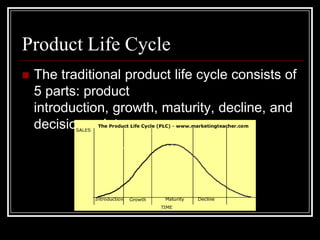
   The traditional product life cycle consists of
    5 parts: product
    introduction, growth, maturity, decline, and
    decision point
Introduction Stage
   Sales are low as the new idea is first introduced to
    the market.
   Customers may not be aware of the product’s
    benefits and features and may not be aware of
    the product itself.
   Most companies experience losses during the
    market introduction stage.
       A lot of money is spent on promotion and product
        development to build product awareness.
       Promotion is aimed at innovators and early adopters.
   Example: Tablet/Phones, Schticky,
Growth Stage
   Rapid growth in sales and profits
       More product awareness
   Competitors see the opportunity and enter the
    market.
       Some competitors will copy the product or may try to
        make it better or more appealing to other target markets.
       The new entries result in more product variety.
 Promotion is aimed at a broader audience.
 More distribution channels are established
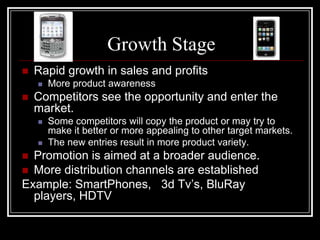
Example: SmartPhones, 3d Tv’s, BluRay
  players, HDTV
Maturity Stage
   Sales begin to level off.
   The competition gets tougher as more
    competitors have entered the market.
       Increased competition creates a downward
        movement in prices.
 Industry profits are largest, but it is also when
  industry profits begin to decline.
 Promotion is targeted to create brand
  differentiation.
Example: Coca-Cola, Fibreglass Hockey sticks,
Decline Stage
 Sales begin to decline.
 New products replace the old.
 Firms will often try to use extension
  strategies.
 Companies may be able to keep some
  sales by appealing to their most loyal
  customers.
Example: SUV’s, DVD’s, WII,
Decision Point
 May decide to reformulate, repackage or
  reintroduce a “new and improved” product
 New promotions and pricing
 Enhance the product by finding new uses
  or by adding new features.
 Discontinue: sell the product to another
  firm, or liquidate inventory
Example: VCR, Tube TV, DVD’s

Product life cycle

  • 1.
    IDC 4O: Sportsand Entertainment Marketing Chapter 5: Product and Price Decisions: Sports
  • 2.
    Product Life Cycle  The traditional product life cycle consists of 5 parts: product introduction, growth, maturity, decline, and decision point
  • 3.
    Introduction Stage  Sales are low as the new idea is first introduced to the market.  Customers may not be aware of the product’s benefits and features and may not be aware of the product itself.  Most companies experience losses during the market introduction stage.  A lot of money is spent on promotion and product development to build product awareness.  Promotion is aimed at innovators and early adopters.  Example: Tablet/Phones, Schticky,
  • 4.
    Growth Stage  Rapid growth in sales and profits  More product awareness  Competitors see the opportunity and enter the market.  Some competitors will copy the product or may try to make it better or more appealing to other target markets.  The new entries result in more product variety.  Promotion is aimed at a broader audience.  More distribution channels are established Example: SmartPhones, 3d Tv’s, BluRay players, HDTV
  • 5.
    Maturity Stage  Sales begin to level off.  The competition gets tougher as more competitors have entered the market.  Increased competition creates a downward movement in prices.  Industry profits are largest, but it is also when industry profits begin to decline.  Promotion is targeted to create brand differentiation. Example: Coca-Cola, Fibreglass Hockey sticks,
  • 6.
    Decline Stage  Salesbegin to decline.  New products replace the old.  Firms will often try to use extension strategies.  Companies may be able to keep some sales by appealing to their most loyal customers. Example: SUV’s, DVD’s, WII,
  • 7.
    Decision Point  Maydecide to reformulate, repackage or reintroduce a “new and improved” product  New promotions and pricing  Enhance the product by finding new uses or by adding new features.  Discontinue: sell the product to another firm, or liquidate inventory Example: VCR, Tube TV, DVD’s