Processor
Working and Architecture
Introduction
What is a Processor ?
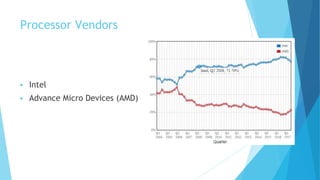
Processor Vendors
▶ Intel
▶ Advance Micro Devices (AMD)
Components of Processor
▶ Arithmetic Logic Unit
▶ Control Unit
▶ Storage Unit
▶ Internal Clock
Control Unit
▶ Control Operation on the other part of the Processor
▶ Control Sequence of Instructions to be executed
▶ Control flow of Data
▶ Send and Receive Control Signals from peripheral
Devices
Arithmetic Logic Unit
▶ Is further divided into Logical Unit and Arithmetic Unit
▶ Logical Unit (Comparison of numbers, Special Characters )
▶ Arithmetic Unit (Addition, Subtraction, multiplication ,division)
Internal Clock
also known as clock rate
every instruction requires fix no of clock ticks for the instruction to be executed
faster the clock more no of instruction to be executed
Cache Memory
it is used with the processor to facilitate the access of data from the
system's main memory
Reduces average time for access
data storage section of the CPU that next set of instructions and data that
is currently needed
Consist of 3 levels , L1,L2,L3.
More is the Size ,better is the performance
Processor Diagram
Processor Operations
processor is termed as computers brain
It executes the sequence of stored instruction called program
there are four phases of processor Operations
1. Fetch instruction
2. Decode instruction
3. execute
4. Result
Processors Operation
Fetch cycle
dealing with retrieving an instruction from main memory
after an instruction is fetched, the PC is imcremented.
Decode Cycle
fetched instruction is further broken down into parts which are related to
other art of the cpu, termed as Opcode , indicates which operation is to
perform
Processors Operation
Execute
Various portions of the processor are connected to perform the desired
operation
Result
the final step returns the result of the executed step will be stored the
registers for the further use of result.
Microarchitecture
is a description of the electrical circuitry of a computer, central processing
unit, or digital signal processor that is sufficient for completely
describing the operation of the hardware.
is the way a given instruction set architecture (ISA) is implemented in a
particular processor.
Microarchitecture and ISA together known as Computer Organization.
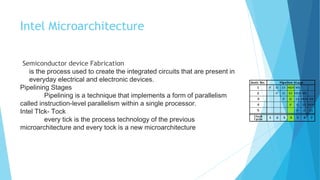
Intel Microarchitecture
Semiconductor device Fabrication
is the process used to create the integrated circuits that are present in
everyday electrical and electronic devices.
Pipelining Stages
Pipelining is a technique that implements a form of parallelism
called instruction-level parallelism within a single processor.
Intel TIck- Tock
every tick is the process technology of the previous
microarchitecture and every tock is a new microarchitecture
Intel Microarchitecture
Intel Core CPU generation
processor generation of a core CPu is a term used to identify
certain CPU families
Instead of using Microarchitecture names simply a generation name is
used
Generation can be determined by the relevant Microarchitecture Code
NAme
1st Generation Nehalem (~45nm)
2nd Generation Sandy Bridge (~32nm)
3rd Generation Ivy Bridge (~22nm)
4th Generation Haswell (~22nm)
Intel Core i 1st Generation
based on Nehalem Microarchitecture
Graphic media Accelerator on chipset Itself
hyper-threading on selected models
QPI replacing Front Side Bus
Intel core i 2nd Generation
based on intel Sandy bridge
increased cache size
improved graphic media accelerator (IGP)
QuickSync
less power Consumption
Intel Core i 3rd Generation
based on intel Ivy Bridge
improved floating point performance and random number generation
die shrink to ~22nm
intel core i 4th Generation
based on Intel Haswell
one more ALU
one more address generation unit
removed voltage controller
Graphical processing unit
Why you need A GPU ?
GPU and CPU
Computational power of CPU and GPU
Which one is best for You ?
I3 vs I5 vs I7
Thank You
Presented by
Pragya Lende | Uday Singh

Processor Specification and Architecture

  • 1.
  • 2.
  • 3.
    Processor Vendors ▶ Intel ▶Advance Micro Devices (AMD)
  • 4.
    Components of Processor ▶Arithmetic Logic Unit ▶ Control Unit ▶ Storage Unit ▶ Internal Clock
  • 5.
    Control Unit ▶ ControlOperation on the other part of the Processor ▶ Control Sequence of Instructions to be executed ▶ Control flow of Data ▶ Send and Receive Control Signals from peripheral Devices
  • 6.
    Arithmetic Logic Unit ▶Is further divided into Logical Unit and Arithmetic Unit ▶ Logical Unit (Comparison of numbers, Special Characters ) ▶ Arithmetic Unit (Addition, Subtraction, multiplication ,division)
  • 7.
    Internal Clock also knownas clock rate every instruction requires fix no of clock ticks for the instruction to be executed faster the clock more no of instruction to be executed
  • 8.
    Cache Memory it isused with the processor to facilitate the access of data from the system's main memory Reduces average time for access data storage section of the CPU that next set of instructions and data that is currently needed Consist of 3 levels , L1,L2,L3. More is the Size ,better is the performance
  • 9.
  • 10.
    Processor Operations processor istermed as computers brain It executes the sequence of stored instruction called program there are four phases of processor Operations 1. Fetch instruction 2. Decode instruction 3. execute 4. Result
  • 11.
    Processors Operation Fetch cycle dealingwith retrieving an instruction from main memory after an instruction is fetched, the PC is imcremented. Decode Cycle fetched instruction is further broken down into parts which are related to other art of the cpu, termed as Opcode , indicates which operation is to perform
  • 12.
    Processors Operation Execute Various portionsof the processor are connected to perform the desired operation Result the final step returns the result of the executed step will be stored the registers for the further use of result.
  • 13.
    Microarchitecture is a descriptionof the electrical circuitry of a computer, central processing unit, or digital signal processor that is sufficient for completely describing the operation of the hardware. is the way a given instruction set architecture (ISA) is implemented in a particular processor. Microarchitecture and ISA together known as Computer Organization.
  • 14.
    Intel Microarchitecture Semiconductor deviceFabrication is the process used to create the integrated circuits that are present in everyday electrical and electronic devices. Pipelining Stages Pipelining is a technique that implements a form of parallelism called instruction-level parallelism within a single processor. Intel TIck- Tock every tick is the process technology of the previous microarchitecture and every tock is a new microarchitecture
  • 15.
  • 16.
    Intel Core CPUgeneration processor generation of a core CPu is a term used to identify certain CPU families Instead of using Microarchitecture names simply a generation name is used Generation can be determined by the relevant Microarchitecture Code NAme 1st Generation Nehalem (~45nm) 2nd Generation Sandy Bridge (~32nm) 3rd Generation Ivy Bridge (~22nm) 4th Generation Haswell (~22nm)
  • 17.
    Intel Core i1st Generation based on Nehalem Microarchitecture Graphic media Accelerator on chipset Itself hyper-threading on selected models QPI replacing Front Side Bus
  • 18.
    Intel core i2nd Generation based on intel Sandy bridge increased cache size improved graphic media accelerator (IGP) QuickSync less power Consumption
  • 19.
    Intel Core i3rd Generation based on intel Ivy Bridge improved floating point performance and random number generation die shrink to ~22nm
  • 20.
    intel core i4th Generation based on Intel Haswell one more ALU one more address generation unit removed voltage controller
  • 21.
    Graphical processing unit Whyyou need A GPU ? GPU and CPU Computational power of CPU and GPU
  • 22.
    Which one isbest for You ? I3 vs I5 vs I7
  • 23.