1
*: Capacity can be increased optionally
INTRODUCTION
WASTE TYPES
WASTE DISPOSAL TYPES
HISTORY OF THE PROJECT
DESCRIPTION OF THE PROJECT
PROTOTYPE OF THE PROJECT
WORKING PRINCIPLE OF THE PROJECT
PROJECT COST and PROFIT STATEMENT
ADVANTAGES OF THE PROJECT
PROJECT PROGRESS STRATEGY
2
As a result of R&D studies
performed in 400m² closed area in
Cekmekoy during 14 years, we have
invented some fully Turkish-produced
technologies. Securing these technologies
by patent, we made projects that would
help world countries. We will initiate a
new nature-friendly energy era with this
technology which shows a higher
performance than its equivalents in the
world.
3
To establish nature and environment
friendly plants.
To assist in meeting the current
deficit by obtaining efficient energy.
To make benefits from the
investments in a short time.
To bring a new dimension to the
energy production.
To create a competitive environment
in the world.
4
To accelerate the transition from
customary fossil fuels to the renewable
fuels.
To save the states from the dependence
on foreign energy sources.
To dispose existing hazardous and
industrial wastes without releasing
harmful gases.
To expand hydrogen energy alternative.
5
Disposal systems for solid, human and
animal excreta, medical, industrial, and
hazardous wastes and electrical power
production. (MDS)
The installation of 99% pure-hydrogen
gas production plants. (HIS)
The production of hydrogen batteries.
The production of low-cost ozone gas.
Use of inefficient geothermal fields in
high performance.
6
Materials, which must be removed
from the environment we live in and;
of which service life is expired, are
defined as waste. The waste material,
which remains after separating paper,
glass, cardboard, and materials like
plastics from the wastes; and cannot
be used in any way, is defined as
garbage.
7
Wastes, emerging from homes
and/or workplaces and not containing
harmful substances, are defined as
„domestic wastes‟. For example; food
waste, shampoo bottles, juice boxes,
glass bottles, tins and metal cans are
domestic wastes.
8
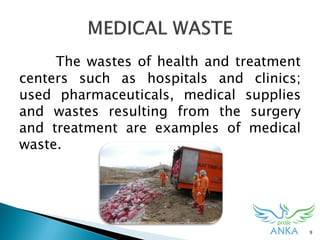
The wastes of health and treatment
centers such as hospitals and clinics;
used pharmaceuticals, medical supplies
and wastes resulting from the surgery
and treatment are examples of medical
waste.
9
The wastes, which are arising in
various production facilities and can
harm human and environmental
health, are defined as „hazardous
waste‟. For example, batteries, paints
and various chemicals are hazardous
wastes.
10
Solid wastes occurring during or
as a result of a process in production
facilities are named as „industrial solid
waste‟.
11
The wastes such as stone, soil, iron
and wood that occur during
construction, demolition and repairs in
houses are called as „construction
wastes‟.
12
Sanitary Landfilling
Composting
Incineration
Our Patented Molecular Transformation
Project
13
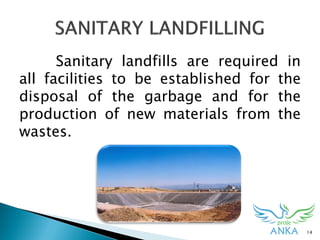
Sanitary landfills are required in
all facilities to be established for the
disposal of the garbage and for the
production of new materials from the
wastes.
14
Providing that suitable land is
found, this method is the most
economical and practical option. The
most important issue of this method is
the appropriate operation of the sanitary
landfill.
15
It is the conversion of organic
substances found in solid waste into
soil remedial agent by being
decomposed by microorganisms in a
controlled manner using suitable
methods and equipment.
It is applied for solid wastes
containing 60-80% organic matter.
16
17
It is the incineration of the
garbage in specially-designed
incinerators. For this process,
calorie/humidity value of the garbage
must be above a certain level.
18
 We have 15 years of patent and application
experience in Hydrogen and Oxygen
production.
 Thick-section metal application is performed
with hydrogen gas at high temperature.
 Air separation systems have been built with
Molecular Separator (28-30 Angstrom) in
which we process oxygen gas (PSA, VPSA,
CRYOGENIC (Increasingly by yield)).
19
 60% fuel saving system and fuel optimization
system have been developed in Hydrogen -
Oxygen internal combustion engines (Hema
Hattat Tractor Production).
 Conversion Hydrogen, Deuterium (Semi
Nuclear), Oxygen, Ozone Generator was
produced with Thermo-nuclear Thermo-
chemical Reactions and 2009 TUBITAK Purity
measurement and elemental analysis reports
have been obtained.
20
 The presentation about our studies in Science
Federation of the European Union had been
presented in Spain for 15 days. – 2009
 The product, which is working with Vortex
Theory and has been developed with our fluid
separation technology, was released to the
market. – 2010
21
 KNOW-HOW sharing has been performed with
ECOQUEST (ACTIVE PURE) company in high-
energy ozone and UV (GERMICIDAL)
applications.
 Product on air-conditioning and purification
systems has been developed, manufactured
and marketed.
22
 To recycle 100% of all kinds of waste entering
into the system.
 System provides gas production to the
electricity generator by conditioning it
without storing and accumulating in order to
meet instant electricity needs.
 To obtain minimum 1kg Garbage = 1kW of
electricity, thermal energy and high-mineral
slag at the level of 3-5% from domestic waste
that is input of the system.
23
 System slag becomes a hygienic product free
from heavy metals and harmful substances at
the end of the process.
 Domestic, Medical, Hazardous and Industrial
waste can be easily neutralized and
processed in the system.
 100 % of the products coming out of the
system are recycled without being buried.
24
25
26
1.
27
2.
28
3.
29
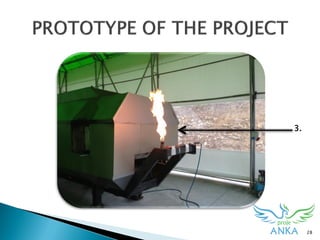
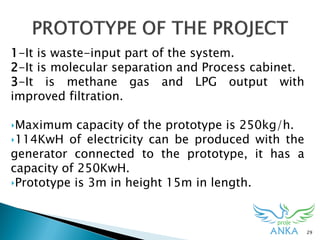
1-It is waste-input part of the system.
2-It is molecular separation and Process cabinet.
3-It is methane gas and LPG output with
improved filtration.
‣Maximum capacity of the prototype is 250kg/h.
‣114KwH of electricity can be produced with the
generator connected to the prototype, it has a
capacity of 250KwH.
‣Prototype is 3m in height 15m in length.
30
31
32
* : Plant will be submitted with 3D presentation and explanation CD.
33
Our solution partner is German origin U.S.
patented Zeno GmbH for the machinery used
apart from patented molecular transformation
module.
34
Recycling Systems
In order to recycle any material for reuse,
several transactions are required to be
performed on the wastes. Material to be recycled
has been used as a product mainly with other
agents and it is depleted. Recycling process can
be performed on these materials in order to
regain the material desired, or in order to obtain
a secondary fuel (such as RDF Systems in cement
35
and a pure substance to be reused. The sizes of
the depleted materials can be different from the
sizes we desire to recycle.
During recycling, some transactions will be
required to be performed in order to separate
the materials from end-of-life materials and in
order to degrade their sizes to the dimensions
we desire. Transactions for recycling systems are
performed in 5 main bodies:
36
1) Transportation transactions
The wastes collected in our neighborhood are
required to be transported to separation field
and between recycling machines; and to
warehouses or vehicles after recycling process is
completed. Transportation process are
performed with appropriate conveyors. HSK
Hidrolik provides necessary conveyors suitable
for all functions.
37
1)A) Conveyors,
Conveyors are needed for the transportation of
wastes and outputs in all recycling systems
which are almost a shredder. Belt conveyor is the
most common used conveyor.
We provide conveyors at desired lengths. It can
be a simple horizontal short belt conveyor as
well as angled and adjustable belt conveyor.
Moreover, roller head can be magnetic or
magnetic head.
38
1)A) Konveyörler,
39
2) Separation transactions,
Waste piles contain desirable and undesirable
substances all together. These substances must
be separated from each other. Separating
transaction must be performed during
transportation to the machines and after each
operation depending on the characteristic of the
substances and waste piles.
40
For example, whereas separation process must be
performed during transportation of the garbage
to the machines before starting recycling
transaction for the garbage, this process is
performed after shredder and granulators for
end-of-life vehicle tires. Separation is made by
the machines added on the conveyors. In
addition, separation can be made during
transportation and before shredding process.
41
42
3) Shredding process
This process is performed with a shredder.
Shredder is a big machine with a very strong
torque. Therefore, shredder is the most
important part of the recycling process. The
suitable shredder must be selected according to
the nature and size of the material to be
shredded.
43
For example, think the sizes of end-of-life tires
of truck, bus and earth mover. Considering
especially steel wires in these tires, it would be
easier for you to understand how powerful these
shredders are.
44
4)Degradation of the materials to the desired
levels
Material shredded in the shredder is then
reduced to the desired size in granulator.
45
“German Machinery; American Technology”
Germany is a country that has reached its
majority in the mechanical machines. Thus, we
have chosen a German partner for the provision
of recycling machines. For the installation and
automation, on the other hand, we have preferred
an American partner which is undisputed leader
in this regard. Therefore, in order to avoid faults
and costs to be incurred as a result of predictive
and trial-and-error methods we produce
46
solutions for the machinery and technology by
getting into partnerships with the best
companies in the world. And we recommend you
not to leave the great business based on
machinery and technology such as recycling to
the amateurs.
If agreed upon the project, projeANKA will begin
the work. At first, procedures such as licensing
will be initiated in order to meet legal and
regulatory requirements on recycling plant.
47
Engineering calculations and drawings will be
checked and finalized by the engineers from the
United States in the area on which recycling plant
will be established. Your recycling machines and
their components will be produced in ZENO
facilities in Germany according to the
specifications determined for your needs.
Following the preparation of the machines, they
will be transported to the plant area and will be
installed under the control of engineers. After
test production, the plant will enter into service.
48
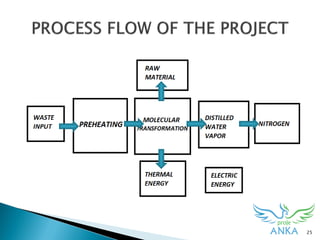
5) Patented Molecular Change Process
This process is the module specifically produced by us.
 The present invention is a disposal system
which transforms all kinds of harmful
domestic and medical wastes into water
vapor and nitrogen gas by separating them
molecularly. It also eliminates heavy metals
and harmful molecules. By providing flash
gasification, system produces electricity with
a generator.
49
 In our system, by disaffiliating the domestic
wastes from external environment, pre-
shredding and pre-heating transactions are
applied to them in a vacuum environment.
Hydrocarbon, carbon monoxide and carbon
dioxide gases are processed at 3,200 C°
based on the principle of self-help and the
molecular decomposition and reconstruction
processes produced by us in the filtration
system. Thus, foreign-dependent energy and
heat demand is eliminated.
50
 With this process, disposal of harmful
molecules in the system is provided. Without
needing a storage, output of conditioned
dust, ash and nitrogen gas is provided (heavy
metals and harmful compounds are kept at
the anode by separating them molecularly).
Present system provides this circle using
much less energy than similar systems.
51
 In the system, oxygen, hydrogen and
methane gas production, molecular
ionization, molecular friction and sieve
systems, flash gasification and emission
gases at the exhaust outlet of the generator
are removed with high voltage and UV
technology.
52
 General Expenses and Labor
 Maintenance and Spare Parts‟ Costs
 Electricity Consumption
53
Organizational Chart
 General Manager (1 Administrator)
 Deputy General Manager (1 Administrator)
 Quality Management Representative (1 Person)
 Technical Manager (1 Engineer)
 Deputy Technical Manager (1 Engineer)
 Occupational Safety Specialist (1 Person)
54
Organizational Chart
 Driver (1 Person)
 Dining Hall Staff (3 People)
 Accountant (1 Person)
 Workshop Maintenance Team (5 Masters)
 Workers (20 People)
TOTAL : 37 People
55
 Electricity Gain -150MW/day
 Waste Disposal Gain - 70€/tonne
 Metal and Glass Recycling
 High-mineral Additive Gain for Fertilizers
56
Machinery costs 9.000.000 €
Generator costs 6.000.000 €
Construction costs 4.000.000 €
Feasibility studies 500.000 €
Extra installation costs 500.000 €
Total *20.000.000 €
57
* : This information is average values calculated according to its original.
58
Table : Investment Cost for Solid Waste Incineration Plants (million TL) (2011)
Unit
Domestic Solid Waste
Incineration Plant
Hazardous Waste
Incineration Plant
Capacity 30 t/h (720 t/d) 10 t/h(240 t/d)
Building and Infrastructure
Construction 65-75 70-85
Incineration and Energy
115-130 70-80Gaining Units
Flue gas, Wastewater, and Solid
110-120 80-90Waste Treatment / processing
Electrotechnical Equipment 30-35 30-35
Storage and Energy Transport 36-43 66-83
Total TL 356-403 316-373
Total € 158€-180€ 140€-165€
* The cost for Molecular Transformation plant is 100.000.000 for 750
tonnes/day basis.
Labor *650.000 €
Plant maintenance costs 300.000 €
Electricity consumption 50.000 €
Total **1.000.000 €
59
* : 37 people x 12 months x 1,500 € = 666,000 €.
** : This information is average values calculated according to its original.
Electricity gain (0,15€/KWh) *8.500.000 €
Garbage disposal fee (70€/tonne) **4.000.000 €
Estimated recycling gain 3.500.000 €
Total ***16.000.000 €
60
* : 150MW = 150 x 1000KW x 365days x 0,15€ = 8,212,500€
** : 150 Tonnes/day x 365days x 70€ = 3,832,500€
*** : This information is average values calculated according to its original.
61
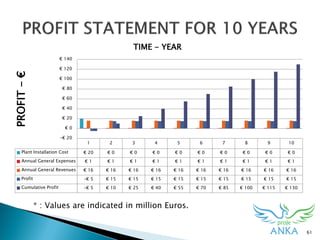
* : Values are indicated in ​​million Euros.
1 2 3 4 5 6 7 8 9 10
Plant Installation Cost € 20 € 0 € 0 € 0 € 0 € 0 € 0 € 0 € 0 € 0
Annual General Expenses € 1 € 1 € 1 € 1 € 1 € 1 € 1 € 1 € 1 € 1
Annual General Revenues € 16 € 16 € 16 € 16 € 16 € 16 € 16 € 16 € 16 € 16
Profit -€ 5 € 15 € 15 € 15 € 15 € 15 € 15 € 15 € 15 € 15
Cumulative Profit -€ 5 € 10 € 25 € 40 € 55 € 70 € 85 € 100 € 115 € 130
-€ 20
€ 0
€ 20
€ 40
€ 60
€ 80
€ 100
€ 120
€ 140
PROFIT-€
TIME - YEAR
 It has more economical investment costs than
other disposal systems.
 It does not release any hazardous gas.
 There is no need for landfill.
 As the construction raw materials can be
used as asphalt or high-mineral organic
fertilizer due to the fact that slag arising as a
result of the process is free of heavy
metals, 100% of the waste entering into the
system is disposed.
62
 It works in much higher capacity than orher
disposal systems generating electricity. It is
patented on the principle of working with
minimum 1kg waste = 1KW electricity.
 Establishment of our system is performed
between 6 and 8 months.
 With its full automation system, it prevents
staff from exposing to dangerous working
conditions.
 As the system does not produce hazardous
emission gases while working, it can be
established at the desired place of the city
and thus logistic costs can be minimized.
63
 Indoor space required for the establishment
of the plant is 10 decares; open space is 20
decares.
 System can be easily designed at various
sizes.
 Existing buried wastes and wastes in
uncontrolled dumping areas can be disposed
of within our project.
64
65
Table : Incineration and Storage Costs for
European Countries - 2011
Austria France Italy Portugal Spain Sweden
proje
ANKA
Incineration Cost
103-168 60-98 78-120 20 30-36 23-46 70
(€/tonne)
Sanitary Disposal
87-219 38-60 21-183 0 13-20 29-40 0
Cost (€/tonne)
Electricity Sales
Price No Data 0,033 0,14 0,045 0,06 0,023 0,15
(€/kWsa)
 Selection of the region.
 Meeting with the mayor of the region.
 Feasibility of the size and quality of the
garbage amounts within the borders of the
municipality.
 Determination of the plant location.
 Planning and pricing the plant according to
its size.
66
 Obtaining finance for the project by meeting
with the Mayor.
 Meeting with Minister of Energy following the
approval of the project and obtaining the
necessary permits.
 Organizing all infrastructure services.
 Installation of the system.
67
RESPONSIBILITIES OF THE MUNICIPALITY
 To create fund for the costs of plant, to get
credit funds from World Banks.
 To make a pre-payment for plant costs at the
amount of 70€ that is disposal price.If
20.000.000€ is paid, a pre-payment is made
for 63 months for 150 tons garbage per day.
 To transfer collected wastes to the plant.
 To provide support in taking the necessary
permits.
68
RESPONSIBILITIES OF THE MUNICIPALITY
 To inform people about recycling.
 To audit plant at certain times.
 To transfer unsanitary disposal areas to proje
ANKA.
69
RESPONSIBILITIES OF Proje ANKA
 To build a clean and environmentally friendly
plant.
 To re-green transferred unsanitary disposal
areas by disposing them.
 To generate clean energy.
 To ensure 100% of recycling.
 To keep the plant up-to-date with newly-
developed patented systems.
 To carry out maintenance process of the plant
fully and timely.
70
71
FOR A CLEANER WORLD,
WHAT COMES FROM LAND GOES TO LAND ….
72
Mr. Eli Erol SIKGOREN
PROJE ANKA
----------------------------------
WEB : www.ProjeAnka.com
GSM : +90 541 255 19 27
E-MAIL : info@projeanka.com
SKYPE : eli.malki83
TRADEMANAGER : TR1010801303

Mds 1909 en

  • 1.
    1 *: Capacity canbe increased optionally
  • 2.
    INTRODUCTION WASTE TYPES WASTE DISPOSALTYPES HISTORY OF THE PROJECT DESCRIPTION OF THE PROJECT PROTOTYPE OF THE PROJECT WORKING PRINCIPLE OF THE PROJECT PROJECT COST and PROFIT STATEMENT ADVANTAGES OF THE PROJECT PROJECT PROGRESS STRATEGY 2
  • 3.
    As a resultof R&D studies performed in 400m² closed area in Cekmekoy during 14 years, we have invented some fully Turkish-produced technologies. Securing these technologies by patent, we made projects that would help world countries. We will initiate a new nature-friendly energy era with this technology which shows a higher performance than its equivalents in the world. 3
  • 4.
    To establish natureand environment friendly plants. To assist in meeting the current deficit by obtaining efficient energy. To make benefits from the investments in a short time. To bring a new dimension to the energy production. To create a competitive environment in the world. 4
  • 5.
    To accelerate thetransition from customary fossil fuels to the renewable fuels. To save the states from the dependence on foreign energy sources. To dispose existing hazardous and industrial wastes without releasing harmful gases. To expand hydrogen energy alternative. 5
  • 6.
    Disposal systems forsolid, human and animal excreta, medical, industrial, and hazardous wastes and electrical power production. (MDS) The installation of 99% pure-hydrogen gas production plants. (HIS) The production of hydrogen batteries. The production of low-cost ozone gas. Use of inefficient geothermal fields in high performance. 6
  • 7.
    Materials, which mustbe removed from the environment we live in and; of which service life is expired, are defined as waste. The waste material, which remains after separating paper, glass, cardboard, and materials like plastics from the wastes; and cannot be used in any way, is defined as garbage. 7
  • 8.
    Wastes, emerging fromhomes and/or workplaces and not containing harmful substances, are defined as „domestic wastes‟. For example; food waste, shampoo bottles, juice boxes, glass bottles, tins and metal cans are domestic wastes. 8
  • 9.
    The wastes ofhealth and treatment centers such as hospitals and clinics; used pharmaceuticals, medical supplies and wastes resulting from the surgery and treatment are examples of medical waste. 9
  • 10.
    The wastes, whichare arising in various production facilities and can harm human and environmental health, are defined as „hazardous waste‟. For example, batteries, paints and various chemicals are hazardous wastes. 10
  • 11.
    Solid wastes occurringduring or as a result of a process in production facilities are named as „industrial solid waste‟. 11
  • 12.
    The wastes suchas stone, soil, iron and wood that occur during construction, demolition and repairs in houses are called as „construction wastes‟. 12
  • 13.
  • 14.
    Sanitary landfills arerequired in all facilities to be established for the disposal of the garbage and for the production of new materials from the wastes. 14
  • 15.
    Providing that suitableland is found, this method is the most economical and practical option. The most important issue of this method is the appropriate operation of the sanitary landfill. 15
  • 16.
    It is theconversion of organic substances found in solid waste into soil remedial agent by being decomposed by microorganisms in a controlled manner using suitable methods and equipment. It is applied for solid wastes containing 60-80% organic matter. 16
  • 17.
  • 18.
    It is theincineration of the garbage in specially-designed incinerators. For this process, calorie/humidity value of the garbage must be above a certain level. 18
  • 19.
     We have15 years of patent and application experience in Hydrogen and Oxygen production.  Thick-section metal application is performed with hydrogen gas at high temperature.  Air separation systems have been built with Molecular Separator (28-30 Angstrom) in which we process oxygen gas (PSA, VPSA, CRYOGENIC (Increasingly by yield)). 19
  • 20.
     60% fuelsaving system and fuel optimization system have been developed in Hydrogen - Oxygen internal combustion engines (Hema Hattat Tractor Production).  Conversion Hydrogen, Deuterium (Semi Nuclear), Oxygen, Ozone Generator was produced with Thermo-nuclear Thermo- chemical Reactions and 2009 TUBITAK Purity measurement and elemental analysis reports have been obtained. 20
  • 21.
     The presentationabout our studies in Science Federation of the European Union had been presented in Spain for 15 days. – 2009  The product, which is working with Vortex Theory and has been developed with our fluid separation technology, was released to the market. – 2010 21
  • 22.
     KNOW-HOW sharinghas been performed with ECOQUEST (ACTIVE PURE) company in high- energy ozone and UV (GERMICIDAL) applications.  Product on air-conditioning and purification systems has been developed, manufactured and marketed. 22
  • 23.
     To recycle100% of all kinds of waste entering into the system.  System provides gas production to the electricity generator by conditioning it without storing and accumulating in order to meet instant electricity needs.  To obtain minimum 1kg Garbage = 1kW of electricity, thermal energy and high-mineral slag at the level of 3-5% from domestic waste that is input of the system. 23
  • 24.
     System slagbecomes a hygienic product free from heavy metals and harmful substances at the end of the process.  Domestic, Medical, Hazardous and Industrial waste can be easily neutralized and processed in the system.  100 % of the products coming out of the system are recycled without being buried. 24
  • 25.
  • 26.
  • 27.
  • 28.
  • 29.
    29 1-It is waste-inputpart of the system. 2-It is molecular separation and Process cabinet. 3-It is methane gas and LPG output with improved filtration. ‣Maximum capacity of the prototype is 250kg/h. ‣114KwH of electricity can be produced with the generator connected to the prototype, it has a capacity of 250KwH. ‣Prototype is 3m in height 15m in length.
  • 30.
  • 31.
  • 32.
    32 * : Plantwill be submitted with 3D presentation and explanation CD.
  • 33.
    33 Our solution partneris German origin U.S. patented Zeno GmbH for the machinery used apart from patented molecular transformation module.
  • 34.
    34 Recycling Systems In orderto recycle any material for reuse, several transactions are required to be performed on the wastes. Material to be recycled has been used as a product mainly with other agents and it is depleted. Recycling process can be performed on these materials in order to regain the material desired, or in order to obtain a secondary fuel (such as RDF Systems in cement
  • 35.
    35 and a puresubstance to be reused. The sizes of the depleted materials can be different from the sizes we desire to recycle. During recycling, some transactions will be required to be performed in order to separate the materials from end-of-life materials and in order to degrade their sizes to the dimensions we desire. Transactions for recycling systems are performed in 5 main bodies:
  • 36.
    36 1) Transportation transactions Thewastes collected in our neighborhood are required to be transported to separation field and between recycling machines; and to warehouses or vehicles after recycling process is completed. Transportation process are performed with appropriate conveyors. HSK Hidrolik provides necessary conveyors suitable for all functions.
  • 37.
    37 1)A) Conveyors, Conveyors areneeded for the transportation of wastes and outputs in all recycling systems which are almost a shredder. Belt conveyor is the most common used conveyor. We provide conveyors at desired lengths. It can be a simple horizontal short belt conveyor as well as angled and adjustable belt conveyor. Moreover, roller head can be magnetic or magnetic head.
  • 38.
  • 39.
    39 2) Separation transactions, Wastepiles contain desirable and undesirable substances all together. These substances must be separated from each other. Separating transaction must be performed during transportation to the machines and after each operation depending on the characteristic of the substances and waste piles.
  • 40.
    40 For example, whereasseparation process must be performed during transportation of the garbage to the machines before starting recycling transaction for the garbage, this process is performed after shredder and granulators for end-of-life vehicle tires. Separation is made by the machines added on the conveyors. In addition, separation can be made during transportation and before shredding process.
  • 41.
  • 42.
    42 3) Shredding process Thisprocess is performed with a shredder. Shredder is a big machine with a very strong torque. Therefore, shredder is the most important part of the recycling process. The suitable shredder must be selected according to the nature and size of the material to be shredded.
  • 43.
    43 For example, thinkthe sizes of end-of-life tires of truck, bus and earth mover. Considering especially steel wires in these tires, it would be easier for you to understand how powerful these shredders are.
  • 44.
    44 4)Degradation of thematerials to the desired levels Material shredded in the shredder is then reduced to the desired size in granulator.
  • 45.
    45 “German Machinery; AmericanTechnology” Germany is a country that has reached its majority in the mechanical machines. Thus, we have chosen a German partner for the provision of recycling machines. For the installation and automation, on the other hand, we have preferred an American partner which is undisputed leader in this regard. Therefore, in order to avoid faults and costs to be incurred as a result of predictive and trial-and-error methods we produce
  • 46.
    46 solutions for themachinery and technology by getting into partnerships with the best companies in the world. And we recommend you not to leave the great business based on machinery and technology such as recycling to the amateurs. If agreed upon the project, projeANKA will begin the work. At first, procedures such as licensing will be initiated in order to meet legal and regulatory requirements on recycling plant.
  • 47.
    47 Engineering calculations anddrawings will be checked and finalized by the engineers from the United States in the area on which recycling plant will be established. Your recycling machines and their components will be produced in ZENO facilities in Germany according to the specifications determined for your needs. Following the preparation of the machines, they will be transported to the plant area and will be installed under the control of engineers. After test production, the plant will enter into service.
  • 48.
    48 5) Patented MolecularChange Process This process is the module specifically produced by us.
  • 49.
     The presentinvention is a disposal system which transforms all kinds of harmful domestic and medical wastes into water vapor and nitrogen gas by separating them molecularly. It also eliminates heavy metals and harmful molecules. By providing flash gasification, system produces electricity with a generator. 49
  • 50.
     In oursystem, by disaffiliating the domestic wastes from external environment, pre- shredding and pre-heating transactions are applied to them in a vacuum environment. Hydrocarbon, carbon monoxide and carbon dioxide gases are processed at 3,200 C° based on the principle of self-help and the molecular decomposition and reconstruction processes produced by us in the filtration system. Thus, foreign-dependent energy and heat demand is eliminated. 50
  • 51.
     With thisprocess, disposal of harmful molecules in the system is provided. Without needing a storage, output of conditioned dust, ash and nitrogen gas is provided (heavy metals and harmful compounds are kept at the anode by separating them molecularly). Present system provides this circle using much less energy than similar systems. 51
  • 52.
     In thesystem, oxygen, hydrogen and methane gas production, molecular ionization, molecular friction and sieve systems, flash gasification and emission gases at the exhaust outlet of the generator are removed with high voltage and UV technology. 52
  • 53.
     General Expensesand Labor  Maintenance and Spare Parts‟ Costs  Electricity Consumption 53
  • 54.
    Organizational Chart  GeneralManager (1 Administrator)  Deputy General Manager (1 Administrator)  Quality Management Representative (1 Person)  Technical Manager (1 Engineer)  Deputy Technical Manager (1 Engineer)  Occupational Safety Specialist (1 Person) 54
  • 55.
    Organizational Chart  Driver(1 Person)  Dining Hall Staff (3 People)  Accountant (1 Person)  Workshop Maintenance Team (5 Masters)  Workers (20 People) TOTAL : 37 People 55
  • 56.
     Electricity Gain-150MW/day  Waste Disposal Gain - 70€/tonne  Metal and Glass Recycling  High-mineral Additive Gain for Fertilizers 56
  • 57.
    Machinery costs 9.000.000€ Generator costs 6.000.000 € Construction costs 4.000.000 € Feasibility studies 500.000 € Extra installation costs 500.000 € Total *20.000.000 € 57 * : This information is average values calculated according to its original.
  • 58.
    58 Table : InvestmentCost for Solid Waste Incineration Plants (million TL) (2011) Unit Domestic Solid Waste Incineration Plant Hazardous Waste Incineration Plant Capacity 30 t/h (720 t/d) 10 t/h(240 t/d) Building and Infrastructure Construction 65-75 70-85 Incineration and Energy 115-130 70-80Gaining Units Flue gas, Wastewater, and Solid 110-120 80-90Waste Treatment / processing Electrotechnical Equipment 30-35 30-35 Storage and Energy Transport 36-43 66-83 Total TL 356-403 316-373 Total € 158€-180€ 140€-165€ * The cost for Molecular Transformation plant is 100.000.000 for 750 tonnes/day basis.
  • 59.
    Labor *650.000 € Plantmaintenance costs 300.000 € Electricity consumption 50.000 € Total **1.000.000 € 59 * : 37 people x 12 months x 1,500 € = 666,000 €. ** : This information is average values calculated according to its original.
  • 60.
    Electricity gain (0,15€/KWh)*8.500.000 € Garbage disposal fee (70€/tonne) **4.000.000 € Estimated recycling gain 3.500.000 € Total ***16.000.000 € 60 * : 150MW = 150 x 1000KW x 365days x 0,15€ = 8,212,500€ ** : 150 Tonnes/day x 365days x 70€ = 3,832,500€ *** : This information is average values calculated according to its original.
  • 61.
    61 * : Valuesare indicated in ​​million Euros. 1 2 3 4 5 6 7 8 9 10 Plant Installation Cost € 20 € 0 € 0 € 0 € 0 € 0 € 0 € 0 € 0 € 0 Annual General Expenses € 1 € 1 € 1 € 1 € 1 € 1 € 1 € 1 € 1 € 1 Annual General Revenues € 16 € 16 € 16 € 16 € 16 € 16 € 16 € 16 € 16 € 16 Profit -€ 5 € 15 € 15 € 15 € 15 € 15 € 15 € 15 € 15 € 15 Cumulative Profit -€ 5 € 10 € 25 € 40 € 55 € 70 € 85 € 100 € 115 € 130 -€ 20 € 0 € 20 € 40 € 60 € 80 € 100 € 120 € 140 PROFIT-€ TIME - YEAR
  • 62.
     It hasmore economical investment costs than other disposal systems.  It does not release any hazardous gas.  There is no need for landfill.  As the construction raw materials can be used as asphalt or high-mineral organic fertilizer due to the fact that slag arising as a result of the process is free of heavy metals, 100% of the waste entering into the system is disposed. 62
  • 63.
     It worksin much higher capacity than orher disposal systems generating electricity. It is patented on the principle of working with minimum 1kg waste = 1KW electricity.  Establishment of our system is performed between 6 and 8 months.  With its full automation system, it prevents staff from exposing to dangerous working conditions.  As the system does not produce hazardous emission gases while working, it can be established at the desired place of the city and thus logistic costs can be minimized. 63
  • 64.
     Indoor spacerequired for the establishment of the plant is 10 decares; open space is 20 decares.  System can be easily designed at various sizes.  Existing buried wastes and wastes in uncontrolled dumping areas can be disposed of within our project. 64
  • 65.
    65 Table : Incinerationand Storage Costs for European Countries - 2011 Austria France Italy Portugal Spain Sweden proje ANKA Incineration Cost 103-168 60-98 78-120 20 30-36 23-46 70 (€/tonne) Sanitary Disposal 87-219 38-60 21-183 0 13-20 29-40 0 Cost (€/tonne) Electricity Sales Price No Data 0,033 0,14 0,045 0,06 0,023 0,15 (€/kWsa)
  • 66.
     Selection ofthe region.  Meeting with the mayor of the region.  Feasibility of the size and quality of the garbage amounts within the borders of the municipality.  Determination of the plant location.  Planning and pricing the plant according to its size. 66
  • 67.
     Obtaining financefor the project by meeting with the Mayor.  Meeting with Minister of Energy following the approval of the project and obtaining the necessary permits.  Organizing all infrastructure services.  Installation of the system. 67
  • 68.
    RESPONSIBILITIES OF THEMUNICIPALITY  To create fund for the costs of plant, to get credit funds from World Banks.  To make a pre-payment for plant costs at the amount of 70€ that is disposal price.If 20.000.000€ is paid, a pre-payment is made for 63 months for 150 tons garbage per day.  To transfer collected wastes to the plant.  To provide support in taking the necessary permits. 68
  • 69.
    RESPONSIBILITIES OF THEMUNICIPALITY  To inform people about recycling.  To audit plant at certain times.  To transfer unsanitary disposal areas to proje ANKA. 69
  • 70.
    RESPONSIBILITIES OF ProjeANKA  To build a clean and environmentally friendly plant.  To re-green transferred unsanitary disposal areas by disposing them.  To generate clean energy.  To ensure 100% of recycling.  To keep the plant up-to-date with newly- developed patented systems.  To carry out maintenance process of the plant fully and timely. 70
  • 71.
    71 FOR A CLEANERWORLD, WHAT COMES FROM LAND GOES TO LAND ….
  • 72.
    72 Mr. Eli ErolSIKGOREN PROJE ANKA ---------------------------------- WEB : www.ProjeAnka.com GSM : +90 541 255 19 27 E-MAIL : info@projeanka.com SKYPE : eli.malki83 TRADEMANAGER : TR1010801303