IMR 7500
Continuous Emission Monitoring System (CEMS)
Version 08/14
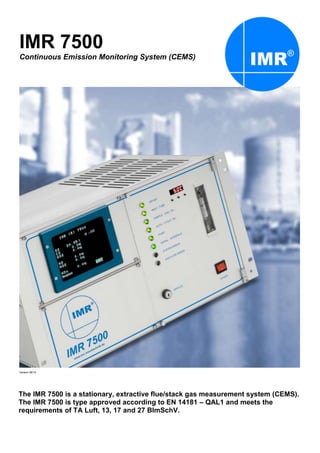
The IMR 7500 is a stationary, extractive flue/stack gas measurement system (CEMS).
The IMR 7500 is type approved according to EN 14181 – QAL1 and meets the
requirements of TA Luft, 13, 17 and 27 BlmSchV.
The Basics
Flue gas analyzers with electrochemical sensors for emission control purposes are in use in many
industrial applications. To increase the efficiency, the availability as well as the durability, gas conditioning
systems are used to eliminate soot and dust particles in the flue gas sample and to avoid condensation of
target substances. Measuring data are transferred online during the measurement or from the analyzer
memory via RS 232 or RS 485 interfaces. Processing of measuring data is, even with standard software,
today a simple task.
It is not a secret anymore that analyzers using electrochemical sensors are as accurate and durable as
systems based on physical measuring technology. More important than the measuring technology is the
selection of the analyzer components. Flue gas extraction probes made of stainless steel, gas
conditioning systems made of glass and the quality of the pump and the motor are the key components to
guarantee high accurate measuring results. An exact definition of the application and the measuring
ranges is essential. This provided, and a analyzer with electrochemical sensors performs well in a CEM
application, but even more cost efficient in the overall cost.
The Application
The IMR 7500 is a system for continuous emission monitoring (CEM) of flue gases in industrial
applications. Up to 6 gases can be measured simultaneously. Typical application for the
IMR 7500 are:
 Emission monitoring
 Furnace optimisation
 Environmental monitoring
 Combustion control
The Performance Criteria
For O2, CO, NO, NO2, SO2 and H2S samples, IMR standard is to use electrochemical sensors. If the
application requires it, for the measurements of, CO2, CxHy (CH4) as well as CO, NO und SO2, NDIR (non-
dispersive infrared absorption) sensors are being used. For other measurement requirements the IMR
7500 is extendable by a TDLS (Tunable Diode Laser Spectrometry) module in order to measure sample
components such as NH3, HCl or H2O. A paramagnetic O2 is also available.
The IMR 7500 is a modular system and consisting of the components flue gas conditioning, flue gas
pump and the analyzer. The components are built-in a 19“ rack, and allow easy access for maintenance
and service. All components that get in touch with the flue gas, such as pump, magnetic valve and the
sensors are located after the flue gas conditioning system to avoid corrosion due to alcalic and/or basic
condensate. A humidity sensor in the gas path way provides additional safety for the analyzer
components in case of failure of the gas conditioning system. The integrated 5,5“ TFT-Display allows
easy check on the analyser readings and the operating condition. Status signals allow documentation of
the analyser status such as service, instrument failure and online measurement.
The installation on site of a IMR 7500 is conveniently made in real time from a personal computer. Same
for the regular calibration of the analyzer with single standard gases. In pre-programmed intervals the
analyzer is performing a 0 calibration with ambient air. The IMR 7500 ensures an annual availability of
over 99 %.
Additionally to the analysis of flue gases, the IMR 7500 can also measure flue gas temperature, flue gas
volume and flue gas velocity. Measuring data are available in digital form at the interfaces RS 232 or RS
485, or as analogue signal 4…20 mA. IMR offers also a data visualization software TabGraph
+.
The calibration software is included in the IMR 7500. It can be operated on any Microsoft compatible
personal computer.
The Solution
IMR offers also complete solutions for continuous emission monitoring systems such as the installation of
analyzers in cabinets and containers for indoor as well as outdoor applications. The scope of delivery
includes gas extraction probes and heated sampling lines. For complete systems IMR provides a
questionnaire to generate all project related information.
IMR 7500 is the cost efficient CEM system from IMR Germany.
The Measuring Principle
The major advantages of electrochemical sensors are fast response, high linearity and high
reproducibility.
Electrochemical sensors are by definition micro fuel cells, designed to be maintenance free and stable for
long periods. They have a direct response to volume concentration of gas rather than partial pressure.
The simplest form of electrochemical toxic gas sensors comprises two electrodes, sensing and counter,
separated by a thin layer of electrolyte. This is enclosed in a plastic housing that has a small capillary to
allow gas entry to the sensing electrode and includes pins which are electrically attached to both
electrodes and allow easy external interface.
Gas diffusing into the sensor is either oxidised or reduced at the sensing electrode and, coupled with a
corresponding (but converse) counter reaction at the counter electrode, a current is generated through
the external circuit. This signal is digitalised as gas concentration in ppm (parts per million). The
indication of the measuring results is either in ppm or in mg with oxygen reference.
To eliminate the cross interference reaction of the various sensors, the IMR 7500 uses additionally a
mathematic correction with matrix calculation. Another advantage of this form of calibration is, that the
sensor performance over the lifetime of a sensor can be optimised. This eliminates also the possibility of
incorrect measuring results due to unusual high sensor drift. The life span of electrochemical sensors is in
average 2 years for oxygen sensors and 3 years for the toxic gas sensors.
For the measurement of CO2 and Hydrocarbons IMR features NDIR sensors.
The Flue Gas Conditioning
The most efficient way to condition gas for flue gas analysis is the refrigeration of the flue gas humidity in
a way of controlled condensation. The advantage of this technology is that condensation of target
substances can be avoided. This is achieved in the gas conditioning system included in the IMR 7500.
The condensed humidity of the flue gas is drained off with a peristaltic pump. To guarantee controlled
condensation, the shape of the heat exchanger in the cooling block is very important. IMR has adopted a
system that enforces immediate contact of the entering flue gas with the refrigerated wall of the heat
exchanger. The instant temperature reduction to approx. 5°C separates the condensate from the gas.
The Peltier controlled gas preparation is the most efficient way of flue gas conditioning. The gas
conditioning system in the IMR 7500 is maintenance free.
The Data Processing
Available for the IMR 7500 is the data processing software TabGraph
+
. Measuring data transferred over
the digital or analogue interfaces are displayed in real time in tabular or graphic form. TabGraph
+
is
programmed to store the incoming measuring data directly on the hard disc of the computer to avoid data
loss due to computer malfunction or power shut-down. TabGraph
+
can also be used to further process
the measuring data into average readings to generate daily averages or annual averages. TabGraph
+
is
an application for any Microsoft Windows system. Establishing an online connection for the PC, the IMR
7500 can also be factory controlled for diagnosis or online maintenance.
The IMR 7500 is the complete system for continuous emission monitoring for almost every industrial
application.
1
IMR 7500
Condensate
Output
Gas
OutputO *2 CO* NO*
NO *2 SO *2
Gas
Input
Purge air
Input
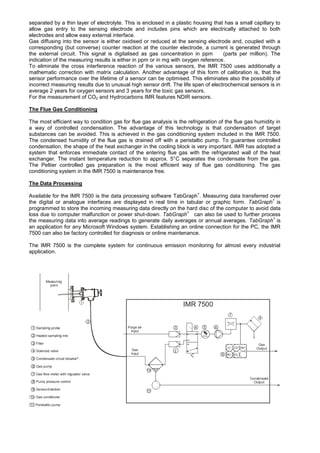
1 Sampling probe
2 Heated sampling line
3 Filter
4 Solenoid valve
5 Condensate circuit breaker
6 Gas pump
7 Gas flow meter with regulator valve
8 Pump pressure control
9 Sensorchamber
10 Gas conditioner
11 Peristaltic pump
*
2
3
10
11
4 5 6
7
8
9
3
Measuring
point
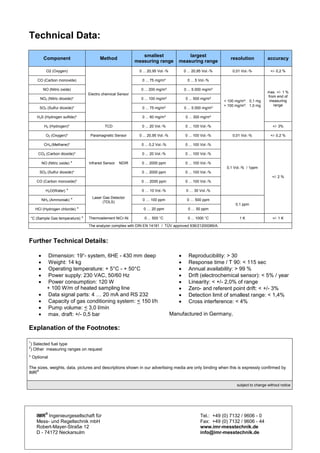
Technical Data:
Component Method
smallest
measuring range
largest
measuring range
resolution accuracy
O2 (Oxygen)
Electro chemical Sensor
0 ... 20,95 Vol.-% 0 ... 20,95 Vol.-% 0,01 Vol.-% +/- 0,2 %
CO (Carbon monoxide) 0 ... 75 mg/m³ 0 ... 5 Vol.-%
max. +/- 1 %
from end of
measuring
range
NO (Nitric oxide) 0 ... 200 mg/m³ 0 ... 5.000 mg/m³
NO2 (Nitric dioxide)* 0 ... 100 mg/m³ 0 ... 500 mg/m³
< 100 mg/m³: 0,1 mg
SO2 (Sulfur dioxide)* 0 ... 75 mg/m³ 0 ... 5.000 mg/m³
> 100 mg/m³: 1,0 mg
H2S (Hydrogen sulfide)* 0 ... 60 mg/m³ 0 ... 300 mg/m³
H2 (Hydrogen)* TCD 0 ... 20 Vol.-% 0 ... 100 Vol.-% +/- 3%
O2 (Oxygen)* Paramagnetic Sensor 0 ... 20,95 Vol.-% 0 ... 100 Vol.-% 0,01 Vol.-% +/- 0,2 %
CH4 (Methane)*
Infrared Sensor NDIR
0 ... 0,2 Vol.-% 0 ... 100 Vol.-%
0,1 Vol.-% / 1ppm
+/- 2 %
CO2 (Carbon dioxide)* 0 ... 20 Vol.-% 0 ... 100 Vol.-%
NO (Nitric oxide) * 0 ... 2000 ppm 0 ... 100 Vol.-%
SO2 (Sulfur dioxide)* 0 ... 2000 ppm 0 ... 100 Vol.-%
CO (Carbon monoxide)* 0 … 2000 ppm 0 ... 100 Vol.-%
H2O(Water) *
Laser Gas Detector
(TDLS)
0 … 10 Vol.-% 0 … 30 Vol.-%
NH3 (Ammoniak) * 0 … 100 ppm 0 … 500 ppm
0,1 ppm
HCl (Hydrogen chloride) * 0 … 20 ppm 0 … 50 ppm
°C (Sample Gas temperature) * Thermoelement NiCr-Ni 0 ... 500 °C 0 ... 1000 °C 1 K +/- 1 K
The analyzer complies with DIN EN 14181 / TÜV approved 936/21200089/A.
Further Technical Details:
 Dimension: 19“- system, 6HE - 430 mm deep
 Weight: 14 kg
 Operating temperature: + 5°C - + 50°C
 Power supply: 230 VAC, 50/60 Hz
 Power consumption: 120 W
+ 100 W/m of heated sampling line
 Data signal parts: 4 … 20 mA and RS 232
 Capacity of gas conditioning system: < 150 l/h
 Pump volume: < 3,0 l/min
 max. draft: +/- 0,5 bar
 Reproducibility: > 30
 Response time / T 90: < 115 sec
 Annual availability: > 99 %
 Drift (electrochemical sensor): < 5% / year
 Linearity: < +/- 2,0% of range
 Zero- and referent point drift: < +/- 3%
 Detection limit of smallest range: < 1,4%
 Cross interference: < 4%
Manufactured in Germany,
Explanation of the Footnotes:
1
) Selected fuel type
2
) Other measuring ranges on request
* Optional
The sizes, weights, data, pictures and descriptions shown in our advertising media are only binding when this is expressly confirmed by
IMR®
subject to change without notice
IMR
®
Ingenieurgesellschaft für Tel.: +49 (0) 7132 / 9606 - 0
Mess- und Regeltechnik mbH Fax: +49 (0) 7132 / 9606 - 44
Robert-Mayer-Straße 12 www.imr-messtechnik.de
D - 74172 Neckarsulm info@imr-messtechnik.de

IMR 7500_eng(1)

  • 1.
    IMR 7500 Continuous EmissionMonitoring System (CEMS) Version 08/14 The IMR 7500 is a stationary, extractive flue/stack gas measurement system (CEMS). The IMR 7500 is type approved according to EN 14181 – QAL1 and meets the requirements of TA Luft, 13, 17 and 27 BlmSchV.
  • 2.
    The Basics Flue gasanalyzers with electrochemical sensors for emission control purposes are in use in many industrial applications. To increase the efficiency, the availability as well as the durability, gas conditioning systems are used to eliminate soot and dust particles in the flue gas sample and to avoid condensation of target substances. Measuring data are transferred online during the measurement or from the analyzer memory via RS 232 or RS 485 interfaces. Processing of measuring data is, even with standard software, today a simple task. It is not a secret anymore that analyzers using electrochemical sensors are as accurate and durable as systems based on physical measuring technology. More important than the measuring technology is the selection of the analyzer components. Flue gas extraction probes made of stainless steel, gas conditioning systems made of glass and the quality of the pump and the motor are the key components to guarantee high accurate measuring results. An exact definition of the application and the measuring ranges is essential. This provided, and a analyzer with electrochemical sensors performs well in a CEM application, but even more cost efficient in the overall cost. The Application The IMR 7500 is a system for continuous emission monitoring (CEM) of flue gases in industrial applications. Up to 6 gases can be measured simultaneously. Typical application for the IMR 7500 are:  Emission monitoring  Furnace optimisation  Environmental monitoring  Combustion control The Performance Criteria For O2, CO, NO, NO2, SO2 and H2S samples, IMR standard is to use electrochemical sensors. If the application requires it, for the measurements of, CO2, CxHy (CH4) as well as CO, NO und SO2, NDIR (non- dispersive infrared absorption) sensors are being used. For other measurement requirements the IMR 7500 is extendable by a TDLS (Tunable Diode Laser Spectrometry) module in order to measure sample components such as NH3, HCl or H2O. A paramagnetic O2 is also available. The IMR 7500 is a modular system and consisting of the components flue gas conditioning, flue gas pump and the analyzer. The components are built-in a 19“ rack, and allow easy access for maintenance and service. All components that get in touch with the flue gas, such as pump, magnetic valve and the sensors are located after the flue gas conditioning system to avoid corrosion due to alcalic and/or basic condensate. A humidity sensor in the gas path way provides additional safety for the analyzer components in case of failure of the gas conditioning system. The integrated 5,5“ TFT-Display allows easy check on the analyser readings and the operating condition. Status signals allow documentation of the analyser status such as service, instrument failure and online measurement. The installation on site of a IMR 7500 is conveniently made in real time from a personal computer. Same for the regular calibration of the analyzer with single standard gases. In pre-programmed intervals the analyzer is performing a 0 calibration with ambient air. The IMR 7500 ensures an annual availability of over 99 %. Additionally to the analysis of flue gases, the IMR 7500 can also measure flue gas temperature, flue gas volume and flue gas velocity. Measuring data are available in digital form at the interfaces RS 232 or RS 485, or as analogue signal 4…20 mA. IMR offers also a data visualization software TabGraph +. The calibration software is included in the IMR 7500. It can be operated on any Microsoft compatible personal computer. The Solution IMR offers also complete solutions for continuous emission monitoring systems such as the installation of analyzers in cabinets and containers for indoor as well as outdoor applications. The scope of delivery includes gas extraction probes and heated sampling lines. For complete systems IMR provides a questionnaire to generate all project related information. IMR 7500 is the cost efficient CEM system from IMR Germany. The Measuring Principle The major advantages of electrochemical sensors are fast response, high linearity and high reproducibility. Electrochemical sensors are by definition micro fuel cells, designed to be maintenance free and stable for long periods. They have a direct response to volume concentration of gas rather than partial pressure. The simplest form of electrochemical toxic gas sensors comprises two electrodes, sensing and counter,
  • 3.
    separated by athin layer of electrolyte. This is enclosed in a plastic housing that has a small capillary to allow gas entry to the sensing electrode and includes pins which are electrically attached to both electrodes and allow easy external interface. Gas diffusing into the sensor is either oxidised or reduced at the sensing electrode and, coupled with a corresponding (but converse) counter reaction at the counter electrode, a current is generated through the external circuit. This signal is digitalised as gas concentration in ppm (parts per million). The indication of the measuring results is either in ppm or in mg with oxygen reference. To eliminate the cross interference reaction of the various sensors, the IMR 7500 uses additionally a mathematic correction with matrix calculation. Another advantage of this form of calibration is, that the sensor performance over the lifetime of a sensor can be optimised. This eliminates also the possibility of incorrect measuring results due to unusual high sensor drift. The life span of electrochemical sensors is in average 2 years for oxygen sensors and 3 years for the toxic gas sensors. For the measurement of CO2 and Hydrocarbons IMR features NDIR sensors. The Flue Gas Conditioning The most efficient way to condition gas for flue gas analysis is the refrigeration of the flue gas humidity in a way of controlled condensation. The advantage of this technology is that condensation of target substances can be avoided. This is achieved in the gas conditioning system included in the IMR 7500. The condensed humidity of the flue gas is drained off with a peristaltic pump. To guarantee controlled condensation, the shape of the heat exchanger in the cooling block is very important. IMR has adopted a system that enforces immediate contact of the entering flue gas with the refrigerated wall of the heat exchanger. The instant temperature reduction to approx. 5°C separates the condensate from the gas. The Peltier controlled gas preparation is the most efficient way of flue gas conditioning. The gas conditioning system in the IMR 7500 is maintenance free. The Data Processing Available for the IMR 7500 is the data processing software TabGraph + . Measuring data transferred over the digital or analogue interfaces are displayed in real time in tabular or graphic form. TabGraph + is programmed to store the incoming measuring data directly on the hard disc of the computer to avoid data loss due to computer malfunction or power shut-down. TabGraph + can also be used to further process the measuring data into average readings to generate daily averages or annual averages. TabGraph + is an application for any Microsoft Windows system. Establishing an online connection for the PC, the IMR 7500 can also be factory controlled for diagnosis or online maintenance. The IMR 7500 is the complete system for continuous emission monitoring for almost every industrial application. 1 IMR 7500 Condensate Output Gas OutputO *2 CO* NO* NO *2 SO *2 Gas Input Purge air Input 1 Sampling probe 2 Heated sampling line 3 Filter 4 Solenoid valve 5 Condensate circuit breaker 6 Gas pump 7 Gas flow meter with regulator valve 8 Pump pressure control 9 Sensorchamber 10 Gas conditioner 11 Peristaltic pump * 2 3 10 11 4 5 6 7 8 9 3 Measuring point
  • 4.
    Technical Data: Component Method smallest measuringrange largest measuring range resolution accuracy O2 (Oxygen) Electro chemical Sensor 0 ... 20,95 Vol.-% 0 ... 20,95 Vol.-% 0,01 Vol.-% +/- 0,2 % CO (Carbon monoxide) 0 ... 75 mg/m³ 0 ... 5 Vol.-% max. +/- 1 % from end of measuring range NO (Nitric oxide) 0 ... 200 mg/m³ 0 ... 5.000 mg/m³ NO2 (Nitric dioxide)* 0 ... 100 mg/m³ 0 ... 500 mg/m³ < 100 mg/m³: 0,1 mg SO2 (Sulfur dioxide)* 0 ... 75 mg/m³ 0 ... 5.000 mg/m³ > 100 mg/m³: 1,0 mg H2S (Hydrogen sulfide)* 0 ... 60 mg/m³ 0 ... 300 mg/m³ H2 (Hydrogen)* TCD 0 ... 20 Vol.-% 0 ... 100 Vol.-% +/- 3% O2 (Oxygen)* Paramagnetic Sensor 0 ... 20,95 Vol.-% 0 ... 100 Vol.-% 0,01 Vol.-% +/- 0,2 % CH4 (Methane)* Infrared Sensor NDIR 0 ... 0,2 Vol.-% 0 ... 100 Vol.-% 0,1 Vol.-% / 1ppm +/- 2 % CO2 (Carbon dioxide)* 0 ... 20 Vol.-% 0 ... 100 Vol.-% NO (Nitric oxide) * 0 ... 2000 ppm 0 ... 100 Vol.-% SO2 (Sulfur dioxide)* 0 ... 2000 ppm 0 ... 100 Vol.-% CO (Carbon monoxide)* 0 … 2000 ppm 0 ... 100 Vol.-% H2O(Water) * Laser Gas Detector (TDLS) 0 … 10 Vol.-% 0 … 30 Vol.-% NH3 (Ammoniak) * 0 … 100 ppm 0 … 500 ppm 0,1 ppm HCl (Hydrogen chloride) * 0 … 20 ppm 0 … 50 ppm °C (Sample Gas temperature) * Thermoelement NiCr-Ni 0 ... 500 °C 0 ... 1000 °C 1 K +/- 1 K The analyzer complies with DIN EN 14181 / TÜV approved 936/21200089/A. Further Technical Details:  Dimension: 19“- system, 6HE - 430 mm deep  Weight: 14 kg  Operating temperature: + 5°C - + 50°C  Power supply: 230 VAC, 50/60 Hz  Power consumption: 120 W + 100 W/m of heated sampling line  Data signal parts: 4 … 20 mA and RS 232  Capacity of gas conditioning system: < 150 l/h  Pump volume: < 3,0 l/min  max. draft: +/- 0,5 bar  Reproducibility: > 30  Response time / T 90: < 115 sec  Annual availability: > 99 %  Drift (electrochemical sensor): < 5% / year  Linearity: < +/- 2,0% of range  Zero- and referent point drift: < +/- 3%  Detection limit of smallest range: < 1,4%  Cross interference: < 4% Manufactured in Germany, Explanation of the Footnotes: 1 ) Selected fuel type 2 ) Other measuring ranges on request * Optional The sizes, weights, data, pictures and descriptions shown in our advertising media are only binding when this is expressly confirmed by IMR® subject to change without notice IMR ® Ingenieurgesellschaft für Tel.: +49 (0) 7132 / 9606 - 0 Mess- und Regeltechnik mbH Fax: +49 (0) 7132 / 9606 - 44 Robert-Mayer-Straße 12 www.imr-messtechnik.de D - 74172 Neckarsulm info@imr-messtechnik.de