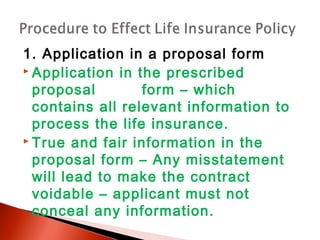

1. Application in a proposal form
 Application in the prescribed
proposal form – which
contains all relevant information to
process the life insurance.
 True and fair information in the
proposal form – Any misstatement
will lead to make the contract
voidable – applicant must not
conceal any information.
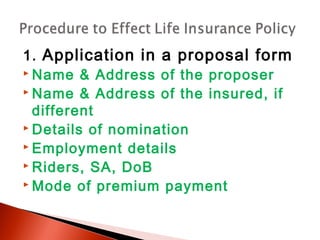
1. Application in a proposal form
 Name & Address of the proposer
 Name & Address of the insured, if
different
 Details of nomination
 Employment details
 Riders, SA, DoB
 Mode of premium payment
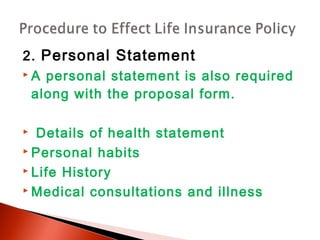
2. Personal Statement
 A personal statement is also required
along with the proposal form.
 Details of health statement
 Personal habits
 Life History
 Medical consultations and illness
3. Proof of Age
 A proof of age is also required
along with the proposal form.
 Copy of School Certificate
 Certified copy of an entry in the
birth register maintained by the
government
4. Special Reports
Medical Report
a) Medical report is a confidential report.
Insurance is given to a person of sound
health and sound mind. Therefore,
insurers insist for a medical examination
of the proposer.
b)Proficient and qualified allopathic doctor
c)Past present health conditions are
examined
d)At the end of the report the examiner will
give his final opinion
4. Special Reports
Agents Confidential Report – Agent is
the link between insured and the
insurance company
a)He can be remarked as the first
underwriter
b)ACR is the property of the insurer and it
is confidential
c)The agent must verify the correctness of
the details before the giving the report
4. Special Reports
Moral Hazard Report – It is prepared by the
an officer of the insurer
a)It contains the details of moral hazards
associated with the insured
b)Moral hazard means the risk to the insurer
due to the dishonesty of the insured
c) MHR must be observed if it is suspected that
the proposer is likely to be dishonest or the
proposer intends to make profit out of the
policy.
6. Acceptance of Proposal
After underwriting, the company makes a
decision to accept or reject the proposal.
IRDA Regulations- decision on the
proposal in 15 days from the proposal
Proposal is accepted if the conditions are
favourable to the insurer
Then an acceptance letter is sent to the
insured
7. First Premium Receipt (FPR)
FPR is the evidence that the
contract has begun
It is issued by the insurer after
receiving the first premium from the
insured
This is the effective date on which
the liability of the insurer
commences.
8. Issue of the Policy (Policy
Document)
On the payment of first premium,
the contract of insurance comes
into existence.
Most important document in the
insurance contract
Document is to be stamped in
accordance with the Indian Stamp
Act, 1899
8. Issue of the Policy (Policy
Document)
Recital Clause/ Preamble – Opening
section- recites the parties to the
contract- proposal and declaration
signed by the party
Operative Clause – Circumstances in
which insurers agree to make
payment or its equivalent to the
insured (Mutual Obligations)
8. Issue of the Policy (Policy
Document)
Attestation Clause – Signature of the
policy and its wordings
Conditions
Schedules
SA, Mode of premium payment,
riders, exclusions, special clauses
9. Other Insurance Documents
a) Cover Note– Cover note is issued
in advance of the policy.
It is issued when the policy cannot
be issued straight away
When negotiation are in progress
Its necessary to provide cover on a
provisional basis
9. Other Insurance Documents
b) Endorsements–
Policies are issued in a standard format
covering certain perils and excluding
certain others. If it is intended to
modify the terms and conditions of the
policy, its done by setting out the
alteration in a memorandum.
Its attached to the policy and forms part
of it. This memorandum is called
endorsements.
9. Other Insurance Documents
b) Prospectus–
Brochure issued by the prospective
buyers of insurance
Scope of benefits, conditions,
warranties, bonus etc.
What are guaranteed / what are not
guaranteed.
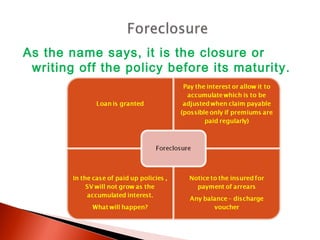
As the name says, it is the closure or
writing off the policy before its maturity.

Procedure to effect life policy and foreclosure

  • 2.
    1. Application ina proposal form  Application in the prescribed proposal form – which contains all relevant information to process the life insurance.  True and fair information in the proposal form – Any misstatement will lead to make the contract voidable – applicant must not conceal any information.
  • 3.
    1. Application ina proposal form  Name & Address of the proposer  Name & Address of the insured, if different  Details of nomination  Employment details  Riders, SA, DoB  Mode of premium payment
  • 4.
    2. Personal Statement A personal statement is also required along with the proposal form.  Details of health statement  Personal habits  Life History  Medical consultations and illness
  • 5.
    3. Proof ofAge  A proof of age is also required along with the proposal form.  Copy of School Certificate  Certified copy of an entry in the birth register maintained by the government
  • 6.
    4. Special Reports MedicalReport a) Medical report is a confidential report. Insurance is given to a person of sound health and sound mind. Therefore, insurers insist for a medical examination of the proposer. b)Proficient and qualified allopathic doctor c)Past present health conditions are examined d)At the end of the report the examiner will give his final opinion
  • 7.
    4. Special Reports AgentsConfidential Report – Agent is the link between insured and the insurance company a)He can be remarked as the first underwriter b)ACR is the property of the insurer and it is confidential c)The agent must verify the correctness of the details before the giving the report
  • 8.
    4. Special Reports MoralHazard Report – It is prepared by the an officer of the insurer a)It contains the details of moral hazards associated with the insured b)Moral hazard means the risk to the insurer due to the dishonesty of the insured c) MHR must be observed if it is suspected that the proposer is likely to be dishonest or the proposer intends to make profit out of the policy.
  • 9.
    6. Acceptance ofProposal After underwriting, the company makes a decision to accept or reject the proposal. IRDA Regulations- decision on the proposal in 15 days from the proposal Proposal is accepted if the conditions are favourable to the insurer Then an acceptance letter is sent to the insured
  • 10.
    7. First PremiumReceipt (FPR) FPR is the evidence that the contract has begun It is issued by the insurer after receiving the first premium from the insured This is the effective date on which the liability of the insurer commences.
  • 11.
    8. Issue ofthe Policy (Policy Document) On the payment of first premium, the contract of insurance comes into existence. Most important document in the insurance contract Document is to be stamped in accordance with the Indian Stamp Act, 1899
  • 12.
    8. Issue ofthe Policy (Policy Document) Recital Clause/ Preamble – Opening section- recites the parties to the contract- proposal and declaration signed by the party Operative Clause – Circumstances in which insurers agree to make payment or its equivalent to the insured (Mutual Obligations)
  • 13.
    8. Issue ofthe Policy (Policy Document) Attestation Clause – Signature of the policy and its wordings Conditions Schedules SA, Mode of premium payment, riders, exclusions, special clauses
  • 14.
    9. Other InsuranceDocuments a) Cover Note– Cover note is issued in advance of the policy. It is issued when the policy cannot be issued straight away When negotiation are in progress Its necessary to provide cover on a provisional basis
  • 15.
    9. Other InsuranceDocuments b) Endorsements– Policies are issued in a standard format covering certain perils and excluding certain others. If it is intended to modify the terms and conditions of the policy, its done by setting out the alteration in a memorandum. Its attached to the policy and forms part of it. This memorandum is called endorsements.
  • 16.
    9. Other InsuranceDocuments b) Prospectus– Brochure issued by the prospective buyers of insurance Scope of benefits, conditions, warranties, bonus etc. What are guaranteed / what are not guaranteed.
  • 18.
    As the namesays, it is the closure or writing off the policy before its maturity.