Dr Karrar Adil Hussein
Team E
Question 1
This is an image of laparoscopic inguinal hernia repair.
1- Name the structures marked by colored strips.
2- Mention the anatomical landmarks made by these structures,
What are their boundaries?
3- What are the indications, advantages, and disadvantages of
laparoscopic inguinal hernia repair?
Answer :
1-
• inferior epigastric vessels
• vas deferens
• spermatic vessels
• Iliopubic tract
2-
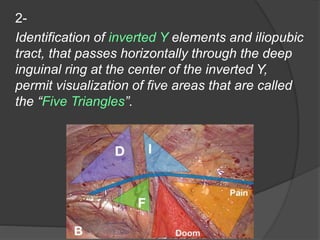
Identification of inverted Y elements and iliopubic
tract, that passes horizontally through the deep
inguinal ring at the center of the inverted Y,
permit visualization of five areas that are called
the “Five Triangles”.
 Triangle of Doom:
 Formed by vas deferens medially, and spermatic vessels, laterally.
 it corresponds to the location of the external iliac vessels (external iliac
artery and vein).
 Triangle of Pain:
 delimited by spermatic vessels Medially and iliopubic tract
superolaterally.
 it represents the passage of lateral cutaneous nerve of the thigh,
femoral branch of the genitofemoral nerve and femoral nerve.
 Triangle of indirect hernias:
 It is not a true triangle, but it corresponds to the deep inguinal ring, the
source of indirect hernias.
 It is formed by inferior epigastric vessels medially and by iliopubic
tract inferiorlaterally.
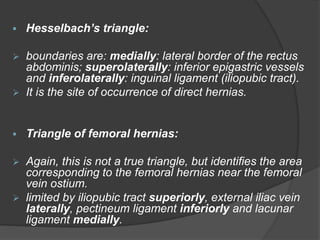
 Hesselbach’s triangle:
 boundaries are: medially: lateral border of the rectus
abdominis; superolaterally: inferior epigastric vessels
and inferolaterally: inguinal ligament (iliopubic tract).
 It is the site of occurrence of direct hernias.
 Triangle of femoral hernias:
 Again, this is not a true triangle, but identifies the area
corresponding to the femoral hernias near the femoral
vein ostium.
 limited by iliopubic tract superiorly, external iliac vein
laterally, pectineum ligament inferiorly and lacunar
ligament medially.
3-
Indications for laparoscopy over open repair:
 recurrent hernias.
 bilateral hernias.
 the need for earlier return to full activities.
Advantages over conventional repair, including the following:
 reduced postoperative pain.
 diminished requirement for narcotics.
 earlier return to work.
 an overall better quality of life.
Disadvantages :
 increased cost.
 longer operation time.
 steeper learning curve.
 higher recurrence and complication rates early in a surgeon’s
experience.
Question 2
A 26-year-old female came with the
complaint of fatigue, postural dizziness,
vague abdominal pain, and weight loss.
On clinical examination, blood pressure
was 90/65 mmHg. there was
hyperpigmentation of skin of the neck, with
involvement of tongue and palate.
1- What is the diagnosis?
2- What is the pathophysiology of the
hyperpigmentation?
3- How to diagnose this disease?
4- What are the autoimmune conditions
associated with this disease?
5- How to prepare such a patient for
surgery?
Answer :
1- Addison's disease (primary adrenal insufficiency).
is adrenocortical insufficiency due to the (autoimmune)
destruction or dysfunction of the majority of adrenal cortex.
It affects glucocorticoid and mineralocorticoid function.
2- Hyperpigmentation of the skin and mucous membranes
often precedes all other symptoms by months to years. It
is caused by the stimulant effect of excess
adrenocorticotrophic hormone (ACTH) on the melanocytes
to produce melanin.
The hyperpigmentation is caused by high levels of
circulating ACTH that bind to the melanocortin 1 receptor
on the surface of dermal melanocytes.
3- Diagnosis :
• Rapid ACTH stimulation test :
 An increase in the plasma cortisol and aldosterone levels above
basal levels 30 minutes after synthetic ACTH injection reflects
normal function of the adrenal cortex.
 In patients with Addison disease, both cortisol and aldosterone
show minimal or no change in response to ACTH.
• Comprehensive metabolic panel :
 The most prominent findings are hyponatremia, hyperkalemia,
and metabolic acidosis.
 Hypoglycemia may be present. Due to increased peripheral
utilization of glucose and increased insulin sensitivity.
• Autoantibody testing.
4- Associated autoimmune diseases :
Autoimmune polyendocrine syndrome :
 APS type I : including mainly:
 Addison's disease.
 Hypoparathyroidism.
 Chronic candidiasis.
 Other associated features include pernicious anaemia, atrophic
gastritis, and vitiligo.
 APS type II (Schmidt's syndrome) : is more common than type I and
is including:
 Addison's disease.
 Insulin dependent diabetes mellitus.
 Autoimmune thyroid disease. (Graves’ disease or Hashimoto's
thyroiditis).
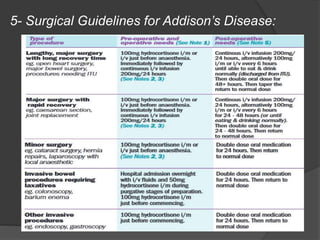
5- Surgical Guidelines for Addison’s Disease:
 For any nil-by-mouth regimen, arrange an
intravenous saline infusion to prevent dehydration
and maintain mineralocorticoid stability, eg. 1000ml
every 8 hours if >50kg.
 Monitor electrolytes and blood pressure post-
operatively for all procedures requiring injected
steroid cover.
 If the patient becomes hypotensive, drowsy or
peripherally shut down, administer 100mg
hydrocortisone i/v or i/m immediately.
 If any post-operative complications arise, (eg.
Fever), delay the return to normal dose.
Question 3
A 30-year-old shepherd presented with a 12
month history of slow-growing, painless mass
in her Rt thigh which gradually increased in
size in the following period.
Her medical history was unremarkable.
O/E : There was a large, non tender lump on
the right upper thigh. The skin on top was
normal. No other swelling or lymphadenopathy
were found.
Imaging was done.
1- Describe the images.
2- What is the diagnosis?
3- Is it a common site for this condition?
4- How to manage this condition?
5- How to prevent intraoperative
dissemination?
Answer :
1-
MR imaging of right thigh :
 T2-weighted coronal image showing large
multiloculated cystic lesions (red arrow) involving right
thigh.
Small cluster of hyperintense daughter cysts is denoted
by yellow arrow.
Blue arrow shows the medial displacement of rectus
femoris muscle.
 T2-weighted axial image showing large multiloculated
cystic lesion involving anterior compartment of right
thigh. Small cluster of hyperintense daughter cysts is
shown by the red arrow.
2- Primary right thigh hydatid cyst.
3-
Muscle hydatidosis is rare, accounting only for 1–4%
of all cases.
Possibly because of muscle lactic acid content and
muscle contraction, two factors that prevent the cyst
growth.
4- Treatment :
 The treatment of choice in musculoskeletal hydatid
disease is surgical excision (pericystectomy),
combined with antihelminthic medication.
 Suggested regime is (one cycle of 28 days of
albendazole preoperatively, and 6 or more courses
of 28 days postoperatively, with an interval of 14
days between them).
 Percutaneous aspiration, infusion of scolicidal
agents and reaspiration (PAIR), under imaging
(ultrasound or CT) guidance can be used as
alternative to surgery in inoperable cases.
5-
 Injecting scolicidal solutions into the hydatid cyst
and packing the operative field with sponges
soaked in scolicidal agents have been used to
avoid dissemination of the parasite during surgery.
 Examples of scolicidal agents :
 20% Hypertonic saline
 3% Hydrogen peroxide
 0.5% Cetrimide
 0.15% Chlorhexidine
 Absolute alcohol
 Povidone iodine (Betadine)
 0.5% Silver nitrate solution
Question 4
1- Name the procedure.
2- What are the indications?
3- How many methods are there for this procedure?
4- What are the complications?
Answer :
1- Hyperthermic Intraperitoneal Chemotherapy (HIPEC).
2- Indications :
cytoreductive surgery combined with hyperthermic intraperitoneal
chemotherapy is the treatment of choice for :
• Primary peritoneal malignancy :
 Peritoneal Mesothelioma.
• Peritoneal Carcinomatosis :
 Colorectal CA.
 Stomach CA.
 Ovarian CA.
 Peritoneal Pseudomyxoma and mucinous tumors of the
appendix.
3-
Methods for HIPEC are :
 Open (coliseum) technique:
Advantage:
 assures optimal distribution of
heat and cytotoxic solution
thanks to manual stirring of the
abdominal contents.
Disadvantage:
 heat loss (with the need to
increase the temperature of the
perfusion fluid and expose the
bowel to the risk of scald
injuries).
 risk of leakage of cytotoxic drugs.
 Closed technique:
Advantage:
 prevents heat loss and
drug spillage.
 increases drug penetration.
Disadvantage:
 does not warrant
homogeneous distribution
of the perfusion fluid.
 Laparoscopic approach:
conceived to fill the gap between the
open and the closed procedures.
combines the advantages of the two
techniques by :
 allowing laparoscopic stirring of
the abdominal contents during a
closed-abdomen HIPEC.
 achieve optimal distribution and
preservation of heat and cytotoxic
drugs.
4- Complications :
 prolonged intestinal atony.
 Bone marrow suppression.
 Nephrotoxicity.
 delayed wound healing.
 prolonged hospitalization.
 Other complications which are not related only to the HIPEC
but are well associated with cytoreduction:
(Pancreatitis, fistula, sepsis, Pulmonary embolism, and
thrombosis).
Question 5
A 35-year-old female presented with the complaint of left
shoulder pain, and difficulty in raising her arm.
She had a history of radical neck dissection 18 months
ago. A month afterwards, patient complaint commenced.
1- What is the diagnosis?
2- What is the pathophysiology?
3- What are the management options?
Answer :
1- Lateral Scapular Winging.
2- Pathophysiology :
deficit in trapezius function due to injury to the spinal accessory
nerve (CN XI).
• Iatrogenic (most common) :
 cervical lymph node biopsy.
 radical neck dissection.
• Traumatic :
 traction injury (motor vehicle or motorcycle accidents).
 blunt trauma.
 penetrating injury to the neck.
4- Treatment :
 Nonoperative :
observation, physical therapy and activity modification.
(controversial given that most injuries are iatrogenic direct nerve injuries
and warrant surgical intervention).
 Operative :
 exploration of the spinal accessory nerve ( repair within 20 months of
injury).
 muscle transfer (Eden-Lange transfer) :
• nerve injury diagnosed late (> 20 months from injury).
• Technique: transfer of the levator scapulae and rhomboid muscles
from the medial border of the scapula to the lateral border, to
reconstruct the trapezius.
 scapulothoracic fusion :
Technique: fusion of the anterior scapula to the posterior rib cage, with
wire and/or plates and screws.
Question 6
A 40-year-old female with history of cesarean section delivery 2 months
ago, presented to the ER with lower abdominal pain, fever, nausea, and
anorexia.
O/E : she was ill-looking, febrile , there was lower abdominal tenderness,
guarding and mild distension.
1- Describe the image.
2- What is the diagnosis?
3- What are the risk factors of this condition?
4- How to prevent it?
Answer :
1-
 CECT of abdomen, axial view, showing left lower
quadrant sharply defined rounded mass
inseparable from the posterior rectus sheath
probably at pro-peritoneal location.
 It has spongiform appearance with a uniform
enhancing wall with core formed of gas foci and
network of curvilinear dense lace-like structures.
2- retained surgical sponge (Gossypiboma).
3- Risk factors for gossypibomas:
 emergency surgeries. (nine fold increase in risk)
 unexpected change in surgery.
 involvement of more than one surgical team.
 team fatigue.
 poor communication between the operating team.
 change in the nursing or theatre staff during an
operation.
 BMI.
 volume of blood loss.
 female sex (gynaecological surgery).
4- Recommendations suggested to prevent gossypibomas include:
 a quiet and well-organized operating room with minimal
distractions, thereby providing an optimum environment for
maximum concentration.
 carrying out two careful sponge counts, one at the beginning and
the second prior to closure of the wound by at least two nurses.
 the counts needs to be audible.
 WHO guidelines for safe surgical procedures advocates using only
surgical sponges with a radio-opaque marker.
 In case of a discrepancy during the sponge count, an
intraoperative radiography of the entire operating field should be
performed prior to closure.
 Recent advances that help identify and avoid gossypibomas is the
use of an electronic surveillance system.
Thank you …

Problem solving : a quiz in surgery.pptx

  • 1.
    Dr Karrar AdilHussein Team E
  • 2.
  • 3.
    This is animage of laparoscopic inguinal hernia repair. 1- Name the structures marked by colored strips. 2- Mention the anatomical landmarks made by these structures, What are their boundaries? 3- What are the indications, advantages, and disadvantages of laparoscopic inguinal hernia repair?
  • 4.
    Answer : 1- • inferiorepigastric vessels • vas deferens • spermatic vessels • Iliopubic tract
  • 5.
    2- Identification of invertedY elements and iliopubic tract, that passes horizontally through the deep inguinal ring at the center of the inverted Y, permit visualization of five areas that are called the “Five Triangles”.
  • 6.
     Triangle ofDoom:  Formed by vas deferens medially, and spermatic vessels, laterally.  it corresponds to the location of the external iliac vessels (external iliac artery and vein).  Triangle of Pain:  delimited by spermatic vessels Medially and iliopubic tract superolaterally.  it represents the passage of lateral cutaneous nerve of the thigh, femoral branch of the genitofemoral nerve and femoral nerve.  Triangle of indirect hernias:  It is not a true triangle, but it corresponds to the deep inguinal ring, the source of indirect hernias.  It is formed by inferior epigastric vessels medially and by iliopubic tract inferiorlaterally.
  • 7.
     Hesselbach’s triangle: boundaries are: medially: lateral border of the rectus abdominis; superolaterally: inferior epigastric vessels and inferolaterally: inguinal ligament (iliopubic tract).  It is the site of occurrence of direct hernias.  Triangle of femoral hernias:  Again, this is not a true triangle, but identifies the area corresponding to the femoral hernias near the femoral vein ostium.  limited by iliopubic tract superiorly, external iliac vein laterally, pectineum ligament inferiorly and lacunar ligament medially.
  • 8.
    3- Indications for laparoscopyover open repair:  recurrent hernias.  bilateral hernias.  the need for earlier return to full activities. Advantages over conventional repair, including the following:  reduced postoperative pain.  diminished requirement for narcotics.  earlier return to work.  an overall better quality of life. Disadvantages :  increased cost.  longer operation time.  steeper learning curve.  higher recurrence and complication rates early in a surgeon’s experience.
  • 9.
  • 10.
    A 26-year-old femalecame with the complaint of fatigue, postural dizziness, vague abdominal pain, and weight loss. On clinical examination, blood pressure was 90/65 mmHg. there was hyperpigmentation of skin of the neck, with involvement of tongue and palate. 1- What is the diagnosis? 2- What is the pathophysiology of the hyperpigmentation? 3- How to diagnose this disease? 4- What are the autoimmune conditions associated with this disease? 5- How to prepare such a patient for surgery?
  • 11.
    Answer : 1- Addison'sdisease (primary adrenal insufficiency). is adrenocortical insufficiency due to the (autoimmune) destruction or dysfunction of the majority of adrenal cortex. It affects glucocorticoid and mineralocorticoid function. 2- Hyperpigmentation of the skin and mucous membranes often precedes all other symptoms by months to years. It is caused by the stimulant effect of excess adrenocorticotrophic hormone (ACTH) on the melanocytes to produce melanin. The hyperpigmentation is caused by high levels of circulating ACTH that bind to the melanocortin 1 receptor on the surface of dermal melanocytes.
  • 12.
    3- Diagnosis : •Rapid ACTH stimulation test :  An increase in the plasma cortisol and aldosterone levels above basal levels 30 minutes after synthetic ACTH injection reflects normal function of the adrenal cortex.  In patients with Addison disease, both cortisol and aldosterone show minimal or no change in response to ACTH. • Comprehensive metabolic panel :  The most prominent findings are hyponatremia, hyperkalemia, and metabolic acidosis.  Hypoglycemia may be present. Due to increased peripheral utilization of glucose and increased insulin sensitivity. • Autoantibody testing.
  • 13.
    4- Associated autoimmunediseases : Autoimmune polyendocrine syndrome :  APS type I : including mainly:  Addison's disease.  Hypoparathyroidism.  Chronic candidiasis.  Other associated features include pernicious anaemia, atrophic gastritis, and vitiligo.  APS type II (Schmidt's syndrome) : is more common than type I and is including:  Addison's disease.  Insulin dependent diabetes mellitus.  Autoimmune thyroid disease. (Graves’ disease or Hashimoto's thyroiditis).
  • 14.
    5- Surgical Guidelinesfor Addison’s Disease:
  • 15.
     For anynil-by-mouth regimen, arrange an intravenous saline infusion to prevent dehydration and maintain mineralocorticoid stability, eg. 1000ml every 8 hours if >50kg.  Monitor electrolytes and blood pressure post- operatively for all procedures requiring injected steroid cover.  If the patient becomes hypotensive, drowsy or peripherally shut down, administer 100mg hydrocortisone i/v or i/m immediately.  If any post-operative complications arise, (eg. Fever), delay the return to normal dose.
  • 16.
  • 17.
    A 30-year-old shepherdpresented with a 12 month history of slow-growing, painless mass in her Rt thigh which gradually increased in size in the following period. Her medical history was unremarkable. O/E : There was a large, non tender lump on the right upper thigh. The skin on top was normal. No other swelling or lymphadenopathy were found. Imaging was done. 1- Describe the images. 2- What is the diagnosis? 3- Is it a common site for this condition? 4- How to manage this condition? 5- How to prevent intraoperative dissemination?
  • 18.
    Answer : 1- MR imagingof right thigh :  T2-weighted coronal image showing large multiloculated cystic lesions (red arrow) involving right thigh. Small cluster of hyperintense daughter cysts is denoted by yellow arrow. Blue arrow shows the medial displacement of rectus femoris muscle.  T2-weighted axial image showing large multiloculated cystic lesion involving anterior compartment of right thigh. Small cluster of hyperintense daughter cysts is shown by the red arrow.
  • 19.
    2- Primary rightthigh hydatid cyst. 3- Muscle hydatidosis is rare, accounting only for 1–4% of all cases. Possibly because of muscle lactic acid content and muscle contraction, two factors that prevent the cyst growth.
  • 20.
    4- Treatment : The treatment of choice in musculoskeletal hydatid disease is surgical excision (pericystectomy), combined with antihelminthic medication.  Suggested regime is (one cycle of 28 days of albendazole preoperatively, and 6 or more courses of 28 days postoperatively, with an interval of 14 days between them).  Percutaneous aspiration, infusion of scolicidal agents and reaspiration (PAIR), under imaging (ultrasound or CT) guidance can be used as alternative to surgery in inoperable cases.
  • 21.
    5-  Injecting scolicidalsolutions into the hydatid cyst and packing the operative field with sponges soaked in scolicidal agents have been used to avoid dissemination of the parasite during surgery.  Examples of scolicidal agents :  20% Hypertonic saline  3% Hydrogen peroxide  0.5% Cetrimide  0.15% Chlorhexidine  Absolute alcohol  Povidone iodine (Betadine)  0.5% Silver nitrate solution
  • 22.
  • 23.
    1- Name theprocedure. 2- What are the indications? 3- How many methods are there for this procedure? 4- What are the complications?
  • 24.
    Answer : 1- HyperthermicIntraperitoneal Chemotherapy (HIPEC). 2- Indications : cytoreductive surgery combined with hyperthermic intraperitoneal chemotherapy is the treatment of choice for : • Primary peritoneal malignancy :  Peritoneal Mesothelioma. • Peritoneal Carcinomatosis :  Colorectal CA.  Stomach CA.  Ovarian CA.  Peritoneal Pseudomyxoma and mucinous tumors of the appendix.
  • 25.
    3- Methods for HIPECare :  Open (coliseum) technique: Advantage:  assures optimal distribution of heat and cytotoxic solution thanks to manual stirring of the abdominal contents. Disadvantage:  heat loss (with the need to increase the temperature of the perfusion fluid and expose the bowel to the risk of scald injuries).  risk of leakage of cytotoxic drugs.
  • 26.
     Closed technique: Advantage: prevents heat loss and drug spillage.  increases drug penetration. Disadvantage:  does not warrant homogeneous distribution of the perfusion fluid.
  • 27.
     Laparoscopic approach: conceivedto fill the gap between the open and the closed procedures. combines the advantages of the two techniques by :  allowing laparoscopic stirring of the abdominal contents during a closed-abdomen HIPEC.  achieve optimal distribution and preservation of heat and cytotoxic drugs.
  • 28.
    4- Complications : prolonged intestinal atony.  Bone marrow suppression.  Nephrotoxicity.  delayed wound healing.  prolonged hospitalization.  Other complications which are not related only to the HIPEC but are well associated with cytoreduction: (Pancreatitis, fistula, sepsis, Pulmonary embolism, and thrombosis).
  • 29.
  • 30.
    A 35-year-old femalepresented with the complaint of left shoulder pain, and difficulty in raising her arm. She had a history of radical neck dissection 18 months ago. A month afterwards, patient complaint commenced. 1- What is the diagnosis? 2- What is the pathophysiology? 3- What are the management options?
  • 31.
    Answer : 1- LateralScapular Winging. 2- Pathophysiology : deficit in trapezius function due to injury to the spinal accessory nerve (CN XI). • Iatrogenic (most common) :  cervical lymph node biopsy.  radical neck dissection. • Traumatic :  traction injury (motor vehicle or motorcycle accidents).  blunt trauma.  penetrating injury to the neck.
  • 32.
    4- Treatment : Nonoperative : observation, physical therapy and activity modification. (controversial given that most injuries are iatrogenic direct nerve injuries and warrant surgical intervention).  Operative :  exploration of the spinal accessory nerve ( repair within 20 months of injury).  muscle transfer (Eden-Lange transfer) : • nerve injury diagnosed late (> 20 months from injury). • Technique: transfer of the levator scapulae and rhomboid muscles from the medial border of the scapula to the lateral border, to reconstruct the trapezius.  scapulothoracic fusion : Technique: fusion of the anterior scapula to the posterior rib cage, with wire and/or plates and screws.
  • 33.
  • 34.
    A 40-year-old femalewith history of cesarean section delivery 2 months ago, presented to the ER with lower abdominal pain, fever, nausea, and anorexia. O/E : she was ill-looking, febrile , there was lower abdominal tenderness, guarding and mild distension. 1- Describe the image. 2- What is the diagnosis? 3- What are the risk factors of this condition? 4- How to prevent it?
  • 35.
    Answer : 1-  CECTof abdomen, axial view, showing left lower quadrant sharply defined rounded mass inseparable from the posterior rectus sheath probably at pro-peritoneal location.  It has spongiform appearance with a uniform enhancing wall with core formed of gas foci and network of curvilinear dense lace-like structures. 2- retained surgical sponge (Gossypiboma).
  • 36.
    3- Risk factorsfor gossypibomas:  emergency surgeries. (nine fold increase in risk)  unexpected change in surgery.  involvement of more than one surgical team.  team fatigue.  poor communication between the operating team.  change in the nursing or theatre staff during an operation.  BMI.  volume of blood loss.  female sex (gynaecological surgery).
  • 37.
    4- Recommendations suggestedto prevent gossypibomas include:  a quiet and well-organized operating room with minimal distractions, thereby providing an optimum environment for maximum concentration.  carrying out two careful sponge counts, one at the beginning and the second prior to closure of the wound by at least two nurses.  the counts needs to be audible.  WHO guidelines for safe surgical procedures advocates using only surgical sponges with a radio-opaque marker.  In case of a discrepancy during the sponge count, an intraoperative radiography of the entire operating field should be performed prior to closure.  Recent advances that help identify and avoid gossypibomas is the use of an electronic surveillance system.
  • 38.