Problem Formulation & Resolution in Online Problem-based Learning Rick Kenny, Athabasca University Mark Bullen, British Columbia Institute of Technology
Introduction E-learning pedagogies must be defensible E-learning pedagogies are evolving E-learning instructional design must be guided by research and theory Examination of problem-based learning in an online course
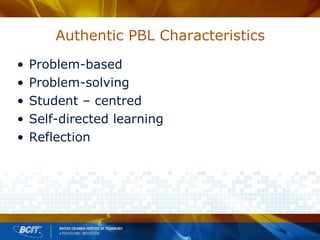
Authentic PBL Characteristics Problem-based Problem-solving Student – centred Self-directed learning Reflection
Effectiveness of PBL Meta-analyses examining use of PBL in Medical Education  Conventional curricula outperformed PBL on measures of basic science  PBL students scored higher on clinical examinations PBL most positive effects when constructs assessed at level of understanding principles that link concepts.
Methodology Research Questions What evidence is there that PBL fosters problem-solving behaviours and skills in undergraduate Agricultural Sciences students? What is the nature of the problem-solving process which students apply when engaged in PBL activities?
Methodology Research Setting Undergraduate Agroecology course Fully online, WebCT   Participants 11 students Two PBL groups
Methodology
Methodology Context PBL work took place in asynchronous discussion forums Instructor participated by monitoring, guiding, clarifying
Analysis Content analysis based on Murphy’s OAD instrument (2004, 2005) Based on Jonassen’s (1997) conceptual framework Two main categories Problem formulation Problem resolution
Methodology – Modified Instrument Agreeing with problem as presented in OAD Defining PBL Space Reflecting on one’s thinking   Identifying value of information   Accessing and reporting on sources of  information   Clarifying (meaning, importance, accuracy of) information   Seeking information to resolve lack of knowledge   Identifying unknowns in knowledge Building knowledge Articulating a problem outside problem  space   Identifying causes of problem   Identifying extent of problem   Minimizing and/or denying problem   Redefining problem within problem  space   Specifying ways that the problem manifests itself   Indicator Problem formulation
Methodology – Modified Instrument Proposing solutions   Identifying solutions Hypothesizing about solutions   Planning to take action to resolve the problem   Acting on solutions   Coming to agreement about solutions   Reaching conclusions   Rejecting/eliminating solutions judged unworkable   Critiquing solutions   Weighing and comparing alternative solutions   Agreeing with solutions proposed by others   Evaluating solutions   Indicator Problem resolution
Results - Pass 1
Results - Pass 2 17.5 66 6.9 26 Other 0 0 0 0 Acting on solutions 0 0 4.2 16 Reaching conclusions  10.3 39 13.8 52 Evaluating solutions 9.8 37 14.3 54 Identifying solutions Problem Resolution 50.7 191 57.8 218 Building knowledge 11.7 44 2.9 11 Defining problem space Problem Formulation % Cases % Cases Coder 3 Coder 1 Process
Results Only coded two levels: category, process Cohen’s kappa used for inter-coder agreement (Cohen, 1960) Categories Case 2, Group 1: 0.449 Case 2, Group 2: 0.593 Processes Case 2, Group 1: 0.344
Issues The PFR process and PBL Unit of analysis Representing the PFR process in a PBL context Training
Contact Information Rick Kenny Associate Professor Centre for Distance Education Athabasca University [email_address] Mark Bullen Associate Dean Learning & Teaching Centre BC Institute of Technology [email_address]

Problem Formulation and Resolution in Online Problem-based Learning

  • 1.
    Problem Formulation &Resolution in Online Problem-based Learning Rick Kenny, Athabasca University Mark Bullen, British Columbia Institute of Technology
  • 2.
    Introduction E-learning pedagogiesmust be defensible E-learning pedagogies are evolving E-learning instructional design must be guided by research and theory Examination of problem-based learning in an online course
  • 3.
    Authentic PBL CharacteristicsProblem-based Problem-solving Student – centred Self-directed learning Reflection
  • 4.
    Effectiveness of PBLMeta-analyses examining use of PBL in Medical Education Conventional curricula outperformed PBL on measures of basic science PBL students scored higher on clinical examinations PBL most positive effects when constructs assessed at level of understanding principles that link concepts.
  • 5.
    Methodology Research QuestionsWhat evidence is there that PBL fosters problem-solving behaviours and skills in undergraduate Agricultural Sciences students? What is the nature of the problem-solving process which students apply when engaged in PBL activities?
  • 6.
    Methodology Research SettingUndergraduate Agroecology course Fully online, WebCT Participants 11 students Two PBL groups
  • 7.
  • 8.
    Methodology Context PBLwork took place in asynchronous discussion forums Instructor participated by monitoring, guiding, clarifying
  • 9.
    Analysis Content analysisbased on Murphy’s OAD instrument (2004, 2005) Based on Jonassen’s (1997) conceptual framework Two main categories Problem formulation Problem resolution
  • 10.
    Methodology – ModifiedInstrument Agreeing with problem as presented in OAD Defining PBL Space Reflecting on one’s thinking Identifying value of information Accessing and reporting on sources of information Clarifying (meaning, importance, accuracy of) information Seeking information to resolve lack of knowledge Identifying unknowns in knowledge Building knowledge Articulating a problem outside problem space Identifying causes of problem Identifying extent of problem Minimizing and/or denying problem Redefining problem within problem space Specifying ways that the problem manifests itself Indicator Problem formulation
  • 11.
    Methodology – ModifiedInstrument Proposing solutions Identifying solutions Hypothesizing about solutions Planning to take action to resolve the problem Acting on solutions Coming to agreement about solutions Reaching conclusions Rejecting/eliminating solutions judged unworkable Critiquing solutions Weighing and comparing alternative solutions Agreeing with solutions proposed by others Evaluating solutions Indicator Problem resolution
  • 12.
  • 13.
    Results - Pass2 17.5 66 6.9 26 Other 0 0 0 0 Acting on solutions 0 0 4.2 16 Reaching conclusions 10.3 39 13.8 52 Evaluating solutions 9.8 37 14.3 54 Identifying solutions Problem Resolution 50.7 191 57.8 218 Building knowledge 11.7 44 2.9 11 Defining problem space Problem Formulation % Cases % Cases Coder 3 Coder 1 Process
  • 14.
    Results Only codedtwo levels: category, process Cohen’s kappa used for inter-coder agreement (Cohen, 1960) Categories Case 2, Group 1: 0.449 Case 2, Group 2: 0.593 Processes Case 2, Group 1: 0.344
  • 15.
    Issues The PFRprocess and PBL Unit of analysis Representing the PFR process in a PBL context Training
  • 16.
    Contact Information RickKenny Associate Professor Centre for Distance Education Athabasca University [email_address] Mark Bullen Associate Dean Learning & Teaching Centre BC Institute of Technology [email_address]