Are BCIT Students Digital Learners? Mark Bullen, Adnan Qayyum, Tannis Morgan 2/25/09
Introduction Sequel to last year’s presentation Research project: How are BCIT students communicating outside the classroom? Do they fit the “net generation” profile Research team 2/25/09
Who Cares? “ Net Generation” claims Implications for higher education Validity of the claims 2/25/09
Net Generation Claims Fundamentally different that previous generations Technologies used How they use technology These differences affect how they learn 2/25/09
Net Generation Claims Exposed to digital technology from an early age Profound impact “ today’s students think and process information fundamentally differently than their predecessors. These differences go further and deeper than most educators suspect or realize” –  Marc Presnsky, 2001 2/25/09
Net Generation Characteristics Multitaskers Sophisticated users of technology Need for immediate feedback Prefer teamwork, collaboration Experiential learners Social Ambitious Career-oriented 2/25/09
Implications for Higher Education Digital game-based learning Collaborative learning Multimedia Interactive learning Expect to be entertained Personalized learning Shift from architecture of presentation to architecture of participation 2/25/09
Validity of Claims Claims not based on sound research North American bias Reviews of research do not support claims Research tends to contradict many of the claims Does this mean business as usual? 2/25/09
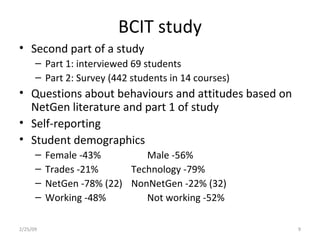
BCIT study Second part of a study Part 1: interviewed 69 students Part 2: Survey (442 students in 14 courses) Questions about behaviours and attitudes based on NetGen literature and part 1 of study Self-reporting Student demographics Female -43% Male -56% Trades -21% Technology -79% NetGen -78% (22) NonNetGen -22% (32) Working -48% Not working -52% 2/25/09
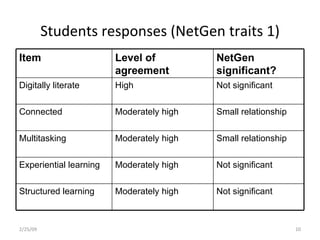
Students responses (NetGen traits 1) 2/25/09 Item Level of agreement NetGen significant? Digitally literate High Not significant Connected Moderately high Small relationship Multitasking Moderately high Small relationship Experiential learning Moderately high Not significant Structured learning Moderately high Not significant
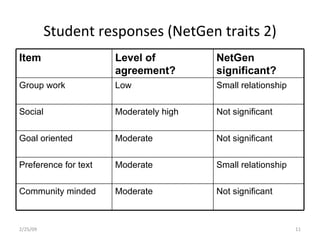
Student responses (NetGen traits 2) 2/25/09 Item Level of agreement? NetGen significant? Group work Low Small relationship Social Moderately high Not significant Goal oriented Moderate Not significant Preference for text Moderate Small relationship Community minded Moderate Not significant
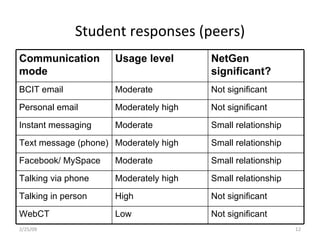
Student responses (peers) 2/25/09 Communication mode Usage level NetGen significant? BCIT email Moderate Not significant Personal email Moderately high Not significant Instant messaging Moderate Small relationship Text message (phone) Moderately high Small relationship Facebook/ MySpace Moderate Small relationship Talking via phone Moderately high Small relationship Talking in person High Not significant WebCT Low Not significant
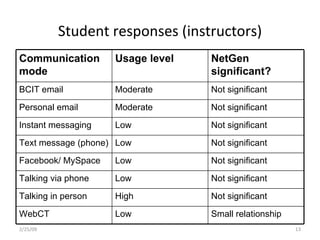
Student responses (instructors) 2/25/09 Communication mode Usage level NetGen significant? BCIT email Moderate Not significant Personal email Moderate Not significant Instant messaging Low Not significant Text message (phone) Low Not significant Facebook/ MySpace Low Not significant Talking via phone Low Not significant Talking in person High Not significant WebCT Low Small relationship
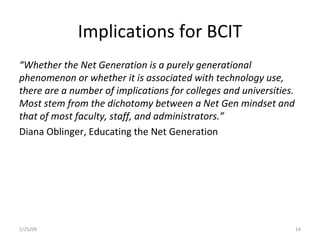
Implications for BCIT “ Whether the Net Generation is a purely generational phenomenon or whether it is associated with technology use, there are a number of implications for colleges and universities. Most stem from the dichotomy between a Net Gen mindset and that of most faculty, staff, and administrators.” Diana Oblinger, Educating the Net Generation 2/25/09
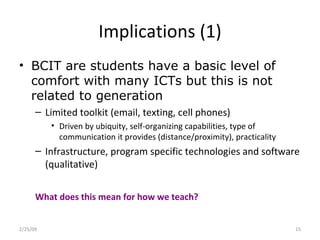
Implications (1) BCIT are students have a basic level of comfort with many ICTs but this is not related to generation Limited toolkit (email, texting, cell phones) Driven by ubiquity, self-organizing capabilities, type of communication it provides (distance/proximity), practicality Infrastructure, program specific technologies and software (qualitative) What does this mean for how we teach?  2/25/09
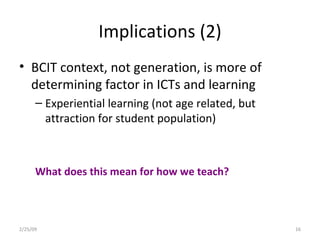
Implications (2) BCIT context, not generation, is more of determining factor in ICTs and learning Experiential learning (not age related, but attraction for student population) What does this mean for how we teach? 2/25/09
Implications (3) Group work is not highly preferred, even though students are highly social and consider themselves to be highly connected because of ICTs Students spend 7-8 hours x 5 days/week on campus 5+ courses at a time access to communication and collaboration is not the problem Motivation to group work?   Appropriateness of group work? What does this mean for how we teach? 2/25/09
Implications (4) Multitasking Students spend 7-8 hours x 5 days/week on campus 5+ courses at a time Substantial amount of students working part time Access and ubiquity of ICTs What does this mean for how we teach? 2/25/09
Conclusion Generation does not explain technology use or learning preferences Context matters--nature of programs, program design Decision making based on needs of your learners 2/25/09
Asking the Right Questions Who are our learners? How are today’s learners different from (or the same as) faculty/administrators? What learning activities are most engaging for learners? Are there ways to use IT to make learning more successful? 2/25/09
For More Information http://netgennonsense.blogspot.com/ [email_address] [email_address] [email_address] 2/25/09

Net Gen P Dday09 Final

  • 1.
    Are BCIT StudentsDigital Learners? Mark Bullen, Adnan Qayyum, Tannis Morgan 2/25/09
  • 2.
    Introduction Sequel tolast year’s presentation Research project: How are BCIT students communicating outside the classroom? Do they fit the “net generation” profile Research team 2/25/09
  • 3.
    Who Cares? “Net Generation” claims Implications for higher education Validity of the claims 2/25/09
  • 4.
    Net Generation ClaimsFundamentally different that previous generations Technologies used How they use technology These differences affect how they learn 2/25/09
  • 5.
    Net Generation ClaimsExposed to digital technology from an early age Profound impact “ today’s students think and process information fundamentally differently than their predecessors. These differences go further and deeper than most educators suspect or realize” – Marc Presnsky, 2001 2/25/09
  • 6.
    Net Generation CharacteristicsMultitaskers Sophisticated users of technology Need for immediate feedback Prefer teamwork, collaboration Experiential learners Social Ambitious Career-oriented 2/25/09
  • 7.
    Implications for HigherEducation Digital game-based learning Collaborative learning Multimedia Interactive learning Expect to be entertained Personalized learning Shift from architecture of presentation to architecture of participation 2/25/09
  • 8.
    Validity of ClaimsClaims not based on sound research North American bias Reviews of research do not support claims Research tends to contradict many of the claims Does this mean business as usual? 2/25/09
  • 9.
    BCIT study Secondpart of a study Part 1: interviewed 69 students Part 2: Survey (442 students in 14 courses) Questions about behaviours and attitudes based on NetGen literature and part 1 of study Self-reporting Student demographics Female -43% Male -56% Trades -21% Technology -79% NetGen -78% (22) NonNetGen -22% (32) Working -48% Not working -52% 2/25/09
  • 10.
    Students responses (NetGentraits 1) 2/25/09 Item Level of agreement NetGen significant? Digitally literate High Not significant Connected Moderately high Small relationship Multitasking Moderately high Small relationship Experiential learning Moderately high Not significant Structured learning Moderately high Not significant
  • 11.
    Student responses (NetGentraits 2) 2/25/09 Item Level of agreement? NetGen significant? Group work Low Small relationship Social Moderately high Not significant Goal oriented Moderate Not significant Preference for text Moderate Small relationship Community minded Moderate Not significant
  • 12.
    Student responses (peers)2/25/09 Communication mode Usage level NetGen significant? BCIT email Moderate Not significant Personal email Moderately high Not significant Instant messaging Moderate Small relationship Text message (phone) Moderately high Small relationship Facebook/ MySpace Moderate Small relationship Talking via phone Moderately high Small relationship Talking in person High Not significant WebCT Low Not significant
  • 13.
    Student responses (instructors)2/25/09 Communication mode Usage level NetGen significant? BCIT email Moderate Not significant Personal email Moderate Not significant Instant messaging Low Not significant Text message (phone) Low Not significant Facebook/ MySpace Low Not significant Talking via phone Low Not significant Talking in person High Not significant WebCT Low Small relationship
  • 14.
    Implications for BCIT“ Whether the Net Generation is a purely generational phenomenon or whether it is associated with technology use, there are a number of implications for colleges and universities. Most stem from the dichotomy between a Net Gen mindset and that of most faculty, staff, and administrators.” Diana Oblinger, Educating the Net Generation 2/25/09
  • 15.
    Implications (1) BCITare students have a basic level of comfort with many ICTs but this is not related to generation Limited toolkit (email, texting, cell phones) Driven by ubiquity, self-organizing capabilities, type of communication it provides (distance/proximity), practicality Infrastructure, program specific technologies and software (qualitative) What does this mean for how we teach? 2/25/09
  • 16.
    Implications (2) BCITcontext, not generation, is more of determining factor in ICTs and learning Experiential learning (not age related, but attraction for student population) What does this mean for how we teach? 2/25/09
  • 17.
    Implications (3) Groupwork is not highly preferred, even though students are highly social and consider themselves to be highly connected because of ICTs Students spend 7-8 hours x 5 days/week on campus 5+ courses at a time access to communication and collaboration is not the problem Motivation to group work? Appropriateness of group work? What does this mean for how we teach? 2/25/09
  • 18.
    Implications (4) MultitaskingStudents spend 7-8 hours x 5 days/week on campus 5+ courses at a time Substantial amount of students working part time Access and ubiquity of ICTs What does this mean for how we teach? 2/25/09
  • 19.
    Conclusion Generation doesnot explain technology use or learning preferences Context matters--nature of programs, program design Decision making based on needs of your learners 2/25/09
  • 20.
    Asking the RightQuestions Who are our learners? How are today’s learners different from (or the same as) faculty/administrators? What learning activities are most engaging for learners? Are there ways to use IT to make learning more successful? 2/25/09
  • 21.
    For More Informationhttp://netgennonsense.blogspot.com/ [email_address] [email_address] [email_address] 2/25/09