Probability Basic
• Introduction: Basic concepts Random experiments & events
• Elementary Theorems
• Probabilistic Modelling
• Independence
• Transformations
• Moments
Real-world experiments:
1. A set of possible experimental outcomes
2. A grouping of these outcomes into classes
called results
3. The relative frequency of these classes in
many independent trials of the experiment
4. Frequency is number of times the
experimental outcome falls into that class,
divided by number of times the experiment is
performed.
Experiment
• A random experiment: is an experiment
we do not know its exact outcome in
advance but we know the set of all possible
outcomes.
1. Mathematical model: three quantities of
interest that are in one-to-one relation with the
three quantities of experimental world
2. A sample space is a collection of objects
that corresponds to the set of mutually
exclusive exhaustive outcomes of the model
of an experiment. Each object  is in the set S
is referred to as a sample point
1. A family of events  denoted {A, B,
C,…}in which each event is a set of
samples points { }
3. A probability measure P which is an
assignment (mapping) of the events defined
on S into the set of real numbers. The
notation is P[A], and have these mapping
properties:
a) For any event A,0 <= P[A] <=1 (II.1)
b) P[S]=1 (II.2)
c) If A and B are “mutually exclusive” events
then P[A U B]=P[A]+P[B] (II.3)
• Two events A, B are said to be statistically
independent if and only if
• Theorem of total probability
If the event B is to occur it must occur in
conjunction with exactly one of the
mutually exclusive exhaustive events A
     
B
P
A
P
AB
P 
   



n
i
i B
A
P
B
P
1
i
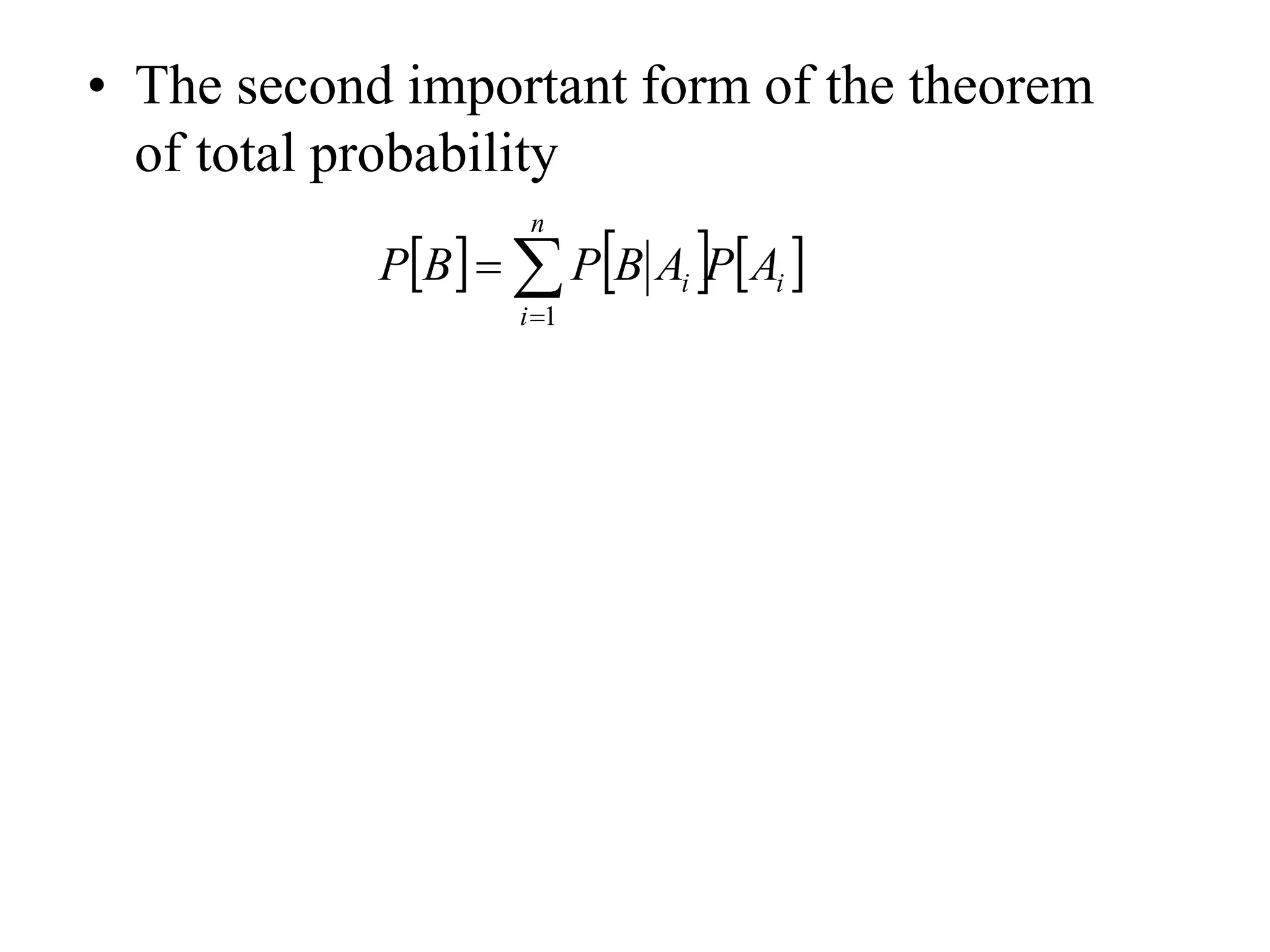
• The second important form of the theorem
of total probability
     
i
n
i
i A
P
A
B
P
B
P 


1
• Bayes’ theorem
   
 


 n
j
j
j
i
i
i
A
P
A
AB
P
A
P
A
AB
P
B
A
P
1
]
[
]
[
Random variables
• Random variable is a variable whose value
depends upon the outcome of a random
experiment
• To each outcome, we associate a real number,
which is in fact the value the random variable
takes on that outcome
• Random variable is a mapping from the points of
the sample space into the (real) line
• Example: If we win the game we win $5, if
we lose we win -$5 and if we draw we win
$0.
W
(3/8)
D
(1/4)
L
(3/8)
S
L
D
W
5
0
5
)
(















X
 
8
3
5
4
1
0
8
3
5
x
to
equal
is
)
X(
y that
probabilit
)
(
:
]
[
:
Notation












]
P[X
]
P[X
]
-
P[X
x]
P[X
x
X
x
X



• Probability distribution function (PDF), also
known as the cumulative distribution
function
 
b
a
for
)
(
)
(
b
a
for
b]
X
P[a
)
(
)
(
0
)
(
1
)
(
0
)
(
:
Properties
)
(
:
PDF

















a
F
b
F
a
F
b
F
F
F
x
F
x
X
P
x
F
x
x
x
x
x
x
x
X
+5
-5 0
x
)
(x
FX
4
1
8
3
8
3
8
5
1
0
]
4
1
[
8
5
]
6
2
[







x
P
x
P
e
upper valu
on the
takes
PDF
ity the
discontinu
of
points
At

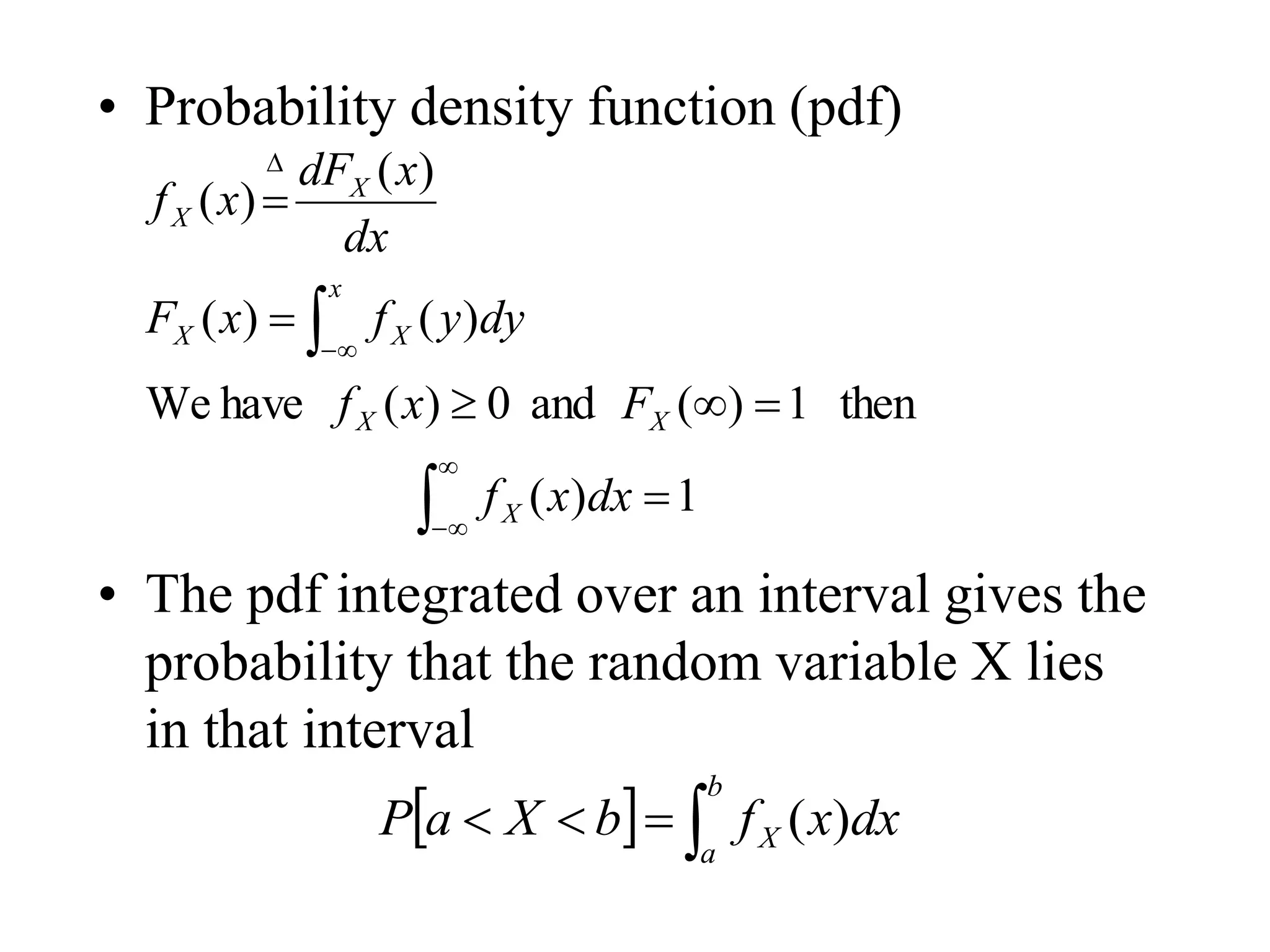
• Probability density function (pdf)
• The pdf integrated over an interval gives the
probability that the random variable X lies
in that interval














1
)
(
then
1
)
(
and
0
)
(
have
We
)
(
)
(
)
(
)
(
dx
x
f
F
x
f
dy
y
f
x
F
dx
x
dF
x
f
X
X
X
x
X
X
X
X
  



b
a
X dx
x
f
b
X
a
P )
(
• Distributed random variable
b
a
b
a
X
b
a
X
X
x
X
x
X
e
e
dx
x
f
b
x
a
P
e
e
a
F
b
F
b
x
a
P
x
x
e
x
f
x
x
e
x
F







































 )
(
]
[
)
(
)
(
]
[
0
0
0
)
(
:
pdf
0
0
0
0
1
)
(
:
PDF
dx
x
f
x
dF
x
f
x
dF
x
F
)
(
)
(
)
(
)
(
pdf
and
)
(
PDF





dx
x
xf
X
X
E
x
xdF
X
X
E
X
X
)
(
]
[
)
(
]
[
is
variable
random
real
a
of
n
expectatio
The














• The expectation of the sum of two random
variables is always equal to the sum of the
expectations of each variable
• This is true even if the variables are dependent
• The expectation operator is a linear operator
]
[
...
]
[
]
[
]
...
[ 2
1
2
1 n
n X
E
X
E
X
E
X
X
X
E 






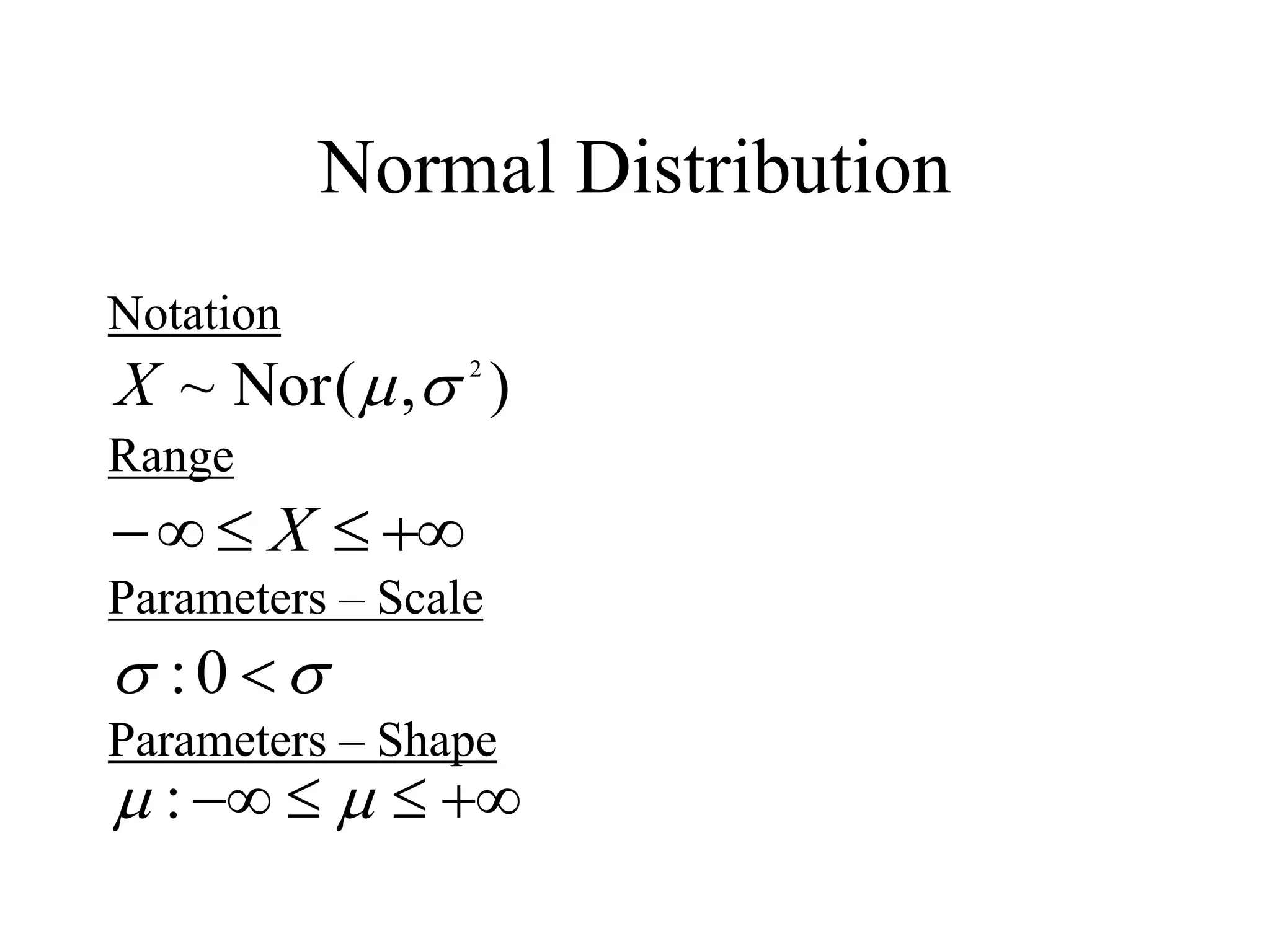
Normal Distribution
Notation
Range
Parameters – Scale
Parameters – Shape
)
,
(
Nor
~ 2


X




 X

 
0
:



 
 :
Normal
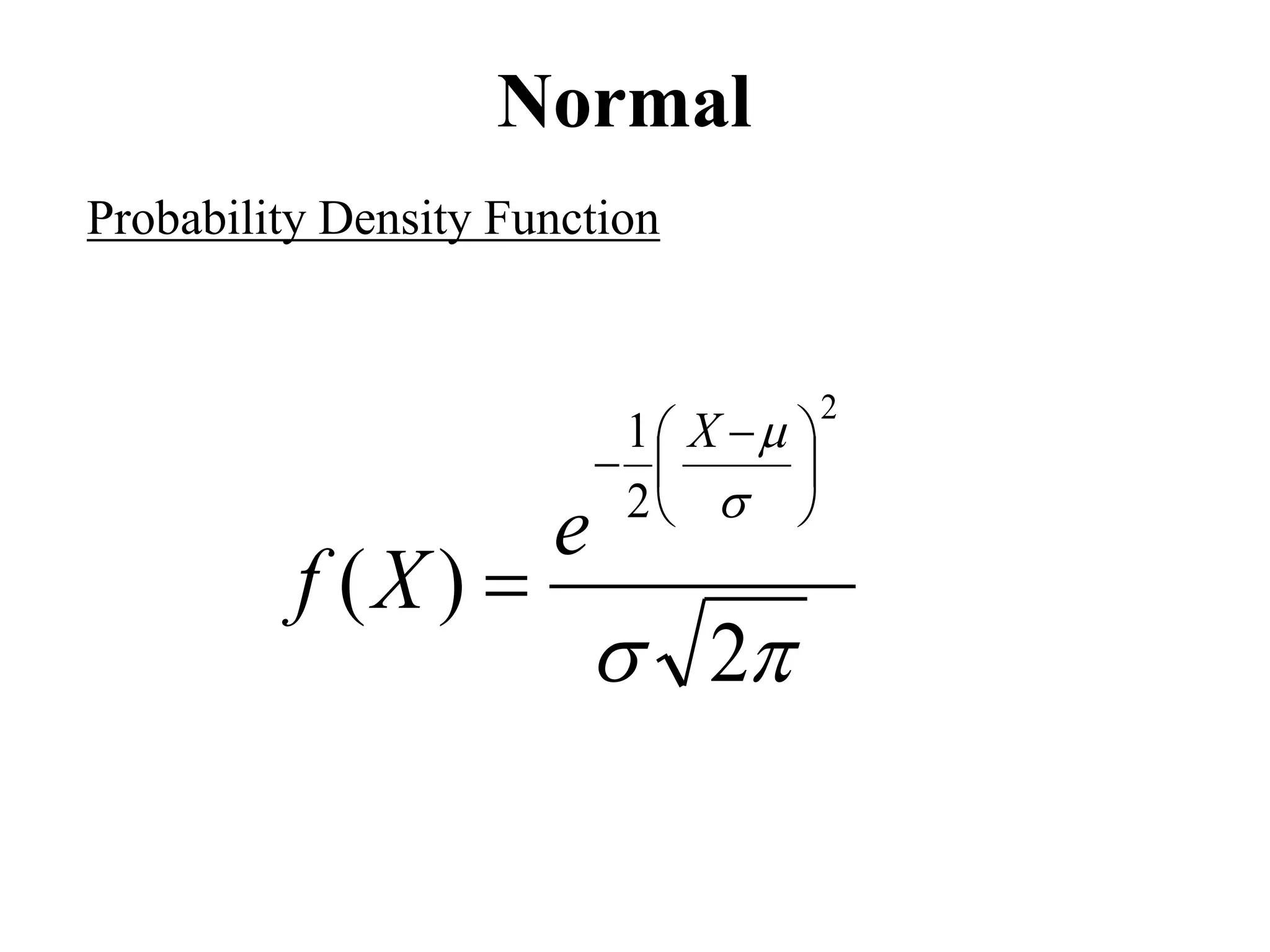
Probability Density Function




2
)
(
2
2
1





 


X
e
X
f
Normal
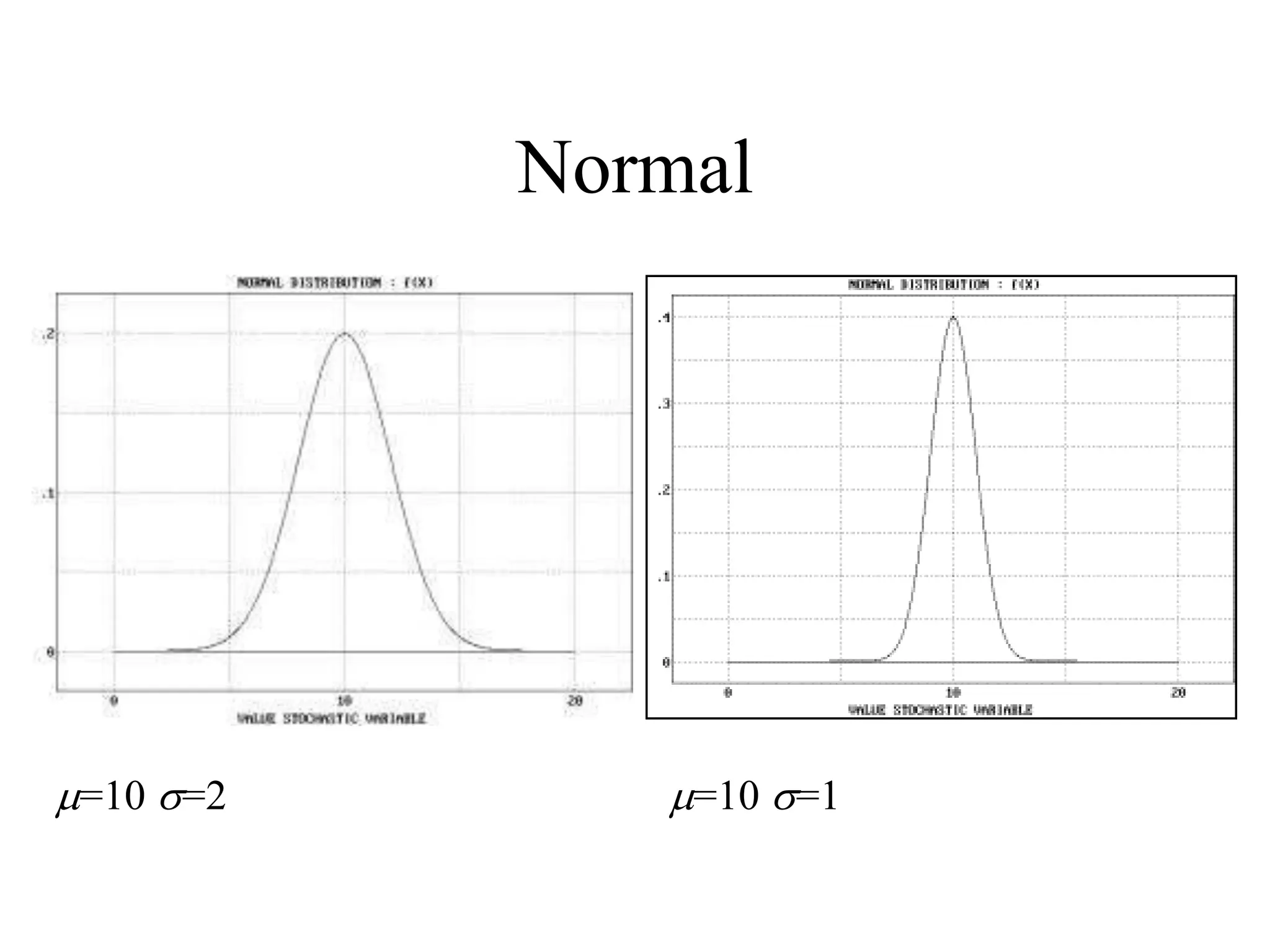
=10 =2 =10 =1
Normal
=0 =2 =0 =1
Normal
=0 =1
Normal
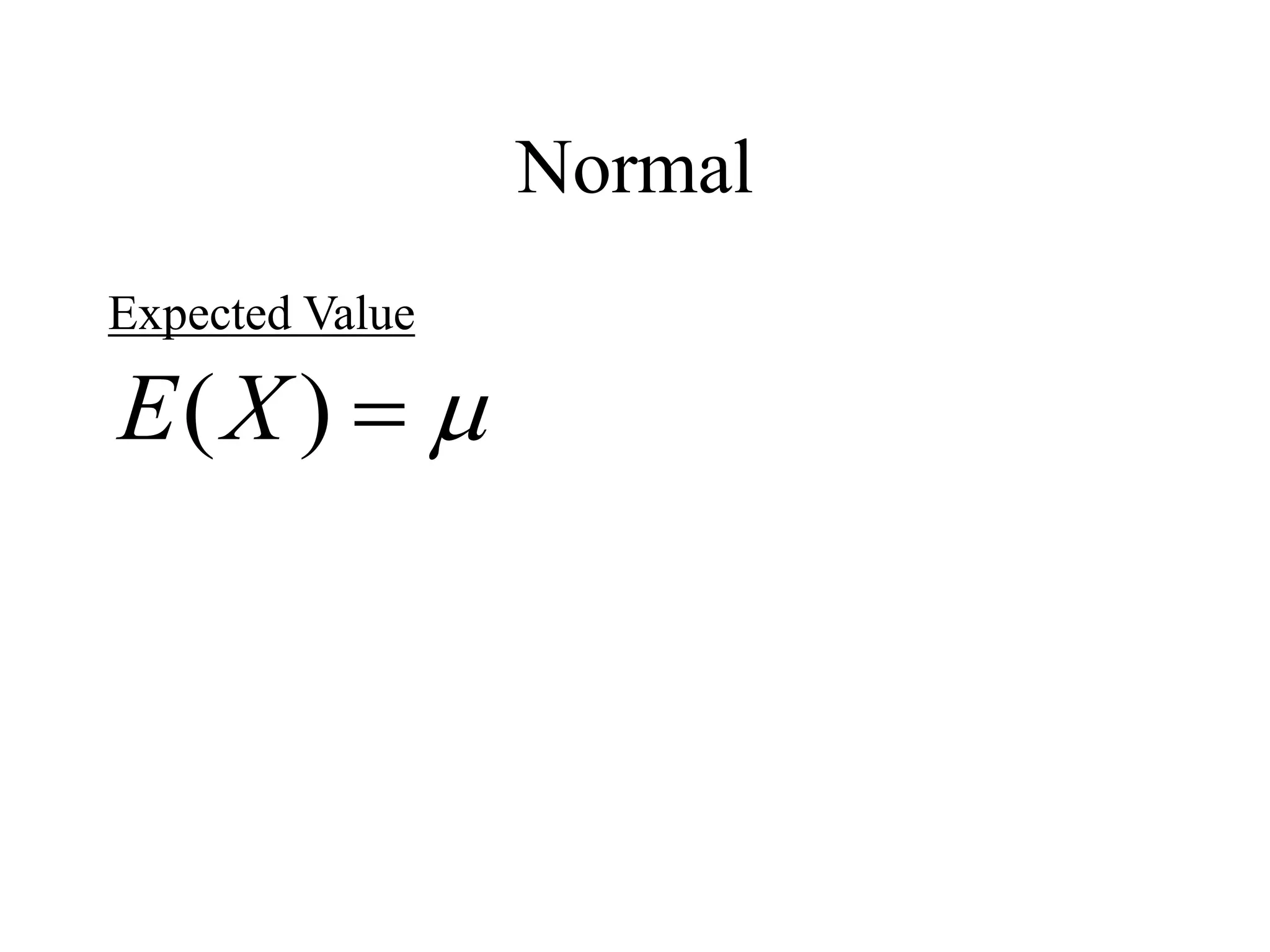
Expected Value


)
(X
E
Normal
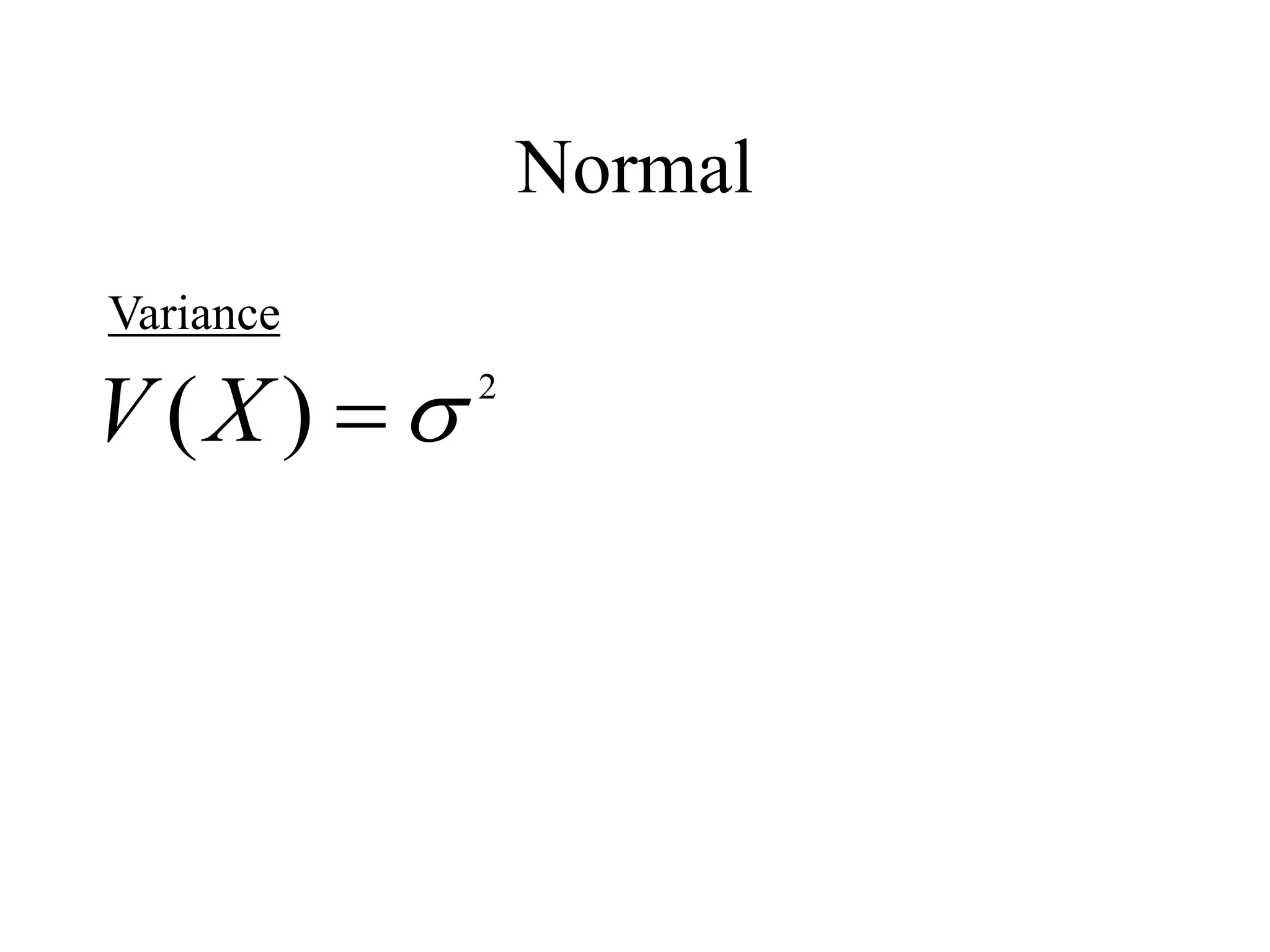
Variance
2
)
( 

X
V
Exponential
Probability Density Function
Distribution Function
X
e
X
f 
 

)
(
X
e
X
F 


1
)
(

probability.pptx

  • 1.
    Probability Basic • Introduction:Basic concepts Random experiments & events • Elementary Theorems • Probabilistic Modelling • Independence • Transformations • Moments
  • 2.
    Real-world experiments: 1. Aset of possible experimental outcomes 2. A grouping of these outcomes into classes called results 3. The relative frequency of these classes in many independent trials of the experiment 4. Frequency is number of times the experimental outcome falls into that class, divided by number of times the experiment is performed.
  • 3.
    Experiment • A randomexperiment: is an experiment we do not know its exact outcome in advance but we know the set of all possible outcomes.
  • 4.
    1. Mathematical model:three quantities of interest that are in one-to-one relation with the three quantities of experimental world 2. A sample space is a collection of objects that corresponds to the set of mutually exclusive exhaustive outcomes of the model of an experiment. Each object  is in the set S is referred to as a sample point 1. A family of events  denoted {A, B, C,…}in which each event is a set of samples points { }
  • 5.
    3. A probabilitymeasure P which is an assignment (mapping) of the events defined on S into the set of real numbers. The notation is P[A], and have these mapping properties: a) For any event A,0 <= P[A] <=1 (II.1) b) P[S]=1 (II.2) c) If A and B are “mutually exclusive” events then P[A U B]=P[A]+P[B] (II.3)
  • 6.
    • Two eventsA, B are said to be statistically independent if and only if • Theorem of total probability If the event B is to occur it must occur in conjunction with exactly one of the mutually exclusive exhaustive events A       B P A P AB P         n i i B A P B P 1 i
  • 7.
    • The secondimportant form of the theorem of total probability       i n i i A P A B P B P    1
  • 8.
    • Bayes’ theorem         n j j j i i i A P A AB P A P A AB P B A P 1 ] [ ] [
  • 9.
    Random variables • Randomvariable is a variable whose value depends upon the outcome of a random experiment • To each outcome, we associate a real number, which is in fact the value the random variable takes on that outcome • Random variable is a mapping from the points of the sample space into the (real) line
  • 10.
    • Example: Ifwe win the game we win $5, if we lose we win -$5 and if we draw we win $0. W (3/8) D (1/4) L (3/8) S L D W 5 0 5 ) (                X   8 3 5 4 1 0 8 3 5 x to equal is ) X( y that probabilit ) ( : ] [ : Notation             ] P[X ] P[X ] - P[X x] P[X x X x X   
  • 11.
    • Probability distributionfunction (PDF), also known as the cumulative distribution function   b a for ) ( ) ( b a for b] X P[a ) ( ) ( 0 ) ( 1 ) ( 0 ) ( : Properties ) ( : PDF                  a F b F a F b F F F x F x X P x F x x x x x x x X
  • 12.
  • 13.
    • Probability densityfunction (pdf) • The pdf integrated over an interval gives the probability that the random variable X lies in that interval               1 ) ( then 1 ) ( and 0 ) ( have We ) ( ) ( ) ( ) ( dx x f F x f dy y f x F dx x dF x f X X X x X X X X       b a X dx x f b X a P ) (
  • 14.
    • Distributed randomvariable b a b a X b a X X x X x X e e dx x f b x a P e e a F b F b x a P x x e x f x x e x F                                         ) ( ] [ ) ( ) ( ] [ 0 0 0 ) ( : pdf 0 0 0 0 1 ) ( : PDF
  • 15.
  • 16.
    • The expectationof the sum of two random variables is always equal to the sum of the expectations of each variable • This is true even if the variables are dependent • The expectation operator is a linear operator ] [ ... ] [ ] [ ] ... [ 2 1 2 1 n n X E X E X E X X X E       
  • 17.
    Normal Distribution Notation Range Parameters –Scale Parameters – Shape ) , ( Nor ~ 2   X      X    0 :       :
  • 18.
  • 19.
  • 20.
  • 21.
  • 22.
  • 23.
  • 24.
    Exponential Probability Density Function DistributionFunction X e X f     ) ( X e X F    1 ) (