Probabilistic Content Model,
with Applications to Generation and Summarization
BRYAN ZHANG HANG|
Outline:
Goal: Modeling Topic Structures of Text
We will use:
 Hidden Markov Model
 Bigrams
 Clustering
Application:
 Sentence Ordering
 Extractive Summerization
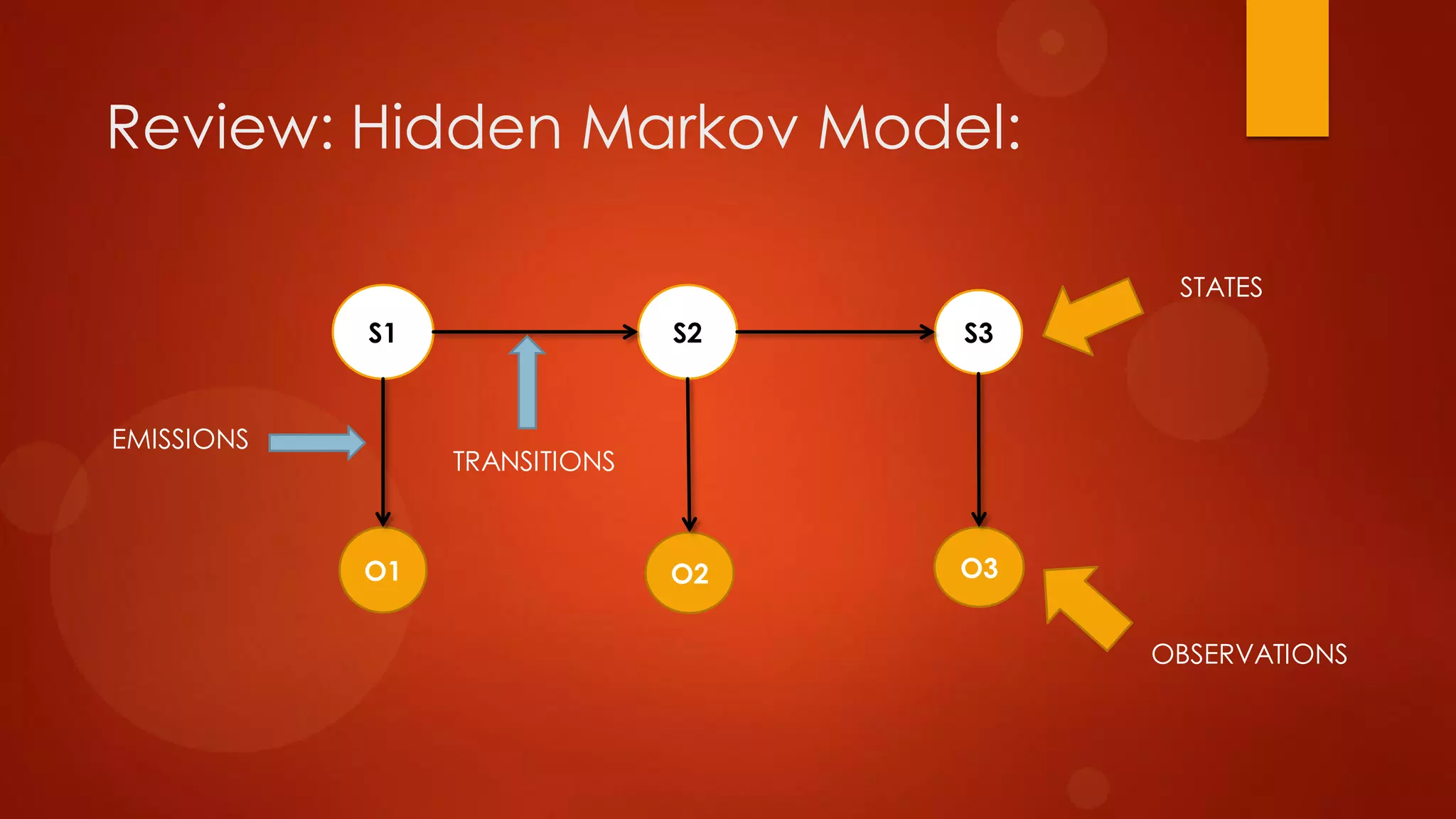
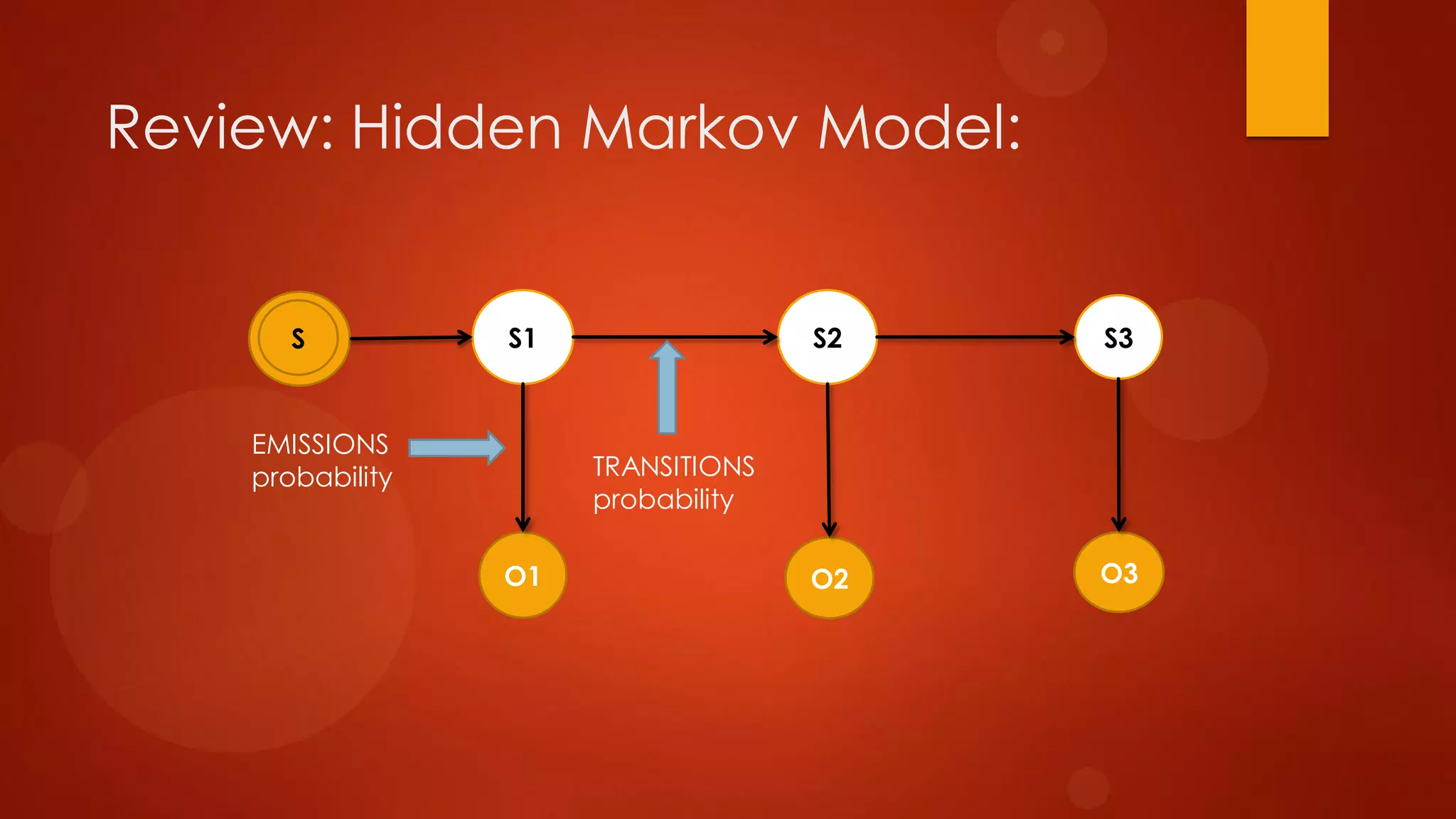
Review: Hidden Markov Model:
S1 S2 S3
O1 O3O2
STATES
OBSERVATIONS
TRANSITIONS
EMISSIONS
Imagine :
 You call your friend who lives in a foreign country from time to tim
e. Every time you ask him or her “ What are you up to?”
 The possible answers are:
“ walk” “ice cream” “shopping”
“reading” “programming” “kayaking”
Review: Hidden Markov Model:
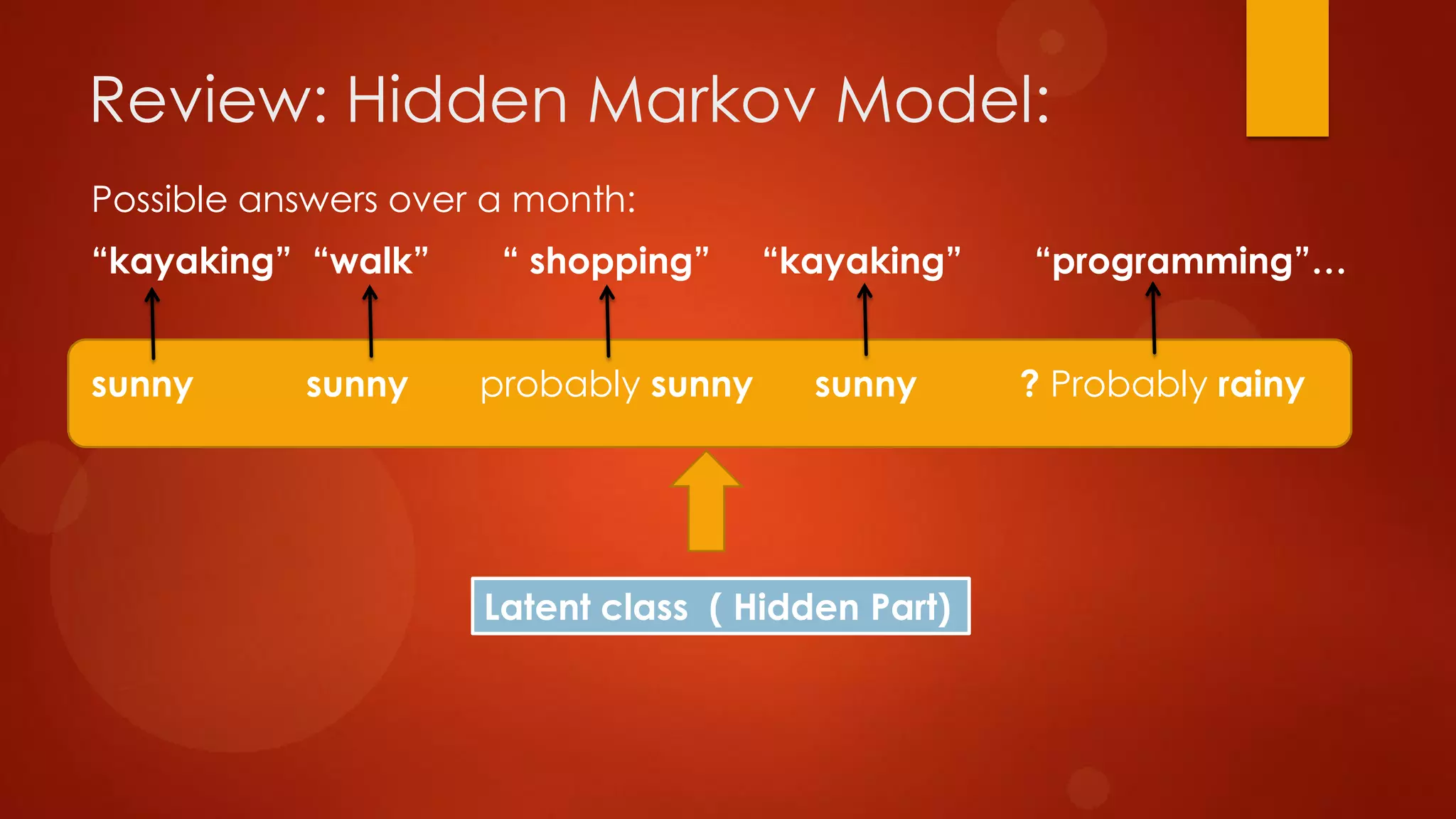
Possible answers over a month:
“kayaking” “walk” “ shopping” “kayaking” “programming”…
sunny sunny probably sunny sunny ? Probably rainy
Review: Hidden Markov Model:
Latent class ( Hidden Part)
Review: Hidden Markov Model:
S1 S2 S3
O1 O3O2
TRANSITIONS
probability
EMISSIONS
probability
S
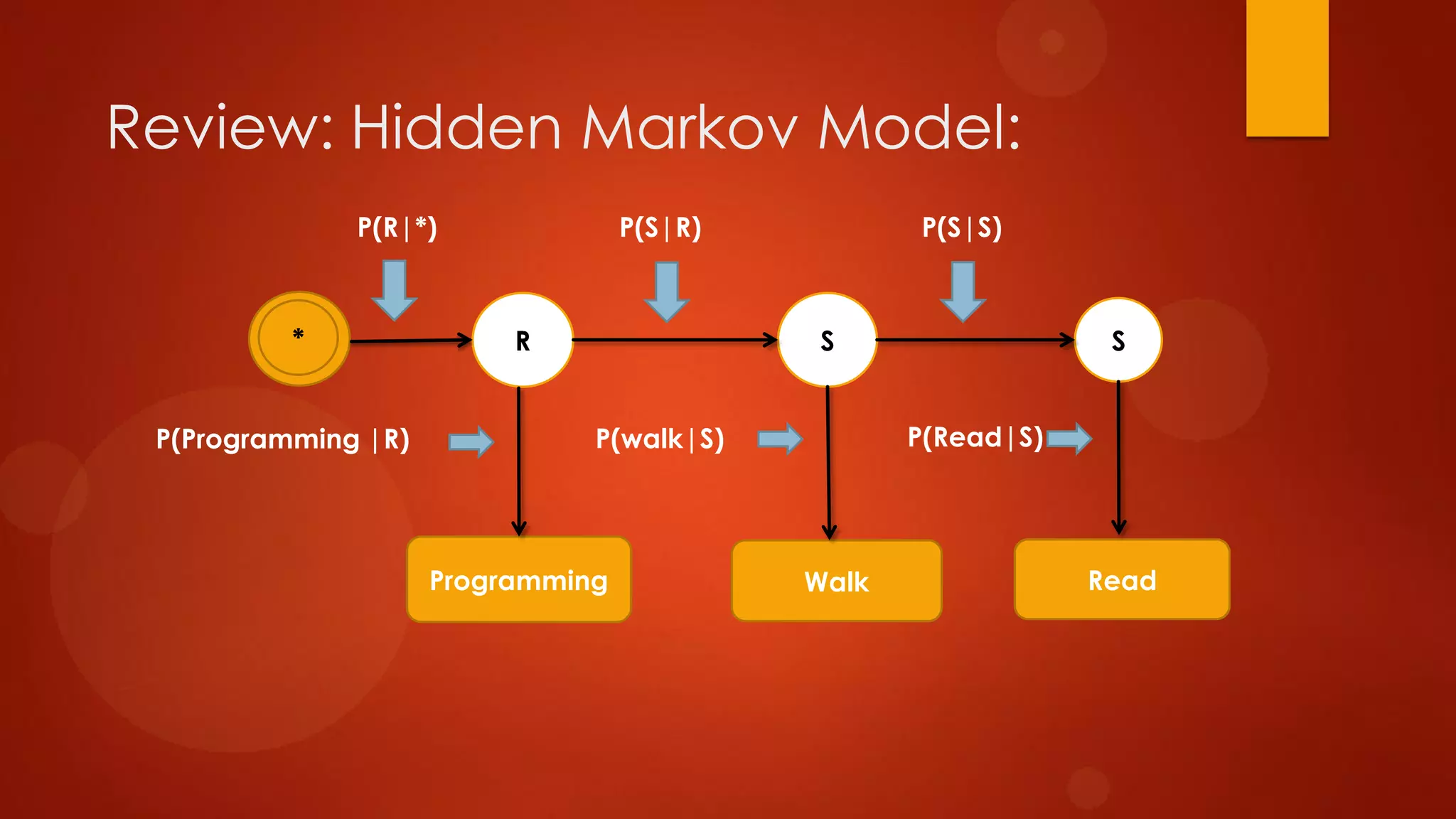
Review: Hidden Markov Model:
R S S
Programming ReadWalk
P(Programming |R)
*
P(R|*) P(S|R) P(S|S)
P(walk|S) P(Read|S)
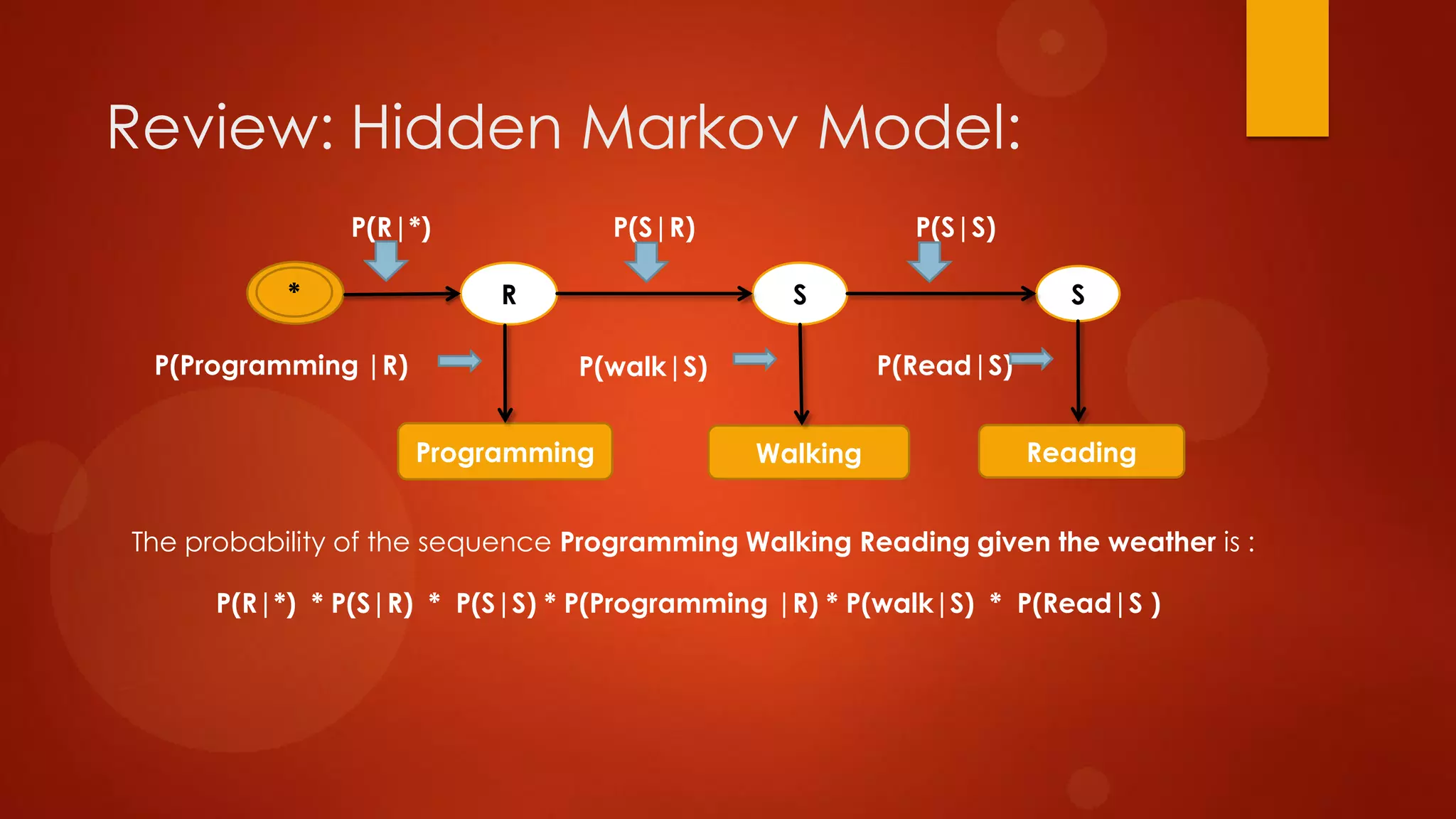
Review: Hidden Markov Model:
R S S
Programming ReadingWalking
P(Programming |R)
*
P(R|*) P(S|R) P(S|S)
P(walk|S) P(Read|S)
The probability of the sequence Programming Walking Reading given the weather is :
P(R|*) * P(S|R) * P(S|S) * P(Programming |R) * P(walk|S) * P(Read|S )
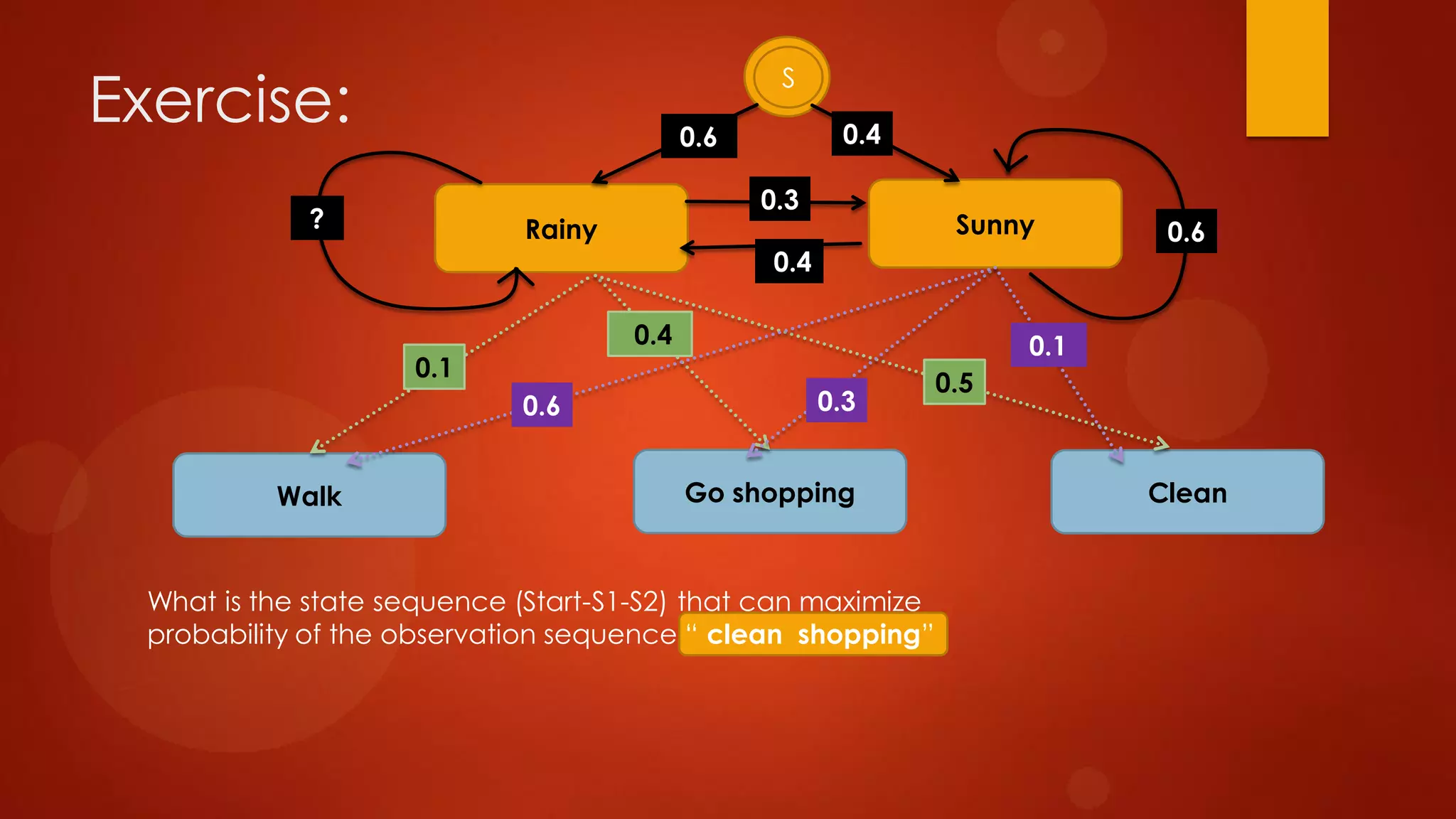
Exercise:
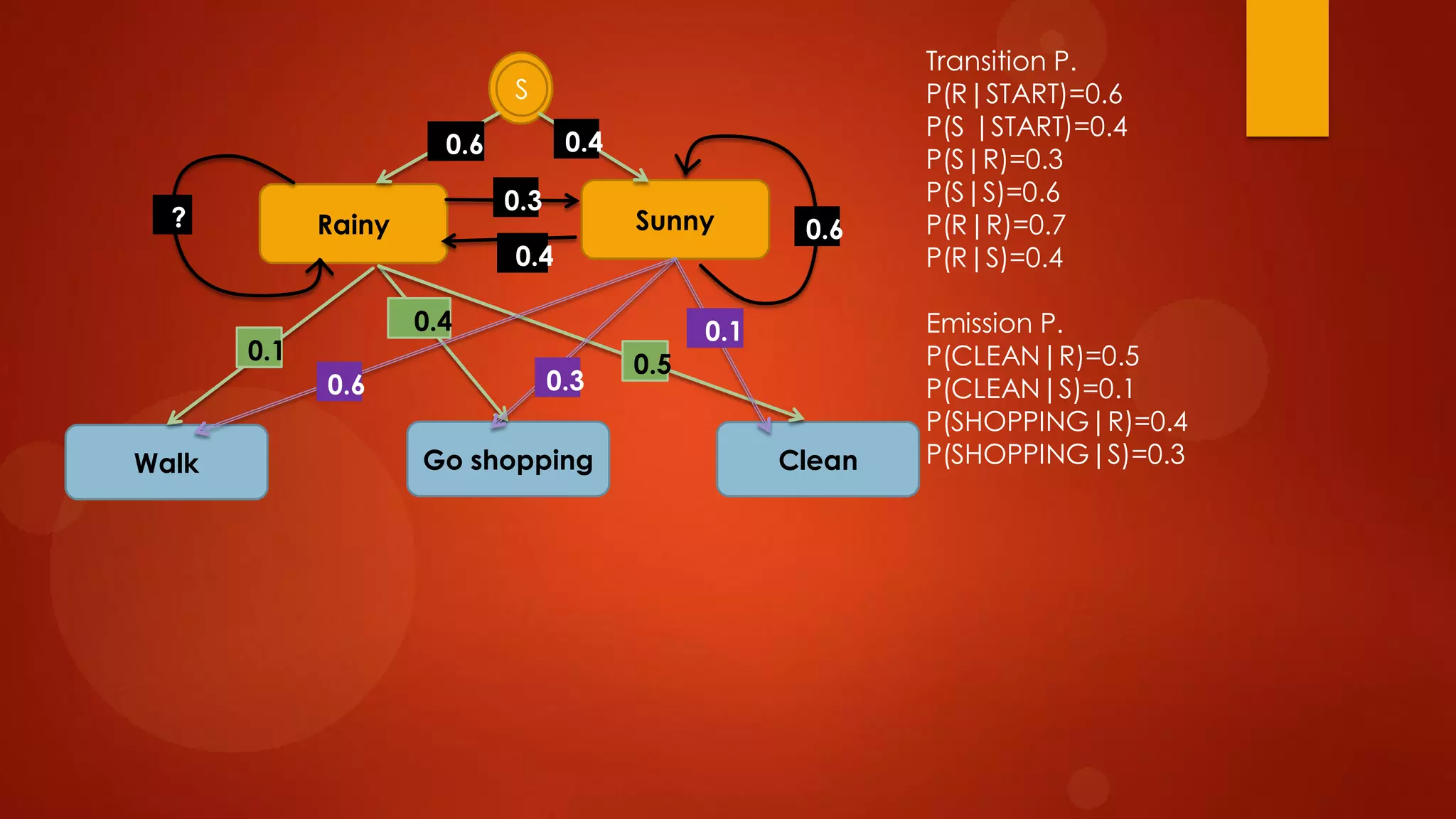
Rainy Sunny
Walk CleanGo shopping
S
0.1
0.4
0.5
0.6 0.3
0.1
0.3
0.4
0.6?
0.40.6
What is the state sequence (Start-S1-S2) that can maximize
probability of the observation sequence “ clean shopping”
Rainy Sunny
Walk CleanGo shopping
S
0.1
0.4
0.5
0.6 0.3
0.1
0.3
0.4
0.6?
0.40.6
Transition P.
P(R|START)=0.6
P(S |START)=0.4
P(S|R)=0.3
P(S|S)=0.6
P(R|R)=0.7
P(R|S)=0.4
Emission P.
P(CLEAN|R)=0.5
P(CLEAN|S)=0.1
P(SHOPPING|R)=0.4
P(SHOPPING|S)=0.3
Transition P.
P(R|START)=0.6
P(S |START)=0.4
P(S|R)=0.3
P(S|S)=0.6
P(R|R)=0.7
P(R|S)=0.4
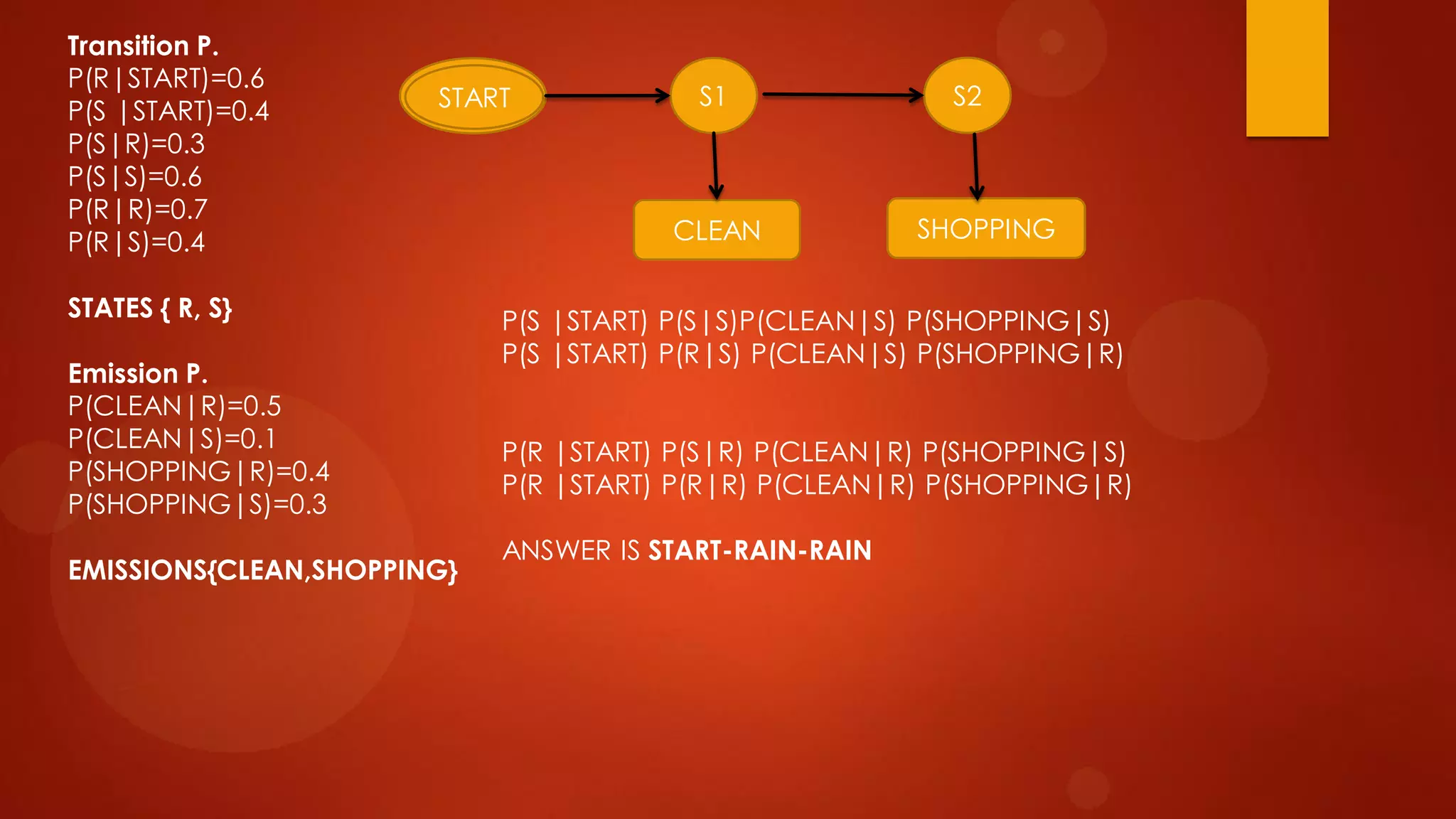
STATES { R, S}
Emission P.
P(CLEAN|R)=0.5
P(CLEAN|S)=0.1
P(SHOPPING|R)=0.4
P(SHOPPING|S)=0.3
EMISSIONS{CLEAN,SHOPPING}
START S1 S2
CLEAN SHOPPING
START
P(S |START) P(S|S)P(CLEAN|S) P(SHOPPING|S)
P(S |START) P(R|S) P(CLEAN|S) P(SHOPPING|R)
P(R |START) P(S|R) P(CLEAN|R) P(SHOPPING|S)
P(R |START) P(R|R) P(CLEAN|R) P(SHOPPING|R)
ANSWER IS START-RAIN-RAIN
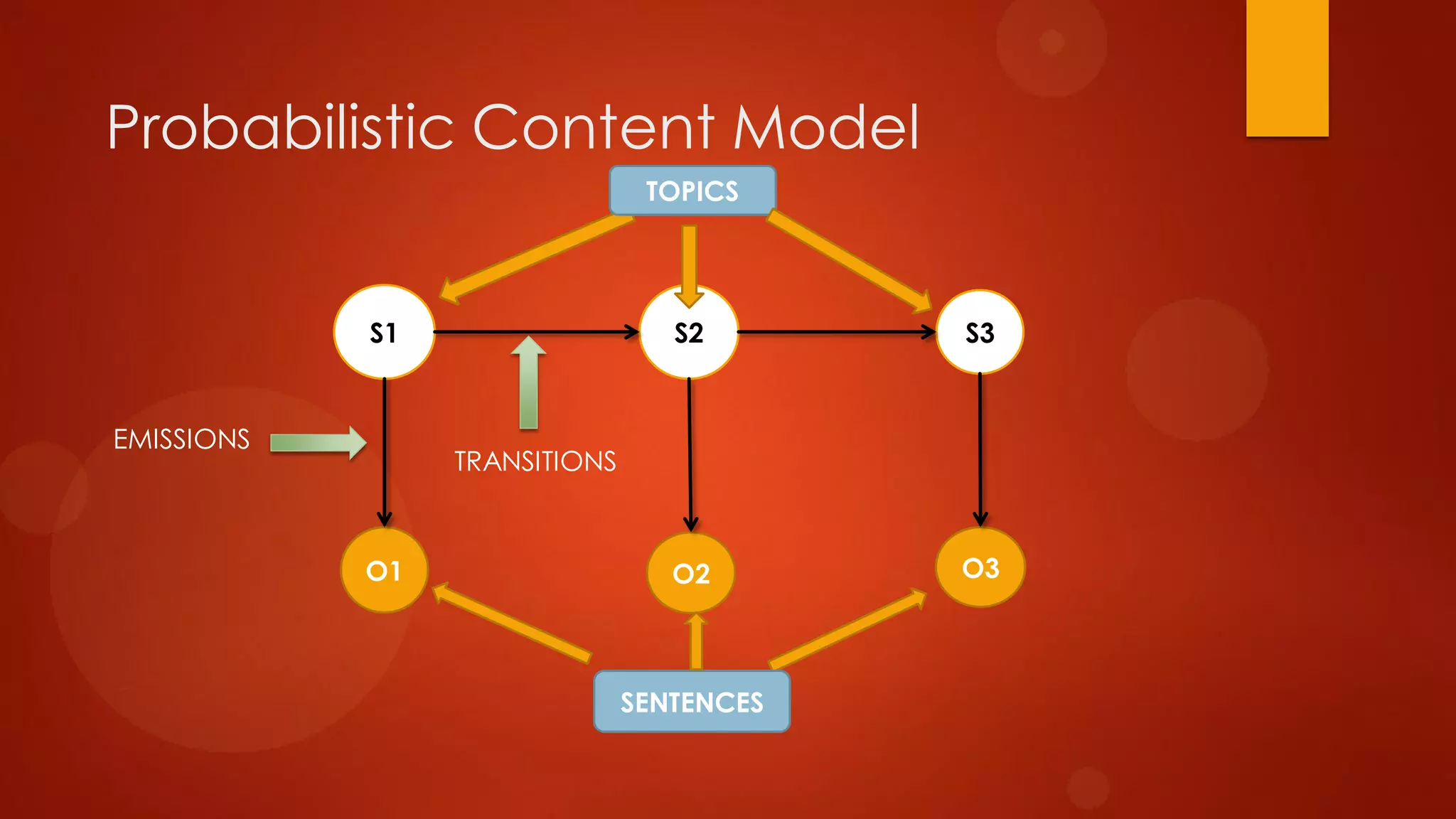
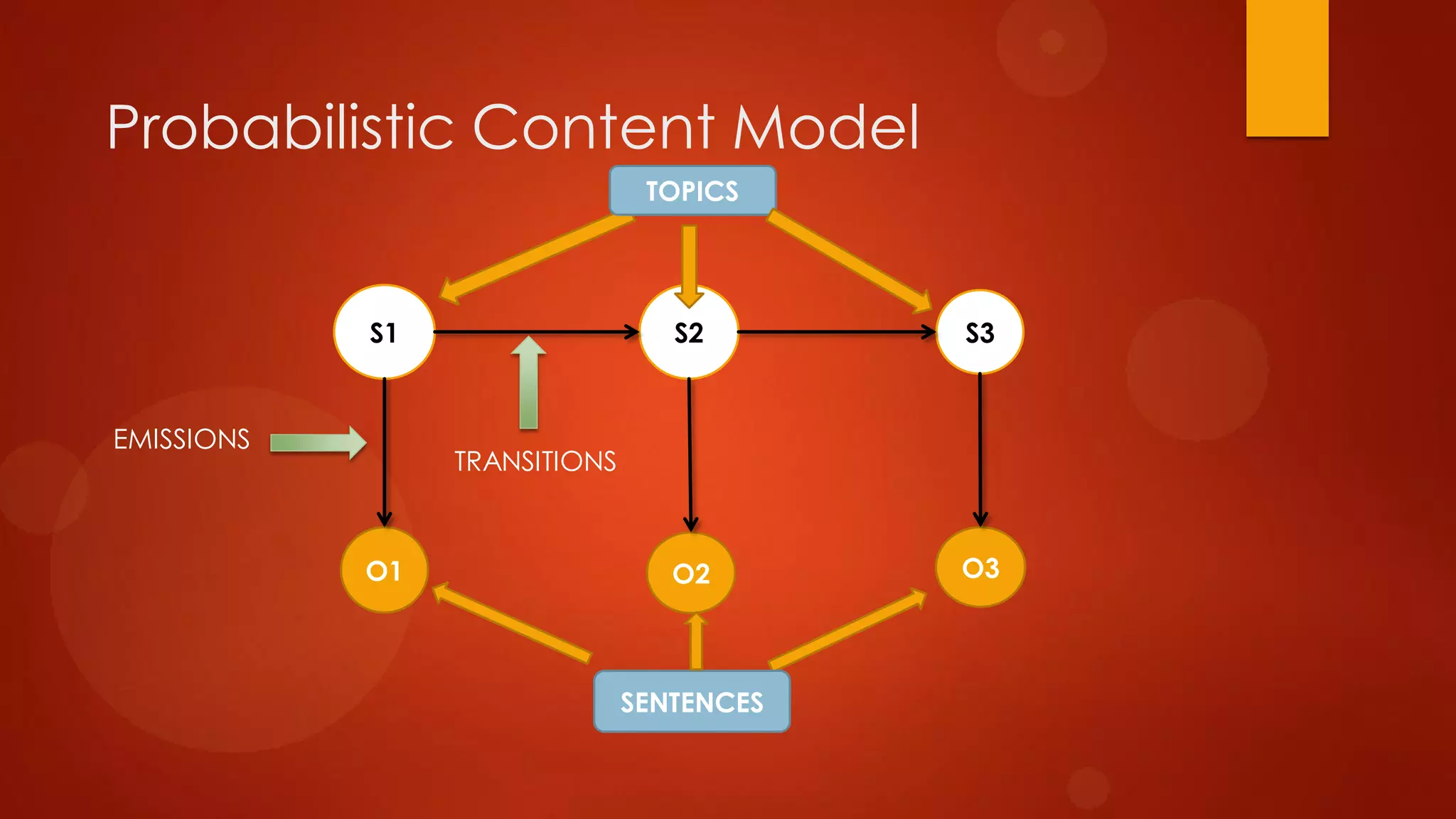
Probabilistic Content Model
S1 S2 S3
O1 O3O2
TOPICS
TRANSITIONS
EMISSIONS
SENTENCES
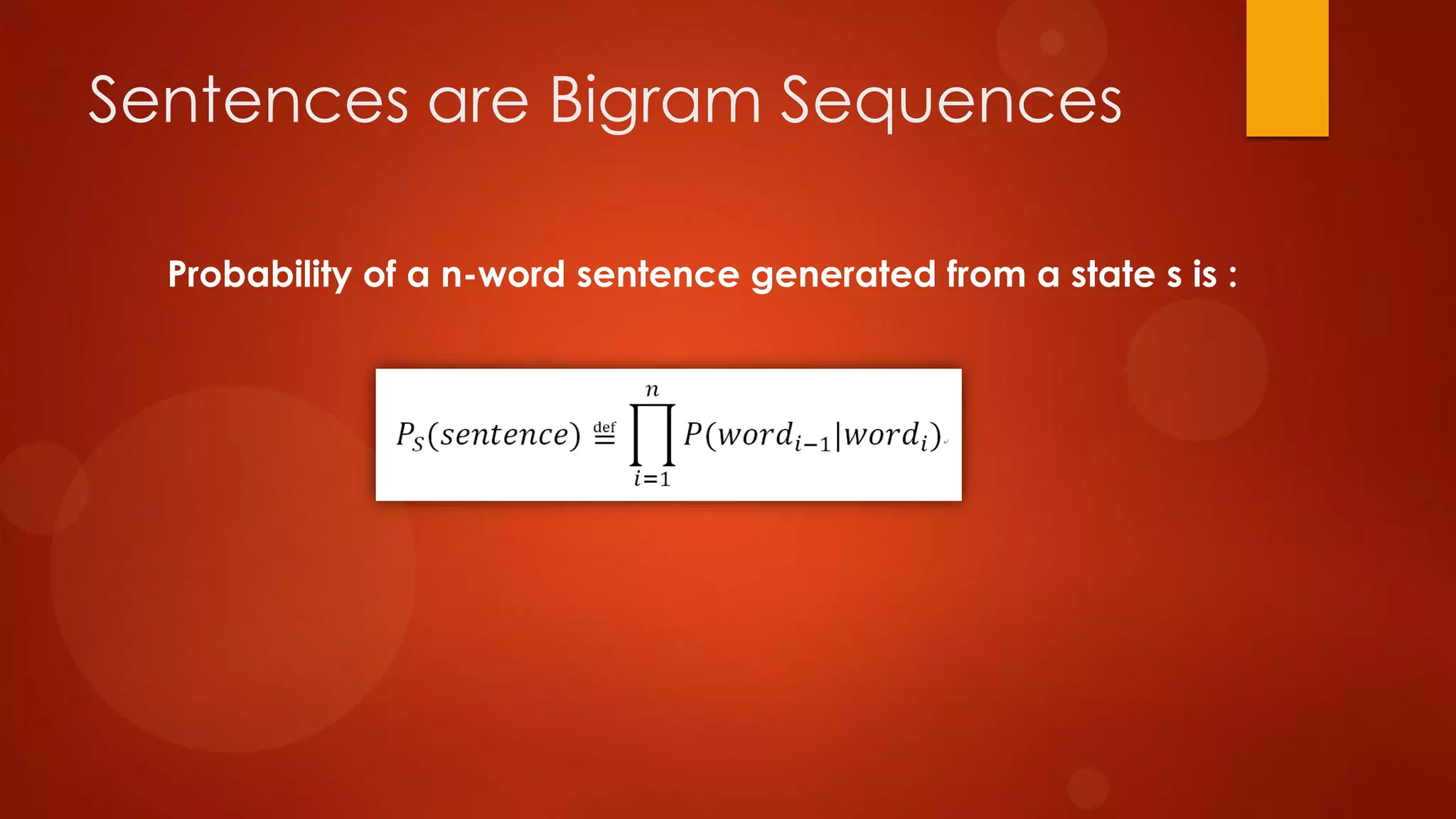
Sentences are Bigram Sequences
Probability of a n-word sentence generated from a state s is :
Probabilistic Content Model
S1 S2 S3
O1 O3O2
TOPICS
TRANSITIONS
EMISSIONS
SENTENCES
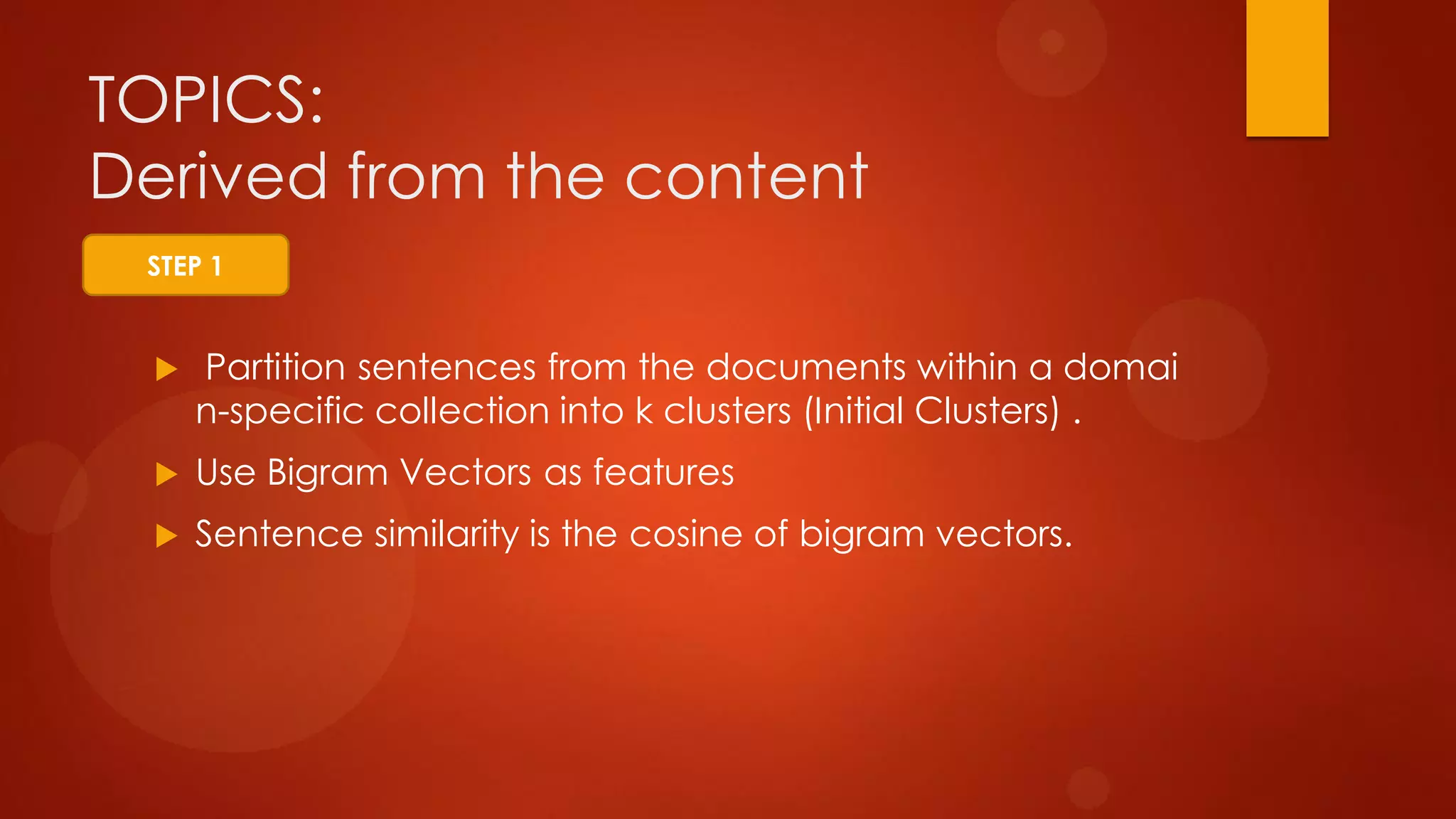
TOPICS:
Derived from the content
 Partition sentences from the documents within a domai
n-specific collection into k clusters (Initial Clusters) .
 Use Bigram Vectors as features
 Sentence similarity is the cosine of bigram vectors.
STEP 1
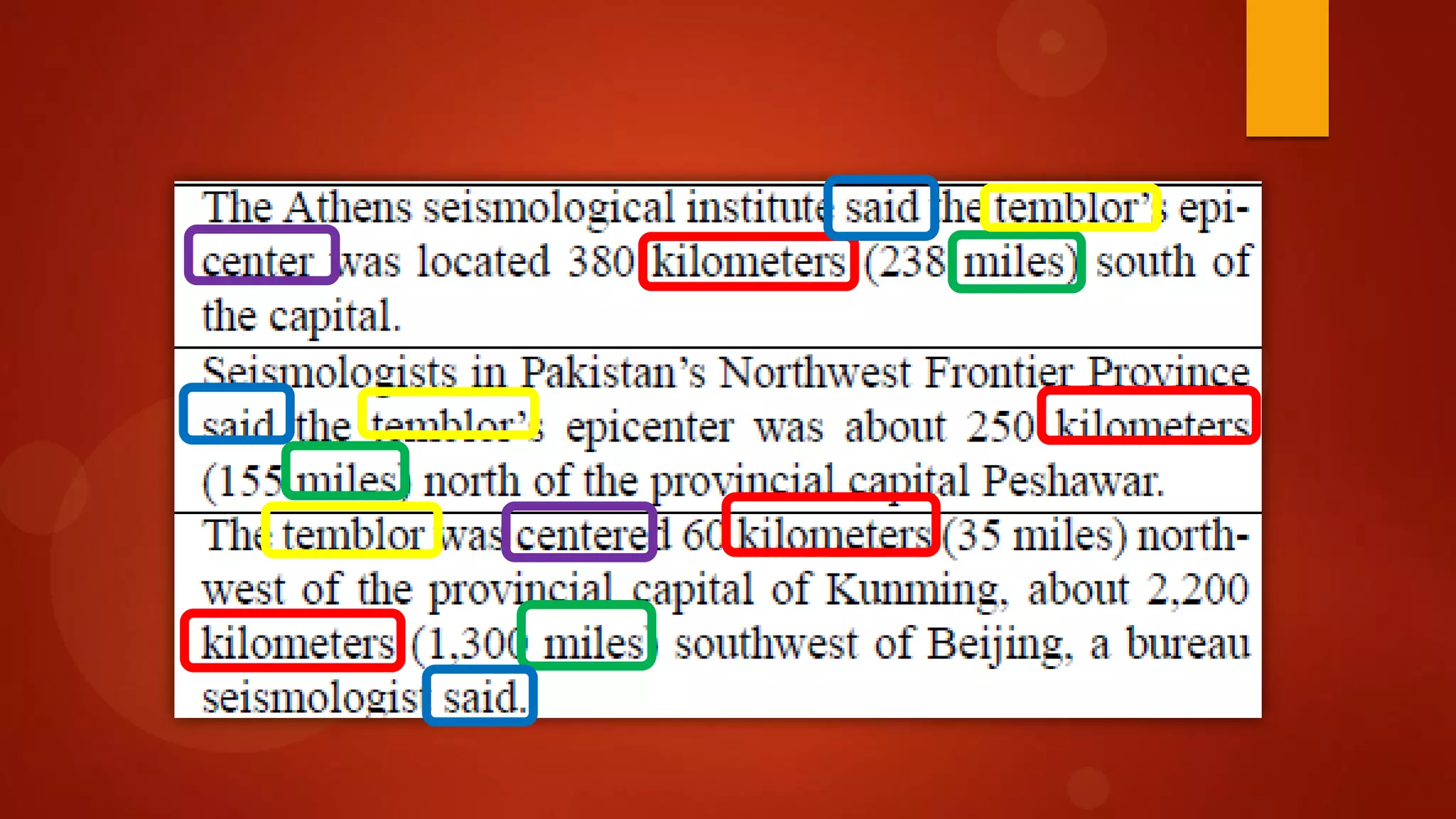
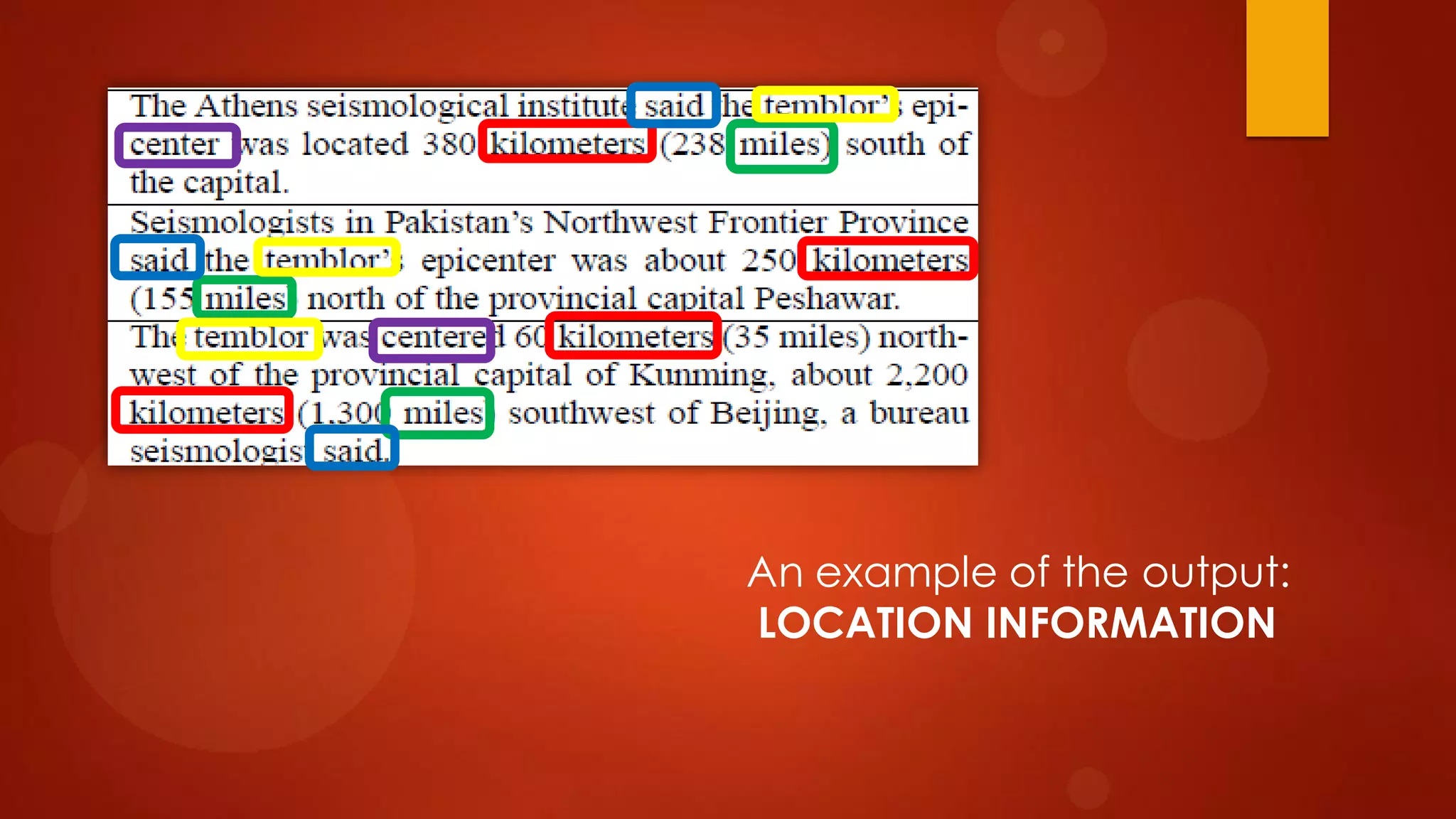
An example of the output:
LOCATION INFORMATION
TOPICS:
Derived from the content
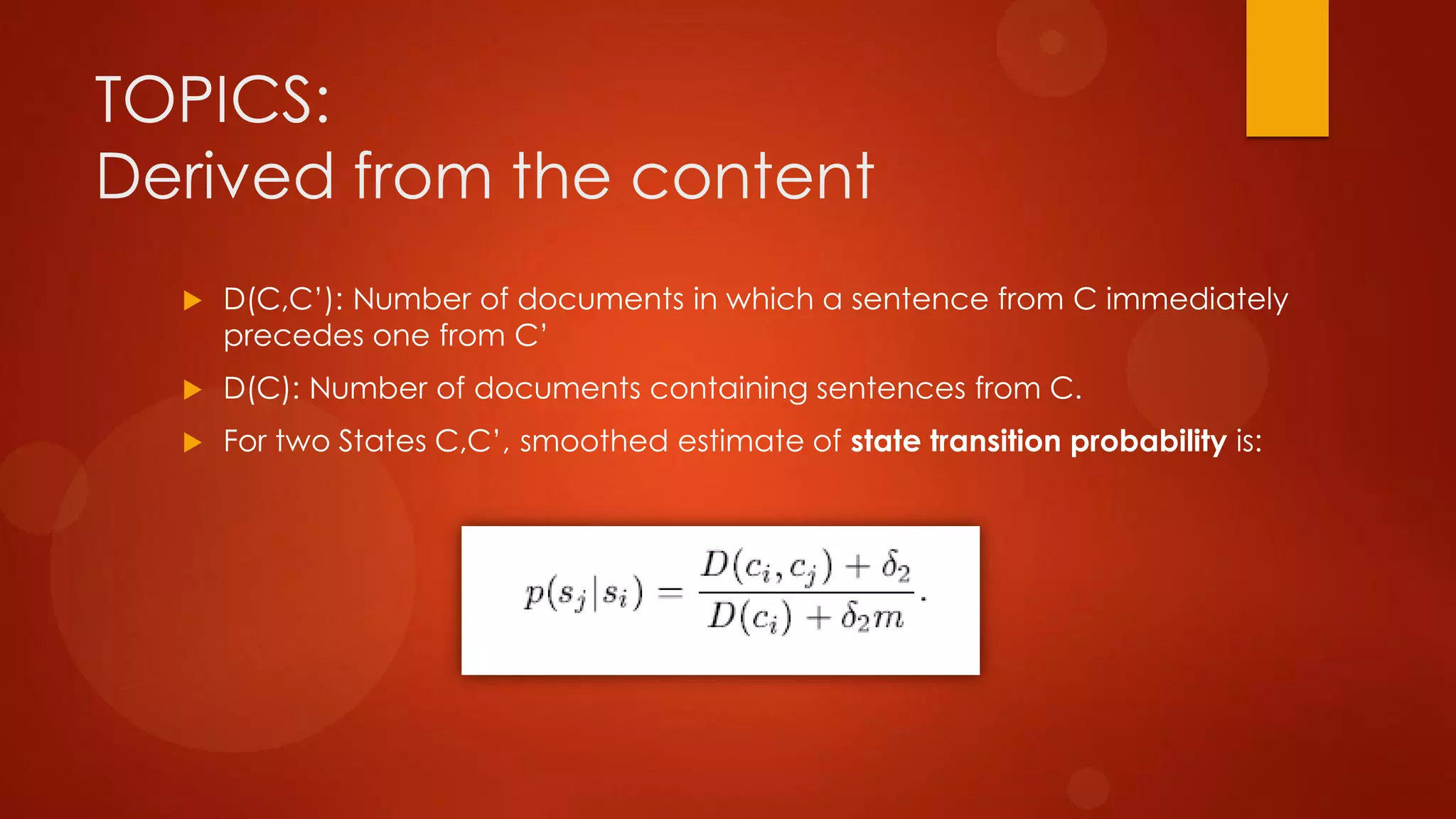
 D(C,C’): Number of documents in which a sentence from C immediately
precedes one from C’
 D(C): Number of documents containing sentences from C.
 For two States C,C’, smoothed estimate of state transition probability is:
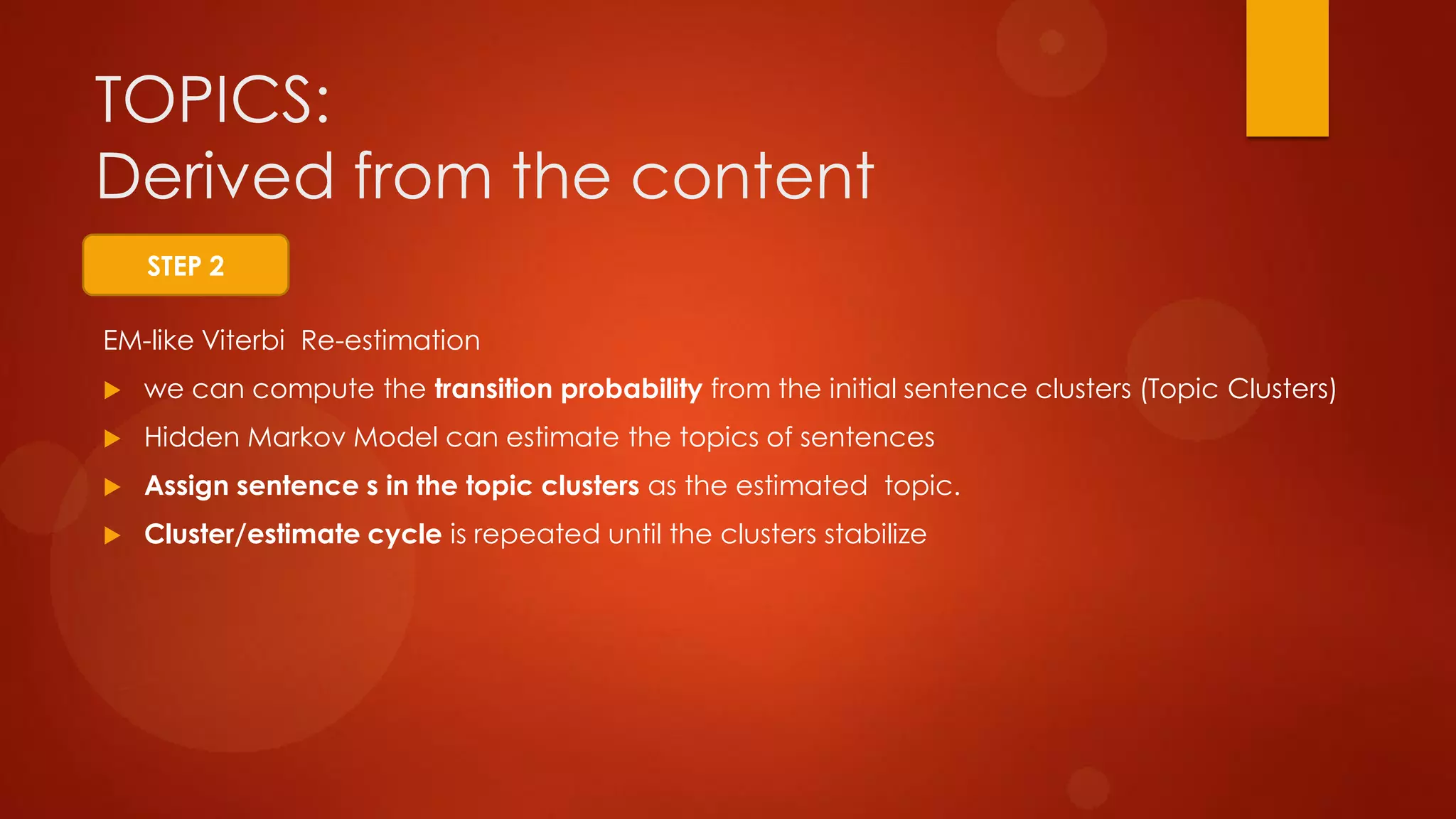
EM-like Viterbi Re-estimation
 we can compute the transition probability from the initial sentence clusters (Topic Clusters)
 Hidden Markov Model can estimate the topics of sentences
 Assign sentence s in the topic clusters as the estimated topic.
 Cluster/estimate cycle is repeated until the clusters stabilize
TOPICS:
Derived from the content
STEP 2
Evaluation Task 1
Information Ordering
 Information ordering task is essential to many text-
synthesis applications
e.g. concept-to-text generation, multi-document
summarization.
Evaluation Task 1
Information Ordering
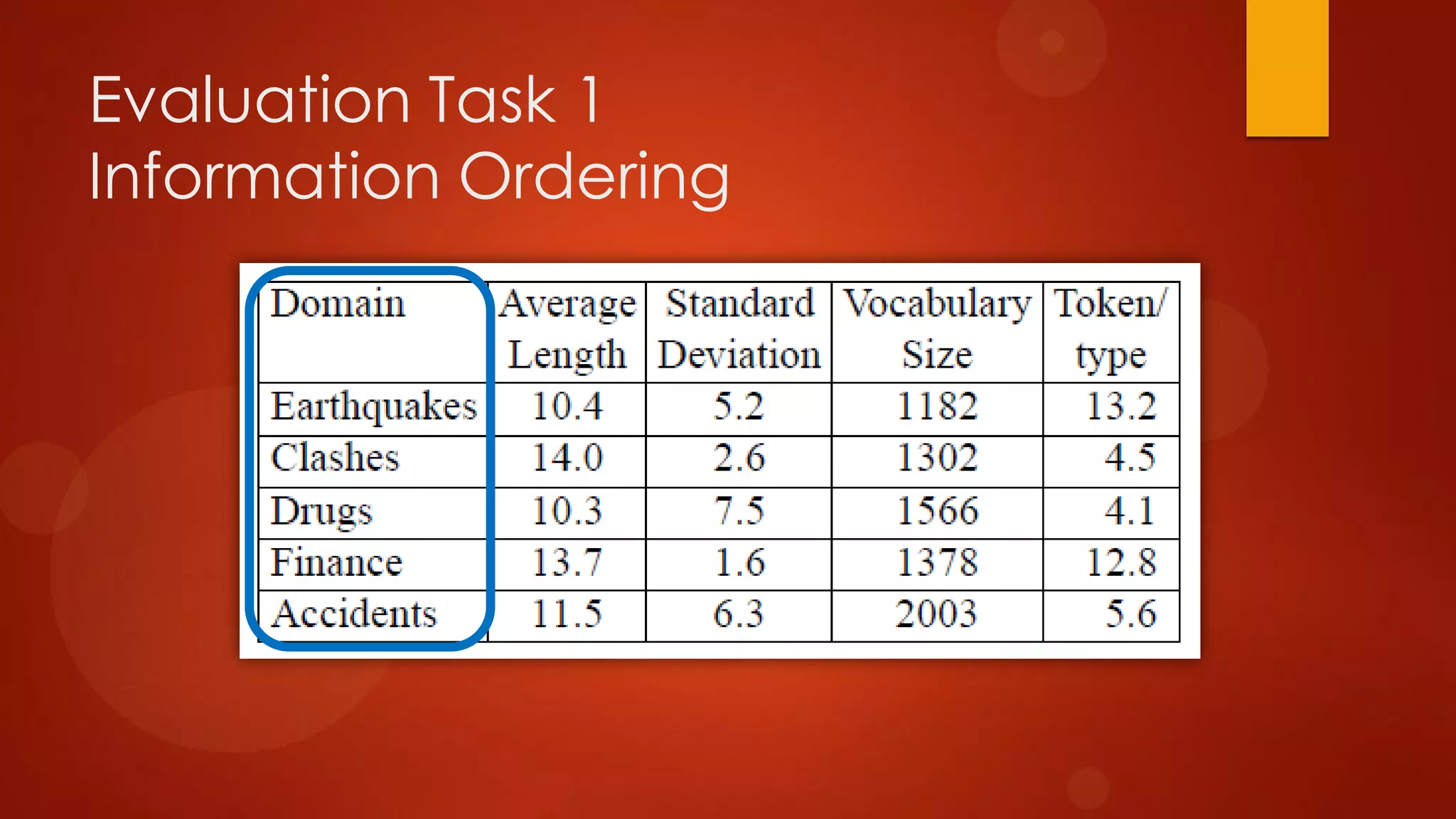
Evaluation Task 1
Information Ordering
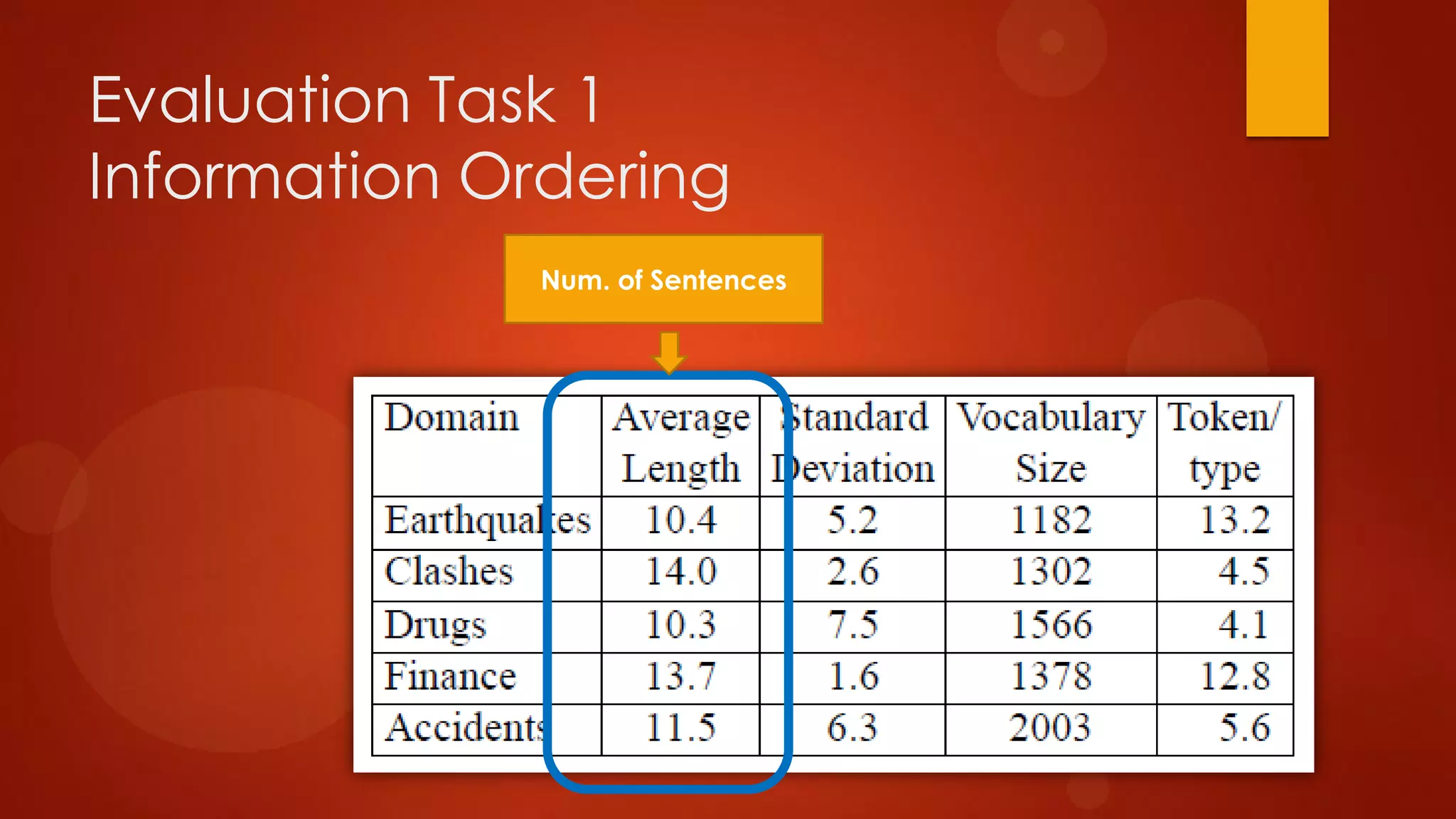
Num. of Sentences
Evaluation Task 1
Information Ordering
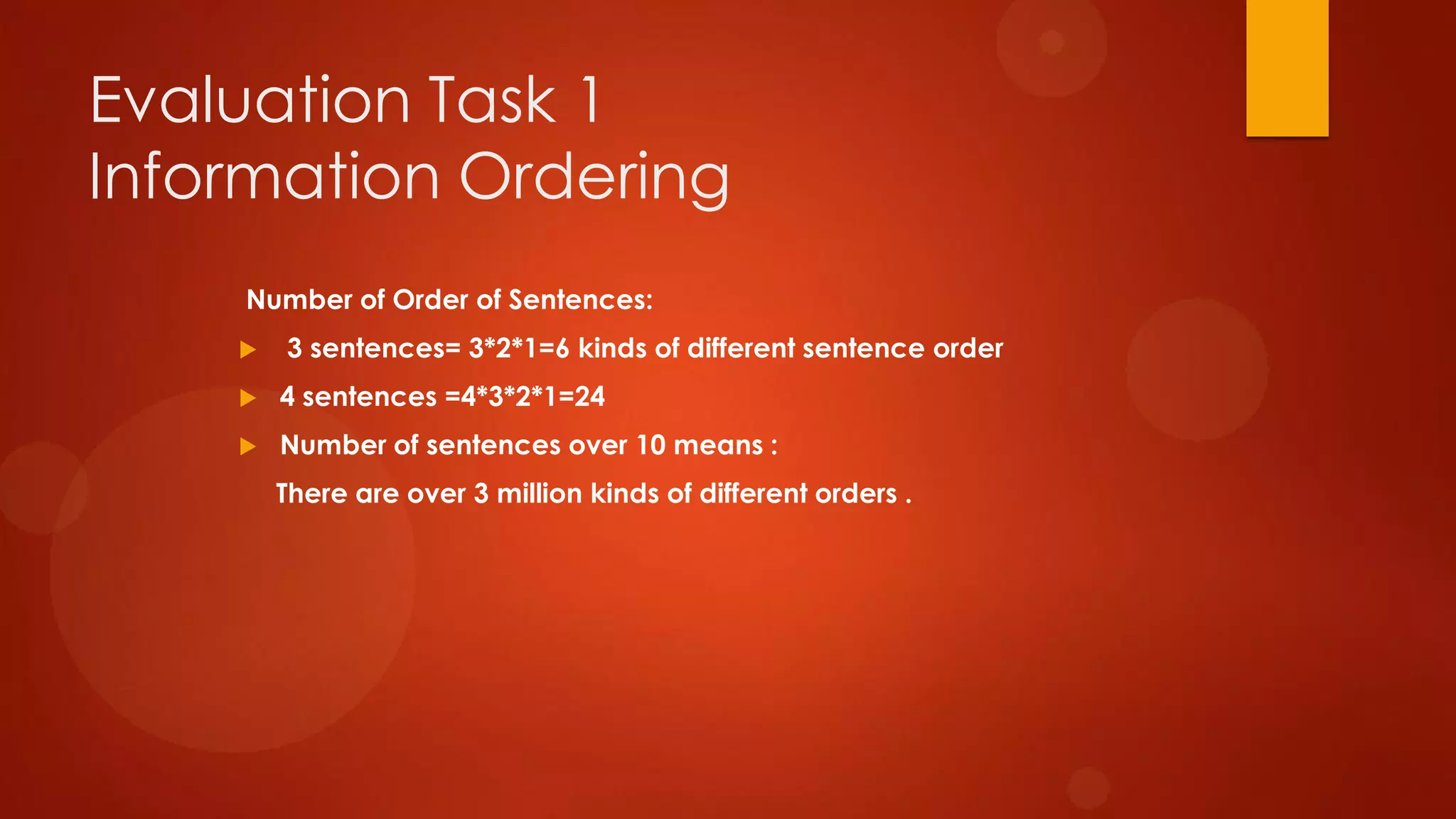
Number of Order of Sentences:
 3 sentences= 3*2*1=6 kinds of different sentence order
 4 sentences =4*3*2*1=24
 Number of sentences over 10 means :
There are over 3 million kinds of different orders .
Evaluation Task 1
Information Ordering
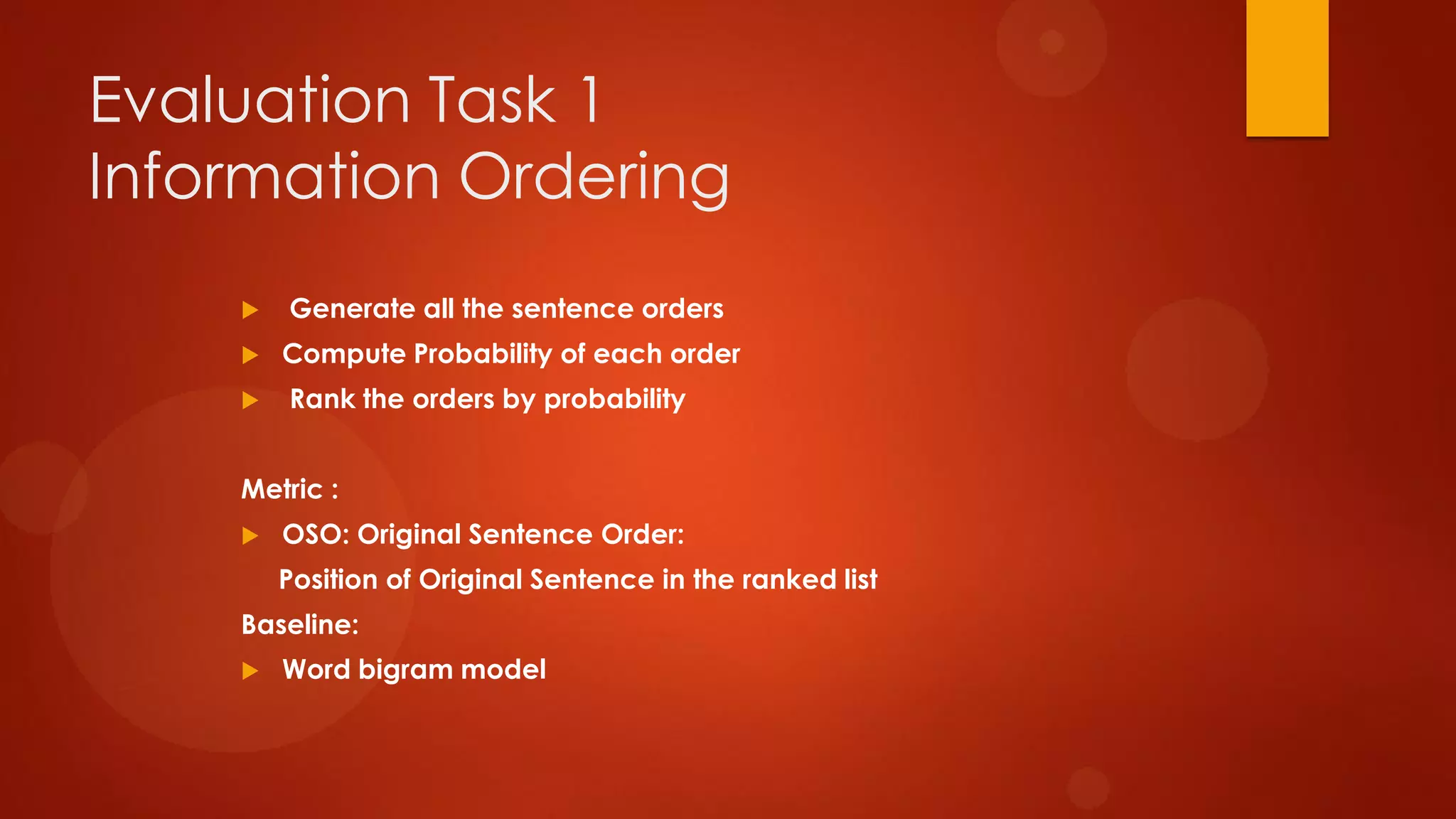
 Generate all the sentence orders
 Compute Probability of each order
 Rank the orders by probability
Metric :
 OSO: Original Sentence Order:
Position of Original Sentence in the ranked list
Baseline:
 Word bigram model
Evaluation Task 1
Information Ordering
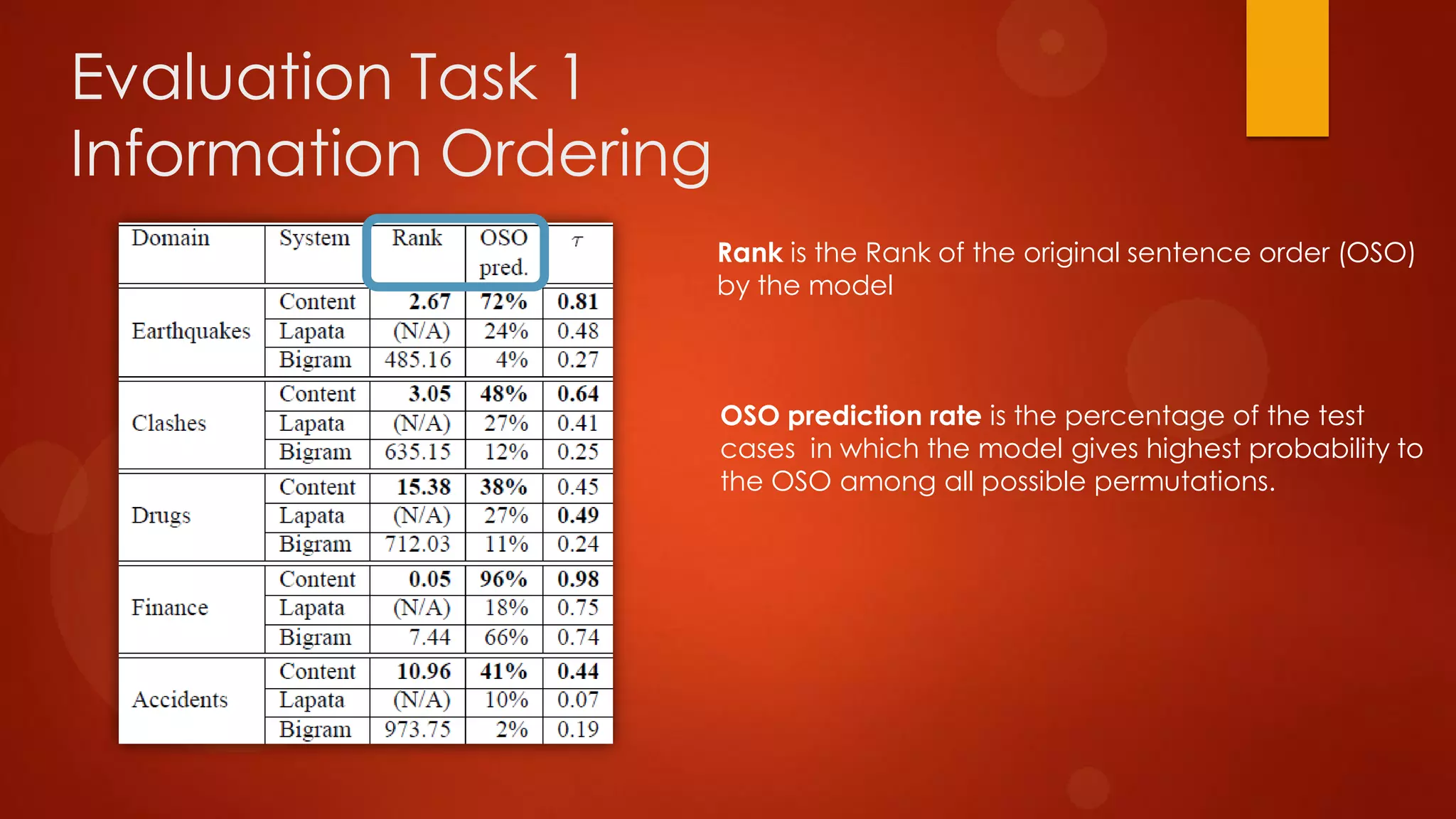
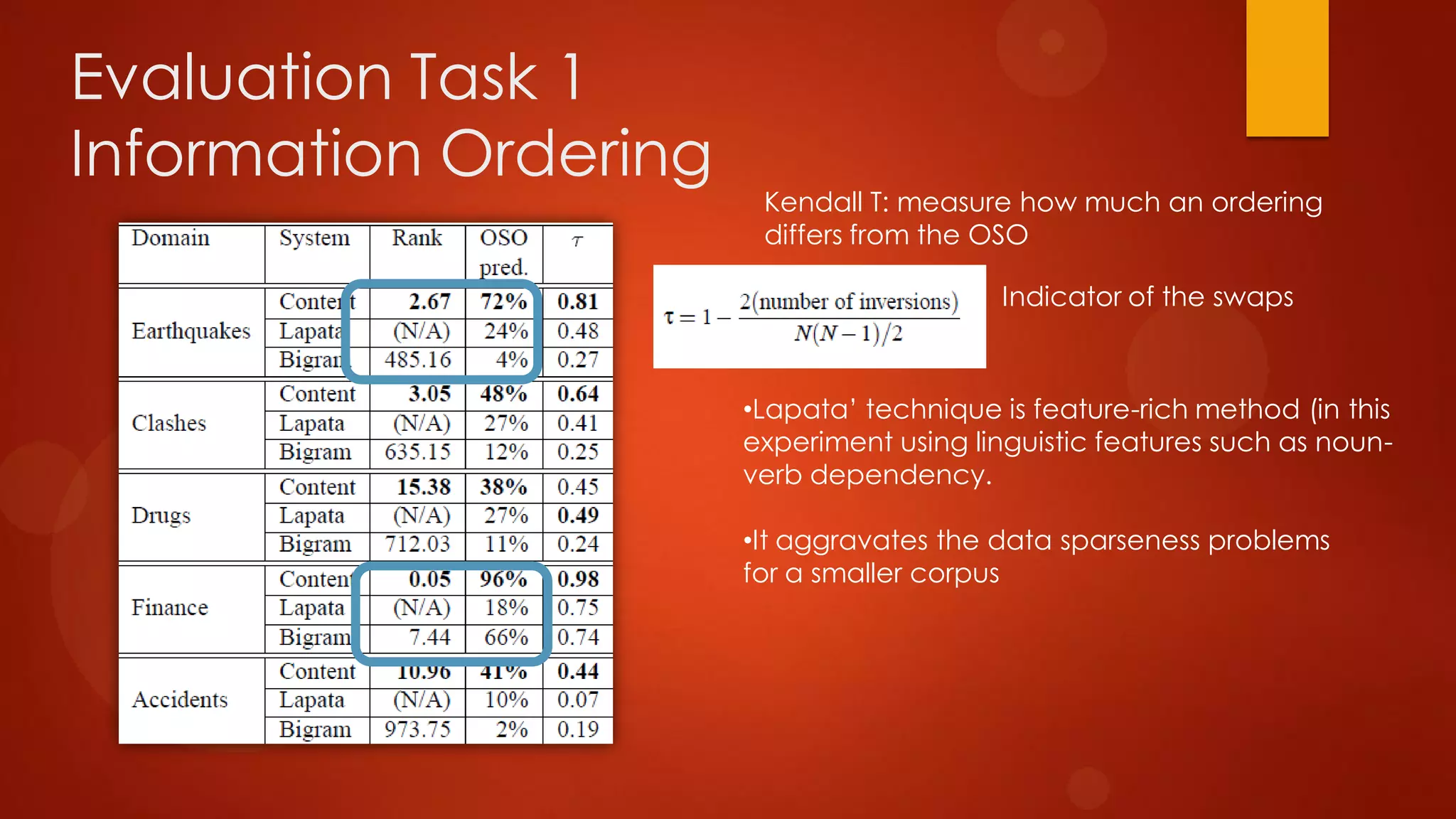
Rank is the Rank of the original sentence order (OSO)
by the model
OSO prediction rate is the percentage of the test
cases in which the model gives highest probability to
the OSO among all possible permutations.
Evaluation Task 1
Information Ordering
Indicator of the swaps
•Lapata’ technique is feature-rich method (in this
experiment using linguistic features such as noun-
verb dependency.
•It aggravates the data sparseness problems
for a smaller corpus
Kendall T: measure how much an ordering
differs from the OSO
Evaluation Task 2
Summarization
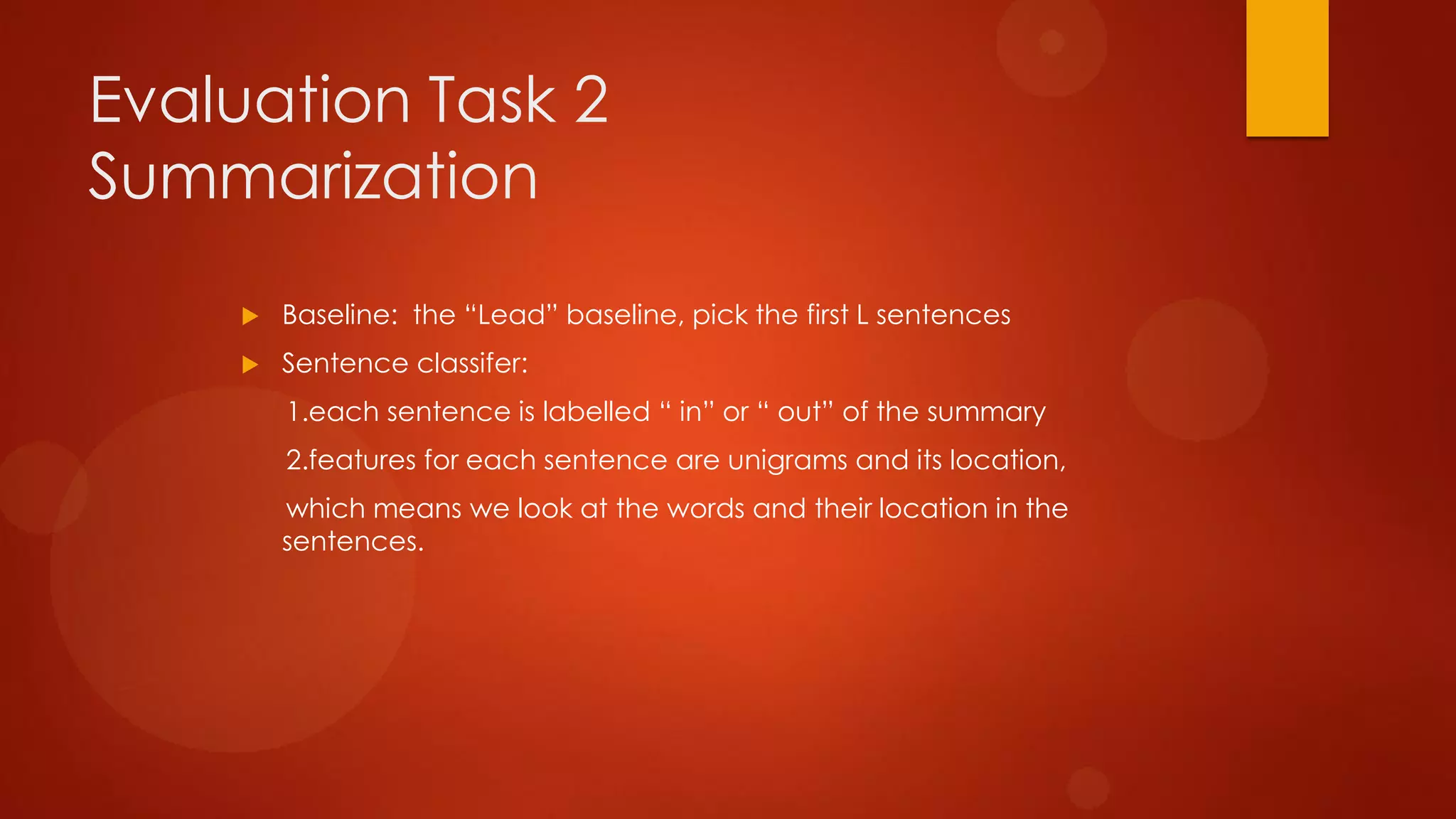
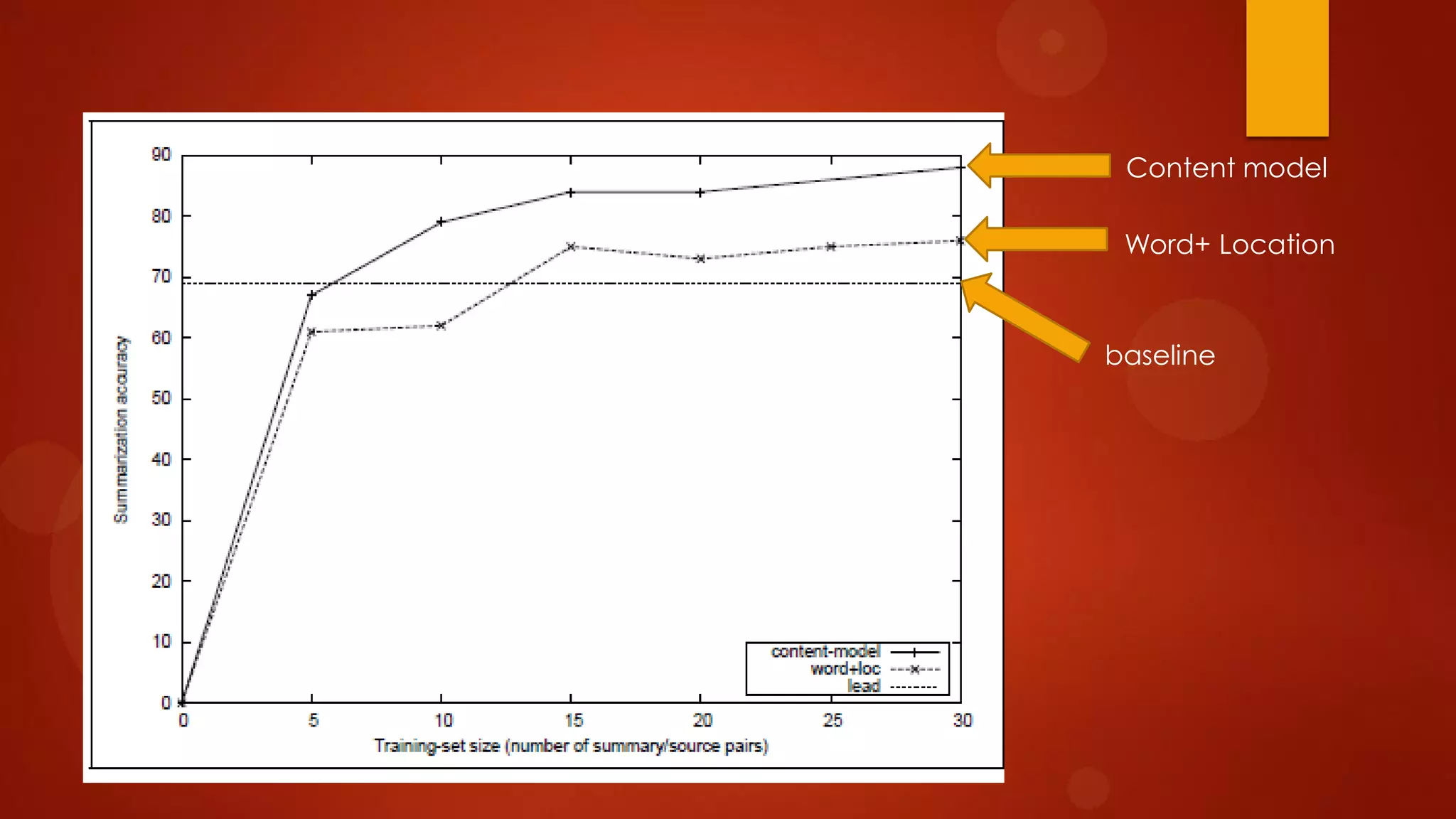
 Baseline: the “Lead” baseline, pick the first L sentences
 Sentence classifer:
1.each sentence is labelled “ in” or “ out” of the summary
2.features for each sentence are unigrams and its location,
which means we look at the words and their location in the
sentences.
Evaluation Task 2
Summarization
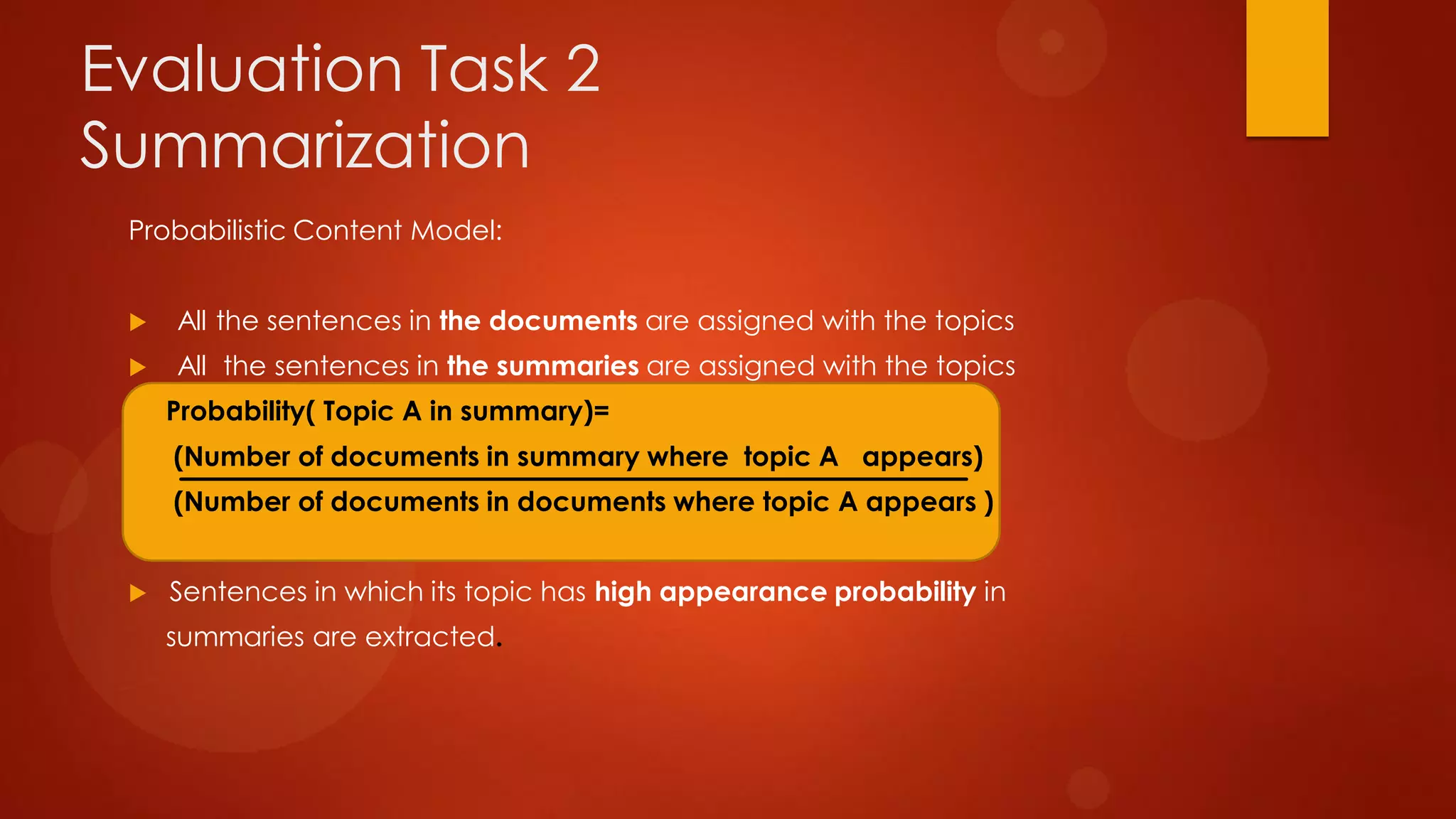
Probabilistic Content Model:
 All the sentences in the documents are assigned with the topics
 All the sentences in the summaries are assigned with the topics
Probability( Topic A in summary)=
(Number of documents in summary where topic A appears)
(Number of documents in documents where topic A appears )
 Sentences in which its topic has high appearance probability in
summaries are extracted.
Evaluation Task 1
Information Ordering
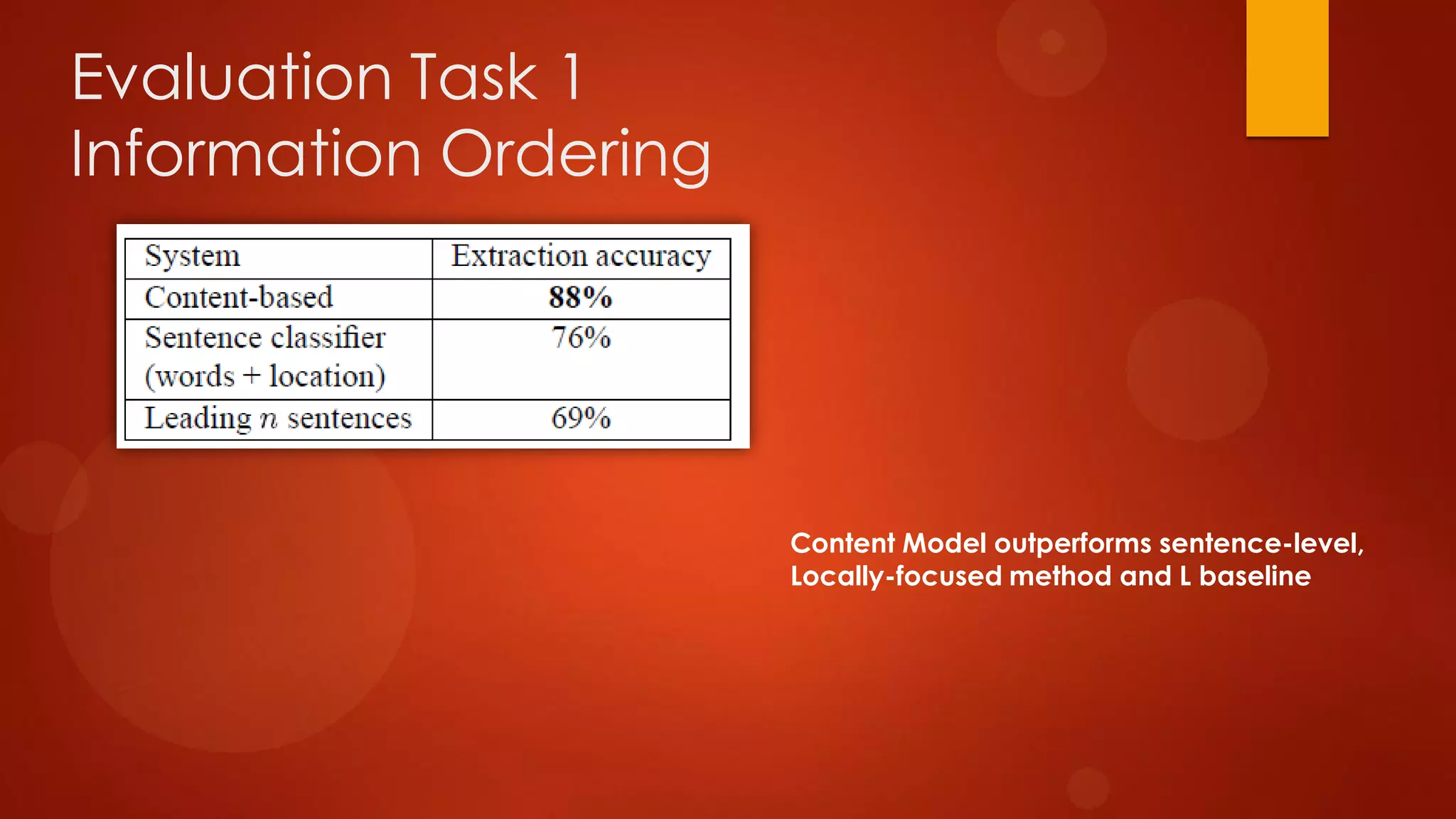
Content Model outperforms sentence-level,
Locally-focused method and L baseline
Content model
Word+ Location
baseline
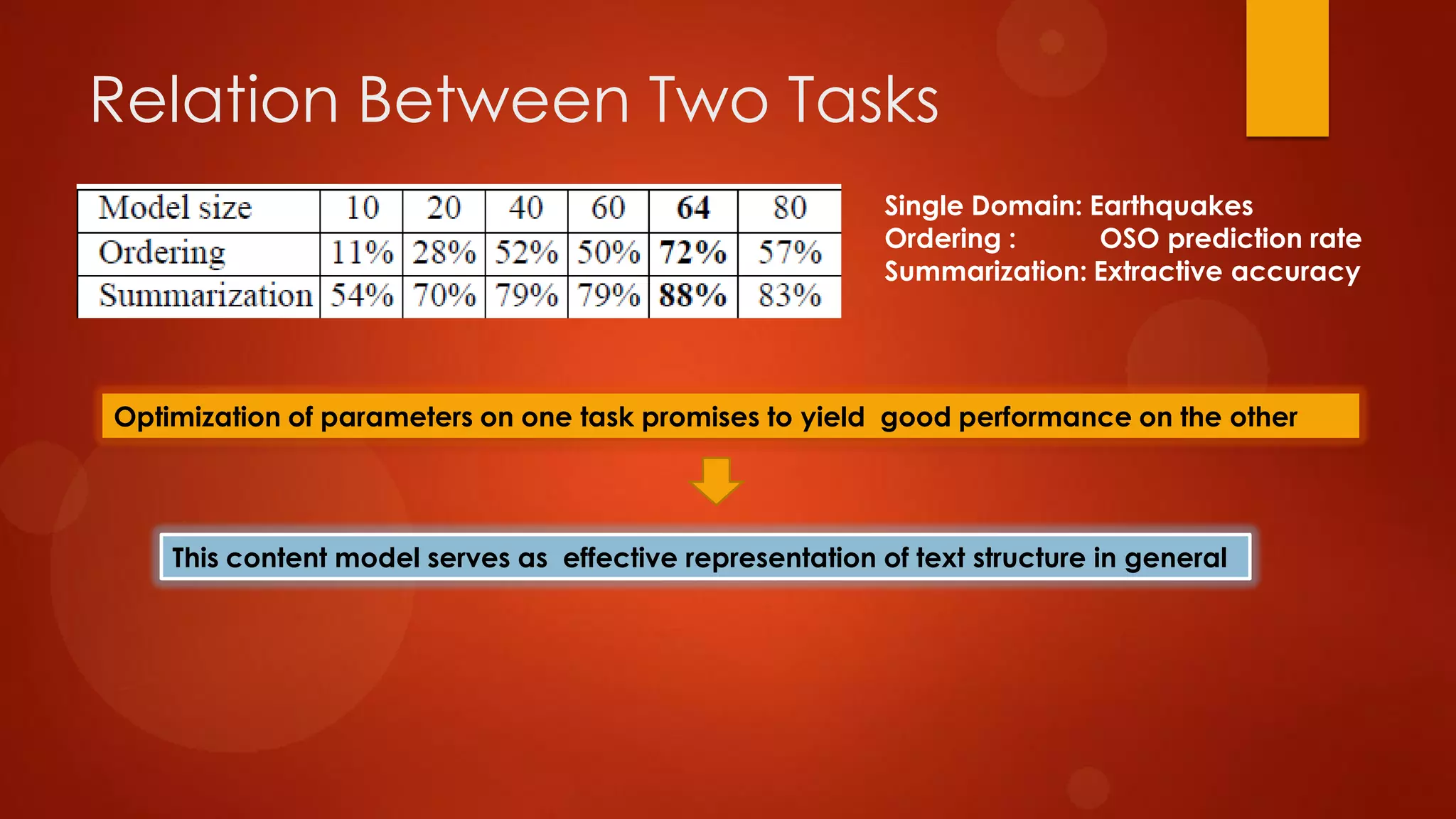
Relation Between Two Tasks
Single Domain: Earthquakes
Ordering : OSO prediction rate
Summarization: Extractive accuracy
Optimization of parameters on one task promises to yield good performance on the other
This content model serves as effective representation of text structure in general
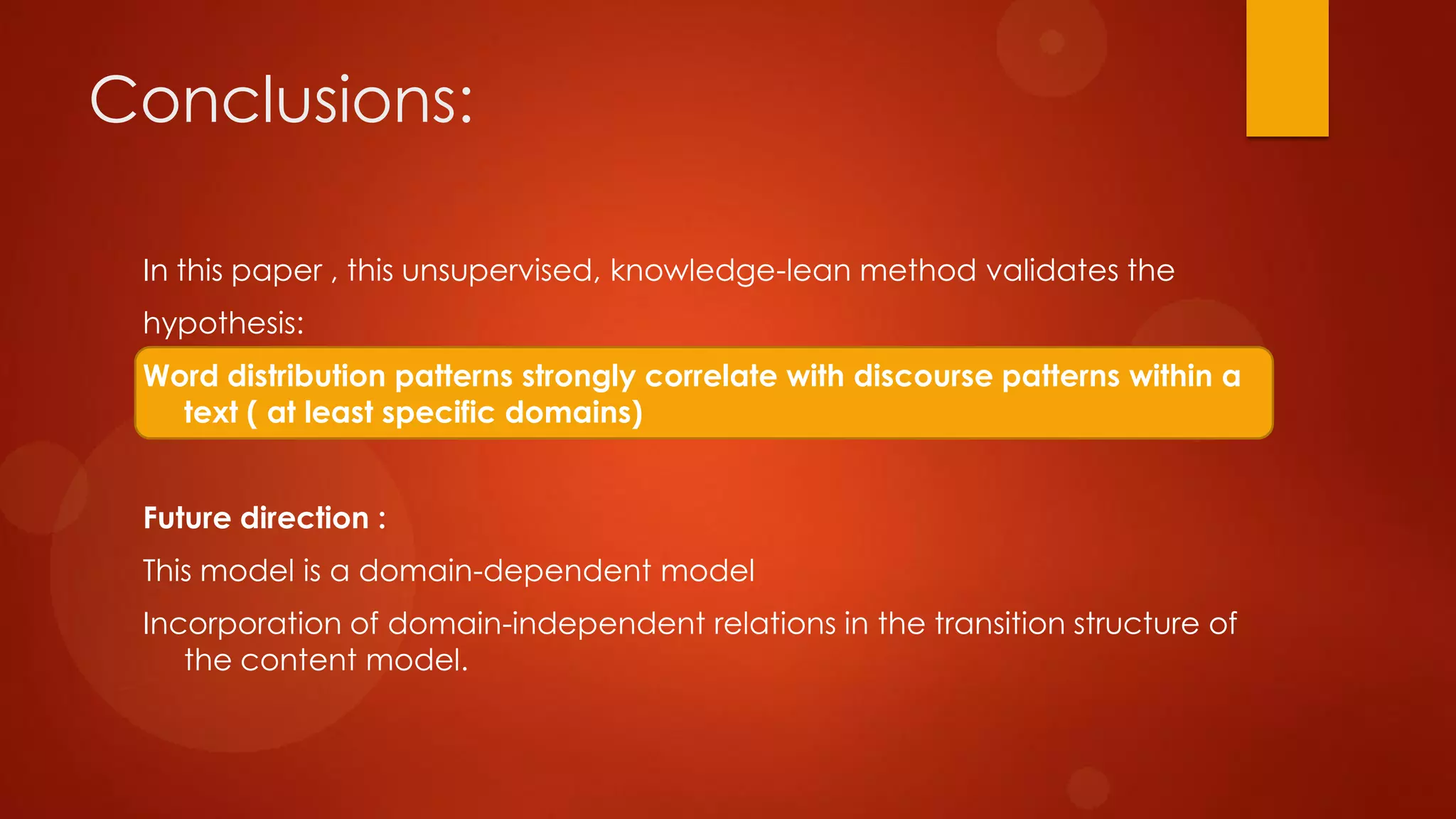
Conclusions:
In this paper , this unsupervised, knowledge-lean method validates the
hypothesis:
Word distribution patterns strongly correlate with discourse patterns within a
text ( at least specific domains)
Future direction :
This model is a domain-dependent model
Incorporation of domain-independent relations in the transition structure of
the content model.
Probabilistic content models,

Probabilistic content models,

  • 1.
    Probabilistic Content Model, withApplications to Generation and Summarization BRYAN ZHANG HANG|
  • 2.
    Outline: Goal: Modeling TopicStructures of Text We will use:  Hidden Markov Model  Bigrams  Clustering Application:  Sentence Ordering  Extractive Summerization
  • 3.
    Review: Hidden MarkovModel: S1 S2 S3 O1 O3O2 STATES OBSERVATIONS TRANSITIONS EMISSIONS
  • 4.
    Imagine :  Youcall your friend who lives in a foreign country from time to tim e. Every time you ask him or her “ What are you up to?”  The possible answers are: “ walk” “ice cream” “shopping” “reading” “programming” “kayaking” Review: Hidden Markov Model:
  • 5.
    Possible answers overa month: “kayaking” “walk” “ shopping” “kayaking” “programming”… sunny sunny probably sunny sunny ? Probably rainy Review: Hidden Markov Model: Latent class ( Hidden Part)
  • 6.
    Review: Hidden MarkovModel: S1 S2 S3 O1 O3O2 TRANSITIONS probability EMISSIONS probability S
  • 7.
    Review: Hidden MarkovModel: R S S Programming ReadWalk P(Programming |R) * P(R|*) P(S|R) P(S|S) P(walk|S) P(Read|S)
  • 8.
    Review: Hidden MarkovModel: R S S Programming ReadingWalking P(Programming |R) * P(R|*) P(S|R) P(S|S) P(walk|S) P(Read|S) The probability of the sequence Programming Walking Reading given the weather is : P(R|*) * P(S|R) * P(S|S) * P(Programming |R) * P(walk|S) * P(Read|S )
  • 9.
    Exercise: Rainy Sunny Walk CleanGoshopping S 0.1 0.4 0.5 0.6 0.3 0.1 0.3 0.4 0.6? 0.40.6 What is the state sequence (Start-S1-S2) that can maximize probability of the observation sequence “ clean shopping”
  • 10.
    Rainy Sunny Walk CleanGoshopping S 0.1 0.4 0.5 0.6 0.3 0.1 0.3 0.4 0.6? 0.40.6 Transition P. P(R|START)=0.6 P(S |START)=0.4 P(S|R)=0.3 P(S|S)=0.6 P(R|R)=0.7 P(R|S)=0.4 Emission P. P(CLEAN|R)=0.5 P(CLEAN|S)=0.1 P(SHOPPING|R)=0.4 P(SHOPPING|S)=0.3
  • 11.
    Transition P. P(R|START)=0.6 P(S |START)=0.4 P(S|R)=0.3 P(S|S)=0.6 P(R|R)=0.7 P(R|S)=0.4 STATES{ R, S} Emission P. P(CLEAN|R)=0.5 P(CLEAN|S)=0.1 P(SHOPPING|R)=0.4 P(SHOPPING|S)=0.3 EMISSIONS{CLEAN,SHOPPING} START S1 S2 CLEAN SHOPPING START P(S |START) P(S|S)P(CLEAN|S) P(SHOPPING|S) P(S |START) P(R|S) P(CLEAN|S) P(SHOPPING|R) P(R |START) P(S|R) P(CLEAN|R) P(SHOPPING|S) P(R |START) P(R|R) P(CLEAN|R) P(SHOPPING|R) ANSWER IS START-RAIN-RAIN
  • 12.
    Probabilistic Content Model S1S2 S3 O1 O3O2 TOPICS TRANSITIONS EMISSIONS SENTENCES
  • 13.
    Sentences are BigramSequences Probability of a n-word sentence generated from a state s is :
  • 14.
    Probabilistic Content Model S1S2 S3 O1 O3O2 TOPICS TRANSITIONS EMISSIONS SENTENCES
  • 15.
    TOPICS: Derived from thecontent  Partition sentences from the documents within a domai n-specific collection into k clusters (Initial Clusters) .  Use Bigram Vectors as features  Sentence similarity is the cosine of bigram vectors. STEP 1
  • 17.
    An example ofthe output: LOCATION INFORMATION
  • 18.
    TOPICS: Derived from thecontent  D(C,C’): Number of documents in which a sentence from C immediately precedes one from C’  D(C): Number of documents containing sentences from C.  For two States C,C’, smoothed estimate of state transition probability is:
  • 19.
    EM-like Viterbi Re-estimation we can compute the transition probability from the initial sentence clusters (Topic Clusters)  Hidden Markov Model can estimate the topics of sentences  Assign sentence s in the topic clusters as the estimated topic.  Cluster/estimate cycle is repeated until the clusters stabilize TOPICS: Derived from the content STEP 2
  • 20.
    Evaluation Task 1 InformationOrdering  Information ordering task is essential to many text- synthesis applications e.g. concept-to-text generation, multi-document summarization.
  • 21.
  • 22.
    Evaluation Task 1 InformationOrdering Num. of Sentences
  • 23.
    Evaluation Task 1 InformationOrdering Number of Order of Sentences:  3 sentences= 3*2*1=6 kinds of different sentence order  4 sentences =4*3*2*1=24  Number of sentences over 10 means : There are over 3 million kinds of different orders .
  • 24.
    Evaluation Task 1 InformationOrdering  Generate all the sentence orders  Compute Probability of each order  Rank the orders by probability Metric :  OSO: Original Sentence Order: Position of Original Sentence in the ranked list Baseline:  Word bigram model
  • 25.
    Evaluation Task 1 InformationOrdering Rank is the Rank of the original sentence order (OSO) by the model OSO prediction rate is the percentage of the test cases in which the model gives highest probability to the OSO among all possible permutations.
  • 26.
    Evaluation Task 1 InformationOrdering Indicator of the swaps •Lapata’ technique is feature-rich method (in this experiment using linguistic features such as noun- verb dependency. •It aggravates the data sparseness problems for a smaller corpus Kendall T: measure how much an ordering differs from the OSO
  • 27.
    Evaluation Task 2 Summarization Baseline: the “Lead” baseline, pick the first L sentences  Sentence classifer: 1.each sentence is labelled “ in” or “ out” of the summary 2.features for each sentence are unigrams and its location, which means we look at the words and their location in the sentences.
  • 28.
    Evaluation Task 2 Summarization ProbabilisticContent Model:  All the sentences in the documents are assigned with the topics  All the sentences in the summaries are assigned with the topics Probability( Topic A in summary)= (Number of documents in summary where topic A appears) (Number of documents in documents where topic A appears )  Sentences in which its topic has high appearance probability in summaries are extracted.
  • 29.
    Evaluation Task 1 InformationOrdering Content Model outperforms sentence-level, Locally-focused method and L baseline
  • 30.
  • 31.
    Relation Between TwoTasks Single Domain: Earthquakes Ordering : OSO prediction rate Summarization: Extractive accuracy Optimization of parameters on one task promises to yield good performance on the other This content model serves as effective representation of text structure in general
  • 32.
    Conclusions: In this paper, this unsupervised, knowledge-lean method validates the hypothesis: Word distribution patterns strongly correlate with discourse patterns within a text ( at least specific domains) Future direction : This model is a domain-dependent model Incorporation of domain-independent relations in the transition structure of the content model.