The Author-Topic Model
Presented by:
Darshan Ramakant Bhat
Freeze Francis
Mohammed Haroon D
by M Rosen-Zvi, et al. (UAI 2004)
Overview
● Motivation
● Model Formulation
○ Topic Model ( i.e LDA)
○ Author Model
○ Author Topic Model
● Parameter Estimation
○ Gibbs Sampling Algorithms
● Results and Evaluation
● Applications
Motivation
● joint author-topic modeling had received little attention.
● author modeling has tended to focus on problem of predicting an author given
the document.
● modelling the interests of authors is a fundamental problem raised by a large
corpus (eg: NIPS dataset).
● this paper introduced a generative model that simultaneously models the
content of documents and the interests of authors.
Notations
● Vocabulary set size : V
● Total unique authors : A
● Document d is identified as (wd
, ad
)
● Nd
: number of words in Document d.
● wd
: Vector of Nd
words (subset of vocabulary)
wd
= [w1d
w2d
…….. wNd d
]
● wid
: ith
word in document d
● Ad
: number of authors of Document d
● ad
: Vector of Ad
authors (subset of authors)
ad
= [a1d
a2d
…….. aAd d
]
● Corpus : Collection D documents
= { (w1
, a1
) , (w2
, a2
) ……. (wD
, aD
) }
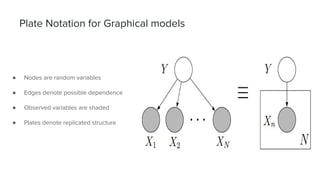
Plate Notation for Graphical models
● Nodes are random variables
● Edges denote possible dependence
● Observed variables are shaded
● Plates denote replicated structure
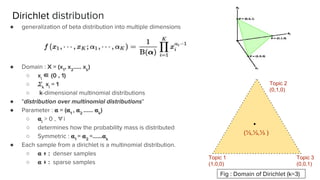
Dirichlet distribution
● generalization of beta distribution into multiple dimensions
● Domain : X = (x1
, x2
….. xk
)
○ xi
∈ (0 , 1)
○ k
xi
= 1
○ k-dimensional multinomial distributions
● "distribution over multinomial distributions"
● Parameter : = ( 1
, 2
…… k
)
○ i
> 0 , ∀i
○ determines how the probability mass is distributed
○ Symmetric : 1
= 2
=…… k
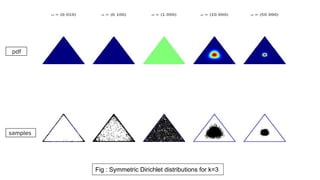
● Each sample from a dirichlet is a multinomial distribution.
○ ↑ : denser samples
○ ↓ : sparse samples
Topic 2
(0,1,0)
Topic 1
(1,0,0)
Topic 3
(0,0,1)
.
(⅓,⅓,⅓ )
Fig : Domain of Dirichlet (k=3)
Fig : Symmetric Dirichlet distributions for k=3
pdf
samples
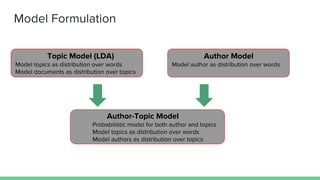
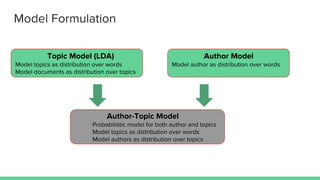
Model Formulation
Topic Model (LDA)
Model topics as distribution over words
Model documents as distribution over topics
Author Model
Model author as distribution over words
Author-Topic Model
Probabilistic model for both author and topics
Model topics as distribution over words
Model authors as distribution over topics
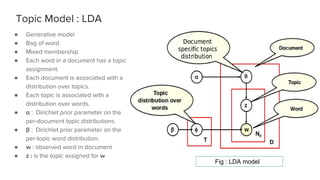
Topic Model : LDA
● Generative model
● Bag of word
● Mixed membership
● Each word in a document has a topic
assignment.
● Each document is associated with a
distribution over topics.
● Each topic is associated with a
distribution over words.
● α : Dirichlet prior parameter on the
per-document topic distributions.
● β : Dirichlet prior parameter on the
per-topic word distribution.
● w : observed word in document
● z : is the topic assigned for w
Fig : LDA model
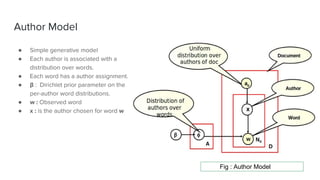
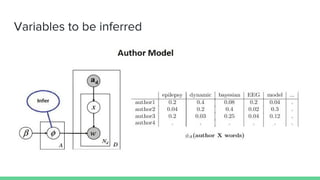
Author Model
● Simple generative model
● Each author is associated with a
distribution over words.
● Each word has a author assignment.
● β : Dirichlet prior parameter on the
per-author word distributions.
● w : Observed word
● x : is the author chosen for word w
Fig : Author Model
Model Formulation
Topic Model (LDA)
Model topics as distribution over words
Model documents as distribution over topics
Author Model
Model author as distribution over words
Author-Topic Model
Probabilistic model for both author and topics
Model topics as distribution over words
Model authors as distribution over topics
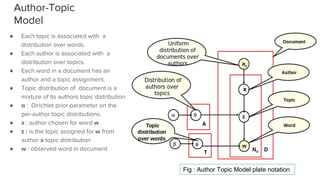
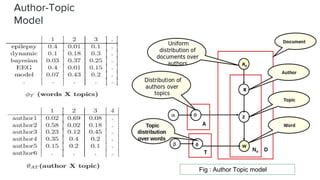
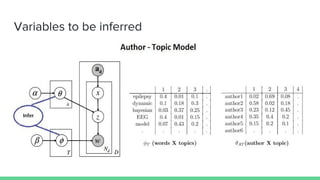
Author-Topic
Model
● Each topic is associated with a
distribution over words.
● Each author is associated with a
distribution over topics.
● Each word in a document has an
author and a topic assignment.
● Topic distribution of document is a
mixture of its authors topic distribution
● α : Dirichlet prior parameter on the
per-author topic distributions.
● x : author chosen for word w
● z : is the topic assigned for w from
author x topic distribution
● w : observed word in document
Fig : Author Topic Model plate notation
Author-Topic
Model
Fig : Author Topic model
Special Cases of ATM
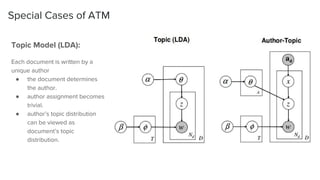
Topic Model (LDA):
Each document is written by a
unique author
● the document determines
the author.
● author assignment becomes
trivial.
● author’s topic distribution
can be viewed as
document’s topic
distribution.
Special Cases of ATM
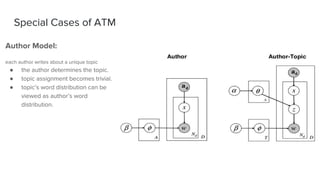
Author Model:
each author writes about a unique topic
● the author determines the topic.
● topic assignment becomes trivial.
● topic’s word distribution can be
viewed as author’s word
distribution.
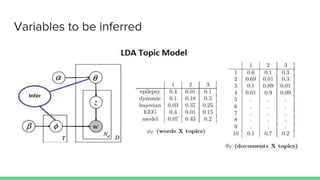
Variables to be inferred
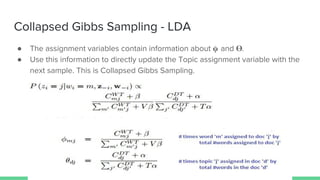
Collapsed Gibbs Sampling - LDA
● The assignment variables contain information about and .
● Use this information to directly update the Topic assignment variable with the
next sample. This is Collapsed Gibbs Sampling.
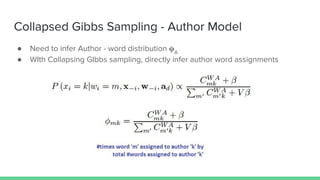
Collapsed Gibbs Sampling - Author Model
● Need to infer Author - word distribution A
● WIth Collapsing GIbbs sampling, directly infer author word assignments
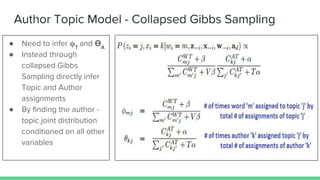
Author Topic Model - Collapsed Gibbs Sampling
● Need to infer T
and ϴA
● Instead through
collapsed Gibbs
Sampling directly infer
Topic and Author
assignments
● By finding the author -
topic joint distribution
conditioned on all other
variables
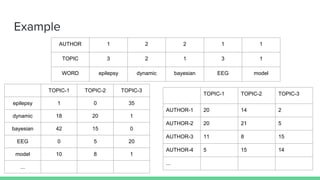
Example
AUTHOR 1 2 2 1 1
TOPIC 3 2 1 3 1
WORD epilepsy dynamic bayesian EEG model
TOPIC-1 TOPIC-2 TOPIC-3
epilepsy 1 0 35
dynamic 18 20 1
bayesian 42 15 0
EEG 0 5 20
model 10 8 1
...
TOPIC-1 TOPIC-2 TOPIC-3
AUTHOR-1 20 14 2
AUTHOR-2 20 21 5
AUTHOR-3 11 8 15
AUTHOR-4 5 15 14
...
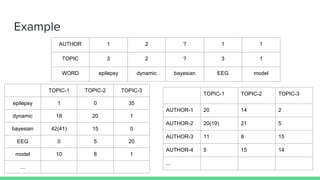
Example
AUTHOR 1 2 ? 1 1
TOPIC 3 2 ? 3 1
WORD epilepsy dynamic bayesian EEG model
TOPIC-1 TOPIC-2 TOPIC-3
epilepsy 1 0 35
dynamic 18 20 1
bayesian 42(41) 15 0
EEG 0 5 20
model 10 8 1
...
TOPIC-1 TOPIC-2 TOPIC-3
AUTHOR-1 20 14 2
AUTHOR-2 20(19) 21 5
AUTHOR-3 11 8 15
AUTHOR-4 5 15 14
...
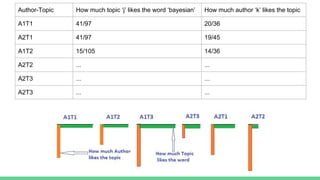
Author-Topic How much topic ‘j’ likes the word ‘bayesian’ How much author ‘k’ likes the topic
A1T1 41/97 20/36
A2T1 41/97 19/45
A1T2 15/105 14/36
A2T2 ... ...
A2T3 ... ...
A2T3 ... ...
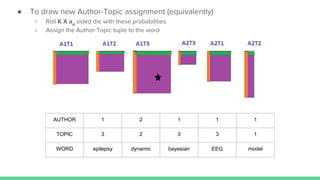
● To draw new Author-Topic assignment (equivalently)
○ Roll K X ad
sided die with these probabilities
○ Assign the Author-Topic tuple to the word
AUTHOR 1 2 1 1 1
TOPIC 3 2 3 3 1
WORD epilepsy dynamic bayesian EEG model
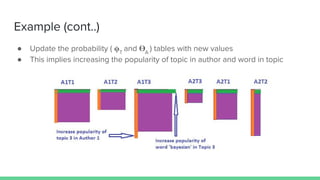
Example (cont..)
● Update the probability ( T
and A
) tables with new values
● This implies increasing the popularity of topic in author and word in topic
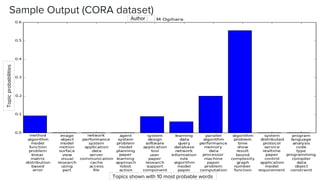
Sample Output (CORA dataset)Topicprobabilities
Topics shown with 10 most probable words
Author :
Experimental Results
● Experiment is done on two types of dataset, papers are chosen from NIPS and
CiteSeer database
● Extremely common words are removed from the corpus, leading V=13,649
unique words in NIPS and V=30,799 in CiteSeer, 2037 authors in NIPS and
85,465 in CiteSeer
● NIPS contains many documents which are closely related to learning theory
and machine learning
● CiteSeer contains variety of topics from User Interface to Solar astrophysics
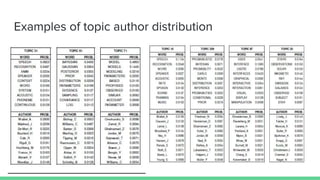
Examples of topic author distribution
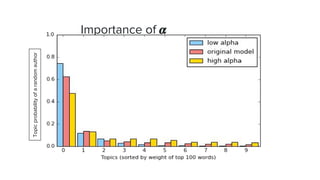
Importance ofTopicprobabilityofarandomauthor
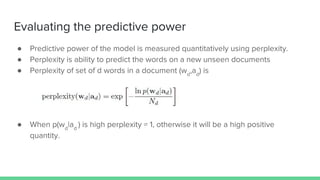
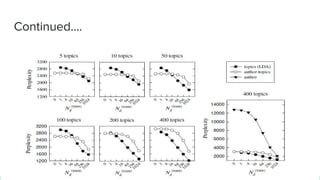
Evaluating the predictive power
● Predictive power of the model is measured quantitatively using perplexity.
● Perplexity is ability to predict the words on a new unseen documents
● Perplexity of set of d words in a document (wd
,ad
) is
● When p(wd
|ad
) is high perplexity ≈ 1, otherwise it will be a high positive
quantity.
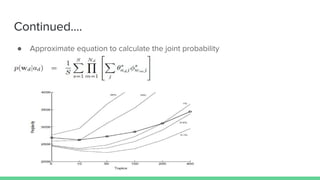
Continued….
● Approximate equation to calculate the joint probability
Continued….
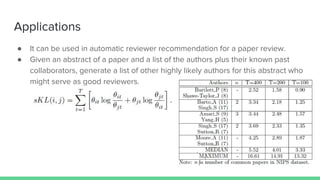
Applications
● It can be used in automatic reviewer recommendation for a paper review.
● Given an abstract of a paper and a list of the authors plus their known past
collaborators, generate a list of other highly likely authors for this abstract who
might serve as good reviewers.
References
● Rosen-Zvi, Michal, et al. "The author-topic model for authors and documents."
Proceedings of the 20th conference on Uncertainty in artificial intelligence.
AUAI Press, 2004.
● D. M. Blei, A. Y. Ng, and M. I. Jordan (2003). “Latent Dirichlet Allocation”.
Journal of Machine Learning Research, 3 : 993–1022.
● T. L. Griffiths, and M. Steyvers (2004). “Finding scientific topics”. Proceedings
of the National Academy of Sciences, 101 (suppl. 1), 5228–5235.
● https://github.com/arongdari/python-topic-model
● https://www.coursera.org/learn/ml-clustering-and-retrieval/home/welcome
Questions?

Author Topic Model

  • 1.
    The Author-Topic Model Presentedby: Darshan Ramakant Bhat Freeze Francis Mohammed Haroon D by M Rosen-Zvi, et al. (UAI 2004)
  • 2.
    Overview ● Motivation ● ModelFormulation ○ Topic Model ( i.e LDA) ○ Author Model ○ Author Topic Model ● Parameter Estimation ○ Gibbs Sampling Algorithms ● Results and Evaluation ● Applications
  • 3.
    Motivation ● joint author-topicmodeling had received little attention. ● author modeling has tended to focus on problem of predicting an author given the document. ● modelling the interests of authors is a fundamental problem raised by a large corpus (eg: NIPS dataset). ● this paper introduced a generative model that simultaneously models the content of documents and the interests of authors.
  • 4.
    Notations ● Vocabulary setsize : V ● Total unique authors : A ● Document d is identified as (wd , ad ) ● Nd : number of words in Document d. ● wd : Vector of Nd words (subset of vocabulary) wd = [w1d w2d …….. wNd d ] ● wid : ith word in document d ● Ad : number of authors of Document d ● ad : Vector of Ad authors (subset of authors) ad = [a1d a2d …….. aAd d ] ● Corpus : Collection D documents = { (w1 , a1 ) , (w2 , a2 ) ……. (wD , aD ) }
  • 5.
    Plate Notation forGraphical models ● Nodes are random variables ● Edges denote possible dependence ● Observed variables are shaded ● Plates denote replicated structure
  • 6.
    Dirichlet distribution ● generalizationof beta distribution into multiple dimensions ● Domain : X = (x1 , x2 ….. xk ) ○ xi ∈ (0 , 1) ○ k xi = 1 ○ k-dimensional multinomial distributions ● "distribution over multinomial distributions" ● Parameter : = ( 1 , 2 …… k ) ○ i > 0 , ∀i ○ determines how the probability mass is distributed ○ Symmetric : 1 = 2 =…… k ● Each sample from a dirichlet is a multinomial distribution. ○ ↑ : denser samples ○ ↓ : sparse samples Topic 2 (0,1,0) Topic 1 (1,0,0) Topic 3 (0,0,1) . (⅓,⅓,⅓ ) Fig : Domain of Dirichlet (k=3)
  • 7.
    Fig : SymmetricDirichlet distributions for k=3 pdf samples
  • 8.
    Model Formulation Topic Model(LDA) Model topics as distribution over words Model documents as distribution over topics Author Model Model author as distribution over words Author-Topic Model Probabilistic model for both author and topics Model topics as distribution over words Model authors as distribution over topics
  • 9.
    Topic Model :LDA ● Generative model ● Bag of word ● Mixed membership ● Each word in a document has a topic assignment. ● Each document is associated with a distribution over topics. ● Each topic is associated with a distribution over words. ● α : Dirichlet prior parameter on the per-document topic distributions. ● β : Dirichlet prior parameter on the per-topic word distribution. ● w : observed word in document ● z : is the topic assigned for w Fig : LDA model
  • 10.
    Author Model ● Simplegenerative model ● Each author is associated with a distribution over words. ● Each word has a author assignment. ● β : Dirichlet prior parameter on the per-author word distributions. ● w : Observed word ● x : is the author chosen for word w Fig : Author Model
  • 11.
    Model Formulation Topic Model(LDA) Model topics as distribution over words Model documents as distribution over topics Author Model Model author as distribution over words Author-Topic Model Probabilistic model for both author and topics Model topics as distribution over words Model authors as distribution over topics
  • 12.
    Author-Topic Model ● Each topicis associated with a distribution over words. ● Each author is associated with a distribution over topics. ● Each word in a document has an author and a topic assignment. ● Topic distribution of document is a mixture of its authors topic distribution ● α : Dirichlet prior parameter on the per-author topic distributions. ● x : author chosen for word w ● z : is the topic assigned for w from author x topic distribution ● w : observed word in document Fig : Author Topic Model plate notation
  • 13.
  • 14.
    Special Cases ofATM Topic Model (LDA): Each document is written by a unique author ● the document determines the author. ● author assignment becomes trivial. ● author’s topic distribution can be viewed as document’s topic distribution.
  • 15.
    Special Cases ofATM Author Model: each author writes about a unique topic ● the author determines the topic. ● topic assignment becomes trivial. ● topic’s word distribution can be viewed as author’s word distribution.
  • 16.
  • 17.
  • 18.
  • 19.
    Collapsed Gibbs Sampling- LDA ● The assignment variables contain information about and . ● Use this information to directly update the Topic assignment variable with the next sample. This is Collapsed Gibbs Sampling.
  • 20.
    Collapsed Gibbs Sampling- Author Model ● Need to infer Author - word distribution A ● WIth Collapsing GIbbs sampling, directly infer author word assignments
  • 21.
    Author Topic Model- Collapsed Gibbs Sampling ● Need to infer T and ϴA ● Instead through collapsed Gibbs Sampling directly infer Topic and Author assignments ● By finding the author - topic joint distribution conditioned on all other variables
  • 22.
    Example AUTHOR 1 22 1 1 TOPIC 3 2 1 3 1 WORD epilepsy dynamic bayesian EEG model TOPIC-1 TOPIC-2 TOPIC-3 epilepsy 1 0 35 dynamic 18 20 1 bayesian 42 15 0 EEG 0 5 20 model 10 8 1 ... TOPIC-1 TOPIC-2 TOPIC-3 AUTHOR-1 20 14 2 AUTHOR-2 20 21 5 AUTHOR-3 11 8 15 AUTHOR-4 5 15 14 ...
  • 23.
    Example AUTHOR 1 2? 1 1 TOPIC 3 2 ? 3 1 WORD epilepsy dynamic bayesian EEG model TOPIC-1 TOPIC-2 TOPIC-3 epilepsy 1 0 35 dynamic 18 20 1 bayesian 42(41) 15 0 EEG 0 5 20 model 10 8 1 ... TOPIC-1 TOPIC-2 TOPIC-3 AUTHOR-1 20 14 2 AUTHOR-2 20(19) 21 5 AUTHOR-3 11 8 15 AUTHOR-4 5 15 14 ...
  • 24.
    Author-Topic How muchtopic ‘j’ likes the word ‘bayesian’ How much author ‘k’ likes the topic A1T1 41/97 20/36 A2T1 41/97 19/45 A1T2 15/105 14/36 A2T2 ... ... A2T3 ... ... A2T3 ... ...
  • 25.
    ● To drawnew Author-Topic assignment (equivalently) ○ Roll K X ad sided die with these probabilities ○ Assign the Author-Topic tuple to the word AUTHOR 1 2 1 1 1 TOPIC 3 2 3 3 1 WORD epilepsy dynamic bayesian EEG model
  • 26.
    Example (cont..) ● Updatethe probability ( T and A ) tables with new values ● This implies increasing the popularity of topic in author and word in topic
  • 27.
    Sample Output (CORAdataset)Topicprobabilities Topics shown with 10 most probable words Author :
  • 28.
    Experimental Results ● Experimentis done on two types of dataset, papers are chosen from NIPS and CiteSeer database ● Extremely common words are removed from the corpus, leading V=13,649 unique words in NIPS and V=30,799 in CiteSeer, 2037 authors in NIPS and 85,465 in CiteSeer ● NIPS contains many documents which are closely related to learning theory and machine learning ● CiteSeer contains variety of topics from User Interface to Solar astrophysics
  • 29.
    Examples of topicauthor distribution
  • 30.
  • 31.
    Evaluating the predictivepower ● Predictive power of the model is measured quantitatively using perplexity. ● Perplexity is ability to predict the words on a new unseen documents ● Perplexity of set of d words in a document (wd ,ad ) is ● When p(wd |ad ) is high perplexity ≈ 1, otherwise it will be a high positive quantity.
  • 32.
    Continued…. ● Approximate equationto calculate the joint probability
  • 33.
  • 34.
    Applications ● It canbe used in automatic reviewer recommendation for a paper review. ● Given an abstract of a paper and a list of the authors plus their known past collaborators, generate a list of other highly likely authors for this abstract who might serve as good reviewers.
  • 35.
    References ● Rosen-Zvi, Michal,et al. "The author-topic model for authors and documents." Proceedings of the 20th conference on Uncertainty in artificial intelligence. AUAI Press, 2004. ● D. M. Blei, A. Y. Ng, and M. I. Jordan (2003). “Latent Dirichlet Allocation”. Journal of Machine Learning Research, 3 : 993–1022. ● T. L. Griffiths, and M. Steyvers (2004). “Finding scientific topics”. Proceedings of the National Academy of Sciences, 101 (suppl. 1), 5228–5235. ● https://github.com/arongdari/python-topic-model ● https://www.coursera.org/learn/ml-clustering-and-retrieval/home/welcome
  • 36.