Lehrstuhl Informatik 5
(Information Systems)
Prof. Dr. M. Jarke
I5-FL-MMYY-1
Learning
Layers
This work is licensed under a Creative Commons Attribution-ShareAlike 3.0 Unported License.
Supporting Workplace Learning
in Small Enterprises by Personal
Learning Environments
Milos Kravcik, Katya Neulinger, Ralf Klamma
Advanced Community Information Systems (ACIS)
RWTH Aachen University, Germany
kravcik@dbis.rwth-aachen.de
ProS Workshop, UMAP, Aalborg, Denmark, July 7th, 2014
Lehrstuhl Informatik 5
(Information Systems)
Prof. Dr. M. Jarke
I5-FL-MMYY-2
Learning
Layers
Agenda
 BOOST project
 Functional requirements
 Technical prototype
 Conclusion and future work
Lehrstuhl Informatik 5
(Information Systems)
Prof. Dr. M. Jarke
I5-FL-MMYY-3
Learning
Layers
BOOST Project
 Issue: SMEs have a decreasing participation in VET
 BOOST: Business perfOrmance imprOvement
through individual employee Skills Training
– Leonardo da Vinci – Lifelong Learning Programme
– http://www.boost-project.eu/
– Integrates outcomes from 2 projects:
– BeCome: methodology
– ROLE: technology
– Focus: enterprises with <20 employees
Lehrstuhl Informatik 5
(Information Systems)
Prof. Dr. M. Jarke
I5-FL-MMYY-4
Learning
Layers
Functional Requirements
Basic Workflow
 Identify critical business goals in the company
 Select employees to address them
 Support their learning
 Monitor the learning progress of the company and
of the employees
Lehrstuhl Informatik 5
(Information Systems)
Prof. Dr. M. Jarke
I5-FL-MMYY-5
Learning
Layers
Functional Requirements
Roles & Data
User Roles
 Manager
– Business manager
– Business advisor
 Trainer
– Training manager
– Learning facilitator
 Employee
Data Model
 Business Goals
– Project administration
– Web development
 Learning Indicators
– Planning, reporting
– Web design, information
architecture
 Learning Resources
Lehrstuhl Informatik 5
(Information Systems)
Prof. Dr. M. Jarke
I5-FL-MMYY-6
Learning
Layers
Functional Requirements
Competence Management
1. Specification of relevant Business Goals (BGs – high-level
competences), their priorities and time scales
2. Assignment of Learning Indicators (LIs – concrete competences) to
each BG, considering also time scales
3. Assignment of Learning Resources (LRs – e.g. documents, widgets,
peers) to LIs
4. Assignment of relevant BGs and LIs to employees
5. Setting up target LI (proficiency) levels for relevant BGs for each
employee, considering time scales
6. Assessment of the start & current LI (proficiency) levels for the
employee
7. Monitoring the training progress in the company and also of each
employee (considering also time scales)
Lehrstuhl Informatik 5
(Information Systems)
Prof. Dr. M. Jarke
I5-FL-MMYY-7
Learning
Layers
Functional Requirements
Learning Process
Concrete requirements for learning are company specific
1. Community support – sharing experience, communication,
collaboration
2. Domain specific support – training (learning) and
assessment
3. Annotation (ranking) of learning resources assigned to LIs
4. Considering preferences (e.g. learning styles) of individuals
Lehrstuhl Informatik 5
(Information Systems)
Prof. Dr. M. Jarke
I5-FL-MMYY-8
Learning
Layers
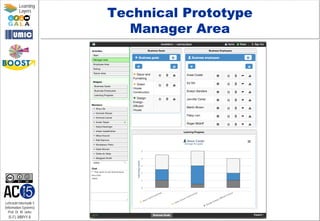
Technical Prototype
Manager Area
Lehrstuhl Informatik 5
(Information Systems)
Prof. Dr. M. Jarke
I5-FL-MMYY-9
Learning
Layers
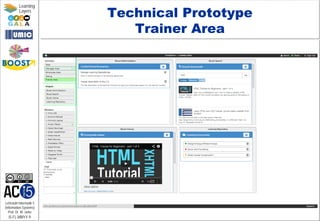
Technical Prototype
Trainer Area
Lehrstuhl Informatik 5
(Information Systems)
Prof. Dr. M. Jarke
I5-FL-MMYY-10
Learning
Layers
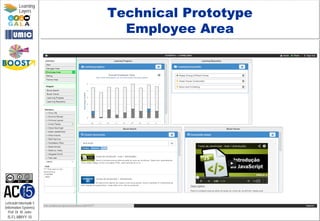
Technical Prototype
Employee Area
Lehrstuhl Informatik 5
(Information Systems)
Prof. Dr. M. Jarke
I5-FL-MMYY-11
Learning
Layers
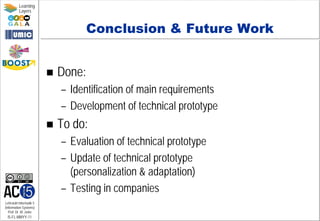
Conclusion & Future Work
 Done:
– Identification of main requirements
– Development of technical prototype
 To do:
– Evaluation of technical prototype
– Update of technical prototype
(personalization & adaptation)
– Testing in companies
Lehrstuhl Informatik 5
(Information Systems)
Prof. Dr. M. Jarke
I5-FL-MMYY-12
Learning
Layers
Demo
http://role-sandbox.eu/spaces/boostdemo

Supporting Workplace Learning in Small Enterprises by Personal Learning Environments

  • 1.
    Lehrstuhl Informatik 5 (InformationSystems) Prof. Dr. M. Jarke I5-FL-MMYY-1 Learning Layers This work is licensed under a Creative Commons Attribution-ShareAlike 3.0 Unported License. Supporting Workplace Learning in Small Enterprises by Personal Learning Environments Milos Kravcik, Katya Neulinger, Ralf Klamma Advanced Community Information Systems (ACIS) RWTH Aachen University, Germany kravcik@dbis.rwth-aachen.de ProS Workshop, UMAP, Aalborg, Denmark, July 7th, 2014
  • 2.
    Lehrstuhl Informatik 5 (InformationSystems) Prof. Dr. M. Jarke I5-FL-MMYY-2 Learning Layers Agenda  BOOST project  Functional requirements  Technical prototype  Conclusion and future work
  • 3.
    Lehrstuhl Informatik 5 (InformationSystems) Prof. Dr. M. Jarke I5-FL-MMYY-3 Learning Layers BOOST Project  Issue: SMEs have a decreasing participation in VET  BOOST: Business perfOrmance imprOvement through individual employee Skills Training – Leonardo da Vinci – Lifelong Learning Programme – http://www.boost-project.eu/ – Integrates outcomes from 2 projects: – BeCome: methodology – ROLE: technology – Focus: enterprises with <20 employees
  • 4.
    Lehrstuhl Informatik 5 (InformationSystems) Prof. Dr. M. Jarke I5-FL-MMYY-4 Learning Layers Functional Requirements Basic Workflow  Identify critical business goals in the company  Select employees to address them  Support their learning  Monitor the learning progress of the company and of the employees
  • 5.
    Lehrstuhl Informatik 5 (InformationSystems) Prof. Dr. M. Jarke I5-FL-MMYY-5 Learning Layers Functional Requirements Roles & Data User Roles  Manager – Business manager – Business advisor  Trainer – Training manager – Learning facilitator  Employee Data Model  Business Goals – Project administration – Web development  Learning Indicators – Planning, reporting – Web design, information architecture  Learning Resources
  • 6.
    Lehrstuhl Informatik 5 (InformationSystems) Prof. Dr. M. Jarke I5-FL-MMYY-6 Learning Layers Functional Requirements Competence Management 1. Specification of relevant Business Goals (BGs – high-level competences), their priorities and time scales 2. Assignment of Learning Indicators (LIs – concrete competences) to each BG, considering also time scales 3. Assignment of Learning Resources (LRs – e.g. documents, widgets, peers) to LIs 4. Assignment of relevant BGs and LIs to employees 5. Setting up target LI (proficiency) levels for relevant BGs for each employee, considering time scales 6. Assessment of the start & current LI (proficiency) levels for the employee 7. Monitoring the training progress in the company and also of each employee (considering also time scales)
  • 7.
    Lehrstuhl Informatik 5 (InformationSystems) Prof. Dr. M. Jarke I5-FL-MMYY-7 Learning Layers Functional Requirements Learning Process Concrete requirements for learning are company specific 1. Community support – sharing experience, communication, collaboration 2. Domain specific support – training (learning) and assessment 3. Annotation (ranking) of learning resources assigned to LIs 4. Considering preferences (e.g. learning styles) of individuals
  • 8.
    Lehrstuhl Informatik 5 (InformationSystems) Prof. Dr. M. Jarke I5-FL-MMYY-8 Learning Layers Technical Prototype Manager Area
  • 9.
    Lehrstuhl Informatik 5 (InformationSystems) Prof. Dr. M. Jarke I5-FL-MMYY-9 Learning Layers Technical Prototype Trainer Area
  • 10.
    Lehrstuhl Informatik 5 (InformationSystems) Prof. Dr. M. Jarke I5-FL-MMYY-10 Learning Layers Technical Prototype Employee Area
  • 11.
    Lehrstuhl Informatik 5 (InformationSystems) Prof. Dr. M. Jarke I5-FL-MMYY-11 Learning Layers Conclusion & Future Work  Done: – Identification of main requirements – Development of technical prototype  To do: – Evaluation of technical prototype – Update of technical prototype (personalization & adaptation) – Testing in companies
  • 12.
    Lehrstuhl Informatik 5 (InformationSystems) Prof. Dr. M. Jarke I5-FL-MMYY-12 Learning Layers Demo http://role-sandbox.eu/spaces/boostdemo