Lehrstuhl Informatik 5
(Information Systems)
Prof. Dr. M. Jarke
I5-FL-MMYY-1 This work is licensed under a Creative Commons Attribution-ShareAlike 3.0 Unported License.
Using Personal Learning
Environments to Support Workplace
Learning in Small Companies
Miloš Kravčík, Kateryna Neulinger, Ralf Klamma
Advanced Community Information Systems (ACIS)
RWTH Aachen University, Germany
kravcik@dbis.rwth-aachen.de
ICWL Conference, Rome, October 28th, 2016
Lehrstuhl Informatik 5
(Information Systems)
Prof. Dr. M. Jarke
I5-FL-MMYY-2
Agenda
 Introduction
 Related Work
 BOOST Methodology
 BOOST Technology
 BOOST Evaluation
 Conclusion
Lehrstuhl Informatik 5
(Information Systems)
Prof. Dr. M. Jarke
I5-FL-MMYY-3
Introduction
 Small enterprises
– Represent majority in developed economies
– Decreasing participation in VET
 Our aim – Web-based learning environment
– Considering business critical needs of companies
& target competences of employees
– Providing tailored learning solutions
Lehrstuhl Informatik 5
(Information Systems)
Prof. Dr. M. Jarke
I5-FL-MMYY-4
Related Work
 Lack of internal capacity and motivation to provide
learning opportunities for employees [Johnson 2002]
 In SME learning takes place through work processes,
is multi episodic, often informal, problem based, takes
place on a just in time basis [Attwell 2012]
 Training provided through government courses is
typically perceived by managers as lacking value in
improving business performance [Jones 2013]
 SRL skills are important and can be supported by
properly designed PLEs [Nussbaumer 2014]
Lehrstuhl Informatik 5
(Information Systems)
Prof. Dr. M. Jarke
I5-FL-MMYY-5
BOOST Approach
 BOOST: Business PerfOrmance imprOvement
through individual employee Skills Training
– BeCome methodology
– ROLE widget-based technology
 Result: Web-based learning environment to support
and monitor learning process at the workplace
Lehrstuhl Informatik 5
(Information Systems)
Prof. Dr. M. Jarke
I5-FL-MMYY-6
BOOST Methodology
Learning Phases
 1 Planning
– Identify critical business goals and competences
– Select employees to address them
 2a Tutoring
– Assign learning resources to competences
 2b Learning
– Support their learning
– Enable searching
 3 Reflection
– Monitor learning progress of company and employees
Lehrstuhl Informatik 5
(Information Systems)
Prof. Dr. M. Jarke
I5-FL-MMYY-7
BOOST Methodology
Data Model & User Roles
 Business Goals (BGs)
– Critical needs
– Project administration
– Web development
 Learning Indicators (LIs)
– Competences
– Planning, reporting
– Web design, information
architecture
 Learning Resources (LRs)
– Materials, tools, peers
 Manager / Trainer
– Specifies company‘s BGs
– Assigns BGs to employees
– Monitors learning progress
– Describes LIs for BGs
– Recommends LRs for LIs
 Employee
– Gets assigned BGs, LIs, LRs
– Learns & reflects
Lehrstuhl Informatik 5
(Information Systems)
Prof. Dr. M. Jarke
I5-FL-MMYY-8
BOOST Technology
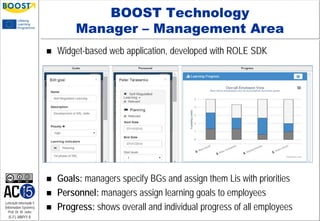
Manager – Management Area
 Widget-based web application, developed with ROLE SDK
 Goals: managers specify BGs and assign them Lis with priorities
 Personnel: managers assign learning goals to employees
 Progress: shows overall and individual progress of all employees
Lehrstuhl Informatik 5
(Information Systems)
Prof. Dr. M. Jarke
I5-FL-MMYY-9
BOOST Technology
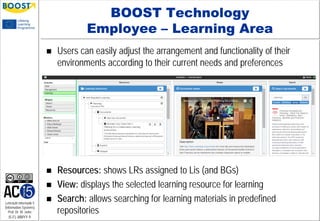
Employee – Learning Area
 Users can easily adjust the arrangement and functionality of their
environments according to their current needs and preferences
 Resources: shows LRs assigned to Lis (and BGs)
 View: displays the selected learning resource for learning
 Search: allows searching for learning materials in predefined
repositories
Lehrstuhl Informatik 5
(Information Systems)
Prof. Dr. M. Jarke
I5-FL-MMYY-10
BOOST Evaluation
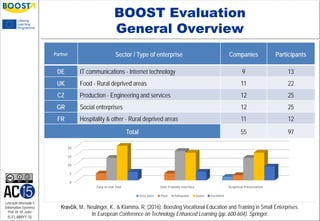
General Overview
0
5
10
15
20
Easy to Use Tool User Friendly Interface Graphical Presentation
Online tool rating
Very poor Poor Adequate Good Excellent
Partner Sector / Type of enterprise Companies Participants
DE IT communications - Internet technology 9 13
UK Food - Rural deprived areas 11 22
CZ Production - Engineering and services 12 25
GR Social enterprises 12 25
FR Hospitality & other - Rural deprived areas 11 12
Total 55 97
Kravčík, M., Neulinger, K., & Klamma, R. (2016). Boosting Vocational Education and Training in Small Enterprises.
In European Conference on Technology Enhanced Learning (pp. 600-604). Springer.
Lehrstuhl Informatik 5
(Information Systems)
Prof. Dr. M. Jarke
I5-FL-MMYY-11
BOOST Evaluation
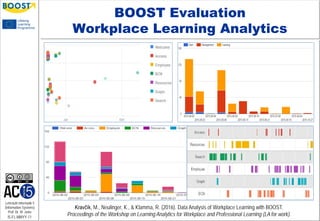
Workplace Learning Analytics
Kravčík, M., Neulinger, K., & Klamma, R. (2016). Data Analysis of Workplace Learning with BOOST.
Proceedings of the Workshop on Learning Analytics for Workplace and Professional Learning (LA for work).
Lehrstuhl Informatik 5
(Information Systems)
Prof. Dr. M. Jarke
I5-FL-MMYY-12
BOOST Evaluation
Interviews in Germany
 “BOOST approach is very useful, because I can set the
learning goals I need for my employees and see their
performance and learning process.”
 “Such tool, as a light-weight alternative to a Learning
Management System, can be used for planning of learning
processes. Provided high-quality learning content is
available, the use of such system will contribute to the
development of the employees’ skills.”
 “There is currently not much support for organizing training in
SME, so BOOST is a good start. The problems of SME are
very diverse, so the system needs to be even more flexible in
terms of adaptability to specific business needs.”
Lehrstuhl Informatik 5
(Information Systems)
Prof. Dr. M. Jarke
I5-FL-MMYY-13
Conclusion
 It is pretty challenging to get small companies
engaged in evaluation
 BOOST approach can be a viable one and has a
potential for further improvement
 Openness and sharing are not so common in the
corporate settings
 Means for different levels of privacy have to be
provided
 BOOST approach is not necessarily restricted on
small companies
Lehrstuhl Informatik 5
(Information Systems)
Prof. Dr. M. Jarke
I5-FL-MMYY-14
References
 BOOST – Business perfOrmance imprOvement through individual
employee Skills Training:
http://www.adam-
europe.eu/adam/project/view.htm?prj=11063#.WA359sm2LgE
 ROLE Software Development Kit:
https://github.com/rwth-acis/ROLE-SDK
Other workplace learning projects of our team:
 Learning Layers – Scaling up Technologies:
http://learning-layers.eu
 WEKIT – Augmented Reality and Wearable Technology:
http://www.wekit.eu
 VIRTUS – Virtual VET Centre:
http://www.virtus-project.eu

Using Personal Learning Environments to Support Workplace Learning in Small Companies

  • 1.
    Lehrstuhl Informatik 5 (InformationSystems) Prof. Dr. M. Jarke I5-FL-MMYY-1 This work is licensed under a Creative Commons Attribution-ShareAlike 3.0 Unported License. Using Personal Learning Environments to Support Workplace Learning in Small Companies Miloš Kravčík, Kateryna Neulinger, Ralf Klamma Advanced Community Information Systems (ACIS) RWTH Aachen University, Germany kravcik@dbis.rwth-aachen.de ICWL Conference, Rome, October 28th, 2016
  • 2.
    Lehrstuhl Informatik 5 (InformationSystems) Prof. Dr. M. Jarke I5-FL-MMYY-2 Agenda  Introduction  Related Work  BOOST Methodology  BOOST Technology  BOOST Evaluation  Conclusion
  • 3.
    Lehrstuhl Informatik 5 (InformationSystems) Prof. Dr. M. Jarke I5-FL-MMYY-3 Introduction  Small enterprises – Represent majority in developed economies – Decreasing participation in VET  Our aim – Web-based learning environment – Considering business critical needs of companies & target competences of employees – Providing tailored learning solutions
  • 4.
    Lehrstuhl Informatik 5 (InformationSystems) Prof. Dr. M. Jarke I5-FL-MMYY-4 Related Work  Lack of internal capacity and motivation to provide learning opportunities for employees [Johnson 2002]  In SME learning takes place through work processes, is multi episodic, often informal, problem based, takes place on a just in time basis [Attwell 2012]  Training provided through government courses is typically perceived by managers as lacking value in improving business performance [Jones 2013]  SRL skills are important and can be supported by properly designed PLEs [Nussbaumer 2014]
  • 5.
    Lehrstuhl Informatik 5 (InformationSystems) Prof. Dr. M. Jarke I5-FL-MMYY-5 BOOST Approach  BOOST: Business PerfOrmance imprOvement through individual employee Skills Training – BeCome methodology – ROLE widget-based technology  Result: Web-based learning environment to support and monitor learning process at the workplace
  • 6.
    Lehrstuhl Informatik 5 (InformationSystems) Prof. Dr. M. Jarke I5-FL-MMYY-6 BOOST Methodology Learning Phases  1 Planning – Identify critical business goals and competences – Select employees to address them  2a Tutoring – Assign learning resources to competences  2b Learning – Support their learning – Enable searching  3 Reflection – Monitor learning progress of company and employees
  • 7.
    Lehrstuhl Informatik 5 (InformationSystems) Prof. Dr. M. Jarke I5-FL-MMYY-7 BOOST Methodology Data Model & User Roles  Business Goals (BGs) – Critical needs – Project administration – Web development  Learning Indicators (LIs) – Competences – Planning, reporting – Web design, information architecture  Learning Resources (LRs) – Materials, tools, peers  Manager / Trainer – Specifies company‘s BGs – Assigns BGs to employees – Monitors learning progress – Describes LIs for BGs – Recommends LRs for LIs  Employee – Gets assigned BGs, LIs, LRs – Learns & reflects
  • 8.
    Lehrstuhl Informatik 5 (InformationSystems) Prof. Dr. M. Jarke I5-FL-MMYY-8 BOOST Technology Manager – Management Area  Widget-based web application, developed with ROLE SDK  Goals: managers specify BGs and assign them Lis with priorities  Personnel: managers assign learning goals to employees  Progress: shows overall and individual progress of all employees
  • 9.
    Lehrstuhl Informatik 5 (InformationSystems) Prof. Dr. M. Jarke I5-FL-MMYY-9 BOOST Technology Employee – Learning Area  Users can easily adjust the arrangement and functionality of their environments according to their current needs and preferences  Resources: shows LRs assigned to Lis (and BGs)  View: displays the selected learning resource for learning  Search: allows searching for learning materials in predefined repositories
  • 10.
    Lehrstuhl Informatik 5 (InformationSystems) Prof. Dr. M. Jarke I5-FL-MMYY-10 BOOST Evaluation General Overview 0 5 10 15 20 Easy to Use Tool User Friendly Interface Graphical Presentation Online tool rating Very poor Poor Adequate Good Excellent Partner Sector / Type of enterprise Companies Participants DE IT communications - Internet technology 9 13 UK Food - Rural deprived areas 11 22 CZ Production - Engineering and services 12 25 GR Social enterprises 12 25 FR Hospitality & other - Rural deprived areas 11 12 Total 55 97 Kravčík, M., Neulinger, K., & Klamma, R. (2016). Boosting Vocational Education and Training in Small Enterprises. In European Conference on Technology Enhanced Learning (pp. 600-604). Springer.
  • 11.
    Lehrstuhl Informatik 5 (InformationSystems) Prof. Dr. M. Jarke I5-FL-MMYY-11 BOOST Evaluation Workplace Learning Analytics Kravčík, M., Neulinger, K., & Klamma, R. (2016). Data Analysis of Workplace Learning with BOOST. Proceedings of the Workshop on Learning Analytics for Workplace and Professional Learning (LA for work).
  • 12.
    Lehrstuhl Informatik 5 (InformationSystems) Prof. Dr. M. Jarke I5-FL-MMYY-12 BOOST Evaluation Interviews in Germany  “BOOST approach is very useful, because I can set the learning goals I need for my employees and see their performance and learning process.”  “Such tool, as a light-weight alternative to a Learning Management System, can be used for planning of learning processes. Provided high-quality learning content is available, the use of such system will contribute to the development of the employees’ skills.”  “There is currently not much support for organizing training in SME, so BOOST is a good start. The problems of SME are very diverse, so the system needs to be even more flexible in terms of adaptability to specific business needs.”
  • 13.
    Lehrstuhl Informatik 5 (InformationSystems) Prof. Dr. M. Jarke I5-FL-MMYY-13 Conclusion  It is pretty challenging to get small companies engaged in evaluation  BOOST approach can be a viable one and has a potential for further improvement  Openness and sharing are not so common in the corporate settings  Means for different levels of privacy have to be provided  BOOST approach is not necessarily restricted on small companies
  • 14.
    Lehrstuhl Informatik 5 (InformationSystems) Prof. Dr. M. Jarke I5-FL-MMYY-14 References  BOOST – Business perfOrmance imprOvement through individual employee Skills Training: http://www.adam- europe.eu/adam/project/view.htm?prj=11063#.WA359sm2LgE  ROLE Software Development Kit: https://github.com/rwth-acis/ROLE-SDK Other workplace learning projects of our team:  Learning Layers – Scaling up Technologies: http://learning-layers.eu  WEKIT – Augmented Reality and Wearable Technology: http://www.wekit.eu  VIRTUS – Virtual VET Centre: http://www.virtus-project.eu