May 11, 2021
May 11, 2021
Who we are: A nonprofit ‘fact tank’ that informs the public about the issues,
attitudes and trends shaping the world. We are nonpartisan and
nonadvocacy, meaning we do not take policy positions or make
recommendations.
We are a subsidiary of The Pew Charitable Trusts, our primary funder. We
partner strategically with philanthropists and institutional funders who share
our commitment to impartial research and data that drive discussion.
What we do: Generate a foundation of facts to enrich public dialogue and
support sound decision-making. We conduct public opinion polling,
demographic research, content analysis and data-driven social science
research.
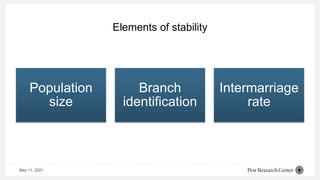
Elements of stability
May 11, 2021
Population
size
Branch
identification
Intermarriage
rate
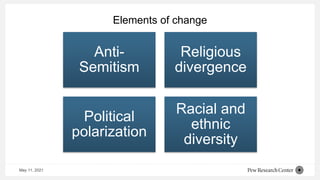
Elements of change
May 11, 2021
Anti-
Semitism
Religious
divergence
Political
polarization
Racial and
ethnic
diversity
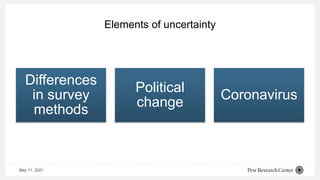
Elements of uncertainty
May 11, 2021
Differences
in survey
methods
Political
change
Coronavirus
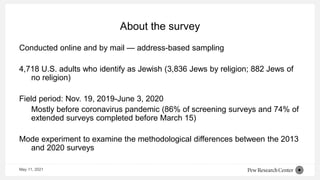
About the survey
Conducted online and by mail — address-based sampling
4,718 U.S. adults who identify as Jewish (3,836 Jews by religion; 882 Jews of
no religion)
Field period: Nov. 19, 2019-June 3, 2020
Mostly before coronavirus pandemic (86% of screening surveys and 74% of
extended surveys completed before March 15)
Mode experiment to examine the methodological differences between the 2013
and 2020 surveys
May 11, 2021
SOME MEASURES ARE FAIRLY STABLE
May 11, 2021
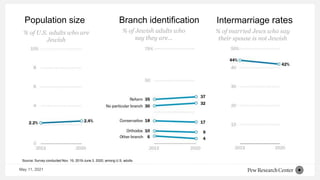
Population size
Source: Survey conducted Nov. 19, 2019-June 3, 2020, among U.S. adults.
% of U.S. adults who are
Jewish
% of Jewish adults who
say they are...
% of married Jews who say
their spouse is not Jewish
Branch identification Intermarriage rates
May 11, 2021
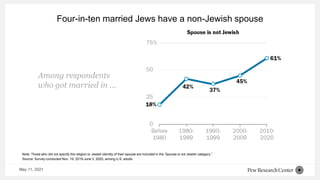
Four-in-ten married Jews have a non-Jewish spouse
Note: Those who did not specify the religion or Jewish identity of their spouse are included in the ‘Spouse is not Jewish category.”
Source: Survey conducted Nov. 19, 2019-June 3, 2020, among U.S. adults.
Among respondents
who got married in …
May 11, 2021
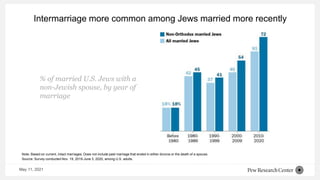
Intermarriage more common among Jews married more recently
Note: Based on current, intact marriages. Does not include past marriage that ended in either divorce or the death of a spouse.
Source: Survey conducted Nov. 19, 2019-June 3, 2020, among U.S. adults.
% of married U.S. Jews with a
non-Jewish spouse, by year of
marriage
May 11, 2021
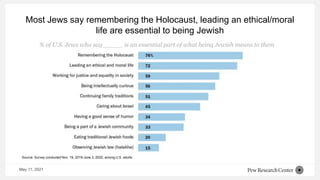
Most Jews say remembering the Holocaust, leading an ethical/moral
life are essential to being Jewish
Source: Survey conducted Nov. 19, 2019-June 3, 2020, among U.S. adults.
% of U.S. Jews who say _____ is an essential part of what being Jewish means to them
May 11, 2021
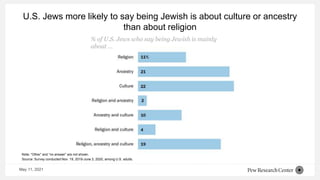
U.S. Jews more likely to say being Jewish is about culture or ancestry
than about religion
Note: “Other” and “no answer” are not shown.
Source: Survey conducted Nov. 19, 2019-June 3, 2020, among U.S. adults.
% of U.S. Jews who say being Jewish is mainly
about …
May 11, 2021
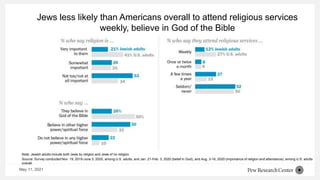
Jews less likely than Americans overall to attend religious services
weekly, believe in God of the Bible
Note: Jewish adults include both Jews by religion and Jews of no religion
Source: Survey conducted Nov. 19, 2019-June 3, 2020, among U.S. adults, and Jan. 21-Feb. 3, 2020 (belief in God), and Aug. 3-16, 2020 (importance of religion and attendance), among U.S. adults
overall.
May 11, 2021
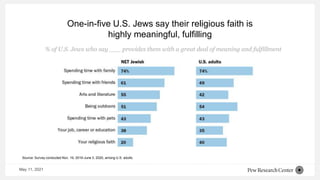
One-in-five U.S. Jews say their religious faith is
highly meaningful, fulfilling
Source: Survey conducted Nov. 19, 2019-June 3, 2020, among U.S. adults.
% of U.S. Jews who say ___ provides them with a great deal of meaning and fulfillment
May 11, 2021
SIGNS OF CHANGE
May 11, 2021
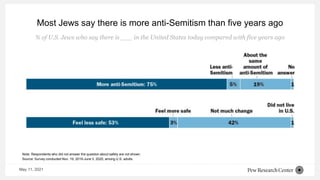
Most Jews say there is more anti-Semitism than five years ago
Note: Respondents who did not answer the question about safety are not shown.
Source: Survey conducted Nov. 19, 2019-June 3, 2020, among U.S. adults.
% of U.S. Jews who say there is ___ in the United States today compared with five years ago
May 11, 2021
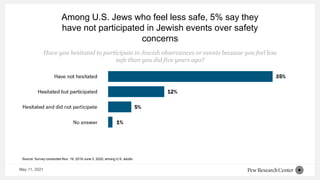
Among U.S. Jews who feel less safe, 5% say they
have not participated in Jewish events over safety
concerns
Source: Survey conducted Nov. 19, 2019-June 3, 2020, among U.S. adults.
Have you hesitated to participate in Jewish observances or events because you feel less
safe than you did five years ago?
May 11, 2021
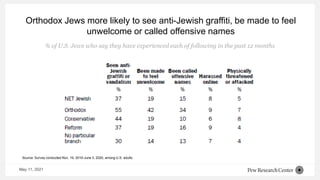
Orthodox Jews more likely to see anti-Jewish graffiti, be made to feel
unwelcome or called offensive names
Source: Survey conducted Nov. 19, 2019-June 3, 2020, among U.S. adults.
% of U.S. Jews who say they have experienced each of following in the past 12 months
May 11, 2021
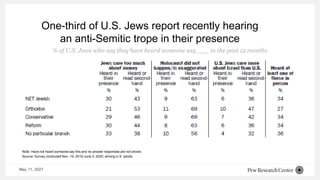
One-third of U.S. Jews report recently hearing
an anti-Semitic trope in their presence
Note: Have not heard someone say this and no answer responses are not shown.
Source: Survey conducted Nov. 19, 2019-June 3, 2020, among U.S. adults.
% of U.S. Jews who say they have heard someone say ___ in the past 12 months
May 11, 2021
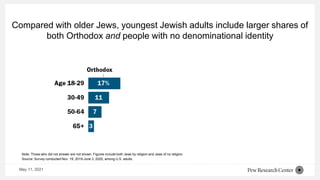
Compared with older Jews, youngest Jewish adults include larger shares of
both Orthodox and people with no denominational identity
Note: Those who did not answer are not shown. Figures include both Jews by religion and Jews of no religion.
Source: Survey conducted Nov. 19, 2019-June 3, 2020, among U.S. adults.
May 11, 2021
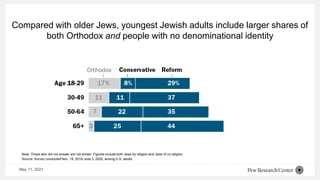
Compared with older Jews, youngest Jewish adults include larger shares of
both Orthodox and people with no denominational identity
Note: Those who did not answer are not shown. Figures include both Jews by religion and Jews of no religion.
Source: Survey conducted Nov. 19, 2019-June 3, 2020, among U.S. adults.
May 11, 2021
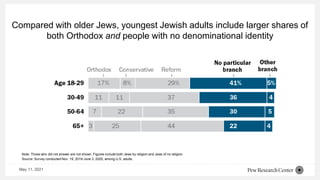
Compared with older Jews, youngest Jewish adults include larger shares of
both Orthodox and people with no denominational identity
Note: Those who did not answer are not shown. Figures include both Jews by religion and Jews of no religion.
Source: Survey conducted Nov. 19, 2019-June 3, 2020, among U.S. adults.
May 11, 2021
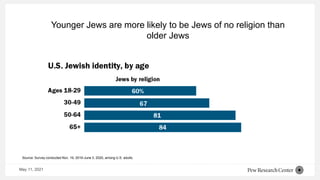
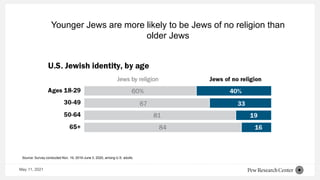
Younger Jews are more likely to be Jews of no religion than
older Jews
May 11, 2021
Source: Survey conducted Nov. 19, 2019-June 3, 2020, among U.S. adults.
Younger Jews are more likely to be Jews of no religion than
older Jews
May 11, 2021
Source: Survey conducted Nov. 19, 2019-June 3, 2020, among U.S. adults.
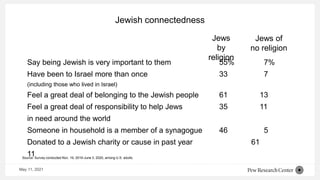
Jewish connectedness
Say being Jewish is very important to them 55% 7%
Have been to Israel more than once 33 7
(including those who lived in Israel)
Feel a great deal of belonging to the Jewish people 61 13
Feel a great deal of responsibility to help Jews 35 11
in need around the world
Someone in household is a member of a synagogue 46 5
Donated to a Jewish charity or cause in past year 61
11
May 11, 2021
Jews
by
religion
Jews of
no religion
Source: Survey conducted Nov. 19, 2019-June 3, 2020, among U.S. adults.
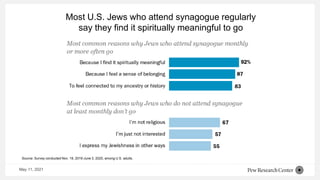
Most U.S. Jews who attend synagogue regularly
say they find it spiritually meaningful to go
Source: Survey conducted Nov. 19, 2019-June 3, 2020, among U.S. adults.
May 11, 2021
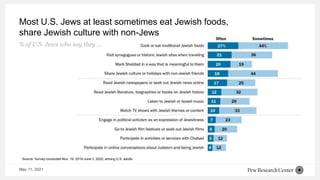
Most U.S. Jews at least sometimes eat Jewish foods,
share Jewish culture with non-Jews
Source: Survey conducted Nov. 19, 2019-June 3, 2020, among U.S. adults.
% of U.S. Jews who say they …
May 11, 2021
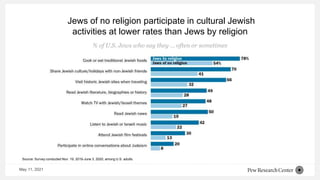
Jews of no religion participate in cultural Jewish
activities at lower rates than Jews by religion
Source: Survey conducted Nov. 19, 2019-June 3, 2020, among U.S. adults.
% of U.S. Jews who say they … often or sometimes
May 11, 2021
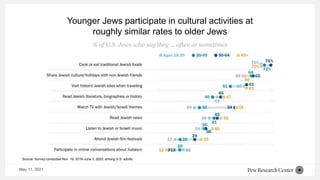
Younger Jews participate in cultural activities at
roughly similar rates to older Jews
Source: Survey conducted Nov. 19, 2019-June 3, 2020, among U.S. adults.
% of U.S. Jews who say they … often or sometimes
May 11, 2021
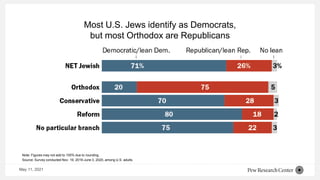
Most U.S. Jews identify as Democrats,
but most Orthodox are Republicans
Note: Figures may not add to 100% due to rounding.
Source: Survey conducted Nov. 19, 2019-June 3, 2020, among U.S. adults.
May 11, 2021
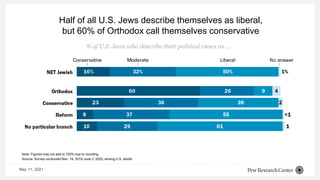
Half of all U.S. Jews describe themselves as liberal,
but 60% of Orthodox call themselves conservative
Note: Figures may not add to 100% due to rounding.
Source: Survey conducted Nov. 19, 2019-June 3, 2020, among U.S. adults.
% of U.S. Jews who describe their political views as …
May 11, 2021
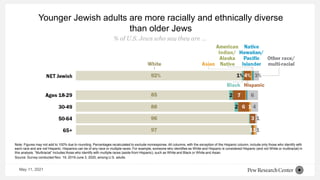
Younger Jewish adults are more racially and ethnically diverse
than older Jews
Note: Figures may not add to 100% due to rounding. Percentages recalculated to exclude nonresponse. All columns, with the exception of the Hispanic column, include only those who identify with
each race and are not Hispanic. Hispanics can be of any race or multiple races. For example, someone who identifies as White and Hispanic is considered Hispanic (and not White or multiracial) in
this analysis. “Multiracial” includes those who identify with multiple races (aside from Hispanic), such as White and Black or White and Asian.
Source: Survey conducted Nov. 19, 2019-June 3, 2020, among U.S. adults.
% of U.S. Jews who say they are …
May 11, 2021
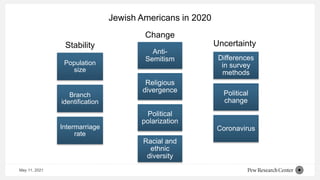
Jewish Americans in 2020
May 11, 2021
Population
size
Branch
identification
Intermarriage
rate
Anti-
Semitism
Religious
divergence
Political
polarization
Racial and
ethnic
diversity
Differences
in survey
methods
Political
change
Coronavirus
Change
Stability Uncertainty
May 11, 2021
www.pewresearch.org
Becka A. Alper
Senior Researcher
Alan Cooperman
Director of Religion Research
info@pewresearch.org

Virtual Event: Jewish Americans in 2020

  • 1.
  • 2.
    May 11, 2021 Whowe are: A nonprofit ‘fact tank’ that informs the public about the issues, attitudes and trends shaping the world. We are nonpartisan and nonadvocacy, meaning we do not take policy positions or make recommendations. We are a subsidiary of The Pew Charitable Trusts, our primary funder. We partner strategically with philanthropists and institutional funders who share our commitment to impartial research and data that drive discussion. What we do: Generate a foundation of facts to enrich public dialogue and support sound decision-making. We conduct public opinion polling, demographic research, content analysis and data-driven social science research.
  • 3.
    Elements of stability May11, 2021 Population size Branch identification Intermarriage rate
  • 4.
    Elements of change May11, 2021 Anti- Semitism Religious divergence Political polarization Racial and ethnic diversity
  • 5.
    Elements of uncertainty May11, 2021 Differences in survey methods Political change Coronavirus
  • 6.
    About the survey Conductedonline and by mail — address-based sampling 4,718 U.S. adults who identify as Jewish (3,836 Jews by religion; 882 Jews of no religion) Field period: Nov. 19, 2019-June 3, 2020 Mostly before coronavirus pandemic (86% of screening surveys and 74% of extended surveys completed before March 15) Mode experiment to examine the methodological differences between the 2013 and 2020 surveys May 11, 2021
  • 7.
    SOME MEASURES AREFAIRLY STABLE May 11, 2021
  • 8.
    Population size Source: Surveyconducted Nov. 19, 2019-June 3, 2020, among U.S. adults. % of U.S. adults who are Jewish % of Jewish adults who say they are... % of married Jews who say their spouse is not Jewish Branch identification Intermarriage rates May 11, 2021
  • 9.
    Four-in-ten married Jewshave a non-Jewish spouse Note: Those who did not specify the religion or Jewish identity of their spouse are included in the ‘Spouse is not Jewish category.” Source: Survey conducted Nov. 19, 2019-June 3, 2020, among U.S. adults. Among respondents who got married in … May 11, 2021
  • 10.
    Intermarriage more commonamong Jews married more recently Note: Based on current, intact marriages. Does not include past marriage that ended in either divorce or the death of a spouse. Source: Survey conducted Nov. 19, 2019-June 3, 2020, among U.S. adults. % of married U.S. Jews with a non-Jewish spouse, by year of marriage May 11, 2021
  • 11.
    Most Jews sayremembering the Holocaust, leading an ethical/moral life are essential to being Jewish Source: Survey conducted Nov. 19, 2019-June 3, 2020, among U.S. adults. % of U.S. Jews who say _____ is an essential part of what being Jewish means to them May 11, 2021
  • 12.
    U.S. Jews morelikely to say being Jewish is about culture or ancestry than about religion Note: “Other” and “no answer” are not shown. Source: Survey conducted Nov. 19, 2019-June 3, 2020, among U.S. adults. % of U.S. Jews who say being Jewish is mainly about … May 11, 2021
  • 13.
    Jews less likelythan Americans overall to attend religious services weekly, believe in God of the Bible Note: Jewish adults include both Jews by religion and Jews of no religion Source: Survey conducted Nov. 19, 2019-June 3, 2020, among U.S. adults, and Jan. 21-Feb. 3, 2020 (belief in God), and Aug. 3-16, 2020 (importance of religion and attendance), among U.S. adults overall. May 11, 2021
  • 14.
    One-in-five U.S. Jewssay their religious faith is highly meaningful, fulfilling Source: Survey conducted Nov. 19, 2019-June 3, 2020, among U.S. adults. % of U.S. Jews who say ___ provides them with a great deal of meaning and fulfillment May 11, 2021
  • 15.
  • 16.
    Most Jews saythere is more anti-Semitism than five years ago Note: Respondents who did not answer the question about safety are not shown. Source: Survey conducted Nov. 19, 2019-June 3, 2020, among U.S. adults. % of U.S. Jews who say there is ___ in the United States today compared with five years ago May 11, 2021
  • 17.
    Among U.S. Jewswho feel less safe, 5% say they have not participated in Jewish events over safety concerns Source: Survey conducted Nov. 19, 2019-June 3, 2020, among U.S. adults. Have you hesitated to participate in Jewish observances or events because you feel less safe than you did five years ago? May 11, 2021
  • 18.
    Orthodox Jews morelikely to see anti-Jewish graffiti, be made to feel unwelcome or called offensive names Source: Survey conducted Nov. 19, 2019-June 3, 2020, among U.S. adults. % of U.S. Jews who say they have experienced each of following in the past 12 months May 11, 2021
  • 19.
    One-third of U.S.Jews report recently hearing an anti-Semitic trope in their presence Note: Have not heard someone say this and no answer responses are not shown. Source: Survey conducted Nov. 19, 2019-June 3, 2020, among U.S. adults. % of U.S. Jews who say they have heard someone say ___ in the past 12 months May 11, 2021
  • 20.
    Compared with olderJews, youngest Jewish adults include larger shares of both Orthodox and people with no denominational identity Note: Those who did not answer are not shown. Figures include both Jews by religion and Jews of no religion. Source: Survey conducted Nov. 19, 2019-June 3, 2020, among U.S. adults. May 11, 2021
  • 21.
    Compared with olderJews, youngest Jewish adults include larger shares of both Orthodox and people with no denominational identity Note: Those who did not answer are not shown. Figures include both Jews by religion and Jews of no religion. Source: Survey conducted Nov. 19, 2019-June 3, 2020, among U.S. adults. May 11, 2021
  • 22.
    Compared with olderJews, youngest Jewish adults include larger shares of both Orthodox and people with no denominational identity Note: Those who did not answer are not shown. Figures include both Jews by religion and Jews of no religion. Source: Survey conducted Nov. 19, 2019-June 3, 2020, among U.S. adults. May 11, 2021
  • 23.
    Younger Jews aremore likely to be Jews of no religion than older Jews May 11, 2021 Source: Survey conducted Nov. 19, 2019-June 3, 2020, among U.S. adults.
  • 24.
    Younger Jews aremore likely to be Jews of no religion than older Jews May 11, 2021 Source: Survey conducted Nov. 19, 2019-June 3, 2020, among U.S. adults.
  • 25.
    Jewish connectedness Say beingJewish is very important to them 55% 7% Have been to Israel more than once 33 7 (including those who lived in Israel) Feel a great deal of belonging to the Jewish people 61 13 Feel a great deal of responsibility to help Jews 35 11 in need around the world Someone in household is a member of a synagogue 46 5 Donated to a Jewish charity or cause in past year 61 11 May 11, 2021 Jews by religion Jews of no religion Source: Survey conducted Nov. 19, 2019-June 3, 2020, among U.S. adults.
  • 26.
    Most U.S. Jewswho attend synagogue regularly say they find it spiritually meaningful to go Source: Survey conducted Nov. 19, 2019-June 3, 2020, among U.S. adults. May 11, 2021
  • 27.
    Most U.S. Jewsat least sometimes eat Jewish foods, share Jewish culture with non-Jews Source: Survey conducted Nov. 19, 2019-June 3, 2020, among U.S. adults. % of U.S. Jews who say they … May 11, 2021
  • 28.
    Jews of noreligion participate in cultural Jewish activities at lower rates than Jews by religion Source: Survey conducted Nov. 19, 2019-June 3, 2020, among U.S. adults. % of U.S. Jews who say they … often or sometimes May 11, 2021
  • 29.
    Younger Jews participatein cultural activities at roughly similar rates to older Jews Source: Survey conducted Nov. 19, 2019-June 3, 2020, among U.S. adults. % of U.S. Jews who say they … often or sometimes May 11, 2021
  • 30.
    Most U.S. Jewsidentify as Democrats, but most Orthodox are Republicans Note: Figures may not add to 100% due to rounding. Source: Survey conducted Nov. 19, 2019-June 3, 2020, among U.S. adults. May 11, 2021
  • 31.
    Half of allU.S. Jews describe themselves as liberal, but 60% of Orthodox call themselves conservative Note: Figures may not add to 100% due to rounding. Source: Survey conducted Nov. 19, 2019-June 3, 2020, among U.S. adults. % of U.S. Jews who describe their political views as … May 11, 2021
  • 32.
    Younger Jewish adultsare more racially and ethnically diverse than older Jews Note: Figures may not add to 100% due to rounding. Percentages recalculated to exclude nonresponse. All columns, with the exception of the Hispanic column, include only those who identify with each race and are not Hispanic. Hispanics can be of any race or multiple races. For example, someone who identifies as White and Hispanic is considered Hispanic (and not White or multiracial) in this analysis. “Multiracial” includes those who identify with multiple races (aside from Hispanic), such as White and Black or White and Asian. Source: Survey conducted Nov. 19, 2019-June 3, 2020, among U.S. adults. % of U.S. Jews who say they are … May 11, 2021
  • 33.
    Jewish Americans in2020 May 11, 2021 Population size Branch identification Intermarriage rate Anti- Semitism Religious divergence Political polarization Racial and ethnic diversity Differences in survey methods Political change Coronavirus Change Stability Uncertainty
  • 34.
    May 11, 2021 www.pewresearch.org BeckaA. Alper Senior Researcher Alan Cooperman Director of Religion Research info@pewresearch.org