BORCELLE Contact
About Us
Photo
Home
01
LESSON 2: EXERCISE PRESCRIPTION
LESSON 3: PRINCIPLES OF EXERCISE
BORCELLE Contact
About Us
Photo
Home
01
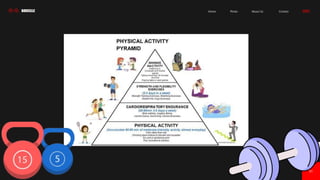
• The bottom of the pyramid is the daily activities that should be done at least a total of 60-
90 minutes of moderate activity near every day. Doing household chores, gardening,
climbing stairs, and participating in recreational activities such as badminton, and
traditional and street games are some of the activities that you may consider to have an
active life style.
• On the second level, if you decided to engage in cardiorespiratory exercises like brisk
walking, jogging, biking, and other aerobic exercise, it is recommended to have a
moderate intensity of 20-60 minutes, 3-5 days a week program.
• Placed on the third level are the strength and flexibility exercises which recommend
having exercise program every 2-3 days in a week. Some of the exercises are yoga,
martial arts, and resistance training. While on top, are the activities that should be done
in minimal number of minutes. Sedentary lifestyle must be avoided, since it contributes
for having non-communicable diseases such as heart diseases, stroke, and diabetes.
Contact
About Us
Photo
Home
03
PYRAMID OF PHYSICAL ACTIVITY
BORCELLE Contact
About Us
Photo
Home
04
EXERCISE PRESCRIPTION
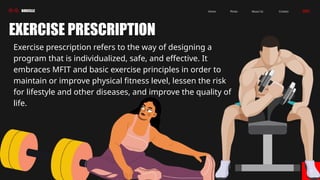
Exercise prescription refers to the way of designing a
program that is individualized, safe, and effective. It
embraces MFIT and basic exercise principles in order to
maintain or improve physical fitness level, lessen the risk
for lifestyle and other diseases, and improve the quality of
life.
PRINCIPLES
OF EXERCISE
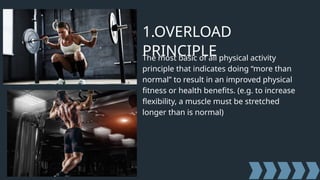
1.OVERLOAD
PRINCIPLE
The most basic of all physical activity
principle that indicates doing “more than
normal” to result in an improved physical
fitness or health benefits. (e.g. to increase
flexibility, a muscle must be stretched
longer than is normal)
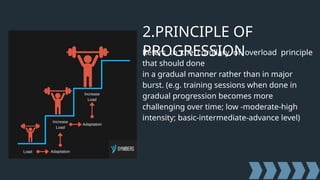
2.PRINCIPLE OF
PROGRESSION
Refers to the corollary of overload principle
that should done
in a gradual manner rather than in major
burst. (e.g. training sessions when done in
gradual progression becomes more
challenging over time; low -moderate-high
intensity; basic-intermediate-advance level)
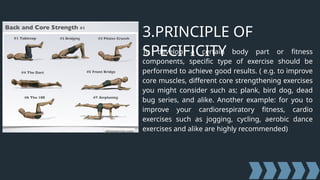
3.PRINCIPLE OF
SPECIFICITY
To develop a certain body part or fitness
components, specific type of exercise should be
performed to achieve good results. ( e.g. to improve
core muscles, different core strengthening exercises
you might consider such as; plank, bird dog, dead
bug series, and alike. Another example: for you to
improve your cardiorespiratory fitness, cardio
exercises such as jogging, cycling, aerobic dance
exercises and alike are highly recommended)
4.PRINCIPLE OF
REVERSIBILITY
It means that disuse or inactivity results in
loss of benefits achieved as a result of
overload. This principle can be sum up or
simplify by the fact that “if you don’t use it,
you will lose it.”e.g. if you do not adhere with
your physical activity like 30 minutes running
everyday, the benefit you attained like weight
loss will gradually erode.
5. PRINCIPLE OF REST AND
RECOVERY
Pertains to the amount of rest needed to allow
the body to adapt to and recover from
exercise. It is important to give our body a
time to recuperate after overload. (e.g. taking
a break between heavy training workout or
recreation and sport activities).
6. PRINCIPLE OF
INDIVIDUALIZATION
We should be guided by this principle and be
constantly reminded that the impact and
benefits of physical activity or workout are
different from
one person to another because of individual
differences. (e.g. the effect and amount of
weight loss in running varies as to the body
composition, metabolism of an individual, and
lifestyle habit).
MFIT Principle
M- Mode( Type Of exercise)
F- Frequency( A number of days)
I- Intensity(Exertion of intense physical activity)
T- Time( Duration)
Quiz Time
Direction: On your ¼ sheet of paper, Choose and write the LETTER ONLY, of
the correct answer
1. Refers to the corollary of overload principle that should done in a gradual
manner.
A. Overload Principle C. Principle Of Individualization
B. Principle Of Progression D. Principle Of Reversibility
2. It means that disuse or inactivity results in loss of benefits achieved as a result of
overload.
C. Principle Rest and Recovery C. Principle Of Progression
D. Principle Reversibility D. Pyramid of Physical activity
3. The impact and benefits of physical activity or workout are different from one person to
another.
E. Principle Of Individualization C. Principle of Specificity
F. Overload Principle D. Principle of Progression
4. For you to improve your cardiorespiratory fitness, cardio exercises such as jogging, cycling,
aerobic dance exercises and alike are highly recommended.
G. Principle Of Reversibility C. Principle of Specificity
H. Overload Principle D. Principle of Progression
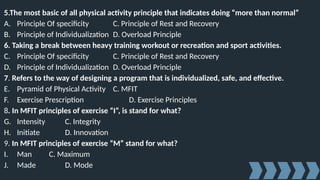
5.The most basic of all physical activity principle that indicates doing “more than normal”
A. Principle Of specificity C. Principle of Rest and Recovery
B. Principle of Individualization D. Overload Principle
6. Taking a break between heavy training workout or recreation and sport activities.
C. Principle Of specificity C. Principle of Rest and Recovery
D. Principle of Individualization D. Overload Principle
7. Refers to the way of designing a program that is individualized, safe, and effective.
E. Pyramid of Physical Activity C. MFIT
F. Exercise Prescription D. Exercise Principles
8. In MFIT principles of exercise “I”, is stand for what?
G. Intensity C. Integrity
H. Initiate D. Innovation
9. In MFIT principles of exercise “M” stand for what?
I. Man C. Maximum
J. Made D. Mode
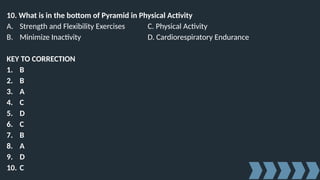
10. What is in the bottom of Pyramid in Physical Activity
A. Strength and Flexibility Exercises C. Physical Activity
B. Minimize Inactivity D. Cardiorespiratory Endurance
KEY TO CORRECTION
1. B
2. B
3. A
4. C
5. D
6. C
7. B
8. A
9. D
10. C

Exercise-prescription-and-principles 2.pptx

  • 1.
    BORCELLE Contact About Us Photo Home 01 LESSON2: EXERCISE PRESCRIPTION LESSON 3: PRINCIPLES OF EXERCISE
  • 2.
  • 3.
    • The bottomof the pyramid is the daily activities that should be done at least a total of 60- 90 minutes of moderate activity near every day. Doing household chores, gardening, climbing stairs, and participating in recreational activities such as badminton, and traditional and street games are some of the activities that you may consider to have an active life style. • On the second level, if you decided to engage in cardiorespiratory exercises like brisk walking, jogging, biking, and other aerobic exercise, it is recommended to have a moderate intensity of 20-60 minutes, 3-5 days a week program. • Placed on the third level are the strength and flexibility exercises which recommend having exercise program every 2-3 days in a week. Some of the exercises are yoga, martial arts, and resistance training. While on top, are the activities that should be done in minimal number of minutes. Sedentary lifestyle must be avoided, since it contributes for having non-communicable diseases such as heart diseases, stroke, and diabetes. Contact About Us Photo Home 03 PYRAMID OF PHYSICAL ACTIVITY
  • 4.
    BORCELLE Contact About Us Photo Home 04 EXERCISEPRESCRIPTION Exercise prescription refers to the way of designing a program that is individualized, safe, and effective. It embraces MFIT and basic exercise principles in order to maintain or improve physical fitness level, lessen the risk for lifestyle and other diseases, and improve the quality of life.
  • 5.
  • 6.
    1.OVERLOAD PRINCIPLE The most basicof all physical activity principle that indicates doing “more than normal” to result in an improved physical fitness or health benefits. (e.g. to increase flexibility, a muscle must be stretched longer than is normal)
  • 7.
    2.PRINCIPLE OF PROGRESSION Refers tothe corollary of overload principle that should done in a gradual manner rather than in major burst. (e.g. training sessions when done in gradual progression becomes more challenging over time; low -moderate-high intensity; basic-intermediate-advance level)
  • 8.
    3.PRINCIPLE OF SPECIFICITY To developa certain body part or fitness components, specific type of exercise should be performed to achieve good results. ( e.g. to improve core muscles, different core strengthening exercises you might consider such as; plank, bird dog, dead bug series, and alike. Another example: for you to improve your cardiorespiratory fitness, cardio exercises such as jogging, cycling, aerobic dance exercises and alike are highly recommended)
  • 9.
    4.PRINCIPLE OF REVERSIBILITY It meansthat disuse or inactivity results in loss of benefits achieved as a result of overload. This principle can be sum up or simplify by the fact that “if you don’t use it, you will lose it.”e.g. if you do not adhere with your physical activity like 30 minutes running everyday, the benefit you attained like weight loss will gradually erode.
  • 10.
    5. PRINCIPLE OFREST AND RECOVERY Pertains to the amount of rest needed to allow the body to adapt to and recover from exercise. It is important to give our body a time to recuperate after overload. (e.g. taking a break between heavy training workout or recreation and sport activities).
  • 11.
    6. PRINCIPLE OF INDIVIDUALIZATION Weshould be guided by this principle and be constantly reminded that the impact and benefits of physical activity or workout are different from one person to another because of individual differences. (e.g. the effect and amount of weight loss in running varies as to the body composition, metabolism of an individual, and lifestyle habit).
  • 12.
    MFIT Principle M- Mode(Type Of exercise) F- Frequency( A number of days) I- Intensity(Exertion of intense physical activity) T- Time( Duration)
  • 13.
    Quiz Time Direction: Onyour ¼ sheet of paper, Choose and write the LETTER ONLY, of the correct answer
  • 14.
    1. Refers tothe corollary of overload principle that should done in a gradual manner. A. Overload Principle C. Principle Of Individualization B. Principle Of Progression D. Principle Of Reversibility 2. It means that disuse or inactivity results in loss of benefits achieved as a result of overload. C. Principle Rest and Recovery C. Principle Of Progression D. Principle Reversibility D. Pyramid of Physical activity 3. The impact and benefits of physical activity or workout are different from one person to another. E. Principle Of Individualization C. Principle of Specificity F. Overload Principle D. Principle of Progression 4. For you to improve your cardiorespiratory fitness, cardio exercises such as jogging, cycling, aerobic dance exercises and alike are highly recommended. G. Principle Of Reversibility C. Principle of Specificity H. Overload Principle D. Principle of Progression
  • 15.
    5.The most basicof all physical activity principle that indicates doing “more than normal” A. Principle Of specificity C. Principle of Rest and Recovery B. Principle of Individualization D. Overload Principle 6. Taking a break between heavy training workout or recreation and sport activities. C. Principle Of specificity C. Principle of Rest and Recovery D. Principle of Individualization D. Overload Principle 7. Refers to the way of designing a program that is individualized, safe, and effective. E. Pyramid of Physical Activity C. MFIT F. Exercise Prescription D. Exercise Principles 8. In MFIT principles of exercise “I”, is stand for what? G. Intensity C. Integrity H. Initiate D. Innovation 9. In MFIT principles of exercise “M” stand for what? I. Man C. Maximum J. Made D. Mode
  • 16.
    10. What isin the bottom of Pyramid in Physical Activity A. Strength and Flexibility Exercises C. Physical Activity B. Minimize Inactivity D. Cardiorespiratory Endurance KEY TO CORRECTION 1. B 2. B 3. A 4. C 5. D 6. C 7. B 8. A 9. D 10. C