PRINCIPLES
OF GOOD SINGING
By: Anne C. Pierce
(State University of Iowa )
PRINCIPLES OF GOOD
SINGING
A pleasant voice results when all
organs involved in singing are equally
and properly developed and used.
In other words, lovely singing means
that breath and dynamics are
controlled, that phrasing is artistic,
quality pleasing, enunciation distinct,
pronunciation correct and intonation
accurate.
It implies that the singer whether
young or old, has a healthy vocal
organ and that:
* she is sensitive to musical
beauty, meaning and effects.
* she sings easily with free and
open throat and flexible tongue,
lips and jaw
* she has alert mind and body
*she desires to sing
THINGS TO REMEMBER
WHILE SINGING
1. Sing correctly
- One must breathe correctly.
- Avoid breathing noisily nor hunch
or raise the shoulders when exhaling
or allow them to slump or fall when
exhaling.
- The breathing should always be
related to the phrases of a song, that
is, you should breathe quietly at the
proper time.
2. Observe Proper Posture
- The body should be alert and
erect; the chest should be
comfortably up and the
head should be held naturally
with the chin at approximately at
right angle to the throat.
- If there is a space between
the ribs and hips, the body
generally will be in an excellent
position for singing.
When standing- place the weight
of the balls of the feet with knees
unbent
( at least 6 inches away)
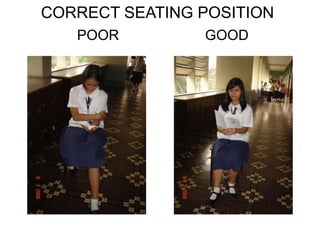
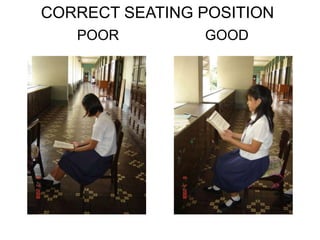
When seated – feet on the floor with
the body slightly away
from the back of the
chair.
3. Sing Pleasingly
- Sing in tune, for intonation effects
quality favorably or unfavorably.
- Faulty pitch is sometimes
caused by a poor musical ear.
-It is more likely to be due to
improper voice production,
carelessness, lack of interest or
fatigue.
(Try to emote, concentrate and
understand what you are
singing)
* An important PRINCIPLE OF GOOD
SINGING is that we should interpret
the song musically and correctly.
* This means that we must always
give careful attention to the thought
and pronunciation of words and the
accuracy of notation.
ALWAYS REMEMBER:
“ She who sings prays twice”
HAPPY SINGING!
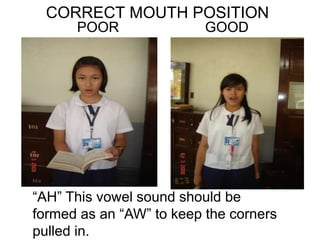
CORRECT MOUTH POSITION
POOR GOOD
“AH” This vowel sound should be
formed as an “AW” to keep the corners
pulled in.
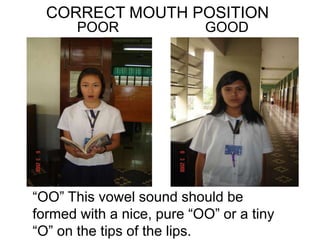
CORRECT MOUTH POSITION
POOR GOOD
“OO” This vowel sound should be
formed with a nice, pure “OO” or a tiny
“O” on the tips of the lips.
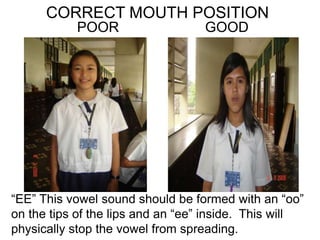
CORRECT MOUTH POSITION
POOR GOOD
“EE” This vowel sound should be formed with an “oo”
on the tips of the lips and an “ee” inside. This will
physically stop the vowel from spreading.
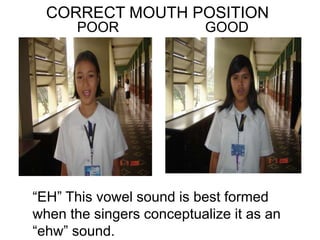
CORRECT MOUTH POSITION
POOR GOOD
“EH” This vowel sound is best formed
when the singers conceptualize it as an
“ehw” sound.
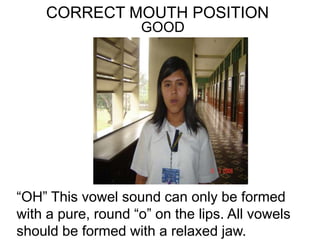
CORRECT MOUTH POSITION
GOOD
“OH” This vowel sound can only be formed
with a pure, round “o” on the lips. All vowels
should be formed with a relaxed jaw.
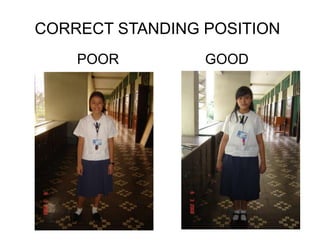
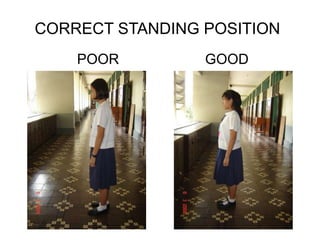
CORRECT STANDING POSITION
POSTURE
Posture is an important prerequisite
to good singing. The breathing
mechanism must be allowed freedom to
take full, deep breaths. The body must
be in proper alignment so that the head
rests on the shoulders and tension is not
created by compensating for poor
posture. Besides, good choirs always
look good.
CORRECT STANDING POSITION
POOR GOOD
CORRECT STANDING POSITION
POOR GOOD
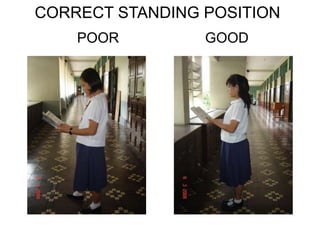
CORRECT STANDING POSITION
(with booklet)
POOR GOOD
CORRECT STANDING POSITION
POOR GOOD
CORRECT SEATING POSITION
POOR GOOD
CORRECT SEATING POSITION
POOR GOOD

Principles of Good Singing

  • 1.
    PRINCIPLES OF GOOD SINGING By:Anne C. Pierce (State University of Iowa )
  • 2.
    PRINCIPLES OF GOOD SINGING Apleasant voice results when all organs involved in singing are equally and properly developed and used. In other words, lovely singing means that breath and dynamics are controlled, that phrasing is artistic, quality pleasing, enunciation distinct, pronunciation correct and intonation accurate.
  • 3.
    It implies thatthe singer whether young or old, has a healthy vocal organ and that: * she is sensitive to musical beauty, meaning and effects. * she sings easily with free and open throat and flexible tongue, lips and jaw * she has alert mind and body *she desires to sing
  • 4.
    THINGS TO REMEMBER WHILESINGING 1. Sing correctly - One must breathe correctly. - Avoid breathing noisily nor hunch or raise the shoulders when exhaling or allow them to slump or fall when exhaling. - The breathing should always be related to the phrases of a song, that is, you should breathe quietly at the proper time.
  • 5.
    2. Observe ProperPosture - The body should be alert and erect; the chest should be comfortably up and the head should be held naturally with the chin at approximately at right angle to the throat.
  • 6.
    - If thereis a space between the ribs and hips, the body generally will be in an excellent position for singing. When standing- place the weight of the balls of the feet with knees unbent ( at least 6 inches away)
  • 7.
    When seated –feet on the floor with the body slightly away from the back of the chair. 3. Sing Pleasingly - Sing in tune, for intonation effects quality favorably or unfavorably.
  • 8.
    - Faulty pitchis sometimes caused by a poor musical ear. -It is more likely to be due to improper voice production, carelessness, lack of interest or fatigue. (Try to emote, concentrate and understand what you are singing)
  • 9.
    * An importantPRINCIPLE OF GOOD SINGING is that we should interpret the song musically and correctly. * This means that we must always give careful attention to the thought and pronunciation of words and the accuracy of notation.
  • 10.
    ALWAYS REMEMBER: “ Shewho sings prays twice” HAPPY SINGING!
  • 11.
    CORRECT MOUTH POSITION POORGOOD “AH” This vowel sound should be formed as an “AW” to keep the corners pulled in.
  • 12.
    CORRECT MOUTH POSITION POORGOOD “OO” This vowel sound should be formed with a nice, pure “OO” or a tiny “O” on the tips of the lips.
  • 13.
    CORRECT MOUTH POSITION POORGOOD “EE” This vowel sound should be formed with an “oo” on the tips of the lips and an “ee” inside. This will physically stop the vowel from spreading.
  • 14.
    CORRECT MOUTH POSITION POORGOOD “EH” This vowel sound is best formed when the singers conceptualize it as an “ehw” sound.
  • 15.
    CORRECT MOUTH POSITION GOOD “OH”This vowel sound can only be formed with a pure, round “o” on the lips. All vowels should be formed with a relaxed jaw.
  • 16.
    CORRECT STANDING POSITION POSTURE Postureis an important prerequisite to good singing. The breathing mechanism must be allowed freedom to take full, deep breaths. The body must be in proper alignment so that the head rests on the shoulders and tension is not created by compensating for poor posture. Besides, good choirs always look good.
  • 17.
  • 18.
  • 19.
  • 20.
  • 21.
  • 22.