Maestría en Educación Bilingüe:  el Ingles como Segundo Idioma  Methods and Approaches of a Second Language. Professor: M.E. Cesar Augusto Hernández Arellano Team “The Who”
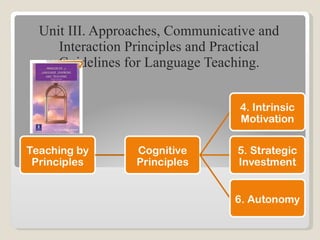
Unit III. Approaches, Communicative and Interaction Principles and Practical Guidelines for Language Teaching.
Principle 4. Intrinsic Motivation. The most powerful rewards are those that are intrinsically motivated within the learner. Because the behaviour stems from needs, wants, or desires within oneself, the behavior itself is self-rewarding: therefore, no externally administered reward is necessary.
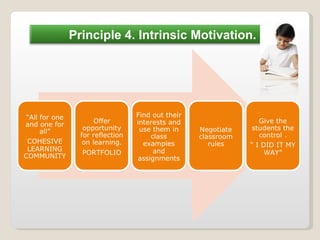
Principle 4. Intrinsic Motivation.
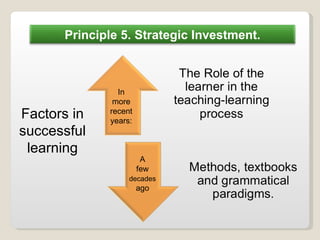
Factors in successful learning A few  decades  ago In more recent years: Principle 5. Strategic Investment.
Successful mastery of the second language will be due to a large extent to a learner´s own personal ¨investment¨ of time, effort, and attention to the second language in the form of an individual battery of strategies for comprehending and producing the language. Principle 5. Strategic Investment.
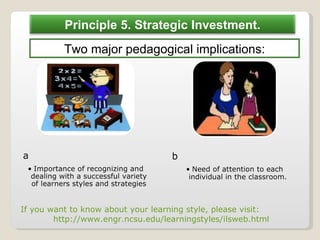
Two major pedagogical implications: If   you   want   to   know   about   your   learning   style ,  please   visit : http://www.engr.ncsu.edu/learningstyles/ilsweb.html Principle 5. Strategic Investment.
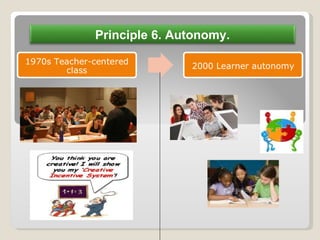
Principle 6. Autonomy.
Successful-   mastery  of a  foreign language will depend to a great extent on learners´ autonomous ability both to take initiative in the classroom and to continue their   journey to success beyond the classroom and the teacher. Principle 6. Autonomy.
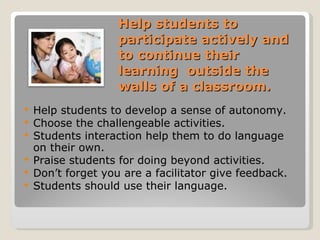
Help students to participate actively and to continue their learning  outside the walls of a classroom. Help students to develop a sense of autonomy. Choose the challengeable activities. Students interaction help them to do language on their own. Praise students for doing beyond activities. Don’t forget you are a facilitator give feedback. Students should use their language.

Principles 4,5 and 6

  • 1.
    Maestría en EducaciónBilingüe: el Ingles como Segundo Idioma Methods and Approaches of a Second Language. Professor: M.E. Cesar Augusto Hernández Arellano Team “The Who”
  • 2.
    Unit III. Approaches,Communicative and Interaction Principles and Practical Guidelines for Language Teaching.
  • 3.
    Principle 4. IntrinsicMotivation. The most powerful rewards are those that are intrinsically motivated within the learner. Because the behaviour stems from needs, wants, or desires within oneself, the behavior itself is self-rewarding: therefore, no externally administered reward is necessary.
  • 4.
  • 5.
    Factors in successfullearning A few decades ago In more recent years: Principle 5. Strategic Investment.
  • 6.
    Successful mastery ofthe second language will be due to a large extent to a learner´s own personal ¨investment¨ of time, effort, and attention to the second language in the form of an individual battery of strategies for comprehending and producing the language. Principle 5. Strategic Investment.
  • 7.
    Two major pedagogicalimplications: If you want to know about your learning style , please visit : http://www.engr.ncsu.edu/learningstyles/ilsweb.html Principle 5. Strategic Investment.
  • 8.
  • 9.
    Successful- mastery of a foreign language will depend to a great extent on learners´ autonomous ability both to take initiative in the classroom and to continue their journey to success beyond the classroom and the teacher. Principle 6. Autonomy.
  • 10.
    Help students toparticipate actively and to continue their learning outside the walls of a classroom. Help students to develop a sense of autonomy. Choose the challengeable activities. Students interaction help them to do language on their own. Praise students for doing beyond activities. Don’t forget you are a facilitator give feedback. Students should use their language.