Understanding Polygons:
Shapes AllAround Us
Welcome, Grade 5 explorers from the Philippines! Today, we're going on
an adventure to discover the world of polygons – the basic building
blocks of many shapes we see every day. Get ready to learn what makes
a polygon special and how to identify different types.
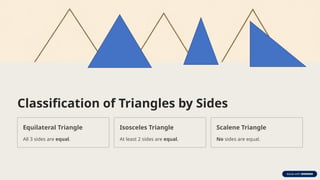
Classification of Trianglesby Sides
Equilateral Triangle
All 3 sides are equal.
Isosceles Triangle
At least 2 sides are equal.
Scalene Triangle
No sides are equal.
5.
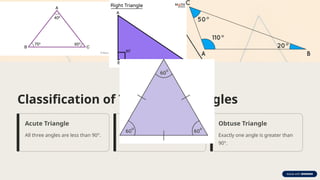
Classification of Trianglesby Angles
Acute Triangle
All three angles are less than 90°.
Right Triangle
Exactly one angle is 90°.
Obtuse Triangle
Exactly one angle is greater than
90°.
6.
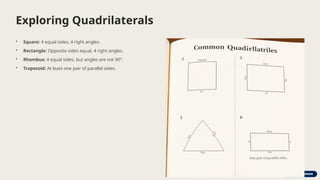
Exploring Quadrilaterals
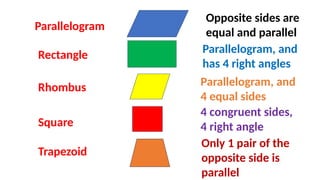
• Square:4 equal sides, 4 right angles.
• Rectangle: Opposite sides equal, 4 right angles.
• Rhombus: 4 equal sides, but angles are not 90°.
• Trapezoid: At least one pair of parallel sides.
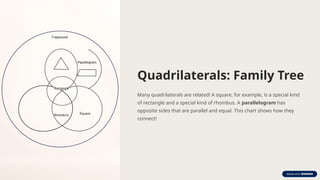
Quadrilaterals: Family Tree
Manyquadrilaterals are related! A square, for example, is a special kind
of rectangle and a special kind of rhombus. A parallelogram has
opposite sides that are parallel and equal. This chart shows how they
connect!
9.
Regular vs. IrregularPolygons
Regular Polygons
• All sides are equal in length.
• All angles are equal in measure.
• Examples: equilateral
triangle, square, regular
hexagon.
Irregular Polygons
• Sides and/or angles are not
equal.
• Examples: scalene triangle,
general quadrilateral, kite.
10.
Polygons in OurWorld
Triangles
Look at the roof of a
traditional Filipino house!
Quadrilaterals
Windows and doors are
often rectangles or squares.
Regular Polygons
A stop sign is a perfect
example of a regular
octagon.
Irregular Polygons
Many kites have fascinating
irregular polygon shapes.
11.
Key Takeaways &Next Steps
• Polygons are flat, closed shapes with straight sides, classified by their number of sides and angles.
• Triangles (3 sides) and quadrilaterals (4 sides) have diverse subtypes based on their unique properties.
• Regular polygons have equal sides and angles, unlike irregular ones.
Now, go forth and explore! How many polygons can you find in your classroom, your home, or even outside your window?
12.
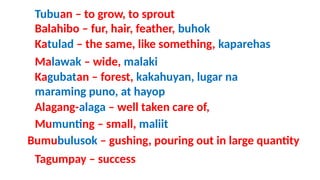
Balahibo – fur,hair, feather, buhok
Tubuan – to grow, to sprout
Katulad – the same, like something, kaparehas
Malawak – wide, malaki
Kagubatan – forest, kakahuyan, lugar na
maraming puno, at hayop
Alagang-alaga – well taken care of,
Mumunting – small, maliit
Bumubulusok – gushing, pouring out in large quantity
Tagumpay – success