The Reading Pyramid:
Understanding the
Process of Building
Strong Literacy Skills
Rizalina C. Labanda
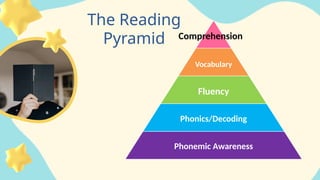
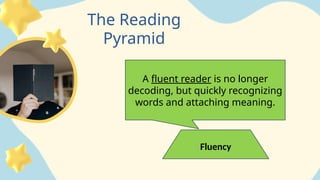
The Reading
Pyramid
Vocabulary
Fluency
Phonics/Decoding
Phonemic Awareness
Comprehension
The Reading
Pyramid
Phonemic Awareness
The first foundational skill to
reading mastery is understanding
of phonemes, the individual
sounds that make up each word.
Mastering Phonemic
Awareness
• For those who struggle with phonemic
awareness, an explicit, systematic
instructional approach is needed.
Assessment
• Simple Assessment can be administered to
help parents determine where their child
struggles.
• Some assessment are administered by a
professional who may be able to diagnose
your child with a specific disorder.
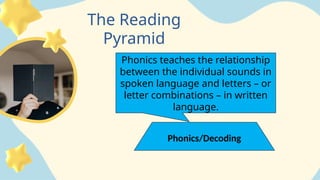
The Reading
Pyramid
Phonics/Decoding
Phonics teaches the relationship
between the individual sounds in
spoken language and letters – or
letter combinations – in written
language.
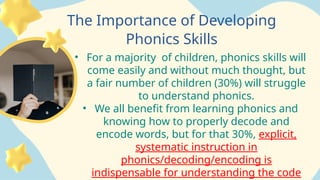
The Importance of Developing
Phonics Skills
• For a majority of children, phonics skills will
come easily and without much thought, but
a fair number of children (30%) will struggle
to understand phonics.
• We all benefit from learning phonics and
knowing how to properly decode and
encode words, but for that 30%, explicit,
systematic instruction in
phonics/decoding/encoding is
indispensable for understanding the code
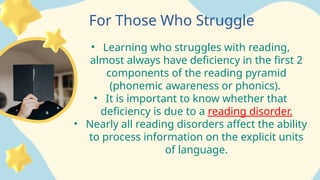
For Those Who Struggle
• Learning who struggles with reading,
almost always have deficiency in the first 2
components of the reading pyramid
(phonemic awareness or phonics).
• It is important to know whether that
deficiency is due to a reading disorder.
• Nearly all reading disorders affect the ability
to process information on the explicit units
of language.
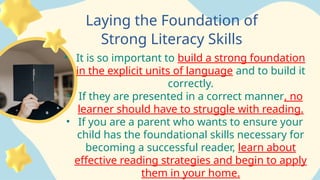
Laying the Foundation of
Strong Literacy Skills
• It is so important to build a strong foundation
in the explicit units of language and to build it
correctly.
• If they are presented in a correct manner, no
learner should have to struggle with reading.
• If you are a parent who wants to ensure your
child has the foundational skills necessary for
becoming a successful reader, learn about
effective reading strategies and begin to apply
them in your home.
The Reading
Pyramid
Fluency
A fluent reader is no longer
decoding, but quickly recognizing
words and attaching meaning.
Fluency: The Art of Speedy
Decoding
• Reading fluency can be defined as the
ability to automatically and correctly
decode words, whether through silent
reading or reading aloud with correct
pronunciation of words and full
articulation of sentences.
Reading Fluency for the
Struggling Reader
• A key component of building fluency is
exposing the learner to more and more
literature.
• For someone with a processing disorder,
new words and context are difficult and
need to be broken down into smaller, more
manageable parts before the learner can
fluently read through a passage.
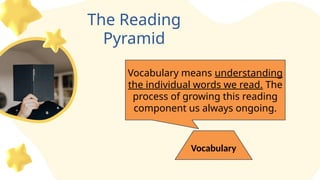
The Reading
Pyramid
Vocabulary
Vocabulary means understanding
the individual words we read. The
process of growing this reading
component us always ongoing.
The Process of Vocabulary
Building
• Vocabulary is the fourth step in the
reading pyramid, BUT that doesn’t mean
that learning to understand the meaning
of words only happens late in the process.
• Building vocabulary begins from the first
day we can actively listen to language.
• Listening vocabulary is only one of the four
types of vocabulary we build. The other
three are speaking, reading, and writing
vocabulary.
The Process of Vocabulary
Building
• As we become phonemically aware we
start our speaking vocabulary.
• Building a reading vocabulary and a
writing vocabulary, is a little more
complex.
• To take reading and writing vocabularies
beyond memorization level, we will need
to have good understanding of phonics
and decoding skills and be able to fluently
The Process of Vocabulary
Building
• When a learner has obtained a strong
understanding of the foundational
components of reading, and can
fluently apply them, he has
everything needed to build an ever-
growing vocabulary.
Hall
Vocabulary for Struggling
Readers
• 30% of learners who struggle with reading
consistently plateau in reading ability at
about a fourth to sixth-grade reading level.
(Dr. Jeanne Chall – Harvard University).
• The reason that the levelling off happens
to those who struggle with reading is
because these learners are unable to
fluently decode large, multi-syllabic words.
Hall
Vocabulary for Struggling
Readers
• Once a learner is able to master the
more fundamental components of
reading, the fourth to sixth-grade
plateau disappears, and learners are
able to reach a high level of
vocabulary and comprehension.
The Reading
Pyramid
Comprehension
Great readers think about what is
happening in a story and share
the emotional journey of the
characters. This is the ultimate
goal for your young reader.
Comprehension: Creating
Value From Text
• Reading comprehension is the ability to
understand what we read. It is the
component that allows us to get value
from text, and it is the ultimate goal of
reading mastery.
• Comprehension sits at the top of the
pyramid because we need a full
understanding of the more foundational
skills of reading if we are to gain meaning
from what we read and deeply
The Depth of Comprehension
• Strategies to Build Comprehension:
• Teaching concept of print
• Asking questions about the words and
text being read
• Helping a learner predict what will
happen next in a story
• Providing reading materials that
approximates a learner’s reading level.
The Depth of Comprehension
• As a learner applies simple
comprehension strategies and gains a
strong understanding of phonemic
awareness, phonics, fluency, and
vocabulary, comprehension comes
naturally and at deep levels.
The Power of a Question
• Asking questions and teaching a learner to
ask questions are powerful tools that
should be used from the very beginning of
literacy instruction.
• Questioning should become an active way
that you help your learner understand
what is being taught.
The Power of a Question
• Ask questions that help the learner:
• Identify what something is or what is
happening.
• Relate to what is being learned.
• Predict what will happen next.
• Encourage your child to ask these types of
questions continually and consistently.
Help them to recognize the power of
asking teacher’s questions as well as
asking oneself questions.
Struggles with
Comprehension
• If a learner is struggling to comprehend
what he/she is reading, it is likely that he
or she has a deficit in one or more of the
foundational skills.
• If you have a child who is struggling with
comprehension, make sure your child has
been fully and explicitly taught the
foundational components of reading
before focusing solely on comprehension-
building strategies.
The Reading Pyramid:
Understanding the Process of Building
Strong Literacy Skills
Rizalina C. Labanda
Thank
You!
Thank
You

reading pyramid Understanding the Process.pptx

  • 1.
    The Reading Pyramid: Understandingthe Process of Building Strong Literacy Skills Rizalina C. Labanda
  • 2.
  • 3.
    The Reading Pyramid Phonemic Awareness Thefirst foundational skill to reading mastery is understanding of phonemes, the individual sounds that make up each word.
  • 4.
    Mastering Phonemic Awareness • Forthose who struggle with phonemic awareness, an explicit, systematic instructional approach is needed. Assessment • Simple Assessment can be administered to help parents determine where their child struggles. • Some assessment are administered by a professional who may be able to diagnose your child with a specific disorder.
  • 5.
    The Reading Pyramid Phonics/Decoding Phonics teachesthe relationship between the individual sounds in spoken language and letters – or letter combinations – in written language.
  • 6.
    The Importance ofDeveloping Phonics Skills • For a majority of children, phonics skills will come easily and without much thought, but a fair number of children (30%) will struggle to understand phonics. • We all benefit from learning phonics and knowing how to properly decode and encode words, but for that 30%, explicit, systematic instruction in phonics/decoding/encoding is indispensable for understanding the code
  • 7.
    For Those WhoStruggle • Learning who struggles with reading, almost always have deficiency in the first 2 components of the reading pyramid (phonemic awareness or phonics). • It is important to know whether that deficiency is due to a reading disorder. • Nearly all reading disorders affect the ability to process information on the explicit units of language.
  • 8.
    Laying the Foundationof Strong Literacy Skills • It is so important to build a strong foundation in the explicit units of language and to build it correctly. • If they are presented in a correct manner, no learner should have to struggle with reading. • If you are a parent who wants to ensure your child has the foundational skills necessary for becoming a successful reader, learn about effective reading strategies and begin to apply them in your home.
  • 9.
    The Reading Pyramid Fluency A fluentreader is no longer decoding, but quickly recognizing words and attaching meaning.
  • 10.
    Fluency: The Artof Speedy Decoding • Reading fluency can be defined as the ability to automatically and correctly decode words, whether through silent reading or reading aloud with correct pronunciation of words and full articulation of sentences.
  • 11.
    Reading Fluency forthe Struggling Reader • A key component of building fluency is exposing the learner to more and more literature. • For someone with a processing disorder, new words and context are difficult and need to be broken down into smaller, more manageable parts before the learner can fluently read through a passage.
  • 12.
    The Reading Pyramid Vocabulary Vocabulary meansunderstanding the individual words we read. The process of growing this reading component us always ongoing.
  • 13.
    The Process ofVocabulary Building • Vocabulary is the fourth step in the reading pyramid, BUT that doesn’t mean that learning to understand the meaning of words only happens late in the process. • Building vocabulary begins from the first day we can actively listen to language. • Listening vocabulary is only one of the four types of vocabulary we build. The other three are speaking, reading, and writing vocabulary.
  • 14.
    The Process ofVocabulary Building • As we become phonemically aware we start our speaking vocabulary. • Building a reading vocabulary and a writing vocabulary, is a little more complex. • To take reading and writing vocabularies beyond memorization level, we will need to have good understanding of phonics and decoding skills and be able to fluently
  • 15.
    The Process ofVocabulary Building • When a learner has obtained a strong understanding of the foundational components of reading, and can fluently apply them, he has everything needed to build an ever- growing vocabulary.
  • 16.
    Hall Vocabulary for Struggling Readers •30% of learners who struggle with reading consistently plateau in reading ability at about a fourth to sixth-grade reading level. (Dr. Jeanne Chall – Harvard University). • The reason that the levelling off happens to those who struggle with reading is because these learners are unable to fluently decode large, multi-syllabic words.
  • 17.
    Hall Vocabulary for Struggling Readers •Once a learner is able to master the more fundamental components of reading, the fourth to sixth-grade plateau disappears, and learners are able to reach a high level of vocabulary and comprehension.
  • 18.
    The Reading Pyramid Comprehension Great readersthink about what is happening in a story and share the emotional journey of the characters. This is the ultimate goal for your young reader.
  • 19.
    Comprehension: Creating Value FromText • Reading comprehension is the ability to understand what we read. It is the component that allows us to get value from text, and it is the ultimate goal of reading mastery. • Comprehension sits at the top of the pyramid because we need a full understanding of the more foundational skills of reading if we are to gain meaning from what we read and deeply
  • 20.
    The Depth ofComprehension • Strategies to Build Comprehension: • Teaching concept of print • Asking questions about the words and text being read • Helping a learner predict what will happen next in a story • Providing reading materials that approximates a learner’s reading level.
  • 21.
    The Depth ofComprehension • As a learner applies simple comprehension strategies and gains a strong understanding of phonemic awareness, phonics, fluency, and vocabulary, comprehension comes naturally and at deep levels.
  • 22.
    The Power ofa Question • Asking questions and teaching a learner to ask questions are powerful tools that should be used from the very beginning of literacy instruction. • Questioning should become an active way that you help your learner understand what is being taught.
  • 23.
    The Power ofa Question • Ask questions that help the learner: • Identify what something is or what is happening. • Relate to what is being learned. • Predict what will happen next. • Encourage your child to ask these types of questions continually and consistently. Help them to recognize the power of asking teacher’s questions as well as asking oneself questions.
  • 24.
    Struggles with Comprehension • Ifa learner is struggling to comprehend what he/she is reading, it is likely that he or she has a deficit in one or more of the foundational skills. • If you have a child who is struggling with comprehension, make sure your child has been fully and explicitly taught the foundational components of reading before focusing solely on comprehension- building strategies.
  • 25.
    The Reading Pyramid: Understandingthe Process of Building Strong Literacy Skills Rizalina C. Labanda Thank You!
  • 26.