Download to read offline


![Primary Source Secondary Source
Lincoln's Gettysburg Address "Lincoln at
Gettysburg: the
Words That Remade
America" by Gary
Wills
The poem "Human Chain" by Seamus
Heaney
"His Nibs:
Self-Reflexivity and
the Significance of
Translation in
Seamus Heaney's
Human Chain." by
Michael Parker in
Irish University
Review (November
2012), pp. 327-350.
The table "Number of Offenses
Known to the Police, Universities and
Colleges" in the FBI's Uniform Crime
Reports, 2012
An article in the
Ithacan entitled
"Study Finds Eastern
Colleges Often
Conceal Campus
Crime"
Mackey, S., Carroll, I., Emir, B.,
Murphy, T., Whalen, E., & Dumenci,
L. (2012). Sensory pain qualities in
neuropathic pain. The Journal Of
Pain, 13(1), 58-63.
doi:10.1016/j.jpain.2011.10.002
[a study published in a peer reviewed
journal]
Vance, E. (2014).
Where Does It
Hurt?. Discover,
35(4), 28-30.
[an article in a
magazine that
includes quotes from
Sean Mackey,
author of the peer
reviewed article on
pain]
Cynthia Scheibe's doctoral
dissertation on the developmental
differences in children's reasoning
about Santa Claus
An article in Parents
Magazine discussing
experts' views on the
harm of lying to
children about Santa
Claus
Primary and Secondary Sources - Ithaca College Library http://ithacalibrary.com/sp/subjects/primary
5 of 5 6/3/2015 10:03 AM](https://image.slidesharecdn.com/primaryandsecondarysources-150603103551-lva1-app6891/85/Primary-and-secondary-sources-5-320.jpg)

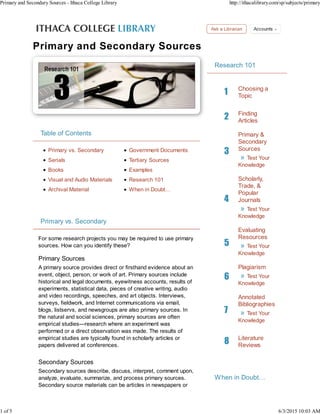
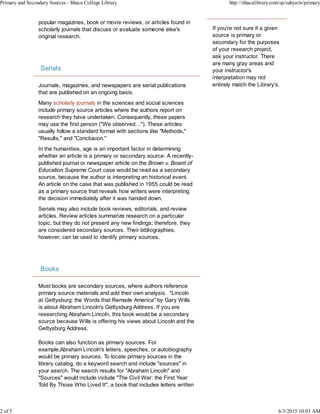
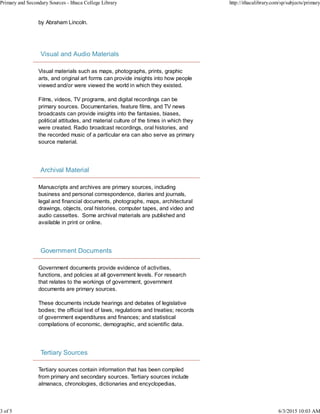
This document discusses the difference between primary and secondary sources for research. Primary sources provide direct evidence about a topic, such as historical documents, interviews, or results of experiments. Secondary sources describe, discuss or analyze primary sources, such as newspaper or magazine articles that interpret original research. Books can also be primary or secondary sources depending on their content. Other types of primary sources include visual materials, archival materials, government documents, and tertiary sources that compile information from primary and secondary sources. Examples are provided to illustrate the difference between primary and secondary sources for specific topics.


![Primary Sources / Secondary Sources [Humanities]](https://cdn.slidesharecdn.com/ss_thumbnails/humanitiesprimarysecondarysources-130930083244-phpapp02-thumbnail.jpg?width=640&height=640&fit=bounds)


