Basic Information
• Architects:-Mass Design Group
• Location :-Kigali, Rwanda
• Architect in Charge:- Mass Design Group
• Area:- 900sqm
• Project Year:- 2010
• Objective: To give poor children best educational environment and facility within minimum cost.
• Number of student:-300
3.
Characteristics
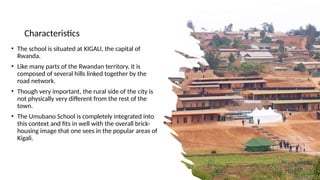
• The schoolis situated at KIGALI, the capital of
Rwanda.
• Like many parts of the Rwandan territory, it is
composed of several hills linked together by the
road network.
• Though very important, the rural side of the city is
not physically very different from the rest of the
town.
• The Umubano School is completely integrated into
this context and fits in well with the overall brick-
housing image that one sees in the popular areas of
Kigali.
4.
Climate
• Located 1°58'Sand 30°07'E, Kigali is almost on the equator
• The altitude of the city (1,400 m average) defines a particular climate.
• The city is green, and rainfalls are significant all through the year.
• The temperature averages between 18°C and 20°C, maximum being around 27°C and minimum
under 10°C.
• Two rainy seasons exist (short and long).
• Rainfall is steady and not heavy during the long rainy season while there are thunderstorms and
heavy rains for short periods during the short rainy season. periods during the short rainy season.
5.
Concept
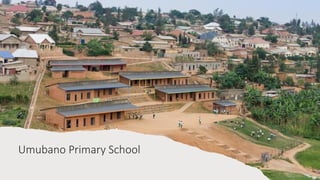
• The Schoolsseven buildings house nine classrooms and a library on a sloping site.
• Unique settings for education have been created to occur within a mix of interior rooms, exterior
teaching areas - some of which are covered by sloping roofs
• Terraced play spaces for children.
6.
Site and SiteAccess
• The Umubano School is located in an area called Kabeza close to the main road to the airport.
• The precise location is the former village of Nyarurembo, which has become an integrated
neighborhood of the city of Kigali.
• The school is built on a hillside.
• The slope is pretty steep (more than 45° in some places so the architects had to find a solution to
cope with the difficult topography.
• Access is very difficult because of the steep slope of the hill of Kabeza . The school can be
accessed by cars, "moto-taxis" and foot.
7.
Surroundings
• The neighborhoodis composed of individual houses located on single pieces of land of different
sizes, most of them over 300 square meters.
• These houses have an individual design but all of them relate to architectural references close to
cottages and housing that can be found in the Western world.
• A small bridge has been built that allows direct connection between this area and the school
• There is no sewerage system in the neighborhood.
8.
Building Description
• Theschool is composed of seven buildings with nine classrooms, an administrative block and a
library that is designed to accommodate a computer center, for a total area of 900 square
meters.
• The computer center will be functional only when the school can buy or is offered computers. For
the moment that place is used as a storage room.
• The massing is designed over five platforms that solve the steep slope issues. Each platform is
dedicated to a specific group of children or to a specific activity
• This made it possible to retain the slope and thus continue to merge into the general image of
the neighborhood.
• Sewerage is not provided in the area. The latrine blocks have "individual" sewerage systems.
9.
Design Features (Responseto physical constraints)
• The outdoor space for need to adapt the school to the topography of the site led to the definition
of platforms, each of them designed to accommodate two or three classrooms, with a specific
platform for the administration and the library.
• These platforms are linked by a walkway that communicates smoothly with the different "levels"
of the project.
• In addition, these platforms constitute both separate "courtyards" and play areas (to reduce the
risk occurring from mixing children of different ages in the same area) and extra tuition.
10.
Design Features(Response tousers requirement)
• The separation of the different platforms is the first of a series of answers to the needs of
the users.
• The particular form of pedagogy implies the possibility to organize classroom space freely,
breaking the dichotomy between the space of the teacher (in front) and the space of the
children.
• The children sit at groups of three to four tables, which creates a very friendly
atmosphere.
• Nursery and first-year classrooms are close to the administration block, while fifth-sixth-
year classrooms are located further down the hill.
• Bathrooms are located in two blocks (one at the top of the hill and one at the bottom).
11.
Design Features
• Eachbuilding constitutes one block under a 10-degree sloped roof.
• Each building is on a platform perpendicular to the general slope of the site.
• As the long sides of the buildings are perpendicular to the slope, they always fit in to the general
landscape,
• The fact that the shape of the hill has been used to organize the platforms makes it difficult to
ensure direct cross ventilation through the rooms, as the back walls (north-east) stand against the
hill.
• Therefore a corrugated plastic clerestory was designed in a double-pitched roof to help
ventilation through the classrooms. This clerestory creates a very individual form for all the
buildings.
12.
• Lively designshave been created through varied placing of bricks on some area of the facades.
• Often creating holes through the walls, these enriched brick areas break the linearity of the front
facades of the buildings, while creating an interesting pattern of shadows in the afternoon.
• Traditional motifs have not been used in the building and specific decoration is absent, apart from
very discreet colors on the outside structure of each block.
13.
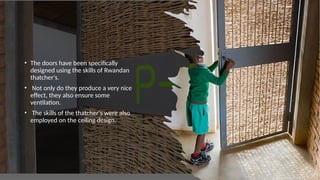
• The doorshave been specifically
designed using the skills of Rwandan
thatcher's.
• Not only do they produce a very nice
effect, they also ensure some
ventilation.
• The skills of the thatcher's were also
employed on the ceiling design.
14.
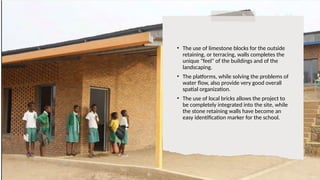
• The useof limestone blocks for the outside
retaining, or terracing, walls completes the
unique "feel" of the buildings and of the
landscaping.
• The platforms, while solving the problems of
water flow, also provide very good overall
spatial organization.
• The use of local bricks allows the project to
be completely integrated into the site, while
the stone retaining walls have become an
easy identification marker for the school.
15.
Classrooms
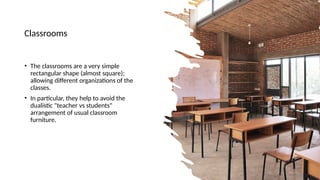
• The classroomsare a very simple
rectangular shape (almost square);
allowing different organizations of the
classes.
• In particular, they help to avoid the
dualistic "teacher vs students"
arrangement of usual classroom
furniture.
16.
Library
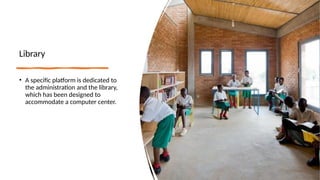
• A specificplatform is dedicated to
the administration and the library,
which has been designed to
accommodate a computer center.
17.
Playground
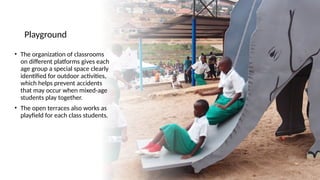
• The organizationof classrooms
on different platforms gives each
age group a special space clearly
identified for outdoor activities,
which helps prevent accidents
that may occur when mixed-age
students play together.
• The open terraces also works as
playfield for each class students.
18.
Landscape
• The landscapingis an essential part of this project. Outdoor space is used by the children during
breaks and every now and then by the professors during their classes.
• The organization of the space as "stages" allows the outdoor space to be used a bit like an
amphitheater. materials and the greens of the space help create a continuity of the outside space
with a central "flow" of nature that makes the landscaping a very important part of the project.
• The vegetation on the slopes helps stabilize the hillside and prevents serious mudslides after
rainfalls.
• Organizing the area into platforms also cleverly diminishes the quantity and speed of water
directly flowing down the slope
19.
Construction And Materials
•A breast wall is set at the top of the site for general stabilization. As for all foundation walls, this
structure is drained. Retaining structures and foundations are made of stone and cement.
• The vertical structure is a combination of concrete poles and beams (against the slope, which
form part of the retaining structure), steel structures (for the outdoor overhangs of roofs) and
structural walls.
• The roof structure is made of single steel tubes, and the roof itself is made of corrugated metal
sheets.
20.
• The infillwalls also play a structural role. They are made of stabilized-earth bricks. • Doors
are made of metal frames with thatching infills.
• Reed ceilings are installed in every room.
• Most of the walls are not plastered and are similar to the majority of unplastered walls in
Rwanda.
21.
Lighting And Ventilation
•Lights used to penetrate through the brick hollows and also make interesting effect at afternoon.
Also penetrate through the ceiling and window
• Though the ventilation was tough due to the hill against north-east wall of the building and slope
of the site. So direct cross ventilation can not be provided
22.
Climatic Performance
• Thoughit was difficult to ensure cross ventilation because of the slope and the fact that the walls
"against" the slope were used as retaining structures, the difference of height between the top of
the two pitches that constitute the roof allow upper ventilation.
• That gap is protected by a corrugated plastic clerestory, which adds to the quality of the light
inside.
• Thatched doors increase the ventilation of the classrooms, as do the "holes" in the walls created
by the areas of brick patterning.
23.
• Kigali suffersheavy rainfalls.
• Therefore the site design was planned to limit erosion of the hill since the different platforms will
slow the flow of rainwater.
• The walkways were another response to this problem as they create a less sloppy way down the
hill
24.
Conclusion
• The schoolis mainly built as a low cost school so that they can reduce the
illiteracy.
• Creative uses of exterior teaches space and interior space is visible in the design.
• Local materials and natural ventilation is also there to balance the design.