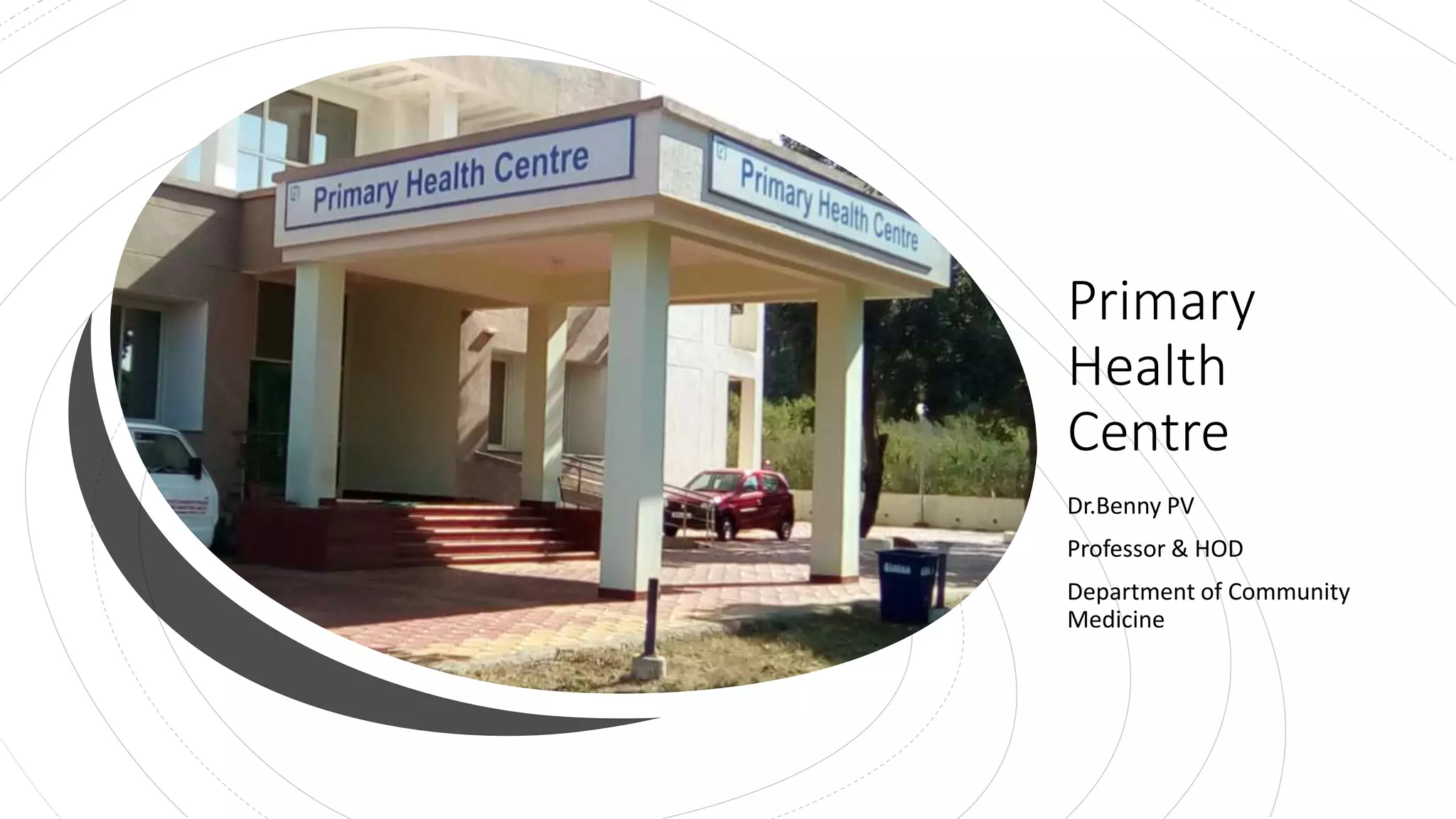
Primary
Health
Centre
Dr.Benny PV
Professor & HOD
Department of Community
Medicine
Concept
Bhore committee- 1946
Provide as close to the people as possible,
an integrated curative and preventive health
care to the rural population with emphasis
on preventive & promotive aspects of health
care
The central council of health-1953
Establishment of PHCs in Community
development blocks to provide
comprehensive health to rural population
Concept..
Mudaliar Committee
• Existing PHCs to be strengthened
• Population scaled down to 40000
1962
Declaration of Alma-Ata
conference
• Health for all by 2000AD
1978
Concept…
National Health Plan
• One PHC for every 30000 rural population- Plains
• One PHC for every 20000 population in hilly,
tribal & backward areas
1983
As on March 2017, 25650
PHCs established in the
country
Mar. 2017
FUNCTIONS OF PHC
1. Medical care
2. MCH including family planning
3. Safe water supply and basic sanitation
4. Prevention and control of locally endemic
diseases
5. Collection and reporting of vital statistics
6. Education about health
7. National Health Programmes- as relevant
8. Referral services
9. Training of health guides, health workers,
local dais and health assistants
10. Basic laboratory services
Indian Public
Health
Standards for
PHCs
• IPHS are a set of uniform standards
envisaged to improve the quality of
health care delivery in the country
Indian Public Health Standards
for PHCs
• Revised in 2012
• Keeping in view the resources available
with respect to functional requirement
for PHCs with minimum standards such as
building, manpower, instruments &
equipments, drugs and other facilities etc
• Standards prescribed are for a PHC
covering 20000-30000 population with six
beds
OBJECTIVES OF IPHS FOR PHCs
• To provide comprehensive primary health
care to the community through the PHC’s
• To achieve and maintain an acceptable
standard of quality of care
• To make the services more responsive
and sensitive to the needs of the
community
TYPES OF PHCs – Based
on delivery case load
• TYPE-A PHC
• PHC with less than 20 deliveries per
month
• TYPE-B PHC
• PHC with 20 or more deliveries per
month
Services
• Medical care
• Maternal & child health care
• Family planning services
• Medical termination of pregnancy using manual
vacuum aspiration technique, wherever trained
personnel and facility exists
• Health education for prevention and management
of RTI/STI
• Nutrition services
• School health services
Services
• Adolescent health care
• Prevention and control of locally
endemic diseases like malaria, kala azar,
JE etc
• Collection and reporting of vital events
• Health education and Behavioural
Change Communication
• Promotion of sanitation including use of
toilet and appropriate garbage disposal
• Testing of water quality and disinfection
of water sources
Services
-National
Health
Programmes
National Tuberculosis Elimination Programme
National AIDS Control Programme
National Programme for Control of Blindness
National Leprosy Eradication Programme
National Programme for Prevention & Control of Deafness
National Mental Health Programme
National Programme for Prevention & Control of Cancer,
Diabetes, CVD and Stroke
Services-
National
Health
Programmes
National Iodine Deficiency
Disorders Control Programme
National Programme For
Prevention & Control of Flurosis
National Tobacco Control
Programme
National Programme for Health
care of Elderly
Services..
Appropriate and prompt
referral of cases needing
special care & transport
facilities
Record of vital events
Services
Training
Basic laboratory facilities
Monitoring and supervision
Selected surgical procedures
Mainstreaming of AYUSH
Physical Medicine and Rehabilitation (PMR)services
Maternal Death Review
Functional Linkages with sub centres
Monitoring and Supervision
Medical care
• OPD services
• 4 hours in the morning & 2
hours in afternoon/evening
• Minimum OPD attendance
– 40 patients per doctor per
day
• 24 hours emergency services
• Referral services
• In patient services(6 beds)
Maternal and child health care
• Antenatal care
• Early registration of pregnancy and minimum 4
ANCs of which at least one must be seen by a
doctor
• minimum laboratory investigations such as
Haemoglobin, blood grouping and Rh typing,
urine albumin and sugar and RPR test for syphilis
• Nutrition and health counselling
• Supplementation of IFA tablets and Td
immunization, brief advice on tobacco
cessation(If mother is smoker)
Maternal and child health care..
Antenatal..
• Tracking of missed and left out ANC
• Identification of high risk pregnancies and
appropriate management
• Referral to First Referral unit or other
hospital in case of high risk pregnancy
Maternal and child health care
• Intranatal care
• 24 hours services for normal delivery
• Promotion of institutional delivery
• Conducting assisted deliveries including forceps and vacuum delivery
whenever required
• Manual removal of placenta
• Appropriate & prompt referral for cases needing specialist care
Maternal and child health care-
Intranatal care..
• Management of pregnancy induced
hypertension including referral
• Pre-referred management in obstetric
emergencies
• Minimum 48 hours of stay after
delivery
• Managing labour using partograph
• Proficient in identification of PPH,
eclampsia sepsis and prompt referral
Maternal and child health care
• Postnatal care
• Ensure postnatal care for 0 & 3rd day at the
health facility both for the mother &
newborn & sending direction to the ANM of
the concerned area for ensuring 7th and
42nd day postnatal home visits
• 3 additional visits for low birth weight baby
(<2500gm) on 14th, 21st, and on 28th day
• Initiation of early breast feeding within one
hour of birth
Maternal and child health care..
Postnatal care..
• Counselling on nutrition, hygiene,
contraception, essential newborn care
& immunization
• Provision of facilities under Janani
Suraksha Yojana (JSY)
• Tracking of missed and left out PNC
Maternal and child health care
• Newborn care
• Facilities for Essential New Born care (ENBC)
and resuscitation
• Early initiation of breastfeeding within one
hour of birth
• Management of neonatal hypothermia
(Provision of warmth /Kangaroo Mother
Care(KMC), infection protection, cord care
and identification of sick new born and
prompt referral)
Maternal and child health care
• Care of the child
• Emergency care of sick child including Integrated
Management of Neonatal & Childhood
Illness(IMNCI)
• Care of routine childhood illness
• Promotion of breast feeding for 6 months
• Full immunisation of all infants and children against
vaccine preventable diseases as per guidelines
• Vitamin A prophylaxis
• Assess the growth and development of the infant &
under 5 year children and make timely referral
• Management of severe acute malnutrition cases
Staffing pattern
STAFF ESSENTIAL
TYPE A TYPE B
Medical officer-MBBS 1 1
Accountant cum data entry operator 1 1
Pharmacist 1 1
Nurse- midwife (Staff nurse) 3 4
Health worker (Female) 1 1
Health assistant (Male) 1 1
Health assistant (Female)/Lady health
visitor
1 1
Laboratory technician 1 1
Multi-skilled group D worker 2 2
Sanitary worker cum watchman 1 1
Total 13 14
THANK YOU

PHC & IPHS

  • 1.
    Primary Health Centre Dr.Benny PV Professor &HOD Department of Community Medicine
  • 2.
    Concept Bhore committee- 1946 Provideas close to the people as possible, an integrated curative and preventive health care to the rural population with emphasis on preventive & promotive aspects of health care The central council of health-1953 Establishment of PHCs in Community development blocks to provide comprehensive health to rural population
  • 3.
    Concept.. Mudaliar Committee • ExistingPHCs to be strengthened • Population scaled down to 40000 1962 Declaration of Alma-Ata conference • Health for all by 2000AD 1978
  • 4.
    Concept… National Health Plan •One PHC for every 30000 rural population- Plains • One PHC for every 20000 population in hilly, tribal & backward areas 1983 As on March 2017, 25650 PHCs established in the country Mar. 2017
  • 5.
    FUNCTIONS OF PHC 1.Medical care 2. MCH including family planning 3. Safe water supply and basic sanitation 4. Prevention and control of locally endemic diseases 5. Collection and reporting of vital statistics 6. Education about health 7. National Health Programmes- as relevant 8. Referral services 9. Training of health guides, health workers, local dais and health assistants 10. Basic laboratory services
  • 6.
    Indian Public Health Standards for PHCs •IPHS are a set of uniform standards envisaged to improve the quality of health care delivery in the country
  • 7.
    Indian Public HealthStandards for PHCs • Revised in 2012 • Keeping in view the resources available with respect to functional requirement for PHCs with minimum standards such as building, manpower, instruments & equipments, drugs and other facilities etc • Standards prescribed are for a PHC covering 20000-30000 population with six beds
  • 8.
    OBJECTIVES OF IPHSFOR PHCs • To provide comprehensive primary health care to the community through the PHC’s • To achieve and maintain an acceptable standard of quality of care • To make the services more responsive and sensitive to the needs of the community
  • 9.
    TYPES OF PHCs– Based on delivery case load • TYPE-A PHC • PHC with less than 20 deliveries per month • TYPE-B PHC • PHC with 20 or more deliveries per month
  • 10.
    Services • Medical care •Maternal & child health care • Family planning services • Medical termination of pregnancy using manual vacuum aspiration technique, wherever trained personnel and facility exists • Health education for prevention and management of RTI/STI • Nutrition services • School health services
  • 11.
    Services • Adolescent healthcare • Prevention and control of locally endemic diseases like malaria, kala azar, JE etc • Collection and reporting of vital events • Health education and Behavioural Change Communication • Promotion of sanitation including use of toilet and appropriate garbage disposal • Testing of water quality and disinfection of water sources
  • 12.
    Services -National Health Programmes National Tuberculosis EliminationProgramme National AIDS Control Programme National Programme for Control of Blindness National Leprosy Eradication Programme National Programme for Prevention & Control of Deafness National Mental Health Programme National Programme for Prevention & Control of Cancer, Diabetes, CVD and Stroke
  • 13.
    Services- National Health Programmes National Iodine Deficiency DisordersControl Programme National Programme For Prevention & Control of Flurosis National Tobacco Control Programme National Programme for Health care of Elderly
  • 14.
    Services.. Appropriate and prompt referralof cases needing special care & transport facilities Record of vital events
  • 15.
    Services Training Basic laboratory facilities Monitoringand supervision Selected surgical procedures Mainstreaming of AYUSH Physical Medicine and Rehabilitation (PMR)services Maternal Death Review Functional Linkages with sub centres Monitoring and Supervision
  • 16.
    Medical care • OPDservices • 4 hours in the morning & 2 hours in afternoon/evening • Minimum OPD attendance – 40 patients per doctor per day • 24 hours emergency services • Referral services • In patient services(6 beds)
  • 17.
    Maternal and childhealth care • Antenatal care • Early registration of pregnancy and minimum 4 ANCs of which at least one must be seen by a doctor • minimum laboratory investigations such as Haemoglobin, blood grouping and Rh typing, urine albumin and sugar and RPR test for syphilis • Nutrition and health counselling • Supplementation of IFA tablets and Td immunization, brief advice on tobacco cessation(If mother is smoker)
  • 18.
    Maternal and childhealth care.. Antenatal.. • Tracking of missed and left out ANC • Identification of high risk pregnancies and appropriate management • Referral to First Referral unit or other hospital in case of high risk pregnancy
  • 19.
    Maternal and childhealth care • Intranatal care • 24 hours services for normal delivery • Promotion of institutional delivery • Conducting assisted deliveries including forceps and vacuum delivery whenever required • Manual removal of placenta • Appropriate & prompt referral for cases needing specialist care
  • 20.
    Maternal and childhealth care- Intranatal care.. • Management of pregnancy induced hypertension including referral • Pre-referred management in obstetric emergencies • Minimum 48 hours of stay after delivery • Managing labour using partograph • Proficient in identification of PPH, eclampsia sepsis and prompt referral
  • 21.
    Maternal and childhealth care • Postnatal care • Ensure postnatal care for 0 & 3rd day at the health facility both for the mother & newborn & sending direction to the ANM of the concerned area for ensuring 7th and 42nd day postnatal home visits • 3 additional visits for low birth weight baby (<2500gm) on 14th, 21st, and on 28th day • Initiation of early breast feeding within one hour of birth
  • 22.
    Maternal and childhealth care.. Postnatal care.. • Counselling on nutrition, hygiene, contraception, essential newborn care & immunization • Provision of facilities under Janani Suraksha Yojana (JSY) • Tracking of missed and left out PNC
  • 23.
    Maternal and childhealth care • Newborn care • Facilities for Essential New Born care (ENBC) and resuscitation • Early initiation of breastfeeding within one hour of birth • Management of neonatal hypothermia (Provision of warmth /Kangaroo Mother Care(KMC), infection protection, cord care and identification of sick new born and prompt referral)
  • 24.
    Maternal and childhealth care • Care of the child • Emergency care of sick child including Integrated Management of Neonatal & Childhood Illness(IMNCI) • Care of routine childhood illness • Promotion of breast feeding for 6 months • Full immunisation of all infants and children against vaccine preventable diseases as per guidelines • Vitamin A prophylaxis • Assess the growth and development of the infant & under 5 year children and make timely referral • Management of severe acute malnutrition cases
  • 25.
    Staffing pattern STAFF ESSENTIAL TYPEA TYPE B Medical officer-MBBS 1 1 Accountant cum data entry operator 1 1 Pharmacist 1 1 Nurse- midwife (Staff nurse) 3 4 Health worker (Female) 1 1 Health assistant (Male) 1 1 Health assistant (Female)/Lady health visitor 1 1 Laboratory technician 1 1 Multi-skilled group D worker 2 2 Sanitary worker cum watchman 1 1 Total 13 14
  • 26.