Journal Name RSCPublishing
COMMUNICATION
This journal is © The Royal Society of Chemistry 2012 J. Name., 2012, 00, 1-3 | 1
Synthesis and structural characterisation of
novel sodium ion containing Langbeinite
materials.
N. J. Williams and P. R. Slater
School of Chemistry, University of Birmingham, Birmingham, West Midlands, UK B15 2TT
The first reported successful preparation of Na+
containing
sulphate Langbeinite materials. Structural study on the
mixed alkali metal phase NaKMg2(SO4)3 reveals
preferential ordering of Na+
and K+
occupancy in the K1
and K2 interstitial sites respectively. A sodium
stoichiometry as high as 1.5 is also reported.
The Langbeinite crystal structure (Figure 1) was first solved for
the natural mineral K2Mg2(SO4)3 by Zemann and Zemann in
19571
. Since then, sulphate Langbeinite materials of general
formula MI
2MII
2(SO4)3 (where MI
= K, Rb and MII
= Mg, Co,
Ni, Zn and Ca) have been thoroughly studied in terms of phase
transitions and ferroelastic and ferroelectric behaviour2
.
Figure 1: Crystal structure of K2Mg2(SO4)3, MgO6 octahedral units(yellow) and SO4
tetrahedral units (purple) are shown and the interstitial K
+
are omitted.
Langbeinite is structurally related to the NASICON and Garnet
crystal structures by the common rigid 3D framework of corner
linked octahedral and tetrahedral units (Figure 1). They vary by
the bond angle around the corner linking oxygen and
consequently by the number, size and coordination of the
interstitial sites. The discovery of fast Na+
conduction in the
framework material series Na1+xZr2SixP3–xO12, later to be
referred to as NASICON, by Hong et al.3, 4
spawned a host of
research interest for the purpose of application as cathode and
solid state electrolyte materials5
for rechargeable ion batteries
for stationary energy storage6
. Similarly, Thangadurai and
Weppner reported fast Li+
conduction in the Garnet-type
material La3M2Li5O12 (M= Nb, Ta)7,8
and propagated many
subsequent studies of the Garnet structure for use as a solid
state electrolyte. Despite this, the Langbeinite framework
crystal structure has never attracted the same research interest
toward ion battery application. This is largely due to the
structure having typically required large interstitial alkali metal
ions such as K+
and Rb+
for structural stability, making
materials of this type too heavy for battery application.
An adapted Pechini sol-gel method was employed to
successfully prepare a phase pure sample of the K2Mg2(SO4)3
phase. This involved the dissolution of stoichiometric quantities
of K2SO4 and MgSO4 in water with citric acid and ethylene
glycol such that ratio between the number of moles of target
K2Mg2(SO4)3 phase, citric acid and ethylene glycol was 1:1:4.
This was repeated for NaKMg2(SO4)3, Na1.5K0.5Mg2(SO4)3 and
Na2Mg2(SO4)3 using appropriate ratios of Na2SO4 and K2SO4.
The solution was then heated at 350 C for 3 hours to form a
gel, ground with an agate mortar and pestle before calcining at
650 C for 12 hours. Characterisation by PXRD was performed
using a Bruker D8 diffractometer with a Cu-K (1.5406 Å)
source.
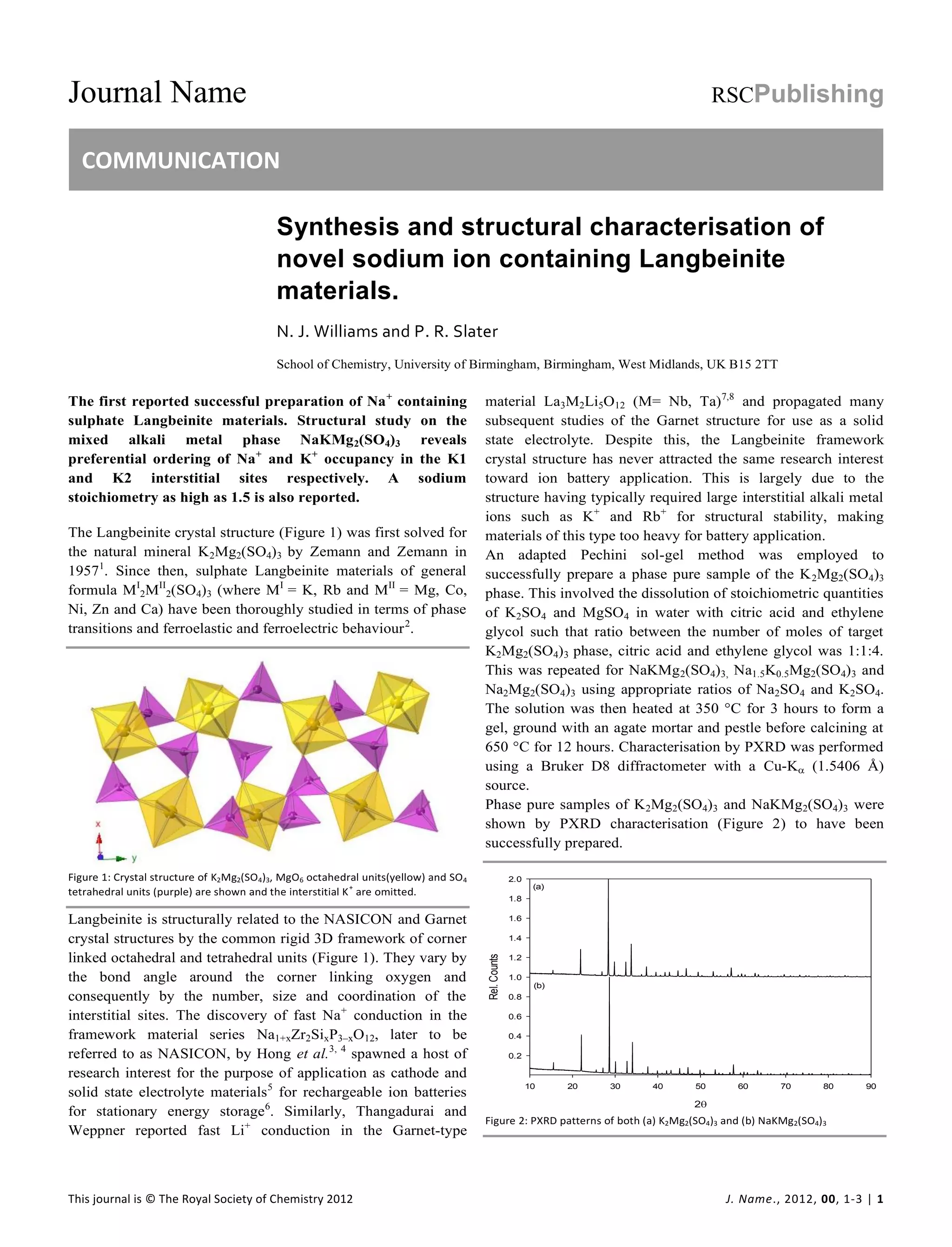
Phase pure samples of K2Mg2(SO4)3 and NaKMg2(SO4)3 were
shown by PXRD characterisation (Figure 2) to have been
successfully prepared.
2
10 20 30 40 50 60 70 80 90
Rel.Counts
0.2
0.4
0.6
0.8
1.0
1.2
1.4
1.6
1.8
2.0
(a)
(b)
Figure 2: PXRD patterns of both (a) K2Mg2(SO4)3 and (b) NaKMg2(SO4)3
COMMUNICATION Journal Name
2 | J. Name., 2012, 00, 1-3 This journal is © The Royal Society of Chemistry 2012
The unit cell parameters calculated from the recorded PXRD
data of NaKMg2(SO4)3 (Table 2) showed a decrease in unit cell
volume compared to K2Mg2(SO4)3. This is as expected, due to
the incorporation of the smaller Na+
into the structure.
Table 1: Unit cell length and volume of the parent and novel Langbeinite
phases prepared.
Phase a (Å) V (Å3
)
K2Mg2(SO4)3 9.919 976
NaKMg2(SO4)3 9.827 949
Na1.5K0.5Mg(SO4)3 9.786 937
The Na2Mg2(SO4)3 phase was not successfully synthesised,
suggesting that a certain quantity of large K+
are required to
occupy the interstitial sites in order for the structure to be
stable.
A phase pure sample of Na1.5K0.5Mg2(SO4)3 was not
successfully prepared due to laboratory time constraints.
However, it was possible to calculate the unit cell parameters of
this phase (Table 2) from PXRD data recorded from the impure
sample (Figure 3 (c)).
2
22 24 26 28 30 32 34
Rel.Counts
0.0
0.5
1.0
1.5
2.0
2.5
3.0
(a)
(b)
(c)
Figure 3: PXRD patterns of (a) K2Mg2(SO4)3, (b) NaKMg2(SO4)3 and (c)
Na1.5K0.5Mg(SO4)3 in the range of 22-35 2
There is a further decrease in unit cell volume observed for
Na1.5K0.5Mg2(SO4)3 compared to the parent phase and the
mixed Na/K phase as expected from an increased stoichiometry
of Na+
incorporated. Plotting the unit cell volume against
stoichiometry of K+
present displays an approximately linear
relationship, in agreement with Vegard’s law.
Structural analysis of the phase pure sample of NaKMg2(SO4)3
was performed† and the generated profiles are displayed in
Figure 4.
Figure 4: Observed, calculated and difference profiles generated from the
Rietveld refinement of NaKMg2(SO4)3
The site occupancy analysis of the experimentally obtained
PXRD data for NaKMg2(SO4)3 confirmed that sodium had
entered the framework. Interestingly, the occupancy analysis
also indicated ordering of both Na+
and K+
into separate
interstitial sites. The sodium ions were observed to
preferentially occupy the larger 12 coordinate K1 site (Figure 5
(a)), whereas the larger potassium ions were found to have
exclusively occupy the smaller 9 coordinate K2 site (Figure 5
(b)).
Figure 5: Computer generated models of the interstitial (a) 12 coordinate K1 site
and (b) 9 coordinate K2 site in the Langbeinite structure.
This work demonstrates that sulphate Langbeinite materials can
be synthesised featuring a large Na+
:K+
ratio occupying the
interstitial sites. Further work in this vein is to reproduce the
previously reported series of double potassium sulphate
Langbeinite2
materials featuring transition metals with similar
sodium ion composition. If this can be achieved then it opens
up the previously unexplored possibility the Langbeinite crystal
structure finding application as a cathode material in sodium
ion batteries.
Notes and references
† Cell parameters, fractional occupancy, atomic positions and bond
lengths were assessed in accordance with the restrictions of the P213
space group by Rietveld least squares refinement using the programme
TOPAS. Refinement was performed based on the K2Mg2(SO4)3 phase2
.
1. A. Zemann and J. Zemann, Acta Crystallographica, 1957, 10,
409-413.
2. D. Speer and E. Salje, Physics and Chemistry of Minerals, 1986,
13, 17-24.
3. H. Y. P. Hong, Materials Research Bulletin, 1976, 11, 173-182.
4. J. B. Goodenough, H. Y. P. Hong and J. A. Kafalas, Materials
Research Bulletin, 1976, 11, 203-220.
5. F. Lalere, J. B. Leriche, M. Courty, S. Boulineau, V. Viallet, C.
Masquelier and V. Seznec, Journal of Power Sources, 2014, 247,
975-980.
6. H. L. Pan, Y. S. Hu and L. Q. Chen, Energy & Environmental
Science, 2013, 6, 2338-2360.
7. V. Thangadurai, H. Kaack and W. J. F. Weppner, Journal of the
American Ceramic Society, 2003, 86, 437-440.
8. V. Thangadurai, S. Adams and W. Weppner, Chemistry of
Materials, 2004, 16, 2998-3006.
2Th Degrees
9085807570656055504540353025201510
Counts
40,000
35,000
30,000
25,000
20,000
15,000
10,000
5,000
0
-5,000
Langbeinite 100.00 %

Writing Sample1- Short Paper

  • 1.
    Journal Name RSCPublishing COMMUNICATION Thisjournal is © The Royal Society of Chemistry 2012 J. Name., 2012, 00, 1-3 | 1 Synthesis and structural characterisation of novel sodium ion containing Langbeinite materials. N. J. Williams and P. R. Slater School of Chemistry, University of Birmingham, Birmingham, West Midlands, UK B15 2TT The first reported successful preparation of Na+ containing sulphate Langbeinite materials. Structural study on the mixed alkali metal phase NaKMg2(SO4)3 reveals preferential ordering of Na+ and K+ occupancy in the K1 and K2 interstitial sites respectively. A sodium stoichiometry as high as 1.5 is also reported. The Langbeinite crystal structure (Figure 1) was first solved for the natural mineral K2Mg2(SO4)3 by Zemann and Zemann in 19571 . Since then, sulphate Langbeinite materials of general formula MI 2MII 2(SO4)3 (where MI = K, Rb and MII = Mg, Co, Ni, Zn and Ca) have been thoroughly studied in terms of phase transitions and ferroelastic and ferroelectric behaviour2 . Figure 1: Crystal structure of K2Mg2(SO4)3, MgO6 octahedral units(yellow) and SO4 tetrahedral units (purple) are shown and the interstitial K + are omitted. Langbeinite is structurally related to the NASICON and Garnet crystal structures by the common rigid 3D framework of corner linked octahedral and tetrahedral units (Figure 1). They vary by the bond angle around the corner linking oxygen and consequently by the number, size and coordination of the interstitial sites. The discovery of fast Na+ conduction in the framework material series Na1+xZr2SixP3–xO12, later to be referred to as NASICON, by Hong et al.3, 4 spawned a host of research interest for the purpose of application as cathode and solid state electrolyte materials5 for rechargeable ion batteries for stationary energy storage6 . Similarly, Thangadurai and Weppner reported fast Li+ conduction in the Garnet-type material La3M2Li5O12 (M= Nb, Ta)7,8 and propagated many subsequent studies of the Garnet structure for use as a solid state electrolyte. Despite this, the Langbeinite framework crystal structure has never attracted the same research interest toward ion battery application. This is largely due to the structure having typically required large interstitial alkali metal ions such as K+ and Rb+ for structural stability, making materials of this type too heavy for battery application. An adapted Pechini sol-gel method was employed to successfully prepare a phase pure sample of the K2Mg2(SO4)3 phase. This involved the dissolution of stoichiometric quantities of K2SO4 and MgSO4 in water with citric acid and ethylene glycol such that ratio between the number of moles of target K2Mg2(SO4)3 phase, citric acid and ethylene glycol was 1:1:4. This was repeated for NaKMg2(SO4)3, Na1.5K0.5Mg2(SO4)3 and Na2Mg2(SO4)3 using appropriate ratios of Na2SO4 and K2SO4. The solution was then heated at 350 C for 3 hours to form a gel, ground with an agate mortar and pestle before calcining at 650 C for 12 hours. Characterisation by PXRD was performed using a Bruker D8 diffractometer with a Cu-K (1.5406 Å) source. Phase pure samples of K2Mg2(SO4)3 and NaKMg2(SO4)3 were shown by PXRD characterisation (Figure 2) to have been successfully prepared. 2 10 20 30 40 50 60 70 80 90 Rel.Counts 0.2 0.4 0.6 0.8 1.0 1.2 1.4 1.6 1.8 2.0 (a) (b) Figure 2: PXRD patterns of both (a) K2Mg2(SO4)3 and (b) NaKMg2(SO4)3
  • 2.
    COMMUNICATION Journal Name 2| J. Name., 2012, 00, 1-3 This journal is © The Royal Society of Chemistry 2012 The unit cell parameters calculated from the recorded PXRD data of NaKMg2(SO4)3 (Table 2) showed a decrease in unit cell volume compared to K2Mg2(SO4)3. This is as expected, due to the incorporation of the smaller Na+ into the structure. Table 1: Unit cell length and volume of the parent and novel Langbeinite phases prepared. Phase a (Å) V (Å3 ) K2Mg2(SO4)3 9.919 976 NaKMg2(SO4)3 9.827 949 Na1.5K0.5Mg(SO4)3 9.786 937 The Na2Mg2(SO4)3 phase was not successfully synthesised, suggesting that a certain quantity of large K+ are required to occupy the interstitial sites in order for the structure to be stable. A phase pure sample of Na1.5K0.5Mg2(SO4)3 was not successfully prepared due to laboratory time constraints. However, it was possible to calculate the unit cell parameters of this phase (Table 2) from PXRD data recorded from the impure sample (Figure 3 (c)). 2 22 24 26 28 30 32 34 Rel.Counts 0.0 0.5 1.0 1.5 2.0 2.5 3.0 (a) (b) (c) Figure 3: PXRD patterns of (a) K2Mg2(SO4)3, (b) NaKMg2(SO4)3 and (c) Na1.5K0.5Mg(SO4)3 in the range of 22-35 2 There is a further decrease in unit cell volume observed for Na1.5K0.5Mg2(SO4)3 compared to the parent phase and the mixed Na/K phase as expected from an increased stoichiometry of Na+ incorporated. Plotting the unit cell volume against stoichiometry of K+ present displays an approximately linear relationship, in agreement with Vegard’s law. Structural analysis of the phase pure sample of NaKMg2(SO4)3 was performed† and the generated profiles are displayed in Figure 4. Figure 4: Observed, calculated and difference profiles generated from the Rietveld refinement of NaKMg2(SO4)3 The site occupancy analysis of the experimentally obtained PXRD data for NaKMg2(SO4)3 confirmed that sodium had entered the framework. Interestingly, the occupancy analysis also indicated ordering of both Na+ and K+ into separate interstitial sites. The sodium ions were observed to preferentially occupy the larger 12 coordinate K1 site (Figure 5 (a)), whereas the larger potassium ions were found to have exclusively occupy the smaller 9 coordinate K2 site (Figure 5 (b)). Figure 5: Computer generated models of the interstitial (a) 12 coordinate K1 site and (b) 9 coordinate K2 site in the Langbeinite structure. This work demonstrates that sulphate Langbeinite materials can be synthesised featuring a large Na+ :K+ ratio occupying the interstitial sites. Further work in this vein is to reproduce the previously reported series of double potassium sulphate Langbeinite2 materials featuring transition metals with similar sodium ion composition. If this can be achieved then it opens up the previously unexplored possibility the Langbeinite crystal structure finding application as a cathode material in sodium ion batteries. Notes and references † Cell parameters, fractional occupancy, atomic positions and bond lengths were assessed in accordance with the restrictions of the P213 space group by Rietveld least squares refinement using the programme TOPAS. Refinement was performed based on the K2Mg2(SO4)3 phase2 . 1. A. Zemann and J. Zemann, Acta Crystallographica, 1957, 10, 409-413. 2. D. Speer and E. Salje, Physics and Chemistry of Minerals, 1986, 13, 17-24. 3. H. Y. P. Hong, Materials Research Bulletin, 1976, 11, 173-182. 4. J. B. Goodenough, H. Y. P. Hong and J. A. Kafalas, Materials Research Bulletin, 1976, 11, 203-220. 5. F. Lalere, J. B. Leriche, M. Courty, S. Boulineau, V. Viallet, C. Masquelier and V. Seznec, Journal of Power Sources, 2014, 247, 975-980. 6. H. L. Pan, Y. S. Hu and L. Q. Chen, Energy & Environmental Science, 2013, 6, 2338-2360. 7. V. Thangadurai, H. Kaack and W. J. F. Weppner, Journal of the American Ceramic Society, 2003, 86, 437-440. 8. V. Thangadurai, S. Adams and W. Weppner, Chemistry of Materials, 2004, 16, 2998-3006. 2Th Degrees 9085807570656055504540353025201510 Counts 40,000 35,000 30,000 25,000 20,000 15,000 10,000 5,000 0 -5,000 Langbeinite 100.00 %