APPLIED PHYSICS LETTERS 91, 252901 ͑2007͒


A series of layered intergrowth phases grown by molecular beam epitaxy:
SrmTiO2+m„m = 1 – 5…
         P. Fisher, S. Wang, M. Skowronski, and P. A. Salvadora͒
         Department of Materials Science and Engineering, Carnegie Mellon University, Pittsburgh, Pennsylvania
         15213, USA
         M. Snyder and O. Maksimov
         Electro-Optics Center, Pennsylvania State University, Freeport, Pennsylvania 16229, USA
         ͑Received 3 August 2007; accepted 12 November 2007; published online 17 December 2007͒
         SrmTiO2+m phases having one TiO2 layer sandwiched between m SrO layers were grown using
         molecular beam epitaxy. The out-of-plane ͑in-plane͒ lattice parameters determined by x-ray
         diffraction were c͑a͒ = 9.14 Å ͑3.78 Å͒, 23.55 Å ͑3.75 Å͒, and 14.60 Å ͑3.75 Å͒ for Sr3TiO5,
         Sr4TiO6, and Sr5TiO7, respectively. Both lattice parameters change abruptly on going from the m
         = 2 Ruddlesden-Popper phase to m = 3 phase, indicating a significant change in the bond lengths ͑or
         strain states͒ on transitioning from the known members to the higher order members of this
         structural family. Electron microscopy confirmed the artificially layered structures. © 2007
         American Institute of Physics. ͓DOI: 10.1063/1.2821107͔

     Layer-by-layer ͑LBL͒ molecular beam epitaxy ͑MBE͒                SrTiO3, Sr2TiO4, and SrO phases.1,7,8 Based on these prin-
has produced various artificially layered crystal structures,          ciples, the c lattice parameter for the odd m phases equals the
including higher-order Ruddlesden-Popper phases1,2                    spacing between TiO2 planes ͑dT in Fig. 1͒, whereas c is
͑poorly ordered in bulk͒, and superlattices, including                twice dT for the even m phases owing to a body-centering
BaTiO3 / SrTiO3 / CaTiO33,4 ͑alloys in bulk͒, many of which           translation. Although these phases are easily envisioned, it is
exhibit promising properties for device applications.                 unknown whether they can be formed and whether they are
BaO / SrTiO3 superlattices ͑phase separated in bulk͒, which           stable with respect to phase separation into the equilibrium
have yet to be produced, are expected to exhibit exciting             phases Sr2TiO4 and SrO.
properties.5 Such structures can be described as being built               In this paper, the m = 3, 4, and 5 phases in the SrmTiO2+m
up from alternating BO2 monolayers ͑B = Ti and Ru͒ with AO            series, and the known m = 1, 2, and ϱ phases, were grown
͑A = Ca, Sr, and Ba͒ monolayers ͑perovskite phases͒ or bilay-         as epitaxial films using an MBE system discussed
ers ͑Ruddlesden-Popper phases͒, as can many other bulk in-            elsewhere.12,13 The LaAlO3͑001͒ single crystal substrates
tergrowth structures. We are interested in the thermodynamic          were etched in a 3:1 HCl: HNO3 solution for 2 – 3 min,14
and kinetic principles that govern the growth of                      rinsed with de-ionized water, and ultrasonically cleaned in
͑AO͒m͑BO2͒n films having more general stacking arrange-                acetone and ethanol for 5 min each. Substrates were an-
ments, especially those not commonly observed in bulk, such           nealed prior to growth for 1 h at 750 ° C under a purified
as m Ͼ 2 and n Ͼ 1.                                                   ozone flow of 0.5 SCCM ͑SCCM denotes cubic centimeter
     Recently, we reported that any stacking sequence in the          per minute at STP͒ ͑pressure= 1.8ϫ 10−6 Torr͒. The same
͑SrO͒m͑TiO2͒n system, for which 2 Ͻ m = n Ͻ 33, reacted to            ozone conditions were used for growth. Growth was moni-
produce epitaxial m = n = 1 SrTiO3 films, implying that a              tored in situ using reflective high energy electron diffraction
large driving force coexists with small barriers for inter-           and was controlled to the monolayer level by calibrating the
reaction and highlighting the bounds of crystal structure             fluxes of both sources ex situ.6,12,13 Deposition was carried
engineering.6 Here, we present the growth of ͑SrO͒m͑TiO2͒n            out by alternating the open source between Sr and Ti ͑the
films with m = 1 – 5 and n = 1, for which artificially layered          other was shuttered͒ to deposit m SrO monolayers followed
crystal structures do form. These crystals belong to the ho-
mologous series SrmTiO2+m that consists of m SrO monolay-
ers followed by one TiO2 monolayer. While SrTiO3,
Sr2TiO4, and SrO ͑m = 1, 2, and ϱ͒ are stable in bulk,7,8
Sr3TiO5, Sr4TiO6, and Sr5TiO7 ͑m = 3, 4, 5͒ have not been
previously reported, nor have structures with the latter stack-
ing arrangements been observed for many other oxides.
Triple and quadruple rocksalt ͑A , AЈ͒O layers have been ob-
served in cuprate superconductors containing A = Sr and Ba,
and AЈO = BiO,9 TlO,9 or HgO10 and in the misfit-layered
oxide Ca3Co4O9.11
     Figure 1 shows schematic unit cells of the targeted
phases ͑m = 1 – 5͒. The strontium, titanium, and oxygen ions
are assumed to arrange in the same manner as in the related           FIG. 1. ͑Color online͒ Models of the known ͑SrTiO3 and Sr2TiO4͒ and
                                                                      predicted ͑Sr3TiO5, Sr4TiO6, and Sr5TiO7͒ structures in the SrmTiO2+m se-
                                                                      ries. The lighter spheres represent Sr2+, the darker spheres represent O2− not
a͒
 Author to whom correspondence should be address. Tel.: ϩ1 412 268    coordinated to Ti4+, and each octahedron has Ti4+ at the center and O2− at all
 2702. FAX: ϩ1 412 268 7596. Electronic mail: paul7@andrew.cmu.edu.   corners.

0003-6951/2007/91͑25͒/252901/3/$23.00                     91, 252901-1                            © 2007 American Institute of Physics
 Downloaded 17 Dec 2007 to 128.118.37.12. Redistribution subject to AIP license or copyright; see http://apl.aip.org/apl/copyright.jsp
252901-2       Fisher et al.                                                                                  Appl. Phys. Lett. 91, 252901 ͑2007͒


                                                                               the m = 3 phases. This indicates that relaxations must occur in
                                                                               all three SrO monolayers ͑the SrO layers were thinner than
                                                                               expected in the m Ͻ 3 phases owing to in-plane tension͒, al-
                                                                               lowing the effective increase to surpass the expected value of
                                                                               bulk SrO.
                                                                                     The low-angle peak in every pattern represents the aver-
                                                                               age distance between TiO2 layers ͑dT͒; these are marked as
                                                                               00l : T ͑for SrTiO3 it is 001: T͒. As expected, this peak shifts
                                                                               to smaller angles with increasing m as the TiO2 planes be-
                                                                               come further separated ͑from 22.88° for m = 1 to 6.24° for
                                                                               m = 5͒. This spacing is equal to the c-lattice parameter
                                                                               ͑1 / 2 c͒ for the odd m ͑even m͒ compositions. The values of
                                                                               dT ͑and the increase from the prior value͒ determined from
                                                                               these patterns are 3.89 ͑N/A͒, 6.27 ͑2.38͒, 9.17 ͑2.9͒, 11.81
                                                                               ͑2.64͒, and 14.16 Å ͑2.35 Å͒ for the m = 1, 2, 3, 4, and 5
                                                                               films, respectively. The increases from the prior dT values
                                                                               also indicate that a substantial relaxation occurs in the SrO
                                                                               distances on going from m = 2 to m = 3.
                                                                                     The observed m values can be compared to the targeted
                                                                               values using m = dT / dF − 1, where dT / dF represents the ob-
                                                                               served average number of monolayers ͑per period͒ and the
                                                                               one represents the single TiO2 monolayer ͑per period͒. The
                                                                               observed m values ͑error in the last digit͒ were 0.99 ͑1͒, 1.99
                                                                               ͑3͒, 3.01 ͑4͒, 4.09 ͑8͒, and 5.05 ͑9͒ for the m = 1, 2, 3, 4, and
                                                                               5 films, respectively. The error on the values of dT and m
                                                                               become more sensitive to measurement errors for the lower
                                                                               angle peaks. Still, the observed m values are in good agree-
FIG. 2. X-ray diffraction patterns for ͑a͒ SrTiO3, ͑b͒ Sr2TiO4, ͑c͒ Sr3TiO5,
͑d͒ Sr4TiO6, ͑e͒ Sr5TiO7, and ͑f͒ SrO films.
                                                                               ment with the targeted values. Note that there is nothing
                                                                               peculiar about the m value for the m = 2 to m = 3 phases,
                                                                               indicating that the large relaxations observed are not associ-
by one TiO2 monolayer, which was repeated for 50 cycles.                       ated with an error in growth periodicity or composition.
Average growth rates were Ϸ0.022, 0.028, 0.035, 0.039, and                     These results indicate that the MBE growth yields artificially
0.043 Å / s for the m = 1 – 5 phases, respectively ͑growth rate                layered SrmTiO2+m films that have excellent average long-
increased with m owing to the higher Sr source flux͒. Films                     range order.
with m Ͼ 2 were air sensitive; they were capped with a pro-                          The c lattice parameters for Sr3TiO5, Sr4TiO6, and
tective MgO layer that allowed for ex situ characterization                    Sr5TiO7 were determined to be 9.14, 23.55 ͑1 / 2 c = 11.78͒,
using x-ray diffraction ͑XRD͒ and transmission electron mi-                    and 14.60 Å, respectively. Asymmetric XRD scans were per-
croscopy ͑TEM͒.6,12,13                                                         formed to measure the in-plane lattice parameters. All mea-
     Figure 2 shows XRD spectra registered from the                            surements were made on 10l peaks with l = 1 – 4 ͑for crystal-
m = 1 – 5 and ϱ members of SrmTiO2+m. In each spectrum, the                    lographic reasons, even m phases have no intensity when l is
00l substrate peaks ͑indexed using pseudocubic notation and                    even͒. The a lattice parameters were determined to be 3.87,
denoted as L : l͒ are the most intense. The MgO 002 peak is                    3.88, 3.79, 3.75, and 3.76 Å for the m = 1, 2, 3, 4, and 5
marked as M. The remaining peaks ͑except the background                        phases, respectively. Literature values are 3.905 and 3.90 Å
peak near 12° marked *͒ can be indexed to the ͑00l͒ planes                     for SrTiO3 and Sr2TiO4, respectively,7,17 and 3.64 Å for SrO
of the SrmTiO2+m films. These peaks, marked with their 00l                      ͑using the primitive tetragonal cell͒.13 The a values measured
values and described below, indicate that the targeted phases                  for our SrTiO3 and Sr2TiO4 films are lower than the bulk
can realized.                                                                  values; an in-plane contraction is expected given the sub-
     The peak representing the average spacing between ad-                     strate’s smaller lattice parameter ͑3.79 Å͒. As observed in c,
jacent atomic planes, or the fundamental reflection, is                         the largest change in a occurs on going from m = 2 to m = 3.
marked as 00l : F in each pattern ͑for SrTiO3 it is 002: F͒.                   For the Sr3TiO5, Sr4TiO6, and Sr5TiO7 phases, the a lattice
The 2␪ location of this fundamental peak decreases with in-                    parameters are found to be much lower than the values for
creasing m ͑from 46.52° for m = 1 to 38.44° for m = 5͒. This is                SrTiO3 and Sr2TiO4 and they are lower than the substrate’s
expected because the average interplanar spacing ͑dF͒ has an                   lattice parameter ͑3.79 Å͒. This implies that the epitaxial
increasing contribution from adjacent SrO–SrO layers as m                      strain is tensile for the m Ͼ 3 phases and, as such, that the
increases. SrO–SrO interplanar distances range from 2.39 Å                     relaxed a values may be lower than our measured values.
͑Sr2TiO4͒15 to 2.58 Å ͑SrO͒13,16 and are larger than the                       Furthermore, the large structural changes observed between
SrO – TiO2 interplanar distance of Ϸ1.95 Å ͑SrTiO3͒17 and                      m = 2 to m = 3 may be associated to this transition in the strain
Sr2TiO4͒.7,15 The values of dF determined from these pat-                      state, although further structural characterization is required.
terns are 1.95, 2.09, 2.29, 2.32, 2.34, and 2.57 Å for the m                   Overall, in-plane relaxations occur with increasing number
= 1, 2, 3, 4, 5, and ϱ films, respectively. We can therefore                    of SrO monolayers toward the bulk lattice parameter of SrO,
determine the effective thickness of the added SrO layer;                      as expected.
these are 2.37, 2.89, 2.44, and 2.42 Å for the m = 2, 3, 4, and                      Figure 3͑a͒ shows a Fourier-filtered cross-sectional TEM
5 films. Note the large jump of 2.89 Å between the m = 2 and                    image of the Sr5TiO7 film taken from the ͓100͔ zone axis in
 Downloaded 17 Dec 2007 to 128.118.37.12. Redistribution subject to AIP license or copyright; see http://apl.aip.org/apl/copyright.jsp
252901-3       Fisher et al.                                                                                     Appl. Phys. Lett. 91, 252901 ͑2007͒


                                                                             diffusional length scales are similar to those in the
                                                                             ͑SrO͒m͑TiO2͒n system that does intermix, we can surmise
                                                                             that the driving force is considerably lower for the coarsen-
                                                                             ing process of rocksalt/perovskite layers as compared to the
                                                                             intermixing of rocksalt/anatase layers. This result is not sur-
                                                                             prising since bond formation ͑enthalpy͒ drives the intermix-
                                                                             ing process for rocksalt/anatase layers, while a reduction in
                                                                             interface energy drives coarsening for rocksalt/perovskite
                                                                             layers. The coarsening driving force for SrmTiO2+m is small
                                                                             because the interfaces are fully coherent and the interfacial
                                                                             bonding resembles the bonding in stable structures. The
                                                                             combined observations from these two studies help describe
                                                                             a set of rules that open the door to the design of a large
                                                                             number of artificially layered ͑SrO͒m͑TiO2͒n phases with
                                                                             m Ͼ 2 and n Ͼ 1.
                                                                                  In conclusion, LBL-MBE was used to grow intergrowth
                                                                             phases in the SrmTiO2+m series ͑m = 1 – 5 and ϱ͒. Samples
                                                                             were characterized structurally using XRD and TEM; high
                                                                             quality samples had out-of-plane c ͑in-plane a͒ lattice param-
                                                                             eters of 9.14 ͑3.78͒, 23.55 ͑3.75͒, and 14.60 Å ͑3.75 Å͒, re-
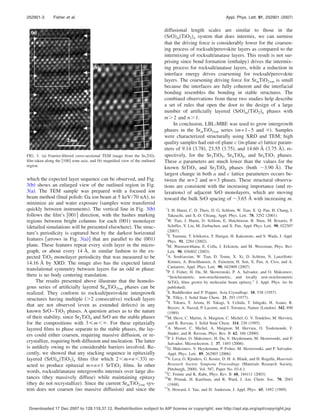
FIG. 3. ͑a͒ Fourier-filtered cross-sectional TEM image from the Sr5TiO7       spectively, for the Sr3TiO5, Sr4TiO6, and Sr5TiO7 phases.
film taken along the ͓100͔ zone axis, and ͑b͒ magnified view of the outlined   These a parameters are much lower than the values for the
region.
                                                                             known SrTiO3 and Sr2TiO4 phases ͑both ϳ3.90 Å͒. The
                                                                             largest change in both a and c lattice parameters occurs be-
which the expected layer sequence can be observed, and Fig.                  tween the m = 2 and m = 3 phases. These structural observa-
3͑b͒ shows an enlarged view of the outlined region in Fig.                   tions are consistent with the increasing importance ͑and re-
3͑a͒. The TEM sample was prepared with a focused ion                         laxations͒ of adjacent SrO monolayers, which are moving
beam method ͑final polish: Ga ion beam at 5 keV/ 70 nA͒, to                   toward the bulk SrO spacing of ϳ3.65 Å with increasing m.
minimize air and water exposure ͑samples were transferred
quickly between instruments͒. The vertical line in Fig. 3͑b͒                 1
                                                                                J. H. Haeni, C. D. Theis, D. G. Schlom, W. Tian, X. Q. Pan, H. Chang, I.
follows the film’s ͓001͔ direction, with the hashes marking                      Takeuchi, and X.-D. Chiang, Appl. Phys. Lett. 78, 3292 ͑2001͒.
regions between bright columns for each ͑001͒ monolayer                       2
                                                                                W. Tian, J. Haeni, D. Schlom, E. Hutchinson, B. Sheu, M. Rosario, P.
͑detailed simulations will be presented elsewhere͒. The struc-                  Schiffer, Y. Liu, M. Zurbuchen, and X. Pan, Appl. Phys. Lett. 90, 022507
                                                                                ͑2007͒.
ture’s periodicity is captured best by the darkest horizontal                 3
                                                                                T. Tsurumi, T. Ichikawa, T. Harigai, H. Kakemoto, and S. Wada, J. Appl.
features ͓arrows in Fig. 3͑a͔͒ that are parallel to the ͑001͒                   Phys. 91, 2284 ͑2002͒.
plane. These features repeat every sixth layer in the micro-                  4
                                                                                M. Warusawithana, E. Colla, J. Eckstein, and M. Weissman, Phys. Rev.
graph, or about every 14 Å, in similar fashion to the ex-                       Lett. 90, 036802 ͑2003͒.
                                                                              5
pected TiO2 monolayer periodicity that was measured to be                       A. Soukiassian, W. Tian, D. Tenne, X. Xi, D. Schlom, N. Lanzillotti-
14.16 Å by XRD. The image also has the expected lateral                         Kimura, A. Bruchhausen, A. Fainstein, H. Sun, X. Pan, A. Cros, and A.
                                                                                Cantarero, Appl. Phys. Lett. 90, 042909 ͑2007͒.
translational symmetry between layers for an odd m phase:                     6
                                                                                P. J. Fisher, H. Du, M. Skowronski, P. A. Salvador, and O. Maksimov,
there is no body centering translation.                                         “Stoichiometric, non-stoichiometric, and locally non-stoichiometric
     The results presented above illustrate that the homolo-                    SrTiO3 films grown by molecular beam epitaxy,” J. Appl. Phys. ͑to be
gous series of artificially layered SrmTiO2+m phases can be                      published͒.
                                                                              7
realized. They conform to rocksalt/perovskite intergrowth                       S. Ruddlesden and P. Popper, Acta Crystallogr. 10, 538 ͑1957͒.
                                                                              8
structures having multiple ͑Ͼ2 consecutive͒ rocksalt layers                     R. Tilley, J. Solid State Chem. 21, 293 ͑1977͒.
                                                                              9
                                                                                Y. Tokura, T. Arima, H. Takagi, S. Uchida, T. Ishigaki, H. Asano, R.
that are not observed ͑even as extended defects͒ in any                         Beyers, A. Nazzal, P. Lacorre, and J. Torrance, Nature ͑London͒ 342, 890
known SrO – TiO2 phases. A question arises as to the nature                     ͑1989͒.
of their stability, since Sr2TiO4 and SrO are the stable phases              10
                                                                                M. Huve, C. Martin, A. Maignon, C. Michel, G. V. Tendeloo, M. Hervieu,
for the compositions with 3 ഛ m Ͻ ϱ. For these epitaxially                      and B. Raveau, J. Solid State Chem. 114, 230 ͑1995͒.
                                                                             11
layered films to phase separate to the stable phases, the lay-                   A. Masset, C. Michel, A. Maignon, M. Hervieu, O. Toulemonde, F.
ers could either coarsen, requiring massive diffusion, or re-                   Studer, and B. Raveau, Phys. Rev. B 62, 166 ͑2000͒.
                                                                             12
                                                                                P. J. Fisher, O. Maksimov, H. Du, V. Heydemann, M. Skowrosnki, and P.
crystallize, requiring both diffusion and nucleation. The latter                Salvador, Microelectron. J. 37, 1493 ͑2006͒.
is unlikely owing to the considerable barriers involved. Re-                 13
                                                                                O. Maksimov, V. Heydemann, P. Fisher, M. Skowrosnki, and P. Salvador,
cently, we showed that any stacking sequence in epitaxially                     Appl. Phys. Lett. 89, 262903 ͑2006͒.
layered ͑SrO͒m͑TiO2͒n films ͑for which 2 Ͻ m = n Ͻ 33͒ re-                    14
                                                                                V. Leca, G. Rjinders, G. Koster, D. H. A. Blank, and H. Rogalla, Materials
acted to produce epitaxial m = n = 1 SrTiO3 films. In other                      Research Society Symposia Proceedings ͑Materials Research Society,
                                                                                Pittsburgh, 2000͒, Vol. 587, Paper No. 03.6.1.
words, rocksalt/anatase intergrowths intermix over large dis-                15
                                                                                C. Fennie and K. Rabe, Phys. Rev. B 68, 184111 ͑2003͒.
tances ͑they massively diffuse͒ while maintaining epitaxy                    16
                                                                                W. Primak, H. Kaufman, and R. Ward, J. Am. Chem. Soc. 70, 2043
͑they do not recrystallize͒. Since the current SrmTiO2+m sys-                   ͑1948͒.
tem does not coarsen ͑no massive diffusion͒ and since the                    17
                                                                                S. Howard, J. Yau, and H. Anderson, J. Appl. Phys. 65, 1492 ͑1989͒.


 Downloaded 17 Dec 2007 to 128.118.37.12. Redistribution subject to AIP license or copyright; see http://apl.aip.org/apl/copyright.jsp

A series of layered intergrowth phases grown by molecular beam epitaxy: SrmTiO2+m(m = 1–5)

  • 1.
    APPLIED PHYSICS LETTERS91, 252901 ͑2007͒ A series of layered intergrowth phases grown by molecular beam epitaxy: SrmTiO2+m„m = 1 – 5… P. Fisher, S. Wang, M. Skowronski, and P. A. Salvadora͒ Department of Materials Science and Engineering, Carnegie Mellon University, Pittsburgh, Pennsylvania 15213, USA M. Snyder and O. Maksimov Electro-Optics Center, Pennsylvania State University, Freeport, Pennsylvania 16229, USA ͑Received 3 August 2007; accepted 12 November 2007; published online 17 December 2007͒ SrmTiO2+m phases having one TiO2 layer sandwiched between m SrO layers were grown using molecular beam epitaxy. The out-of-plane ͑in-plane͒ lattice parameters determined by x-ray diffraction were c͑a͒ = 9.14 Å ͑3.78 Å͒, 23.55 Å ͑3.75 Å͒, and 14.60 Å ͑3.75 Å͒ for Sr3TiO5, Sr4TiO6, and Sr5TiO7, respectively. Both lattice parameters change abruptly on going from the m = 2 Ruddlesden-Popper phase to m = 3 phase, indicating a significant change in the bond lengths ͑or strain states͒ on transitioning from the known members to the higher order members of this structural family. Electron microscopy confirmed the artificially layered structures. © 2007 American Institute of Physics. ͓DOI: 10.1063/1.2821107͔ Layer-by-layer ͑LBL͒ molecular beam epitaxy ͑MBE͒ SrTiO3, Sr2TiO4, and SrO phases.1,7,8 Based on these prin- has produced various artificially layered crystal structures, ciples, the c lattice parameter for the odd m phases equals the including higher-order Ruddlesden-Popper phases1,2 spacing between TiO2 planes ͑dT in Fig. 1͒, whereas c is ͑poorly ordered in bulk͒, and superlattices, including twice dT for the even m phases owing to a body-centering BaTiO3 / SrTiO3 / CaTiO33,4 ͑alloys in bulk͒, many of which translation. Although these phases are easily envisioned, it is exhibit promising properties for device applications. unknown whether they can be formed and whether they are BaO / SrTiO3 superlattices ͑phase separated in bulk͒, which stable with respect to phase separation into the equilibrium have yet to be produced, are expected to exhibit exciting phases Sr2TiO4 and SrO. properties.5 Such structures can be described as being built In this paper, the m = 3, 4, and 5 phases in the SrmTiO2+m up from alternating BO2 monolayers ͑B = Ti and Ru͒ with AO series, and the known m = 1, 2, and ϱ phases, were grown ͑A = Ca, Sr, and Ba͒ monolayers ͑perovskite phases͒ or bilay- as epitaxial films using an MBE system discussed ers ͑Ruddlesden-Popper phases͒, as can many other bulk in- elsewhere.12,13 The LaAlO3͑001͒ single crystal substrates tergrowth structures. We are interested in the thermodynamic were etched in a 3:1 HCl: HNO3 solution for 2 – 3 min,14 and kinetic principles that govern the growth of rinsed with de-ionized water, and ultrasonically cleaned in ͑AO͒m͑BO2͒n films having more general stacking arrange- acetone and ethanol for 5 min each. Substrates were an- ments, especially those not commonly observed in bulk, such nealed prior to growth for 1 h at 750 ° C under a purified as m Ͼ 2 and n Ͼ 1. ozone flow of 0.5 SCCM ͑SCCM denotes cubic centimeter Recently, we reported that any stacking sequence in the per minute at STP͒ ͑pressure= 1.8ϫ 10−6 Torr͒. The same ͑SrO͒m͑TiO2͒n system, for which 2 Ͻ m = n Ͻ 33, reacted to ozone conditions were used for growth. Growth was moni- produce epitaxial m = n = 1 SrTiO3 films, implying that a tored in situ using reflective high energy electron diffraction large driving force coexists with small barriers for inter- and was controlled to the monolayer level by calibrating the reaction and highlighting the bounds of crystal structure fluxes of both sources ex situ.6,12,13 Deposition was carried engineering.6 Here, we present the growth of ͑SrO͒m͑TiO2͒n out by alternating the open source between Sr and Ti ͑the films with m = 1 – 5 and n = 1, for which artificially layered other was shuttered͒ to deposit m SrO monolayers followed crystal structures do form. These crystals belong to the ho- mologous series SrmTiO2+m that consists of m SrO monolay- ers followed by one TiO2 monolayer. While SrTiO3, Sr2TiO4, and SrO ͑m = 1, 2, and ϱ͒ are stable in bulk,7,8 Sr3TiO5, Sr4TiO6, and Sr5TiO7 ͑m = 3, 4, 5͒ have not been previously reported, nor have structures with the latter stack- ing arrangements been observed for many other oxides. Triple and quadruple rocksalt ͑A , AЈ͒O layers have been ob- served in cuprate superconductors containing A = Sr and Ba, and AЈO = BiO,9 TlO,9 or HgO10 and in the misfit-layered oxide Ca3Co4O9.11 Figure 1 shows schematic unit cells of the targeted phases ͑m = 1 – 5͒. The strontium, titanium, and oxygen ions are assumed to arrange in the same manner as in the related FIG. 1. ͑Color online͒ Models of the known ͑SrTiO3 and Sr2TiO4͒ and predicted ͑Sr3TiO5, Sr4TiO6, and Sr5TiO7͒ structures in the SrmTiO2+m se- ries. The lighter spheres represent Sr2+, the darker spheres represent O2− not a͒ Author to whom correspondence should be address. Tel.: ϩ1 412 268 coordinated to Ti4+, and each octahedron has Ti4+ at the center and O2− at all 2702. FAX: ϩ1 412 268 7596. Electronic mail: paul7@andrew.cmu.edu. corners. 0003-6951/2007/91͑25͒/252901/3/$23.00 91, 252901-1 © 2007 American Institute of Physics Downloaded 17 Dec 2007 to 128.118.37.12. Redistribution subject to AIP license or copyright; see http://apl.aip.org/apl/copyright.jsp
  • 2.
    252901-2 Fisher et al. Appl. Phys. Lett. 91, 252901 ͑2007͒ the m = 3 phases. This indicates that relaxations must occur in all three SrO monolayers ͑the SrO layers were thinner than expected in the m Ͻ 3 phases owing to in-plane tension͒, al- lowing the effective increase to surpass the expected value of bulk SrO. The low-angle peak in every pattern represents the aver- age distance between TiO2 layers ͑dT͒; these are marked as 00l : T ͑for SrTiO3 it is 001: T͒. As expected, this peak shifts to smaller angles with increasing m as the TiO2 planes be- come further separated ͑from 22.88° for m = 1 to 6.24° for m = 5͒. This spacing is equal to the c-lattice parameter ͑1 / 2 c͒ for the odd m ͑even m͒ compositions. The values of dT ͑and the increase from the prior value͒ determined from these patterns are 3.89 ͑N/A͒, 6.27 ͑2.38͒, 9.17 ͑2.9͒, 11.81 ͑2.64͒, and 14.16 Å ͑2.35 Å͒ for the m = 1, 2, 3, 4, and 5 films, respectively. The increases from the prior dT values also indicate that a substantial relaxation occurs in the SrO distances on going from m = 2 to m = 3. The observed m values can be compared to the targeted values using m = dT / dF − 1, where dT / dF represents the ob- served average number of monolayers ͑per period͒ and the one represents the single TiO2 monolayer ͑per period͒. The observed m values ͑error in the last digit͒ were 0.99 ͑1͒, 1.99 ͑3͒, 3.01 ͑4͒, 4.09 ͑8͒, and 5.05 ͑9͒ for the m = 1, 2, 3, 4, and 5 films, respectively. The error on the values of dT and m become more sensitive to measurement errors for the lower angle peaks. Still, the observed m values are in good agree- FIG. 2. X-ray diffraction patterns for ͑a͒ SrTiO3, ͑b͒ Sr2TiO4, ͑c͒ Sr3TiO5, ͑d͒ Sr4TiO6, ͑e͒ Sr5TiO7, and ͑f͒ SrO films. ment with the targeted values. Note that there is nothing peculiar about the m value for the m = 2 to m = 3 phases, indicating that the large relaxations observed are not associ- by one TiO2 monolayer, which was repeated for 50 cycles. ated with an error in growth periodicity or composition. Average growth rates were Ϸ0.022, 0.028, 0.035, 0.039, and These results indicate that the MBE growth yields artificially 0.043 Å / s for the m = 1 – 5 phases, respectively ͑growth rate layered SrmTiO2+m films that have excellent average long- increased with m owing to the higher Sr source flux͒. Films range order. with m Ͼ 2 were air sensitive; they were capped with a pro- The c lattice parameters for Sr3TiO5, Sr4TiO6, and tective MgO layer that allowed for ex situ characterization Sr5TiO7 were determined to be 9.14, 23.55 ͑1 / 2 c = 11.78͒, using x-ray diffraction ͑XRD͒ and transmission electron mi- and 14.60 Å, respectively. Asymmetric XRD scans were per- croscopy ͑TEM͒.6,12,13 formed to measure the in-plane lattice parameters. All mea- Figure 2 shows XRD spectra registered from the surements were made on 10l peaks with l = 1 – 4 ͑for crystal- m = 1 – 5 and ϱ members of SrmTiO2+m. In each spectrum, the lographic reasons, even m phases have no intensity when l is 00l substrate peaks ͑indexed using pseudocubic notation and even͒. The a lattice parameters were determined to be 3.87, denoted as L : l͒ are the most intense. The MgO 002 peak is 3.88, 3.79, 3.75, and 3.76 Å for the m = 1, 2, 3, 4, and 5 marked as M. The remaining peaks ͑except the background phases, respectively. Literature values are 3.905 and 3.90 Å peak near 12° marked *͒ can be indexed to the ͑00l͒ planes for SrTiO3 and Sr2TiO4, respectively,7,17 and 3.64 Å for SrO of the SrmTiO2+m films. These peaks, marked with their 00l ͑using the primitive tetragonal cell͒.13 The a values measured values and described below, indicate that the targeted phases for our SrTiO3 and Sr2TiO4 films are lower than the bulk can realized. values; an in-plane contraction is expected given the sub- The peak representing the average spacing between ad- strate’s smaller lattice parameter ͑3.79 Å͒. As observed in c, jacent atomic planes, or the fundamental reflection, is the largest change in a occurs on going from m = 2 to m = 3. marked as 00l : F in each pattern ͑for SrTiO3 it is 002: F͒. For the Sr3TiO5, Sr4TiO6, and Sr5TiO7 phases, the a lattice The 2␪ location of this fundamental peak decreases with in- parameters are found to be much lower than the values for creasing m ͑from 46.52° for m = 1 to 38.44° for m = 5͒. This is SrTiO3 and Sr2TiO4 and they are lower than the substrate’s expected because the average interplanar spacing ͑dF͒ has an lattice parameter ͑3.79 Å͒. This implies that the epitaxial increasing contribution from adjacent SrO–SrO layers as m strain is tensile for the m Ͼ 3 phases and, as such, that the increases. SrO–SrO interplanar distances range from 2.39 Å relaxed a values may be lower than our measured values. ͑Sr2TiO4͒15 to 2.58 Å ͑SrO͒13,16 and are larger than the Furthermore, the large structural changes observed between SrO – TiO2 interplanar distance of Ϸ1.95 Å ͑SrTiO3͒17 and m = 2 to m = 3 may be associated to this transition in the strain Sr2TiO4͒.7,15 The values of dF determined from these pat- state, although further structural characterization is required. terns are 1.95, 2.09, 2.29, 2.32, 2.34, and 2.57 Å for the m Overall, in-plane relaxations occur with increasing number = 1, 2, 3, 4, 5, and ϱ films, respectively. We can therefore of SrO monolayers toward the bulk lattice parameter of SrO, determine the effective thickness of the added SrO layer; as expected. these are 2.37, 2.89, 2.44, and 2.42 Å for the m = 2, 3, 4, and Figure 3͑a͒ shows a Fourier-filtered cross-sectional TEM 5 films. Note the large jump of 2.89 Å between the m = 2 and image of the Sr5TiO7 film taken from the ͓100͔ zone axis in Downloaded 17 Dec 2007 to 128.118.37.12. Redistribution subject to AIP license or copyright; see http://apl.aip.org/apl/copyright.jsp
  • 3.
    252901-3 Fisher et al. Appl. Phys. Lett. 91, 252901 ͑2007͒ diffusional length scales are similar to those in the ͑SrO͒m͑TiO2͒n system that does intermix, we can surmise that the driving force is considerably lower for the coarsen- ing process of rocksalt/perovskite layers as compared to the intermixing of rocksalt/anatase layers. This result is not sur- prising since bond formation ͑enthalpy͒ drives the intermix- ing process for rocksalt/anatase layers, while a reduction in interface energy drives coarsening for rocksalt/perovskite layers. The coarsening driving force for SrmTiO2+m is small because the interfaces are fully coherent and the interfacial bonding resembles the bonding in stable structures. The combined observations from these two studies help describe a set of rules that open the door to the design of a large number of artificially layered ͑SrO͒m͑TiO2͒n phases with m Ͼ 2 and n Ͼ 1. In conclusion, LBL-MBE was used to grow intergrowth phases in the SrmTiO2+m series ͑m = 1 – 5 and ϱ͒. Samples were characterized structurally using XRD and TEM; high quality samples had out-of-plane c ͑in-plane a͒ lattice param- eters of 9.14 ͑3.78͒, 23.55 ͑3.75͒, and 14.60 Å ͑3.75 Å͒, re- FIG. 3. ͑a͒ Fourier-filtered cross-sectional TEM image from the Sr5TiO7 spectively, for the Sr3TiO5, Sr4TiO6, and Sr5TiO7 phases. film taken along the ͓100͔ zone axis, and ͑b͒ magnified view of the outlined These a parameters are much lower than the values for the region. known SrTiO3 and Sr2TiO4 phases ͑both ϳ3.90 Å͒. The largest change in both a and c lattice parameters occurs be- which the expected layer sequence can be observed, and Fig. tween the m = 2 and m = 3 phases. These structural observa- 3͑b͒ shows an enlarged view of the outlined region in Fig. tions are consistent with the increasing importance ͑and re- 3͑a͒. The TEM sample was prepared with a focused ion laxations͒ of adjacent SrO monolayers, which are moving beam method ͑final polish: Ga ion beam at 5 keV/ 70 nA͒, to toward the bulk SrO spacing of ϳ3.65 Å with increasing m. minimize air and water exposure ͑samples were transferred quickly between instruments͒. The vertical line in Fig. 3͑b͒ 1 J. H. Haeni, C. D. Theis, D. G. Schlom, W. Tian, X. Q. Pan, H. Chang, I. follows the film’s ͓001͔ direction, with the hashes marking Takeuchi, and X.-D. Chiang, Appl. Phys. Lett. 78, 3292 ͑2001͒. regions between bright columns for each ͑001͒ monolayer 2 W. Tian, J. Haeni, D. Schlom, E. Hutchinson, B. Sheu, M. Rosario, P. ͑detailed simulations will be presented elsewhere͒. The struc- Schiffer, Y. Liu, M. Zurbuchen, and X. Pan, Appl. Phys. Lett. 90, 022507 ͑2007͒. ture’s periodicity is captured best by the darkest horizontal 3 T. Tsurumi, T. Ichikawa, T. Harigai, H. Kakemoto, and S. Wada, J. Appl. features ͓arrows in Fig. 3͑a͔͒ that are parallel to the ͑001͒ Phys. 91, 2284 ͑2002͒. plane. These features repeat every sixth layer in the micro- 4 M. Warusawithana, E. Colla, J. Eckstein, and M. Weissman, Phys. Rev. graph, or about every 14 Å, in similar fashion to the ex- Lett. 90, 036802 ͑2003͒. 5 pected TiO2 monolayer periodicity that was measured to be A. Soukiassian, W. Tian, D. Tenne, X. Xi, D. Schlom, N. Lanzillotti- 14.16 Å by XRD. The image also has the expected lateral Kimura, A. Bruchhausen, A. Fainstein, H. Sun, X. Pan, A. Cros, and A. Cantarero, Appl. Phys. Lett. 90, 042909 ͑2007͒. translational symmetry between layers for an odd m phase: 6 P. J. Fisher, H. Du, M. Skowronski, P. A. Salvador, and O. Maksimov, there is no body centering translation. “Stoichiometric, non-stoichiometric, and locally non-stoichiometric The results presented above illustrate that the homolo- SrTiO3 films grown by molecular beam epitaxy,” J. Appl. Phys. ͑to be gous series of artificially layered SrmTiO2+m phases can be published͒. 7 realized. They conform to rocksalt/perovskite intergrowth S. Ruddlesden and P. Popper, Acta Crystallogr. 10, 538 ͑1957͒. 8 structures having multiple ͑Ͼ2 consecutive͒ rocksalt layers R. Tilley, J. Solid State Chem. 21, 293 ͑1977͒. 9 Y. Tokura, T. Arima, H. Takagi, S. Uchida, T. Ishigaki, H. Asano, R. that are not observed ͑even as extended defects͒ in any Beyers, A. Nazzal, P. Lacorre, and J. Torrance, Nature ͑London͒ 342, 890 known SrO – TiO2 phases. A question arises as to the nature ͑1989͒. of their stability, since Sr2TiO4 and SrO are the stable phases 10 M. Huve, C. Martin, A. Maignon, C. Michel, G. V. Tendeloo, M. Hervieu, for the compositions with 3 ഛ m Ͻ ϱ. For these epitaxially and B. Raveau, J. Solid State Chem. 114, 230 ͑1995͒. 11 layered films to phase separate to the stable phases, the lay- A. Masset, C. Michel, A. Maignon, M. Hervieu, O. Toulemonde, F. ers could either coarsen, requiring massive diffusion, or re- Studer, and B. Raveau, Phys. Rev. B 62, 166 ͑2000͒. 12 P. J. Fisher, O. Maksimov, H. Du, V. Heydemann, M. Skowrosnki, and P. crystallize, requiring both diffusion and nucleation. The latter Salvador, Microelectron. J. 37, 1493 ͑2006͒. is unlikely owing to the considerable barriers involved. Re- 13 O. Maksimov, V. Heydemann, P. Fisher, M. Skowrosnki, and P. Salvador, cently, we showed that any stacking sequence in epitaxially Appl. Phys. Lett. 89, 262903 ͑2006͒. layered ͑SrO͒m͑TiO2͒n films ͑for which 2 Ͻ m = n Ͻ 33͒ re- 14 V. Leca, G. Rjinders, G. Koster, D. H. A. Blank, and H. Rogalla, Materials acted to produce epitaxial m = n = 1 SrTiO3 films. In other Research Society Symposia Proceedings ͑Materials Research Society, Pittsburgh, 2000͒, Vol. 587, Paper No. 03.6.1. words, rocksalt/anatase intergrowths intermix over large dis- 15 C. Fennie and K. Rabe, Phys. Rev. B 68, 184111 ͑2003͒. tances ͑they massively diffuse͒ while maintaining epitaxy 16 W. Primak, H. Kaufman, and R. Ward, J. Am. Chem. Soc. 70, 2043 ͑they do not recrystallize͒. Since the current SrmTiO2+m sys- ͑1948͒. tem does not coarsen ͑no massive diffusion͒ and since the 17 S. Howard, J. Yau, and H. Anderson, J. Appl. Phys. 65, 1492 ͑1989͒. Downloaded 17 Dec 2007 to 128.118.37.12. Redistribution subject to AIP license or copyright; see http://apl.aip.org/apl/copyright.jsp