DEFINITION
 Community mental health- psychiatric nursing
 CMHN is the application of specialized knowledge to populations and
communities to promote and maintain mental health, and to rehabilitate
populations at risk that continue to have residual effects of mental illness.
Philosophy
 The philosophy of care is based on the belief that care directed towards the
individual, the family and the group contributes to the health care of the
population as a whole.
NATIONAL METAL HEALTH PROGRAM
 The Government of India has launched the National Mental Health
Programme (NMHP) in 1982
NATIONAL METAL HEALTH PROGRAM
OBJECTIVES :
 1. To ensure the availability and accessibility of minimum mental
healthcare for all in the foreseeable future, particularly to the most
vulnerable and underprivileged sections of the population;
 2. To encourage the application of mental health knowledge in general
healthcare and in social development; and
 3. To promote community participation in the mental health service
development and to stimulate efforts towards self-help in the community.
AIMS
 1. Prevention and treatment of mental and neurological disorders
and their associated disabilities.
 2. Use of mental health technology to improve general health
services.
 3. Application of mental health principles in total national
development to improve quality of life
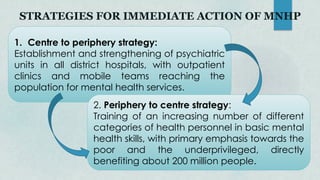
STRATEGIES FOR IMMEDIATE ACTION OF MNHP
1. Centre to periphery strategy:
Establishment and strengthening of psychiatric
units in all district hospitals, with outpatient
clinics and mobile teams reaching the
population for mental health services.
2. Periphery to centre strategy:
Training of an increasing number of different
categories of health personnel in basic mental
health skills, with primary emphasis towards the
poor and the underprivileged, directly
benefiting about 200 million people.
Approaches
 • Integration of mental health care services with the existing general health
services.
 • Utilization of the existing infrastructure of health services and also deliver
the minimum mental health care services.
 • Provision of appropriate task-oriented training to the existing health staff.
 • Linkage of mental health services with the existing community
development program.
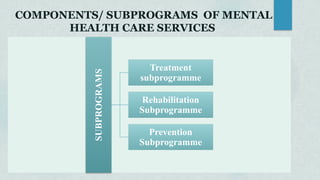
COMPONENTS/ SUBPROGRAMS OF MENTAL
HEALTH CARE SERVICES
SUBPROGRAMS
Treatment
subprogramme
Rehabilitation
Subprogramme
Prevention
Subprogramme
TREATMENT SUBPROGRAMME
 A. Village and sub-center level
multipurpose workers (MPW)and health supervisors (HS), under the supervision of
medical officer(MO) to be trained for:
 a. management of psychiatric emergencies
 b. administration and supervision of maintenance treatment for chronic psychiatric
disorders
 c. diagnosis and management of grandmal epilepsy, especially in children
 d. liaison with local school teachers and parents regarding mental retardation and
behavioural problems in children
 e. counseling in problems related to alcohol and drug abuse
TREATMENT SUBPROGRAMME
 B. MO of Primary Health Centre (PHC) aided by HS, to be trained for:
a. supervision of MPW's performance
b. elementary diagnosis
c. treatment of functional psychosis
d. treatment of uncomplicated cases of psychiatric disorders associated with
physical diseases
e. management of uncomplicated psycho-social problems
 f. epidemiological surveillance of mental morbidity
 C. District hospital:
 There should be at least one psychiatrist attached to every district hospital as
an integral part of the district health services.
 The district hospital should have 30-50 psychiatric beds.
 The psychiatrist in a district hospital was envisaged to devote only a part of
his time to clinical care and a greater part in training and supervision of
non-specialist health workers.
TREATMENT SUBPROGRAMME
 D. Mental hospitals and teaching psychiatric units:
Major activities of these higher centers of psychiatric care include:
a. help in care of 'difficult' cases
b. teaching
c. specialized facilities like, occupational therapy units, psychotherapy,
counseling and behavioural therapy
Rehabilitation Subprogramme
 The components
maintenance treatment of epileptics and psychotics at the community levels.
development of rehabilitation centres at both the district level and the higher
referral centres.
Prevention Subprogramme
 The prevention component is to be community-based, with the initial focus
on prevention and control of alcohol-related problems.
 Later, problems such as addictions, juvenile delinquency and acute
adjustment problems such as suicidal attempts are to be addressed.
PREVENTIVE PSYCHIATRY
 Definition:
Preventive psychiatry is defined as services rendered in the community in
order to prevent the mental illness and promote the mental health.
Main features of preventive psychiatry
Focus on prevention
Rendering continuity of care
Multidisciplinary approach
Promotion of services
Rendering care by coordinating with accessible community health services.
THE PUBLIC HEALTH MODEL(MODEL OF PREVENTIVE
PSYCHIATRY)
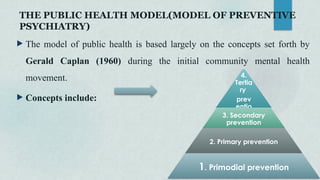
 The model of public health is based largely on the concepts set forth by
Gerald Caplan (1960) during the initial community mental health
movement.
 Concepts include:
4.
Tertia
ry
prev
entio
n
3. Secondary
prevention
2. Primary prevention
1. Primodial prevention
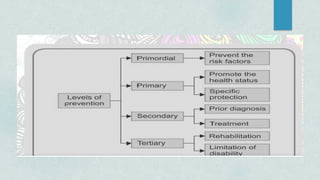
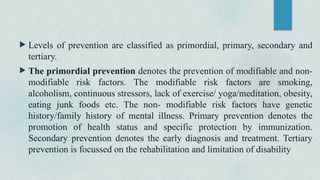
 Levels of prevention are classified as primordial, primary, secondary and
tertiary.
 The primordial prevention denotes the prevention of modifiable and non-
modifiable risk factors. The modifiable risk factors are smoking,
alcoholism, continuous stressors, lack of exercise/ yoga/meditation, obesity,
eating junk foods etc. The non- modifiable risk factors have genetic
history/family history of mental illness. Primary prevention denotes the
promotion of health status and specific protection by immunization.
Secondary prevention denotes the early diagnosis and treatment. Tertiary
prevention is focussed on the rehabilitation and limitation of disability
Primary Prevention
 Primary prevention seeks to prevent the occurrence of mental disorders by
strengthening individual, family and group coping abilities.
POPUATION AT RISK
Adolescence
Marriage
Midlife
Retirement
Individual centered intervention
 Antenatal care to the mother and educating her
 Ensuring timely and efficient obstetrical assistance
 Dietary corrections to those infants suffering from metabolic disorders.
 Correction of endocrine disorders.
 Liberalization of laws regarding termination of pregnancy, when it is unwanted.
 Training programs for physically, and mentally handicapped children
 Counseling the parents of physically and mentally handicapped
 Fostering bonding behaviours.
Contd …
 Interventions oriented to the child in the school
Teaching growth and development to parents and teachers.
Identifying the problems of scholastic performance and emotional
disturbances among school children and giving timely intervention.
School teachers can be taught to recognize the beginning symptoms of
problems and referring to appropriate agencies.
Contd..
 Family centered interventions to ensure harmonious relationship
Consulting with parents about appropriate disciplinary measures.
Promoting open healthy communication in families.
Rendering crisis counseling to the parents of physically and mentally
handicapped children.
Ensuring harmonious relationship among members of the family and
teaching healthy adaptive techniques at the time of stress producing events.
Contd..
 Interventions oriented to keep families intact
Extending mental health education services at Child Guidance Clinics
Strengthening social support for the frustrated aged and helping them to
retain their usefulness.
Promoting educational services in the field of mental health and mental
hygiene.
Developing parent-teacher associations.
Providing marital counseling for those having marital problems.
Contd…
 5. Interventions for families in crisis
 In developmental crisis
 situations such as the child passing through adolescence, birth of a new baby,
retirement or menopause, death of a wage earner in the family, desertion by the spouse
etc.
 crisis intervention can be given at
 • Mental hygiene clinics
 • Psychiatric first-aid centers
 • Walk-in clinics
Contd..
6. Mental health education
 Conduct mass health education programs regarding prevention of mental
illnesses and promotion of mental health in the community.
 Educate health workers regarding prevention of mental illness so that they
can function effectively in all the areas of prevention.
Contd…
 7. Society-centered preventive measure
Community development Culturally deprived families need biological and
psychosocial supplies.
They need better hygienic living conditions, proper food, education,
health facilities, and recreational facilities. Otherwise, psychopathy,
alcoholism, drug addiction, crime and mental illness, will result in such
situations.
• Collection and evaluation of epidemiological, bio-statistical data.
ROLE OF NURSE IN PRIMARY PREVENTION
 1.Individual centered intervention
 2. Interventions oriented to the child in the school
 3. Family centered interventions to ensure harmonious relationship
 4. Interventions oriented to keep families intact
 5. Interventions for families in crisis
 6. Mental health education
 7. Society-centered preventive measures
Secondary Prevention
 Secondary prevention targets people who show early symptoms of mental
health disruption but regain premorbid level of functioning through
aggressive treatment.
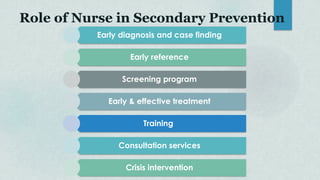
Role of Nurse in Secondary Prevention
Early diagnosis and case finding
Early reference
Screening program
Early & effective treatment
Training
Consultation services
Crisis intervention
Role of Nurse in Secondary Prevention
 Early diagnosis and case finding:
This can be achieved by educating the public, community leaders,
industrialists, Mahila mandals, Balwadis etc. in how to recognize early
symptoms of mental illness.
Case finding through screening and periodic examination of population at
risk, monitoring of clients etc.
Thus in clinics, schools, home health care and the work place, community
mental health nurses detect early signs of increased levels of anxiety,
decreased ability to cope with stress and failure to perceive self, the
environment and/ or reality accurately, and provide direct services as
appropriate
Contd…
 Early reference: The public should be educated to refer these cases to
proper hospitals as soon as they recognize early symptoms of mental
illness.
 Screening programs : Simple questionnaires should be developed to
identify the symptoms of mental illness, and administration of the same in
the community for early identification of cases. These questionnaires can be
simplified in local languages, and used widely in the colleges, schools,
industries etc
Contd..
 Early and effective treatment for patient, and if necessary, to family members
as relevant; providing counseling services to caregivers of mentally ill patients.
 Training of health personnel : Orientation courses should be provided to
health workers to detect cases in the course of their routine work.
 Consultation services
 Crisis intervention :If crisis is not tackled in time it may lead to suicide or
mental disorders. Sometimes anticipating the crisis situation and guiding the
individual in time can help them to cope with the crisis situation in a better way
Tertiary Prevention
 Tertiary prevention targets those with mental illness and helps to reduce the
severity, discomfort and disability associated with their illness.
 In these terms community mental health nurses play a vital role in monitoring
the progress of discharged patients in halfway homes, houses etc., especially
with regard to their medication regimen, coordination of care etc.
Role of a Nurse in Tertiary Prevention
 Family members should be involved actively in the treatment program so that
effective follow-up can be ensured.
 Occupational and recreational activities should be organized in the hospital
 Community based programs
launched through meeting with the family members when the need for
discharge from the hospital should be emphasized.
implemented through day hospitals, night hospitals, after care clinics, half-
way homes, ex-patient hostels, foster care homes etc.
Follow up care can be handed over to community health nurses.
constant communication between the community health nurses and the
mental health institution regarding the follow up is mandatory.
Contd..
 The ultimate aim is to re-socialize and re-motivate the patient for a functional
role in the community, consistent with his resources.
 Nurses need to be familiar with the agencies in the community that provide
these services.
 Collaborative relationships between mental health care providers and
community agencies are essential.
Contd..
 Training in Community Living (TCL)program, designed by 'Stein and
Test'.
 In this model when a person is referred for a hospital admission the staff
goes to the community with him rather than his going to the hospital to be
with the staff.
This enables the nurse to assess accurately the skills that the person needs
to learn and to mutually agree on realistic goals
Contd..
 Nurses in the community are in a key position to monitor community attitudes
and help in fostering a realistic attitude towards the mentally ill.
Community mental health centers
Features
Commitment : need assessment & accessibility
Services : integrated & balanced
Long-term care: care transition
Case management : continuity of care
Community participation: decision making about mental health care needs
and programs
Evaluation and research
Community Mental Health Practice Sites
 • Community mental health centers
 • Youth centers
 • Private practice office
 • Crisis centers
 • Shelters
 • Clients' homes
 • School and day care centers
 • Nursing homes
 • Day hospital facilities
 • Emergency department of community hospitals
 • Churches, temples, mosques
Available community facilities
 Psychiatric hospitals
 Partial hospitalization
 Quarterway homes
 Halfway home
 Self help groups
 Suicide prevention centers
 Others
Psychiatric hospitals
 Hospitals have become part of a continuum of mental health services
available to patients and their families, and offer a variety of treatments for
psychiatric disorders.
Partial hospitalization
 Partial hospitalization is an innovative alternative to hospitalization.
 It is ideally suited to most of the psychiatric syndromes, particularly chronic
psychotic disorders, neurotic conditions, personality disorders, drug and
alcohol dependence and mental retardation.
 Day care centers, day hospitals and day treatment programs come under partial
hospitalization.
Partial hospitalization
 Advantages
lesser separation from families,
more involvement in the treatment program and
lessening of patient's preoccupation with the illness, which may be
intensified by full hospitalization.
Day care centres in India
 Sanjivini, New Delhi
 SCARF (Schizophrenia Research Foundation),
 Chennai, has started a day care center called "BAVISHYA"in 1985
 Association of the Friends of Mentally Ill, Mumbai
 Institute of Mental Health, Ahmedabad
 Psychiatric Center, Kolkata
 NIMHANS, Bangalore
 Krupamayie Institute of Mental Health, Miraj
 Anugraha Day Care Center, Chennai
 The Richmond Fellowship Society, Bangalore
Quarterway homes
 This is a place usually located within the hospital campus itself, but not
having the regular services of a hospital.
 There may not be routine nursing staff or routine rounds, and most of the
activities of the place are taken care of by the patients themselves
 Examples of such homes are 13thand 14th psychiatric wards of NIMHANS
at Bangalore
Halfway home
 A halfway home is a transitory residential center for mentally ill patients who no longer
need the full services of a hospital, but are not yet ready for a completely independent
living.
 It attempts to maintain a climate of health rather than of illness, and to develop and
strengthen individual capacities.
 At the same time it enables the recognition of problems that require medical attention,
and permits the discovery of conditions in the community which are acting adversely on
the individual.
 Thus, halfway homes have a major role in the rehabilitation of the mentally ill individual
Objectives
 • To ensure a smooth transition from the hospital to the family.
 • To integrate the individual into the mainstream of life.
Activities
 Assessment:
Clinical assessment
Social assessment
psychological
vocational assessment
Activities
 Reduction of impairments:
 This includes reduction or elimination of the symptoms and cognitive
impairments that interfere with social and vocational performance.
 These impairments are eliminated for the greater part by various
psychotropic agents.
Activities
 Remediation of disabilities through skill training: Skill training is used
to remediate disabilities in social, family and vocational functioning
 Remediating disabilities through supportive interventions: These
strategies aim at helping the individuals compensate for handicaps by
learning skills in living and working environments, adjusting the individual
and family expectations to a level of functioning that is realistically
attainable
halfway homes available in India
 • Medico-Pastoral Association, Bangalore
 • Atmashakti Vidyalaya, Bangalore
 • Richmond Fellowship, Bangalore
 • Puraskara Aftercare Home, Bangalore
 • Cadabam's Home for the Mentally Disabled, Bangalore
 • Family Fellowship Society for Psychosocial Rehabilitation, Bangalore
 • Raju Rehabilitation Foundation, Bangalore
halfway homes available in India
 • YWCA Halfway Home for Mentally Ill, Chennai
 • Dr. Boaz's Rehabilitation Center, Chennai
 • Dr. Dhairyan's Psychotherapy and Rehabilitation Center, Chennai
 • Sowkya Halfway Home at Madurai
 • Delhi Psychosocial Rehabilitation Society
 • Paripurnata Halfway Home, West Bengal
 • Societyfor Mental Health, Kerala
Self-help groups
 Self-help groups are composed of people who are trying to cope with a
specific problem or life crisis, and have improved the emotional health and
wellbeing of many people.
 Usually organized with a particular task in mind, such groups do not
attempt to explore individual psychodynamics in great depth or to change
personality functioning significantly.
Characteristics
 Homogeneity
 Strong cohesion
 Emotional bonding
 Mutual trust
 Sharing
 Enhance quality of life
Strategies:
 The strategies used by group leaders include promotion of dialogue, self-
disclosure and encouragement among members.
 Concepts used in support groups include
 Psycho-education,
 self-disclosure, and
 mutual support
Examples of self-help groups are Alcoholics Anonymous (AA),Association for
Mentally Disabled (AMEND)
Self help group- functions
 demonstrate to individuals that they are not alone in having a particular
problem.
 Sharing each others' experiences not only helps the members by providing
mutual support, but also by generating alternate ways to view and resolve
problems.
 help in overcoming maladaptive patterns of behaviour or states of feeling that
traditional mental health professionals have not generally dealt with
successfully.
Process –self help groups
 social affiliation;
 learning self control; and
 modeling methods
to cope with stress and acting to change the social environment.
Suicide prevention centres
 There are many suicide prevention centers in India in the voluntary sectors
doing good work and helping those in need.
 Some of them are:
• Helping Hands and MPA in Bangalore
• Sneha in Chennai
• Sahara in Mumbai
• Sanjivini and Sumaitri in New Delhi
Others
 • Community group homes
 • Large homes for long-term care
 • Hostels
 • Home care programs
 • District rehabilitation centers

NATIONAL MENTAL HEALTH PROGRAMME.pptxppt

  • 1.
    DEFINITION  Community mentalhealth- psychiatric nursing  CMHN is the application of specialized knowledge to populations and communities to promote and maintain mental health, and to rehabilitate populations at risk that continue to have residual effects of mental illness.
  • 2.
    Philosophy  The philosophyof care is based on the belief that care directed towards the individual, the family and the group contributes to the health care of the population as a whole.
  • 3.
    NATIONAL METAL HEALTHPROGRAM  The Government of India has launched the National Mental Health Programme (NMHP) in 1982
  • 4.
    NATIONAL METAL HEALTHPROGRAM OBJECTIVES :  1. To ensure the availability and accessibility of minimum mental healthcare for all in the foreseeable future, particularly to the most vulnerable and underprivileged sections of the population;  2. To encourage the application of mental health knowledge in general healthcare and in social development; and  3. To promote community participation in the mental health service development and to stimulate efforts towards self-help in the community.
  • 5.
    AIMS  1. Preventionand treatment of mental and neurological disorders and their associated disabilities.  2. Use of mental health technology to improve general health services.  3. Application of mental health principles in total national development to improve quality of life
  • 6.
    STRATEGIES FOR IMMEDIATEACTION OF MNHP 1. Centre to periphery strategy: Establishment and strengthening of psychiatric units in all district hospitals, with outpatient clinics and mobile teams reaching the population for mental health services. 2. Periphery to centre strategy: Training of an increasing number of different categories of health personnel in basic mental health skills, with primary emphasis towards the poor and the underprivileged, directly benefiting about 200 million people.
  • 7.
    Approaches  • Integrationof mental health care services with the existing general health services.  • Utilization of the existing infrastructure of health services and also deliver the minimum mental health care services.  • Provision of appropriate task-oriented training to the existing health staff.  • Linkage of mental health services with the existing community development program.
  • 8.
    COMPONENTS/ SUBPROGRAMS OFMENTAL HEALTH CARE SERVICES SUBPROGRAMS Treatment subprogramme Rehabilitation Subprogramme Prevention Subprogramme
  • 9.
    TREATMENT SUBPROGRAMME  A.Village and sub-center level multipurpose workers (MPW)and health supervisors (HS), under the supervision of medical officer(MO) to be trained for:  a. management of psychiatric emergencies  b. administration and supervision of maintenance treatment for chronic psychiatric disorders  c. diagnosis and management of grandmal epilepsy, especially in children  d. liaison with local school teachers and parents regarding mental retardation and behavioural problems in children  e. counseling in problems related to alcohol and drug abuse
  • 10.
    TREATMENT SUBPROGRAMME  B.MO of Primary Health Centre (PHC) aided by HS, to be trained for: a. supervision of MPW's performance b. elementary diagnosis c. treatment of functional psychosis d. treatment of uncomplicated cases of psychiatric disorders associated with physical diseases e. management of uncomplicated psycho-social problems  f. epidemiological surveillance of mental morbidity
  • 11.
     C. Districthospital:  There should be at least one psychiatrist attached to every district hospital as an integral part of the district health services.  The district hospital should have 30-50 psychiatric beds.  The psychiatrist in a district hospital was envisaged to devote only a part of his time to clinical care and a greater part in training and supervision of non-specialist health workers. TREATMENT SUBPROGRAMME
  • 12.
    TREATMENT SUBPROGRAMME  D.Mental hospitals and teaching psychiatric units: Major activities of these higher centers of psychiatric care include: a. help in care of 'difficult' cases b. teaching c. specialized facilities like, occupational therapy units, psychotherapy, counseling and behavioural therapy
  • 13.
    Rehabilitation Subprogramme  Thecomponents maintenance treatment of epileptics and psychotics at the community levels. development of rehabilitation centres at both the district level and the higher referral centres.
  • 14.
    Prevention Subprogramme  Theprevention component is to be community-based, with the initial focus on prevention and control of alcohol-related problems.  Later, problems such as addictions, juvenile delinquency and acute adjustment problems such as suicidal attempts are to be addressed.
  • 15.
    PREVENTIVE PSYCHIATRY  Definition: Preventivepsychiatry is defined as services rendered in the community in order to prevent the mental illness and promote the mental health. Main features of preventive psychiatry Focus on prevention Rendering continuity of care Multidisciplinary approach Promotion of services Rendering care by coordinating with accessible community health services.
  • 16.
    THE PUBLIC HEALTHMODEL(MODEL OF PREVENTIVE PSYCHIATRY)  The model of public health is based largely on the concepts set forth by Gerald Caplan (1960) during the initial community mental health movement.  Concepts include: 4. Tertia ry prev entio n 3. Secondary prevention 2. Primary prevention 1. Primodial prevention
  • 18.
     Levels ofprevention are classified as primordial, primary, secondary and tertiary.  The primordial prevention denotes the prevention of modifiable and non- modifiable risk factors. The modifiable risk factors are smoking, alcoholism, continuous stressors, lack of exercise/ yoga/meditation, obesity, eating junk foods etc. The non- modifiable risk factors have genetic history/family history of mental illness. Primary prevention denotes the promotion of health status and specific protection by immunization. Secondary prevention denotes the early diagnosis and treatment. Tertiary prevention is focussed on the rehabilitation and limitation of disability
  • 19.
    Primary Prevention  Primaryprevention seeks to prevent the occurrence of mental disorders by strengthening individual, family and group coping abilities. POPUATION AT RISK Adolescence Marriage Midlife Retirement
  • 20.
    Individual centered intervention Antenatal care to the mother and educating her  Ensuring timely and efficient obstetrical assistance  Dietary corrections to those infants suffering from metabolic disorders.  Correction of endocrine disorders.  Liberalization of laws regarding termination of pregnancy, when it is unwanted.  Training programs for physically, and mentally handicapped children  Counseling the parents of physically and mentally handicapped  Fostering bonding behaviours.
  • 21.
    Contd …  Interventionsoriented to the child in the school Teaching growth and development to parents and teachers. Identifying the problems of scholastic performance and emotional disturbances among school children and giving timely intervention. School teachers can be taught to recognize the beginning symptoms of problems and referring to appropriate agencies.
  • 22.
    Contd..  Family centeredinterventions to ensure harmonious relationship Consulting with parents about appropriate disciplinary measures. Promoting open healthy communication in families. Rendering crisis counseling to the parents of physically and mentally handicapped children. Ensuring harmonious relationship among members of the family and teaching healthy adaptive techniques at the time of stress producing events.
  • 23.
    Contd..  Interventions orientedto keep families intact Extending mental health education services at Child Guidance Clinics Strengthening social support for the frustrated aged and helping them to retain their usefulness. Promoting educational services in the field of mental health and mental hygiene. Developing parent-teacher associations. Providing marital counseling for those having marital problems.
  • 24.
    Contd…  5. Interventionsfor families in crisis  In developmental crisis  situations such as the child passing through adolescence, birth of a new baby, retirement or menopause, death of a wage earner in the family, desertion by the spouse etc.  crisis intervention can be given at  • Mental hygiene clinics  • Psychiatric first-aid centers  • Walk-in clinics
  • 25.
    Contd.. 6. Mental healtheducation  Conduct mass health education programs regarding prevention of mental illnesses and promotion of mental health in the community.  Educate health workers regarding prevention of mental illness so that they can function effectively in all the areas of prevention.
  • 26.
    Contd…  7. Society-centeredpreventive measure Community development Culturally deprived families need biological and psychosocial supplies. They need better hygienic living conditions, proper food, education, health facilities, and recreational facilities. Otherwise, psychopathy, alcoholism, drug addiction, crime and mental illness, will result in such situations. • Collection and evaluation of epidemiological, bio-statistical data.
  • 27.
    ROLE OF NURSEIN PRIMARY PREVENTION  1.Individual centered intervention  2. Interventions oriented to the child in the school  3. Family centered interventions to ensure harmonious relationship  4. Interventions oriented to keep families intact  5. Interventions for families in crisis  6. Mental health education  7. Society-centered preventive measures
  • 28.
    Secondary Prevention  Secondaryprevention targets people who show early symptoms of mental health disruption but regain premorbid level of functioning through aggressive treatment.
  • 29.
    Role of Nursein Secondary Prevention Early diagnosis and case finding Early reference Screening program Early & effective treatment Training Consultation services Crisis intervention
  • 30.
    Role of Nursein Secondary Prevention  Early diagnosis and case finding: This can be achieved by educating the public, community leaders, industrialists, Mahila mandals, Balwadis etc. in how to recognize early symptoms of mental illness. Case finding through screening and periodic examination of population at risk, monitoring of clients etc. Thus in clinics, schools, home health care and the work place, community mental health nurses detect early signs of increased levels of anxiety, decreased ability to cope with stress and failure to perceive self, the environment and/ or reality accurately, and provide direct services as appropriate
  • 31.
    Contd…  Early reference:The public should be educated to refer these cases to proper hospitals as soon as they recognize early symptoms of mental illness.  Screening programs : Simple questionnaires should be developed to identify the symptoms of mental illness, and administration of the same in the community for early identification of cases. These questionnaires can be simplified in local languages, and used widely in the colleges, schools, industries etc
  • 32.
    Contd..  Early andeffective treatment for patient, and if necessary, to family members as relevant; providing counseling services to caregivers of mentally ill patients.  Training of health personnel : Orientation courses should be provided to health workers to detect cases in the course of their routine work.  Consultation services  Crisis intervention :If crisis is not tackled in time it may lead to suicide or mental disorders. Sometimes anticipating the crisis situation and guiding the individual in time can help them to cope with the crisis situation in a better way
  • 33.
    Tertiary Prevention  Tertiaryprevention targets those with mental illness and helps to reduce the severity, discomfort and disability associated with their illness.  In these terms community mental health nurses play a vital role in monitoring the progress of discharged patients in halfway homes, houses etc., especially with regard to their medication regimen, coordination of care etc.
  • 34.
    Role of aNurse in Tertiary Prevention  Family members should be involved actively in the treatment program so that effective follow-up can be ensured.  Occupational and recreational activities should be organized in the hospital  Community based programs launched through meeting with the family members when the need for discharge from the hospital should be emphasized. implemented through day hospitals, night hospitals, after care clinics, half- way homes, ex-patient hostels, foster care homes etc. Follow up care can be handed over to community health nurses. constant communication between the community health nurses and the mental health institution regarding the follow up is mandatory.
  • 35.
    Contd..  The ultimateaim is to re-socialize and re-motivate the patient for a functional role in the community, consistent with his resources.  Nurses need to be familiar with the agencies in the community that provide these services.  Collaborative relationships between mental health care providers and community agencies are essential.
  • 36.
    Contd..  Training inCommunity Living (TCL)program, designed by 'Stein and Test'.  In this model when a person is referred for a hospital admission the staff goes to the community with him rather than his going to the hospital to be with the staff. This enables the nurse to assess accurately the skills that the person needs to learn and to mutually agree on realistic goals
  • 37.
    Contd..  Nurses inthe community are in a key position to monitor community attitudes and help in fostering a realistic attitude towards the mentally ill.
  • 38.
    Community mental healthcenters Features Commitment : need assessment & accessibility Services : integrated & balanced Long-term care: care transition Case management : continuity of care Community participation: decision making about mental health care needs and programs Evaluation and research
  • 39.
    Community Mental HealthPractice Sites  • Community mental health centers  • Youth centers  • Private practice office  • Crisis centers  • Shelters  • Clients' homes  • School and day care centers  • Nursing homes  • Day hospital facilities  • Emergency department of community hospitals  • Churches, temples, mosques
  • 40.
    Available community facilities Psychiatric hospitals  Partial hospitalization  Quarterway homes  Halfway home  Self help groups  Suicide prevention centers  Others
  • 41.
    Psychiatric hospitals  Hospitalshave become part of a continuum of mental health services available to patients and their families, and offer a variety of treatments for psychiatric disorders.
  • 42.
    Partial hospitalization  Partialhospitalization is an innovative alternative to hospitalization.  It is ideally suited to most of the psychiatric syndromes, particularly chronic psychotic disorders, neurotic conditions, personality disorders, drug and alcohol dependence and mental retardation.  Day care centers, day hospitals and day treatment programs come under partial hospitalization.
  • 43.
    Partial hospitalization  Advantages lesserseparation from families, more involvement in the treatment program and lessening of patient's preoccupation with the illness, which may be intensified by full hospitalization.
  • 44.
    Day care centresin India  Sanjivini, New Delhi  SCARF (Schizophrenia Research Foundation),  Chennai, has started a day care center called "BAVISHYA"in 1985  Association of the Friends of Mentally Ill, Mumbai  Institute of Mental Health, Ahmedabad  Psychiatric Center, Kolkata  NIMHANS, Bangalore  Krupamayie Institute of Mental Health, Miraj  Anugraha Day Care Center, Chennai  The Richmond Fellowship Society, Bangalore
  • 45.
    Quarterway homes  Thisis a place usually located within the hospital campus itself, but not having the regular services of a hospital.  There may not be routine nursing staff or routine rounds, and most of the activities of the place are taken care of by the patients themselves  Examples of such homes are 13thand 14th psychiatric wards of NIMHANS at Bangalore
  • 46.
    Halfway home  Ahalfway home is a transitory residential center for mentally ill patients who no longer need the full services of a hospital, but are not yet ready for a completely independent living.  It attempts to maintain a climate of health rather than of illness, and to develop and strengthen individual capacities.  At the same time it enables the recognition of problems that require medical attention, and permits the discovery of conditions in the community which are acting adversely on the individual.  Thus, halfway homes have a major role in the rehabilitation of the mentally ill individual
  • 47.
    Objectives  • Toensure a smooth transition from the hospital to the family.  • To integrate the individual into the mainstream of life.
  • 48.
    Activities  Assessment: Clinical assessment Socialassessment psychological vocational assessment
  • 49.
    Activities  Reduction ofimpairments:  This includes reduction or elimination of the symptoms and cognitive impairments that interfere with social and vocational performance.  These impairments are eliminated for the greater part by various psychotropic agents.
  • 50.
    Activities  Remediation ofdisabilities through skill training: Skill training is used to remediate disabilities in social, family and vocational functioning  Remediating disabilities through supportive interventions: These strategies aim at helping the individuals compensate for handicaps by learning skills in living and working environments, adjusting the individual and family expectations to a level of functioning that is realistically attainable
  • 51.
    halfway homes availablein India  • Medico-Pastoral Association, Bangalore  • Atmashakti Vidyalaya, Bangalore  • Richmond Fellowship, Bangalore  • Puraskara Aftercare Home, Bangalore  • Cadabam's Home for the Mentally Disabled, Bangalore  • Family Fellowship Society for Psychosocial Rehabilitation, Bangalore  • Raju Rehabilitation Foundation, Bangalore
  • 52.
    halfway homes availablein India  • YWCA Halfway Home for Mentally Ill, Chennai  • Dr. Boaz's Rehabilitation Center, Chennai  • Dr. Dhairyan's Psychotherapy and Rehabilitation Center, Chennai  • Sowkya Halfway Home at Madurai  • Delhi Psychosocial Rehabilitation Society  • Paripurnata Halfway Home, West Bengal  • Societyfor Mental Health, Kerala
  • 53.
    Self-help groups  Self-helpgroups are composed of people who are trying to cope with a specific problem or life crisis, and have improved the emotional health and wellbeing of many people.  Usually organized with a particular task in mind, such groups do not attempt to explore individual psychodynamics in great depth or to change personality functioning significantly.
  • 54.
    Characteristics  Homogeneity  Strongcohesion  Emotional bonding  Mutual trust  Sharing  Enhance quality of life
  • 55.
    Strategies:  The strategiesused by group leaders include promotion of dialogue, self- disclosure and encouragement among members.  Concepts used in support groups include  Psycho-education,  self-disclosure, and  mutual support Examples of self-help groups are Alcoholics Anonymous (AA),Association for Mentally Disabled (AMEND)
  • 56.
    Self help group-functions  demonstrate to individuals that they are not alone in having a particular problem.  Sharing each others' experiences not only helps the members by providing mutual support, but also by generating alternate ways to view and resolve problems.  help in overcoming maladaptive patterns of behaviour or states of feeling that traditional mental health professionals have not generally dealt with successfully.
  • 57.
    Process –self helpgroups  social affiliation;  learning self control; and  modeling methods to cope with stress and acting to change the social environment.
  • 58.
    Suicide prevention centres There are many suicide prevention centers in India in the voluntary sectors doing good work and helping those in need.  Some of them are: • Helping Hands and MPA in Bangalore • Sneha in Chennai • Sahara in Mumbai • Sanjivini and Sumaitri in New Delhi
  • 59.
    Others  • Communitygroup homes  • Large homes for long-term care  • Hostels  • Home care programs  • District rehabilitation centers