Bulletin of Electrical Engineering and Informatics
Vol. 8, No. 3, September 2019, pp. 855~862
ISSN: 2302-9285, DOI: 10.11591/eei.v8i3.1505  855
Journal homepage: http://beei.org/index.php/EEI
Pre-trained based CNN model to identify finger vein
Subha Fairuz1
, Mohamed Hadi Habaebi2
, Elsheikh Mohamed Ahmed Elsheikh3
1,2
Department of Electrical and Computer Engineering, International Islamic University Malaysia, Malaysia
3
Universiti Kuala Lumpur British Malaysian Institute, Selangor, Malaysia
Article Info ABSTRACT
Article history:
Received Mar 5, 2019
Revised May 8, 2019
Accepted May 24, 2019
In current biometric security systems using images for security
authentication, finger vein-based systems are getting special attention in
particular attributable to the facts such as insurance of data confidentiality
and higher accuracy. Previous studies were mostly based on finger-print,
palm vein etc. however, due to being more secure than fingerprint system
and due to the fact that each person's finger vein is different from others
finger vein are impossible to use to do forgery as veins reside under the skin.
The system that we worked on functions by recognizing vein patterns from
images of fingers which are captured using near Infrared (NIR) technology.
Due to the lack of an available database, we created and used our own dataset
which was pre-trained using transfer learning of AlexNet model and
verification is done by applying correct as well as incorrect test images. The
result of deep convolutional neural network (CNN) based several
experimental results are shown with training accuracy, training loss, Receiver
Operating Characteristic (ROC) Curve and Area Under the Curve (AUC).
Keywords:
Alexnet
Biometric identification
Convolutional Neural Network
(CNN)
Finger-vein recognition
Transfer learning
Copyright © 2019 Institute of Advanced Engineering and Science.
All rights reserved.
Corresponding Author:
Mohamed Hadi Habaebi,
Department of Electrical and Computer Engineering,
Faculty of Engineering, International Islamic University Malaysia,
Jalan Gombak, 53100 Kuala Lumpur, Malaysia.
Email: habaebi@iium.edu.my
1. INTRODUCTION
Biometric identification-based technology has seen an outstanding growth in the recent years and
among them finger vein-based identification is mention worthy due to its efficiency in providing security and
accuracy [1]. The security is ensured in this system from forgery and interference due to the fact that the vein
network is located internally within the body and cannot be affected by outside disturbances such as dirtiness,
humidity [2, 3]. Finger vein-based systems have benefits in comparison to other conventional techniques
since it is non-intrusive and device size is smaller. Thus, it possesses great future prospects in the biometric
technology field [4].
Locating veins under the skin means revealing venous networks using sophisticated camera
technologies in order to make these networks distinguishable and a technology which can accomplish this
feat is known as line tracking technique [5]. Among other mention-worthy techniques such as Far-infrared
(FIR) and Near-infrared (NIR) is able to detect finger veins accurately. NIR and FIR both camera
technologies possess the capability of infiltrating 5mm under the skin tissue and illuminating 740-940
nanometers [6] whereas human eyes are only able to see in between 380-720 nanometers in the visible light
spectrum [7]. FIR detects tissues with higher temperature adjacent to the outside skin while NIR captures
venous networks which carries blood due to the blood having the ability to absorb infrared radiation. [8].
Though the advances in the finger-vein based biometric technology are terrific but still processes for
vein extraction from fingers remains dependent on four methods which are local-invariant based methods
[9, 10], statistical based methods [11], sub-space learning-based techniques [12] and vessel extraction
[13, 14]. It is possible to extract venous networks as a line like structures [15], as minutiae [16], as curvature
 ISSN: 2302-9285
Bulletin of Electr Eng and Inf, Vol. 8, No. 3, September 2019 : 855 – 862
856
[7, 8] or as a network of dark lines as apart of vessel extraction. Besides these techniques, there are other
ways of recognition such as tracking times and curvature values, thresholds and neighborhood number. [17]
In a traditional finger vein authentication system, there are four steps: Image Acquisition,
Pre-processing, feature extraction and matching or verification. To ensure higher accuracy rate of finger vein
recognition process training-base methods are more efficient than a non-training-based algorithm.
Convolutional neural network (CNN) based network model contains an input layer, several hidden layers,
output layer [18, 19]. Generally, a CNN network contains an input layer, several hidden layers, output layer.
An architecture of Alexnet is illustrated in Figure 1, where the first layer is the input image 224x224 then
several hidden layers and finally the output layer.
Figure 1. Architecture of Alexnet [20]
Common hidden layers are convolution layer, Rectified Linear Units (ReLu), pooling, normalization
etc. Hundreds of images can be modified by this CNN models, for this reason to train a network GPU is
needed otherwise difficult to work with complex models. [21] However, more difficult security problem such
as, spoofing attacks in finger vein database [22] also getting impressive result. Table 1 shows comparison of
related works [23].
Identification accuracy achieved in the research [17] for databases such as HKPU, FV-USM,
SDUMLA is 98% while for database UTFVP the rate is 99.4%. A vision-based device was proposed and
developed in [8] which is a promising device for phlebotomy procedures. A deep learning-based approach
known as LeNet-5 model of CNN which used convolutional neural network for finger vein identification in
[24] showcasing a recognition rate of 96% in the Windows-based system and 100% in Linux based system.
AlexNet of CNN approach was used in [25] for finger vein recognition which produced an accuracy rate of
99.53%. VGG Net-16 of CNN was used for developing a finger vein identification system in [26] which
showcased a recognition rate of 97.7%.
Table 1. Comparison of related works [23]
Author- year Topic Method Strength Limitation
Rig Das, Emanuele
Maiorana, Patrizio
Campisi, 2018 [17]
Convolutional Neural
Network for Finger-Vein-
based Biometric
Identification
Applied deep learning
method using
existence public
databases
Used four public
databases and establish
CNN based finger vein
identification system.
Static images used only,
didn’t created own
database for the
experiments
Kazi Istiaque Ahmed,
Mohamed Hadi Habaebi,
Md Rafiqul Islam and
Nur Aishah Bt
Zainal,2017 [8]
Enhanced Vision Based
Vein Detection System
NIR imaging
Technique and
contrast limited
adaptive equalization
to process images
Image quality is better
and detecting the vein
in real time
Expensive hardware is
used to capture images
K. S. Itqan, A. R.
Syafeeza , F. G. Gong, N.
Mustafa,
2016 [24]
User Identification
System based on finger-
vein Patterns using
convolutional neural
network
LeNet-5 network
trained finger vein
images
Own databased is used
and experimental
result is pretty
acceptable
Image quality is low,
recognition is not in real
time.
Wenjie Liu, Weijun Li,
Linjun Sun, 2017 [25]
Finger Vein Recognition
Based on Deep Learning
AlexNet based deep
learning method used
for finger vein
recognition
Result beats
expectancy and
showed CNN is better
than traditional
algorithms
Image quality is not
pleasing, can be more
accurate
Hyung Gil Hong, Min
Beom Lee and Kang
Ryoung Park, 2017 [26]
Convolutional Neural
Network-Based Finger-
Vein Recognition Using
NIR Image Sensors
Two public databases
are used to prove
CNN
Non-trained classes
can be recognized and
reduce complexity
Proposed method is quite
more complex than
existing methods.
Bulletin of Electr Eng and Inf ISSN: 2302-9285 
Pre-trained based CNN model to identify finger vein (Subha Fairuz)
857
In this research, we are using human finger vein data to acknowledge human identity using our
finger vein collector device. However, we assembled more than one copies of a finger and keep as one
information which later accommodated for training. In the next section, we illustrated our finger vein
recognition approach. In the third section, we explained our experimental results and analysis, and also the
last section is about our future vision of this work and conclusion.
2. RESEARCH METHOD
The technology which is revolutionizing the research field of computer vision is CNN and it is
continuing to increase the advancement of accurate image classification besides playing a key role in
performing feature extraction and recognition tasks such as image retrieval, object detection, semantic
segmentation [27]. Due to the fact that the modern era is technologically advanced meaning enhanced
computing power and GPU acceleration which makes it possible for the robust and efficient use of CNN.
Based on deep CNN a model known as AlexNet [28] which consists of two fully-connected layers, five
convolutional layers, and a softmax output layer. This network is coherent, unlike other simplistic networks
which include Rectified Linear Units (ReLU), dropout and overlap pooling [29].
2.1. Developed a device and construct the database
To create an information and capture finger vein images, we create a tool which can take finger vein
pictures by exploitation transmission imaging. There is a space to insert the finger and taking finger vein
images, however, the light source illuminates from the underside of the tool as well as images captured from
the top. To induce high-quality information, we covered the surroundings, used CMOS camera, take away
background noises, NIR light sources, detected the region of interest (ROI) and stored the images in two
different folders, one for training and another one for testing.
We collected twice total 12 finger's data and save those according to person's identity for both
training and testing purpose. For training, we stored 100 images whereas, 30 images for testing purpose, each
folders image are altered furthermore and removed the noises, detected the ROI and kept the data with the
support of MATLAB [30].
2.2. Training of CNN model
Alexnet can be trained from the initial stage of the network by using random adjustment of weights
or it can be trained a pre-train model using transfer learning features, which is faster and also a small number
of images needs to train the model. There are five convolutional layers and three fully-connected (FC) layer,
in each convolutional layer consist of convolution, Rectified Linear Unit (ReLU) pooling feature detection
layers and fully-connected layers connect every neuron of a layer to another layer and provide classification
output using softmax function [29].
a. To proceed with the transfer learning process, we pre-processed our input image from 747×366×3 to
227×227×3
b. First convolutional layer’s (conv1) filter size is 11×11×3 where stride and padding are 4,0 respectively.
c. ReLu confirms a negative value to zero and keeps it positive
d. Max pooling reduces the number of parameters by using non-linear downsampling and normalization
kernel size is 3×3. When an input image is finished processing then we get an image with the dimension
55×55×96
e. A similar technique is used for other convolutional layers where conv2, conv3, conv4, conv5 generates
the following dimensions 27×27×256, 13×13×384, 13×13×384, 13×13×256.
f. In conv2 filter size is 5×5 with stride 1. In the similar manner conv3, conv4, conv5 uses 3×3 filter and
stride 1. After getting fully-connected layers, we dropout 50%.
3. RESULTS AND ANALYSIS
A simple confusion matrix is a table of four types of combinations of actual and predicted value
which can measure the performance of a classifier on a test dataset based on that actual values showed in the
following Table 2. If the predicted result is the positive and actual result is also positive then it is known as
the true positive (TP). Again, If the predicted result is negative but the actual result is positive then it is
known as the true negative (TN). Contrarily, If the predicted result is the positive but actual result is negative
then that term known as false positive (FP). Furthermore, If the predicted result is the negative and actual
result is also negative then it is known as the false negative (FN).
 ISSN: 2302-9285
Bulletin of Electr Eng and Inf, Vol. 8, No. 3, September 2019 : 855 – 862
858
Table 2. Confusion matrix
Confusion Matrix
Predicted Positive (P) Predicted Negative (N)
Actual Positive (P) True Positive (TP) False Negative (FN)
Actual Negative (N) False Positive (FP) True Negative (TN)
True positive rate (TPR) or, Sensitivity, TPR=TP/P=TP/(TP+FN);
True Negative rate (TNR) or, Specificity, TNR=TN/N=TN/(TN+FP);
False Positive rate (FPR), FPR=1-TNR=FP/(TN+FP), So, Accuracy
(ACC)=(TP+TN)/(TP+FP+FN+TN)
True positive rate or sensitivity against False positive rate is known as receiver operating
characteristic (ROC) curve which is the curve of probability and it shows the performance of a classification
model. Area Under the curve (AUC) indicates the quality of the ROC curve. AUC will be 1 when the ROC
curve has an ideal classifier however AUC value zero indicates that the experiment is predicting the false
classes [23, 30, 31].
3.1. Actual training data and test data
3.1.1. Experiment 1
Using transfer learning on pre-trained Alexnet, we experimented through various type of testing to
get a feasible result for our finger vein identification system.
For the first experiment, we used 50 images from each of the four classes to train our network where
the highest number of the epoch was 8 and the mini-batch size was 20 shown in Figure 2(a) which took a
total time of 37.5s for the test to run while the predictive ability is 91% and AUC is 0.942. As we can see in
the first experiment performance is really pleasant. A better model means lower the losses, the loss value
indicates how strong or poorly a specific model is performing after each iteration, However, one would
assume that the reduction of loss after each, or several, iteration(s). From Figure 2(b), we can see that training
loss going downward from around 1.4 to 1.
(a) (b)
Figure 2. (a)ROC curve of Experiment 1, (b) Training accuracy (%) and loss of Experiment 1
3.1.2. Experiment 2
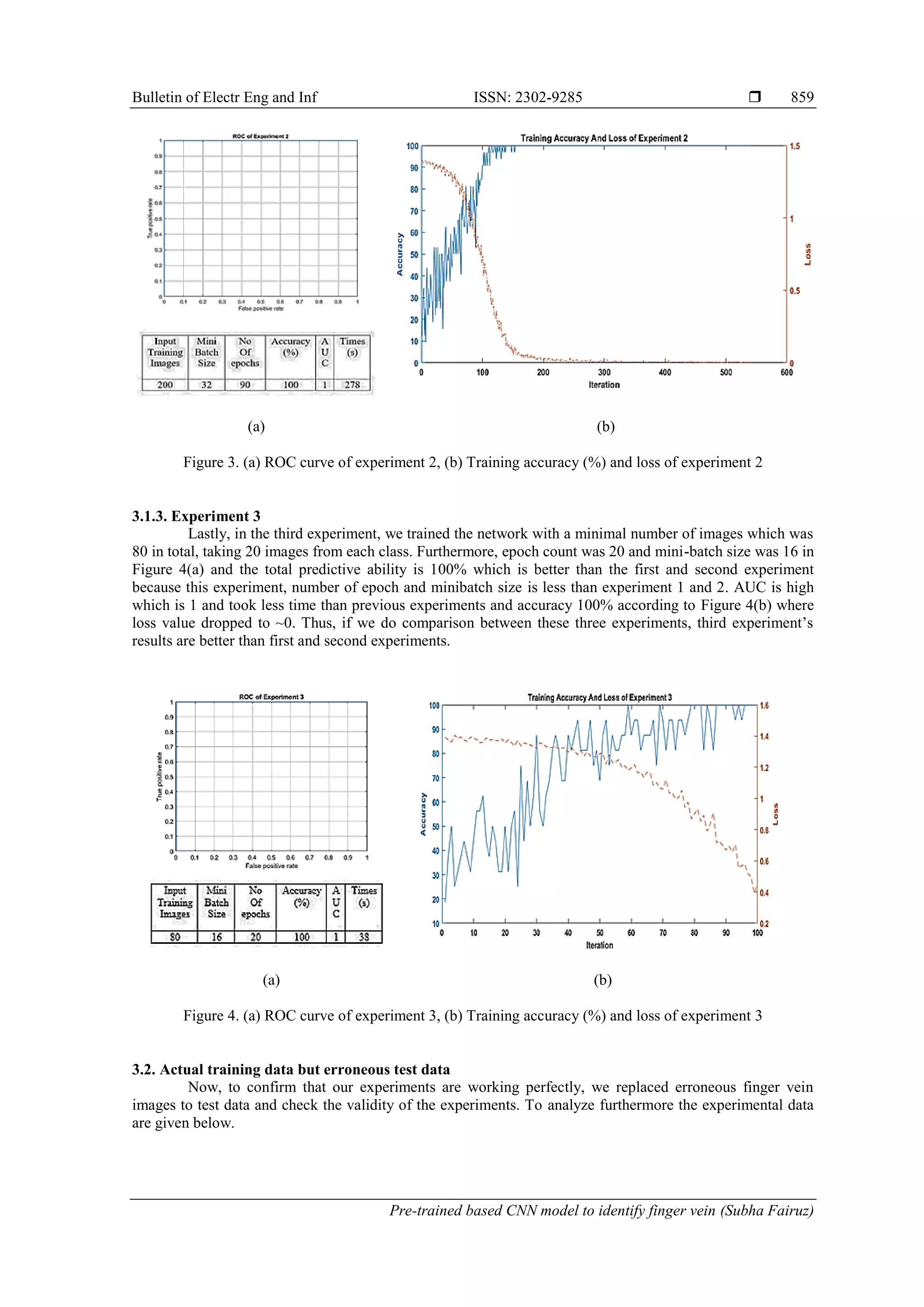
On the other hand, for the second experiment we used 50 images per finger to train the network
which took an execution time of 178s which is higher than the previous experiment. Although the second test
took a slightly higher time for processing the data, the predictive efficiency is 100% and AUC is 1 which is
an excellent in terms of performance. It is also notable that, the number of epochs is 90 and minibatch size
was 32 according to Figure 3(a), which is better in comparison to the first experiment still, this experiment
delivered a better result. In this experiment from Figure 3(a), we can see that AUC is in ideal situation and
predictability is 100% while Figure 3(b) showcases training loss drop to 0.
Bulletin of Electr Eng and Inf ISSN: 2302-9285 
Pre-trained based CNN model to identify finger vein (Subha Fairuz)
859
(a) (b)
Figure 3. (a) ROC curve of experiment 2, (b) Training accuracy (%) and loss of experiment 2
3.1.3. Experiment 3
Lastly, in the third experiment, we trained the network with a minimal number of images which was
80 in total, taking 20 images from each class. Furthermore, epoch count was 20 and mini-batch size was 16 in
Figure 4(a) and the total predictive ability is 100% which is better than the first and second experiment
because this experiment, number of epoch and minibatch size is less than experiment 1 and 2. AUC is high
which is 1 and took less time than previous experiments and accuracy 100% according to Figure 4(b) where
loss value dropped to ~0. Thus, if we do comparison between these three experiments, third experiment’s
results are better than first and second experiments.
(a) (b)
Figure 4. (a) ROC curve of experiment 3, (b) Training accuracy (%) and loss of experiment 3
3.2. Actual training data but erroneous test data
Now, to confirm that our experiments are working perfectly, we replaced erroneous finger vein
images to test data and check the validity of the experiments. To analyze furthermore the experimental data
are given below.
 ISSN: 2302-9285
Bulletin of Electr Eng and Inf, Vol. 8, No. 3, September 2019 : 855 – 862
860
3.2.1. Experiment 1
In this experiment 1, we trained the Alexnet as previously but replaced the four categories with
several erroneous test data. This experiment 1 as shown in Figure 5 displays the training accuracy is 50% and
AUC is 0.6. We know that 50% accuracy is not decent enough for recognition as well as the AUC is 0.6
which indicates a poor model and from ROC curve 5(a), we can state that it not a perfect model which is in
fact true. In 5(b), training loss did not cross 1 but dropping the values which specifies that the model is
working according but not with proper data.
(a) (b)
Figure 5. (a) ROC curve of Experiment 1, (b) Training Accuracy (%) and loss of Experiment 1
3.2.2. Experiment 2
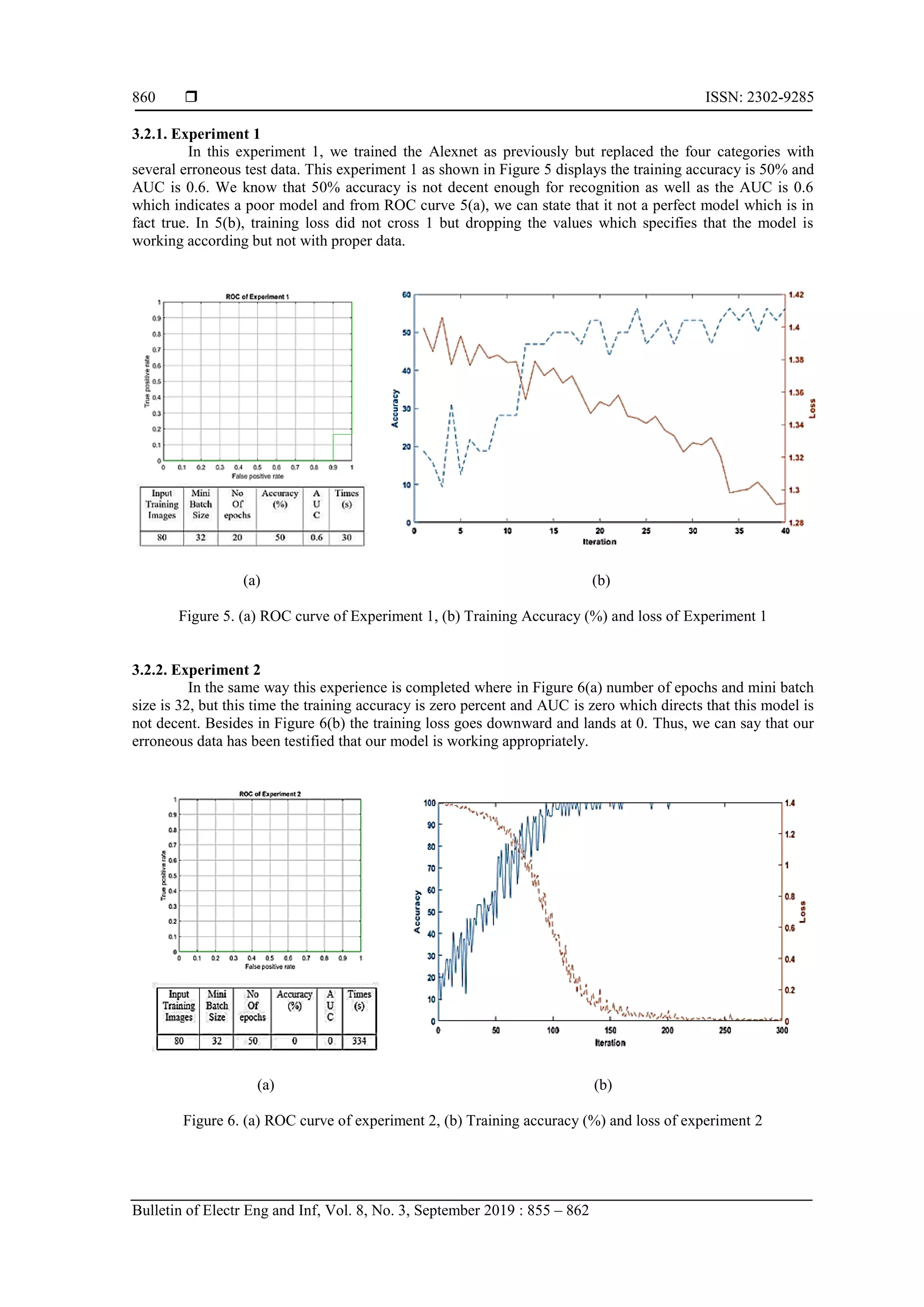
In the same way this experience is completed where in Figure 6(a) number of epochs and mini batch
size is 32, but this time the training accuracy is zero percent and AUC is zero which directs that this model is
not decent. Besides in Figure 6(b) the training loss goes downward and lands at 0. Thus, we can say that our
erroneous data has been testified that our model is working appropriately.
(a) (b)
Figure 6. (a) ROC curve of experiment 2, (b) Training accuracy (%) and loss of experiment 2
Bulletin of Electr Eng and Inf ISSN: 2302-9285 
Pre-trained based CNN model to identify finger vein (Subha Fairuz)
861
4. CONCLUSION
In this paper, we introduced a transfer learning base CNN model which can recognize a finger vein
with pre-trained test data. However, we analyzed and verified that the model is giving precise results by
using both correct and erroneous test data. Further, we visualized the ROC curve and found experiment 3 in
the previous section as a supreme model where used 20 epochs, 16 minibatch sizes and attained 100%
training accuracy and AUC=1 and in experiment 2 of section 3.2.2, was the worst example where accuracy
0% and AUC=0 which means, this example predicted false classes. The outcome was satisfactory and, in the
future, we would like to develop a real-time system based on these experimental results which will have the
ability to identify finger veins in real time.
ACKNOWLEDGEMENTS
This work was conducted at IoT and Wireless Communication Protocols Laboratory, ECE
Department, International Islamic University Malaysia (IIUM) and is partially funded by IIUM Publication
RIGS grant no. P-RIGS19-003-0003.
REFERENCES
[1] J. F. Yang, Y. S. Shi, and J. L. Yang, “Person identification Based on finger-vein features,” Computers in Human
Behavior, vol. 28, pp. 1565- 1570, 2011
[2] J C. Hashimoto, “Finger vein authentication technology and its future,” Symposium on VLSI Circuits Digest of
Technical Papers, pp. 5-8, Honolulu, US, July 2006
[3] T. Yanagawa, S. Aoki, and T.Ohyama, “Human finger vein images are diverse and its patterns are useful for
personal identification,” Kyushu University.
[4] Yu Lu, Sook Yoon, Shan Juan Xi “Finger vein identification using polydirectional local line binary pattern”,
International Conference on ICT Convergence, 10.1109/ICTC.2013.6675307, 2013
[5] B. Besra and R. K. Mohapatra, "Extraction of segmented vein patterns using repeated line tracking algorithm," 2017
Third International Conference on Sensing, Signal Processing and Security (ICSSS),Chennai, 2017, pp. 89-92.
[6] G. C. Meng, A. Shahzad, N. M. Saad, A. S. Malik and F. Meriaudeau, "Prototype design for wearable veins
localization system using near infrared imaging technique," 2015 IEEE 11th International Colloquium on Signal
Processing & Its Applications (CSPA), Kuala Lumpur, 2015, pp. 112-115.
[7] Ficke, B. W., Ransom, E. F., & Oakes, J. E., "Near-Infrared Vein Visualization in Index Finger Pollicization",
Journal of Hand Surgery, 42(6), 481.e1-481.e2. 2016.
[8] K. I. Ahmed, M. H. Habaebi, M. R. Islam and N. A. B. Zainal, "Enhanced vision based vein detection system," 2017
IEEE 4th International Conference on Smart Instrumentation, Measurement and Application (ICSIMA), Putrajaya,
2017, pp. 1-6.
[9] H. Qin, L. Qin, L. Xue, X. He, C. Yu, and X. Liang, “Finger-vein verification based on multi-features fusion,”
Sensors, vol. 13, no. 11, pp. 15 048–15 067, 2013
[10] L. Yang, G. Yang, Y. Yin and X. Xi, "Finger Vein Recognition With Anatomy Structure Analysis," in IEEE
Transactions on Circuits and Systems for Video Technology, vol. 28, no. 8, pp. 1892-1905, Aug. 2018.
[11] E. C. Lee, H. Jung, and D. Kim, “New finger biometric method using near infrared imaging,” Sensors, vol. 11, no. 3,
pp. 2319–2333, 2011.
[12] J.-D. Wu and C.-T. Liu, “Finger-vein pattern identification using principal component analysis and the neural
network technique,” Expert Systems with Applications, vol. 38, no. 5, pp. 5423–5427, 2011.
[13] A. Kumar and Y. Zhou, "Human Identification Using Finger Images," in IEEE Transactions on Image Processing,
vol. 21, no. 4, pp. 2228-2244, April 2012.
[14] N. Miura, A. Nagasaka, and T. Miyatake, “Feature extraction of finger- vein patterns based on repeated line tracking
and its application to personal identification,” Machine Vision and Applications, vol. 15, no. 4, pp. 194–203, 2004.
[15] J. Yang, Y. Shi, and G. Jia, “Finger-vein image matching based on adaptive curve transformation,” Patt. Rec., vol.
66, pp. 34–43, 2017.
[16] F. Liu, G. Yang, Y. Yin, and S. Wang, “Singular value decomposition-based minutiae matching method for finger
vein recognition,” Neuro- computing, vol. 145, pp. 75 – 89, 2014
[17] R. Das, E. Piciucco, E. Maiorana and P. Campisi, "Convolutional Neural Network for Finger-Vein-Based Biometric
Identification," in IEEE Transactions on Information Forensics and Security, vol. 14, no. 2, pp. 360-373, Feb. 2019.
[18] Mathworks, “Introducing Deep Learning with MATLAB”,
https://fr.mathworks.com/content/dam/mathworks/tagteam/Objects/d/80879v00_Deep_Learning_ebook.pdf,2017
[19] Subha Fairuz, Mohamed Hadi Habaebi, “Convolutional Neural Network-based Finger Vein Recognition using Near
Infrared Images”, 7th International Conference on Computer and Communication Engineering (ICCCE), 2018.
[20] Anibal Pedraza1, Jaime Gallego1, Samuel Lopez1, “Glomerulus classification with Convolutional Neural
Networks”, Communications in Computer and Information Science. June 2017
[21] https://www.mathworks.com/solutions/deeplearning/convolutional-neural-network.html
[22] Raghavendra, R Busch, C Tirunagar,“The 1st
Competition on Counter Measures to Finger Vein Spoofing Attacks”,
 ISSN: 2302-9285
Bulletin of Electr Eng and Inf, Vol. 8, No. 3, September 2019 : 855 – 862
862
[23] S. Fairuz, M. H. Habaebi and E. M. A. Elsheikh, "Finger Vein Identification Based On Transfer Learning of
AlexNet," 2018 7th International Conference on Computer and Communication Engineering (ICCCE), Kuala
Lumpur, 2018, pp. 465-469.
[24] K. S. Itqan, A. R. Syafeeza, F. G. Gong, N. Mustafa,”User Identification System based on finger-vein Patterns using
convolutional neural network”, ARPN Journal of Engineering and Applied Sciences, 2016
[25] W. Liu, W. Li, L. Sun, L. Zhang and P. Chen, "Finger vein recognition based on deep learning," 2017 12th IEEE
Conference on Industrial Electronics and Applications (ICIEA), Siem Reap, 2017, pp. 205-210.
[26] Hyung Gil Hong, Min Beom Lee and Kang Ryoung Park. “Convolutional Neural Network-Based Finger-Vein
Recognition Using NIR Image Sensors”. Sensors (Basel). 2017 Jun 17(6): 1297.
[27] M. D. Zeiler and R. Fergus, “Visualizing and understanding convolutional neural networks,”Proceedings of the
European Conference on Computer Vision, 2014
[28] A. Krizhevsky, I. Sutskever, G. E. Hinton, “Imagenet classification with deep convolutional neural networks,”
Advances in Neural Information Processing Systems, vol.2, pp. 1097-1105, 2012.
[29] L. Xiao, Q. Yan and S. Deng, "Scene classification with improved AlexNet model," 2017 12th International
Conference on Intelligent Systems and Knowledge Engineering (ISKE), Nanjing, 2017, pp. 1-6.
[30] David J. Hand, “Measuring classifier performance: a coherent alternative to the area under the ROC curve”, Mach
Learn. 2009, 77: 103–123
[31] Teddy Surya Gunawan, Ahmad Fakhrur Razi Mohd Noor, Mira Kartiwi, “Development of English Handwritten
Recognition Using Deep Neural Network,” Indonesian Journal of Electrical Engineering and Computer Science,
10(2), pp. 562-568, 2018
BIOGRAPHIES OF AUTHORS
Subha Fairuz is pursuing her MSc in Computer and Information Engineering, International
Islamic University Malaysia. Her research interests are in image processing, deep learning and
IOT.
Mohamed Hadi Habaebi is with the department of electrical and Computer Engineering,
International Islamic University Malaysia. His research interests are in IoT, wireless
communications and Networking.
Dr Elsheikh Mohamed Ahmed Elsheikh currently works as an assisting professor at University
Kuala Lumpur British Malaysian Institute in Selangor, Malaysia. He obtained his Ph.D.
(Electronic and Electrical Engineering) and M.Sc. (Radio Systems Engineering) from
University College London and University of Hull, respectively; in the United Kingdom.
He obtained B.Sc. (Electrical and Electronic Engineering) from University of Khartoum in
Sudan. Dr Elsheikh is interested in communication theory and information theory and their
application to wireless communication. Current research include resource allocation and
optimum operation techniques applied to cognitive radio networks and relay channels.

Pre-trained based CNN model to identify finger vein

  • 1.
    Bulletin of ElectricalEngineering and Informatics Vol. 8, No. 3, September 2019, pp. 855~862 ISSN: 2302-9285, DOI: 10.11591/eei.v8i3.1505  855 Journal homepage: http://beei.org/index.php/EEI Pre-trained based CNN model to identify finger vein Subha Fairuz1 , Mohamed Hadi Habaebi2 , Elsheikh Mohamed Ahmed Elsheikh3 1,2 Department of Electrical and Computer Engineering, International Islamic University Malaysia, Malaysia 3 Universiti Kuala Lumpur British Malaysian Institute, Selangor, Malaysia Article Info ABSTRACT Article history: Received Mar 5, 2019 Revised May 8, 2019 Accepted May 24, 2019 In current biometric security systems using images for security authentication, finger vein-based systems are getting special attention in particular attributable to the facts such as insurance of data confidentiality and higher accuracy. Previous studies were mostly based on finger-print, palm vein etc. however, due to being more secure than fingerprint system and due to the fact that each person's finger vein is different from others finger vein are impossible to use to do forgery as veins reside under the skin. The system that we worked on functions by recognizing vein patterns from images of fingers which are captured using near Infrared (NIR) technology. Due to the lack of an available database, we created and used our own dataset which was pre-trained using transfer learning of AlexNet model and verification is done by applying correct as well as incorrect test images. The result of deep convolutional neural network (CNN) based several experimental results are shown with training accuracy, training loss, Receiver Operating Characteristic (ROC) Curve and Area Under the Curve (AUC). Keywords: Alexnet Biometric identification Convolutional Neural Network (CNN) Finger-vein recognition Transfer learning Copyright © 2019 Institute of Advanced Engineering and Science. All rights reserved. Corresponding Author: Mohamed Hadi Habaebi, Department of Electrical and Computer Engineering, Faculty of Engineering, International Islamic University Malaysia, Jalan Gombak, 53100 Kuala Lumpur, Malaysia. Email: habaebi@iium.edu.my 1. INTRODUCTION Biometric identification-based technology has seen an outstanding growth in the recent years and among them finger vein-based identification is mention worthy due to its efficiency in providing security and accuracy [1]. The security is ensured in this system from forgery and interference due to the fact that the vein network is located internally within the body and cannot be affected by outside disturbances such as dirtiness, humidity [2, 3]. Finger vein-based systems have benefits in comparison to other conventional techniques since it is non-intrusive and device size is smaller. Thus, it possesses great future prospects in the biometric technology field [4]. Locating veins under the skin means revealing venous networks using sophisticated camera technologies in order to make these networks distinguishable and a technology which can accomplish this feat is known as line tracking technique [5]. Among other mention-worthy techniques such as Far-infrared (FIR) and Near-infrared (NIR) is able to detect finger veins accurately. NIR and FIR both camera technologies possess the capability of infiltrating 5mm under the skin tissue and illuminating 740-940 nanometers [6] whereas human eyes are only able to see in between 380-720 nanometers in the visible light spectrum [7]. FIR detects tissues with higher temperature adjacent to the outside skin while NIR captures venous networks which carries blood due to the blood having the ability to absorb infrared radiation. [8]. Though the advances in the finger-vein based biometric technology are terrific but still processes for vein extraction from fingers remains dependent on four methods which are local-invariant based methods [9, 10], statistical based methods [11], sub-space learning-based techniques [12] and vessel extraction [13, 14]. It is possible to extract venous networks as a line like structures [15], as minutiae [16], as curvature
  • 2.
     ISSN: 2302-9285 Bulletinof Electr Eng and Inf, Vol. 8, No. 3, September 2019 : 855 – 862 856 [7, 8] or as a network of dark lines as apart of vessel extraction. Besides these techniques, there are other ways of recognition such as tracking times and curvature values, thresholds and neighborhood number. [17] In a traditional finger vein authentication system, there are four steps: Image Acquisition, Pre-processing, feature extraction and matching or verification. To ensure higher accuracy rate of finger vein recognition process training-base methods are more efficient than a non-training-based algorithm. Convolutional neural network (CNN) based network model contains an input layer, several hidden layers, output layer [18, 19]. Generally, a CNN network contains an input layer, several hidden layers, output layer. An architecture of Alexnet is illustrated in Figure 1, where the first layer is the input image 224x224 then several hidden layers and finally the output layer. Figure 1. Architecture of Alexnet [20] Common hidden layers are convolution layer, Rectified Linear Units (ReLu), pooling, normalization etc. Hundreds of images can be modified by this CNN models, for this reason to train a network GPU is needed otherwise difficult to work with complex models. [21] However, more difficult security problem such as, spoofing attacks in finger vein database [22] also getting impressive result. Table 1 shows comparison of related works [23]. Identification accuracy achieved in the research [17] for databases such as HKPU, FV-USM, SDUMLA is 98% while for database UTFVP the rate is 99.4%. A vision-based device was proposed and developed in [8] which is a promising device for phlebotomy procedures. A deep learning-based approach known as LeNet-5 model of CNN which used convolutional neural network for finger vein identification in [24] showcasing a recognition rate of 96% in the Windows-based system and 100% in Linux based system. AlexNet of CNN approach was used in [25] for finger vein recognition which produced an accuracy rate of 99.53%. VGG Net-16 of CNN was used for developing a finger vein identification system in [26] which showcased a recognition rate of 97.7%. Table 1. Comparison of related works [23] Author- year Topic Method Strength Limitation Rig Das, Emanuele Maiorana, Patrizio Campisi, 2018 [17] Convolutional Neural Network for Finger-Vein- based Biometric Identification Applied deep learning method using existence public databases Used four public databases and establish CNN based finger vein identification system. Static images used only, didn’t created own database for the experiments Kazi Istiaque Ahmed, Mohamed Hadi Habaebi, Md Rafiqul Islam and Nur Aishah Bt Zainal,2017 [8] Enhanced Vision Based Vein Detection System NIR imaging Technique and contrast limited adaptive equalization to process images Image quality is better and detecting the vein in real time Expensive hardware is used to capture images K. S. Itqan, A. R. Syafeeza , F. G. Gong, N. Mustafa, 2016 [24] User Identification System based on finger- vein Patterns using convolutional neural network LeNet-5 network trained finger vein images Own databased is used and experimental result is pretty acceptable Image quality is low, recognition is not in real time. Wenjie Liu, Weijun Li, Linjun Sun, 2017 [25] Finger Vein Recognition Based on Deep Learning AlexNet based deep learning method used for finger vein recognition Result beats expectancy and showed CNN is better than traditional algorithms Image quality is not pleasing, can be more accurate Hyung Gil Hong, Min Beom Lee and Kang Ryoung Park, 2017 [26] Convolutional Neural Network-Based Finger- Vein Recognition Using NIR Image Sensors Two public databases are used to prove CNN Non-trained classes can be recognized and reduce complexity Proposed method is quite more complex than existing methods.
  • 3.
    Bulletin of ElectrEng and Inf ISSN: 2302-9285  Pre-trained based CNN model to identify finger vein (Subha Fairuz) 857 In this research, we are using human finger vein data to acknowledge human identity using our finger vein collector device. However, we assembled more than one copies of a finger and keep as one information which later accommodated for training. In the next section, we illustrated our finger vein recognition approach. In the third section, we explained our experimental results and analysis, and also the last section is about our future vision of this work and conclusion. 2. RESEARCH METHOD The technology which is revolutionizing the research field of computer vision is CNN and it is continuing to increase the advancement of accurate image classification besides playing a key role in performing feature extraction and recognition tasks such as image retrieval, object detection, semantic segmentation [27]. Due to the fact that the modern era is technologically advanced meaning enhanced computing power and GPU acceleration which makes it possible for the robust and efficient use of CNN. Based on deep CNN a model known as AlexNet [28] which consists of two fully-connected layers, five convolutional layers, and a softmax output layer. This network is coherent, unlike other simplistic networks which include Rectified Linear Units (ReLU), dropout and overlap pooling [29]. 2.1. Developed a device and construct the database To create an information and capture finger vein images, we create a tool which can take finger vein pictures by exploitation transmission imaging. There is a space to insert the finger and taking finger vein images, however, the light source illuminates from the underside of the tool as well as images captured from the top. To induce high-quality information, we covered the surroundings, used CMOS camera, take away background noises, NIR light sources, detected the region of interest (ROI) and stored the images in two different folders, one for training and another one for testing. We collected twice total 12 finger's data and save those according to person's identity for both training and testing purpose. For training, we stored 100 images whereas, 30 images for testing purpose, each folders image are altered furthermore and removed the noises, detected the ROI and kept the data with the support of MATLAB [30]. 2.2. Training of CNN model Alexnet can be trained from the initial stage of the network by using random adjustment of weights or it can be trained a pre-train model using transfer learning features, which is faster and also a small number of images needs to train the model. There are five convolutional layers and three fully-connected (FC) layer, in each convolutional layer consist of convolution, Rectified Linear Unit (ReLU) pooling feature detection layers and fully-connected layers connect every neuron of a layer to another layer and provide classification output using softmax function [29]. a. To proceed with the transfer learning process, we pre-processed our input image from 747×366×3 to 227×227×3 b. First convolutional layer’s (conv1) filter size is 11×11×3 where stride and padding are 4,0 respectively. c. ReLu confirms a negative value to zero and keeps it positive d. Max pooling reduces the number of parameters by using non-linear downsampling and normalization kernel size is 3×3. When an input image is finished processing then we get an image with the dimension 55×55×96 e. A similar technique is used for other convolutional layers where conv2, conv3, conv4, conv5 generates the following dimensions 27×27×256, 13×13×384, 13×13×384, 13×13×256. f. In conv2 filter size is 5×5 with stride 1. In the similar manner conv3, conv4, conv5 uses 3×3 filter and stride 1. After getting fully-connected layers, we dropout 50%. 3. RESULTS AND ANALYSIS A simple confusion matrix is a table of four types of combinations of actual and predicted value which can measure the performance of a classifier on a test dataset based on that actual values showed in the following Table 2. If the predicted result is the positive and actual result is also positive then it is known as the true positive (TP). Again, If the predicted result is negative but the actual result is positive then it is known as the true negative (TN). Contrarily, If the predicted result is the positive but actual result is negative then that term known as false positive (FP). Furthermore, If the predicted result is the negative and actual result is also negative then it is known as the false negative (FN).
  • 4.
     ISSN: 2302-9285 Bulletinof Electr Eng and Inf, Vol. 8, No. 3, September 2019 : 855 – 862 858 Table 2. Confusion matrix Confusion Matrix Predicted Positive (P) Predicted Negative (N) Actual Positive (P) True Positive (TP) False Negative (FN) Actual Negative (N) False Positive (FP) True Negative (TN) True positive rate (TPR) or, Sensitivity, TPR=TP/P=TP/(TP+FN); True Negative rate (TNR) or, Specificity, TNR=TN/N=TN/(TN+FP); False Positive rate (FPR), FPR=1-TNR=FP/(TN+FP), So, Accuracy (ACC)=(TP+TN)/(TP+FP+FN+TN) True positive rate or sensitivity against False positive rate is known as receiver operating characteristic (ROC) curve which is the curve of probability and it shows the performance of a classification model. Area Under the curve (AUC) indicates the quality of the ROC curve. AUC will be 1 when the ROC curve has an ideal classifier however AUC value zero indicates that the experiment is predicting the false classes [23, 30, 31]. 3.1. Actual training data and test data 3.1.1. Experiment 1 Using transfer learning on pre-trained Alexnet, we experimented through various type of testing to get a feasible result for our finger vein identification system. For the first experiment, we used 50 images from each of the four classes to train our network where the highest number of the epoch was 8 and the mini-batch size was 20 shown in Figure 2(a) which took a total time of 37.5s for the test to run while the predictive ability is 91% and AUC is 0.942. As we can see in the first experiment performance is really pleasant. A better model means lower the losses, the loss value indicates how strong or poorly a specific model is performing after each iteration, However, one would assume that the reduction of loss after each, or several, iteration(s). From Figure 2(b), we can see that training loss going downward from around 1.4 to 1. (a) (b) Figure 2. (a)ROC curve of Experiment 1, (b) Training accuracy (%) and loss of Experiment 1 3.1.2. Experiment 2 On the other hand, for the second experiment we used 50 images per finger to train the network which took an execution time of 178s which is higher than the previous experiment. Although the second test took a slightly higher time for processing the data, the predictive efficiency is 100% and AUC is 1 which is an excellent in terms of performance. It is also notable that, the number of epochs is 90 and minibatch size was 32 according to Figure 3(a), which is better in comparison to the first experiment still, this experiment delivered a better result. In this experiment from Figure 3(a), we can see that AUC is in ideal situation and predictability is 100% while Figure 3(b) showcases training loss drop to 0.
  • 5.
    Bulletin of ElectrEng and Inf ISSN: 2302-9285  Pre-trained based CNN model to identify finger vein (Subha Fairuz) 859 (a) (b) Figure 3. (a) ROC curve of experiment 2, (b) Training accuracy (%) and loss of experiment 2 3.1.3. Experiment 3 Lastly, in the third experiment, we trained the network with a minimal number of images which was 80 in total, taking 20 images from each class. Furthermore, epoch count was 20 and mini-batch size was 16 in Figure 4(a) and the total predictive ability is 100% which is better than the first and second experiment because this experiment, number of epoch and minibatch size is less than experiment 1 and 2. AUC is high which is 1 and took less time than previous experiments and accuracy 100% according to Figure 4(b) where loss value dropped to ~0. Thus, if we do comparison between these three experiments, third experiment’s results are better than first and second experiments. (a) (b) Figure 4. (a) ROC curve of experiment 3, (b) Training accuracy (%) and loss of experiment 3 3.2. Actual training data but erroneous test data Now, to confirm that our experiments are working perfectly, we replaced erroneous finger vein images to test data and check the validity of the experiments. To analyze furthermore the experimental data are given below.
  • 6.
     ISSN: 2302-9285 Bulletinof Electr Eng and Inf, Vol. 8, No. 3, September 2019 : 855 – 862 860 3.2.1. Experiment 1 In this experiment 1, we trained the Alexnet as previously but replaced the four categories with several erroneous test data. This experiment 1 as shown in Figure 5 displays the training accuracy is 50% and AUC is 0.6. We know that 50% accuracy is not decent enough for recognition as well as the AUC is 0.6 which indicates a poor model and from ROC curve 5(a), we can state that it not a perfect model which is in fact true. In 5(b), training loss did not cross 1 but dropping the values which specifies that the model is working according but not with proper data. (a) (b) Figure 5. (a) ROC curve of Experiment 1, (b) Training Accuracy (%) and loss of Experiment 1 3.2.2. Experiment 2 In the same way this experience is completed where in Figure 6(a) number of epochs and mini batch size is 32, but this time the training accuracy is zero percent and AUC is zero which directs that this model is not decent. Besides in Figure 6(b) the training loss goes downward and lands at 0. Thus, we can say that our erroneous data has been testified that our model is working appropriately. (a) (b) Figure 6. (a) ROC curve of experiment 2, (b) Training accuracy (%) and loss of experiment 2
  • 7.
    Bulletin of ElectrEng and Inf ISSN: 2302-9285  Pre-trained based CNN model to identify finger vein (Subha Fairuz) 861 4. CONCLUSION In this paper, we introduced a transfer learning base CNN model which can recognize a finger vein with pre-trained test data. However, we analyzed and verified that the model is giving precise results by using both correct and erroneous test data. Further, we visualized the ROC curve and found experiment 3 in the previous section as a supreme model where used 20 epochs, 16 minibatch sizes and attained 100% training accuracy and AUC=1 and in experiment 2 of section 3.2.2, was the worst example where accuracy 0% and AUC=0 which means, this example predicted false classes. The outcome was satisfactory and, in the future, we would like to develop a real-time system based on these experimental results which will have the ability to identify finger veins in real time. ACKNOWLEDGEMENTS This work was conducted at IoT and Wireless Communication Protocols Laboratory, ECE Department, International Islamic University Malaysia (IIUM) and is partially funded by IIUM Publication RIGS grant no. P-RIGS19-003-0003. REFERENCES [1] J. F. Yang, Y. S. Shi, and J. L. Yang, “Person identification Based on finger-vein features,” Computers in Human Behavior, vol. 28, pp. 1565- 1570, 2011 [2] J C. Hashimoto, “Finger vein authentication technology and its future,” Symposium on VLSI Circuits Digest of Technical Papers, pp. 5-8, Honolulu, US, July 2006 [3] T. Yanagawa, S. Aoki, and T.Ohyama, “Human finger vein images are diverse and its patterns are useful for personal identification,” Kyushu University. [4] Yu Lu, Sook Yoon, Shan Juan Xi “Finger vein identification using polydirectional local line binary pattern”, International Conference on ICT Convergence, 10.1109/ICTC.2013.6675307, 2013 [5] B. Besra and R. K. Mohapatra, "Extraction of segmented vein patterns using repeated line tracking algorithm," 2017 Third International Conference on Sensing, Signal Processing and Security (ICSSS),Chennai, 2017, pp. 89-92. [6] G. C. Meng, A. Shahzad, N. M. Saad, A. S. Malik and F. Meriaudeau, "Prototype design for wearable veins localization system using near infrared imaging technique," 2015 IEEE 11th International Colloquium on Signal Processing & Its Applications (CSPA), Kuala Lumpur, 2015, pp. 112-115. [7] Ficke, B. W., Ransom, E. F., & Oakes, J. E., "Near-Infrared Vein Visualization in Index Finger Pollicization", Journal of Hand Surgery, 42(6), 481.e1-481.e2. 2016. [8] K. I. Ahmed, M. H. Habaebi, M. R. Islam and N. A. B. Zainal, "Enhanced vision based vein detection system," 2017 IEEE 4th International Conference on Smart Instrumentation, Measurement and Application (ICSIMA), Putrajaya, 2017, pp. 1-6. [9] H. Qin, L. Qin, L. Xue, X. He, C. Yu, and X. Liang, “Finger-vein verification based on multi-features fusion,” Sensors, vol. 13, no. 11, pp. 15 048–15 067, 2013 [10] L. Yang, G. Yang, Y. Yin and X. Xi, "Finger Vein Recognition With Anatomy Structure Analysis," in IEEE Transactions on Circuits and Systems for Video Technology, vol. 28, no. 8, pp. 1892-1905, Aug. 2018. [11] E. C. Lee, H. Jung, and D. Kim, “New finger biometric method using near infrared imaging,” Sensors, vol. 11, no. 3, pp. 2319–2333, 2011. [12] J.-D. Wu and C.-T. Liu, “Finger-vein pattern identification using principal component analysis and the neural network technique,” Expert Systems with Applications, vol. 38, no. 5, pp. 5423–5427, 2011. [13] A. Kumar and Y. Zhou, "Human Identification Using Finger Images," in IEEE Transactions on Image Processing, vol. 21, no. 4, pp. 2228-2244, April 2012. [14] N. Miura, A. Nagasaka, and T. Miyatake, “Feature extraction of finger- vein patterns based on repeated line tracking and its application to personal identification,” Machine Vision and Applications, vol. 15, no. 4, pp. 194–203, 2004. [15] J. Yang, Y. Shi, and G. Jia, “Finger-vein image matching based on adaptive curve transformation,” Patt. Rec., vol. 66, pp. 34–43, 2017. [16] F. Liu, G. Yang, Y. Yin, and S. Wang, “Singular value decomposition-based minutiae matching method for finger vein recognition,” Neuro- computing, vol. 145, pp. 75 – 89, 2014 [17] R. Das, E. Piciucco, E. Maiorana and P. Campisi, "Convolutional Neural Network for Finger-Vein-Based Biometric Identification," in IEEE Transactions on Information Forensics and Security, vol. 14, no. 2, pp. 360-373, Feb. 2019. [18] Mathworks, “Introducing Deep Learning with MATLAB”, https://fr.mathworks.com/content/dam/mathworks/tagteam/Objects/d/80879v00_Deep_Learning_ebook.pdf,2017 [19] Subha Fairuz, Mohamed Hadi Habaebi, “Convolutional Neural Network-based Finger Vein Recognition using Near Infrared Images”, 7th International Conference on Computer and Communication Engineering (ICCCE), 2018. [20] Anibal Pedraza1, Jaime Gallego1, Samuel Lopez1, “Glomerulus classification with Convolutional Neural Networks”, Communications in Computer and Information Science. June 2017 [21] https://www.mathworks.com/solutions/deeplearning/convolutional-neural-network.html [22] Raghavendra, R Busch, C Tirunagar,“The 1st Competition on Counter Measures to Finger Vein Spoofing Attacks”,
  • 8.
     ISSN: 2302-9285 Bulletinof Electr Eng and Inf, Vol. 8, No. 3, September 2019 : 855 – 862 862 [23] S. Fairuz, M. H. Habaebi and E. M. A. Elsheikh, "Finger Vein Identification Based On Transfer Learning of AlexNet," 2018 7th International Conference on Computer and Communication Engineering (ICCCE), Kuala Lumpur, 2018, pp. 465-469. [24] K. S. Itqan, A. R. Syafeeza, F. G. Gong, N. Mustafa,”User Identification System based on finger-vein Patterns using convolutional neural network”, ARPN Journal of Engineering and Applied Sciences, 2016 [25] W. Liu, W. Li, L. Sun, L. Zhang and P. Chen, "Finger vein recognition based on deep learning," 2017 12th IEEE Conference on Industrial Electronics and Applications (ICIEA), Siem Reap, 2017, pp. 205-210. [26] Hyung Gil Hong, Min Beom Lee and Kang Ryoung Park. “Convolutional Neural Network-Based Finger-Vein Recognition Using NIR Image Sensors”. Sensors (Basel). 2017 Jun 17(6): 1297. [27] M. D. Zeiler and R. Fergus, “Visualizing and understanding convolutional neural networks,”Proceedings of the European Conference on Computer Vision, 2014 [28] A. Krizhevsky, I. Sutskever, G. E. Hinton, “Imagenet classification with deep convolutional neural networks,” Advances in Neural Information Processing Systems, vol.2, pp. 1097-1105, 2012. [29] L. Xiao, Q. Yan and S. Deng, "Scene classification with improved AlexNet model," 2017 12th International Conference on Intelligent Systems and Knowledge Engineering (ISKE), Nanjing, 2017, pp. 1-6. [30] David J. Hand, “Measuring classifier performance: a coherent alternative to the area under the ROC curve”, Mach Learn. 2009, 77: 103–123 [31] Teddy Surya Gunawan, Ahmad Fakhrur Razi Mohd Noor, Mira Kartiwi, “Development of English Handwritten Recognition Using Deep Neural Network,” Indonesian Journal of Electrical Engineering and Computer Science, 10(2), pp. 562-568, 2018 BIOGRAPHIES OF AUTHORS Subha Fairuz is pursuing her MSc in Computer and Information Engineering, International Islamic University Malaysia. Her research interests are in image processing, deep learning and IOT. Mohamed Hadi Habaebi is with the department of electrical and Computer Engineering, International Islamic University Malaysia. His research interests are in IoT, wireless communications and Networking. Dr Elsheikh Mohamed Ahmed Elsheikh currently works as an assisting professor at University Kuala Lumpur British Malaysian Institute in Selangor, Malaysia. He obtained his Ph.D. (Electronic and Electrical Engineering) and M.Sc. (Radio Systems Engineering) from University College London and University of Hull, respectively; in the United Kingdom. He obtained B.Sc. (Electrical and Electronic Engineering) from University of Khartoum in Sudan. Dr Elsheikh is interested in communication theory and information theory and their application to wireless communication. Current research include resource allocation and optimum operation techniques applied to cognitive radio networks and relay channels.