The Effectiveness of Computer Assisted
  Pronunciation Training for Foreign
   Language Learning by Children


               Presenter: Sze-Chu Liu
               Instructor: Dr. Pi-Ying Teresa Hsu

                                        2102/10/15
                                                    1
Citation


Neri, A., Mich, O., Gerosa, M., & Giuliani, D.
(2008). The effectiveness of computer
assisted pronunciation training for foreign
language learning by children. Computer
Assisted Language Learning, 21(5), 393-
408.


                                                 2
Outline


Introduction
The CAPT system considered: PARLING
Method
Results
Conclusions
Reflection


                                       3
Some Abbreviations

CAPT = Computer Assisted Pronunciation
        Training

ASR = Automatic Speech Recognition

ITC-irst = Istituto Trentino di Cultura –
            Istituto per la Ricerca Scientifica
            e Tecnologica

                                                  4
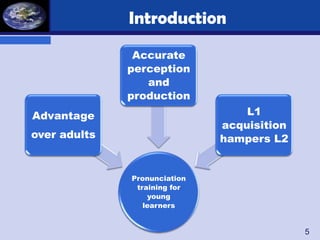
Introduction
               Accurate
              perception
                 and
              production
Advantage                         L1
                              acquisition
over adults                   hampers L2


              Pronunciation
               training for
                  young
                 learners


                                            5
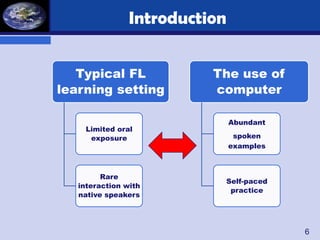
Introduction


   Typical FL             The use of
learning setting          computer

                               Abundant
    Limited oral
     exposure                   spoken
                               examples


         Rare
                           Self-paced
   interaction with
                            practice
   native speakers


                                          6
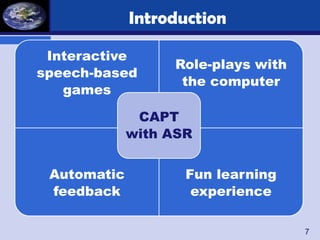
Introduction

 Interactive
                  Role-plays with
speech-based
                   the computer
   games

              CAPT
             with ASR


 Automatic          Fun learning
 feedback            experience

                                    7
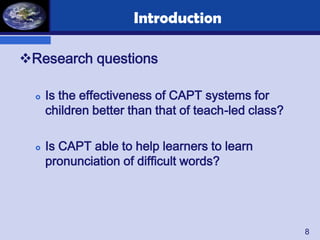
Introduction

Research questions

     Is the effectiveness of CAPT systems for
      children better than that of teach-led class?

     Is CAPT able to help learners to learn
      pronunciation of difficult words?


                                                      8
The CAPT system considered:
        PARLING
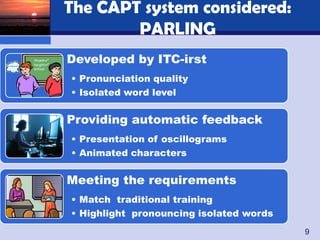
Developed by ITC-irst
• Pronunciation quality
• Isolated word level


Providing automatic feedback
• Presentation of oscillograms
• Animated characters


Meeting the requirements
• Match traditional training
• Highlight pronouncing isolated words
                                         9
The CAPT system considered:
        PARLING
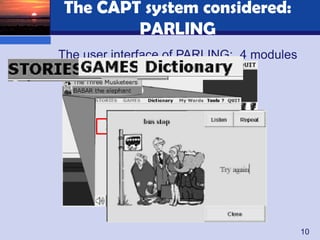
The user interface of PARLING: 4 modules


                                           10
The CAPT system considered:
                   PARLING
       The ASR component
Training Process
  • Native British English speakers + Italian
    learners of English


   Recognization process
      •Forced time-alignment likelihood (A)
      •Phone recognition likelihood (B)


        Decision making
            • If A>B, respond “accept”; Otherwise,
              “reject”                               11
Method
    Participants

               • Total: 28
Number of
               • Control group: 15
 samples       • Experimental group: 13


               • 11-year-old Italian native speakers
  Profile      • Same public school
               • Same curriculum


               • All had 4 years of English FL
Background       classes
                                                       12
Method
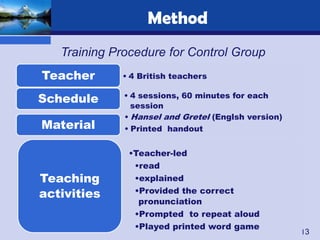
   Training Procedure for Control Group
Teacher      • 4 British teachers

Schedule      • 4 sessions, 60 minutes for each
                session
              • Hansel and Gretel (Englsh version)
Material      • Printed handout


               •Teacher-led
                •read
Teaching        •explained
activities      •Provided the correct
                 pronunciation
                •Prompted to repeat aloud
                •Played printed word game
                                                     13
Method
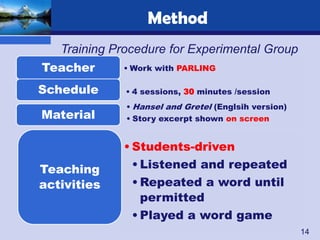
  Training Procedure for Experimental Group
Teacher      • Work with PARLING

Schedule      • 4 sessions, 30 minutes /session
              • Hansel and Gretel (Englsih version)
Material      • Story excerpt shown on screen


             • Students-driven
Teaching       • Listened and repeated
activities     • Repeated a word until
                 permitted
               • Played a word game
                                                      14
Method
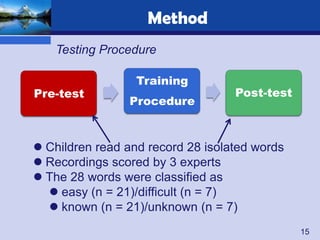
   Testing Procedure

                  Training
Pre-test                           Post-test
                Procedure


 Children read and record 28 isolated words
 Recordings scored by 3 experts
 The 28 words were classified as
   easy (n = 21)/difficult (n = 7)
   known (n = 21)/unknown (n = 7)
                                               15
Method
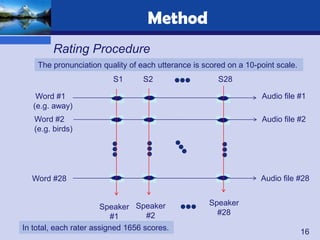
        Rating Procedure
    The pronunciation quality of each utterance is scored on a 10-point scale.
                          S1      S2                   S28

    Word #1                                                        Audio file #1
   (e.g. away)
   Word #2                                                         Audio file #2
   (e.g. birds)


  Word #28                                                         Audio file #28


                                                    Speaker
                        Speaker Speaker
                                    #2                #28
                           #1
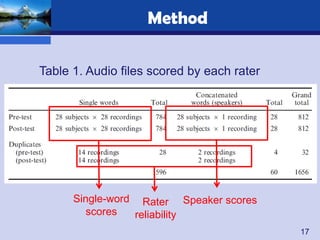
In total, each rater assigned 1656 scores.
                                                                                 16
Method

Table 1. Audio files scored by each rater


      Single-word Rater Speaker scores
         scores  reliability
                                            17
Results

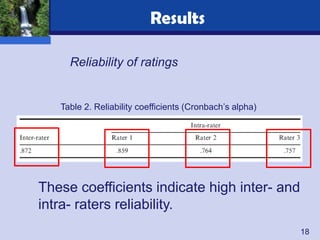
     Reliability of ratings


   Table 2. Reliability coefficients (Cronbach’s alpha)


These coefficients indicate high inter- and
intra- raters reliability.
                                                          18
Results
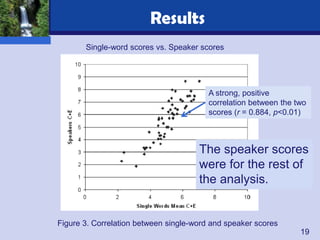
       Single-word scores vs. Speaker scores


                                         A strong, positive
                                         correlation between the two
                                         scores (r = 0.884, p<0.01)


                                      The speaker scores
                                      were for the rest of
                                      the analysis.


Figure 3. Correlation between single-word and speaker scores
                                                                  19
Results
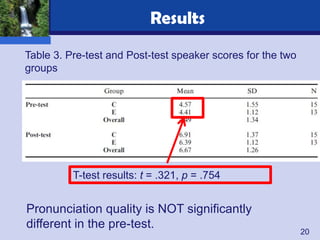
Table 3. Pre-test and Post-test speaker scores for the two
groups


          T-test results: t = .321, p = .754


Pronunciation quality is NOT significantly
different in the pre-test.
                                                             20
Results

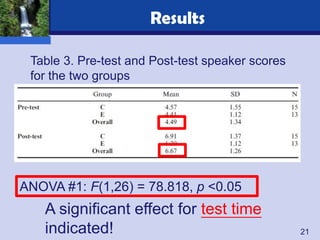
 Table 3. Pre-test and Post-test speaker scores
 for the two groups


ANOVA #1: F(1,26) = 78.818, p <0.05
   A significant effect for test time
   indicated!                                     21
Results

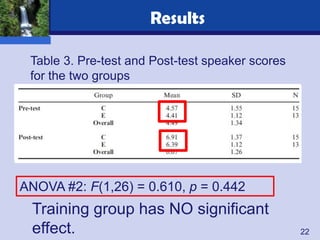
 Table 3. Pre-test and Post-test speaker scores
 for the two groups


ANOVA #2: F(1,26) = 0.610, p = 0.442
 Training group has NO significant
 effect.                                          22
Results

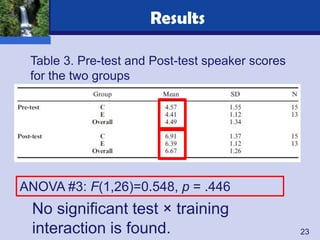
 Table 3. Pre-test and Post-test speaker scores
 for the two groups


ANOVA #3: F(1,26)=0.548, p = .446
 No significant test × training
 interaction is found.                            23
Results
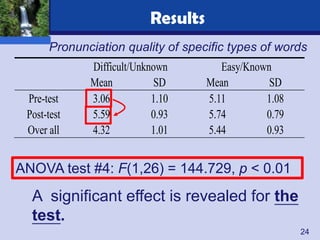
      Pronunciation quality of specific types of words
             Difficult/Unknown         Easy/Known
             Mean          SD       Mean         SD
 Pre-test    3.06          1.10     5.11        1.08
 Post-test   5.59          0.93     5.74        0.79
 Over all    4.32          1.01     5.44        0.93


ANOVA test #4: F(1,26) = 144.729, p < 0.01
  A significant effect is revealed for the
  test.
                                                       24
Results
             Pronunciation quality of specific types of words

                   Difficult/Unknown                Easy/Known
                   Mean          SD              Mean         SD
 Pre-test          3.06          1.10            5.11        1.08
 Post-test         5.59          0.93            5.74        0.79
 Over all          4.32          1.01            5.44        0.93


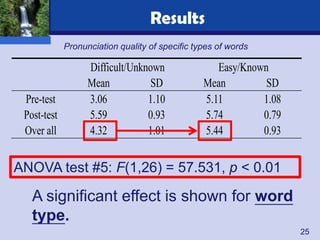
ANOVA test #5: F(1,26) = 57.531, p < 0.01

   A significant effect is shown for word
   type.
                                                                    25
Results
            Pronunciation quality of specific types of words

                  Difficult/Unknown                Easy/Known
                  Mean          SD              Mean         SD
Pre-test          3.06          1.10            5.11        1.08
Post-test         5.59          0.93            5.74        0.79
Over all          4.32          1.01            5.44        0.93

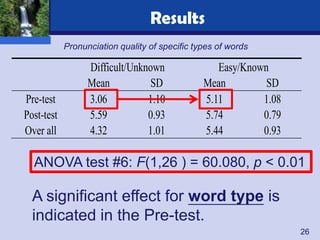
  ANOVA test #6: F(1,26 ) = 60.080, p < 0.01

  A significant effect for word type is
  indicated in the Pre-test.
                                                                   26
Conclusions

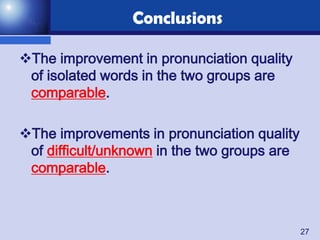
The improvement in pronunciation quality
 of isolated words in the two groups are
 comparable.

The improvements in pronunciation quality
 of difficult/unknown in the two groups are
 comparable.


                                              27
Reflection

If the participants change to college
 students, the material should be carefully
 selected.

The improvement of pronunciation quality
 at sentence level can be one direction for
 future research.

The sample seems to be small.
                                              28
Thank you for listening!


                           29

Presentation劉思竹v4.2 10122608

  • 1.
    The Effectiveness ofComputer Assisted Pronunciation Training for Foreign Language Learning by Children Presenter: Sze-Chu Liu Instructor: Dr. Pi-Ying Teresa Hsu 2102/10/15 1
  • 2.
    Citation Neri, A., Mich,O., Gerosa, M., & Giuliani, D. (2008). The effectiveness of computer assisted pronunciation training for foreign language learning by children. Computer Assisted Language Learning, 21(5), 393- 408. 2
  • 3.
    Outline Introduction The CAPT systemconsidered: PARLING Method Results Conclusions Reflection 3
  • 4.
    Some Abbreviations CAPT =Computer Assisted Pronunciation Training ASR = Automatic Speech Recognition ITC-irst = Istituto Trentino di Cultura – Istituto per la Ricerca Scientifica e Tecnologica 4
  • 5.
    Introduction Accurate perception and production Advantage L1 acquisition over adults hampers L2 Pronunciation training for young learners 5
  • 6.
    Introduction Typical FL The use of learning setting computer Abundant Limited oral exposure spoken examples Rare Self-paced interaction with practice native speakers 6
  • 7.
    Introduction Interactive Role-plays with speech-based the computer games CAPT with ASR Automatic Fun learning feedback experience 7
  • 8.
    Introduction Research questions  Is the effectiveness of CAPT systems for children better than that of teach-led class?  Is CAPT able to help learners to learn pronunciation of difficult words? 8
  • 9.
    The CAPT systemconsidered: PARLING Developed by ITC-irst • Pronunciation quality • Isolated word level Providing automatic feedback • Presentation of oscillograms • Animated characters Meeting the requirements • Match traditional training • Highlight pronouncing isolated words 9
  • 10.
    The CAPT systemconsidered: PARLING The user interface of PARLING: 4 modules 10
  • 11.
    The CAPT systemconsidered: PARLING The ASR component Training Process • Native British English speakers + Italian learners of English Recognization process •Forced time-alignment likelihood (A) •Phone recognition likelihood (B) Decision making • If A>B, respond “accept”; Otherwise, “reject” 11
  • 12.
    Method Participants • Total: 28 Number of • Control group: 15 samples • Experimental group: 13 • 11-year-old Italian native speakers Profile • Same public school • Same curriculum • All had 4 years of English FL Background classes 12
  • 13.
    Method Training Procedure for Control Group Teacher • 4 British teachers Schedule • 4 sessions, 60 minutes for each session • Hansel and Gretel (Englsh version) Material • Printed handout •Teacher-led •read Teaching •explained activities •Provided the correct pronunciation •Prompted to repeat aloud •Played printed word game 13
  • 14.
    Method TrainingProcedure for Experimental Group Teacher • Work with PARLING Schedule • 4 sessions, 30 minutes /session • Hansel and Gretel (Englsih version) Material • Story excerpt shown on screen • Students-driven Teaching • Listened and repeated activities • Repeated a word until permitted • Played a word game 14
  • 15.
    Method Testing Procedure Training Pre-test Post-test Procedure  Children read and record 28 isolated words  Recordings scored by 3 experts  The 28 words were classified as  easy (n = 21)/difficult (n = 7)  known (n = 21)/unknown (n = 7) 15
  • 16.
    Method Rating Procedure The pronunciation quality of each utterance is scored on a 10-point scale. S1 S2 S28 Word #1 Audio file #1 (e.g. away) Word #2 Audio file #2 (e.g. birds) Word #28 Audio file #28 Speaker Speaker Speaker #2 #28 #1 In total, each rater assigned 1656 scores. 16
  • 17.
    Method Table 1. Audiofiles scored by each rater Single-word Rater Speaker scores scores reliability 17
  • 18.
    Results Reliability of ratings Table 2. Reliability coefficients (Cronbach’s alpha) These coefficients indicate high inter- and intra- raters reliability. 18
  • 19.
    Results Single-word scores vs. Speaker scores A strong, positive correlation between the two scores (r = 0.884, p<0.01) The speaker scores were for the rest of the analysis. Figure 3. Correlation between single-word and speaker scores 19
  • 20.
    Results Table 3. Pre-testand Post-test speaker scores for the two groups T-test results: t = .321, p = .754 Pronunciation quality is NOT significantly different in the pre-test. 20
  • 21.
    Results Table 3.Pre-test and Post-test speaker scores for the two groups ANOVA #1: F(1,26) = 78.818, p <0.05 A significant effect for test time indicated! 21
  • 22.
    Results Table 3.Pre-test and Post-test speaker scores for the two groups ANOVA #2: F(1,26) = 0.610, p = 0.442 Training group has NO significant effect. 22
  • 23.
    Results Table 3.Pre-test and Post-test speaker scores for the two groups ANOVA #3: F(1,26)=0.548, p = .446 No significant test × training interaction is found. 23
  • 24.
    Results Pronunciation quality of specific types of words Difficult/Unknown Easy/Known Mean SD Mean SD Pre-test 3.06 1.10 5.11 1.08 Post-test 5.59 0.93 5.74 0.79 Over all 4.32 1.01 5.44 0.93 ANOVA test #4: F(1,26) = 144.729, p < 0.01 A significant effect is revealed for the test. 24
  • 25.
    Results Pronunciation quality of specific types of words Difficult/Unknown Easy/Known Mean SD Mean SD Pre-test 3.06 1.10 5.11 1.08 Post-test 5.59 0.93 5.74 0.79 Over all 4.32 1.01 5.44 0.93 ANOVA test #5: F(1,26) = 57.531, p < 0.01 A significant effect is shown for word type. 25
  • 26.
    Results Pronunciation quality of specific types of words Difficult/Unknown Easy/Known Mean SD Mean SD Pre-test 3.06 1.10 5.11 1.08 Post-test 5.59 0.93 5.74 0.79 Over all 4.32 1.01 5.44 0.93 ANOVA test #6: F(1,26 ) = 60.080, p < 0.01 A significant effect for word type is indicated in the Pre-test. 26
  • 27.
    Conclusions The improvement inpronunciation quality of isolated words in the two groups are comparable. The improvements in pronunciation quality of difficult/unknown in the two groups are comparable. 27
  • 28.
    Reflection If the participantschange to college students, the material should be carefully selected. The improvement of pronunciation quality at sentence level can be one direction for future research. The sample seems to be small. 28
  • 29.
    Thank you forlistening! 29