MADE BY- YATIN TALWAR
991110301
F7
 Routing
 Routing protocols
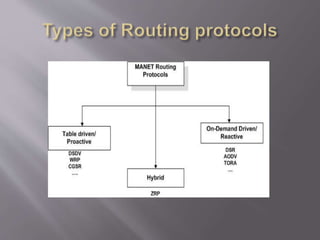
 Types of Routing Protocols
 Wireless Networks
 AODV
 DSR
 Routing is a process of selecting best paths in a
network.
 Routing process directs forwarding(packet) on
the basis of routing tables which maintain the
record of the routes to various network
destinations.
 Routing is performed in different kinds of
networks like telephone network, electronic
data network(such as internet).
1. Reactive protocol(on demand)
- Discover routes when needed.
- Source initiated route discovery.
2. Proactive protocol
- Traditional shortest path protocols
- Based on periodic updates.
 There are two types of wireless networks-
1. Network with fixed infrastructure
2. Ad-hoc wireless networks
 A reactive routing protocol AODV uses
traditional routing tables, one entry per
destination and sequence numbers are used to
determine whether routing information is up-
to-date and to prevent routing loops. Source
broadcasts a route request which contains
source IP address and destination IP address.
Each node forwards packets depending upon
the IP address.
 In AODV routing protocol, there are control
messages used for discovery and breakage of
routes-
1. RREQ
2. RREP
3. RERR
4. HELLO Message
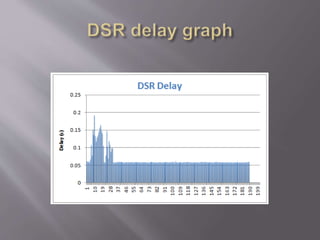
 The key distinguishing feature of DSR is
the use of source routing. That is, the sender
knows the complete hop-by-hop route to
the destination. These routes are stored in a
route cache. The data packets carry the
source route in the packet header. When a
node in the ad hoc network attempts to
send a data packet to a destination for
which it does not already know the route, it
uses a route discovery process to
dynamically determine such a route.
 DSR protocol is divided into two mechanisms
which show the basic operation of DSR.
The two mechanisms are:
1. Route Discovery
2. Route Maintenance
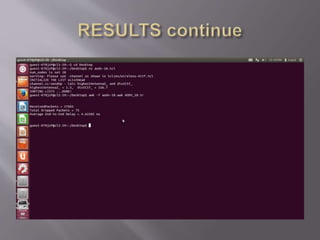
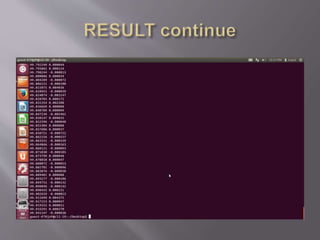
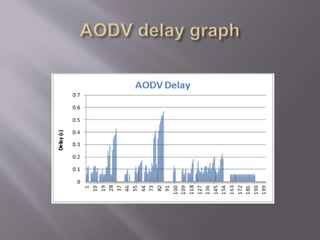
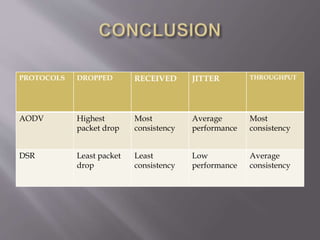
PROTOCOLS DROPPED RECEIVED JITTER THROUGHPUT
AODV Highest
packet drop
Most
consistency
Average
performance
Most
consistency
DSR Least packet
drop
Least
consistency
Low
performance
Average
consistency
THANK
YOU

Presentation2modi

  • 1.
    MADE BY- YATINTALWAR 991110301 F7
  • 2.
     Routing  Routingprotocols  Types of Routing Protocols  Wireless Networks  AODV  DSR
  • 3.
     Routing isa process of selecting best paths in a network.  Routing process directs forwarding(packet) on the basis of routing tables which maintain the record of the routes to various network destinations.  Routing is performed in different kinds of networks like telephone network, electronic data network(such as internet).
  • 4.
    1. Reactive protocol(ondemand) - Discover routes when needed. - Source initiated route discovery. 2. Proactive protocol - Traditional shortest path protocols - Based on periodic updates.
  • 6.
     There aretwo types of wireless networks- 1. Network with fixed infrastructure 2. Ad-hoc wireless networks
  • 7.
     A reactiverouting protocol AODV uses traditional routing tables, one entry per destination and sequence numbers are used to determine whether routing information is up- to-date and to prevent routing loops. Source broadcasts a route request which contains source IP address and destination IP address. Each node forwards packets depending upon the IP address.
  • 8.
     In AODVrouting protocol, there are control messages used for discovery and breakage of routes- 1. RREQ 2. RREP 3. RERR 4. HELLO Message
  • 10.
     The keydistinguishing feature of DSR is the use of source routing. That is, the sender knows the complete hop-by-hop route to the destination. These routes are stored in a route cache. The data packets carry the source route in the packet header. When a node in the ad hoc network attempts to send a data packet to a destination for which it does not already know the route, it uses a route discovery process to dynamically determine such a route.
  • 11.
     DSR protocolis divided into two mechanisms which show the basic operation of DSR. The two mechanisms are: 1. Route Discovery 2. Route Maintenance
  • 18.
    PROTOCOLS DROPPED RECEIVEDJITTER THROUGHPUT AODV Highest packet drop Most consistency Average performance Most consistency DSR Least packet drop Least consistency Low performance Average consistency
  • 19.