RETRENCHMENT STRATEGY
Presented by:
Sajid Khan
12/17/2016
NATIONAL UNIVERSITY OF MODERN LANGUAGES
(Lahore Campus)
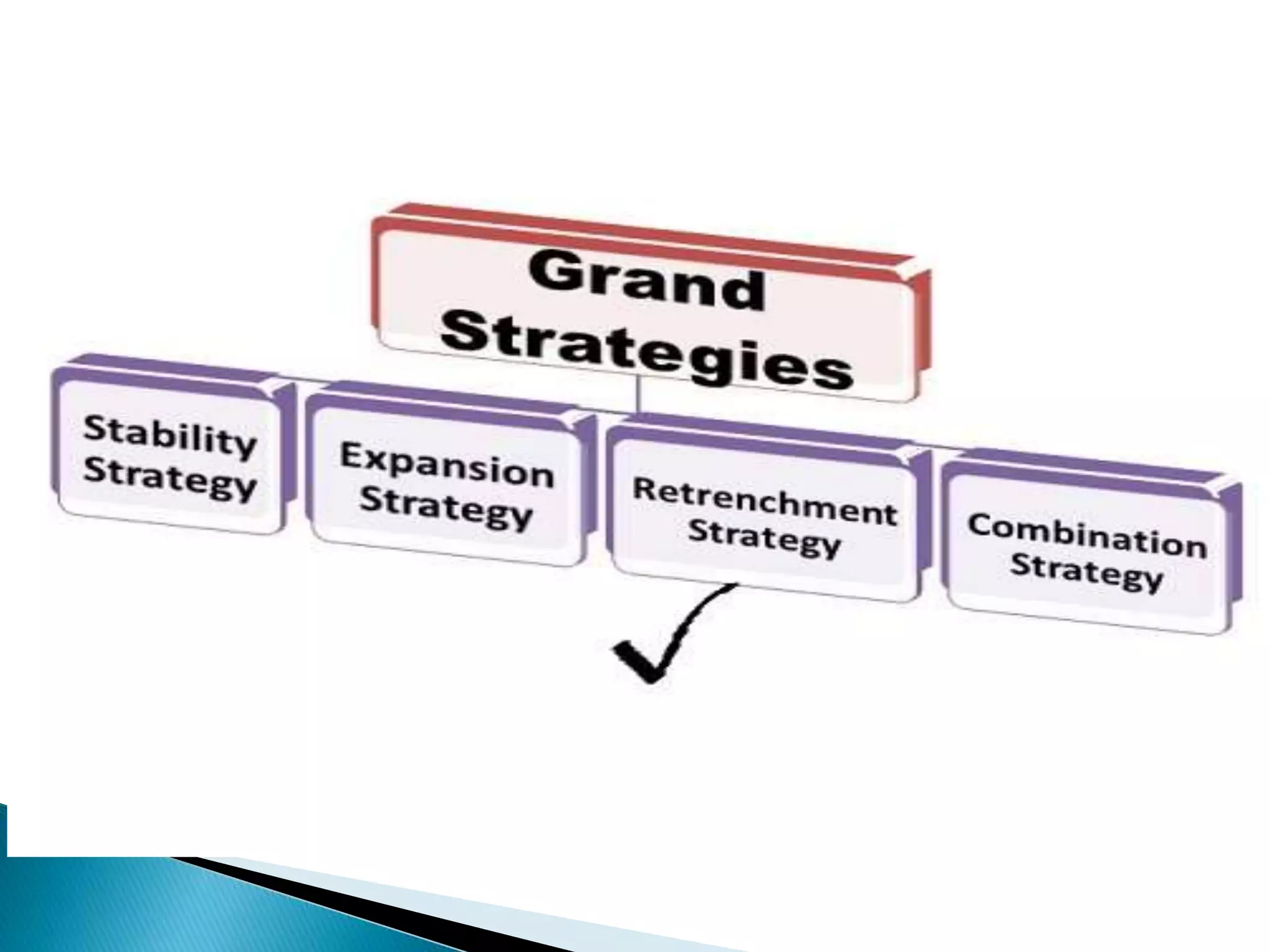
Grand strategies
 The grand strategies are concerned with the
decisions about the allocation and transfer of
resources from one business to the other and
managing the business portfolio efficiently,
such that the overall objective of the
organization is achieved.
 The Grand Strategies are also called as
Master Strategies or Corporate Strategies.
RETRENCHMENT MEANS:
“To cut down or reduce something or to use
resources more carefully”.
RETRENCHMENT STRATEGY:
Retrenchment strategy is followed when an
organization substantially to reduce the scope
of its activities . This is done through an attempt
to find out the problem areas and diagnose the
causes of problems.
when retrenchment strategy is appropriate?
A retrenchment strategy is appropriate in a
situations when a corporation needs to cut
expenses with the goal of becoming financially
stable.
Some of the retrenchment strategies adopted
by an organizations are:
Downsizing
Voluntary retirement Scheme
HR outsourcing
Early retirement plan
DOWNSIZING:
Reduction in organization size & operating
cost implemented by management in order to
improve organizational efficiency.
REASONS OF DOWNSIZING:
Merger & Acquisition
Economic crises
When company goes at loss
Outsourcing
Change in management
VOLUNTARY RETIREMENT SCHEME
A VRS is a package offered to employees as an
incentive to retire earlier than their normal
retirement age also known as GOLD
HANDSHAKE
EMPLOYS ELIGIBILITY FOR VRS:
Employs having 15 years of service or 40 years of
age are eligible to avail this scheme
HUMAN RESOURCE OUTSOURCING:
HR outsourcing is a process in which the human
resource activities of an organizations are
outsourced so as to focus on the organizations
core competencies.
BENEFITS OF HR OUTSOURCING
Cost saving
Time saving
Excellent support
Best technical staff
TYPES OF RETRENCHMENT STRATEGIES
TURNAROUND STRATEGY:
This retrenchment strategy is followed by an
organization when it feels that the decisions
made earlier is wrong and needs to be undone
before it damages the profitability of the
company.
Following are some of the indication which point out that
a turnaround strategy is needed for an organization to
survive these are:
 Continues negative cash flows
 Continues losses
 Declining market share
 Mismanagement
 Deterioration in physical facilities
Thus an organization which faces one or more of these
issues is referred to as Sick Company's
EXAMPLE.
Dell is the best example. In 2006 Dell announced
the cost-cutting measure and to do so it start selling
product directly but unfortunately suffered a loss,
then in 2007 Dell withdrew it direct selling strategy
and start selling computer to retail out & today it is
the second largest retailer in the world.
DIVESTMENT/ DIVESTITURE STRATEGY:
A divestment strategy involves the sale or liquidation of
a portion of a business thus it mean that when an
organization cutoff the loss-making units, divisions,
SBU from its product line then it adopt the divestment
strategy.
REASONS:
Firm is unable to face competition
Persistent negative cash flows from that
particular business
 technological up gradation for that particular
business which cannot afford by the business
LIQUIDATION STRATEGY:
It is the most unpleasant strategy adopted by the
organization which includes selling of its assets
& winding up of the business operations.
REASONS:
Continues losses
Obsolete technology
High competion
Poor management
Any Question???

Presentation2

  • 1.
    RETRENCHMENT STRATEGY Presented by: SajidKhan 12/17/2016 NATIONAL UNIVERSITY OF MODERN LANGUAGES (Lahore Campus)
  • 2.
    Grand strategies  Thegrand strategies are concerned with the decisions about the allocation and transfer of resources from one business to the other and managing the business portfolio efficiently, such that the overall objective of the organization is achieved.  The Grand Strategies are also called as Master Strategies or Corporate Strategies.
  • 4.
    RETRENCHMENT MEANS: “To cutdown or reduce something or to use resources more carefully”. RETRENCHMENT STRATEGY: Retrenchment strategy is followed when an organization substantially to reduce the scope of its activities . This is done through an attempt to find out the problem areas and diagnose the causes of problems.
  • 5.
    when retrenchment strategyis appropriate? A retrenchment strategy is appropriate in a situations when a corporation needs to cut expenses with the goal of becoming financially stable.
  • 6.
    Some of theretrenchment strategies adopted by an organizations are: Downsizing Voluntary retirement Scheme HR outsourcing Early retirement plan
  • 7.
    DOWNSIZING: Reduction in organizationsize & operating cost implemented by management in order to improve organizational efficiency. REASONS OF DOWNSIZING: Merger & Acquisition Economic crises When company goes at loss Outsourcing Change in management
  • 8.
    VOLUNTARY RETIREMENT SCHEME AVRS is a package offered to employees as an incentive to retire earlier than their normal retirement age also known as GOLD HANDSHAKE EMPLOYS ELIGIBILITY FOR VRS: Employs having 15 years of service or 40 years of age are eligible to avail this scheme
  • 9.
    HUMAN RESOURCE OUTSOURCING: HRoutsourcing is a process in which the human resource activities of an organizations are outsourced so as to focus on the organizations core competencies. BENEFITS OF HR OUTSOURCING Cost saving Time saving Excellent support Best technical staff
  • 10.
  • 11.
    TURNAROUND STRATEGY: This retrenchmentstrategy is followed by an organization when it feels that the decisions made earlier is wrong and needs to be undone before it damages the profitability of the company.
  • 12.
    Following are someof the indication which point out that a turnaround strategy is needed for an organization to survive these are:  Continues negative cash flows  Continues losses  Declining market share  Mismanagement  Deterioration in physical facilities Thus an organization which faces one or more of these issues is referred to as Sick Company's
  • 13.
    EXAMPLE. Dell is thebest example. In 2006 Dell announced the cost-cutting measure and to do so it start selling product directly but unfortunately suffered a loss, then in 2007 Dell withdrew it direct selling strategy and start selling computer to retail out & today it is the second largest retailer in the world.
  • 14.
    DIVESTMENT/ DIVESTITURE STRATEGY: Adivestment strategy involves the sale or liquidation of a portion of a business thus it mean that when an organization cutoff the loss-making units, divisions, SBU from its product line then it adopt the divestment strategy. REASONS: Firm is unable to face competition Persistent negative cash flows from that particular business  technological up gradation for that particular business which cannot afford by the business
  • 15.
    LIQUIDATION STRATEGY: It isthe most unpleasant strategy adopted by the organization which includes selling of its assets & winding up of the business operations. REASONS: Continues losses Obsolete technology High competion Poor management
  • 17.