Practical Workforce Development
Recruitment & Retention…..getting it right
John Sauer, University of Minnesota
Disability In-Service
Training Support
Service Inc.
Practical Workforce Development
Recruitment & Retention…..getting it right
John Sauer, Project Coordinator
Research and Training Center,
University of Minnesota
sauer006@umn.edu
November 6, 2008
Interventions
National Training Institute for Frontline
Supervisors and Technical Assistance
Project
Participants
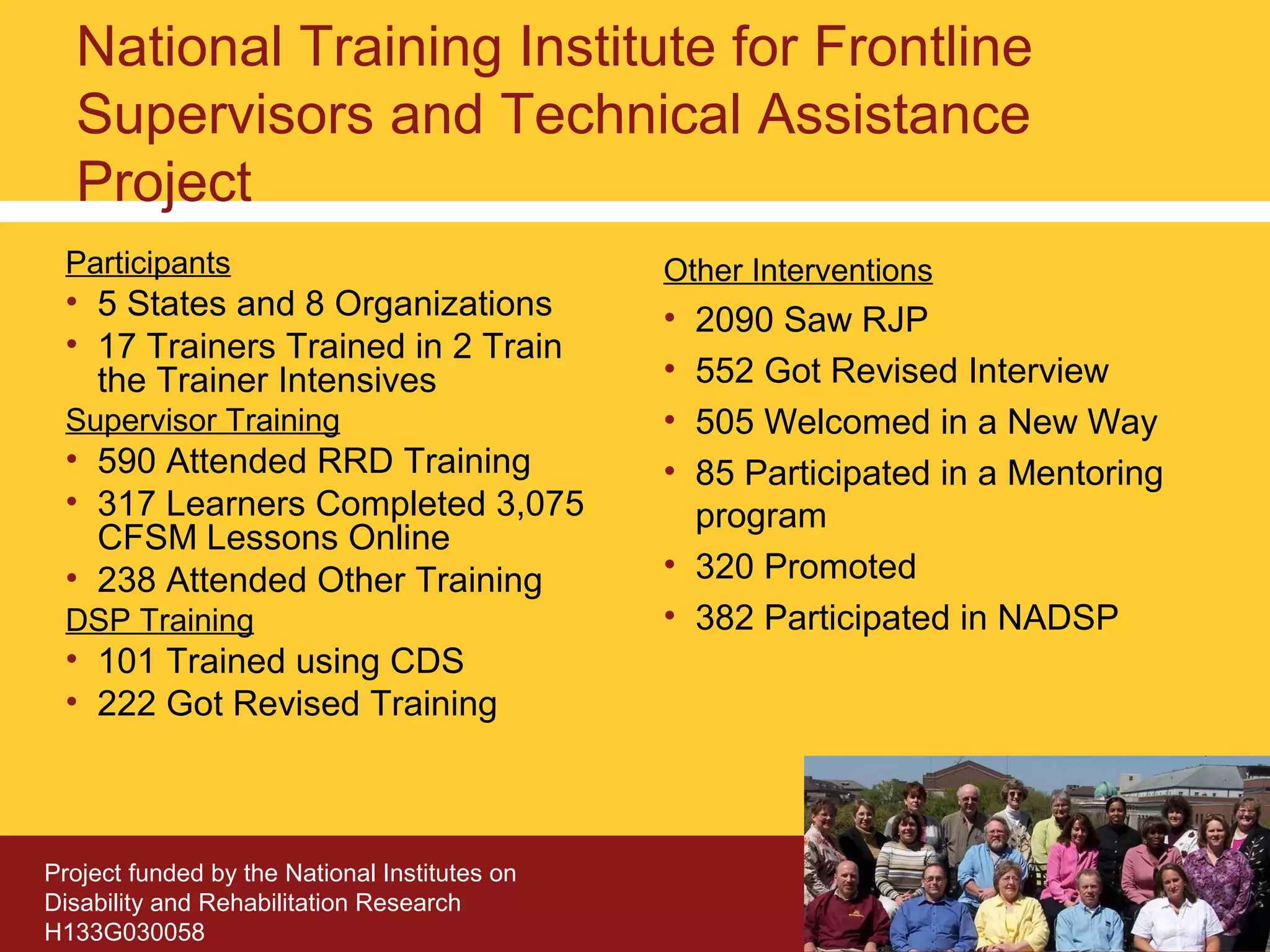
• 5 States and 8 Organizations
• 17 Trainers Trained in 2 Train
the Trainer Intensives
Supervisor Training
• 590 Attended RRD Training
• 317 Learners Completed 3,075
CFSM Lessons Online
• 238 Attended Other Training
DSP Training
• 101 Trained using CDS
• 222 Got Revised Training
Other Interventions
• 2090 Saw RJP
• 552 Got Revised Interview
• 505 Welcomed in a New Way
• 85 Participated in a Mentoring
program
• 320 Promoted
• 382 Participated in NADSP
Project funded by the National Institutes on
Disability and Rehabilitation Research
H133G030058
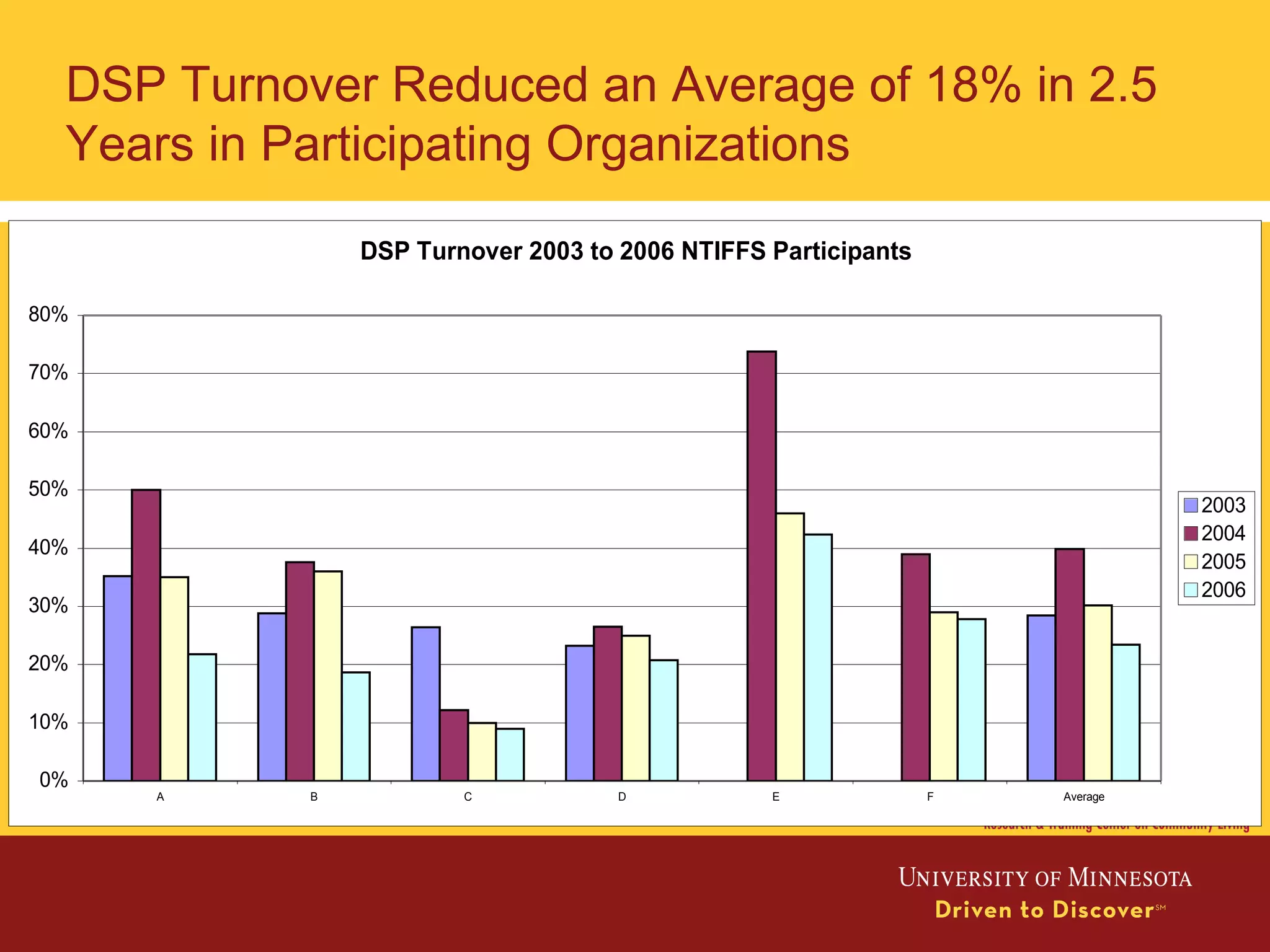
DSP Turnover 2003 to 2006 NTIFFS Participants
0%
10%
20%
30%
40%
50%
60%
70%
80%
A B C D E F Average
2003
2004
2005
2006
DSP Turnover Reduced an Average of 18% in 2.5
Years in Participating Organizations
Moving Mountains: Themes across
high performing organizations
• Learning organizations
• Executive Directors/CEO relied on advice from DSPs
and knew who they were
• Made listening opportunities a part of their routine
• Executive and management staff made it clear by
modeling that they could and would do direct support
• Decision-making authority given to DSPs and site level
supervisors
• Culturally competent
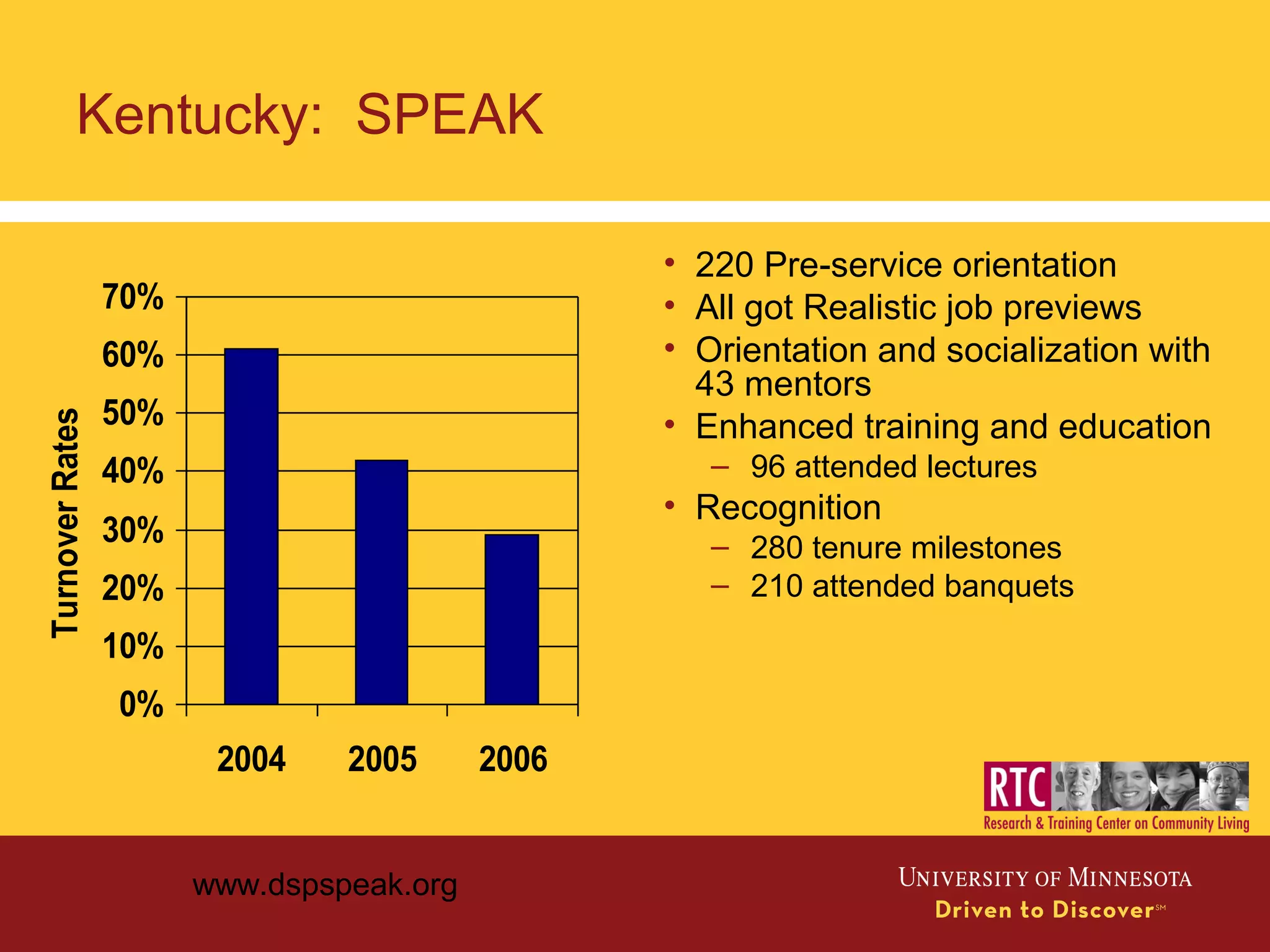
Kentucky: SPEAK
0%
10%
20%
30%
40%
50%
60%
70%
2004 2005 2006
TurnoverRates
• 220 Pre-service orientation
• All got Realistic job previews
• Orientation and socialization with
43 mentors
• Enhanced training and education
– 96 attended lectures
• Recognition
– 280 tenure milestones
– 210 attended banquets
www.dspspeak.org
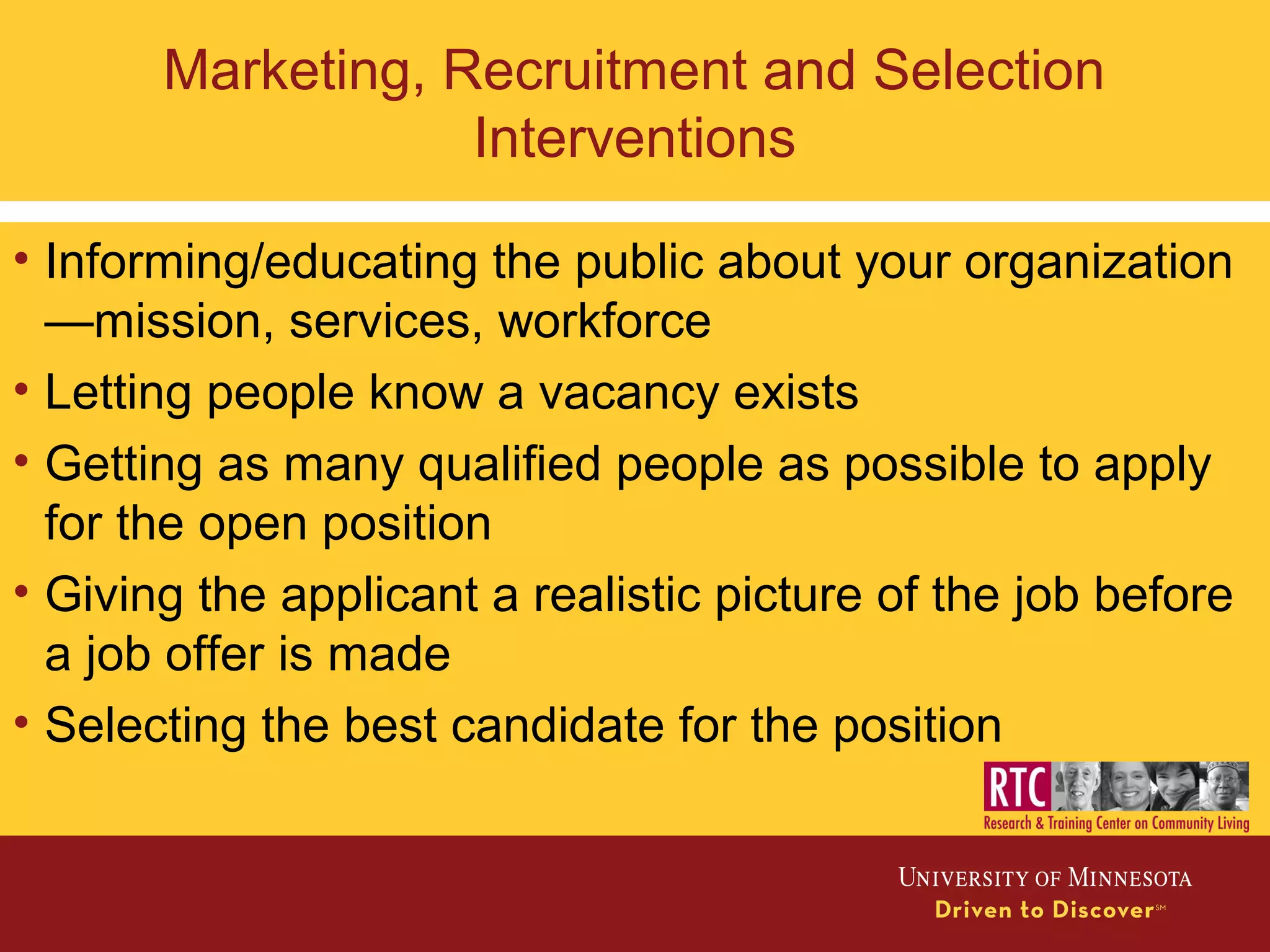
Marketing, Recruitment and Selection
Interventions
• Informing/educating the public about your organization
—mission, services, workforce
• Letting people know a vacancy exists
• Getting as many qualified people as possible to apply
for the open position
• Giving the applicant a realistic picture of the job before
a job offer is made
• Selecting the best candidate for the position
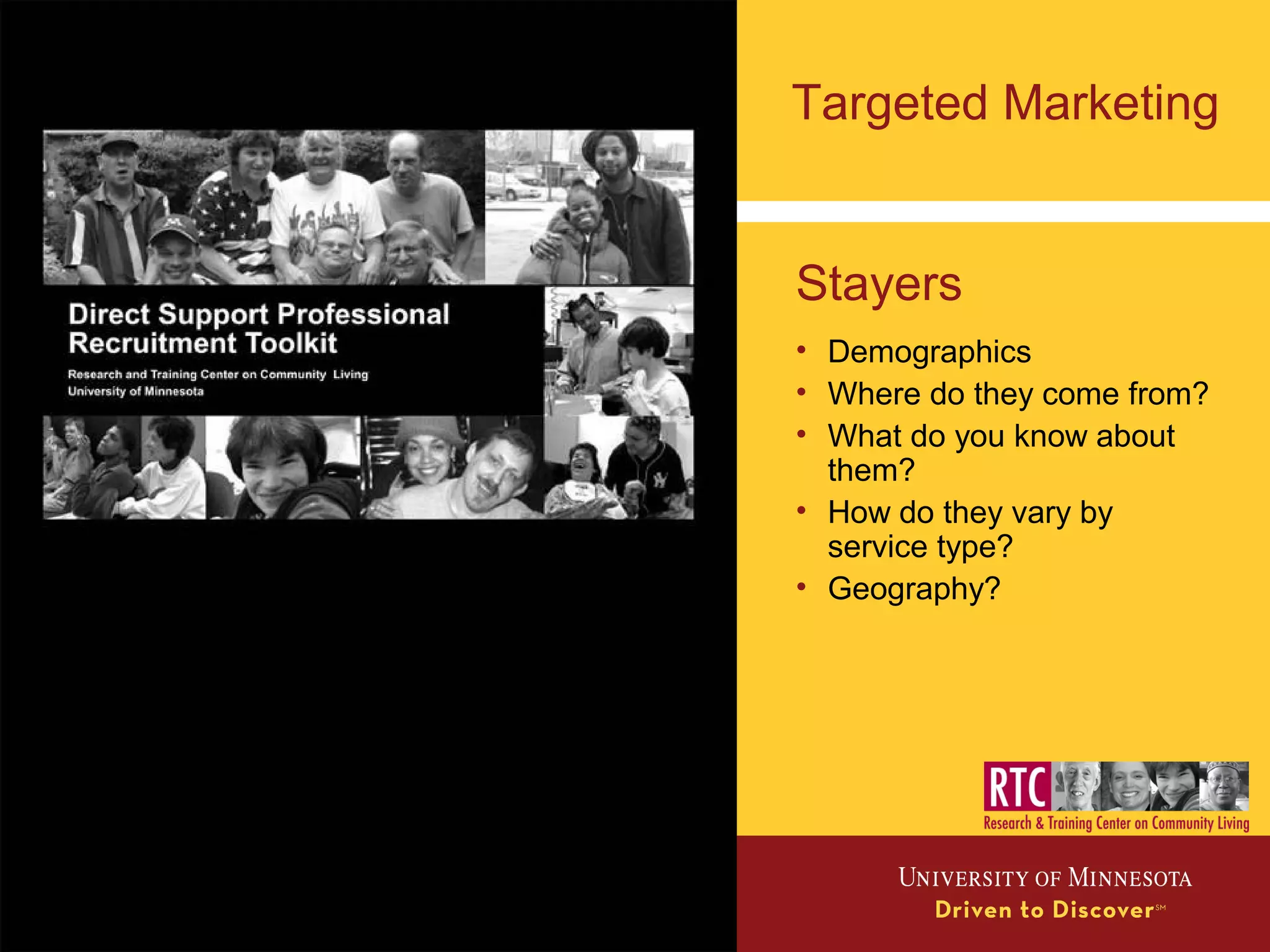
Targeted Marketing
Stayers
• Demographics
• Where do they come from?
• What do you know about
them?
• How do they vary by
service type?
• Geography?
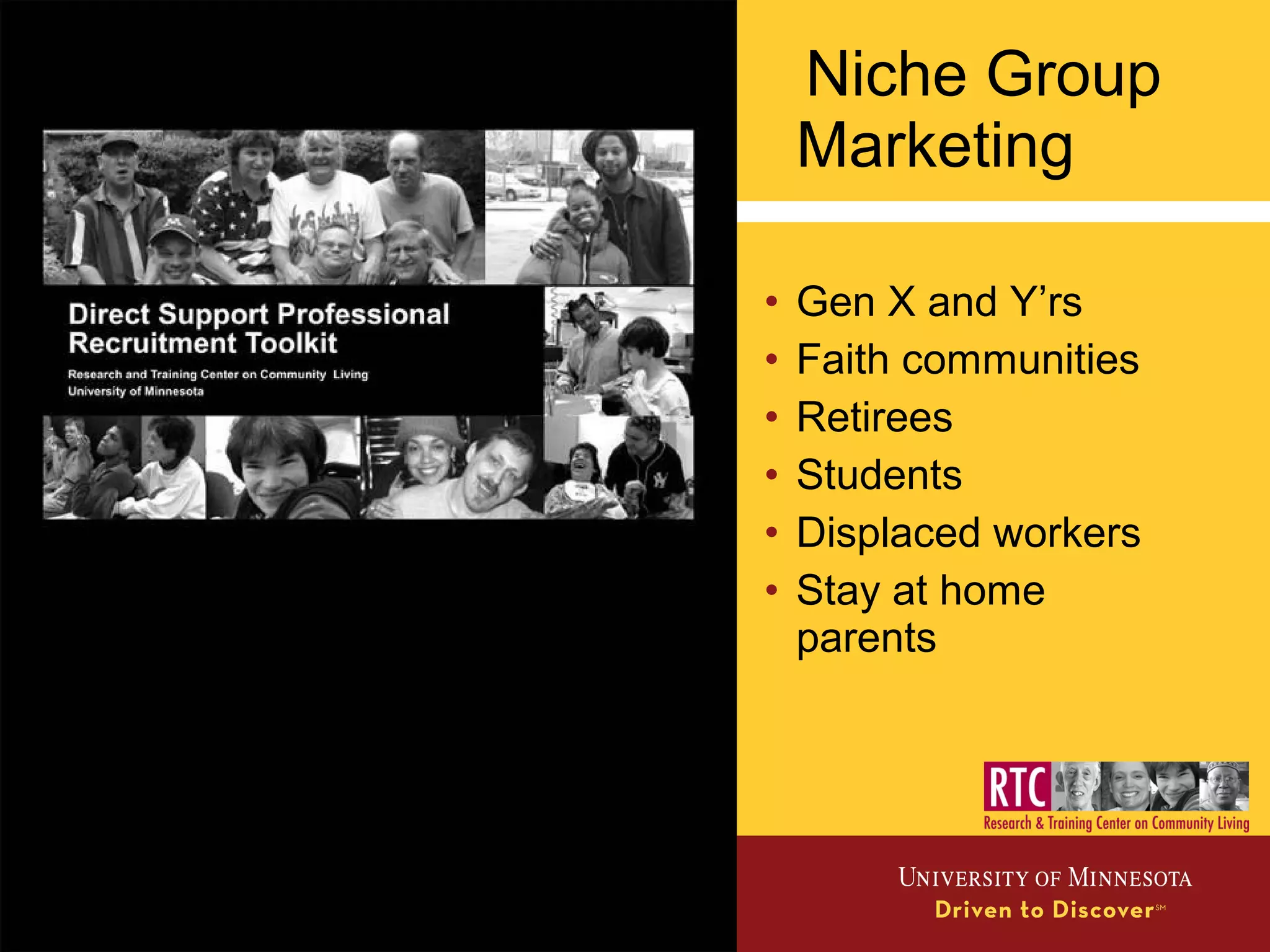
Niche Group
Marketing
• Gen X and Y’rs
• Faith communities
• Retirees
• Students
• Displaced workers
• Stay at home
parents
Small Group Activity
• What are the Benefits of hiring persons from
your niche group?
• Write an ad that would attract potential DSPs
from your niche group
• Where would you post/run your ad?
What is Recruitment?
Recruitment is the process used
by the organization to
• communicate with potential applicants that a
position is available, and
• describe the position so the potential
applicant has an accurate understanding of
the job
(Wanous, 1992)
Examples of Recruitment Sources
Inside sources
• current employees
• people receiving services
and their families or friends
• volunteers
• staff friends
• service coordinators or case
managers
• board members
• people such as consultants
Outside sources
• newspaper advertisements
• Internet ads
• Fliers regarding open
positions
• job boards and placement
offices in high schools and
colleges
What is Selection?
Definition
• The process used to assure good matches between
• The applicant’s
– Skills
– Interests
– Ability to do the job and
• The organization’s
– Job requirements
– Culture and climate
– Commitment to workforce development
Effective Selection Strategies
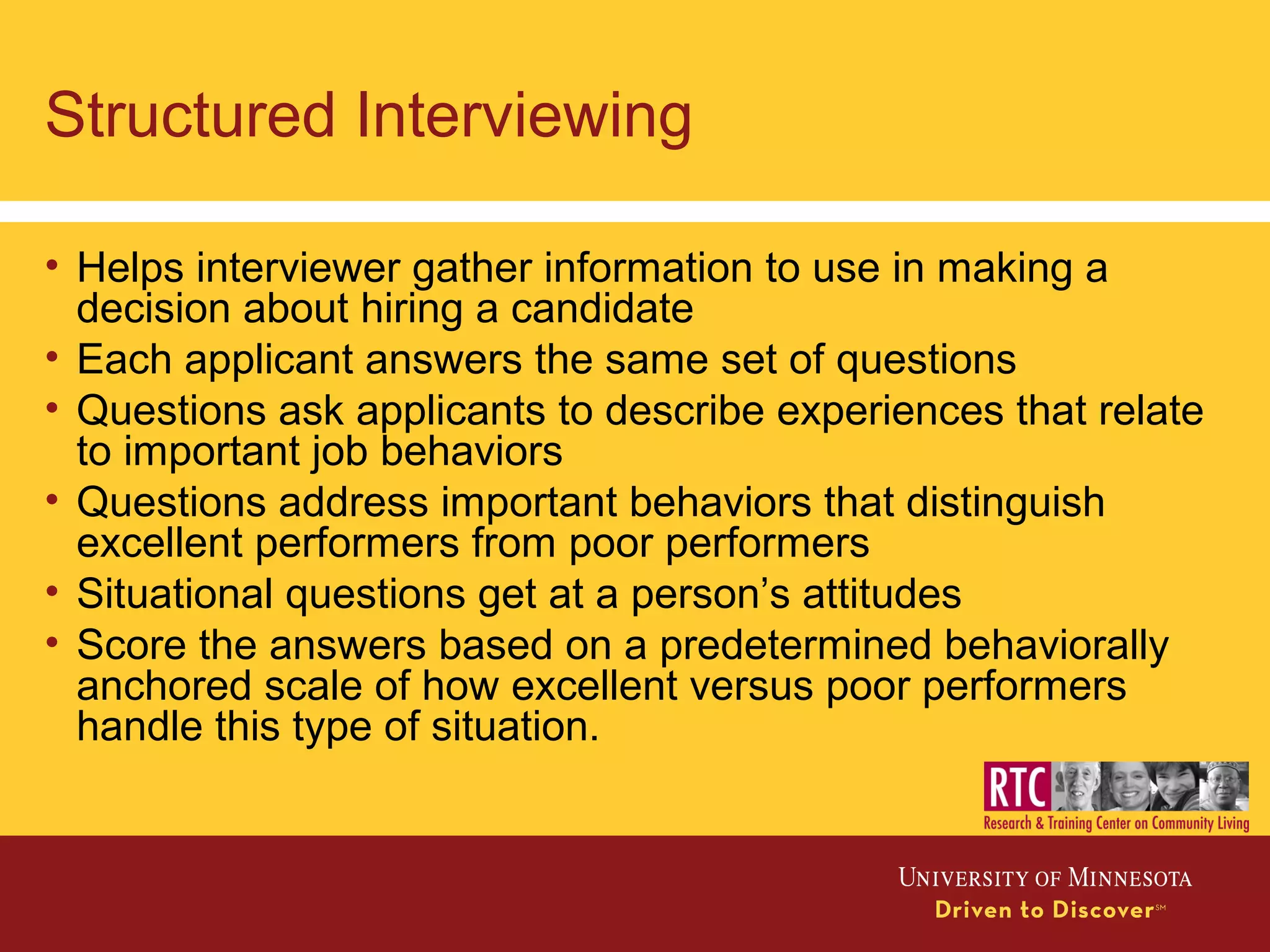
• Structured interviews
• Realistic Job Previews
• Structured observations
• Cognitive ability tests
– Writing exercises
– English proficiency tests (IL)
• Interview with DSPs
• Interview with individuals and family
members
Structured Interviewing
• Helps interviewer gather information to use in making a
decision about hiring a candidate
• Each applicant answers the same set of questions
• Questions ask applicants to describe experiences that relate
to important job behaviors
• Questions address important behaviors that distinguish
excellent performers from poor performers
• Situational questions get at a person’s attitudes
• Score the answers based on a predetermined behaviorally
anchored scale of how excellent versus poor performers
handle this type of situation.
What is one thing you wish you
knew about your job before you
accepted it?
Large Group Reflection
Realistic Job Previews: A definition
Presenting factual, balanced information
to job applicants about the position
and the organization before a job offer
has been made
Characteristics of Effective RJP’s
• Present the RJP early in the application process before a job
offer is made
• Make the purpose of the RJP clear to applicant
• Include viewpoints of individuals receiving supports and their
family members
• Use actual observations of DSPs on the job
• Include information about how current employees view their
jobs
• Balance positive and challenging parts of the job to reflect
actual work requirements and experience
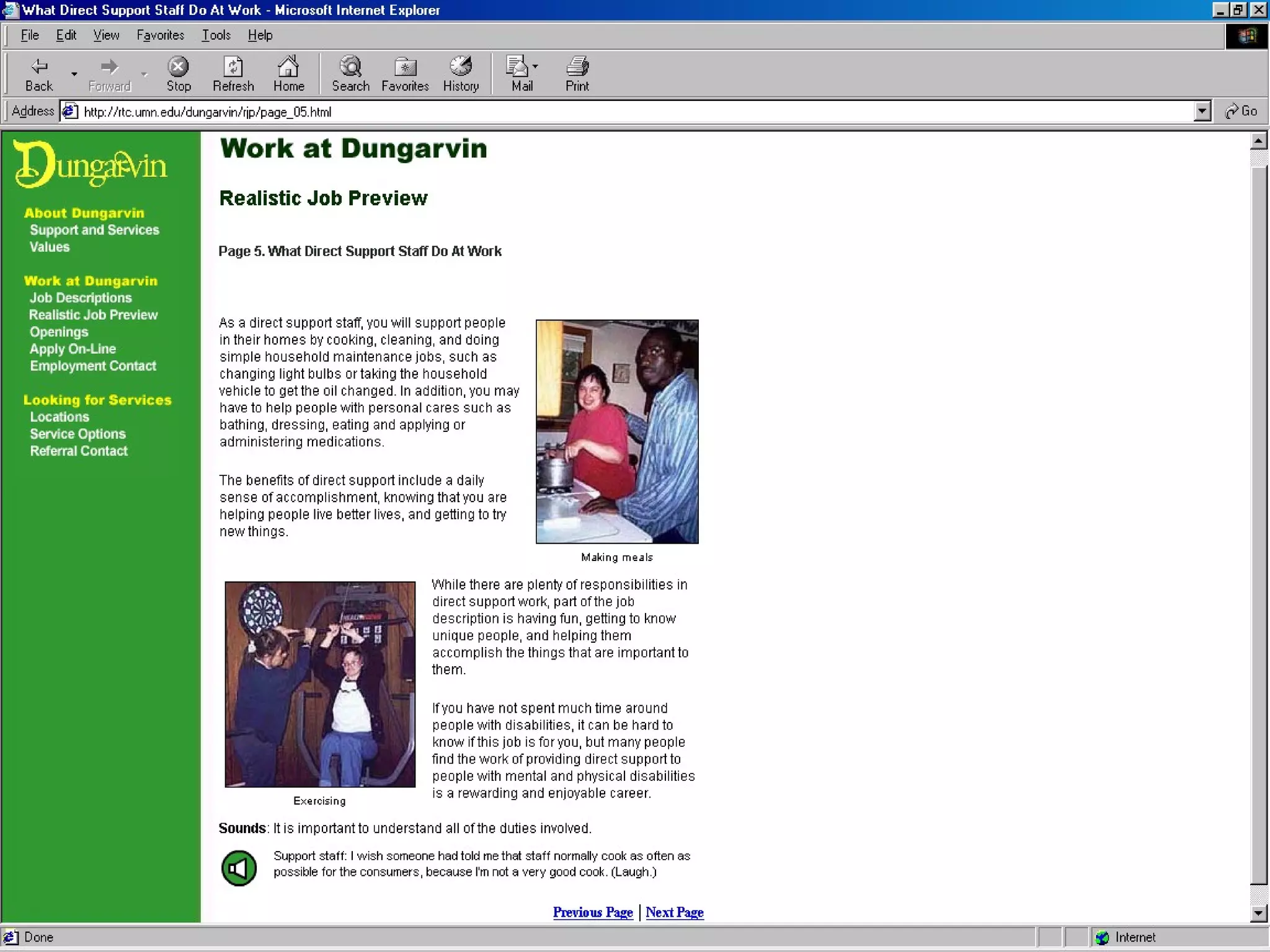
RJP Photo Scrapbooks
Http:/rtc.umn.edu/
dungarvin/rjp
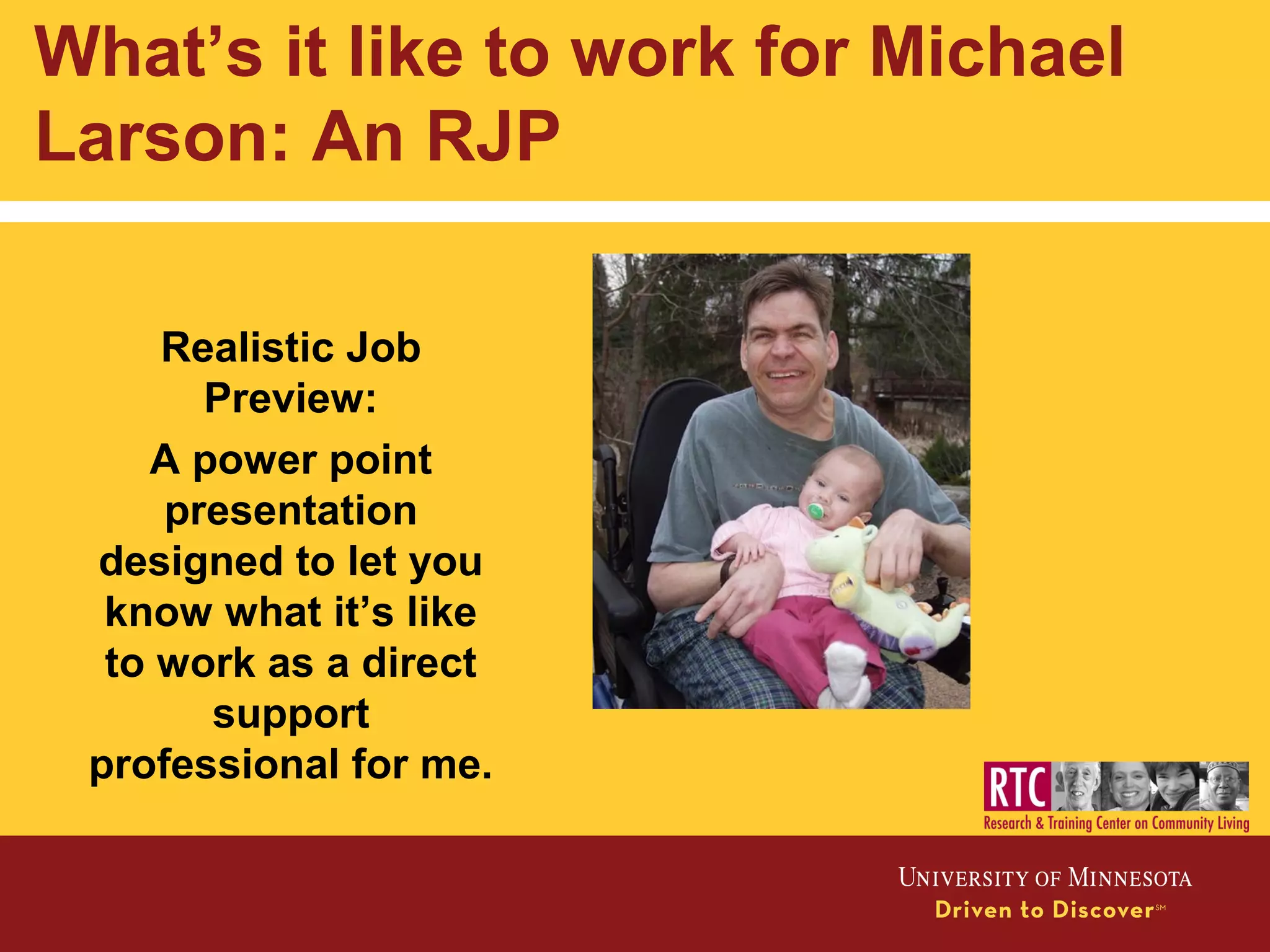
What’s it like to work for Michael
Larson: An RJP
Realistic Job
Preview:
A power point
presentation
designed to let you
know what it’s like
to work as a direct
support
professional for me.
Direct Support:
A realistic job preview
Let’s Review and Rate
this RJP Video

Interventions - Presentation 2 John Sauer MSW and M Ed Institute on Community Integration, University of Minnesota USA November 2008

  • 1.
    Practical Workforce Development Recruitment& Retention…..getting it right John Sauer, University of Minnesota Disability In-Service Training Support Service Inc.
  • 2.
    Practical Workforce Development Recruitment& Retention…..getting it right John Sauer, Project Coordinator Research and Training Center, University of Minnesota sauer006@umn.edu November 6, 2008
  • 3.
  • 4.
    National Training Institutefor Frontline Supervisors and Technical Assistance Project Participants • 5 States and 8 Organizations • 17 Trainers Trained in 2 Train the Trainer Intensives Supervisor Training • 590 Attended RRD Training • 317 Learners Completed 3,075 CFSM Lessons Online • 238 Attended Other Training DSP Training • 101 Trained using CDS • 222 Got Revised Training Other Interventions • 2090 Saw RJP • 552 Got Revised Interview • 505 Welcomed in a New Way • 85 Participated in a Mentoring program • 320 Promoted • 382 Participated in NADSP Project funded by the National Institutes on Disability and Rehabilitation Research H133G030058
  • 5.
    DSP Turnover 2003to 2006 NTIFFS Participants 0% 10% 20% 30% 40% 50% 60% 70% 80% A B C D E F Average 2003 2004 2005 2006 DSP Turnover Reduced an Average of 18% in 2.5 Years in Participating Organizations
  • 6.
    Moving Mountains: Themesacross high performing organizations • Learning organizations • Executive Directors/CEO relied on advice from DSPs and knew who they were • Made listening opportunities a part of their routine • Executive and management staff made it clear by modeling that they could and would do direct support • Decision-making authority given to DSPs and site level supervisors • Culturally competent
  • 7.
    Kentucky: SPEAK 0% 10% 20% 30% 40% 50% 60% 70% 2004 20052006 TurnoverRates • 220 Pre-service orientation • All got Realistic job previews • Orientation and socialization with 43 mentors • Enhanced training and education – 96 attended lectures • Recognition – 280 tenure milestones – 210 attended banquets www.dspspeak.org
  • 8.
    Marketing, Recruitment andSelection Interventions • Informing/educating the public about your organization —mission, services, workforce • Letting people know a vacancy exists • Getting as many qualified people as possible to apply for the open position • Giving the applicant a realistic picture of the job before a job offer is made • Selecting the best candidate for the position
  • 9.
    Targeted Marketing Stayers • Demographics •Where do they come from? • What do you know about them? • How do they vary by service type? • Geography?
  • 10.
    Niche Group Marketing • GenX and Y’rs • Faith communities • Retirees • Students • Displaced workers • Stay at home parents
  • 11.
    Small Group Activity •What are the Benefits of hiring persons from your niche group? • Write an ad that would attract potential DSPs from your niche group • Where would you post/run your ad?
  • 12.
    What is Recruitment? Recruitmentis the process used by the organization to • communicate with potential applicants that a position is available, and • describe the position so the potential applicant has an accurate understanding of the job (Wanous, 1992)
  • 13.
    Examples of RecruitmentSources Inside sources • current employees • people receiving services and their families or friends • volunteers • staff friends • service coordinators or case managers • board members • people such as consultants Outside sources • newspaper advertisements • Internet ads • Fliers regarding open positions • job boards and placement offices in high schools and colleges
  • 14.
    What is Selection? Definition •The process used to assure good matches between • The applicant’s – Skills – Interests – Ability to do the job and • The organization’s – Job requirements – Culture and climate – Commitment to workforce development
  • 15.
    Effective Selection Strategies •Structured interviews • Realistic Job Previews • Structured observations • Cognitive ability tests – Writing exercises – English proficiency tests (IL) • Interview with DSPs • Interview with individuals and family members
  • 16.
    Structured Interviewing • Helpsinterviewer gather information to use in making a decision about hiring a candidate • Each applicant answers the same set of questions • Questions ask applicants to describe experiences that relate to important job behaviors • Questions address important behaviors that distinguish excellent performers from poor performers • Situational questions get at a person’s attitudes • Score the answers based on a predetermined behaviorally anchored scale of how excellent versus poor performers handle this type of situation.
  • 17.
    What is onething you wish you knew about your job before you accepted it? Large Group Reflection
  • 18.
    Realistic Job Previews:A definition Presenting factual, balanced information to job applicants about the position and the organization before a job offer has been made
  • 19.
    Characteristics of EffectiveRJP’s • Present the RJP early in the application process before a job offer is made • Make the purpose of the RJP clear to applicant • Include viewpoints of individuals receiving supports and their family members • Use actual observations of DSPs on the job • Include information about how current employees view their jobs • Balance positive and challenging parts of the job to reflect actual work requirements and experience
  • 20.
  • 21.
  • 22.
    What’s it liketo work for Michael Larson: An RJP Realistic Job Preview: A power point presentation designed to let you know what it’s like to work as a direct support professional for me.
  • 23.
    Direct Support: A realisticjob preview Let’s Review and Rate this RJP Video

Editor's Notes

  • #6 Changes in practices often creates turnover Which is reflected in the numbers - four of the six organizations experienced an increase in turnover in when they began to implement their intervention strategies. The 2006 represents only a half of a years worth of data. Note: This analysis excludes RENEW and SW Wyoming Center who did not complete the project Note: The 2003 average does not include data from organization E or F so may be lower than it would have been if those had been included.
  • #11 Show a copy of Marketing toolkit and review it.
  • #13 Recruitment is the process used by the organization to communicate with potential applicants that a position is available, and describe the position so the potential applicant has an accurate understanding of the job A mismatch between the employee’s job wants and the organizations job climate (the way things are done) can: reduce job satisfaction and organizational commitment which could lead to voluntary quitting (Wanous, 1992)
  • #14 One way to look at sources is: Inside sources=people Outside sources=places Some of the ways to cultivate inside sources include: Involve consumers, families, DSPs, board members and other staff in recruitment efforts Post all jobs internally Promote from within Recruitment bonuses for current staff Hiring bonuses for new hires Develop a recruiting card with info about your organization on it
  • #15 A mismatch between the employee’s skills and the job requirements can lead to Poor performance and termination for unqualified employees Reduced quality of services and increased risk of abuse and neglect Dissatisfaction and voluntary quitting for an overqualified employee
  • #19 Include Information that potential staff are… unlikely to know, or likely to have unrealistic expectations about Examples Hours of work and overtime expectations Characteristics and needs of consumers Required to do certain duties like: cooking, driving, supporting a person with completing their ADLs
  • #20 Make the purpose of the RJP clear to applicant (e.g., to help people decide whether to take the job if offered) Use actual observations (e.g., direct observation of meals or interviews with current staff) Include information about how current employees view about their jobs (e.g., participation in interview or videotape) Balance positive and negative information to reflect actual experience (use a script if you do this in the interview) Present the RJP early in the application process Job Features to highlight Coworker characteristics Consumer characteristics Opportunities to do fun things Salary, benefits and paid leave Hours and scheduling practices Typical duties and routines Staff training opportunities Supervisory style Difficult or unpleasant tasks assisting with personal care caring for medical needs supporting people w/challenging behavior providing transportation physically demanding work cooking and paper work Promotional opportunities Positive features of the job
  • #23 This is really John Smith. I wonder why he wanted to change his name for this piece; no one would believe that John Smith is his real name. This idea for a power point came as a result of our new product, find, choose, and keep great DSPs, which we will talk about at the end with the section on consumer-directed intervention strategies. These are only a few slides about working with John who
  • #24 We will show the RTC-developed RJP video at the end of this section on Realistic Job Previews.