THE
MOST SIGNIFICANT CHANGE
(MSC) TECHNIQUE
RARE, 2013 - Assessment Task 2
A dialogical approach to information
gathering for monitoring and evaluation.
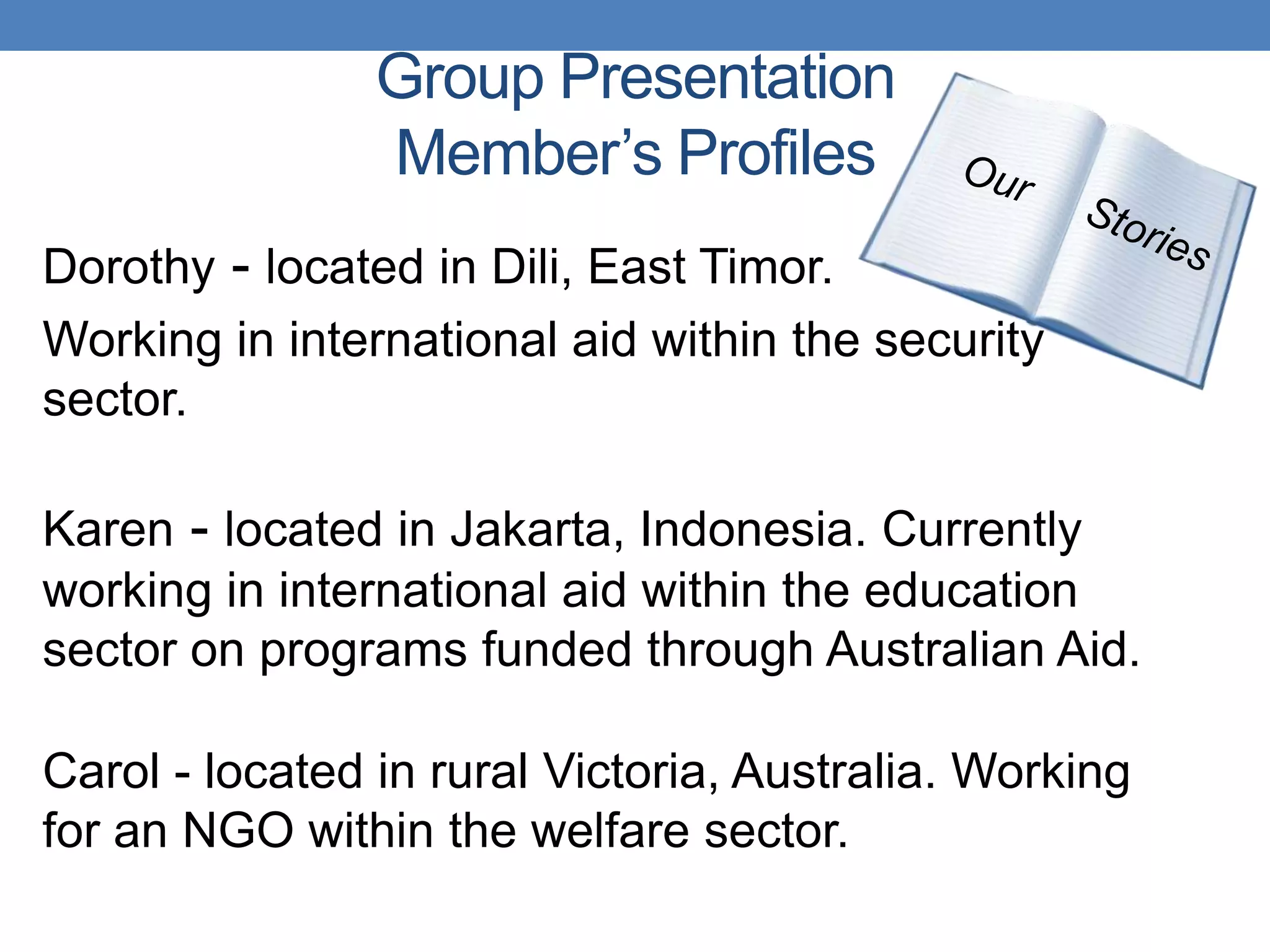
Group Presentation
Member‟s Profiles
Dorothy - located in Dili, East Timor.
Working in international aid within the security
sector.
Karen - located in Jakarta, Indonesia. Currently
working in international aid within the education
sector on programs funded through Australian Aid.
Carol - located in rural Victoria, Australia. Working
for an NGO within the welfare sector.
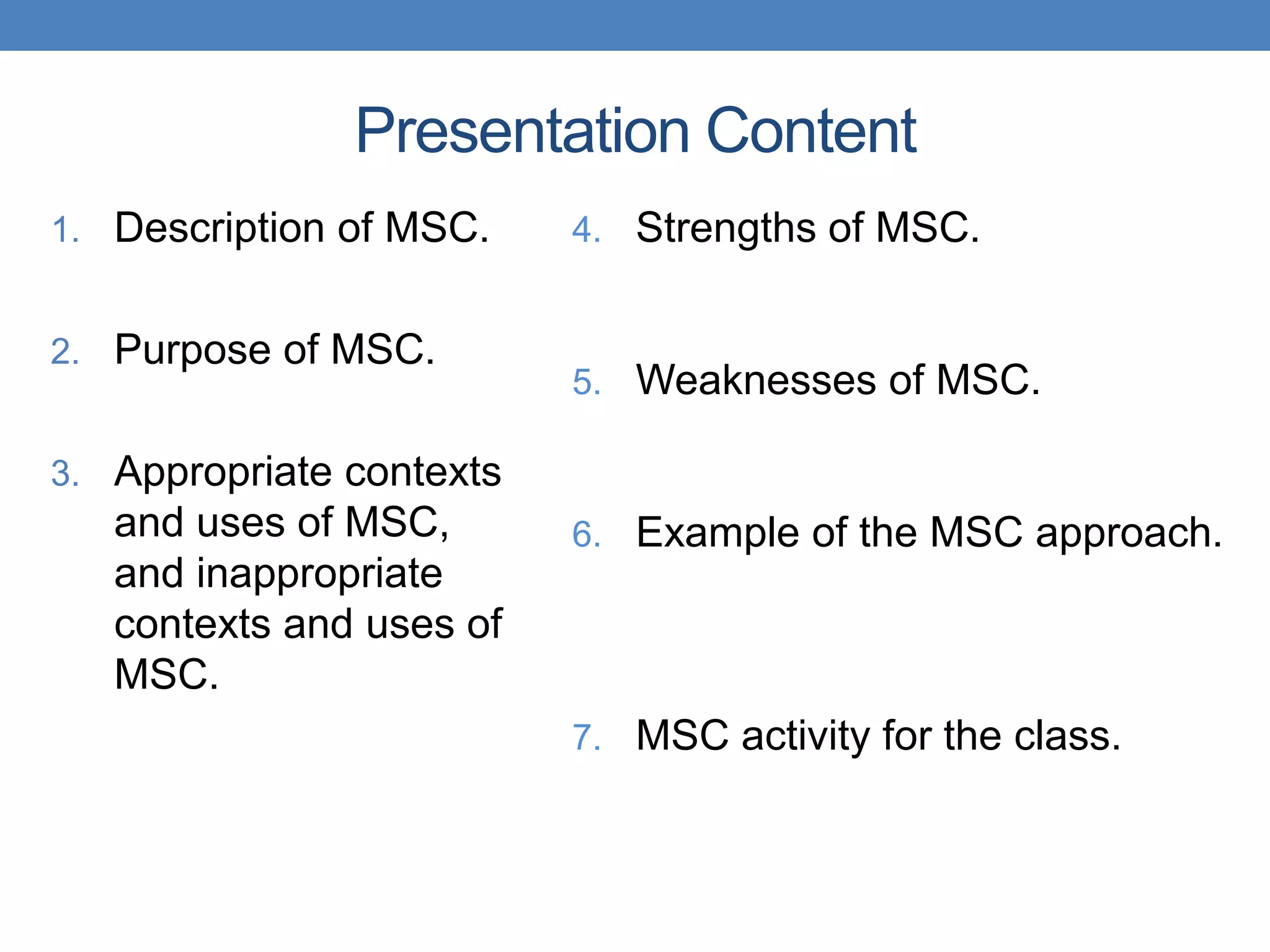
Presentation Content
1. Description of MSC.
2. Purpose of MSC.
3. Appropriate contexts
and uses of MSC,
and inappropriate
contexts and uses of
MSC.
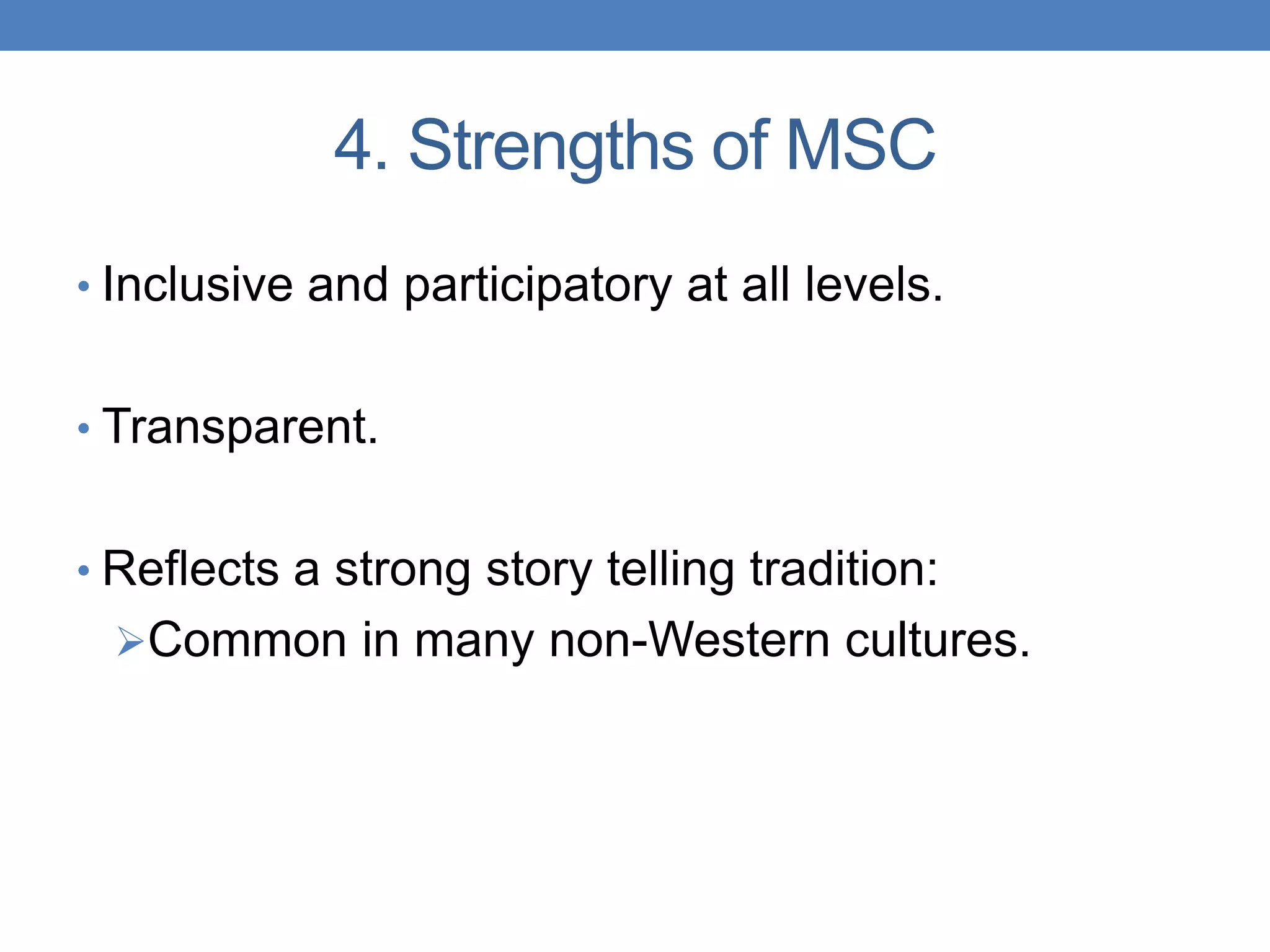
4. Strengths of MSC.
5. Weaknesses of MSC.
6. Example of the MSC approach.
7. MSC activity for the class.
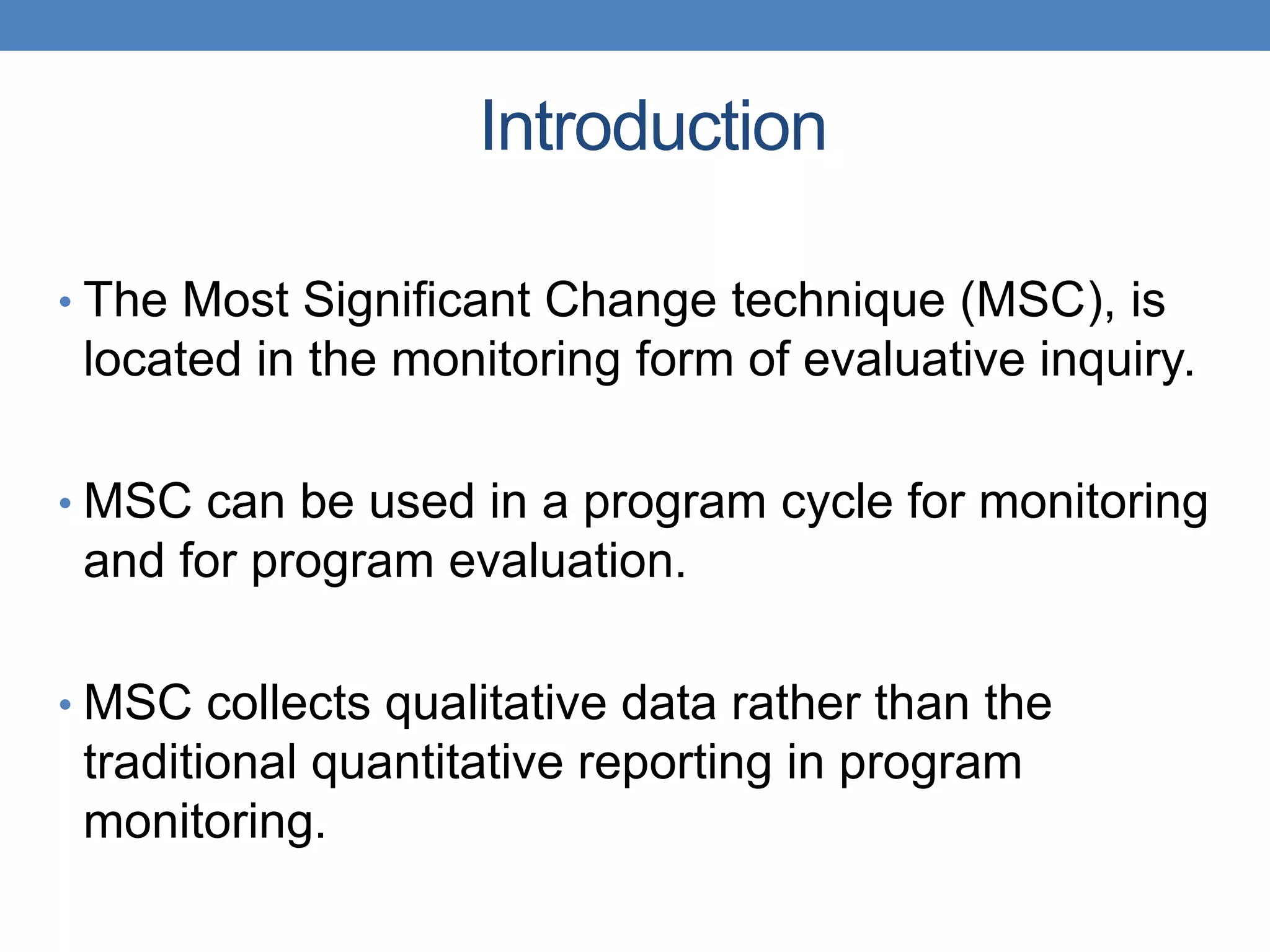
Introduction
• The Most Significant Change technique (MSC), is
located in the monitoring form of evaluative inquiry.
• MSC can be used in a program cycle for monitoring
and for program evaluation.
• MSC collects qualitative data rather than the
traditional quantitative reporting in program
monitoring.
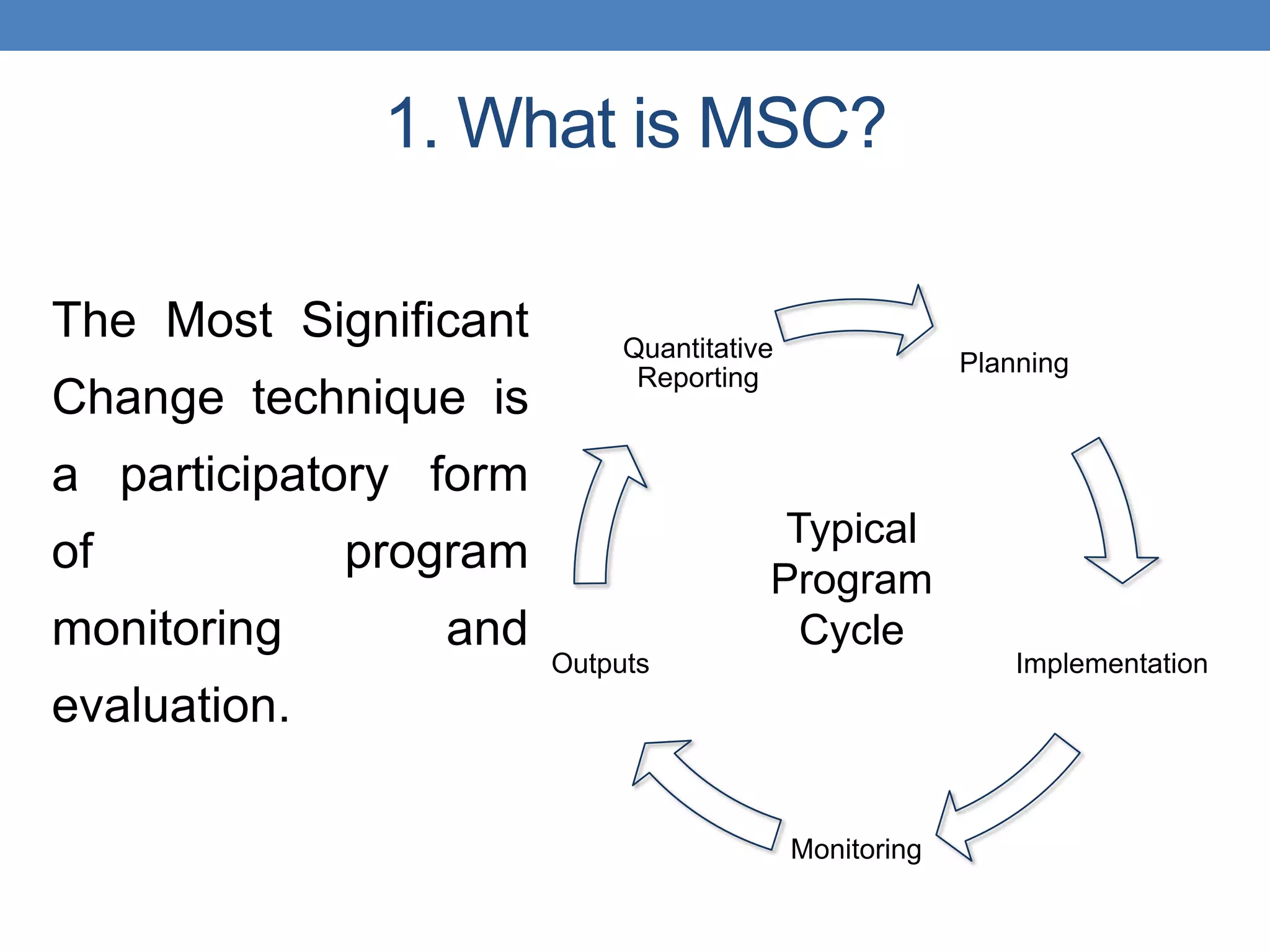
1. What is MSC?
Planning
Implementation
Monitoring
Outputs
Quantitative
Reporting
The Most Significant
Change technique is
a participatory form
of program
monitoring and
evaluation.
Typical
Program
Cycle
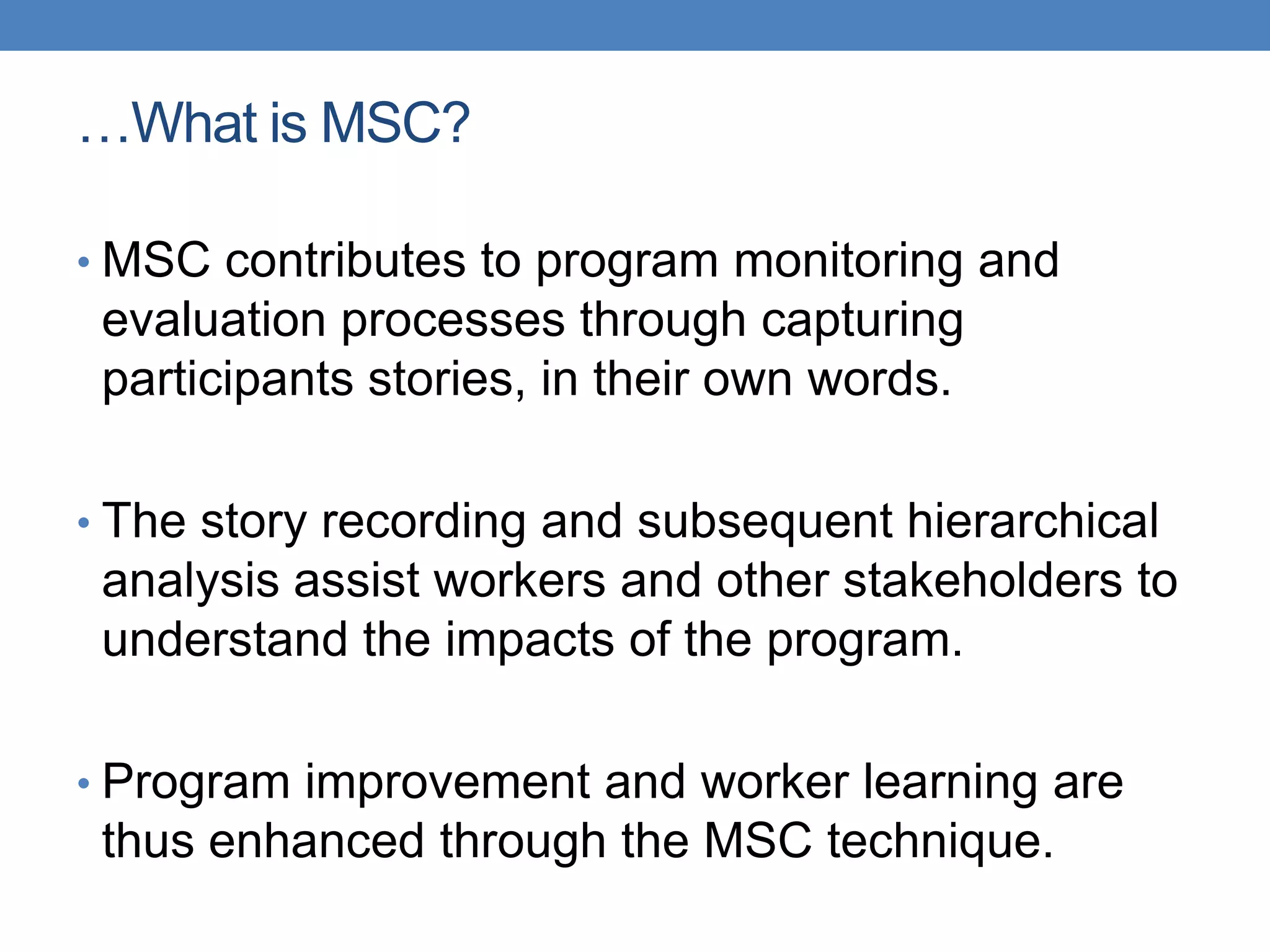
…What is MSC?
• MSC contributes to program monitoring and
evaluation processes through capturing
participants stories, in their own words.
• The story recording and subsequent hierarchical
analysis assist workers and other stakeholders to
understand the impacts of the program.
• Program improvement and worker learning are
thus enhanced through the MSC technique.
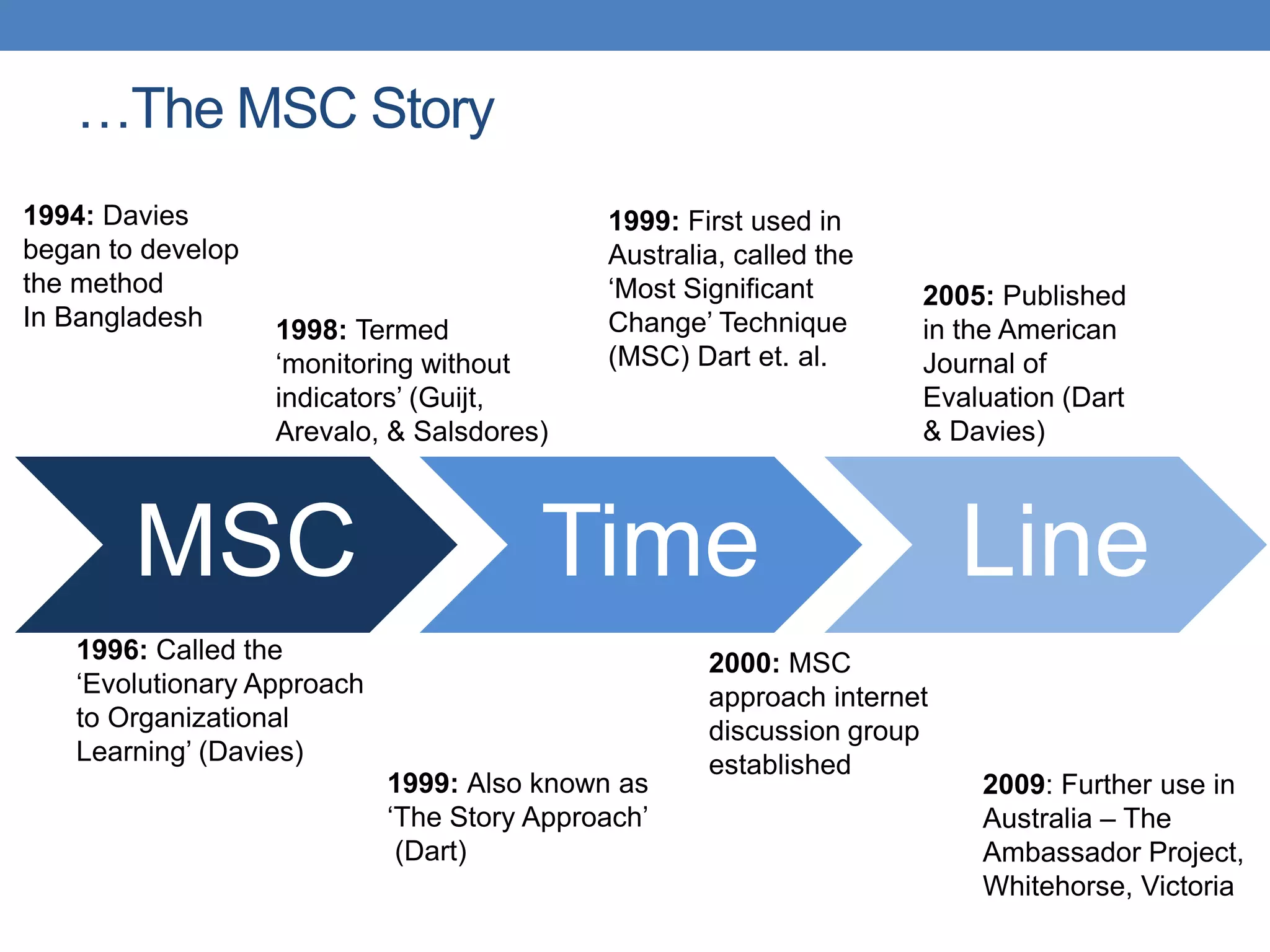
…The MSC Story
MSC Time Line
1994: Davies
began to develop
the method
In Bangladesh
1996: Called the
„Evolutionary Approach
to Organizational
Learning‟ (Davies)
1998: Termed
„monitoring without
indicators‟ (Guijt,
Arevalo, & Salsdores)
1999: Also known as
„The Story Approach‟
(Dart)
1999: First used in
Australia, called the
„Most Significant
Change‟ Technique
(MSC) Dart et. al.
2009: Further use in
Australia – The
Ambassador Project,
Whitehorse, Victoria
2000: MSC
approach internet
discussion group
established
2005: Published
in the American
Journal of
Evaluation (Dart
& Davies)
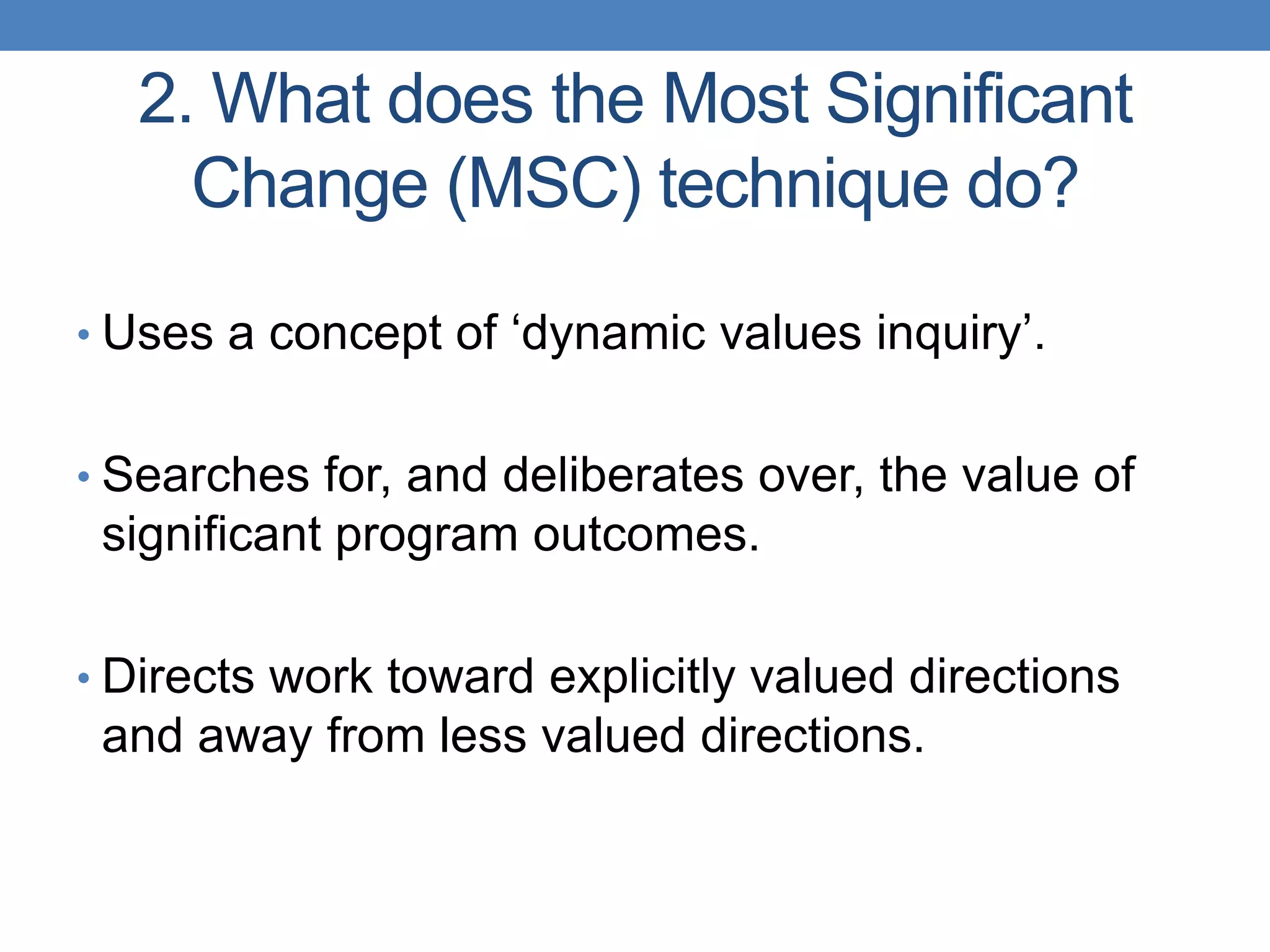
2. What does the Most Significant
Change (MSC) technique do?
• Uses a concept of „dynamic values inquiry‟.
• Searches for, and deliberates over, the value of
significant program outcomes.
• Directs work toward explicitly valued directions
and away from less valued directions.
…Collecting SC Stories
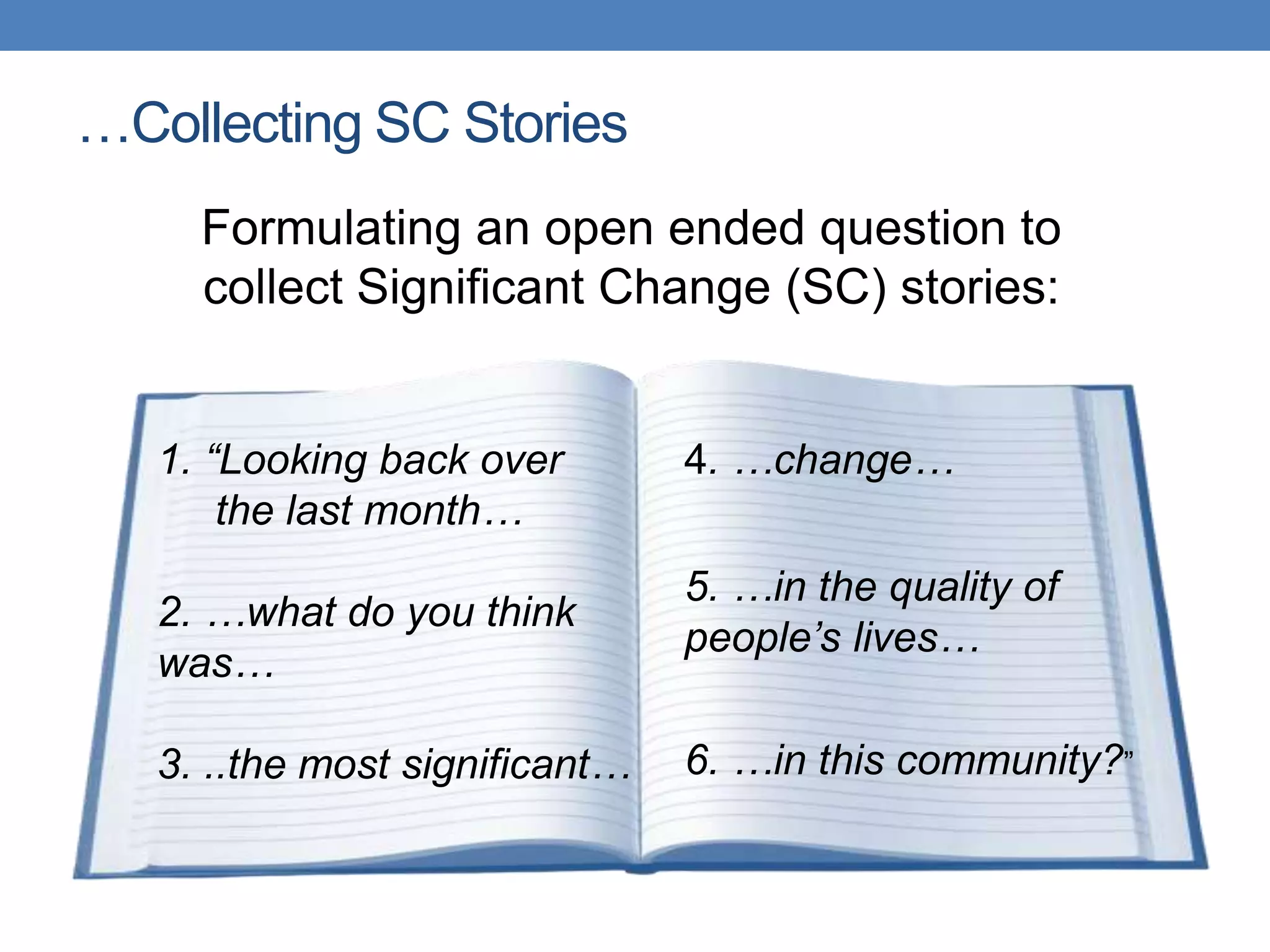
Formulating an open ended question to
collect Significant Change (SC) stories:
1. “Looking back over
the last month…
2. …what do you think
was…
3. ..the most significant…
4. …change…
5. …in the quality of
people’s lives…
6. …in this community?”
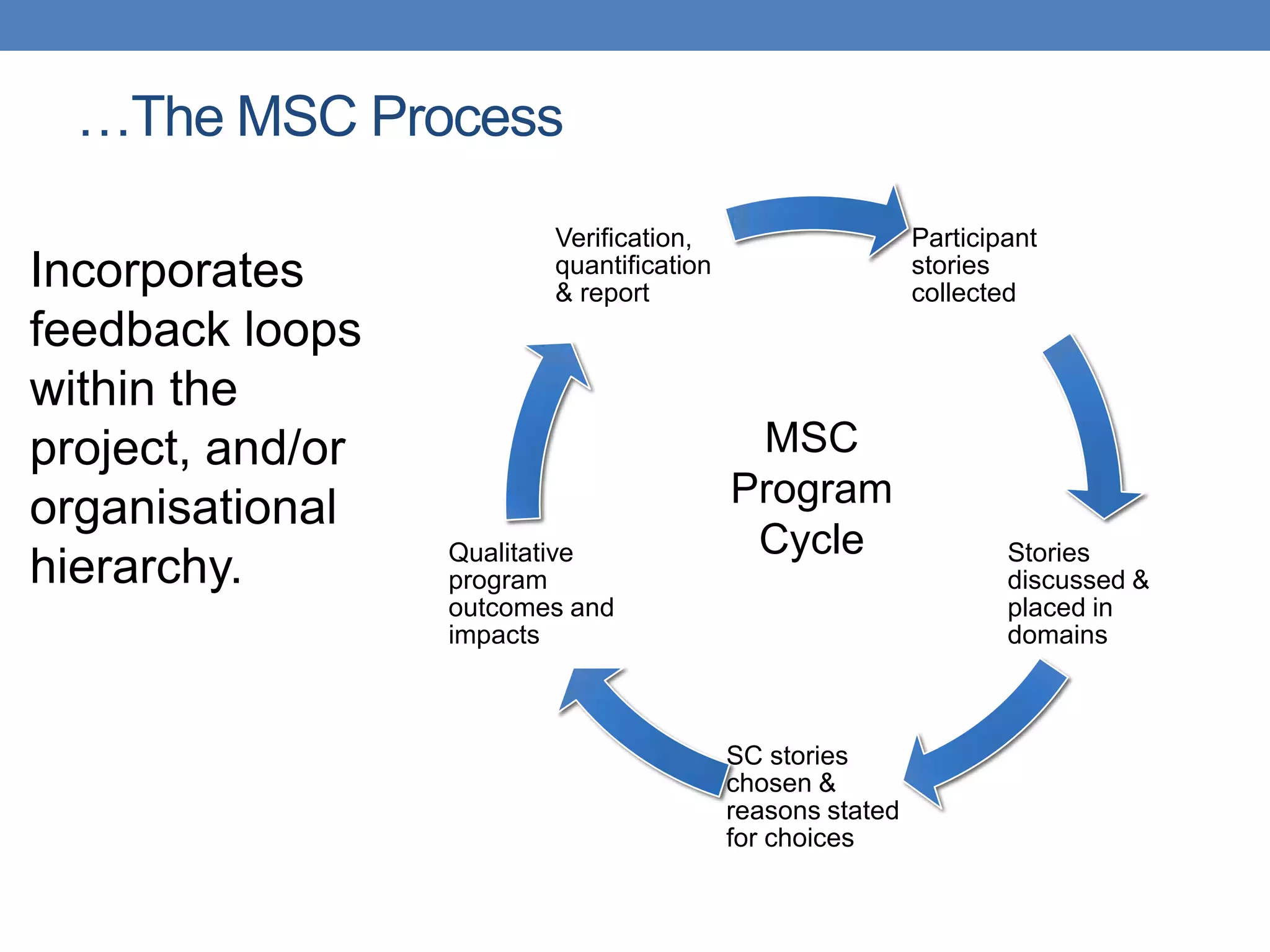
…The MSC Process
Participant
stories
collected
Stories
discussed &
placed in
domains
SC stories
chosen &
reasons stated
for choices
Qualitative
program
outcomes and
impacts
Verification,
quantification
& report
MSC
Program
Cycle
Incorporates
feedback loops
within the
project, and/or
organisational
hierarchy.
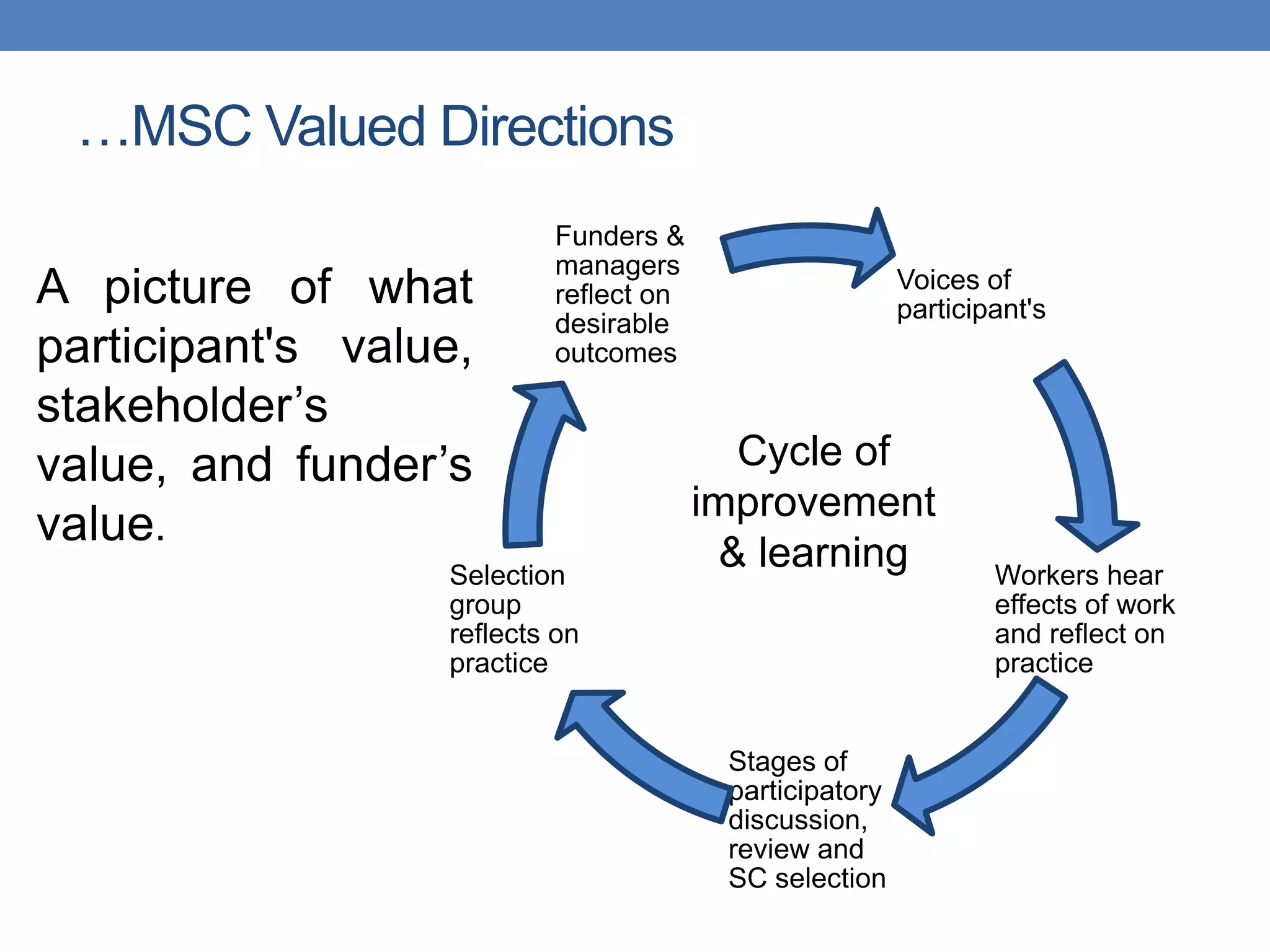
…MSC Valued Directions
Voices of
participant's
Workers hear
effects of work
and reflect on
practice
Stages of
participatory
discussion,
review and
SC selection
Selection
group
reflects on
practice
Funders &
managers
reflect on
desirable
outcomes
A picture of what
participant's value,
stakeholder‟s
value, and funder‟s
value.
Cycle of
improvement
& learning
3. Where does MSC fit?
Introduction
• The evaluator must always choose approaches
and methods which are the most appropriate for
the situation.
• MSC implementation can be adapted to suit
some situation specific characteristics.
• However, MSC is more useful and better aligned
to certain contexts than others.
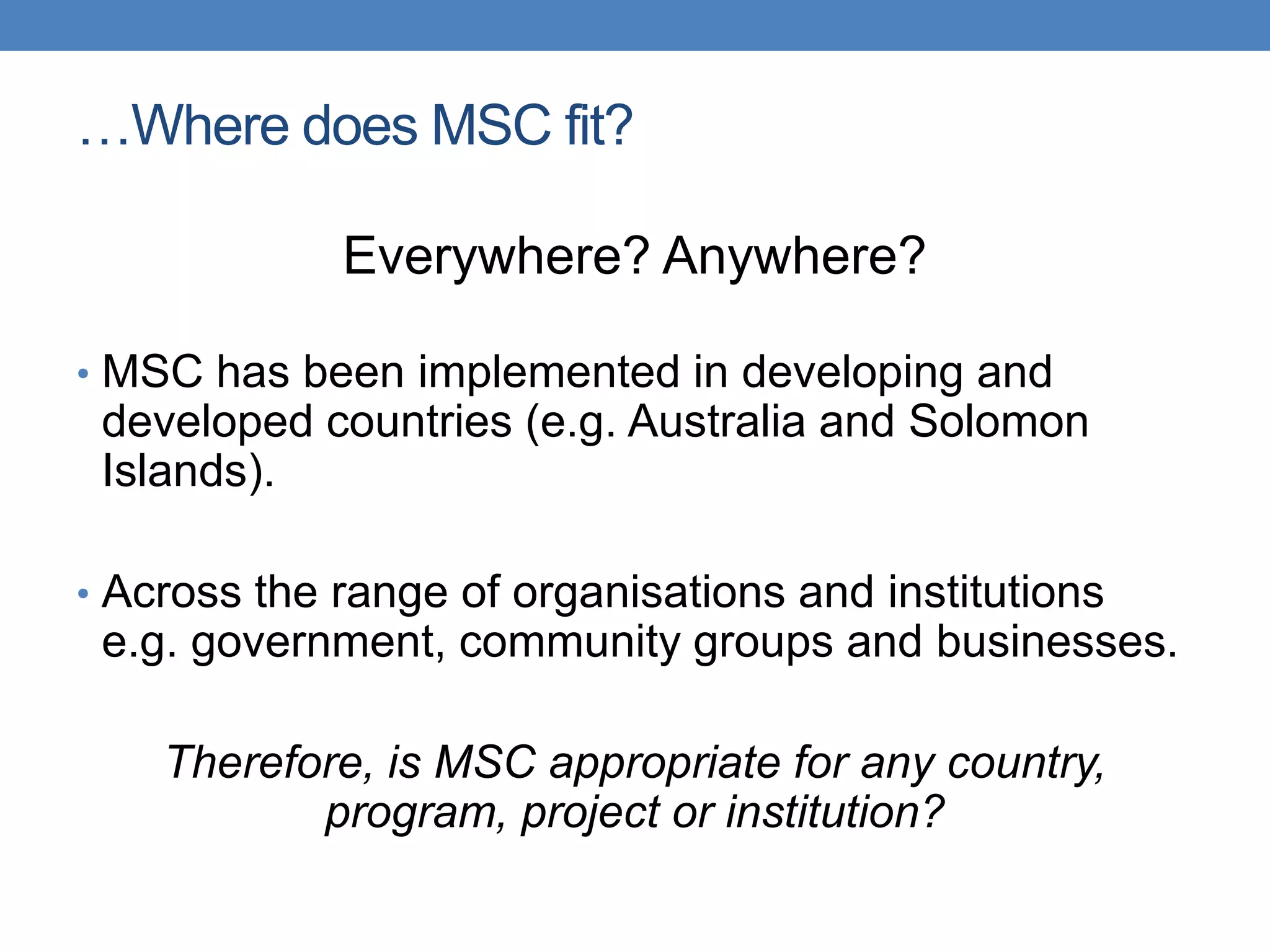
…Where does MSC fit?
Everywhere? Anywhere?
• MSC has been implemented in developing and
developed countries (e.g. Australia and Solomon
Islands).
• Across the range of organisations and institutions
e.g. government, community groups and businesses.
Therefore, is MSC appropriate for any country,
program, project or institution?
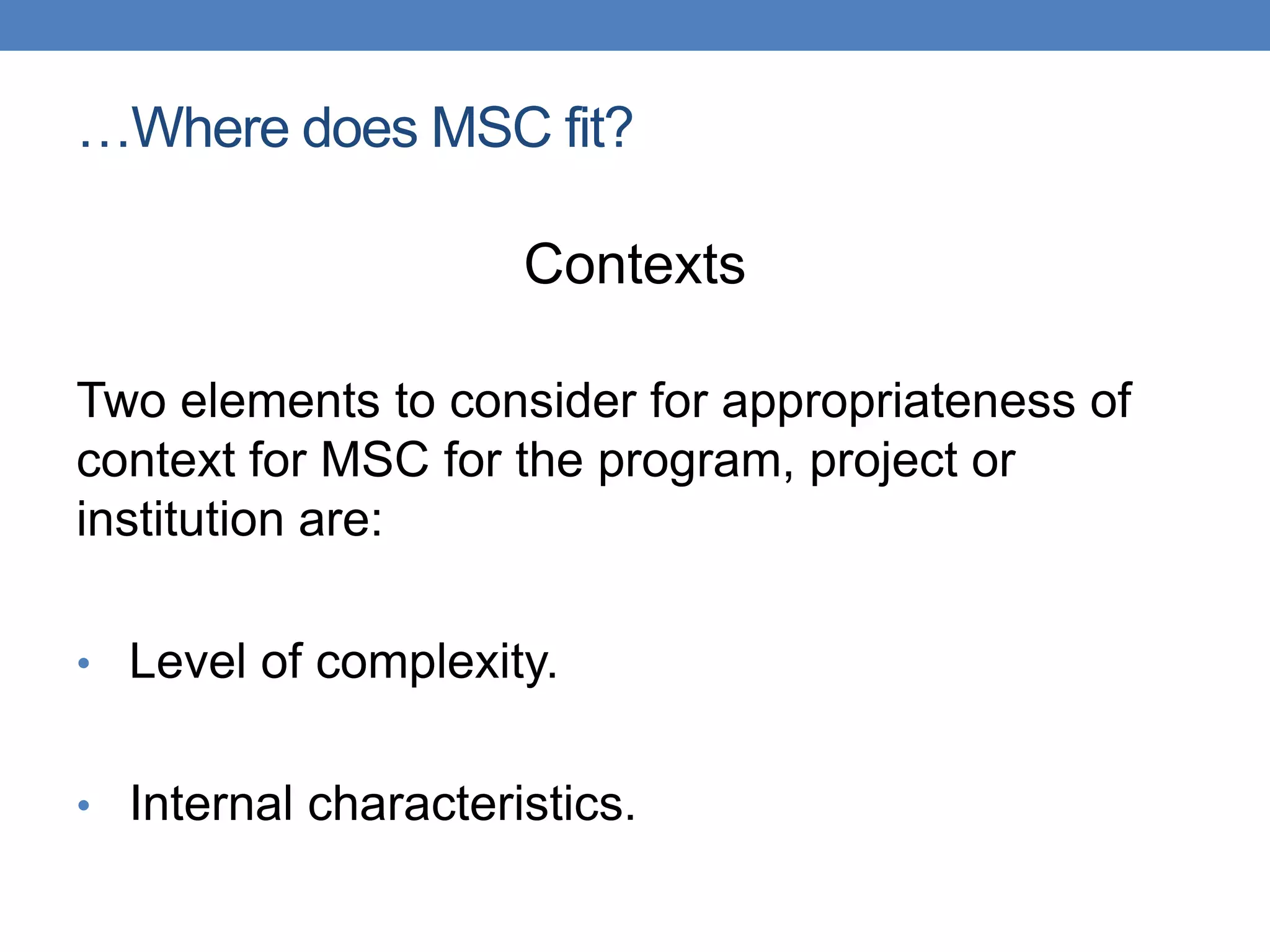
…Where does MSC fit?
Contexts
Two elements to consider for appropriateness of
context for MSC for the program, project or
institution are:
• Level of complexity.
• Internal characteristics.
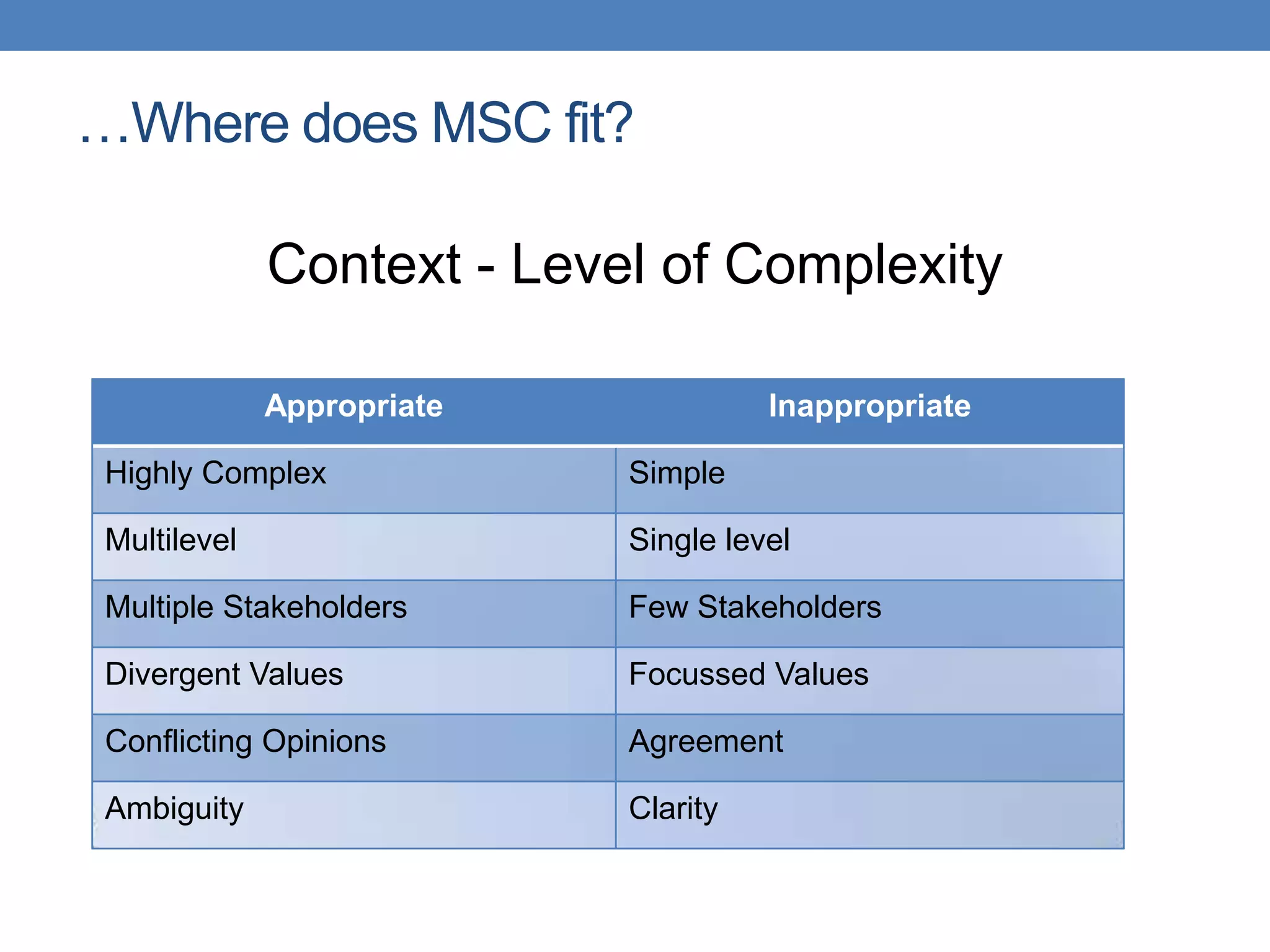
…Where does MSC fit?
Context - Level of Complexity
Appropriate Inappropriate
Highly Complex Simple
Multilevel Single level
Multiple Stakeholders Few Stakeholders
Divergent Values Focussed Values
Conflicting Opinions Agreement
Ambiguity Clarity
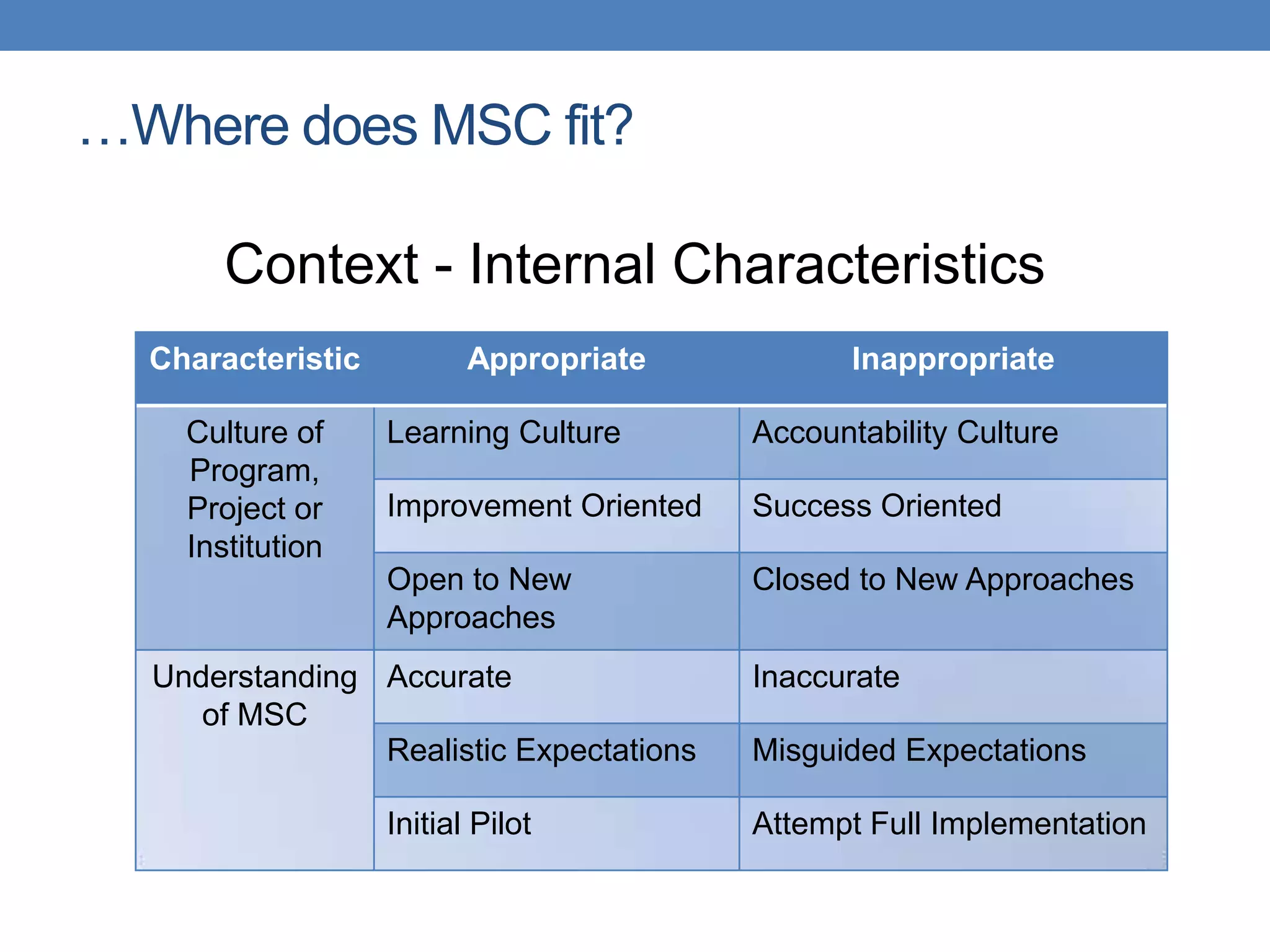
…Where does MSC fit?
Context - Internal Characteristics
Characteristic Appropriate Inappropriate
Culture of
Program,
Project or
Institution
Learning Culture Accountability Culture
Improvement Oriented Success Oriented
Open to New
Approaches
Closed to New Approaches
Understanding
of MSC
Accurate Inaccurate
Realistic Expectations Misguided Expectations
Initial Pilot Attempt Full Implementation
…Where does MSC fit?
Context - Internal Characteristics
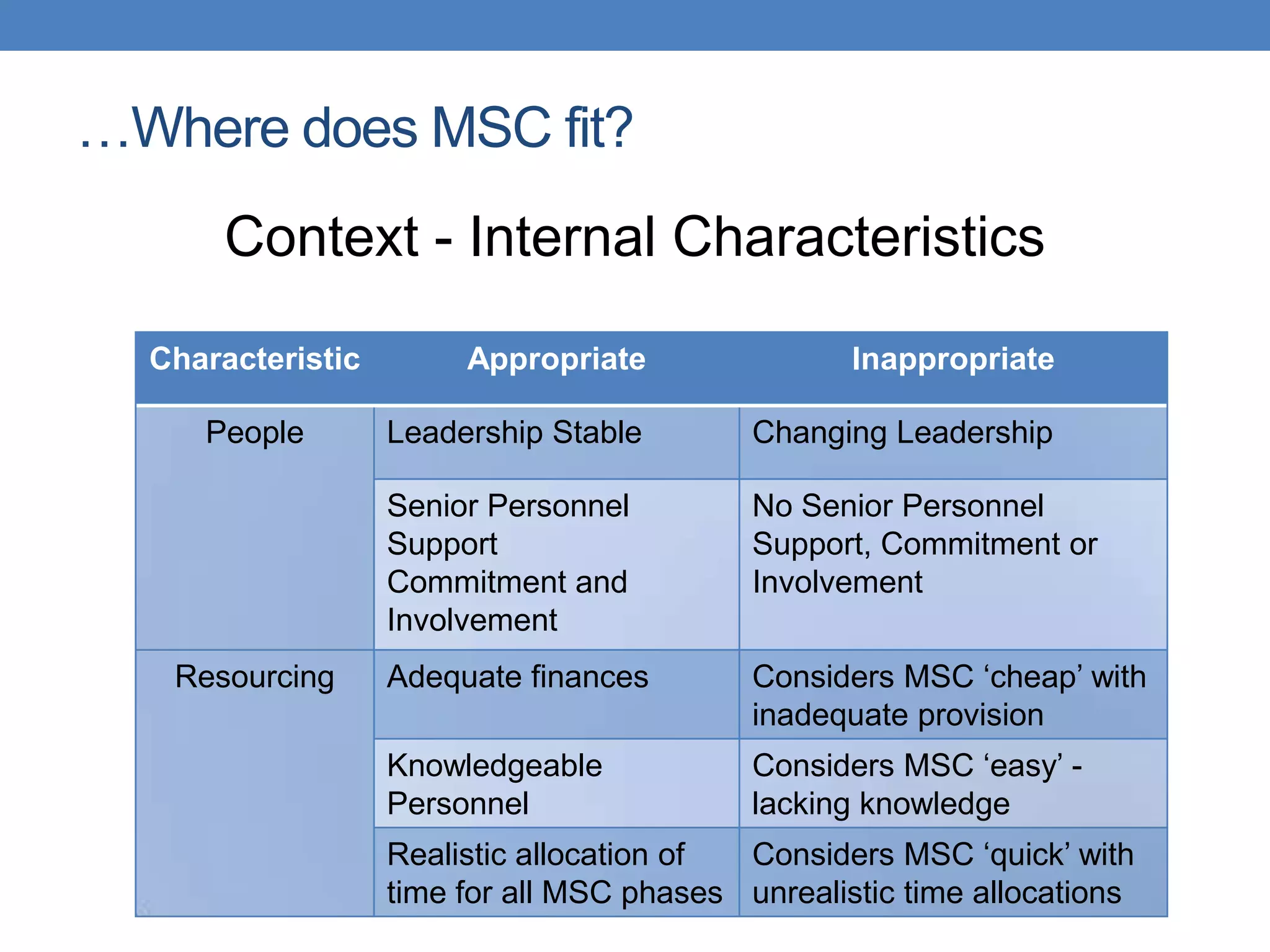
Characteristic Appropriate Inappropriate
People Leadership Stable Changing Leadership
Senior Personnel
Support
Commitment and
Involvement
No Senior Personnel
Support, Commitment or
Involvement
Resourcing Adequate finances Considers MSC „cheap‟ with
inadequate provision
Knowledgeable
Personnel
Considers MSC „easy‟ -
lacking knowledge
Realistic allocation of
time for all MSC phases
Considers MSC „quick‟ with
unrealistic time allocations
…Where does MSC fit?
For anything?
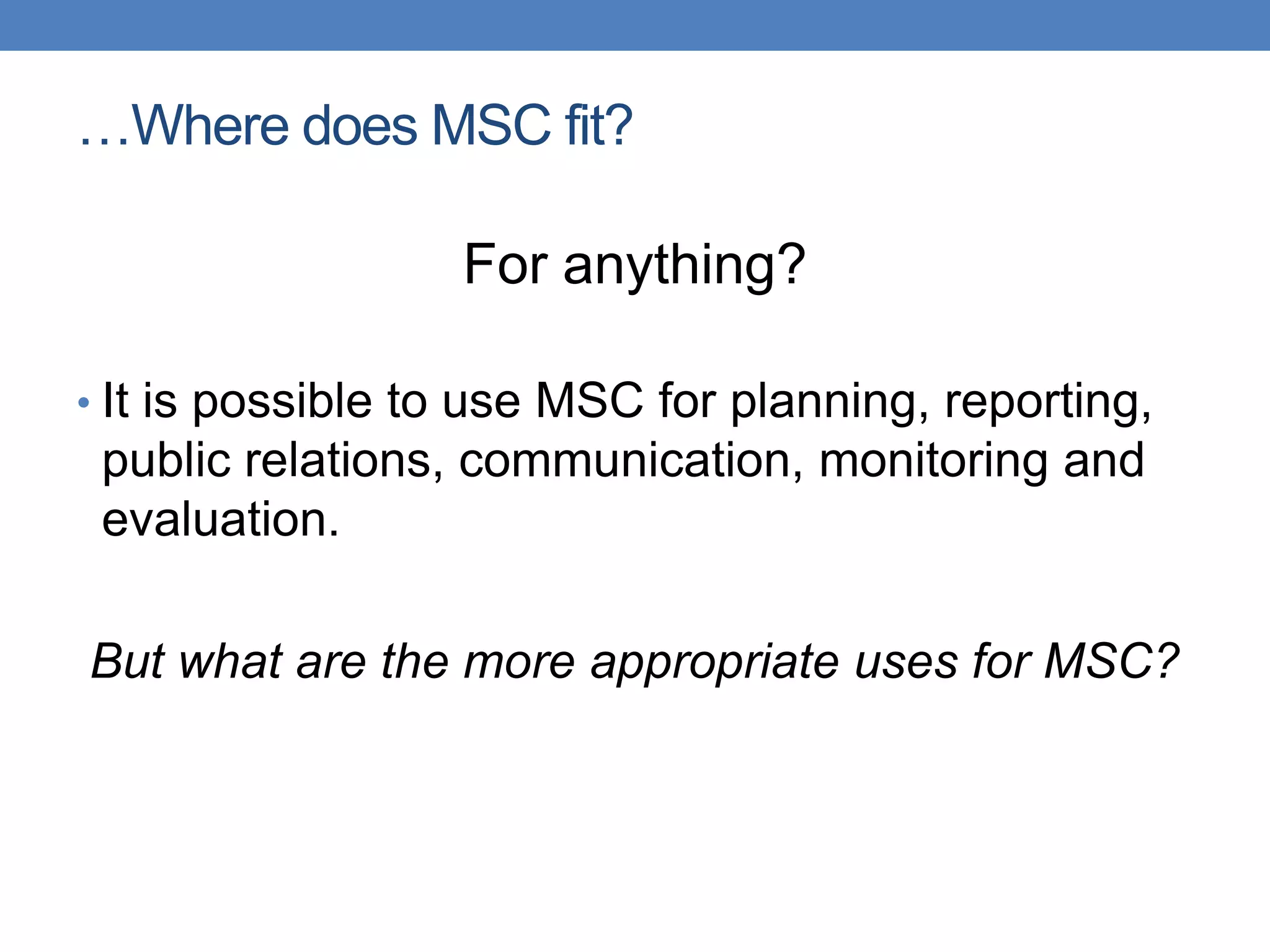
• It is possible to use MSC for planning, reporting,
public relations, communication, monitoring and
evaluation.
But what are the more appropriate uses for MSC?
…Where does MSC fit?
Uses
Appropriate Inappropriate
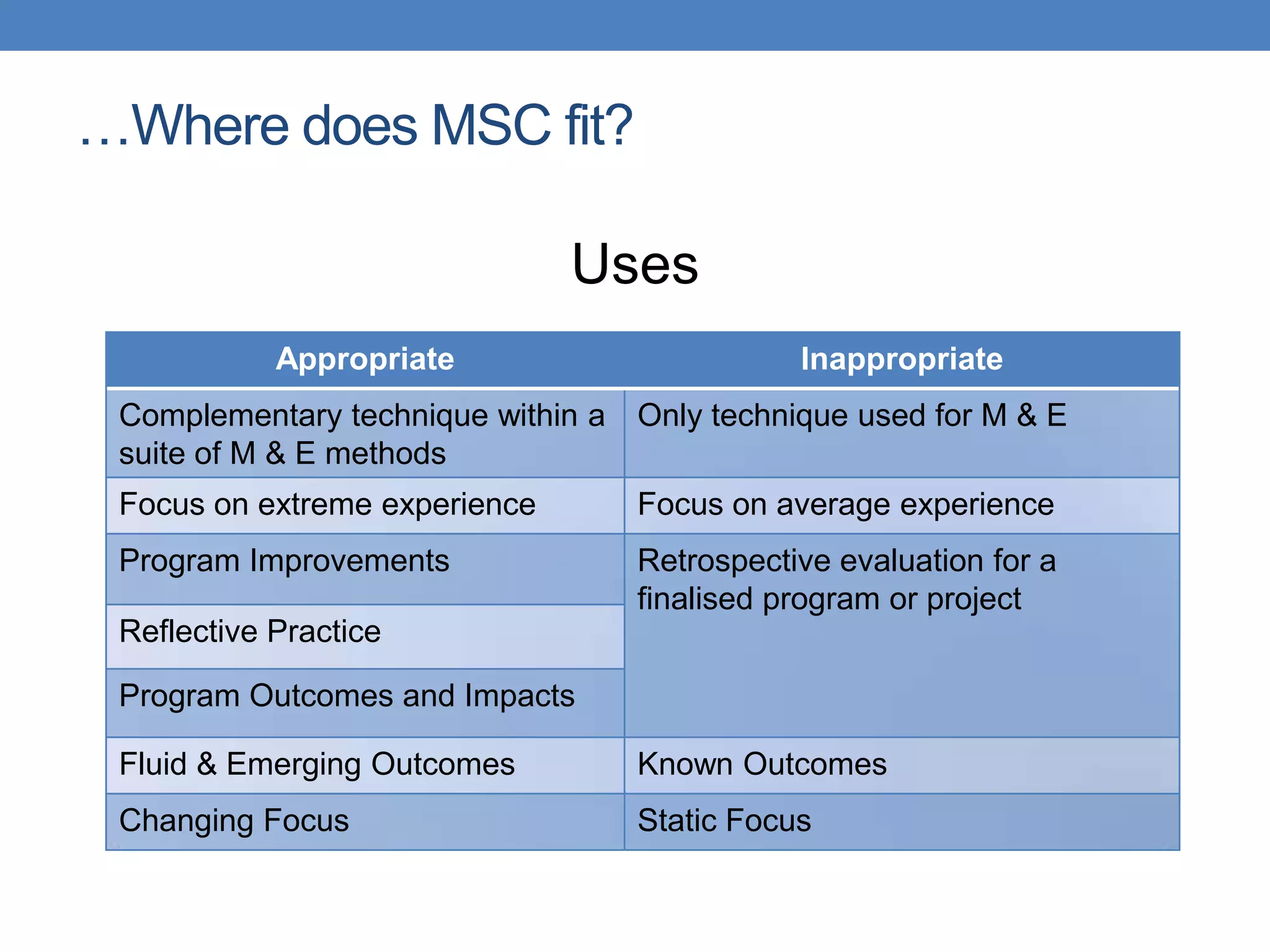
Complementary technique within a
suite of M & E methods
Only technique used for M & E
Focus on extreme experience Focus on average experience
Program Improvements Retrospective evaluation for a
finalised program or project
Reflective Practice
Program Outcomes and Impacts
Fluid & Emerging Outcomes Known Outcomes
Changing Focus Static Focus
…Where does MSC fit?
Uses
Appropriate Inappropriate
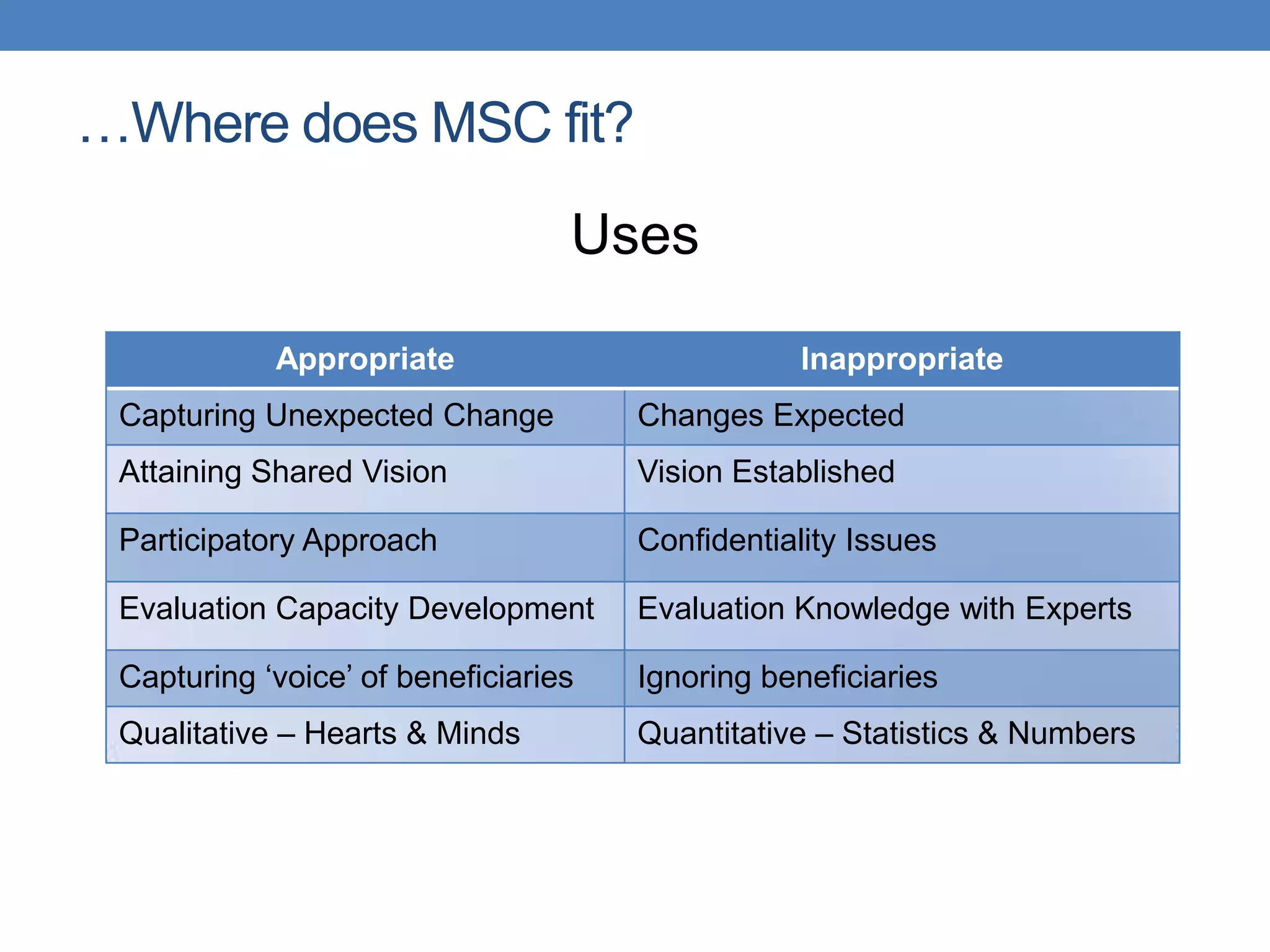
Capturing Unexpected Change Changes Expected
Attaining Shared Vision Vision Established
Participatory Approach Confidentiality Issues
Evaluation Capacity Development Evaluation Knowledge with Experts
Capturing „voice‟ of beneficiaries Ignoring beneficiaries
Qualitative – Hearts & Minds Quantitative – Statistics & Numbers
4. Strengths of MSC
• Inclusive and participatory at all levels.
• Transparent.
• Reflects a strong story telling tradition:
Common in many non-Western cultures.
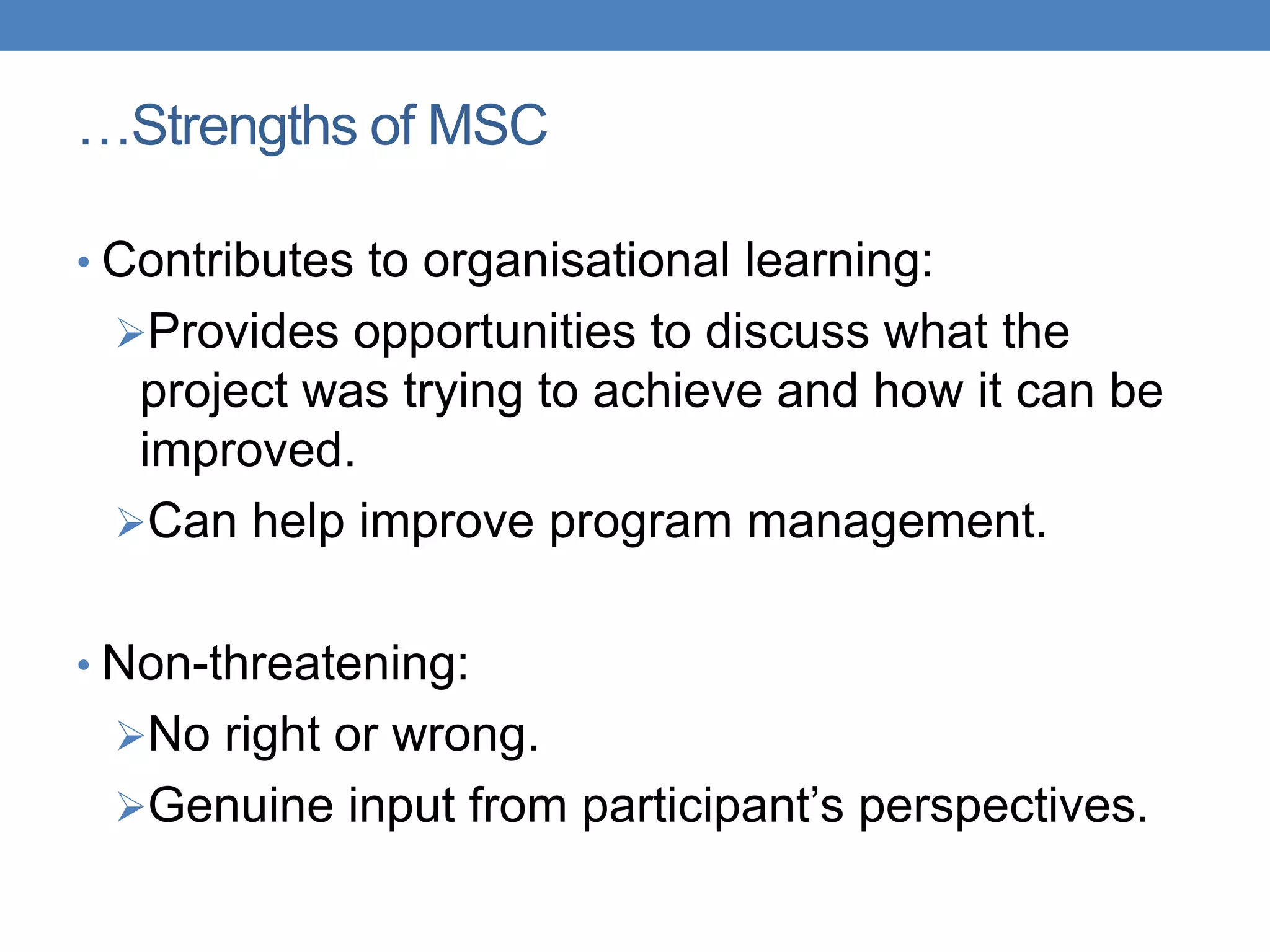
• Contributes to organisational learning:
Provides opportunities to discuss what the
project was trying to achieve and how it can be
improved.
Can help improve program management.
• Non-threatening:
No right or wrong.
Genuine input from participant‟s perspectives.
…Strengths of MSC
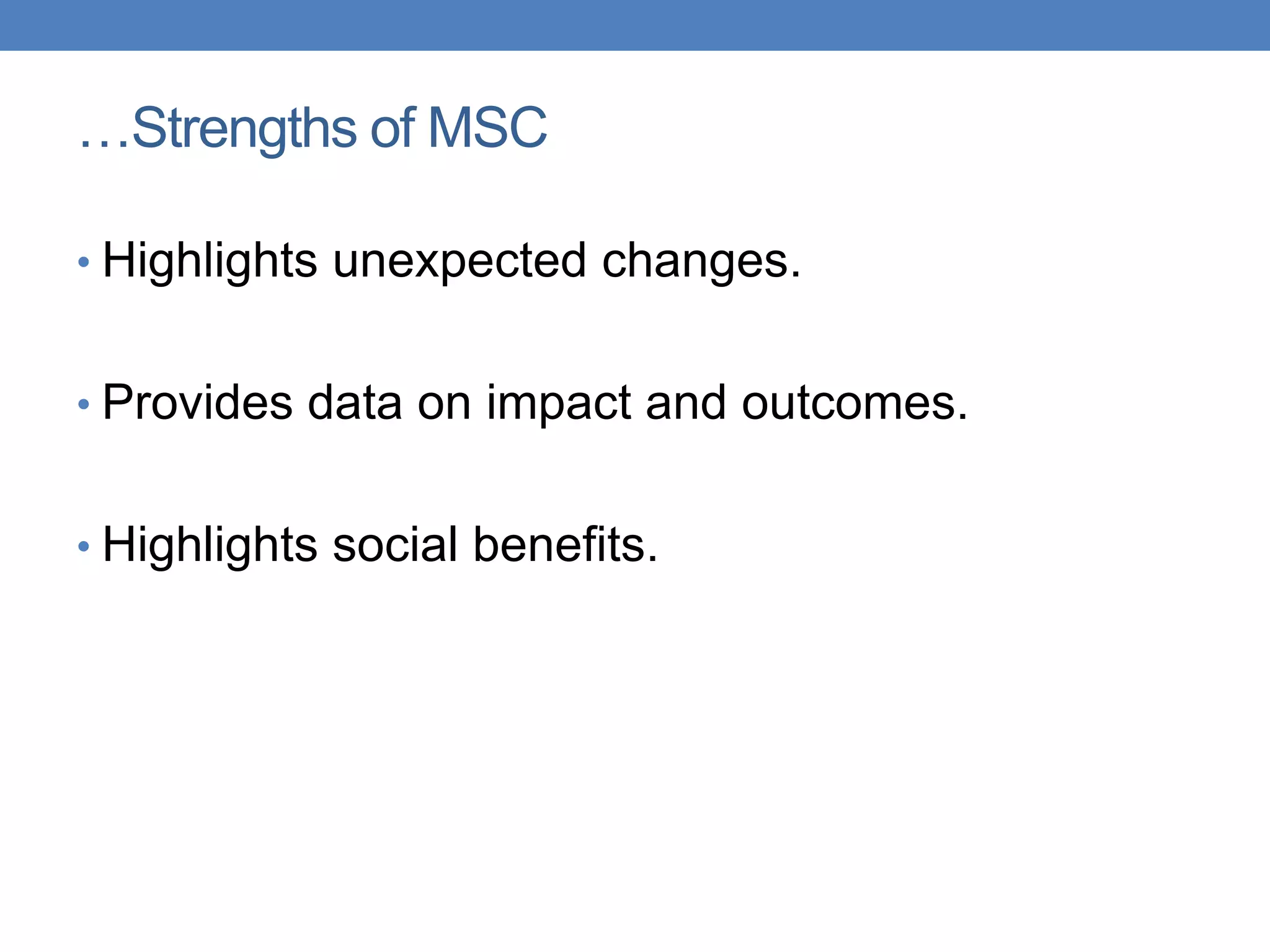
• Highlights unexpected changes.
• Provides data on impact and outcomes.
• Highlights social benefits.
…Strengths of MSC
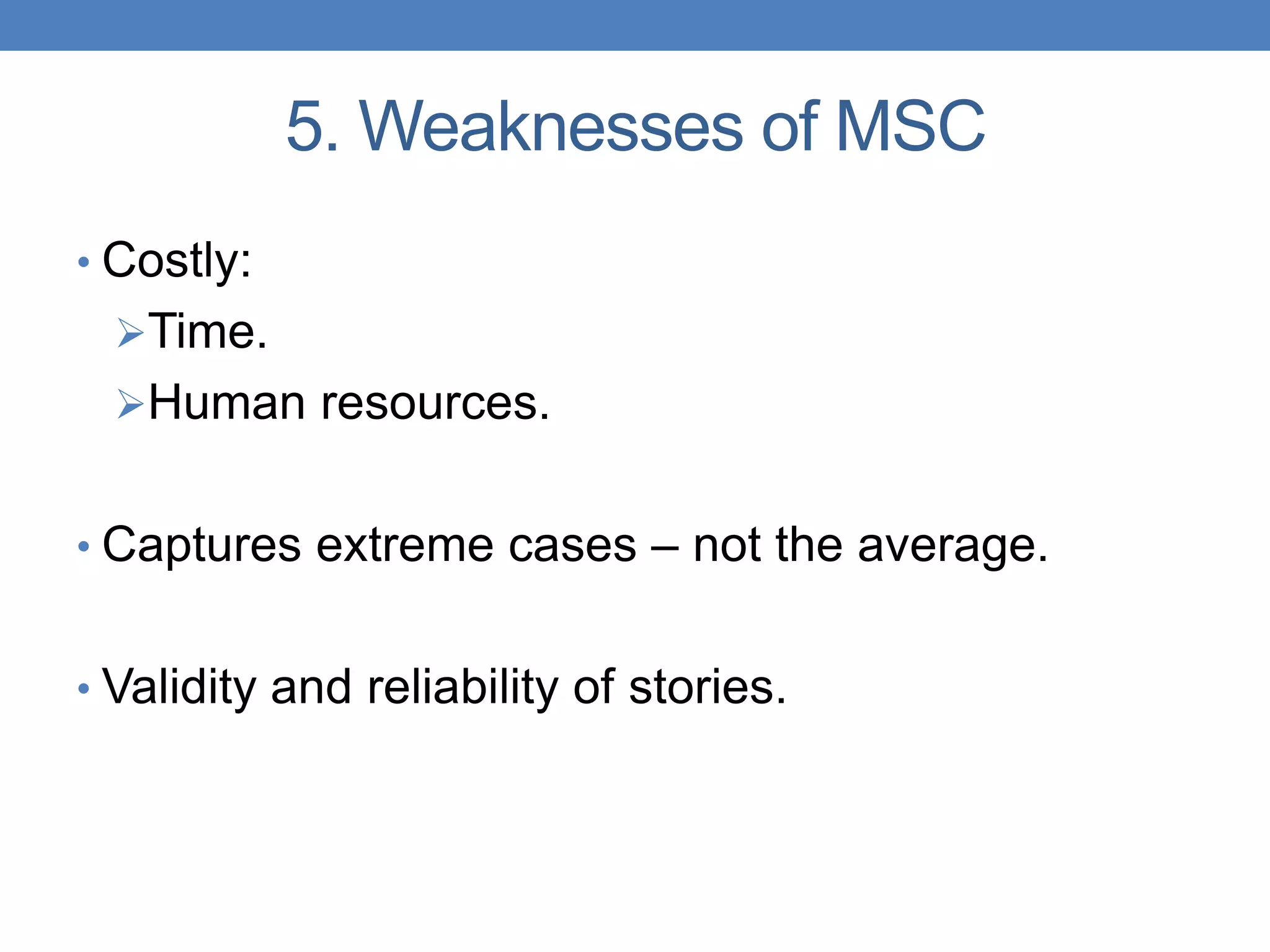
5. Weaknesses of MSC
• Costly:
Time.
Human resources.
• Captures extreme cases – not the average.
• Validity and reliability of stories.
• Language – can be a barrier/impediment to the
process.
• Difficulties with domains – “fuzzy”.
…Weaknesses of MSC
6. MSC In Action
Check out this link to see a great example of
MSC in action:
http://www.youtube.com/watch?v=NkuJ69zKScU
To engage you further in the MSC technique we
have put together some activities for you to try.
Please refer to the activity section within the
written component of our MSC presentation.
7. MSC Class Activity

MSC FINAL PPT (3)

  • 1.
    THE MOST SIGNIFICANT CHANGE (MSC)TECHNIQUE RARE, 2013 - Assessment Task 2 A dialogical approach to information gathering for monitoring and evaluation.
  • 2.
    Group Presentation Member‟s Profiles Dorothy- located in Dili, East Timor. Working in international aid within the security sector. Karen - located in Jakarta, Indonesia. Currently working in international aid within the education sector on programs funded through Australian Aid. Carol - located in rural Victoria, Australia. Working for an NGO within the welfare sector.
  • 3.
    Presentation Content 1. Descriptionof MSC. 2. Purpose of MSC. 3. Appropriate contexts and uses of MSC, and inappropriate contexts and uses of MSC. 4. Strengths of MSC. 5. Weaknesses of MSC. 6. Example of the MSC approach. 7. MSC activity for the class.
  • 4.
    Introduction • The MostSignificant Change technique (MSC), is located in the monitoring form of evaluative inquiry. • MSC can be used in a program cycle for monitoring and for program evaluation. • MSC collects qualitative data rather than the traditional quantitative reporting in program monitoring.
  • 5.
    1. What isMSC? Planning Implementation Monitoring Outputs Quantitative Reporting The Most Significant Change technique is a participatory form of program monitoring and evaluation. Typical Program Cycle
  • 6.
    …What is MSC? •MSC contributes to program monitoring and evaluation processes through capturing participants stories, in their own words. • The story recording and subsequent hierarchical analysis assist workers and other stakeholders to understand the impacts of the program. • Program improvement and worker learning are thus enhanced through the MSC technique.
  • 7.
    …The MSC Story MSCTime Line 1994: Davies began to develop the method In Bangladesh 1996: Called the „Evolutionary Approach to Organizational Learning‟ (Davies) 1998: Termed „monitoring without indicators‟ (Guijt, Arevalo, & Salsdores) 1999: Also known as „The Story Approach‟ (Dart) 1999: First used in Australia, called the „Most Significant Change‟ Technique (MSC) Dart et. al. 2009: Further use in Australia – The Ambassador Project, Whitehorse, Victoria 2000: MSC approach internet discussion group established 2005: Published in the American Journal of Evaluation (Dart & Davies)
  • 8.
    2. What doesthe Most Significant Change (MSC) technique do? • Uses a concept of „dynamic values inquiry‟. • Searches for, and deliberates over, the value of significant program outcomes. • Directs work toward explicitly valued directions and away from less valued directions.
  • 9.
    …Collecting SC Stories Formulatingan open ended question to collect Significant Change (SC) stories: 1. “Looking back over the last month… 2. …what do you think was… 3. ..the most significant… 4. …change… 5. …in the quality of people’s lives… 6. …in this community?”
  • 10.
    …The MSC Process Participant stories collected Stories discussed& placed in domains SC stories chosen & reasons stated for choices Qualitative program outcomes and impacts Verification, quantification & report MSC Program Cycle Incorporates feedback loops within the project, and/or organisational hierarchy.
  • 11.
    …MSC Valued Directions Voicesof participant's Workers hear effects of work and reflect on practice Stages of participatory discussion, review and SC selection Selection group reflects on practice Funders & managers reflect on desirable outcomes A picture of what participant's value, stakeholder‟s value, and funder‟s value. Cycle of improvement & learning
  • 12.
    3. Where doesMSC fit? Introduction • The evaluator must always choose approaches and methods which are the most appropriate for the situation. • MSC implementation can be adapted to suit some situation specific characteristics. • However, MSC is more useful and better aligned to certain contexts than others.
  • 13.
    …Where does MSCfit? Everywhere? Anywhere? • MSC has been implemented in developing and developed countries (e.g. Australia and Solomon Islands). • Across the range of organisations and institutions e.g. government, community groups and businesses. Therefore, is MSC appropriate for any country, program, project or institution?
  • 14.
    …Where does MSCfit? Contexts Two elements to consider for appropriateness of context for MSC for the program, project or institution are: • Level of complexity. • Internal characteristics.
  • 15.
    …Where does MSCfit? Context - Level of Complexity Appropriate Inappropriate Highly Complex Simple Multilevel Single level Multiple Stakeholders Few Stakeholders Divergent Values Focussed Values Conflicting Opinions Agreement Ambiguity Clarity
  • 16.
    …Where does MSCfit? Context - Internal Characteristics Characteristic Appropriate Inappropriate Culture of Program, Project or Institution Learning Culture Accountability Culture Improvement Oriented Success Oriented Open to New Approaches Closed to New Approaches Understanding of MSC Accurate Inaccurate Realistic Expectations Misguided Expectations Initial Pilot Attempt Full Implementation
  • 17.
    …Where does MSCfit? Context - Internal Characteristics Characteristic Appropriate Inappropriate People Leadership Stable Changing Leadership Senior Personnel Support Commitment and Involvement No Senior Personnel Support, Commitment or Involvement Resourcing Adequate finances Considers MSC „cheap‟ with inadequate provision Knowledgeable Personnel Considers MSC „easy‟ - lacking knowledge Realistic allocation of time for all MSC phases Considers MSC „quick‟ with unrealistic time allocations
  • 18.
    …Where does MSCfit? For anything? • It is possible to use MSC for planning, reporting, public relations, communication, monitoring and evaluation. But what are the more appropriate uses for MSC?
  • 19.
    …Where does MSCfit? Uses Appropriate Inappropriate Complementary technique within a suite of M & E methods Only technique used for M & E Focus on extreme experience Focus on average experience Program Improvements Retrospective evaluation for a finalised program or project Reflective Practice Program Outcomes and Impacts Fluid & Emerging Outcomes Known Outcomes Changing Focus Static Focus
  • 20.
    …Where does MSCfit? Uses Appropriate Inappropriate Capturing Unexpected Change Changes Expected Attaining Shared Vision Vision Established Participatory Approach Confidentiality Issues Evaluation Capacity Development Evaluation Knowledge with Experts Capturing „voice‟ of beneficiaries Ignoring beneficiaries Qualitative – Hearts & Minds Quantitative – Statistics & Numbers
  • 21.
    4. Strengths ofMSC • Inclusive and participatory at all levels. • Transparent. • Reflects a strong story telling tradition: Common in many non-Western cultures.
  • 22.
    • Contributes toorganisational learning: Provides opportunities to discuss what the project was trying to achieve and how it can be improved. Can help improve program management. • Non-threatening: No right or wrong. Genuine input from participant‟s perspectives. …Strengths of MSC
  • 23.
    • Highlights unexpectedchanges. • Provides data on impact and outcomes. • Highlights social benefits. …Strengths of MSC
  • 24.
    5. Weaknesses ofMSC • Costly: Time. Human resources. • Captures extreme cases – not the average. • Validity and reliability of stories.
  • 25.
    • Language –can be a barrier/impediment to the process. • Difficulties with domains – “fuzzy”. …Weaknesses of MSC
  • 26.
    6. MSC InAction Check out this link to see a great example of MSC in action: http://www.youtube.com/watch?v=NkuJ69zKScU
  • 27.
    To engage youfurther in the MSC technique we have put together some activities for you to try. Please refer to the activity section within the written component of our MSC presentation. 7. MSC Class Activity