Practical Workforce Development
Recruitment & Retention…..getting it right
John Sauer, University of Minnesota
Disability In-Service
Training Support
Service Inc.
Practical Workforce Development
Recruitment & Retention…..getting it right
John Sauer, Project Coordinator
Research and Training Center,
University of Minnesota
sauer006@umn.edu
November 6, 2008
Agenda
• Learning Outcomes
• Background/Workforce Challenges
• Workforce Development Resources (USA)
• Intervention Strategies
– Marketing, Recruitment, Selection
– Orientation, Socialization, Mentoring
– Training, Credentialing, Professional Development
– Team Building, Participatory Management, Recognition
– Developing Frontline Supervisors
– Systemic Solutions
• The Organizational Workforce Development Plan and Process
• Brainstorm/Prioritize Follow-Along Activities
• Conclusion and Evaluation
Learning Outcomes
By the end of the workshop, participants will be able to:
• Describe several key DSP workforce challenges (USA/AUS)
• Identify several DSP Workforce resources in USA
• Discuss at least one intervention strategy for: recruitment,
selection, orientation, training, and retention.
• Explain the key components of an organization intervention
plan
• Each organization commits to completing an Action Plan
• Create a framework for future learning
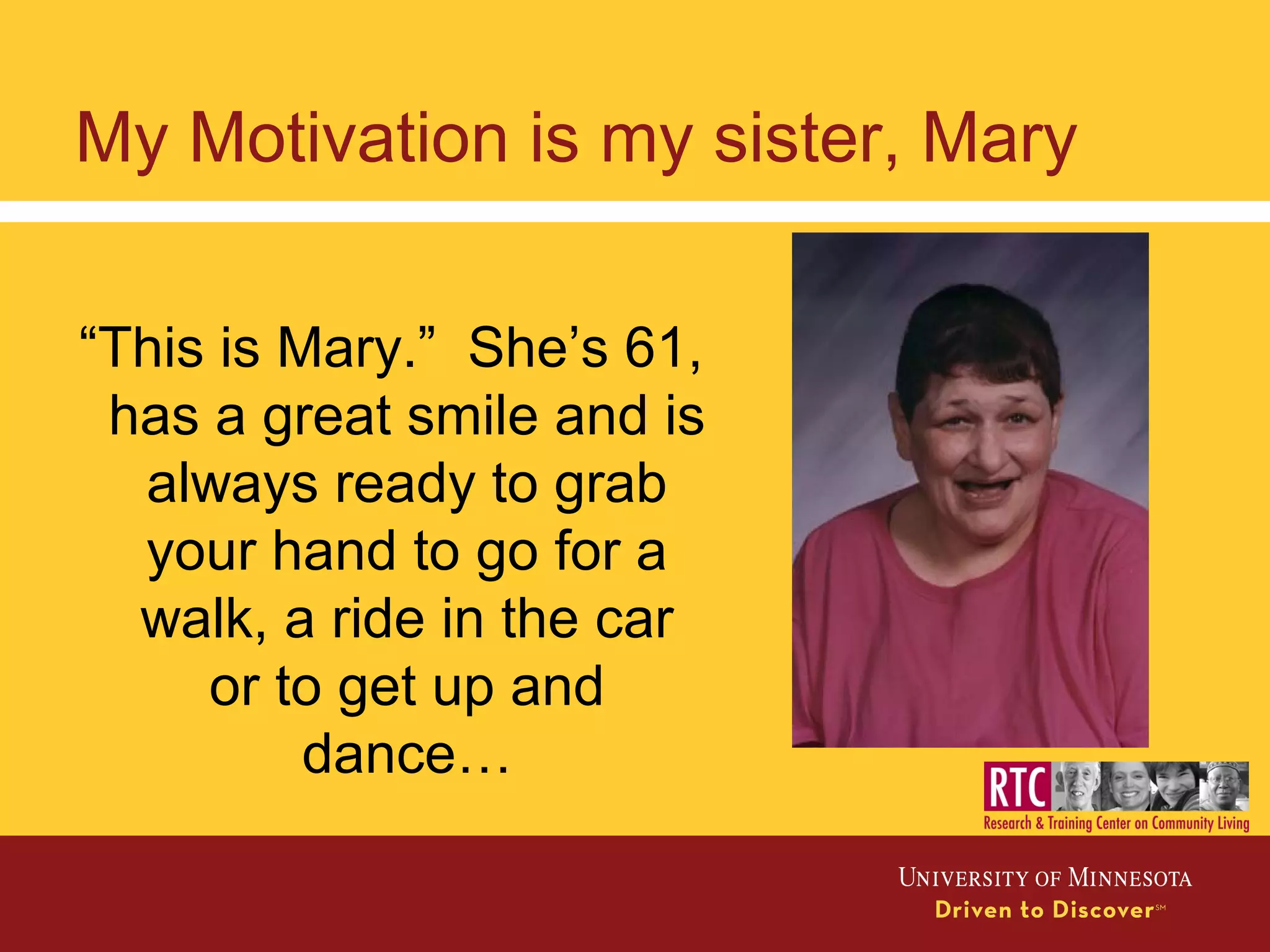
“This is Mary.” She’s 61,
has a great smile and is
always ready to grab
your hand to go for a
walk, a ride in the car
or to get up and
dance…
My Motivation is my sister, Mary
What We Want: Passionate Commitment to
Creating Inclusive Communities
• People have personally joyful and fulfilling lives
• People live in their communities of choice
• People have real work and/or meaningful things to do during the
day to keep them motivated and inspired about life, that they
choose to do AND that they are paid appropriately to do
• People have friends with and without disabilities
• People do things in their life that many other people do in their
communities and that they also enjoy doing
• People have new and different experiences that are integrated
• People remain connected to families and are supported to do so
• Community members are involved in making it all happen
Workforce Challenges
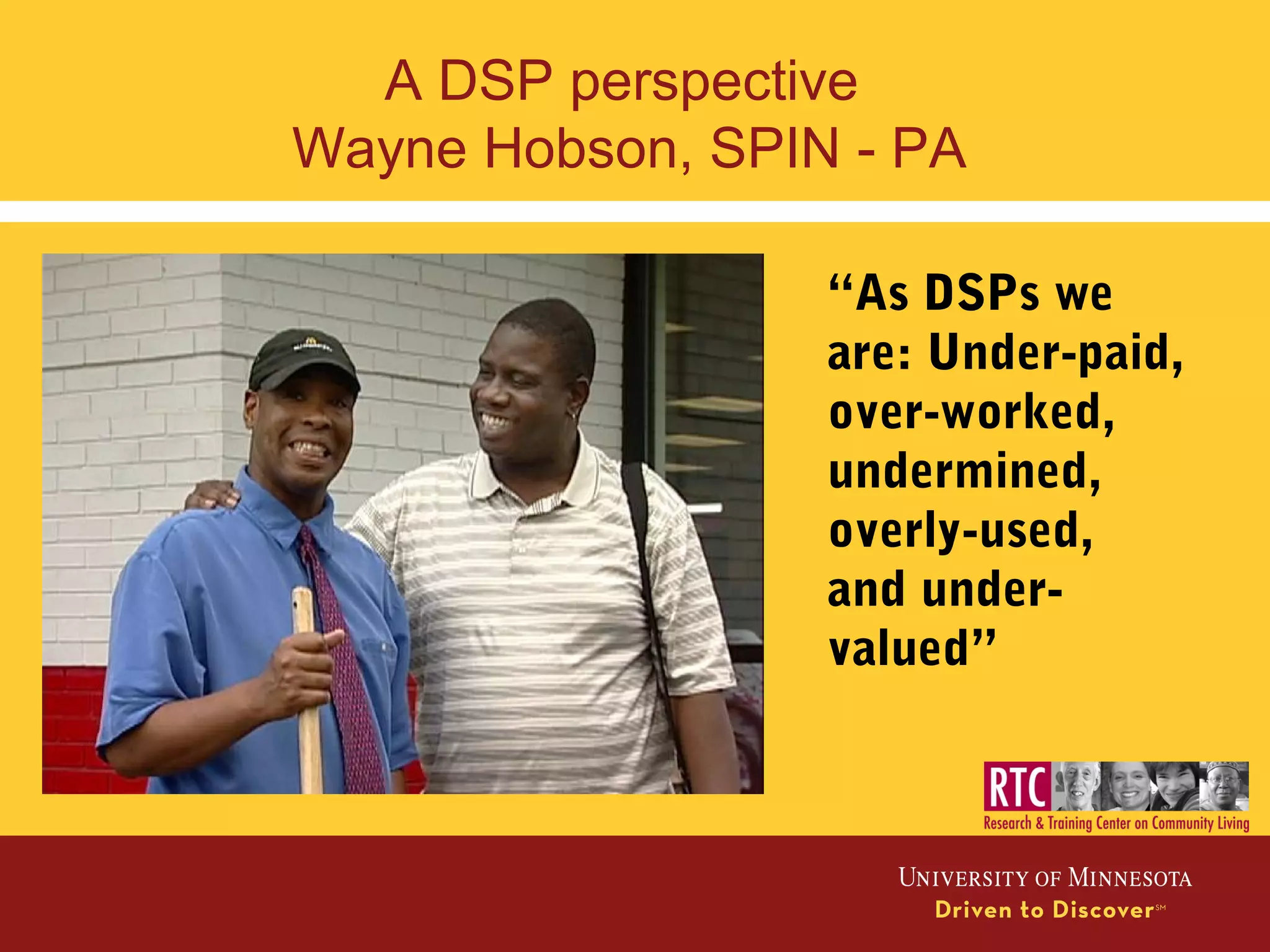
“As DSPs we
are: Under-paid,
over-worked,
undermined,
overly-used,
and under-
valued”
A DSP perspective
Wayne Hobson, SPIN - PA
Status Quo is Expensive
Executive Director Perspective
• Average turnover rate of 55%
• Vacancy rates as high as 18%
• New hire average cost is about $2,400 -
$3,500
• No occupational title
• Low wage ($8.68 US)
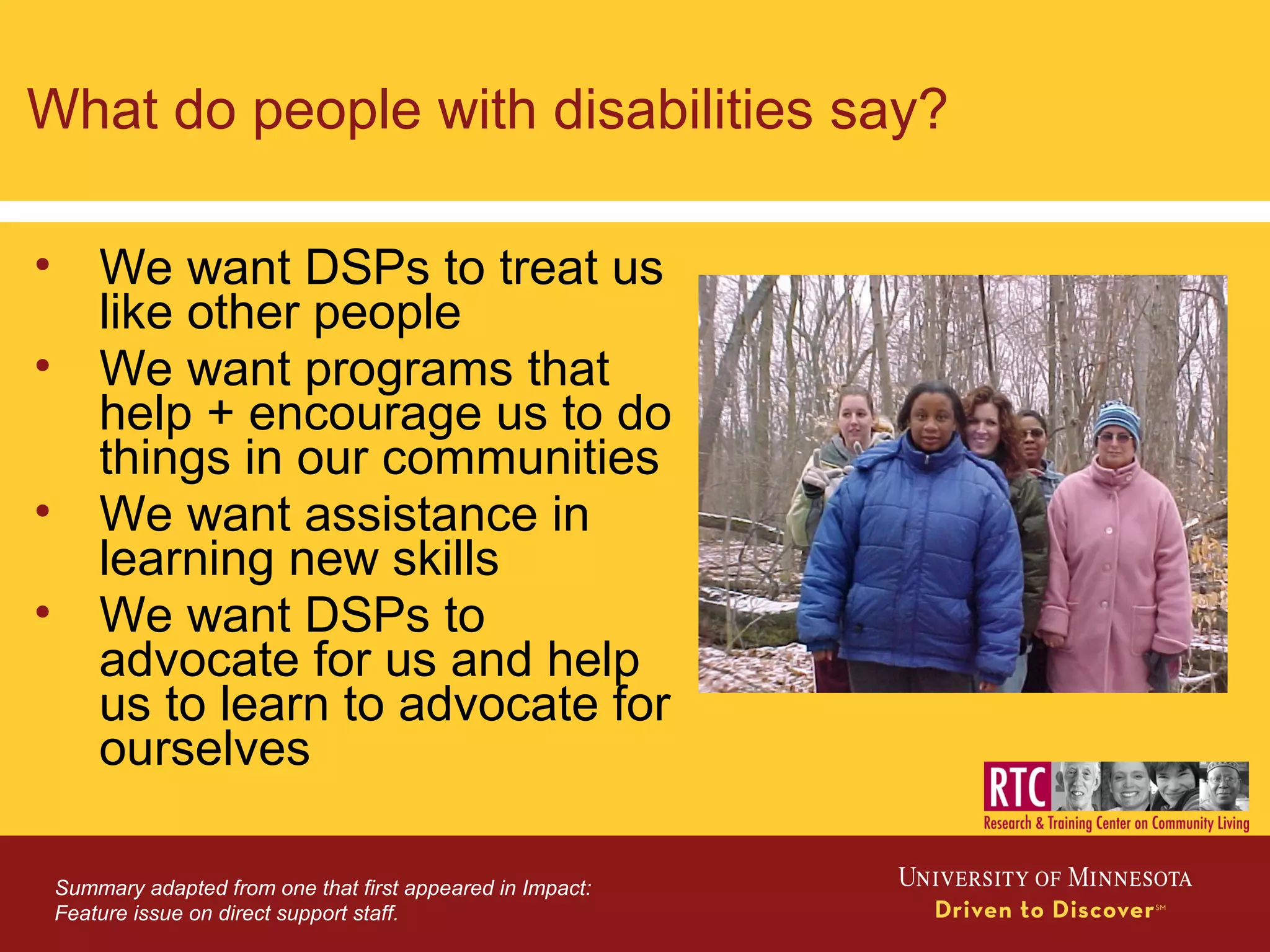
What do people with disabilities say?
• We want DSPs to treat us
like other people
• We want programs that
help + encourage us to do
things in our communities
• We want assistance in
learning new skills
• We want DSPs to
advocate for us and help
us to learn to advocate for
ourselves
Summary adapted from one that first appeared in Impact:
Feature issue on direct support staff.
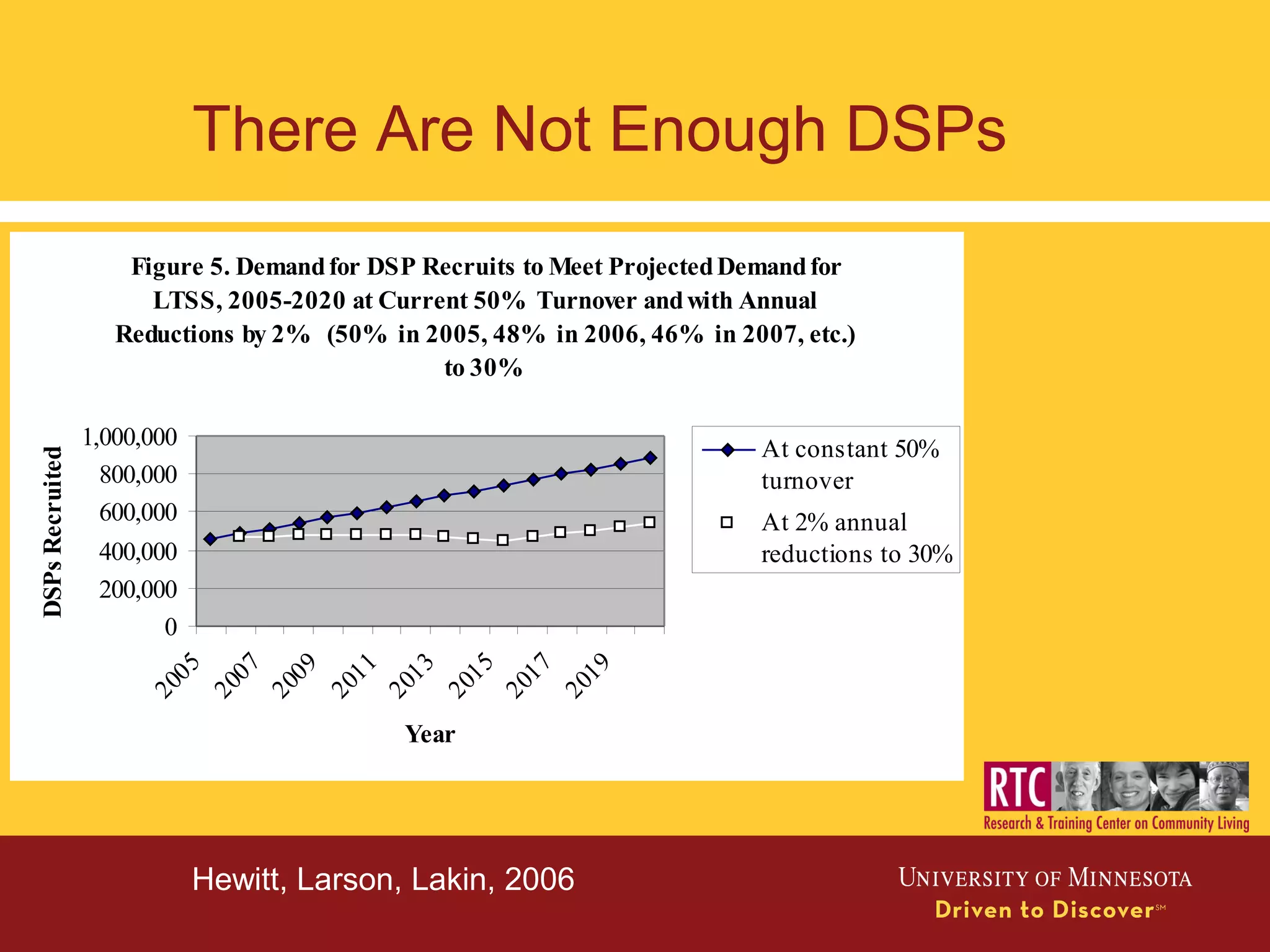
There Are Not Enough DSPs
Figure 5. Demandfor DSP Recruits to Meet ProjectedDemandfor
LTSS, 2005-2020 at Current 50% Turnover andwith Annual
Reductions by 2% (50% in 2005, 48% in 2006, 46% in 2007, etc.)
to 30%
0
200,000
400,000
600,000
800,000
1,000,000
2005
2007
2009
2011
2013
2015
2017
2019
Year
DSPsRecruited
At constant 50%
turnover
At 2% annual
reductions to 30%
Hewitt, Larson, Lakin, 2006
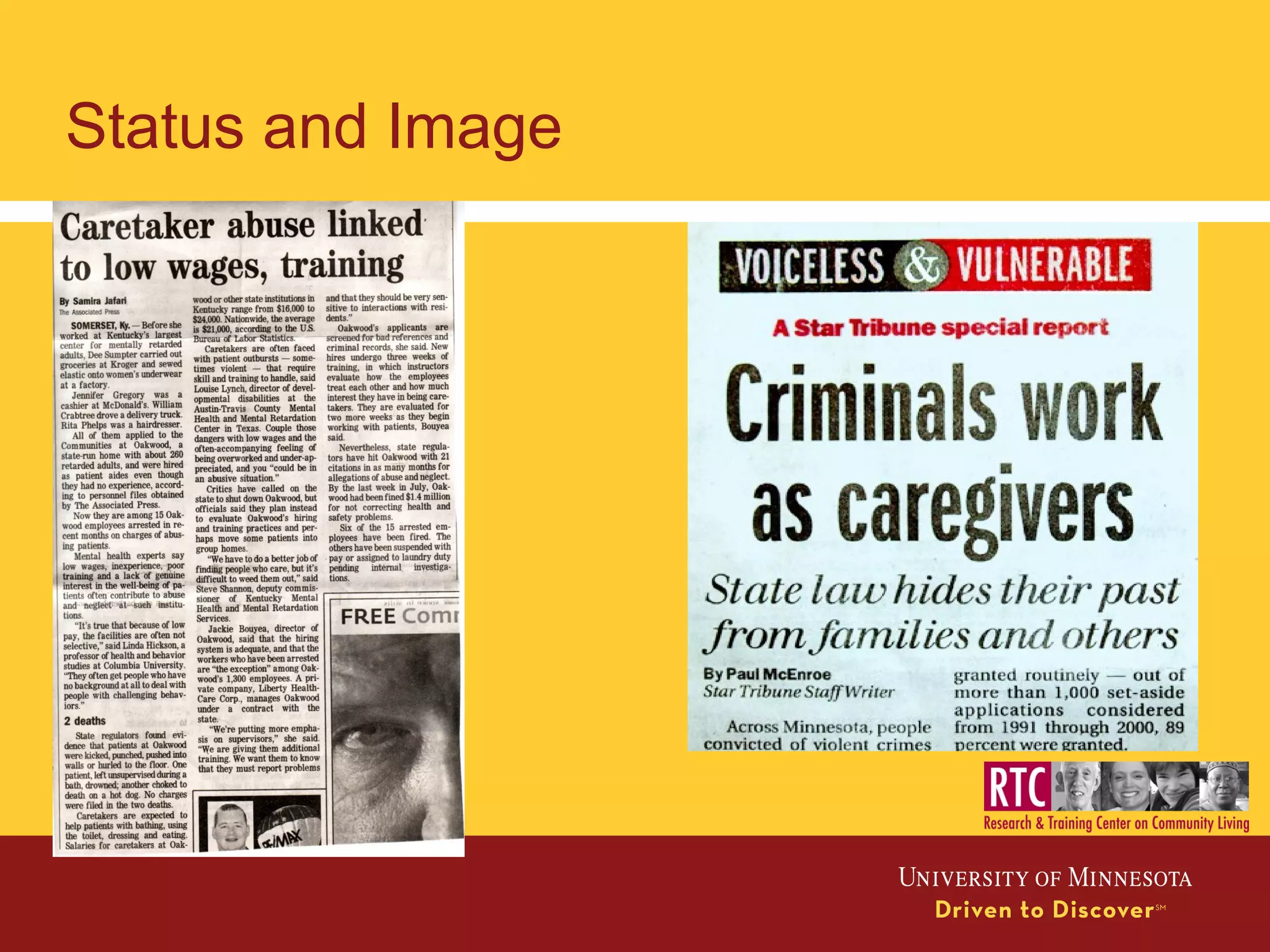
Status and Image
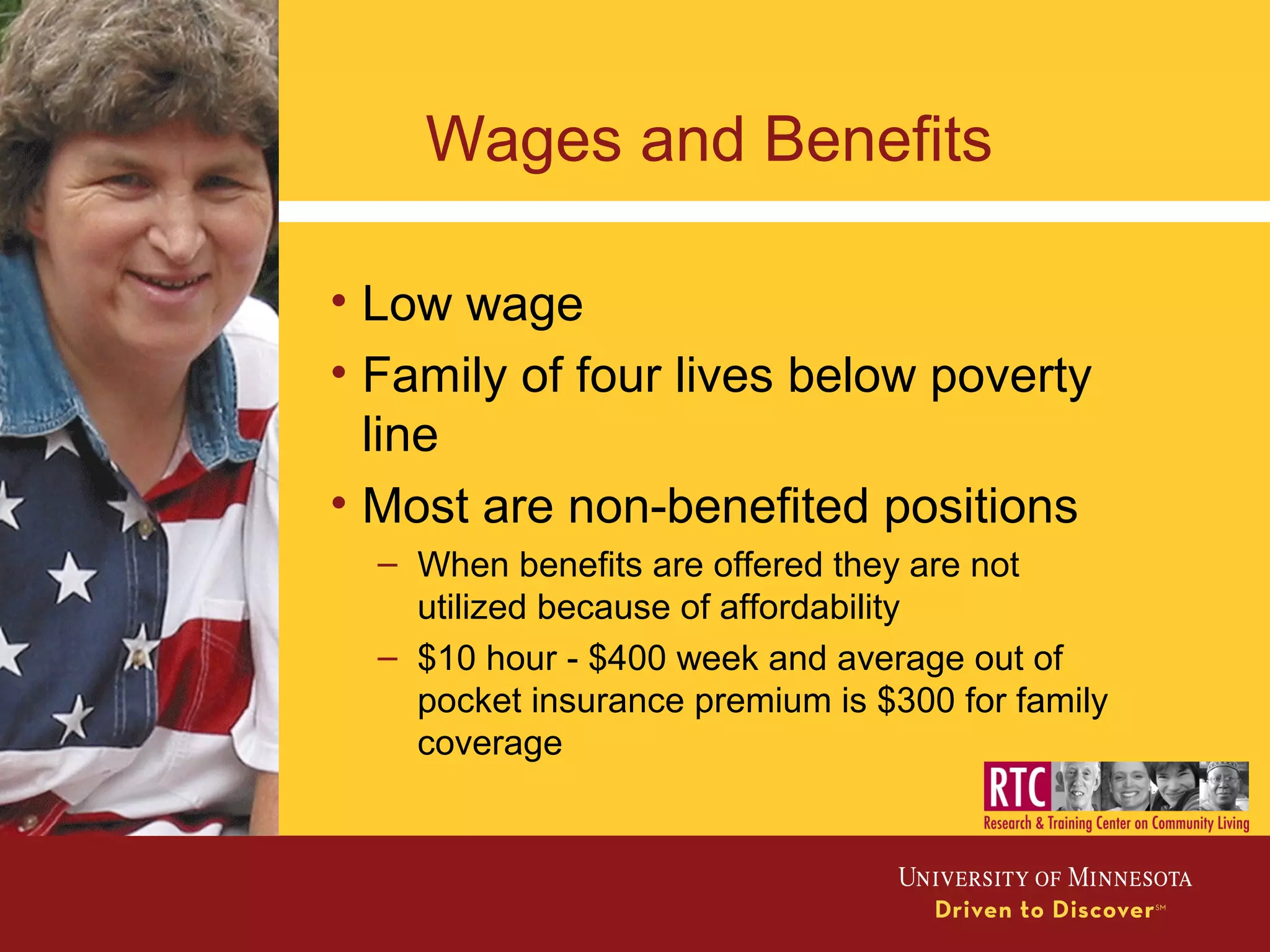
Wages and Benefits
• Low wage
• Family of four lives below poverty
line
• Most are non-benefited positions
– When benefits are offered they are not
utilized because of affordability
– $10 hour - $400 week and average out of
pocket insurance premium is $300 for family
coverage
New Trends in Supports
• Roles of DSPs are changing
• More people whom DSPs support are living in
smaller community settings and need
individualized supports
• Increased dispersal and isolation of DSPs
• Therefore, DSPs need to rely more on their
own knowledge and skills to problem solve
various situations
Education and Training Challenges
• H.S. degree, driver’s license and pass criminal background
check
• Mandatory minimum-focus on rules and regulations
• Tremendous variation in quality and quantity across
organizations-lack of competency-based training
• Little attention paid to adult learning
• No career path, certification or credentialing exists for DSPs
• Tremendous barriers for DSPs
– Work more than one job
– Geography
– Incentives
– Attitudes
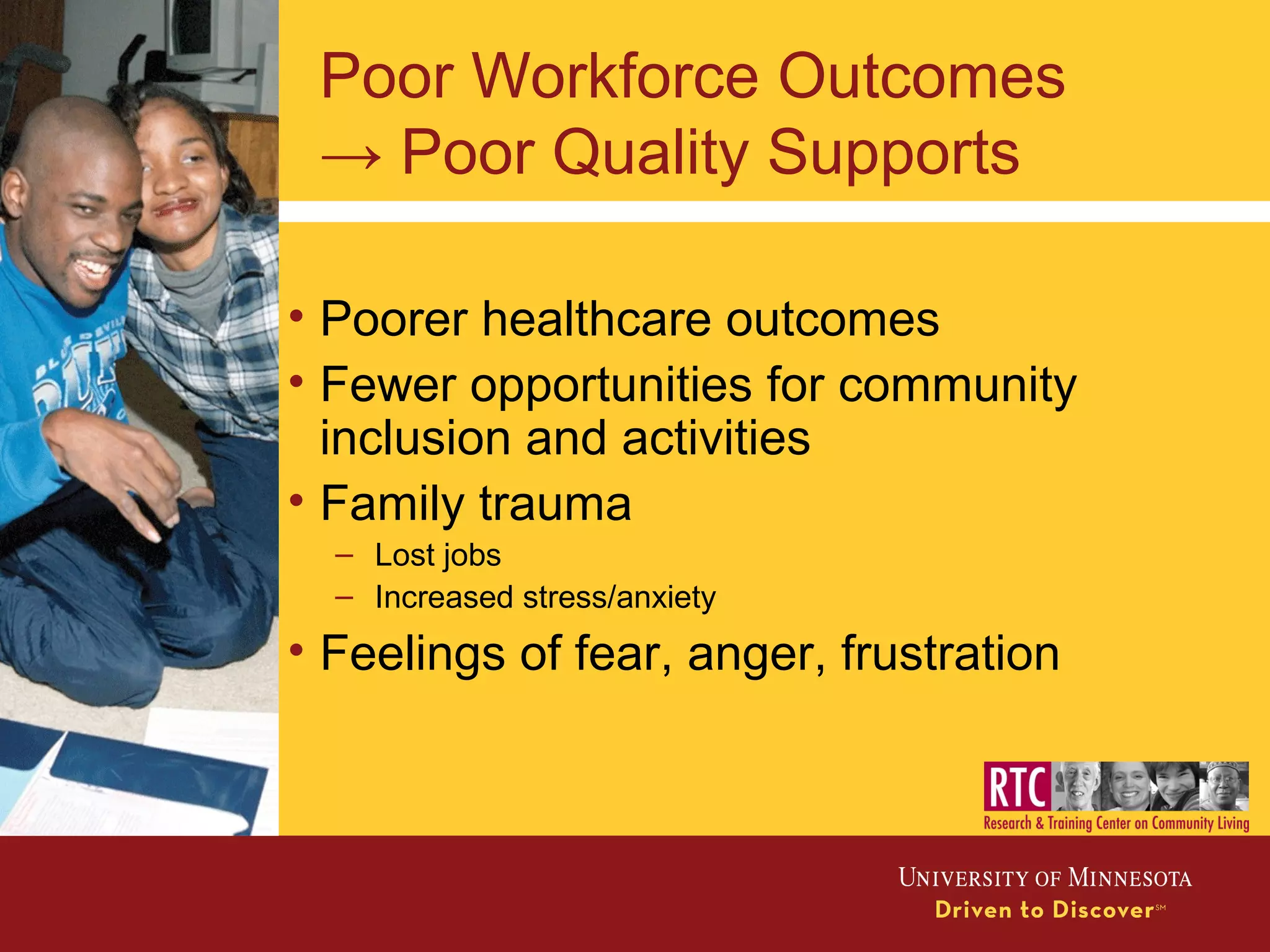
Poor Workforce Outcomes
→ Poor Quality Supports
• Poorer healthcare outcomes
• Fewer opportunities for community
inclusion and activities
• Family trauma
– Lost jobs
– Increased stress/anxiety
• Feelings of fear, anger, frustration
3
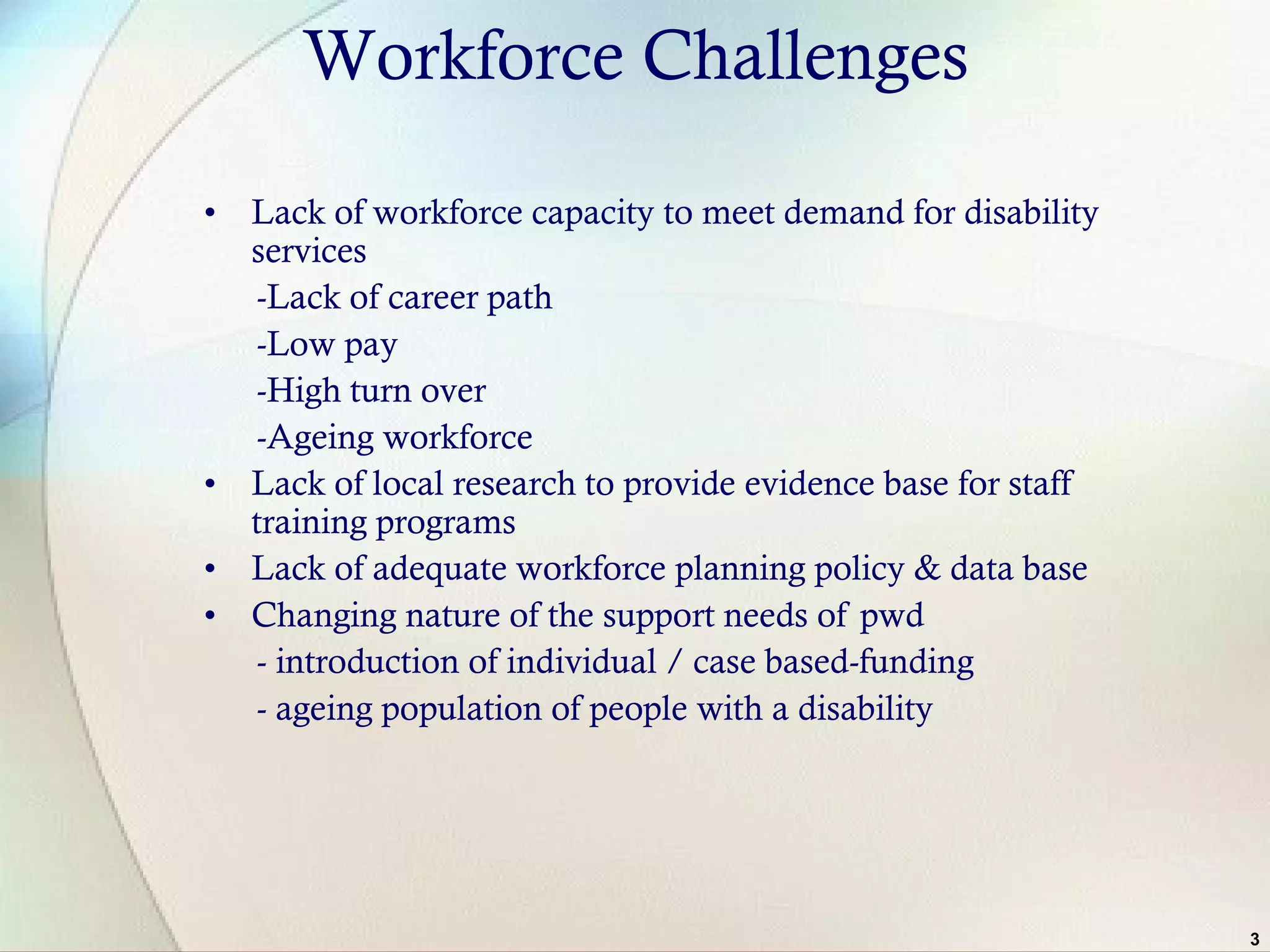
Workforce Challenges
• Lack of workforce capacity to meet demand for disability
services
-Lack of career path
-Low pay
-High turn over
-Ageing workforce
• Lack of local research to provide evidence base for staff
training programs
• Lack of adequate workforce planning policy & data base
• Changing nature of the support needs of pwd
- introduction of individual / case based-funding
- ageing population of people with a disability
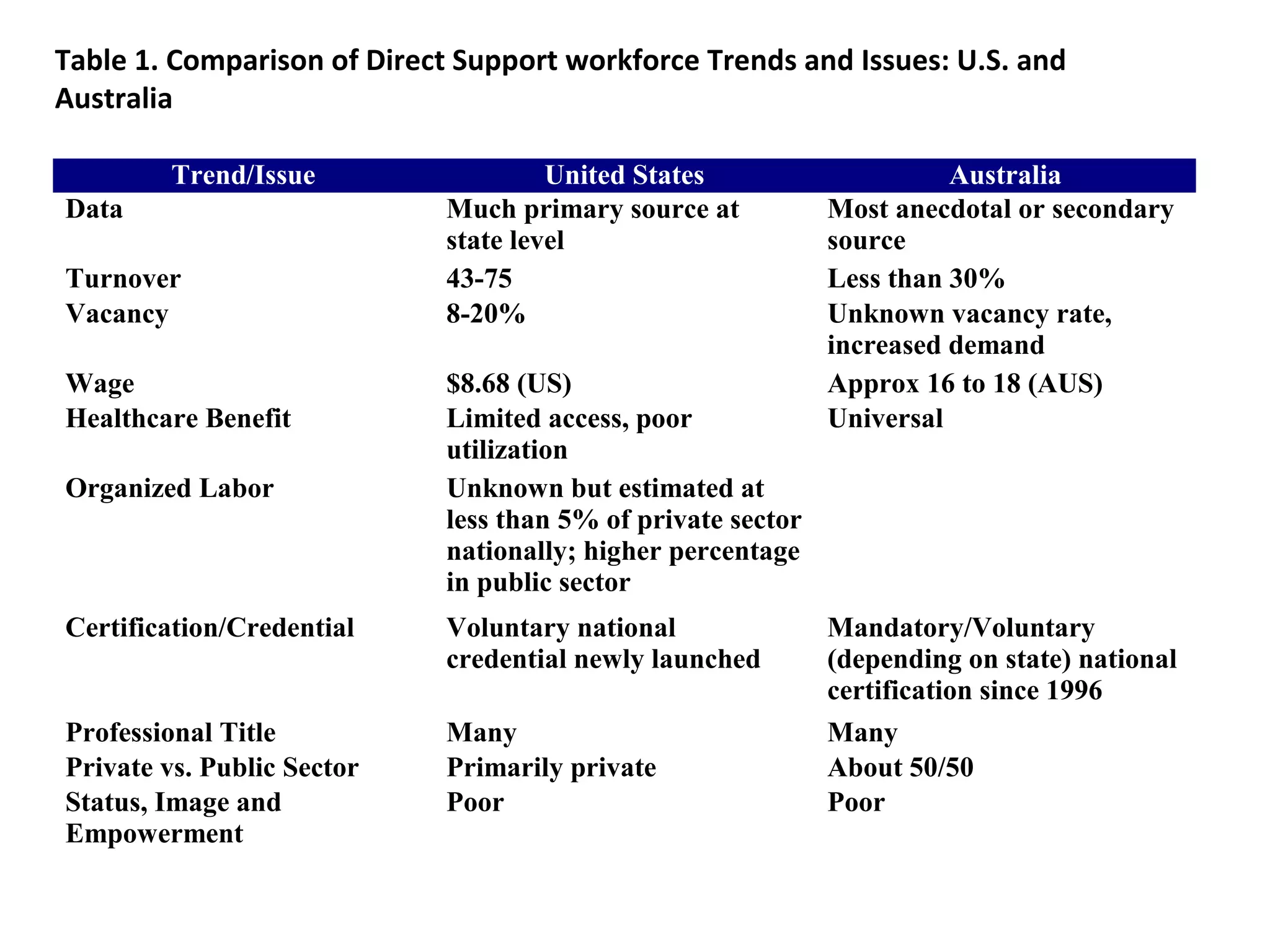
Trend/Issue United States Australia
Data Much primary source at
state level
Most anecdotal or secondary
source
Turnover 43-75 Less than 30%
Vacancy 8-20% Unknown vacancy rate,
increased demand
Wage $8.68 (US) Approx 16 to 18 (AUS)
Healthcare Benefit Limited access, poor
utilization
Universal
Organized Labor Unknown but estimated at
less than 5% of private sector
nationally; higher percentage
in public sector
Certification/Credential Voluntary national
credential newly launched
Mandatory/Voluntary
(depending on state) national
certification since 1996
Professional Title Many Many
Private vs. Public Sector Primarily private About 50/50
Status, Image and
Empowerment
Poor Poor
Table 1. Comparison of Direct Support workforce Trends and Issues: U.S. and
Australia
National Resources to Address
Workforce Challenges
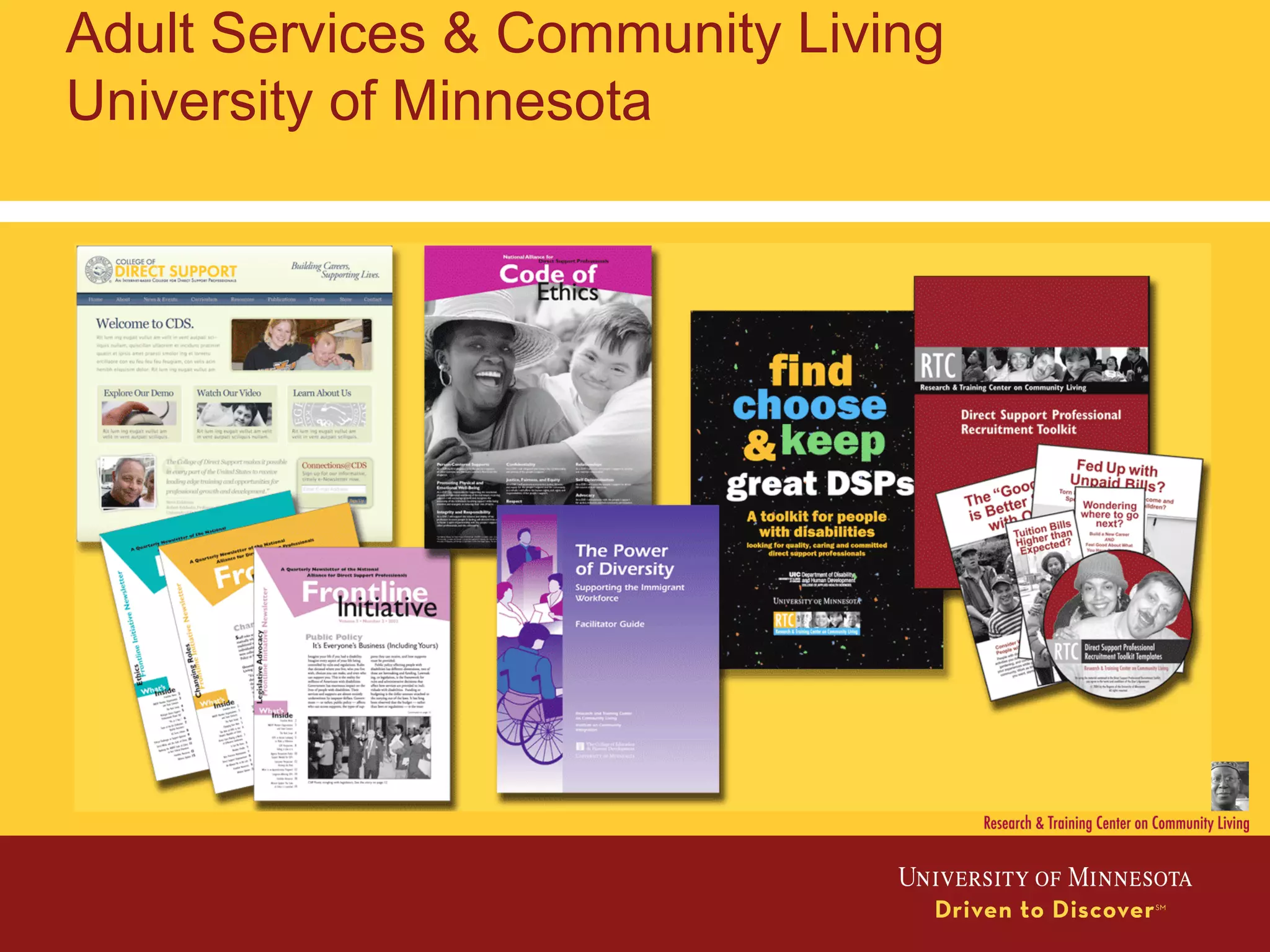
Adult Services & Community Living
University of Minnesota
DSP Workforce Web Sites
• http://www.rtc.umn.edu/dsp - direct support
workforce issues in community human services
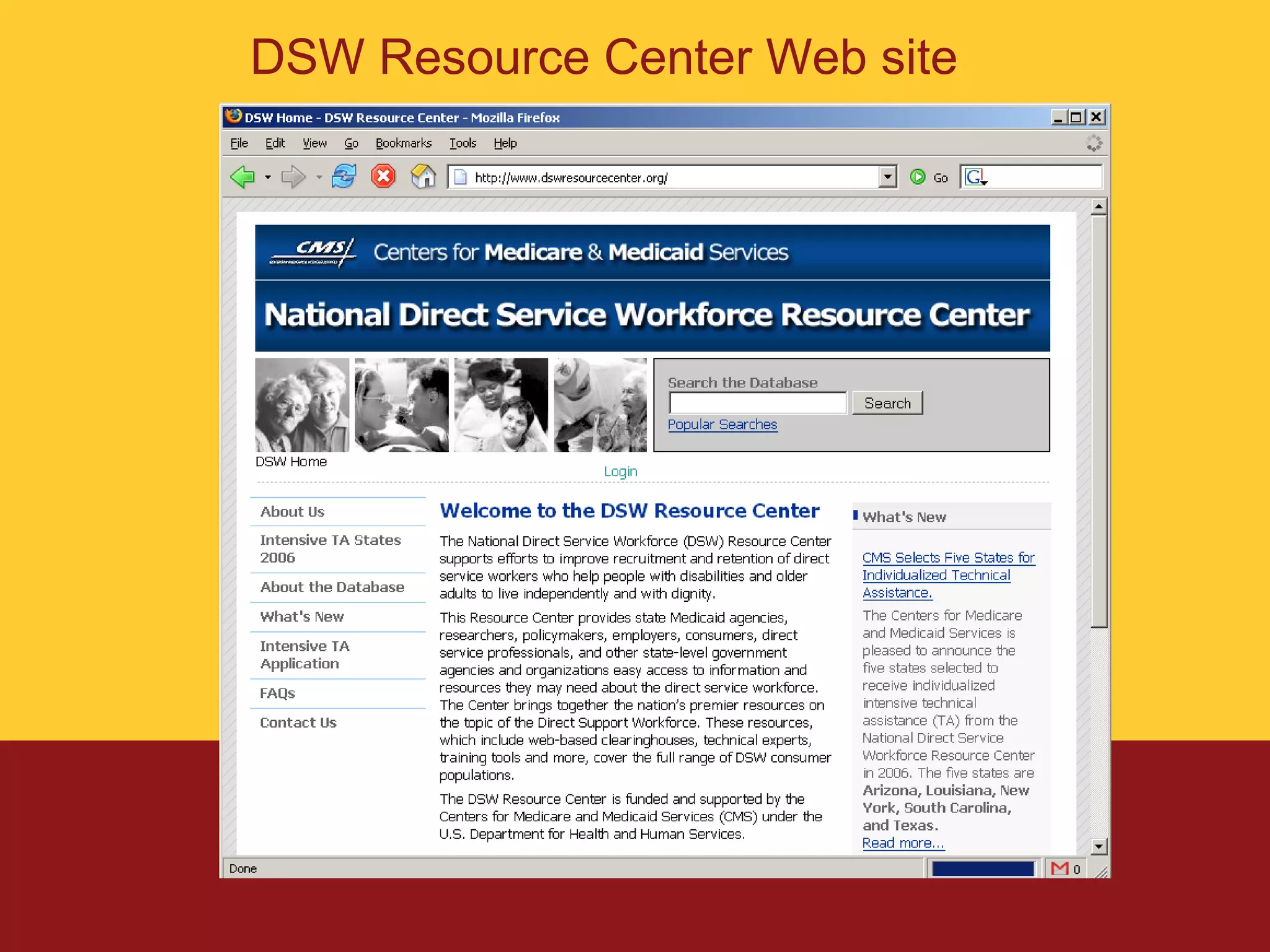
• http://www.dswresourcecenter.org – CMS funded
national center on direct support worker issues in health
and community human services
• http://www.annapoliscoalition.org/ - behavioral
health, paraprofessional and professional workforce issues
as well as rural
• http://www.nadsp.org – national association for direct
support professionals
• http://www.paraprofessional.org/ - paraprofessionals
in health care industry including nursing home, home
health and PCA
National Alliance for Direct Support
Professionals
www.nadsp.org
DSW Resource Center Web site
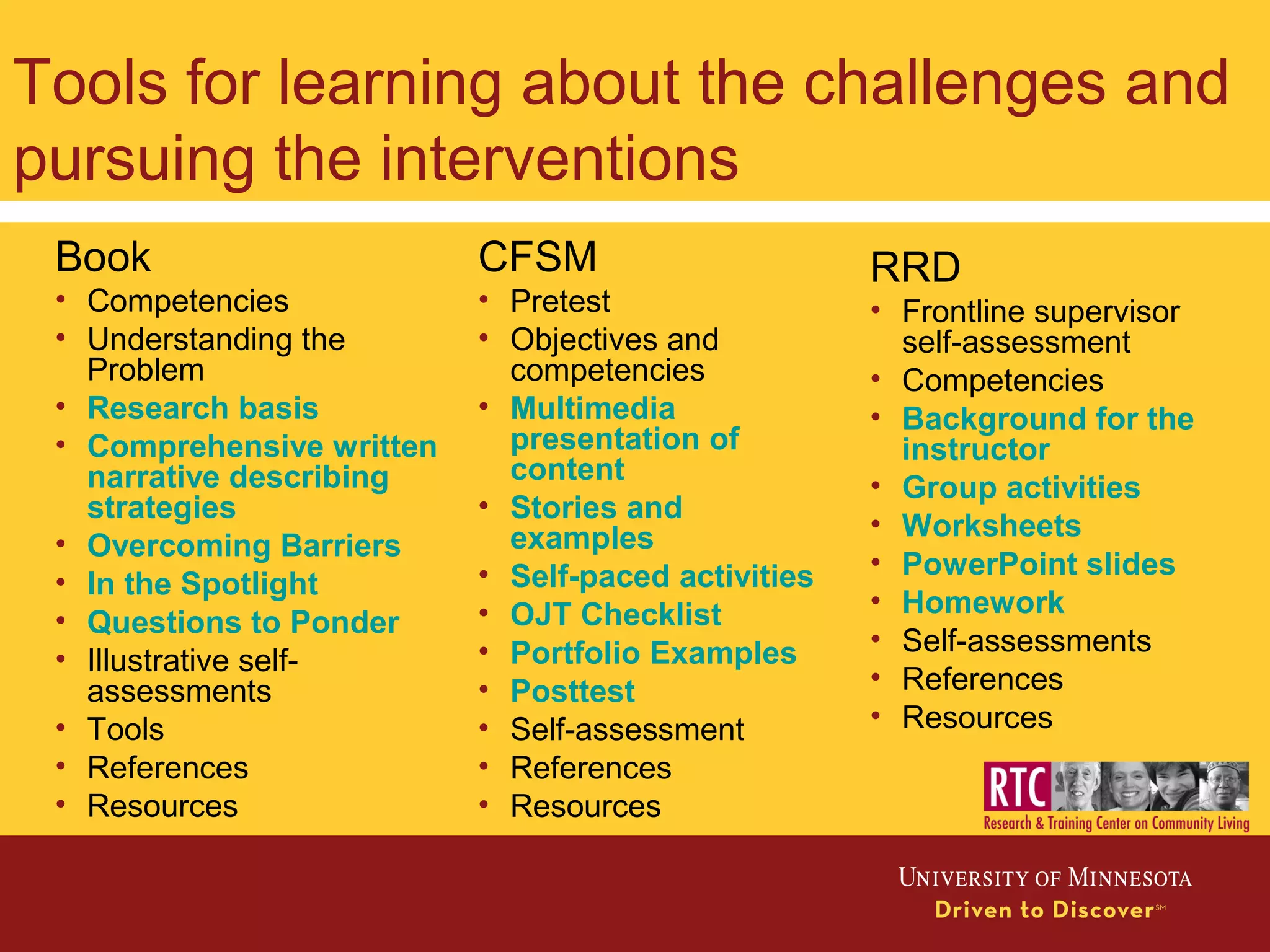
Tools for learning about the challenges and
pursuing the interventions
RRD
• Frontline supervisor
self-assessment
• Competencies
• Background for the
instructor
• Group activities
• Worksheets
• PowerPoint slides
• Homework
• Self-assessments
• References
• Resources
Book
• Competencies
• Understanding the
Problem
• Research basis
• Comprehensive written
narrative describing
strategies
• Overcoming Barriers
• In the Spotlight
• Questions to Ponder
• Illustrative self-
assessments
• Tools
• References
• Resources
CFSM
• Pretest
• Objectives and
competencies
• Multimedia
presentation of
content
• Stories and
examples
• Self-paced activities
• OJT Checklist
• Portfolio Examples
• Posttest
• Self-assessment
• References
• Resources

Overview - Presentation 1 - John Sauer MSW and M Ed Institute on Community Integration, University of Minnesota USA November 2008

  • 1.
    Practical Workforce Development Recruitment& Retention…..getting it right John Sauer, University of Minnesota Disability In-Service Training Support Service Inc.
  • 2.
    Practical Workforce Development Recruitment& Retention…..getting it right John Sauer, Project Coordinator Research and Training Center, University of Minnesota sauer006@umn.edu November 6, 2008
  • 3.
    Agenda • Learning Outcomes •Background/Workforce Challenges • Workforce Development Resources (USA) • Intervention Strategies – Marketing, Recruitment, Selection – Orientation, Socialization, Mentoring – Training, Credentialing, Professional Development – Team Building, Participatory Management, Recognition – Developing Frontline Supervisors – Systemic Solutions • The Organizational Workforce Development Plan and Process • Brainstorm/Prioritize Follow-Along Activities • Conclusion and Evaluation
  • 4.
    Learning Outcomes By theend of the workshop, participants will be able to: • Describe several key DSP workforce challenges (USA/AUS) • Identify several DSP Workforce resources in USA • Discuss at least one intervention strategy for: recruitment, selection, orientation, training, and retention. • Explain the key components of an organization intervention plan • Each organization commits to completing an Action Plan • Create a framework for future learning
  • 5.
    “This is Mary.”She’s 61, has a great smile and is always ready to grab your hand to go for a walk, a ride in the car or to get up and dance… My Motivation is my sister, Mary
  • 6.
    What We Want:Passionate Commitment to Creating Inclusive Communities • People have personally joyful and fulfilling lives • People live in their communities of choice • People have real work and/or meaningful things to do during the day to keep them motivated and inspired about life, that they choose to do AND that they are paid appropriately to do • People have friends with and without disabilities • People do things in their life that many other people do in their communities and that they also enjoy doing • People have new and different experiences that are integrated • People remain connected to families and are supported to do so • Community members are involved in making it all happen
  • 7.
  • 8.
    “As DSPs we are:Under-paid, over-worked, undermined, overly-used, and under- valued” A DSP perspective Wayne Hobson, SPIN - PA
  • 9.
    Status Quo isExpensive Executive Director Perspective • Average turnover rate of 55% • Vacancy rates as high as 18% • New hire average cost is about $2,400 - $3,500 • No occupational title • Low wage ($8.68 US)
  • 10.
    What do peoplewith disabilities say? • We want DSPs to treat us like other people • We want programs that help + encourage us to do things in our communities • We want assistance in learning new skills • We want DSPs to advocate for us and help us to learn to advocate for ourselves Summary adapted from one that first appeared in Impact: Feature issue on direct support staff.
  • 11.
    There Are NotEnough DSPs Figure 5. Demandfor DSP Recruits to Meet ProjectedDemandfor LTSS, 2005-2020 at Current 50% Turnover andwith Annual Reductions by 2% (50% in 2005, 48% in 2006, 46% in 2007, etc.) to 30% 0 200,000 400,000 600,000 800,000 1,000,000 2005 2007 2009 2011 2013 2015 2017 2019 Year DSPsRecruited At constant 50% turnover At 2% annual reductions to 30% Hewitt, Larson, Lakin, 2006
  • 12.
  • 13.
    Wages and Benefits •Low wage • Family of four lives below poverty line • Most are non-benefited positions – When benefits are offered they are not utilized because of affordability – $10 hour - $400 week and average out of pocket insurance premium is $300 for family coverage
  • 14.
    New Trends inSupports • Roles of DSPs are changing • More people whom DSPs support are living in smaller community settings and need individualized supports • Increased dispersal and isolation of DSPs • Therefore, DSPs need to rely more on their own knowledge and skills to problem solve various situations
  • 15.
    Education and TrainingChallenges • H.S. degree, driver’s license and pass criminal background check • Mandatory minimum-focus on rules and regulations • Tremendous variation in quality and quantity across organizations-lack of competency-based training • Little attention paid to adult learning • No career path, certification or credentialing exists for DSPs • Tremendous barriers for DSPs – Work more than one job – Geography – Incentives – Attitudes
  • 16.
    Poor Workforce Outcomes →Poor Quality Supports • Poorer healthcare outcomes • Fewer opportunities for community inclusion and activities • Family trauma – Lost jobs – Increased stress/anxiety • Feelings of fear, anger, frustration
  • 17.
    3 Workforce Challenges • Lackof workforce capacity to meet demand for disability services -Lack of career path -Low pay -High turn over -Ageing workforce • Lack of local research to provide evidence base for staff training programs • Lack of adequate workforce planning policy & data base • Changing nature of the support needs of pwd - introduction of individual / case based-funding - ageing population of people with a disability
  • 18.
    Trend/Issue United StatesAustralia Data Much primary source at state level Most anecdotal or secondary source Turnover 43-75 Less than 30% Vacancy 8-20% Unknown vacancy rate, increased demand Wage $8.68 (US) Approx 16 to 18 (AUS) Healthcare Benefit Limited access, poor utilization Universal Organized Labor Unknown but estimated at less than 5% of private sector nationally; higher percentage in public sector Certification/Credential Voluntary national credential newly launched Mandatory/Voluntary (depending on state) national certification since 1996 Professional Title Many Many Private vs. Public Sector Primarily private About 50/50 Status, Image and Empowerment Poor Poor Table 1. Comparison of Direct Support workforce Trends and Issues: U.S. and Australia
  • 19.
    National Resources toAddress Workforce Challenges
  • 20.
    Adult Services &Community Living University of Minnesota
  • 21.
    DSP Workforce WebSites • http://www.rtc.umn.edu/dsp - direct support workforce issues in community human services • http://www.dswresourcecenter.org – CMS funded national center on direct support worker issues in health and community human services • http://www.annapoliscoalition.org/ - behavioral health, paraprofessional and professional workforce issues as well as rural • http://www.nadsp.org – national association for direct support professionals • http://www.paraprofessional.org/ - paraprofessionals in health care industry including nursing home, home health and PCA
  • 22.
    National Alliance forDirect Support Professionals www.nadsp.org
  • 23.
  • 24.
    Tools for learningabout the challenges and pursuing the interventions RRD • Frontline supervisor self-assessment • Competencies • Background for the instructor • Group activities • Worksheets • PowerPoint slides • Homework • Self-assessments • References • Resources Book • Competencies • Understanding the Problem • Research basis • Comprehensive written narrative describing strategies • Overcoming Barriers • In the Spotlight • Questions to Ponder • Illustrative self- assessments • Tools • References • Resources CFSM • Pretest • Objectives and competencies • Multimedia presentation of content • Stories and examples • Self-paced activities • OJT Checklist • Portfolio Examples • Posttest • Self-assessment • References • Resources

Editor's Notes

  • #11 Other things that PWD say are: We want programs that offer choices We want to be involved in decisions that affect us and to take responsibility for those decisions We want DSPs that encourage us to speak for ourselves. We want staff members to treat us with respect and dignity, to encourage personal choice and independence
  • #15 Need more complex skills due to increase in individualized supports
  • #16 For Alaska some current challenges in this area include: Don’t have the right trainings and professional development courses to offer DSPs Lack a statewide resource center and training calendar for direct service professionals New and incumbent direct support professionals do not have a focused career path for continued growth and development The great thing, though, is AADSC has included these areasin its revised strategic plans.
  • #25 Sherri